Approaches to language
teaching
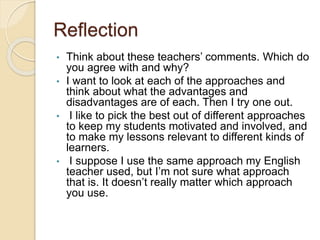
Reflection
• Think about these teachers’ comments. Which do
you agree with and why?
• I want to look at each of the approaches and
think about what the advantages and
disadvantages are of each. Then I try one out.
• I like to pick the best out of different approaches
to keep my students motivated and involved, and
to make my lessons relevant to different kinds of
learners.
• I suppose I use the same approach my English
teacher used, but I’m not sure what approach
that is. It doesn’t really matter which approach
you use.
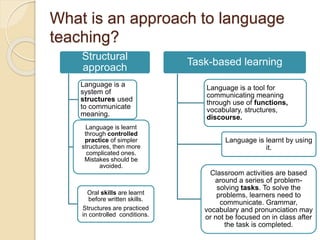
What is an approach to language
teaching?
Structural
approach
Language is a
system of
structures used
to communicate
meaning.
Language is learnt
through controlled
practice of simpler
structures, then more
complicated ones.
Mistakes should be
avoided.
Oral skills are learnt
before written skills.
Structures are practiced
in controlled conditions.
Task-based learning
Language is a tool for
communicating meaning
through use of functions,
vocabulary, structures,
discourse.
Language is learnt by using
it.
Classroom activities are based
around a series of problem-
solving tasks. To solve the
problems, learners need to
communicate. Grammar,
vocabulary and pronunciation may
or not be focused on in class after
the task is completed.
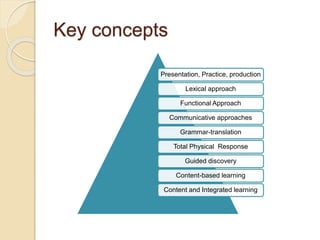
Key concepts
Presentation, Practice, production
Lexical approach
Functional Approach
Communicative approaches
Grammar-translation
Total Physical Response
Guided discovery
Content-based learning
Content and Integrated learning
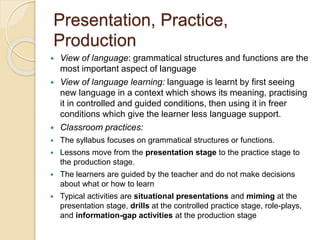
Presentation, Practice,
Production
 View of language: grammatical structures and functions are the
most important aspect of language
 View of language learning: language is learnt by first seeing
new language in a context which shows its meaning, practising
it in controlled and guided conditions, then using it in freer
conditions which give the learner less language support.
 Classroom practices:
 The syllabus focuses on grammatical structures or functions.
 Lessons move from the presentation stage to the practice stage to
the production stage.
 The learners are guided by the teacher and do not make decisions
about what or how to learn
 Typical activities are situational presentations and miming at the
presentation stage, drills at the controlled practice stage, role-plays,
and information-gap activities at the production stage
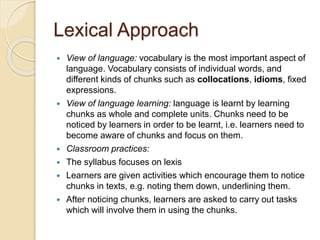
Lexical Approach
 View of language: vocabulary is the most important aspect of
language. Vocabulary consists of individual words, and
different kinds of chunks such as collocations, idioms, fixed
expressions.
 View of language learning: language is learnt by learning
chunks as whole and complete units. Chunks need to be
noticed by learners in order to be learnt, i.e. learners need to
become aware of chunks and focus on them.
 Classroom practices:
 The syllabus focuses on lexis
 Learners are given activities which encourage them to notice
chunks in texts, e.g. noting them down, underlining them.
 After noticing chunks, learners are asked to carry out tasks
which will involve them in using the chunks.
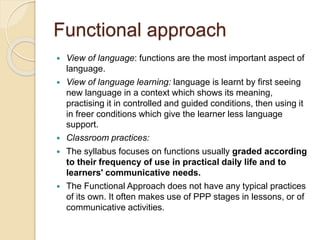
Functional approach
 View of language: functions are the most important aspect of
language.
 View of language learning: language is learnt by first seeing
new language in a context which shows its meaning,
practising it in controlled and guided conditions, then using it
in freer conditions which give the learner less language
support.
 Classroom practices:
 The syllabus focuses on functions usually graded according
to their frequency of use in practical daily life and to
learners' communicative needs.
 The Functional Approach does not have any typical practices
of its own. It often makes use of PPP stages in lessons, or of
communicative activities.
Communicative approaches
 View of language: communication is the most important
aspect of language. Meaning is communicated through
functions, grammar, vocabulary, discourse and skills.
 View of language learning: the best way to learn language is
to use it in interaction, rather than to learn about it.
 Classroom practices:
 The syllabus focuses on tasks, functions and topic areas
based on learners' communicative needs.
 Pair and group work enable lots of interaction to take place in
the classroom, so they are a key part of classroom activities.
 • Communicating meaning is very important.
 • Fluency is more important than accuracy. Classroom
activities focus on fluency much more than accuracy.
Grammar-Translation
 View of language: language is made up of grammatical
rules.
 View of language learning: language is learnt by
analysing and applying grammatical rules.
 Classroom practices:
 Studying grammatical rules presented through
grammatical terms, then applying them in exercises.
 Working out what language means by applying rules.
 Learning lists of words by heart.
 Translating texts and/or isolated sentences from LI to
L2 or vice versa.
 Emphasis on grammatical accuracy.
Total Physical Response
 View of language: grammatical structures and vocabulary are the most
important aspect of language.
 View of language learning:
 Learners learn by being exposed to language. Comprehension comes
before production.
 Learners often need a silent period (a period of time during which
learners hear language rather than produce it, as babies do) to take in
language, so they should not be forced to speak before they are ready.
 Language is learnt best when it is accompanied by doing things physically.
 Learning takes place when learners are relaxed.
 Classroom practices:
 Used mainly with young learners and beginners.
 The syllabus focuses on grammatical structures and vocabulary involved
in giving and following instructions.
 Lessons involve the teacher giving instructions and the learners physically
carrying out the instructions in the classroom, e.g. 'Walk to the table',
'Open the door'.
Guided discovery
 View of language: language has patterns of meaning and use.
 View of language learning: learners learn language best if they
work out patterns and rules of language themselves rather than
being given them by the teacher.
 Classroom practices:
 The teacher gives learners examples of a target language area,
e.g. a text containing several examples of the past tense, a
recording containing several sentences each with different
patterns of sentence stress. The teacher then asks the
learners to work out what the rules of use seem to be for the
target language.
 The teacher often gives the learners the rules after they have
worked them out or asks them to complete gapped rules.
 This approach is often used together with PPP, Task-based
Learning and the Functional Approach.
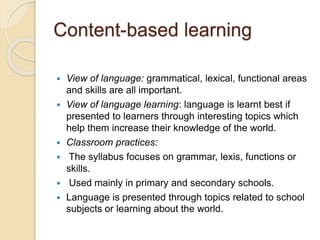
Content-based learning
 View of language: grammatical, lexical, functional areas
and skills are all important.
 View of language learning: language is learnt best if
presented to learners through interesting topics which
help them increase their knowledge of the world.
 Classroom practices:
 The syllabus focuses on grammar, lexis, functions or
skills.
 Used mainly in primary and secondary schools.
 Language is presented through topics related to school
subjects or learning about the world.
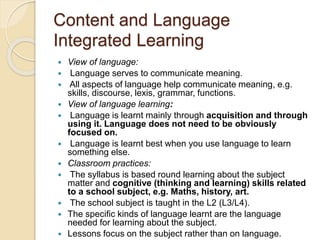
Content and Language
Integrated Learning
 View of language:
 Language serves to communicate meaning.
 All aspects of language help communicate meaning, e.g.
skills, discourse, lexis, grammar, functions.
 View of language learning:
 Language is learnt mainly through acquisition and through
using it. Language does not need to be obviously
focused on.
 Language is learnt best when you use language to learn
something else.
 Classroom practices:
 The syllabus is based round learning about the subject
matter and cognitive (thinking and learning) skills related
to a school subject, e.g. Maths, history, art.
 The school subject is taught in the L2 (L3/L4).
 The specific kinds of language learnt are the language
needed for learning about the subject.
 Lessons focus on the subject rather than on language.

01 Approaches to Language Teaching

  • 1.
  • 2.
    Reflection • Think aboutthese teachers’ comments. Which do you agree with and why? • I want to look at each of the approaches and think about what the advantages and disadvantages are of each. Then I try one out. • I like to pick the best out of different approaches to keep my students motivated and involved, and to make my lessons relevant to different kinds of learners. • I suppose I use the same approach my English teacher used, but I’m not sure what approach that is. It doesn’t really matter which approach you use.
  • 3.
    What is anapproach to language teaching? Structural approach Language is a system of structures used to communicate meaning. Language is learnt through controlled practice of simpler structures, then more complicated ones. Mistakes should be avoided. Oral skills are learnt before written skills. Structures are practiced in controlled conditions. Task-based learning Language is a tool for communicating meaning through use of functions, vocabulary, structures, discourse. Language is learnt by using it. Classroom activities are based around a series of problem- solving tasks. To solve the problems, learners need to communicate. Grammar, vocabulary and pronunciation may or not be focused on in class after the task is completed.
  • 4.
    Key concepts Presentation, Practice,production Lexical approach Functional Approach Communicative approaches Grammar-translation Total Physical Response Guided discovery Content-based learning Content and Integrated learning
  • 5.
    Presentation, Practice, Production  Viewof language: grammatical structures and functions are the most important aspect of language  View of language learning: language is learnt by first seeing new language in a context which shows its meaning, practising it in controlled and guided conditions, then using it in freer conditions which give the learner less language support.  Classroom practices:  The syllabus focuses on grammatical structures or functions.  Lessons move from the presentation stage to the practice stage to the production stage.  The learners are guided by the teacher and do not make decisions about what or how to learn  Typical activities are situational presentations and miming at the presentation stage, drills at the controlled practice stage, role-plays, and information-gap activities at the production stage
  • 6.
    Lexical Approach  Viewof language: vocabulary is the most important aspect of language. Vocabulary consists of individual words, and different kinds of chunks such as collocations, idioms, fixed expressions.  View of language learning: language is learnt by learning chunks as whole and complete units. Chunks need to be noticed by learners in order to be learnt, i.e. learners need to become aware of chunks and focus on them.  Classroom practices:  The syllabus focuses on lexis  Learners are given activities which encourage them to notice chunks in texts, e.g. noting them down, underlining them.  After noticing chunks, learners are asked to carry out tasks which will involve them in using the chunks.
  • 7.
    Functional approach  Viewof language: functions are the most important aspect of language.  View of language learning: language is learnt by first seeing new language in a context which shows its meaning, practising it in controlled and guided conditions, then using it in freer conditions which give the learner less language support.  Classroom practices:  The syllabus focuses on functions usually graded according to their frequency of use in practical daily life and to learners' communicative needs.  The Functional Approach does not have any typical practices of its own. It often makes use of PPP stages in lessons, or of communicative activities.
  • 8.
    Communicative approaches  Viewof language: communication is the most important aspect of language. Meaning is communicated through functions, grammar, vocabulary, discourse and skills.  View of language learning: the best way to learn language is to use it in interaction, rather than to learn about it.  Classroom practices:  The syllabus focuses on tasks, functions and topic areas based on learners' communicative needs.  Pair and group work enable lots of interaction to take place in the classroom, so they are a key part of classroom activities.  • Communicating meaning is very important.  • Fluency is more important than accuracy. Classroom activities focus on fluency much more than accuracy.
  • 9.
    Grammar-Translation  View oflanguage: language is made up of grammatical rules.  View of language learning: language is learnt by analysing and applying grammatical rules.  Classroom practices:  Studying grammatical rules presented through grammatical terms, then applying them in exercises.  Working out what language means by applying rules.  Learning lists of words by heart.  Translating texts and/or isolated sentences from LI to L2 or vice versa.  Emphasis on grammatical accuracy.
  • 10.
    Total Physical Response View of language: grammatical structures and vocabulary are the most important aspect of language.  View of language learning:  Learners learn by being exposed to language. Comprehension comes before production.  Learners often need a silent period (a period of time during which learners hear language rather than produce it, as babies do) to take in language, so they should not be forced to speak before they are ready.  Language is learnt best when it is accompanied by doing things physically.  Learning takes place when learners are relaxed.  Classroom practices:  Used mainly with young learners and beginners.  The syllabus focuses on grammatical structures and vocabulary involved in giving and following instructions.  Lessons involve the teacher giving instructions and the learners physically carrying out the instructions in the classroom, e.g. 'Walk to the table', 'Open the door'.
  • 11.
    Guided discovery  Viewof language: language has patterns of meaning and use.  View of language learning: learners learn language best if they work out patterns and rules of language themselves rather than being given them by the teacher.  Classroom practices:  The teacher gives learners examples of a target language area, e.g. a text containing several examples of the past tense, a recording containing several sentences each with different patterns of sentence stress. The teacher then asks the learners to work out what the rules of use seem to be for the target language.  The teacher often gives the learners the rules after they have worked them out or asks them to complete gapped rules.  This approach is often used together with PPP, Task-based Learning and the Functional Approach.
  • 12.
    Content-based learning  Viewof language: grammatical, lexical, functional areas and skills are all important.  View of language learning: language is learnt best if presented to learners through interesting topics which help them increase their knowledge of the world.  Classroom practices:  The syllabus focuses on grammar, lexis, functions or skills.  Used mainly in primary and secondary schools.  Language is presented through topics related to school subjects or learning about the world.
  • 13.
    Content and Language IntegratedLearning  View of language:  Language serves to communicate meaning.  All aspects of language help communicate meaning, e.g. skills, discourse, lexis, grammar, functions.  View of language learning:  Language is learnt mainly through acquisition and through using it. Language does not need to be obviously focused on.  Language is learnt best when you use language to learn something else.  Classroom practices:  The syllabus is based round learning about the subject matter and cognitive (thinking and learning) skills related to a school subject, e.g. Maths, history, art.  The school subject is taught in the L2 (L3/L4).  The specific kinds of language learnt are the language needed for learning about the subject.  Lessons focus on the subject rather than on language.