Nobal Niraula
4th Oct 2010
1
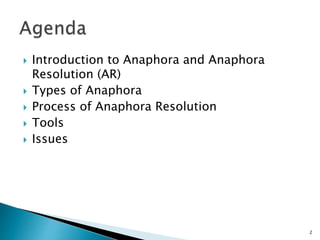
 Introduction to Anaphora and Anaphora
Resolution (AR)
 Types of Anaphora
 Process of Anaphora Resolution
 Tools
 Issues
2
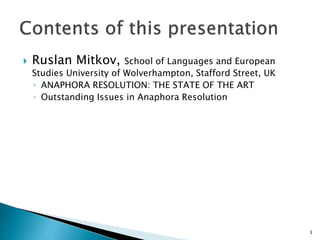
 Ruslan Mitkov, School of Languages and European
Studies University of Wolverhampton, Stafford Street, UK
◦ ANAPHORA RESOLUTION: THE STATE OF THE ART
◦ Outstanding Issues in Anaphora Resolution
3
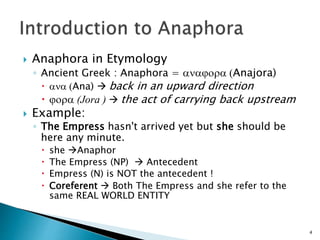
 Anaphora in Etymology
◦ Ancient Greek : Anaphora = anajora (Anajora)
 ana (Ana)  back in an upward direction
 jora (Jora )  the act of carrying back upstream
 Example:
◦ The Empress hasn't arrived yet but she should be
here any minute.
 she Anaphor
 The Empress (NP)  Antecedent
 Empress (N) is NOT the antecedent !
 Coreferent  Both The Empress and she refer to the
same REAL WORLD ENTITY
4
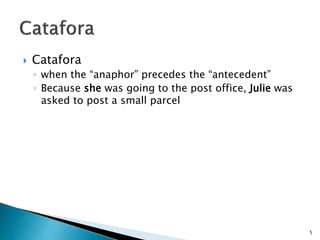
 Catafora
◦ when the “anaphor” precedes the “antecedent”
◦ Because she was going to the post office, Julie was
asked to post a small parcel
5
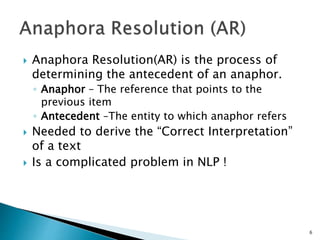
 Anaphora Resolution(AR) is the process of
determining the antecedent of an anaphor.
◦ Anaphor – The reference that points to the
previous item
◦ Antecedent –The entity to which anaphor refers
 Needed to derive the “Correct Interpretation”
of a text
 Is a complicated problem in NLP !
6
 Natural Language Interfaces
 Machine Translation
 Automatic Abstracting
 Information Extraction
7
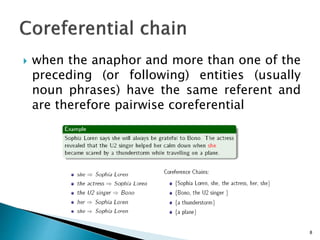
 when the anaphor and more than one of the
preceding (or following) entities (usually
noun phrases) have the same referent and
are therefore pairwise coreferential
8
 Anaphora Resolution
◦ System has to determine antecedents of anaphors
 Coreference Resolution
◦ Identify all coreference CHAINS
◦ the task of AR is considered successful, if any of
the preceding entities in the coreferential chain is
identified as an antecedent.
9
 Pronominal anaphora
◦ The most widespread type of anaphora
◦ Realized by anaphoric pronouns
 Computational Linguists from many different
countries attended the tutorial. They took extensive
notes.
◦ Not all pronouns in English are anaphoric
◦ Example
 It is raining.
 It is non-anaphoric
10
 Definite noun phrase anaphora
◦ when the antecedent is referred by a definite
noun phrase representing either same concept
(repetition) or semantically close concepts (e.g.
synonyms, superordinates).
◦ Example
 Computational Linguists from many different countries
attended the tutorial. The participants found it hard to
cope with the speed of the presentation.
11
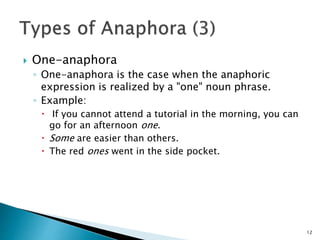
 One-anaphora
◦ One-anaphora is the case when the anaphoric
expression is realized by a "one" noun phrase.
◦ Example:
 If you cannot attend a tutorial in the morning, you can
go for an afternoon one.
 Some are easier than others.
 The red ones went in the side pocket.
12
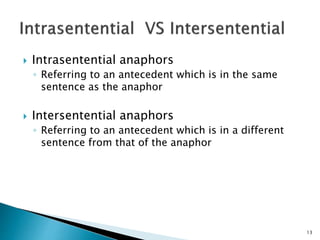
 Intrasentential anaphors
◦ Referring to an antecedent which is in the same
sentence as the anaphor
 Intersentential anaphors
◦ Referring to an antecedent which is in a different
sentence from that of the anaphor
13
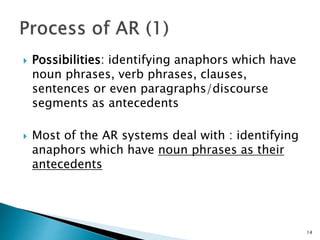
 Possibilities: identifying anaphors which have
noun phrases, verb phrases, clauses,
sentences or even paragraphs/discourse
segments as antecedents
 Most of the AR systems deal with : identifying
anaphors which have noun phrases as their
antecedents
14
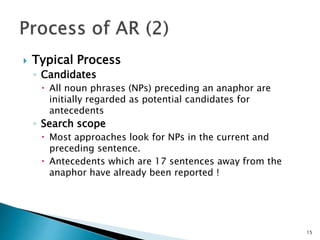
 Typical Process
◦ Candidates
 All noun phrases (NPs) preceding an anaphor are
initially regarded as potential candidates for
antecedents
◦ Search scope
 Most approaches look for NPs in the current and
preceding sentence.
 Antecedents which are 17 sentences away from the
anaphor have already been reported !
15
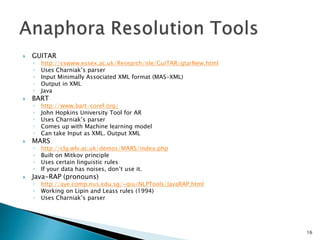
 GUITAR
◦ http://cswww.essex.ac.uk/Research/nle/GuiTAR/gtarNew.html
◦ Uses Charniak’s parser
◦ Input Minimally Associated XML format (MAS-XML)
◦ Output in XML
◦ Java
 BART
◦ http://www.bart-coref.org/
◦ John Hopkins University Tool for AR
◦ Uses Charniak’s parser
◦ Comes up with Machine learning model
◦ Can take Input as XML. Output XML
 MARS
◦ http://clg.wlv.ac.uk/demos/MARS/index.php
◦ Built on Mitkov principle
◦ Uses certain linguistic rules
◦ If your data has noises, don’t use it.
 Java-RAP (pronouns)
◦ http://aye.comp.nus.edu.sg/~qiu/NLPTools/JavaRAP.html
◦ Working on Lipin and Leass rules (1994)
◦ Uses Charniak’s parser
16
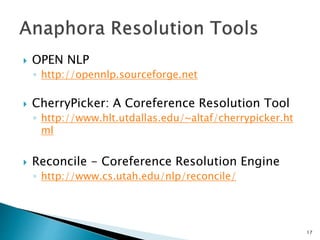
 OPEN NLP
◦ http://opennlp.sourceforge.net
 CherryPicker: A Coreference Resolution Tool
◦ http://www.hlt.utdallas.edu/~altaf/cherrypicker.ht
ml
 Reconcile - Coreference Resolution Engine
◦ http://www.cs.utah.edu/nlp/reconcile/
17
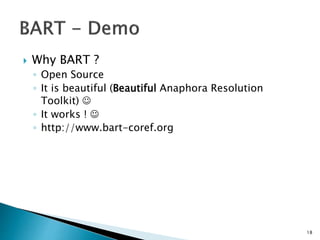
 Why BART ?
◦ Open Source
◦ It is beautiful (Beautiful Anaphora Resolution
Toolkit) 
◦ It works ! 
◦ http://www.bart-coref.org
18
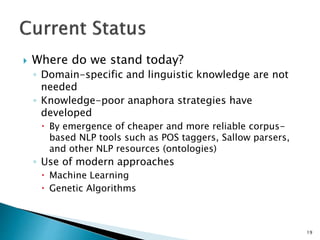
 Where do we stand today?
◦ Domain-specific and linguistic knowledge are not
needed
◦ Knowledge-poor anaphora strategies have
developed
 By emergence of cheaper and more reliable corpus-
based NLP tools such as POS taggers, Sallow parsers,
and other NLP resources (ontologies)
◦ Use of modern approaches
 Machine Learning
 Genetic Algorithms
19
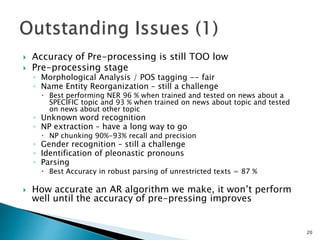
 Accuracy of Pre-processing is still TOO low
 Pre-processing stage
◦ Morphological Analysis / POS tagging -- fair
◦ Name Entity Reorganization – still a challenge
 Best performing NER 96 % when trained and tested on news about a
SPECIFIC topic and 93 % when trained on news about topic and tested
on news about other topic
◦ Unknown word recognition
◦ NP extraction – have a long way to go
 NP chunking 90%-93% recall and precision
◦ Gender recognition – still a challenge
◦ Identification of pleonastic pronouns
◦ Parsing
 Best Accuracy in robust parsing of unrestricted texts = 87 %
 How accurate an AR algorithm we make, it won’t perform
well until the accuracy of pre-pressing improves
20
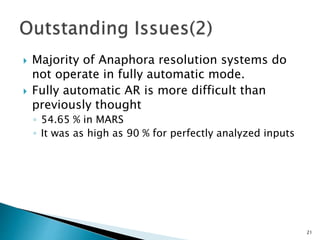
 Majority of Anaphora resolution systems do
not operate in fully automatic mode.
 Fully automatic AR is more difficult than
previously thought
◦ 54.65 % in MARS
◦ It was as high as 90 % for perfectly analyzed inputs
21
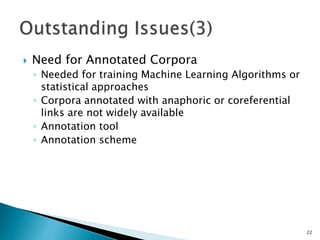
 Need for Annotated Corpora
◦ Needed for training Machine Learning Algorithms or
statistical approaches
◦ Corpora annotated with anaphoric or coreferential
links are not widely available
◦ Annotation tool
◦ Annotation scheme
22
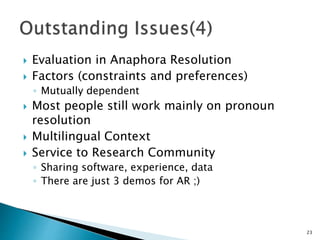
 Evaluation in Anaphora Resolution
 Factors (constraints and preferences)
◦ Mutually dependent
 Most people still work mainly on pronoun
resolution
 Multilingual Context
 Service to Research Community
◦ Sharing software, experience, data
◦ There are just 3 demos for AR ;)
23
 “NLP in general is very difficult but after
working hard on Anaphora Resolution we
have learned that it is particularly difficult”~
Mitkov
 "A pessimist sees the difficulty in every
opportunity; an optimist sees the opportunity
in every difficulty”~Winston Churchill
 “All we have to do is work more and HOPE for
SLOW but STEADY progress. We just have to
be PATIENT !” ~ Mitkov
24
 Some papers
◦ AR in multi-person dialogue
 Haven’t found any paper specific to Tutoring
25
Massimo Poesio Slides: Anaphora Resolution for Practical Tasks, University of
Trento
26

Anaphora resolution

  • 1.
  • 2.
     Introduction toAnaphora and Anaphora Resolution (AR)  Types of Anaphora  Process of Anaphora Resolution  Tools  Issues 2
  • 3.
     Ruslan Mitkov,School of Languages and European Studies University of Wolverhampton, Stafford Street, UK ◦ ANAPHORA RESOLUTION: THE STATE OF THE ART ◦ Outstanding Issues in Anaphora Resolution 3
  • 4.
     Anaphora inEtymology ◦ Ancient Greek : Anaphora = anajora (Anajora)  ana (Ana)  back in an upward direction  jora (Jora )  the act of carrying back upstream  Example: ◦ The Empress hasn't arrived yet but she should be here any minute.  she Anaphor  The Empress (NP)  Antecedent  Empress (N) is NOT the antecedent !  Coreferent  Both The Empress and she refer to the same REAL WORLD ENTITY 4
  • 5.
     Catafora ◦ whenthe “anaphor” precedes the “antecedent” ◦ Because she was going to the post office, Julie was asked to post a small parcel 5
  • 6.
     Anaphora Resolution(AR)is the process of determining the antecedent of an anaphor. ◦ Anaphor – The reference that points to the previous item ◦ Antecedent –The entity to which anaphor refers  Needed to derive the “Correct Interpretation” of a text  Is a complicated problem in NLP ! 6
  • 7.
     Natural LanguageInterfaces  Machine Translation  Automatic Abstracting  Information Extraction 7
  • 8.
     when theanaphor and more than one of the preceding (or following) entities (usually noun phrases) have the same referent and are therefore pairwise coreferential 8
  • 9.
     Anaphora Resolution ◦System has to determine antecedents of anaphors  Coreference Resolution ◦ Identify all coreference CHAINS ◦ the task of AR is considered successful, if any of the preceding entities in the coreferential chain is identified as an antecedent. 9
  • 10.
     Pronominal anaphora ◦The most widespread type of anaphora ◦ Realized by anaphoric pronouns  Computational Linguists from many different countries attended the tutorial. They took extensive notes. ◦ Not all pronouns in English are anaphoric ◦ Example  It is raining.  It is non-anaphoric 10
  • 11.
     Definite nounphrase anaphora ◦ when the antecedent is referred by a definite noun phrase representing either same concept (repetition) or semantically close concepts (e.g. synonyms, superordinates). ◦ Example  Computational Linguists from many different countries attended the tutorial. The participants found it hard to cope with the speed of the presentation. 11
  • 12.
     One-anaphora ◦ One-anaphorais the case when the anaphoric expression is realized by a "one" noun phrase. ◦ Example:  If you cannot attend a tutorial in the morning, you can go for an afternoon one.  Some are easier than others.  The red ones went in the side pocket. 12
  • 13.
     Intrasentential anaphors ◦Referring to an antecedent which is in the same sentence as the anaphor  Intersentential anaphors ◦ Referring to an antecedent which is in a different sentence from that of the anaphor 13
  • 14.
     Possibilities: identifyinganaphors which have noun phrases, verb phrases, clauses, sentences or even paragraphs/discourse segments as antecedents  Most of the AR systems deal with : identifying anaphors which have noun phrases as their antecedents 14
  • 15.
     Typical Process ◦Candidates  All noun phrases (NPs) preceding an anaphor are initially regarded as potential candidates for antecedents ◦ Search scope  Most approaches look for NPs in the current and preceding sentence.  Antecedents which are 17 sentences away from the anaphor have already been reported ! 15
  • 16.
     GUITAR ◦ http://cswww.essex.ac.uk/Research/nle/GuiTAR/gtarNew.html ◦Uses Charniak’s parser ◦ Input Minimally Associated XML format (MAS-XML) ◦ Output in XML ◦ Java  BART ◦ http://www.bart-coref.org/ ◦ John Hopkins University Tool for AR ◦ Uses Charniak’s parser ◦ Comes up with Machine learning model ◦ Can take Input as XML. Output XML  MARS ◦ http://clg.wlv.ac.uk/demos/MARS/index.php ◦ Built on Mitkov principle ◦ Uses certain linguistic rules ◦ If your data has noises, don’t use it.  Java-RAP (pronouns) ◦ http://aye.comp.nus.edu.sg/~qiu/NLPTools/JavaRAP.html ◦ Working on Lipin and Leass rules (1994) ◦ Uses Charniak’s parser 16
  • 17.
     OPEN NLP ◦http://opennlp.sourceforge.net  CherryPicker: A Coreference Resolution Tool ◦ http://www.hlt.utdallas.edu/~altaf/cherrypicker.ht ml  Reconcile - Coreference Resolution Engine ◦ http://www.cs.utah.edu/nlp/reconcile/ 17
  • 18.
     Why BART? ◦ Open Source ◦ It is beautiful (Beautiful Anaphora Resolution Toolkit)  ◦ It works !  ◦ http://www.bart-coref.org 18
  • 19.
     Where dowe stand today? ◦ Domain-specific and linguistic knowledge are not needed ◦ Knowledge-poor anaphora strategies have developed  By emergence of cheaper and more reliable corpus- based NLP tools such as POS taggers, Sallow parsers, and other NLP resources (ontologies) ◦ Use of modern approaches  Machine Learning  Genetic Algorithms 19
  • 20.
     Accuracy ofPre-processing is still TOO low  Pre-processing stage ◦ Morphological Analysis / POS tagging -- fair ◦ Name Entity Reorganization – still a challenge  Best performing NER 96 % when trained and tested on news about a SPECIFIC topic and 93 % when trained on news about topic and tested on news about other topic ◦ Unknown word recognition ◦ NP extraction – have a long way to go  NP chunking 90%-93% recall and precision ◦ Gender recognition – still a challenge ◦ Identification of pleonastic pronouns ◦ Parsing  Best Accuracy in robust parsing of unrestricted texts = 87 %  How accurate an AR algorithm we make, it won’t perform well until the accuracy of pre-pressing improves 20
  • 21.
     Majority ofAnaphora resolution systems do not operate in fully automatic mode.  Fully automatic AR is more difficult than previously thought ◦ 54.65 % in MARS ◦ It was as high as 90 % for perfectly analyzed inputs 21
  • 22.
     Need forAnnotated Corpora ◦ Needed for training Machine Learning Algorithms or statistical approaches ◦ Corpora annotated with anaphoric or coreferential links are not widely available ◦ Annotation tool ◦ Annotation scheme 22
  • 23.
     Evaluation inAnaphora Resolution  Factors (constraints and preferences) ◦ Mutually dependent  Most people still work mainly on pronoun resolution  Multilingual Context  Service to Research Community ◦ Sharing software, experience, data ◦ There are just 3 demos for AR ;) 23
  • 24.
     “NLP ingeneral is very difficult but after working hard on Anaphora Resolution we have learned that it is particularly difficult”~ Mitkov  "A pessimist sees the difficulty in every opportunity; an optimist sees the opportunity in every difficulty”~Winston Churchill  “All we have to do is work more and HOPE for SLOW but STEADY progress. We just have to be PATIENT !” ~ Mitkov 24
  • 25.
     Some papers ◦AR in multi-person dialogue  Haven’t found any paper specific to Tutoring 25
  • 26.
    Massimo Poesio Slides:Anaphora Resolution for Practical Tasks, University of Trento 26