WELCOME toWELCOME to
PRESENTED BYPRESENTED BY
20132013
Competency-Based Language Teaching
(CBLT)
Merryana Christiani 201012500982
Teaching English as a ForeignTeaching English as a Foreign
LanguageLanguage
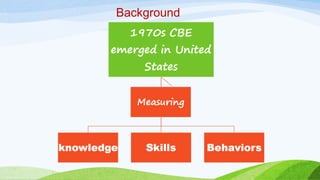
Background
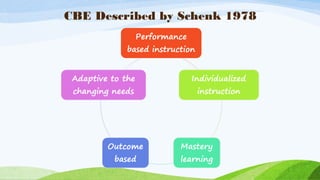
CBE Described by Schenk 1978
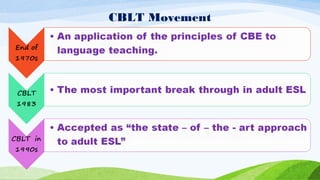
CBLT Movement
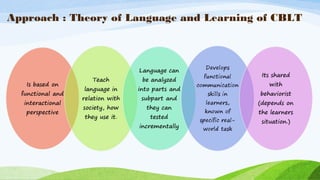
Approach : Theory of Language and Learning of CBLT
Design : Objectives, Syllabus, Learning activities, Role
of Learners, Teachers and Materials
 Syllabus according to R. Docking (1994)
 Start with field of knowledge
 Subject based content and syllabus
 Objectives
 Assessment based on norm referencing
 Receiving marks for performances
 CBLT
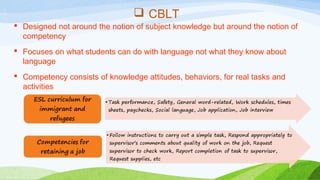
 Designed not around the notion of subject knowledge but around the notion of
competency
 Focuses on what students can do with language not what they know about
language
 Competency consists of knowledge attitudes, behaviors, for real tasks and
activities
Explanation about relation between competencies and job
performance
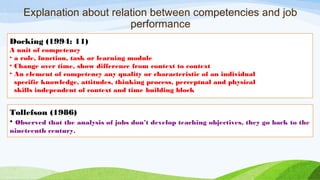
Docking (1994: 11)
A unit of competency
• a role, function, task or learning module
• Change over time, show difference from context to context
• An element of competency any quality or characteristic of an individual
specific knowledge, attitudes, thinking process, perceptual and physical
skills independent of context and time building block
Tollefson (1986)
• Observed that the analysis of jobs don’t develop teaching objectives, they go back to the
nineteenth century.
Auerbach in 1986 Provides Eight key features
of CBE programs in ESL
A focus on successful functioning in society
A focus on life skills
Task-or performance-centered orientation
Modularized instruction
Outcomes that are made explicit a priori
Continuous and on going assessment
Demonstrated mastery of performance objectives
Individualized, student-centered instruction
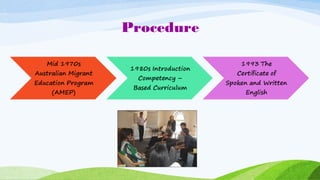
Procedure
Spoken & Written English have 4 stages
of Competencies
1.Knowledge and Learning Competencies
2.Oral Competency
3.Reading Competency
4.Writing Competency
ConclusioConclusio
nn
 Embraced with enthusiasm
 Criticized practically and philosophically
 No valid procedures available
 Impossibility of applying needed competencies (adult
living, survival, functioning proficiently in the community)
 CBLT Perspective
 CBLT Appearance
 “It can confidently be said, as we enter a new millennium,
that the business of improving learning competencies and
skills will remain one of the world’s fastest growing
industries and priorities”.
English is a difficult language------ for some
A few days ago, Prime Minister Mori was given some Basic English conversation
training before he visits washington and meets president Barack Obama.
The instructor told Mori Prime Minister, when you shake hand with President
Obama, please say “how are you?”.
Then Mr Obama should say, “I am fine, and you?”
Now you should say “me too”
Afterwards we, translator, will do the work for you.
It looks quite simple, but the truth is.....
When Mori met Obama, he mistakenly said “who are you? (Instead of “How are you?”)
Mr Obama was a bit shocked but still managed to react with humor: “Well, I’m
Michelle’s husband, ha-ha...”
Then Mori replied “Me too, ha-ha...”
Then there was a long silence in the meeting room.
Competency Based Language Teaching (CBLT)

Competency Based Language Teaching (CBLT)

  • 1.
    WELCOME toWELCOME to PRESENTEDBYPRESENTED BY 20132013 Competency-Based Language Teaching (CBLT) Merryana Christiani 201012500982 Teaching English as a ForeignTeaching English as a Foreign LanguageLanguage
  • 2.
  • 3.
    CBE Described bySchenk 1978
  • 4.
  • 5.
    Approach : Theoryof Language and Learning of CBLT
  • 6.
    Design : Objectives,Syllabus, Learning activities, Role of Learners, Teachers and Materials  Syllabus according to R. Docking (1994)  Start with field of knowledge  Subject based content and syllabus  Objectives  Assessment based on norm referencing  Receiving marks for performances
  • 7.
     CBLT  Designednot around the notion of subject knowledge but around the notion of competency  Focuses on what students can do with language not what they know about language  Competency consists of knowledge attitudes, behaviors, for real tasks and activities
  • 8.
    Explanation about relationbetween competencies and job performance Docking (1994: 11) A unit of competency • a role, function, task or learning module • Change over time, show difference from context to context • An element of competency any quality or characteristic of an individual specific knowledge, attitudes, thinking process, perceptual and physical skills independent of context and time building block Tollefson (1986) • Observed that the analysis of jobs don’t develop teaching objectives, they go back to the nineteenth century.
  • 9.
    Auerbach in 1986Provides Eight key features of CBE programs in ESL A focus on successful functioning in society A focus on life skills Task-or performance-centered orientation Modularized instruction Outcomes that are made explicit a priori Continuous and on going assessment Demonstrated mastery of performance objectives Individualized, student-centered instruction
  • 10.
  • 11.
    Spoken & WrittenEnglish have 4 stages of Competencies 1.Knowledge and Learning Competencies 2.Oral Competency 3.Reading Competency 4.Writing Competency
  • 12.
    ConclusioConclusio nn  Embraced withenthusiasm  Criticized practically and philosophically  No valid procedures available  Impossibility of applying needed competencies (adult living, survival, functioning proficiently in the community)  CBLT Perspective  CBLT Appearance  “It can confidently be said, as we enter a new millennium, that the business of improving learning competencies and skills will remain one of the world’s fastest growing industries and priorities”.
  • 13.
    English is adifficult language------ for some A few days ago, Prime Minister Mori was given some Basic English conversation training before he visits washington and meets president Barack Obama. The instructor told Mori Prime Minister, when you shake hand with President Obama, please say “how are you?”. Then Mr Obama should say, “I am fine, and you?” Now you should say “me too” Afterwards we, translator, will do the work for you. It looks quite simple, but the truth is..... When Mori met Obama, he mistakenly said “who are you? (Instead of “How are you?”) Mr Obama was a bit shocked but still managed to react with humor: “Well, I’m Michelle’s husband, ha-ha...” Then Mori replied “Me too, ha-ha...” Then there was a long silence in the meeting room.