Good
Afternoon

Lesson 9
‘Expanding
your
vocabulary’
Facts about vocabulary
acquisition
*the knowledge of a word not only
implies a definition but also how that
word fits into the world.
*Its acquisition is very crucial to
academic development
*it is known to play a key role in a
person’s proficiency in both his and her
first and second language and is shown
to be the best predictor of reading
comprehension in L1 and L2.
*if one does not understand most
of the words he/she reads, he/she
can not possibly comprehend as a
whole.
*studies have revealed that
students are required to
understand 95% of the words they
read for text comprehension
Facts about vocabulary
acquisition
*mastering a breadth of vocabulary
requires careful instruction and
practice.
*Vocabulary acquisition is not
something that can ever be
mastered overnight; it is
something that expands and
deepens over a course of lifetime.
Facts about vocabulary
acquisition
Acquiring wider
vocabulary
How does one add more words
to the stock of vocabulary
he/she has?
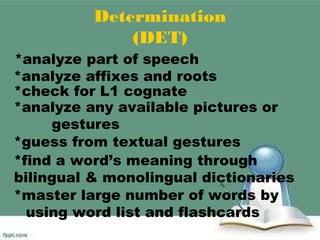
Determination
(DET)
*master large number of words by
using word list and flashcards
*analyze part of speech
*analyze affixes and roots
*check for L1 cognate
*analyze any available pictures or
gestures
*guess from textual gestures
*find a word’s meaning through
bilingual & monolingual dictionaries
Social
(SOC)
*discovering new meaning through
group work activity
*asking teacher for L1 transition
*asking teacher for paraphrase
or synonyms of new word
*asking teacher for a sentence
including the new word
*asking class mate for meaning
*or interacting with native
speakers
Social
(SOC)
*studying and practicing meaning in a
group
*teacher’s checking the students’
flashcards or word list
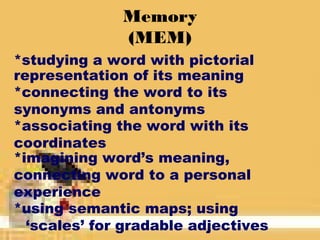
Memory
(MEM)
*using semantic maps; using
‘scales’ for gradable adjectives
*studying a word with pictorial
representation of its meaning
*imagining word’s meaning,
connecting word to a personal
experience
*associating the word with its
coordinates
*connecting the word to its
synonyms and antonyms
*configuration
*using peg method
*using loci method
*grouping words together to study them
*grouping words spatially on a page
*using new word in sentences
*grouping words together within
storyline
*studying the spelling of a word
*studying the sound of a word
*saying new word aloud when studying
*imaging word form
*underlining initial letters of the word
*using semantic feature grids
*using key word method
*remembering affixes and roots
*remembering parts of speech
*paraphrasing the word’s meaning
*using cognates in study
*learning the word of an idiom together
*using physical action when learning a
word
Cognitive
(COG)
*keeping a vocabulary notebook
*verbal repetition
*written repetition
*word lists
*flash cards taking notes in class
*using the vocabulary section in
students’ textbook
*listening to tape of word list
*putting English labels on physical
objects
*using the vocabulary section in
students’ textbook
Metacognitive
(MET)
*continuing to study word
over time
*using English language media
*using spaced word practice
*skipping or passing new word
*testing oneself with word test
Thank you
for listening

REPORTERS:
Aica M. Tuazon.
Gelyn A. Ermac.
BSED English II

vocabulary words

  • 1.
  • 2.
  • 3.
    Facts about vocabulary acquisition *theknowledge of a word not only implies a definition but also how that word fits into the world. *Its acquisition is very crucial to academic development *it is known to play a key role in a person’s proficiency in both his and her first and second language and is shown to be the best predictor of reading comprehension in L1 and L2.
  • 4.
    *if one doesnot understand most of the words he/she reads, he/she can not possibly comprehend as a whole. *studies have revealed that students are required to understand 95% of the words they read for text comprehension Facts about vocabulary acquisition
  • 5.
    *mastering a breadthof vocabulary requires careful instruction and practice. *Vocabulary acquisition is not something that can ever be mastered overnight; it is something that expands and deepens over a course of lifetime. Facts about vocabulary acquisition
  • 6.
    Acquiring wider vocabulary How doesone add more words to the stock of vocabulary he/she has?
  • 7.
    Determination (DET) *master large numberof words by using word list and flashcards *analyze part of speech *analyze affixes and roots *check for L1 cognate *analyze any available pictures or gestures *guess from textual gestures *find a word’s meaning through bilingual & monolingual dictionaries
  • 8.
    Social (SOC) *discovering new meaningthrough group work activity *asking teacher for L1 transition *asking teacher for paraphrase or synonyms of new word *asking teacher for a sentence including the new word *asking class mate for meaning
  • 9.
    *or interacting withnative speakers Social (SOC) *studying and practicing meaning in a group *teacher’s checking the students’ flashcards or word list
  • 10.
    Memory (MEM) *using semantic maps;using ‘scales’ for gradable adjectives *studying a word with pictorial representation of its meaning *imagining word’s meaning, connecting word to a personal experience *associating the word with its coordinates *connecting the word to its synonyms and antonyms
  • 11.
    *configuration *using peg method *usingloci method *grouping words together to study them *grouping words spatially on a page *using new word in sentences *grouping words together within storyline *studying the spelling of a word *studying the sound of a word *saying new word aloud when studying *imaging word form *underlining initial letters of the word
  • 12.
    *using semantic featuregrids *using key word method *remembering affixes and roots *remembering parts of speech *paraphrasing the word’s meaning *using cognates in study *learning the word of an idiom together *using physical action when learning a word
  • 13.
    Cognitive (COG) *keeping a vocabularynotebook *verbal repetition *written repetition *word lists *flash cards taking notes in class *using the vocabulary section in students’ textbook *listening to tape of word list *putting English labels on physical objects *using the vocabulary section in students’ textbook
  • 14.
    Metacognitive (MET) *continuing to studyword over time *using English language media *using spaced word practice *skipping or passing new word *testing oneself with word test
  • 15.
    Thank you for listening  REPORTERS: AicaM. Tuazon. Gelyn A. Ermac. BSED English II