Markedness: Marked and
Unmarked forms
By: Ibrahim Muneer
What's Markedness?
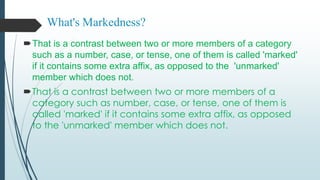
That is a contrast between two or more members of a category
such as a number, case, or tense, one of them is called 'marked'
if it contains some extra affix, as opposed to the 'unmarked'
member which does not.
That is a contrast between two or more members of a
category such as number, case, or tense, one of them is
called 'marked' if it contains some extra affix, as opposed
to the 'unmarked' member which does not.
Markedness
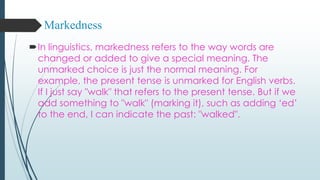
In linguistics, markedness refers to the way words are
changed or added to give a special meaning. The
unmarked choice is just the normal meaning. For
example, the present tense is unmarked for English verbs.
If I just say "walk" that refers to the present tense. But if we
add something to "walk" (marking it), such as adding ‘ed’
to the end, I can indicate the past: "walked".
Markedness
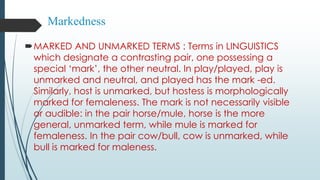
MARKED AND UNMARKED TERMS : Terms in LINGUISTICS
which designate a contrasting pair, one possessing a
special ‘mark’, the other neutral. In play/played, play is
unmarked and neutral, and played has the mark -ed.
Similarly, host is unmarked, but hostess is morphologically
marked for femaleness. The mark is not necessarily visible
or audible: in the pair horse/mule, horse is the more
general, unmarked term, while mule is marked for
femaleness. In the pair cow/bull, cow is unmarked, while
bull is marked for maleness.
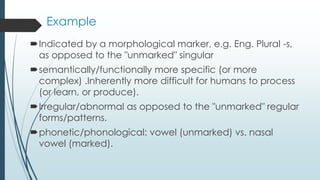
Example
Indicated by a morphological marker, e.g. Eng. Plural -s,
as opposed to the "unmarked" singular
semantically/functionally more specific (or more
complex) .Inherently more difficult for humans to process
(or learn, or produce).
Irregular/abnormal as opposed to the "unmarked" regular
forms/patterns.
phonetic/phonological: vowel (unmarked) vs. nasal
vowel (marked).
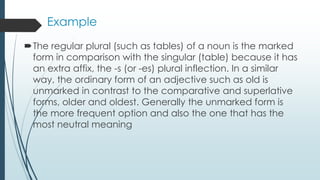
Example
The regular plural (such as tables) of a noun is the marked
form in comparison with the singular (table) because it has
an extra affix, the -s (or -es) plural inflection. In a similar
way, the ordinary form of an adjective such as old is
unmarked in contrast to the comparative and superlative
forms, older and oldest. Generally the unmarked form is
the more frequent option and also the one that has the
most neutral meaning
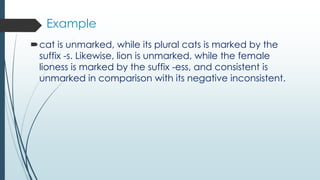
Example
cat is unmarked, while its plural cats is marked by the
suffix -s. Likewise, lion is unmarked, while the female
lioness is marked by the suffix -ess, and consistent is
unmarked in comparison with its negative inconsistent.
Example
Male things are unmarked, while female things are
marked with special endings like "ess" and "ette". For
example: "actress", "poetess". In man (humanity), the
male is known as the "man", while the female is known as
the "woman". In a discussion about some random
persons, "he" is often used to refer to one of them. The
ending ‘ette" by the way is also used for the diminutive or
non-serious, as in "dinette". In general, femaleness in
language is associated with small size and non-
seriousness.
https://www.slideshare.net/tazhw/markedness

Markedness: Marked and Unmarked forms

  • 1.
    Markedness: Marked and Unmarkedforms By: Ibrahim Muneer
  • 2.
    What's Markedness? That isa contrast between two or more members of a category such as a number, case, or tense, one of them is called 'marked' if it contains some extra affix, as opposed to the 'unmarked' member which does not. That is a contrast between two or more members of a category such as number, case, or tense, one of them is called 'marked' if it contains some extra affix, as opposed to the 'unmarked' member which does not.
  • 3.
    Markedness In linguistics, markednessrefers to the way words are changed or added to give a special meaning. The unmarked choice is just the normal meaning. For example, the present tense is unmarked for English verbs. If I just say "walk" that refers to the present tense. But if we add something to "walk" (marking it), such as adding ‘ed’ to the end, I can indicate the past: "walked".
  • 4.
    Markedness MARKED AND UNMARKEDTERMS : Terms in LINGUISTICS which designate a contrasting pair, one possessing a special ‘mark’, the other neutral. In play/played, play is unmarked and neutral, and played has the mark -ed. Similarly, host is unmarked, but hostess is morphologically marked for femaleness. The mark is not necessarily visible or audible: in the pair horse/mule, horse is the more general, unmarked term, while mule is marked for femaleness. In the pair cow/bull, cow is unmarked, while bull is marked for maleness.
  • 5.
    Example Indicated by amorphological marker, e.g. Eng. Plural -s, as opposed to the "unmarked" singular semantically/functionally more specific (or more complex) .Inherently more difficult for humans to process (or learn, or produce). Irregular/abnormal as opposed to the "unmarked" regular forms/patterns. phonetic/phonological: vowel (unmarked) vs. nasal vowel (marked).
  • 6.
    Example The regular plural(such as tables) of a noun is the marked form in comparison with the singular (table) because it has an extra affix, the -s (or -es) plural inflection. In a similar way, the ordinary form of an adjective such as old is unmarked in contrast to the comparative and superlative forms, older and oldest. Generally the unmarked form is the more frequent option and also the one that has the most neutral meaning
  • 7.
    Example cat is unmarked,while its plural cats is marked by the suffix -s. Likewise, lion is unmarked, while the female lioness is marked by the suffix -ess, and consistent is unmarked in comparison with its negative inconsistent.
  • 8.
    Example Male things areunmarked, while female things are marked with special endings like "ess" and "ette". For example: "actress", "poetess". In man (humanity), the male is known as the "man", while the female is known as the "woman". In a discussion about some random persons, "he" is often used to refer to one of them. The ending ‘ette" by the way is also used for the diminutive or non-serious, as in "dinette". In general, femaleness in language is associated with small size and non- seriousness.
  • 9.