Lexical teaching
improve production, raise confidence, internalize grammar
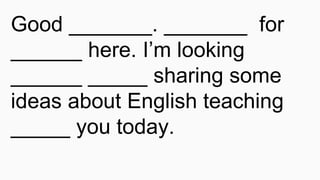
Good _______. _______ for
______ here. I’m looking
______ _____ sharing some
ideas about English teaching
_____ you today.
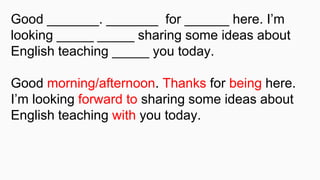
Good _______. _______ for ______ here. I’m
looking _____ _____ sharing some ideas about
English teaching _____ you today.
Good morning/afternoon. Thanks for being here.
I’m looking forward to sharing some ideas about
English teaching with you today.
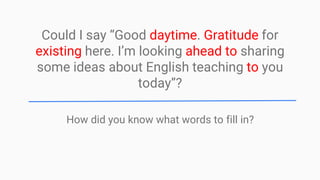
Could I say “Good daytime. Gratitude for
existing here. I’m looking ahead to sharing
some ideas about English teaching to you
today”?
How did you know what words to fill in?
What is lexical teaching?
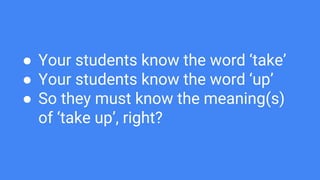
● Your students know the word ‘take’
● Your students know the word ‘up’
● So they must know the meaning(s)
of ‘take up’, right?
Words words words
Lexical teaching means focusing on the lexis, or words, of a language. Instead
of grammar, lexis (or lexical items) is understood as the central element for
language development.
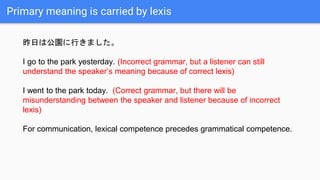
Primary meaning is carried by lexis
昨日は公園に行きました。
I go to the park yesterday. (Incorrect grammar, but a listener can still
understand the speaker’s meaning because of correct lexis)
I went to the park today. (Correct grammar, but there will be
misunderstanding between the speaker and listener because of incorrect
lexis)
For communication, lexical competence precedes grammatical competence.
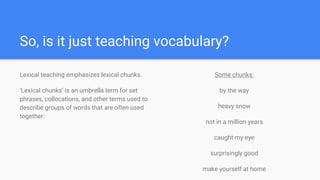
So, is it just teaching vocabulary?
Lexical teaching emphasizes lexical chunks.
‘Lexical chunks’ is an umbrella term for set
phrases, collocations, and other terms used to
describe groups of words that are often used
together.
Some chunks:
by the way
heavy snow
not in a million years
caught my eye
surprisingly good
make yourself at home
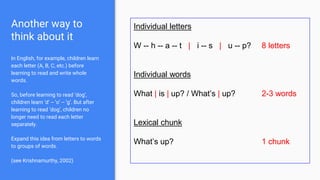
Another way to
think about it
In English, for example, children learn
each letter (A, B, C, etc.) before
learning to read and write whole
words.
So, before learning to read ‘dog’,
children learn ‘d’ -- ‘o’ -- ‘g’. But after
learning to read ‘dog’, children no
longer need to read each letter
separately.
Expand this idea from letters to words
to groups of words.
(see Krishnamurthy, 2002)
Individual letters
W -- h -- a -- t | i -- s | u -- p? 8 letters
Individual words
What | is | up? / What’s | up? 2-3 words
Lexical chunk
What’s up? 1 chunk
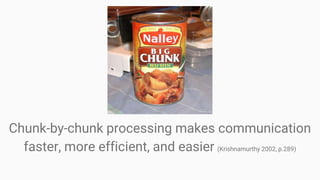
Chunk-by-chunk processing makes communication
faster, more efficient, and easier (Krishnamurthy 2002, p.289)
So far so good?
(how many words are in the
question above? How many
lexical chunks?)
Some principles (see Selivan, 2013)
1. Avoid teaching single words unless that is how the word is used.
2. Examples are better than explanations.
3. Words first, then grammar.
4. Encourage the study of high frequency patterns and words.
5. Explore uses and meanings of words students already ‘know’.
What activities are
there for this kind
of teaching?
Lexical teaching does not require
teachers to make big changes to their
teaching styles.
There are a lot of activities for lexical
teaching that can be adapted to fit
with a teacher’s existing style.
(for examples see Davis & Kryszewska
2003; Lackman 2010)
Find someone who…
...likes to get their own way.
...takes a long time to get up in the morning.
...wants to get a pet.
...is getting together with friends after school.
...gets your sense of humor.
...
…
…
...
Song gapping and other musical activities
…
[Maybe a reason why] all the doors are
closed
[So you could] open one that [leads you
to] the perfect road
Like a lightning bolt, your heart will
glow
And [when it's time] you'll know
…
…
_____ _____ _____ _____ all the doors
are closed
_____ _____ _____ open one that _____
_____ _____ the perfect road
Like a lightning bolt, your heart will
glow
And _____ _____ _____ you'll know
…
Remove lexical chunks that illustrate particular vocabulary, grammar patterns, discourse
patterns, or other language features you want to emphasize.
Firework (Katy Perry)
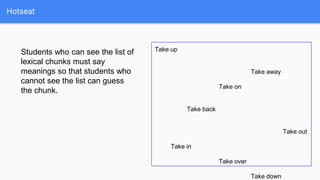
Hotseat
Take up
Take away
Take on
Take back
Take out
Take in
Take over
Take down
Students who can see the list of
lexical chunks must say
meanings so that students who
cannot see the list can guess
the chunk.
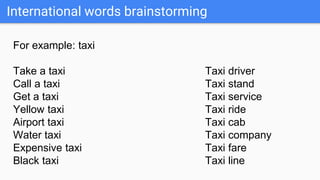
International words brainstorming
For example: taxi
Take a taxi Taxi driver
Call a taxi Taxi stand
Get a taxi Taxi service
Yellow taxi Taxi ride
Airport taxi Taxi cab
Water taxi Taxi company
Expensive taxi Taxi fare
Black taxi Taxi line
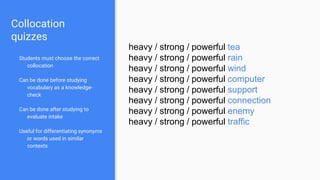
Collocation
quizzes
Students must choose the correct
collocation
Can be done before studying
vocabulary as a knowledge-
check
Can be done after studying to
evaluate intake
Useful for differentiating synonyms
or words used in similar
contexts
heavy / strong / powerful tea
heavy / strong / powerful rain
heavy / strong / powerful wind
heavy / strong / powerful computer
heavy / strong / powerful support
heavy / strong / powerful connection
heavy / strong / powerful enemy
heavy / strong / powerful traffic
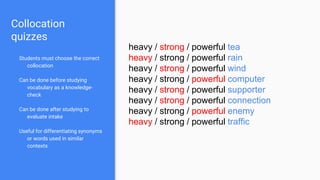
Collocation
quizzes
Students must choose the correct
collocation
Can be done before studying
vocabulary as a knowledge-
check
Can be done after studying to
evaluate intake
Useful for differentiating synonyms
or words used in similar
contexts
heavy / strong / powerful tea
heavy / strong / powerful rain
heavy / strong / powerful wind
heavy / strong / powerful computer
heavy / strong / powerful supporter
heavy / strong / powerful connection
heavy / strong / powerful enemy
heavy / strong / powerful traffic
What about
grammar?!?
A little background
The Lexical Approach
Pioneered by Lewis (1993)
Language is a personal tool, not an abstract
resource
Successful language is different than
accurate language
Chunking mimics the way children learn to
process language
Lexicogrammar
Lexis and grammar are not different domains
Some see lexis as delicate grammar (for
example, Halliday 1994), for others lexis is
the starting point of grammar (for
example, Hunston & Francis 1999)
Language patterns cannot be separated into
categories of only grammar and only lexis
(Hunston & Francis 1999)
Learning lexis is learning grammar
“I want to go home.”
If we want to analyze want to go in the above sentence, should we see it as a
collocation (lexical item) or as finite verb + infinitive (traditional grammar).
Well, it can be both: lexicogrammar.
Want colligates with infinitive forms, and go is one of the most common
collocations for want in that grammar pattern. The lexis and the grammar are
intertwined.
How many chunks can you find? It’s ok if some chunks overlap.
“I am happy to join with you today in what will go
down in history as the greatest demonstration for
freedom in the history of our nation.”
- Martin Luther King, Jr.
How many chunks can you find? It’s ok if some chunks overlap.
“I am happy to join with you today in what will go
down in history as the greatest demonstration for
freedom in the history of our nation.”
Examples:
● (personal pronoun) (be-verb) happy to
● happy to [verb]
● join with you --- in
● in what will go down [in history] as
● go down in history
● demonstration for
● go down
● in the history of
Benefits
Improved
production
Raised confidence
Internalized grammar
Learners can produce
language that more
accurately reflects the
patterns of natural language
use.Their brains are freed up
to focus on other aspects of
their discourse and
communication.
Benefits
Improved production
Raised
confidence
Internalized grammar
Learners can be more
confident that the language
they produce will be
understood. They can
understand more in listening
and reading activities, too.
Benefits
Improved production
Raised confidence
Internalized
grammar
The use and reuse of
naturally occurring patterns
means that learners get a lot
of practice with a variety of
meaningful grammar
structures without having to
think about the grammar
structures.
More lexicogrammar development activities
Use chunks as templates for grammar exploration
Could you pass me the water, please?
Could you ------- [------] the water, please?
Could you pass [me] ----- ------, please?
Could you ------- [-----] ------- -------, please?
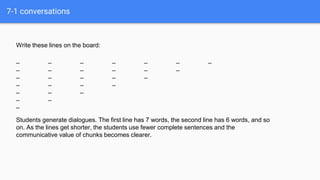
7-1 conversations
Write these lines on the board:
_ _ _ _ _ _ _
_ _ _ _ _ _
_ _ _ _ _
_ _ _ _
_ _ _
_ _
_
Students generate dialogues. The first line has 7 words, the second line has 6 words, and so
on. As the lines get shorter, the students use fewer complete sentences and the
communicative value of chunks becomes clearer.
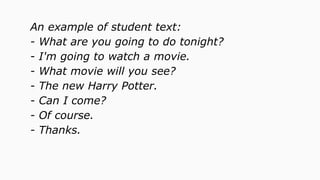
An example of student text:
- What are you going to do tonight?
- I'm going to watch a movie.
- What movie will you see?
- The new Harry Potter.
- Can I come?
- Of course.
- Thanks.
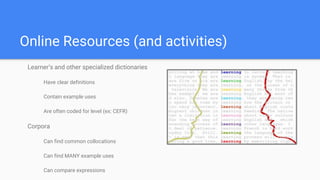
Online Resources (and activities)
Learner’s and other specialized dictionaries
Have clear definitions
Contain example uses
Are often coded for level (ex: CEFR)
Corpora
Can find common collocations
Can find MANY example uses
Can compare expressions
References
Davis, P. and Kryszewska, H. (2003). Chunking for beginners, Humanising Language Teaching, 5:2.
Halliday, M.A.K. (1994). An Introduction to Functional Frammar. 2nd edition. London: Arnold.
Hunston, S., & Francis, G. (2000). Pattern grammar: A corpus-driven approach to the lexical grammar of English.
Amsterdam: John Benjamins.
Krishnamurthy, R. (2002). Language as chunks, not words. JALT 2002 Conference Proceedings, p. 288-294.
Lackman, K. (2010). Lexical Approach Activities: A revolutionary way of teaching. Ken Lackman & Associates
Educational Consultants.
Lewis, M. (1993). The Lexical Approach: The State of ELT and a Way Forward. Hove: LTP.
Selivan, L. (2013). Start teaching lexically in 2013, Leoxicon (Blog), http://leoxicon.blogspot.jp/.
Discussion
1. Would lexical teaching be good for your classes? Do you already do it, or something
similar?
2. Are there barriers that would make it difficult to do lexical teaching in your classes?
Are there some inherent problems in lexical teaching?
3. Do you have some ideas for activities you often use for vocabulary teaching that
could be altered for lexical teaching?
4. Are there other resources (online or offline) that would be useful for lexical teaching?
5. Is there a different approach to developing word knowledge and vocabulary that you
prefer? Do you have any vocabulary or lexis teaching advice?
6. Could lexical teaching supplement or be used with other strategies you like for
vocabulary and/or grammar study?

Lexical Teaching

  • 1.
    Lexical teaching improve production,raise confidence, internalize grammar
  • 2.
    Good _______. _______for ______ here. I’m looking ______ _____ sharing some ideas about English teaching _____ you today.
  • 3.
    Good _______. _______for ______ here. I’m looking _____ _____ sharing some ideas about English teaching _____ you today. Good morning/afternoon. Thanks for being here. I’m looking forward to sharing some ideas about English teaching with you today.
  • 4.
    Could I say“Good daytime. Gratitude for existing here. I’m looking ahead to sharing some ideas about English teaching to you today”? How did you know what words to fill in?
  • 5.
    What is lexicalteaching?
  • 6.
    ● Your studentsknow the word ‘take’ ● Your students know the word ‘up’ ● So they must know the meaning(s) of ‘take up’, right?
  • 7.
    Words words words Lexicalteaching means focusing on the lexis, or words, of a language. Instead of grammar, lexis (or lexical items) is understood as the central element for language development.
  • 8.
    Primary meaning iscarried by lexis 昨日は公園に行きました。 I go to the park yesterday. (Incorrect grammar, but a listener can still understand the speaker’s meaning because of correct lexis) I went to the park today. (Correct grammar, but there will be misunderstanding between the speaker and listener because of incorrect lexis) For communication, lexical competence precedes grammatical competence.
  • 9.
    So, is itjust teaching vocabulary? Lexical teaching emphasizes lexical chunks. ‘Lexical chunks’ is an umbrella term for set phrases, collocations, and other terms used to describe groups of words that are often used together. Some chunks: by the way heavy snow not in a million years caught my eye surprisingly good make yourself at home
  • 10.
    Another way to thinkabout it In English, for example, children learn each letter (A, B, C, etc.) before learning to read and write whole words. So, before learning to read ‘dog’, children learn ‘d’ -- ‘o’ -- ‘g’. But after learning to read ‘dog’, children no longer need to read each letter separately. Expand this idea from letters to words to groups of words. (see Krishnamurthy, 2002) Individual letters W -- h -- a -- t | i -- s | u -- p? 8 letters Individual words What | is | up? / What’s | up? 2-3 words Lexical chunk What’s up? 1 chunk
  • 11.
    Chunk-by-chunk processing makescommunication faster, more efficient, and easier (Krishnamurthy 2002, p.289)
  • 12.
    So far sogood? (how many words are in the question above? How many lexical chunks?)
  • 13.
    Some principles (seeSelivan, 2013) 1. Avoid teaching single words unless that is how the word is used. 2. Examples are better than explanations. 3. Words first, then grammar. 4. Encourage the study of high frequency patterns and words. 5. Explore uses and meanings of words students already ‘know’.
  • 14.
    What activities are therefor this kind of teaching? Lexical teaching does not require teachers to make big changes to their teaching styles. There are a lot of activities for lexical teaching that can be adapted to fit with a teacher’s existing style. (for examples see Davis & Kryszewska 2003; Lackman 2010) Find someone who… ...likes to get their own way. ...takes a long time to get up in the morning. ...wants to get a pet. ...is getting together with friends after school. ...gets your sense of humor. ... … … ...
  • 15.
    Song gapping andother musical activities … [Maybe a reason why] all the doors are closed [So you could] open one that [leads you to] the perfect road Like a lightning bolt, your heart will glow And [when it's time] you'll know … … _____ _____ _____ _____ all the doors are closed _____ _____ _____ open one that _____ _____ _____ the perfect road Like a lightning bolt, your heart will glow And _____ _____ _____ you'll know … Remove lexical chunks that illustrate particular vocabulary, grammar patterns, discourse patterns, or other language features you want to emphasize. Firework (Katy Perry)
  • 16.
    Hotseat Take up Take away Takeon Take back Take out Take in Take over Take down Students who can see the list of lexical chunks must say meanings so that students who cannot see the list can guess the chunk.
  • 17.
    International words brainstorming Forexample: taxi Take a taxi Taxi driver Call a taxi Taxi stand Get a taxi Taxi service Yellow taxi Taxi ride Airport taxi Taxi cab Water taxi Taxi company Expensive taxi Taxi fare Black taxi Taxi line
  • 18.
    Collocation quizzes Students must choosethe correct collocation Can be done before studying vocabulary as a knowledge- check Can be done after studying to evaluate intake Useful for differentiating synonyms or words used in similar contexts heavy / strong / powerful tea heavy / strong / powerful rain heavy / strong / powerful wind heavy / strong / powerful computer heavy / strong / powerful support heavy / strong / powerful connection heavy / strong / powerful enemy heavy / strong / powerful traffic
  • 19.
    Collocation quizzes Students must choosethe correct collocation Can be done before studying vocabulary as a knowledge- check Can be done after studying to evaluate intake Useful for differentiating synonyms or words used in similar contexts heavy / strong / powerful tea heavy / strong / powerful rain heavy / strong / powerful wind heavy / strong / powerful computer heavy / strong / powerful supporter heavy / strong / powerful connection heavy / strong / powerful enemy heavy / strong / powerful traffic
  • 20.
  • 21.
    A little background TheLexical Approach Pioneered by Lewis (1993) Language is a personal tool, not an abstract resource Successful language is different than accurate language Chunking mimics the way children learn to process language Lexicogrammar Lexis and grammar are not different domains Some see lexis as delicate grammar (for example, Halliday 1994), for others lexis is the starting point of grammar (for example, Hunston & Francis 1999) Language patterns cannot be separated into categories of only grammar and only lexis (Hunston & Francis 1999)
  • 22.
    Learning lexis islearning grammar “I want to go home.” If we want to analyze want to go in the above sentence, should we see it as a collocation (lexical item) or as finite verb + infinitive (traditional grammar). Well, it can be both: lexicogrammar. Want colligates with infinitive forms, and go is one of the most common collocations for want in that grammar pattern. The lexis and the grammar are intertwined.
  • 23.
    How many chunkscan you find? It’s ok if some chunks overlap. “I am happy to join with you today in what will go down in history as the greatest demonstration for freedom in the history of our nation.” - Martin Luther King, Jr.
  • 24.
    How many chunkscan you find? It’s ok if some chunks overlap. “I am happy to join with you today in what will go down in history as the greatest demonstration for freedom in the history of our nation.” Examples: ● (personal pronoun) (be-verb) happy to ● happy to [verb] ● join with you --- in ● in what will go down [in history] as ● go down in history ● demonstration for ● go down ● in the history of
  • 25.
    Benefits Improved production Raised confidence Internalized grammar Learnerscan produce language that more accurately reflects the patterns of natural language use.Their brains are freed up to focus on other aspects of their discourse and communication.
  • 26.
    Benefits Improved production Raised confidence Internalized grammar Learnerscan be more confident that the language they produce will be understood. They can understand more in listening and reading activities, too.
  • 27.
    Benefits Improved production Raised confidence Internalized grammar Theuse and reuse of naturally occurring patterns means that learners get a lot of practice with a variety of meaningful grammar structures without having to think about the grammar structures.
  • 28.
    More lexicogrammar developmentactivities Use chunks as templates for grammar exploration Could you pass me the water, please? Could you ------- [------] the water, please? Could you pass [me] ----- ------, please? Could you ------- [-----] ------- -------, please?
  • 29.
    7-1 conversations Write theselines on the board: _ _ _ _ _ _ _ _ _ _ _ _ _ _ _ _ _ _ _ _ _ _ _ _ _ _ _ _ Students generate dialogues. The first line has 7 words, the second line has 6 words, and so on. As the lines get shorter, the students use fewer complete sentences and the communicative value of chunks becomes clearer.
  • 30.
    An example ofstudent text: - What are you going to do tonight? - I'm going to watch a movie. - What movie will you see? - The new Harry Potter. - Can I come? - Of course. - Thanks.
  • 31.
    Online Resources (andactivities) Learner’s and other specialized dictionaries Have clear definitions Contain example uses Are often coded for level (ex: CEFR) Corpora Can find common collocations Can find MANY example uses Can compare expressions
  • 32.
    References Davis, P. andKryszewska, H. (2003). Chunking for beginners, Humanising Language Teaching, 5:2. Halliday, M.A.K. (1994). An Introduction to Functional Frammar. 2nd edition. London: Arnold. Hunston, S., & Francis, G. (2000). Pattern grammar: A corpus-driven approach to the lexical grammar of English. Amsterdam: John Benjamins. Krishnamurthy, R. (2002). Language as chunks, not words. JALT 2002 Conference Proceedings, p. 288-294. Lackman, K. (2010). Lexical Approach Activities: A revolutionary way of teaching. Ken Lackman & Associates Educational Consultants. Lewis, M. (1993). The Lexical Approach: The State of ELT and a Way Forward. Hove: LTP. Selivan, L. (2013). Start teaching lexically in 2013, Leoxicon (Blog), http://leoxicon.blogspot.jp/.
  • 33.
    Discussion 1. Would lexicalteaching be good for your classes? Do you already do it, or something similar? 2. Are there barriers that would make it difficult to do lexical teaching in your classes? Are there some inherent problems in lexical teaching? 3. Do you have some ideas for activities you often use for vocabulary teaching that could be altered for lexical teaching? 4. Are there other resources (online or offline) that would be useful for lexical teaching? 5. Is there a different approach to developing word knowledge and vocabulary that you prefer? Do you have any vocabulary or lexis teaching advice? 6. Could lexical teaching supplement or be used with other strategies you like for vocabulary and/or grammar study?