Teaching Vocabulary 
Helping ESL Students Learn Vocabulary 
For Educational Purposes Only © American TESOL Institute
What is Involved in Teaching Vocabulary? 
Vocabulary should be integrated with subject matter. 
Activities should be cooperative and non- threatening. 
Helpful to pre-introduce words before they are encountered in text. 
Background knowledge should be tapped. 
Students to become independent learners.
How can Students Become Effective at Learning Vocabulary? 
Students are actively involved in their own learning. 
Students self-monitor their progress. 
Students are given multiple exposures to new words.
What Can Teachers Do? 
Integrate vocabulary learning within content. 
Offer various vocabulary-building activities. 
Build background to elicit student prior knowledge. 
Foster development of “word bank.”
Pre-Teach 
Pre-teach vocabulary words before student reads. 
Preview reading material for unfamiliar words or terms. 
Define and discuss new words to build understanding. 
Teacher receives feedback from student to determine depth of understanding.
Background Knowledge 
Teacher introduces new vocabulary, terms, definitions, or concepts. 
Teacher asks students to share prior knowledge during whole class discussion. 
This prepares students for new learning. 
Students are able to relate new information to personal experience.
Repeated Exposure: 
Repeat exposure to new words. 
Students need to hear and use words. 
Provide multiple opportunities to use new word in written and spoken form.
Key Words 
Introduce key words before reading text. 
Teach students “word clue” to help understand. 
May be definition, example, or image that helps make connection. 
For example; “peninsula” is a piece of land that projects into a body of water and is connected with the mainland by an isthmus. 
Today we will be learning about the Iberian Peninsula. 
Create link to facilitate memory of new word when reading in text.
Word Maps 
Student previews reading material to find unfamiliar words. 
Student creates graphic organizer. 
New word is placed at top or center of map. 
Branching off of word may be examples, qualities, or classification.
Example 
Vocabulary word: debate 
Definition: To discuss opposing reasons; argue 
Synonym: discuss 
For example: “Joe’s mother said that the decision to buy a new car was not open to debate; she had already chosen a Ford Focus as the family vehicle.”
Context Clues 
Words may also be defined within a text. 
Context Clues such as the following are used to learn meaning while reading. 
He ate as ravenouslyas a bear. 
A machete, like a sword, can be very dangerous. 
Artificial respirationwas applied to the nearly drowned man. 
A cockroachhas two antennae, or feelers, on its head.
Word Level Analysis 
Examine the word for prefixes, suffixes, and/or root words. 
This will reveal meanings embedded within words according to their structure. 
Teachers can focus on the most common prefixes, suffixes, and root words.
Prefix 
The prefix “mis” means wrong, bad, no, or not. 
For example, “misapply” means to use badly or incorrectly. 
The prefix “pre” means before, in front of, or prior. 
For example, “prejudice” means a judgment or opinion formed before the facts are known.
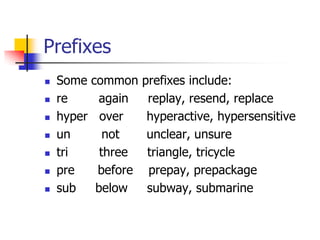
Prefixes 
Some common prefixes include: 
re again replay, resend, replace 
hyper over hyperactive, hypersensitive 
un not unclear, unsure 
tri three triangle, tricycle 
pre before prepay, prepackage 
sub below subway, submarine
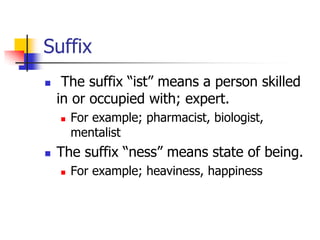
Suffix 
The suffix “ist” means a person skilled in or occupied with; expert. 
For example; pharmacist, biologist, mentalist 
The suffix “ness” means state of being. 
For example; heaviness, happiness
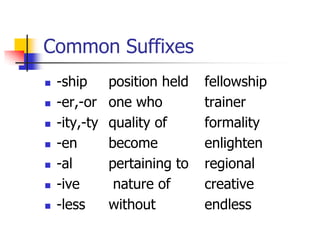
Common Suffixes 
-shipposition heldfellowship 
-er,-orone whotrainer 
-ity,-tyquality offormality 
-enbecomeenlighten 
-alpertaining toregional 
-ivenature of creative 
-lesswithoutendless
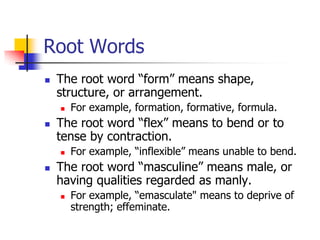
Root Words 
The root word “form” means shape, structure, or arrangement. 
For example, formation, formative, formula. 
The root word “flex” means to bend or to tense by contraction. 
For example, “inflexible” means unable to bend. 
The root word “masculine” means male, or having qualities regarded as manly. 
For example, “emasculate" means to deprive of strength; effeminate.
Cognates 
Cognates are words that are similar in students’ native language and English. 
Teaching cognates is a way to relate words in English to the students’ first language. 
For example; “possible” is a cognate of the Spanish word “posible.” 
“Apple” is a cognate of the German word “apfel.”
Summary 
Vocabulary development is important in learning to speak, listen, read and write English. 
Teachers can help students master new words in a variety of ways. 
Ultimately students learn how to become responsible for their own learning. 
Learning new words becomes a life-long endeavor.
Sources 
http://www.k12reader.com/effective- strategies-for-teaching-vocabulary/ Article by Joelle Brummitt-Yale 
Stahl, Norman and Boylan,Hunter. Teaching Developmental Reading. Boston, New York; Bedford/St. Martin’s, 2003. Print

Teaching vocabulary

  • 1.
    Teaching Vocabulary HelpingESL Students Learn Vocabulary For Educational Purposes Only © American TESOL Institute
  • 2.
    What is Involvedin Teaching Vocabulary? Vocabulary should be integrated with subject matter. Activities should be cooperative and non- threatening. Helpful to pre-introduce words before they are encountered in text. Background knowledge should be tapped. Students to become independent learners.
  • 3.
    How can StudentsBecome Effective at Learning Vocabulary? Students are actively involved in their own learning. Students self-monitor their progress. Students are given multiple exposures to new words.
  • 4.
    What Can TeachersDo? Integrate vocabulary learning within content. Offer various vocabulary-building activities. Build background to elicit student prior knowledge. Foster development of “word bank.”
  • 5.
    Pre-Teach Pre-teach vocabularywords before student reads. Preview reading material for unfamiliar words or terms. Define and discuss new words to build understanding. Teacher receives feedback from student to determine depth of understanding.
  • 6.
    Background Knowledge Teacherintroduces new vocabulary, terms, definitions, or concepts. Teacher asks students to share prior knowledge during whole class discussion. This prepares students for new learning. Students are able to relate new information to personal experience.
  • 7.
    Repeated Exposure: Repeatexposure to new words. Students need to hear and use words. Provide multiple opportunities to use new word in written and spoken form.
  • 8.
    Key Words Introducekey words before reading text. Teach students “word clue” to help understand. May be definition, example, or image that helps make connection. For example; “peninsula” is a piece of land that projects into a body of water and is connected with the mainland by an isthmus. Today we will be learning about the Iberian Peninsula. Create link to facilitate memory of new word when reading in text.
  • 9.
    Word Maps Studentpreviews reading material to find unfamiliar words. Student creates graphic organizer. New word is placed at top or center of map. Branching off of word may be examples, qualities, or classification.
  • 10.
    Example Vocabulary word:debate Definition: To discuss opposing reasons; argue Synonym: discuss For example: “Joe’s mother said that the decision to buy a new car was not open to debate; she had already chosen a Ford Focus as the family vehicle.”
  • 11.
    Context Clues Wordsmay also be defined within a text. Context Clues such as the following are used to learn meaning while reading. He ate as ravenouslyas a bear. A machete, like a sword, can be very dangerous. Artificial respirationwas applied to the nearly drowned man. A cockroachhas two antennae, or feelers, on its head.
  • 12.
    Word Level Analysis Examine the word for prefixes, suffixes, and/or root words. This will reveal meanings embedded within words according to their structure. Teachers can focus on the most common prefixes, suffixes, and root words.
  • 13.
    Prefix The prefix“mis” means wrong, bad, no, or not. For example, “misapply” means to use badly or incorrectly. The prefix “pre” means before, in front of, or prior. For example, “prejudice” means a judgment or opinion formed before the facts are known.
  • 14.
    Prefixes Some commonprefixes include: re again replay, resend, replace hyper over hyperactive, hypersensitive un not unclear, unsure tri three triangle, tricycle pre before prepay, prepackage sub below subway, submarine
  • 15.
    Suffix The suffix“ist” means a person skilled in or occupied with; expert. For example; pharmacist, biologist, mentalist The suffix “ness” means state of being. For example; heaviness, happiness
  • 16.
    Common Suffixes -shippositionheldfellowship -er,-orone whotrainer -ity,-tyquality offormality -enbecomeenlighten -alpertaining toregional -ivenature of creative -lesswithoutendless
  • 17.
    Root Words Theroot word “form” means shape, structure, or arrangement. For example, formation, formative, formula. The root word “flex” means to bend or to tense by contraction. For example, “inflexible” means unable to bend. The root word “masculine” means male, or having qualities regarded as manly. For example, “emasculate" means to deprive of strength; effeminate.
  • 18.
    Cognates Cognates arewords that are similar in students’ native language and English. Teaching cognates is a way to relate words in English to the students’ first language. For example; “possible” is a cognate of the Spanish word “posible.” “Apple” is a cognate of the German word “apfel.”
  • 19.
    Summary Vocabulary developmentis important in learning to speak, listen, read and write English. Teachers can help students master new words in a variety of ways. Ultimately students learn how to become responsible for their own learning. Learning new words becomes a life-long endeavor.
  • 20.
    Sources http://www.k12reader.com/effective- strategies-for-teaching-vocabulary/Article by Joelle Brummitt-Yale Stahl, Norman and Boylan,Hunter. Teaching Developmental Reading. Boston, New York; Bedford/St. Martin’s, 2003. Print