


The Lexical approach: some underlying principles and practice. .
What is the lexical approach? Why include it in our practice?   A look at inherent difficulties in present practice and possible responses . What can we do to implement these ideas? Some ways of using this approach in the classroom .
What is lexis?   Lexicon: the vocabulary of a language as distinct from the grammar, the total stock of words and meaningful combinations of words in a language.
The nature of meaning… a bit of an enigma
What does a word mean? Some words have only one meaning, others have no meaning without other words.  Some have the same sounds but different meanings, others have highly changeable meanings.  A great many have idiomatic meanings as well as their main meanings. motorbike  house  pop  up  so  a
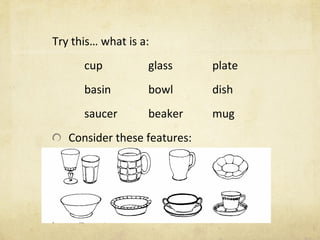
Try this… what is a:  cup glass plate basin bowl dish saucer beaker mug Consider these features: Material, flatness, handles, shape, use, position.
Metaphorical meanings. These are not just the as big as a house, built like a brick dunny metaphors, but the little ones like,  time flies ,  found a way to ,  or take the point Metaphor is used to express an abstract notion by using a concrete example. The example chosen is culturally significant, eg. we say in English  “ I caught a cold, ”  we say in Māori,  “ Kua pāngia (touched) au e te rewharewha. ” See if you can find 5 or 6 small metaphors in this text.
NZ Herald 24/9/0/9 (Re Sydney dust storm)  It ripped across Victoria and NSW with gales gusting to 100km/h, thunderstorms, and hailstones sometimes as big as cricket  balls.  As it hit the mining city of Broken Hill in far western NSW on Tuesday,the front ripped out trees, damaged homes and  closed roads.  Two miners were trapped underground for almost 24 hours when power supplies were knocked out.  As  Canberra was blanketed by a deep, dark mist that cloaked landmarks such as Parliament House and the War Memorial, and dumped layers of dust across the capital, winds ravaged fruit crops and bombarded the town of Crookwell with  hail heavy enough to smash roofs and damage cars. Dust was whipped from Lake Eyre in a repeat of the 1983 storm that lifted 50,000 tonnes of topsoil from Victoria's Mallee region, formed it into a cloud extending  thousands of metres into the atmosphere, and dumped 1000 tonnes on Melbourne The blood-orange backdrop to the city skyline provided plenty of fodder for  photographers, who roamed the streets, snapping the peculiar scenes. Sydney ’ s beachers were bathed in a red glow, although that did not deter some dawn bathers and surfers from plunging into the waves. A few joggers and cyclists were also  out and about ignoring health warnings and watering eyes. The air was pierced by fire  alarms, which went off in buildings across the city, triggered by dust particles.
So what do we know about meaning? Meaning is mercurial and often random Meaning is often dependant on what something is not rather than what it is. (when is it a bowl and not a basin?) Meaning is dependant on the combination of words (I ’ m just popping out vs. I ’ m just popping balloons) And the context they are used in. (Shut up! vs. You shut up and I ’ ll get the car.) Meaning is a sort of code which a community of speakers construct from agreed understandings (Take a seat. Momentarily. Bathroom)
The Lexical Approach and what it offers. The lexical approach is characterised by a focus on the development of a vocabulary of meaningful chunks which can be adapted, combined and recombined to fulfil different functions or purposes.  The rules for these actions are derived from observation, hypothesis and experimentation rather than from learnt grammar rules.  Language is grammaticised lexis not lexicalised grammar.
What are the key elements in the lexical approach?  The content: Types of chunks . (chunks may belong to more than one category) Single words, eg. motorbike polywords, eg. overdone, cup of tea Idiomatic phrases which don ’ t mean what they say, eg.  What a buzz! Heads, eg. Once upon a time…  After a while… Look… Frames, eg. Tell ___ what ___. Collocations, words which are found in close proximity,   eg. shut down/up/in/out. contract…agree to, negotiate, write, carry out, complete. Fixed and semi-fixed expressions, eg. I ’ ll see you soon. It takes two to tango
The importance of collocation Notice we don ’ t say,  “ do a contract, ”  even though  do  and  carry out  are synonymous,  nor do we say,  “ the rain is dropping ”  although drop and fall are synonymous. Find some collocations for: - pop - treated - house - real Collocations are the words that native speakers choose to put together, the choice is arbitrary.
The strategies Critical awareness. We want our students to be learners of language not passive receivers  We want them to be intrigued by the patterns of the language Critical awareness is taught by our modelling, directing, questioning, setting of routines for collecting and recycling Recycling   Good language learners collect useful chunks, try to fit them into the schema they have, and experiment with them.
Be efficient learners by knowing how… New learning is moved into the long term memory by: recording  revisiting over a period of time  repeating, recycling,  adding cognitive depth.
PPP  versus  OHE The  P resent  P ractice  P roduce  paradigm is based on a discredited educational theory.(Behaviourism) It assumes that learning is linear.  Actually learning is better represented as a schema or web. What do successful language learners do? They  O bserve,  H ypothesize , and  E xperiment
Why include it in our practice? Is our present practice the complete answer? What issues come up in our reflection on present practice? Do we presently have answers to those issues?
Does the traditional approach meet learners ’  needs?   Defining  is one present scaffolding strategy. Does what we tell them help them unpack? If we say that  “ bank ”  means  “ a place dealing with money ”   how does that help… “ She stood on the bank ”  or  “ I was banking on it. ” How do we make meaning of  “ every now and again ”  by defining the individual words? Many dictionaries do not give examples of the word in use.
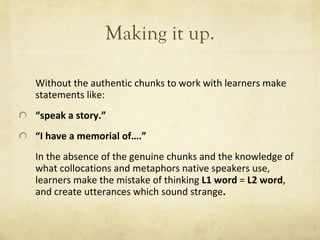
Making it up. Without the authentic chunks to work with learners make statements like: “ speak a story. ” “ I have a memorial of…. ”   In the absence of the genuine chunks and the knowledge of what collocations and metaphors native speakers use, learners make the mistake of thinking  L1 word  =  L2 word , and create utterances which sound strange .
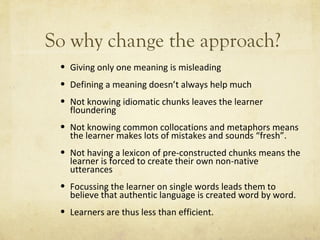
So why change the approach? Giving only one meaning is misleading Defining a meaning doesn ’ t always help much Not knowing idiomatic chunks leaves the learner floundering Not knowing common collocations and metaphors means the learner makes lots of mistakes and sounds  “ fresh ” . Not having a lexicon of pre-constructed chunks means the learner is forced to create their own non-native utterances Focussing the learner on single words leads them to believe that authentic language is created word by word. Learners are thus less than efficient.
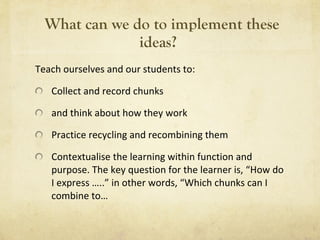
What can we do to implement these ideas?   Teach ourselves and our students to: Collect and record chunks  and think about how they work  Practice recycling and recombining them Contextualise the learning within function and purpose. The key question for the learner is,  “ How do I express ….. ”  in other words,  “ Which chunks can I combine to…
Classroom action As chunks  are encountered , record and display them as schema …  maunganui    piki i te.. kia hohou te maungarongo  maunga kōrero  Maunga  Maungakiekie Eke ki runga i… Ehara taku maunga i te maunga  nekeneke   Discuss the ins and outs with the learners
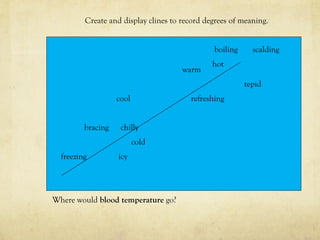
Create and display clines to record degrees of meaning.     boiling  scalding hot     warm tepid   cool   refreshing bracing   chilly    cold freezing   icy Where would  blood temperature  go?
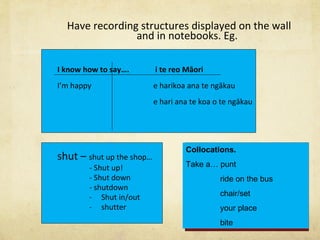
Have recording structures displayed on the wall and in notebooks. Eg. I know how to say….   i te reo Māori  I ’ m happy e harikoa ana te ngākau e hari ana te koa o te ngākau shut –  shut up the shop… - Shut up! - Shut down - shutdown Shut in/out shutter Collocations. Take a… punt   ride on the bus   chair/set   your place   bite
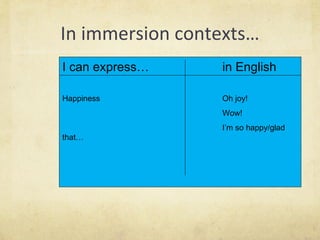
In immersion contexts… I can express… in English Happiness Oh joy! Wow! I ’ m so happy/glad that…
The lexical approach is not a replacement for other approaches but a change of focus  in our teaching. By changing our focus our learners will be more efficient
In summary, we need to… Deliberately draw attention to chunks, collocations, idioms, metaphor etc. and invite learners to do the same.  Focus attention on identifying and using chunks Teach learners to be critically aware Teach them what good language learners do and how to do it. Read more about it… Lewis, M. (1993)  The Lexical Approach. The state of ELT and a Way  Forward.  Thomson Heinle, Boston USA.  Lewis M (ed) (2000)  Teaching Collocation . Thomson Heinle, Boston USA. Lewis, M. (2002)  Implementing the Lexical Approach. Putting Theory into  Practice.  Thomson Heinle, Boston USA. Thornbury, S. (2002)  How to Teach Vocabulary.  Pearson Longman, Essex  England.

Lexical Approach

  • 1.
    The Lexical approach:some underlying principles and practice. .
  • 2.
    What is thelexical approach? Why include it in our practice? A look at inherent difficulties in present practice and possible responses . What can we do to implement these ideas? Some ways of using this approach in the classroom .
  • 3.
    What is lexis? Lexicon: the vocabulary of a language as distinct from the grammar, the total stock of words and meaningful combinations of words in a language.
  • 4.
    The nature ofmeaning… a bit of an enigma
  • 5.
    What does aword mean? Some words have only one meaning, others have no meaning without other words. Some have the same sounds but different meanings, others have highly changeable meanings. A great many have idiomatic meanings as well as their main meanings. motorbike house pop up so a
  • 6.
    Try this… whatis a: cup glass plate basin bowl dish saucer beaker mug Consider these features: Material, flatness, handles, shape, use, position.
  • 7.
    Metaphorical meanings. Theseare not just the as big as a house, built like a brick dunny metaphors, but the little ones like, time flies , found a way to , or take the point Metaphor is used to express an abstract notion by using a concrete example. The example chosen is culturally significant, eg. we say in English “ I caught a cold, ” we say in Māori, “ Kua pāngia (touched) au e te rewharewha. ” See if you can find 5 or 6 small metaphors in this text.
  • 8.
    NZ Herald 24/9/0/9(Re Sydney dust storm) It ripped across Victoria and NSW with gales gusting to 100km/h, thunderstorms, and hailstones sometimes as big as cricket balls. As it hit the mining city of Broken Hill in far western NSW on Tuesday,the front ripped out trees, damaged homes and closed roads. Two miners were trapped underground for almost 24 hours when power supplies were knocked out. As Canberra was blanketed by a deep, dark mist that cloaked landmarks such as Parliament House and the War Memorial, and dumped layers of dust across the capital, winds ravaged fruit crops and bombarded the town of Crookwell with hail heavy enough to smash roofs and damage cars. Dust was whipped from Lake Eyre in a repeat of the 1983 storm that lifted 50,000 tonnes of topsoil from Victoria's Mallee region, formed it into a cloud extending thousands of metres into the atmosphere, and dumped 1000 tonnes on Melbourne The blood-orange backdrop to the city skyline provided plenty of fodder for photographers, who roamed the streets, snapping the peculiar scenes. Sydney ’ s beachers were bathed in a red glow, although that did not deter some dawn bathers and surfers from plunging into the waves. A few joggers and cyclists were also out and about ignoring health warnings and watering eyes. The air was pierced by fire alarms, which went off in buildings across the city, triggered by dust particles.
  • 9.
    So what dowe know about meaning? Meaning is mercurial and often random Meaning is often dependant on what something is not rather than what it is. (when is it a bowl and not a basin?) Meaning is dependant on the combination of words (I ’ m just popping out vs. I ’ m just popping balloons) And the context they are used in. (Shut up! vs. You shut up and I ’ ll get the car.) Meaning is a sort of code which a community of speakers construct from agreed understandings (Take a seat. Momentarily. Bathroom)
  • 10.
    The Lexical Approachand what it offers. The lexical approach is characterised by a focus on the development of a vocabulary of meaningful chunks which can be adapted, combined and recombined to fulfil different functions or purposes. The rules for these actions are derived from observation, hypothesis and experimentation rather than from learnt grammar rules. Language is grammaticised lexis not lexicalised grammar.
  • 11.
    What are thekey elements in the lexical approach? The content: Types of chunks . (chunks may belong to more than one category) Single words, eg. motorbike polywords, eg. overdone, cup of tea Idiomatic phrases which don ’ t mean what they say, eg. What a buzz! Heads, eg. Once upon a time… After a while… Look… Frames, eg. Tell ___ what ___. Collocations, words which are found in close proximity, eg. shut down/up/in/out. contract…agree to, negotiate, write, carry out, complete. Fixed and semi-fixed expressions, eg. I ’ ll see you soon. It takes two to tango
  • 12.
    The importance ofcollocation Notice we don ’ t say, “ do a contract, ” even though do and carry out are synonymous, nor do we say, “ the rain is dropping ” although drop and fall are synonymous. Find some collocations for: - pop - treated - house - real Collocations are the words that native speakers choose to put together, the choice is arbitrary.
  • 13.
    The strategies Criticalawareness. We want our students to be learners of language not passive receivers We want them to be intrigued by the patterns of the language Critical awareness is taught by our modelling, directing, questioning, setting of routines for collecting and recycling Recycling Good language learners collect useful chunks, try to fit them into the schema they have, and experiment with them.
  • 14.
    Be efficient learnersby knowing how… New learning is moved into the long term memory by: recording revisiting over a period of time repeating, recycling, adding cognitive depth.
  • 15.
    PPP versus OHE The P resent P ractice P roduce paradigm is based on a discredited educational theory.(Behaviourism) It assumes that learning is linear. Actually learning is better represented as a schema or web. What do successful language learners do? They O bserve, H ypothesize , and E xperiment
  • 16.
    Why include itin our practice? Is our present practice the complete answer? What issues come up in our reflection on present practice? Do we presently have answers to those issues?
  • 17.
    Does the traditionalapproach meet learners ’ needs? Defining is one present scaffolding strategy. Does what we tell them help them unpack? If we say that “ bank ” means “ a place dealing with money ” how does that help… “ She stood on the bank ” or “ I was banking on it. ” How do we make meaning of “ every now and again ” by defining the individual words? Many dictionaries do not give examples of the word in use.
  • 18.
    Making it up.Without the authentic chunks to work with learners make statements like: “ speak a story. ” “ I have a memorial of…. ” In the absence of the genuine chunks and the knowledge of what collocations and metaphors native speakers use, learners make the mistake of thinking L1 word = L2 word , and create utterances which sound strange .
  • 19.
    So why changethe approach? Giving only one meaning is misleading Defining a meaning doesn ’ t always help much Not knowing idiomatic chunks leaves the learner floundering Not knowing common collocations and metaphors means the learner makes lots of mistakes and sounds “ fresh ” . Not having a lexicon of pre-constructed chunks means the learner is forced to create their own non-native utterances Focussing the learner on single words leads them to believe that authentic language is created word by word. Learners are thus less than efficient.
  • 20.
    What can wedo to implement these ideas? Teach ourselves and our students to: Collect and record chunks and think about how they work Practice recycling and recombining them Contextualise the learning within function and purpose. The key question for the learner is, “ How do I express ….. ” in other words, “ Which chunks can I combine to…
  • 21.
    Classroom action Aschunks are encountered , record and display them as schema … maunganui piki i te.. kia hohou te maungarongo maunga kōrero Maunga Maungakiekie Eke ki runga i… Ehara taku maunga i te maunga nekeneke Discuss the ins and outs with the learners
  • 22.
    Create and displayclines to record degrees of meaning. boiling scalding hot warm tepid cool refreshing bracing chilly cold freezing icy Where would blood temperature go?
  • 23.
    Have recording structuresdisplayed on the wall and in notebooks. Eg. I know how to say…. i te reo Māori I ’ m happy e harikoa ana te ngākau e hari ana te koa o te ngākau shut – shut up the shop… - Shut up! - Shut down - shutdown Shut in/out shutter Collocations. Take a… punt ride on the bus chair/set your place bite
  • 24.
    In immersion contexts…I can express… in English Happiness Oh joy! Wow! I ’ m so happy/glad that…
  • 25.
    The lexical approachis not a replacement for other approaches but a change of focus in our teaching. By changing our focus our learners will be more efficient
  • 26.
    In summary, weneed to… Deliberately draw attention to chunks, collocations, idioms, metaphor etc. and invite learners to do the same. Focus attention on identifying and using chunks Teach learners to be critically aware Teach them what good language learners do and how to do it. Read more about it… Lewis, M. (1993) The Lexical Approach. The state of ELT and a Way Forward. Thomson Heinle, Boston USA. Lewis M (ed) (2000) Teaching Collocation . Thomson Heinle, Boston USA. Lewis, M. (2002) Implementing the Lexical Approach. Putting Theory into Practice. Thomson Heinle, Boston USA. Thornbury, S. (2002) How to Teach Vocabulary. Pearson Longman, Essex England.