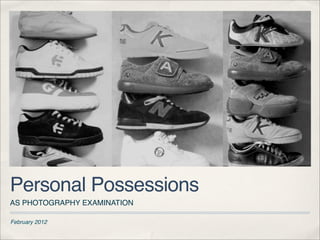
Personal Possessions
AS PHOTOGRAPHY EXAMINATION

February 2012
Personal Possessions

Personal possessions have provided inspiration for many
photographers. Sometimes the photographs of belongings
can reveal the personality and interests of the owner.
Explore appropriate examples and produce your own work.
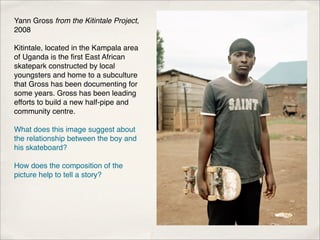
Yann Gross from the Kitintale Project,
2008

Kitintale, located in the Kampala area
of Uganda is the first East African
skatepark constructed by local
youngsters and home to a subculture
that Gross has been documenting for
some years. Gross has been leading
efforts to build a new half-pipe and
community centre.

What does this image suggest about
the relationship between the boy and
his skateboard?

How does the composition of the
picture help to tell a story?
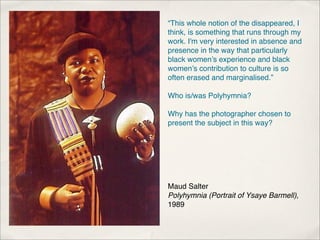
“This whole notion of the disappeared, I
think, is something that runs through my
work. I'm very interested in absence and
presence in the way that particularly
black women’s experience and black
women’s contribution to culture is so
often erased and marginalised.”

Who is/was Polyhymnia?

Why has the photographer chosen to
present the subject in this way?


Maud Salter
Polyhymnia (Portrait of Ysaye Barmell),
1989
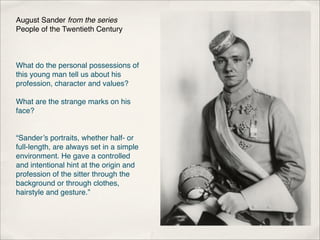
August Sander from the series
People of the Twentieth Century


What do the personal possessions of
this young man tell us about his
profession, character and values?

What are the strange marks on his
face?


“Sander’s portraits, whether half- or
full-length, are always set in a simple
environment. He gave a controlled
and intentional hint at the origin and
profession of the sitter through the
background or through clothes,
hairstyle and gesture.”
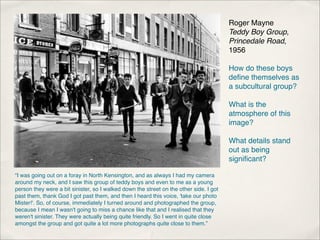
Roger Mayne
                                                                                        Teddy Boy Group,
                                                                                        Princedale Road,
                                                                                        1956

                                                                                        How do these boys
                                                                                        define themselves as
                                                                                        a subcultural group?

                                                                                        What is the
                                                                                        atmosphere of this
                                                                                        image?

                                                                                        What details stand
                                                                                        out as being
                                                                                        significant?

“I was going out on a foray in North Kensington, and as always I had my camera
around my neck, and I saw this group of teddy boys and even to me as a young
person they were a bit sinister, so I walked down the street on the other side. I got
past them, thank God I got past them, and then I heard this voice, 'take our photo
Mister!'. So, of course, immediately I turned around and photographed the group,
because I mean I wasn't going to miss a chance like that and I realised that they
weren't sinister. They were actually being quite friendly. So I went in quite close
amongst the group and got quite a lot more photographs quite close to them.”
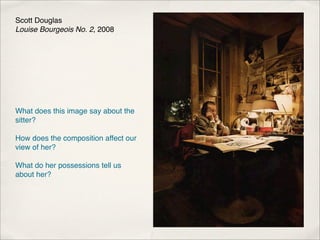
Scott Douglas
Louise Bourgeois No. 2, 2008


What does this image say about the
sitter?

How does the composition affect our
view of her?

What do her possessions tell us
about her?
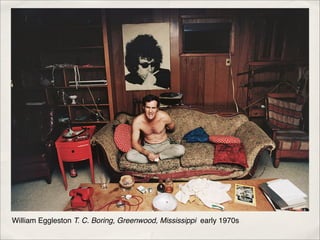
William Eggleston T. C. Boring, Greenwood, Mississippi early 1970s
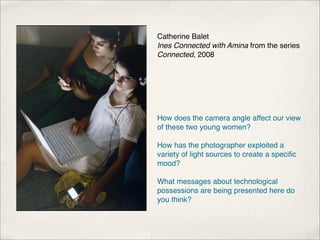
Catherine Balet
Ines Connected with Amina from the series
Connected, 2008


How does the camera angle affect our view
of these two young women?

How has the photographer exploited a
variety of light sources to create a specific
mood?

What messages about technological
possessions are being presented here do
you think?
“In the 20th century, and especially its last decades, our
relationship to things fundamentally changed. In his essay ‘On the
Poetics of Things in Modernism’, Michael Jakob discusses how
natural products, prized from the Renaissance to the
Enlightenment, have been supplanted by manufactured, mass-
produced goods. Mass production democratizes objects, making
them widely affordable - the trade-off being that they are no longer
special, no longer unique. They have to rely for their appeal on their
glint of newness.”

The Ecstasy of Things, Edited by Thomas Seelig & Urs Stahel
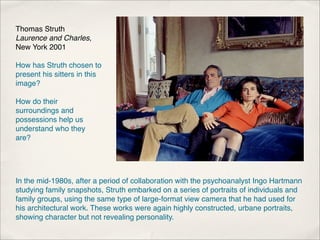
Thomas Struth
Laurence and Charles,
New York 2001

How has Struth chosen to
present his sitters in this
image?

How do their
surroundings and
possessions help us
understand who they
are?


In the mid-1980s, after a period of collaboration with the psychoanalyst Ingo Hartmann
studying family snapshots, Struth embarked on a series of portraits of individuals and
family groups, using the same type of large-format view camera that he had used for
his architectural work. These works were again highly constructed, urbane portraits,
showing character but not revealing personality.
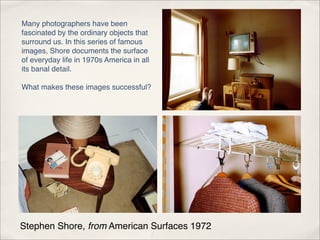
Many photographers have been
fascinated by the ordinary objects that
surround us. In this series of famous
images, Shore documents the surface
of everyday life in 1970s America in all
its banal detail.

What makes these images successful?


Stephen Shore, from American Surfaces 1972
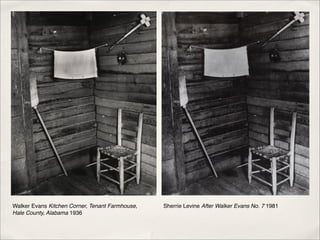
Walker Evans Kitchen Corner, Tenant Farmhouse,   Sherrie Levine After Walker Evans No. 7 1981
Hale County, Alabama 1936
The series, entitled After Walker Evans, became
a landmark of postmodernism, both praised and
attacked as a feminist hijacking of patriarchal
authority, a critique of the commodification of art,
and an elegy on the death of modernism. Far
from a high-concept cheap shot, Levine's works
from this series tell the story of our perpetually
dashed hopes to create meaning, the inability to
recapture the past, and our own lost illusions.
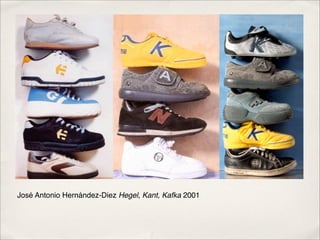
José Antonio Hernández-Diez Hegel, Kant, Kafka 2001
Alec Soth Charles, Vasa, Minnesota 2002


What strikes you as interesting and/or
unusual about this image?

Imagine the portrait without the toy
planes. What would be lost?
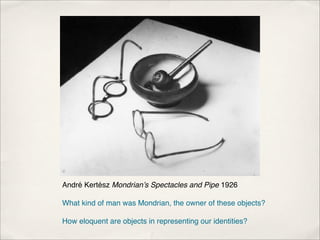
André Kertész Mondrian’s Spectacles and Pipe 1926

What kind of man was Mondrian, the owner of these objects?

How eloquent are objects in representing our identities?
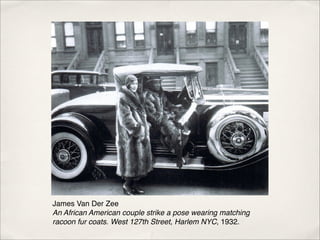
James Van Der Zee
An African American couple strike a pose wearing matching
racoon fur coats. West 127th Street, Harlem NYC, 1932.
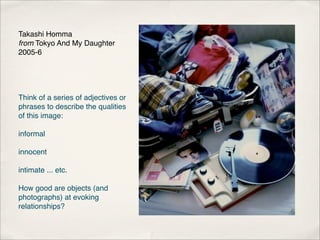
Takashi Homma
from Tokyo And My Daughter
2005-6


Think of a series of adjectives or
phrases to describe the qualities
of this image:

informal

innocent

intimate ... etc.

How good are objects (and
photographs) at evoking
relationships?
“Things are an integral part of the psychological makeup of every
individual as possessions or projected desires. They are guarantors
of social status and life-enhancement, proof of affection,
crystallised points of identity, a pledge of transcendence.
Something of the childish pleasure in things, in which the thing
becomes the world and the self, survives in the adult.”

The Ecstasy of Things, Edited by Thomas Seelig & Urs Stahel
Some questions to ask yourself:

Which of your personal possessions hold the most meaning?

Where do we tend to keep our special objects?

Which one object would best represent you or someone you know?

Can a single object reveal anything meaningful about its owner?

In what sense can possessions be a kind of trap?

What would it be like to get rid of all the things we own?

How could you photograph the entire contents of your bedroom?

What is it like to give an object as a gift?

Personal possessions presentation

  • 1.
    Personal Possessions AS PHOTOGRAPHYEXAMINATION February 2012
  • 2.
    Personal Possessions Personal possessionshave provided inspiration for many photographers. Sometimes the photographs of belongings can reveal the personality and interests of the owner. Explore appropriate examples and produce your own work.
  • 3.
    Yann Gross fromthe Kitintale Project, 2008 Kitintale, located in the Kampala area of Uganda is the first East African skatepark constructed by local youngsters and home to a subculture that Gross has been documenting for some years. Gross has been leading efforts to build a new half-pipe and community centre. What does this image suggest about the relationship between the boy and his skateboard? How does the composition of the picture help to tell a story?
  • 4.
    “This whole notionof the disappeared, I think, is something that runs through my work. I'm very interested in absence and presence in the way that particularly black women’s experience and black women’s contribution to culture is so often erased and marginalised.” Who is/was Polyhymnia? Why has the photographer chosen to present the subject in this way? Maud Salter Polyhymnia (Portrait of Ysaye Barmell), 1989
  • 5.
    August Sander fromthe series People of the Twentieth Century What do the personal possessions of this young man tell us about his profession, character and values? What are the strange marks on his face? “Sander’s portraits, whether half- or full-length, are always set in a simple environment. He gave a controlled and intentional hint at the origin and profession of the sitter through the background or through clothes, hairstyle and gesture.”
  • 6.
    Roger Mayne Teddy Boy Group, Princedale Road, 1956 How do these boys define themselves as a subcultural group? What is the atmosphere of this image? What details stand out as being significant? “I was going out on a foray in North Kensington, and as always I had my camera around my neck, and I saw this group of teddy boys and even to me as a young person they were a bit sinister, so I walked down the street on the other side. I got past them, thank God I got past them, and then I heard this voice, 'take our photo Mister!'. So, of course, immediately I turned around and photographed the group, because I mean I wasn't going to miss a chance like that and I realised that they weren't sinister. They were actually being quite friendly. So I went in quite close amongst the group and got quite a lot more photographs quite close to them.”
  • 7.
    Scott Douglas Louise BourgeoisNo. 2, 2008 What does this image say about the sitter? How does the composition affect our view of her? What do her possessions tell us about her?
  • 8.
    William Eggleston T.C. Boring, Greenwood, Mississippi early 1970s
  • 9.
    Catherine Balet Ines Connectedwith Amina from the series Connected, 2008 How does the camera angle affect our view of these two young women? How has the photographer exploited a variety of light sources to create a specific mood? What messages about technological possessions are being presented here do you think?
  • 10.
    “In the 20thcentury, and especially its last decades, our relationship to things fundamentally changed. In his essay ‘On the Poetics of Things in Modernism’, Michael Jakob discusses how natural products, prized from the Renaissance to the Enlightenment, have been supplanted by manufactured, mass- produced goods. Mass production democratizes objects, making them widely affordable - the trade-off being that they are no longer special, no longer unique. They have to rely for their appeal on their glint of newness.” The Ecstasy of Things, Edited by Thomas Seelig & Urs Stahel
  • 11.
    Thomas Struth Laurence andCharles, New York 2001 How has Struth chosen to present his sitters in this image? How do their surroundings and possessions help us understand who they are? In the mid-1980s, after a period of collaboration with the psychoanalyst Ingo Hartmann studying family snapshots, Struth embarked on a series of portraits of individuals and family groups, using the same type of large-format view camera that he had used for his architectural work. These works were again highly constructed, urbane portraits, showing character but not revealing personality.
  • 12.
    Many photographers havebeen fascinated by the ordinary objects that surround us. In this series of famous images, Shore documents the surface of everyday life in 1970s America in all its banal detail. What makes these images successful? Stephen Shore, from American Surfaces 1972
  • 13.
    Walker Evans KitchenCorner, Tenant Farmhouse, Sherrie Levine After Walker Evans No. 7 1981 Hale County, Alabama 1936
  • 14.
    The series, entitledAfter Walker Evans, became a landmark of postmodernism, both praised and attacked as a feminist hijacking of patriarchal authority, a critique of the commodification of art, and an elegy on the death of modernism. Far from a high-concept cheap shot, Levine's works from this series tell the story of our perpetually dashed hopes to create meaning, the inability to recapture the past, and our own lost illusions.
  • 15.
    José Antonio Hernández-DiezHegel, Kant, Kafka 2001
  • 16.
    Alec Soth Charles,Vasa, Minnesota 2002 What strikes you as interesting and/or unusual about this image? Imagine the portrait without the toy planes. What would be lost?
  • 17.
    André Kertész Mondrian’sSpectacles and Pipe 1926 What kind of man was Mondrian, the owner of these objects? How eloquent are objects in representing our identities?
  • 18.
    James Van DerZee An African American couple strike a pose wearing matching racoon fur coats. West 127th Street, Harlem NYC, 1932.
  • 19.
    Takashi Homma from TokyoAnd My Daughter 2005-6 Think of a series of adjectives or phrases to describe the qualities of this image: informal innocent intimate ... etc. How good are objects (and photographs) at evoking relationships?
  • 20.
    “Things are anintegral part of the psychological makeup of every individual as possessions or projected desires. They are guarantors of social status and life-enhancement, proof of affection, crystallised points of identity, a pledge of transcendence. Something of the childish pleasure in things, in which the thing becomes the world and the self, survives in the adult.” The Ecstasy of Things, Edited by Thomas Seelig & Urs Stahel
  • 21.
    Some questions toask yourself: Which of your personal possessions hold the most meaning? Where do we tend to keep our special objects? Which one object would best represent you or someone you know? Can a single object reveal anything meaningful about its owner? In what sense can possessions be a kind of trap? What would it be like to get rid of all the things we own? How could you photograph the entire contents of your bedroom? What is it like to give an object as a gift?