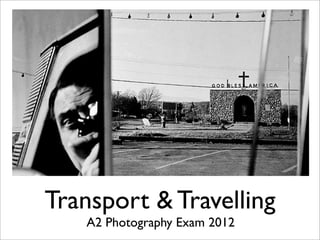
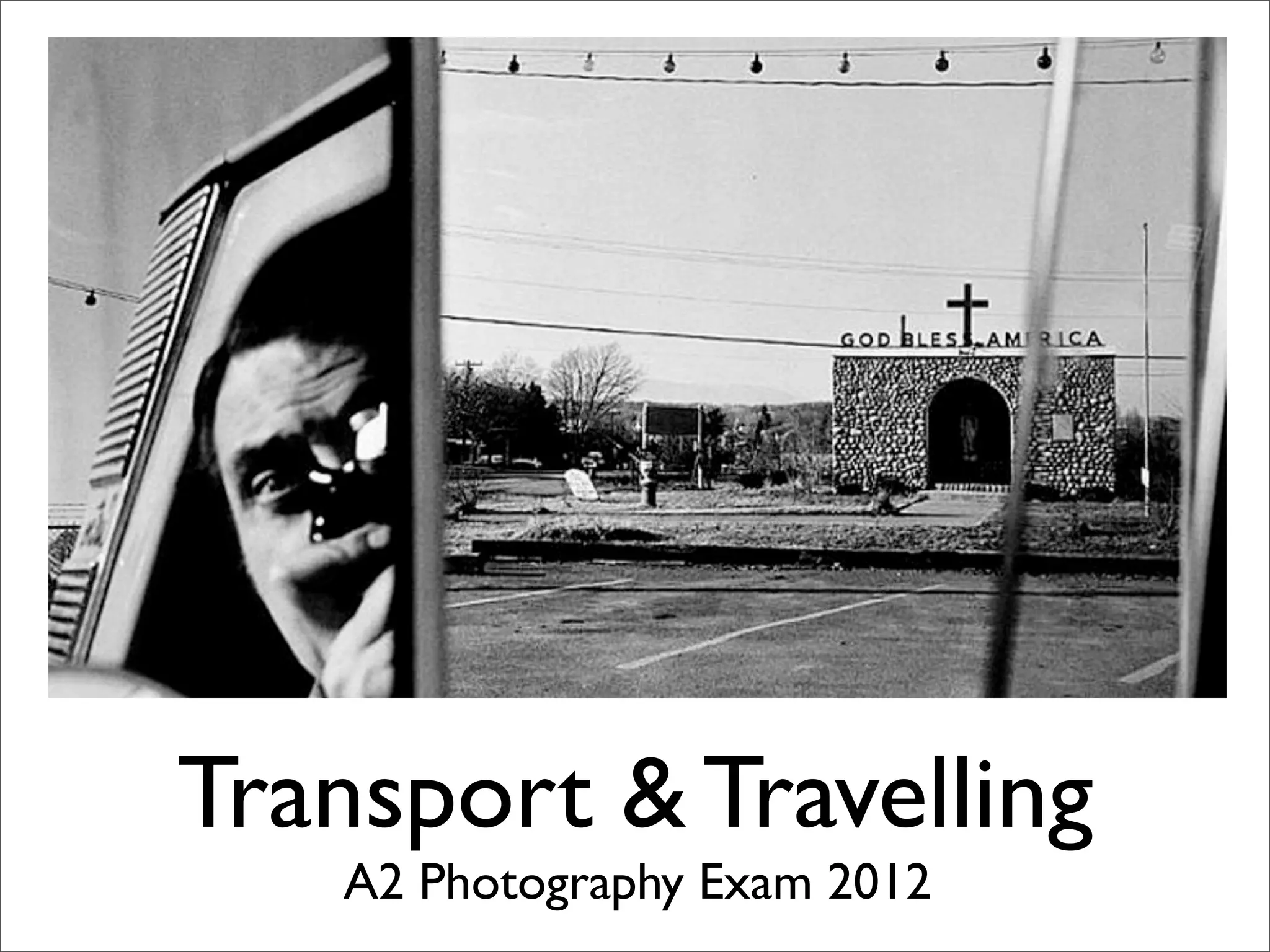
Transport & Travelling
   A2 Photography Exam 2012
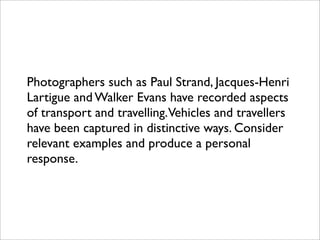
Photographers such as Paul Strand, Jacques-Henri
Lartigue and Walker Evans have recorded aspects
of transport and travelling.Vehicles and travellers
have been captured in distinctive ways. Consider
relevant examples and produce a personal
response.
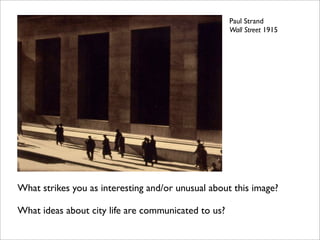
Paul Strand
                                                     Wall Street 1915


What strikes you as interesting and/or unusual about this image?

What ideas about city life are communicated to us?
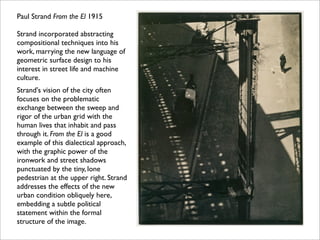
Paul Strand From the El 1915

Strand incorporated abstracting
compositional techniques into his
work, marrying the new language of
geometric surface design to his
interest in street life and machine
culture.
Strand's vision of the city often
focuses on the problematic
exchange between the sweep and
rigor of the urban grid with the
human lives that inhabit and pass
through it. From the El is a good
example of this dialectical approach,
with the graphic power of the
ironwork and street shadows
punctuated by the tiny, lone
pedestrian at the upper right. Strand
addresses the effects of the new
urban condition obliquely here,
embedding a subtle political
statement within the formal
structure of the image.
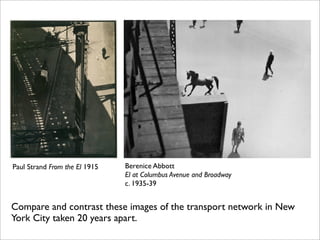
Paul Strand From the El 1915   Berenice Abbott
                               El at Columbus Avenue and Broadway
                               c. 1935-39


Compare and contrast these images of the transport network in New
York City taken 20 years apart.
Paul Strand Wire Wheel 1917

Skyscrapers and machines -
quintessential symbols of modern
life in the early twentieth century -
were among Strand's last subjects.
Duchamp and Picabia had
introduced machines into American
art when they arrived in New York
in 1915, and automobiles capable of
going fifty miles an hour were
everywhere. "Just at the present the
sole ambition seems to be to roll
about, day in and day out, every
moment in [these] machines.
Literally a rolling around in the
present symbol of wealth," Alfred
Stieglitz noted. Strand, interested in
mechanics and cars since childhood,
made photographs with the
sensuousness of a youth running his
hand over the voluptuous fenders of
his dream machine.
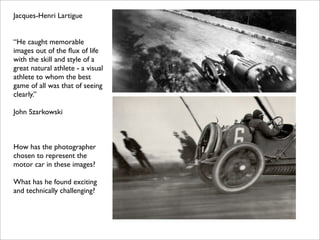
Jacques-Henri Lartigue


“He caught memorable
images out of the flux of life
with the skill and style of a
great natural athlete - a visual
athlete to whom the best
game of all was that of seeing
clearly.”

John Szarkowski


How has the photographer
chosen to represent the
motor car in these images?

What has he found exciting
and technically challenging?
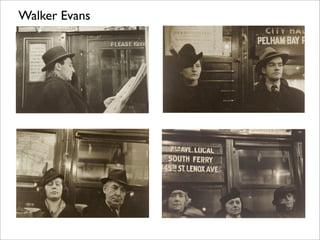
Walker Evans Subway Portrait: Sixteen
Women, New York, 1938-41,
assembled 1959


“[Walker Evans intuited] the affinity
between the modern artist and the
secret agent – both of them intrepid
observers and recorders, purveyors of
inside information and coded
messages, peripatetic voyeurs who
embrace alienation as an occupational
hazard.”
Mia Fineman

“I’m not interested in people in the
portrait sense, in the individual sense.
I’m interested in people as part of the
pictures and as themselves, but
anonymous.”
Walker Evans
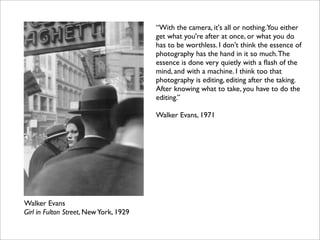
Walker Evans
“With the camera, it's all or nothing.You either
                                        get what you're after at once, or what you do
                                        has to be worthless. I don't think the essence of
                                        photography has the hand in it so much. The
                                        essence is done very quietly with a flash of the
                                        mind, and with a machine. I think too that
                                        photography is editing, editing after the taking.
                                        After knowing what to take, you have to do the
                                        editing.”

                                        Walker Evans, 1971


Walker Evans
Girl in Fulton Street, New York, 1929
Walker Evans      Walker Evans
[Roadside Sign]   Junked Cars, Connecticut
1973-74           1973-74
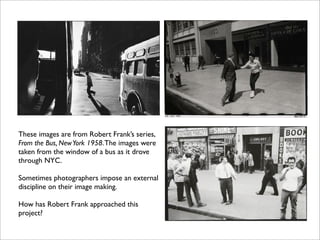
These images are from Robert Frank’s series,
From the Bus, New York 1958. The images were
taken from the window of a bus as it drove
through NYC.

Sometimes photographers impose an external
discipline on their image making.

How has Robert Frank approached this
project?
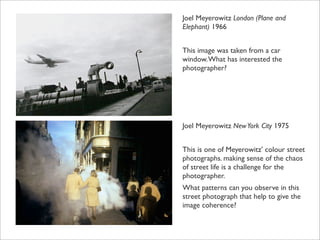
Joel Meyerowitz London (Plane and
Elephant) 1966


This image was taken from a car
window. What has interested the
photographer?


Joel Meyerowitz New York City 1975


This is one of Meyerowitz’ colour street
photographs. making sense of the chaos
of street life is a challenge for the
photographer.
What patterns can you observe in this
street photograph that help to give the
image coherence?
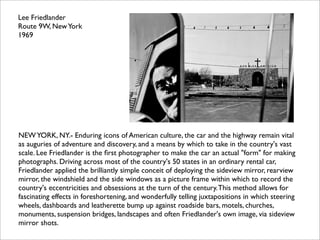
Lee Friedlander
Route 9W, New York
1969


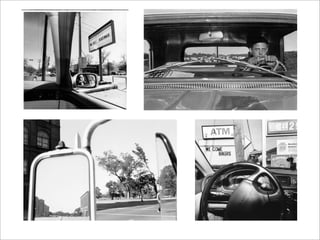
NEW YORK, NY.- Enduring icons of American culture, the car and the highway remain vital
as auguries of adventure and discovery, and a means by which to take in the country's vast
scale. Lee Friedlander is the first photographer to make the car an actual "form" for making
photographs. Driving across most of the country's 50 states in an ordinary rental car,
Friedlander applied the brilliantly simple conceit of deploying the sideview mirror, rearview
mirror, the windshield and the side windows as a picture frame within which to record the
country's eccentricities and obsessions at the turn of the century. This method allows for
fascinating effects in foreshortening, and wonderfully telling juxtapositions in which steering
wheels, dashboards and leatherette bump up against roadside bars, motels, churches,
monuments, suspension bridges, landscapes and often Friedlander's own image, via sideview
mirror shots.
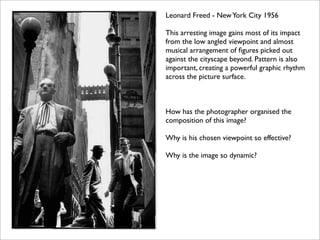
Leonard Freed - New York City 1956

This arresting image gains most of its impact
from the low angled viewpoint and almost
musical arrangement of figures picked out
against the cityscape beyond. Pattern is also
important, creating a powerful graphic rhythm
across the picture surface.


How has the photographer organised the
composition of this image?

Why is his chosen viewpoint so effective?

Why is the image so dynamic?
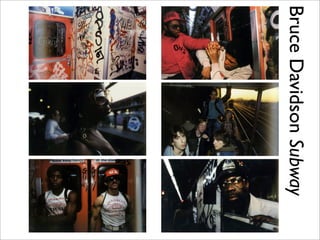
Bruce Davidson Subway
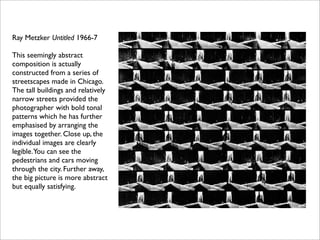
Ray Metzker Untitled 1966-7

This seemingly abstract
composition is actually
constructed from a series of
streetscapes made in Chicago.
The tall buildings and relatively
narrow streets provided the
photographer with bold tonal
patterns which he has further
emphasised by arranging the
images together. Close up, the
individual images are clearly
legible.You can see the
pedestrians and cars moving
through the city. Further away,
the big picture is more abstract
but equally satisfying.
Some questions to ask yourself:

How do you feel when you are a particular mode of transport?

What is it like to go on a journey?

How do people travel in the city and what is the experience like for
the traveller and the observer?

What techniques can you employ to capture the dynamism and
motion of travelling at speed?

Why do we travel? Make a list of all the journeys you make in a
week, month, year...

How does the mode of transport affect your experience of
travelling?

Transport & travelling presentation

  • 1.
    Transport & Travelling A2 Photography Exam 2012
  • 2.
    Photographers such asPaul Strand, Jacques-Henri Lartigue and Walker Evans have recorded aspects of transport and travelling.Vehicles and travellers have been captured in distinctive ways. Consider relevant examples and produce a personal response.
  • 3.
    Paul Strand Wall Street 1915 What strikes you as interesting and/or unusual about this image? What ideas about city life are communicated to us?
  • 4.
    Paul Strand Fromthe El 1915 Strand incorporated abstracting compositional techniques into his work, marrying the new language of geometric surface design to his interest in street life and machine culture. Strand's vision of the city often focuses on the problematic exchange between the sweep and rigor of the urban grid with the human lives that inhabit and pass through it. From the El is a good example of this dialectical approach, with the graphic power of the ironwork and street shadows punctuated by the tiny, lone pedestrian at the upper right. Strand addresses the effects of the new urban condition obliquely here, embedding a subtle political statement within the formal structure of the image.
  • 5.
    Paul Strand Fromthe El 1915 Berenice Abbott El at Columbus Avenue and Broadway c. 1935-39 Compare and contrast these images of the transport network in New York City taken 20 years apart.
  • 6.
    Paul Strand WireWheel 1917 Skyscrapers and machines - quintessential symbols of modern life in the early twentieth century - were among Strand's last subjects. Duchamp and Picabia had introduced machines into American art when they arrived in New York in 1915, and automobiles capable of going fifty miles an hour were everywhere. "Just at the present the sole ambition seems to be to roll about, day in and day out, every moment in [these] machines. Literally a rolling around in the present symbol of wealth," Alfred Stieglitz noted. Strand, interested in mechanics and cars since childhood, made photographs with the sensuousness of a youth running his hand over the voluptuous fenders of his dream machine.
  • 7.
    Jacques-Henri Lartigue “He caughtmemorable images out of the flux of life with the skill and style of a great natural athlete - a visual athlete to whom the best game of all was that of seeing clearly.” John Szarkowski How has the photographer chosen to represent the motor car in these images? What has he found exciting and technically challenging?
  • 8.
    Walker Evans SubwayPortrait: Sixteen Women, New York, 1938-41, assembled 1959 “[Walker Evans intuited] the affinity between the modern artist and the secret agent – both of them intrepid observers and recorders, purveyors of inside information and coded messages, peripatetic voyeurs who embrace alienation as an occupational hazard.” Mia Fineman “I’m not interested in people in the portrait sense, in the individual sense. I’m interested in people as part of the pictures and as themselves, but anonymous.” Walker Evans
  • 9.
  • 10.
    “With the camera,it's all or nothing.You either get what you're after at once, or what you do has to be worthless. I don't think the essence of photography has the hand in it so much. The essence is done very quietly with a flash of the mind, and with a machine. I think too that photography is editing, editing after the taking. After knowing what to take, you have to do the editing.” Walker Evans, 1971 Walker Evans Girl in Fulton Street, New York, 1929
  • 11.
    Walker Evans Walker Evans [Roadside Sign] Junked Cars, Connecticut 1973-74 1973-74
  • 12.
    These images arefrom Robert Frank’s series, From the Bus, New York 1958. The images were taken from the window of a bus as it drove through NYC. Sometimes photographers impose an external discipline on their image making. How has Robert Frank approached this project?
  • 13.
    Joel Meyerowitz London(Plane and Elephant) 1966 This image was taken from a car window. What has interested the photographer? Joel Meyerowitz New York City 1975 This is one of Meyerowitz’ colour street photographs. making sense of the chaos of street life is a challenge for the photographer. What patterns can you observe in this street photograph that help to give the image coherence?
  • 14.
    Lee Friedlander Route 9W,New York 1969 NEW YORK, NY.- Enduring icons of American culture, the car and the highway remain vital as auguries of adventure and discovery, and a means by which to take in the country's vast scale. Lee Friedlander is the first photographer to make the car an actual "form" for making photographs. Driving across most of the country's 50 states in an ordinary rental car, Friedlander applied the brilliantly simple conceit of deploying the sideview mirror, rearview mirror, the windshield and the side windows as a picture frame within which to record the country's eccentricities and obsessions at the turn of the century. This method allows for fascinating effects in foreshortening, and wonderfully telling juxtapositions in which steering wheels, dashboards and leatherette bump up against roadside bars, motels, churches, monuments, suspension bridges, landscapes and often Friedlander's own image, via sideview mirror shots.
  • 16.
    Leonard Freed -New York City 1956 This arresting image gains most of its impact from the low angled viewpoint and almost musical arrangement of figures picked out against the cityscape beyond. Pattern is also important, creating a powerful graphic rhythm across the picture surface. How has the photographer organised the composition of this image? Why is his chosen viewpoint so effective? Why is the image so dynamic?
  • 17.
  • 18.
    Ray Metzker Untitled1966-7 This seemingly abstract composition is actually constructed from a series of streetscapes made in Chicago. The tall buildings and relatively narrow streets provided the photographer with bold tonal patterns which he has further emphasised by arranging the images together. Close up, the individual images are clearly legible.You can see the pedestrians and cars moving through the city. Further away, the big picture is more abstract but equally satisfying.
  • 19.
    Some questions toask yourself: How do you feel when you are a particular mode of transport? What is it like to go on a journey? How do people travel in the city and what is the experience like for the traveller and the observer? What techniques can you employ to capture the dynamism and motion of travelling at speed? Why do we travel? Make a list of all the journeys you make in a week, month, year... How does the mode of transport affect your experience of travelling?