POST-METHOD ERA
 Understanding Post-method
  pedagogy: Transcending the
  limitations of the concept of
  method
 Communicative language
  teaching. Task based language
  teaching

WEEK 4
Agenda
• Your voices on the readings
• Discussion of Task-based vs Communicative language learning
• Discussion of Kumar’s article on shifting trends in TESOL
Tips for writing successful and meaningful blogs
1. Avoid sentences like “I really like Kumar’s Chapter 4” Delve into the
   ideas and theories in the articles, not your overall responses.
2. Synthesize the readings. Try to find a common theme in all readings.
   Don’t only focus on one reading each week.
3. Ask meaningful questions. Move beyond reading for
   comprehension, read for critical knowledge building by asking good
   questions to yourself as a pre-service teacher and to your fellow
   classmates.
4. Write about what makes you passionate in the readings. Quality is more
   important than quantity. Create a log that is worthwhile reading in the
   future. That will help you see your own evolving teacher knowledge
   and identity.
5. See blogs as important identity construction sites not as a simple class
   assignments (where it’s always easy to cut corners by just typing stuff
   that’s not impactful to you and others)
6. Finally, BLOG regularly. Blogs are part of your course requirement and
   count as part of your final grade.
YOUR VOICES…
Nate says…
• I feel that Brown closed this chapter quite nicely, with addressing
  the dynamic nature of the classroom. While all the approaches
  throughout the chapter seemed very beneficial to learners, no one
  approach should not be adopted. This reminded me of the similar
  mindset towards methods. Just like with methods, a teacher must
  keep in mind that theoretical stances are always changing and
  student needs are all different. There are different approaches for
  different circumstances.
Melissa says…
• Brown discusses the concept of "post method" and taps into the
  different approaches within a language classroom. First, he
  discusses that it is better to focus on the approach the teacher uses
  for language teaching (effective tasks and techniques) instead of a
  method for all. As future teachers, we have to be aware of the
  learner's context and offer the appropriate blend of tasks for each
  student. Before entering the education program, I had ignored and
  was oblivious about the fact that a learner's needs and
  geographical, social, and political contexts play a vital part on
  teaching and learning. We need to consider their context and apply
  our teaching to their specific needs to appropriately educate them.
  Now, I have learned to be more focused on the learners'
  background and specific needs, apply it to the approach I am going
  to use, as well as reflect on my own experiences and practice, to
  effectively teach every diverse student I will come across in the
  future.
Melisa adds…
• Kumar (the article) suggests that creating a new method is not the
  way to go, but instead it is to find a new way to help and advise
  teachers to create a sense of plausibility. Method should not be
  considered valuable anymore. Post method pedagogy helps
  language teachers be cautious and value the learner's
  context, carefully assess and treat the learner, and appropriately
  work with diverse students with aid from "local assessments of
  students' strategies for learning". And finally, he discusses critical
  discourse emphasizing on the importance of "extending the
  educational space to the social, cultural, political language use", not
  just settling on teaching the pragmatic domains of language use. It
  is to consider the culture and knowledge within the personal
  experiences of the students and teachers. Teachers have to create a
  sense of awareness on beliefs, identities and overall structure
  within the classroom environment.
Lauren says…
• In the beginning of his essay Kuma describes the modern way we
  should be thinking about TESOL practices. He states that before
  1990 TESOL was in a period of awareness but now we are in a
  period of awakening. I like how he says this, as teachers we learn so
  many pedagogies, methods and techniques we need to take what
  we think is best look at our students and figure out what is most
  beneficial for our classroom. We should not just be aware of these
  teachings we should be “awakened”, figure out how to put these
  practices into action.
Ryann says…
• I want to call attention to a statement Brown makes on page 41. He
  states, that the problem with the term "method"is that it connotes
  a fixes set of classroom practices that serve as a prescription. That a
  method can be applied to any classroom to cure the issues despite
  context and leads to learning. As we have discussed in
  class, teaching calls for a pedagogy of particularity. Can we really
  diagnose what is needed in a classroom and prescribe a remedy?
  There is not a method for all. As much as we may want an "easy
  solution" TESOL is complex and as Brown state son page 44, out
  approaches to language teaching must be designed for specific
  contexts of teaching.
Ryan says…
• While reading I thought about how useful many ELL students may see
  CLT. I'm sure many ELLs would enjoy what is described as purposeful
  lessons that they can use day-to-day which promotes communicative
  fluency while still improving grammar. CLT focuses on meaningful
  exchanges outside of the classroom and is said to use creative classroom
  activities including games, role playing scenarios etc. to practice this
  communicative capacity and motivate students. While reading this
  article, this method sounds wonderful and effective. However, research
  found three serious doubts on the efficacy of CLT including its
  authenticity, acceptability and adaptability. Based on classroom
  observations it has been found that the application of this method really
  isn't up to par and there is actually very little communicated in the L2
  classroom as learners did not have genuine interaction in the classroom.
  CLT appears to be based off exaggerated claims and misrepresented
  ideas. Kumar also states that this method lacked adaptability meaning it
  could not be adapted for various contexts of language teaching to meet
  different sociocultural demands. Kumar suggests that this pedagogy is
  center-based and out of sync with local
  linguistic, educational, social, political and cultural needs (64).
Brown chapter 3
• To assume a gap between theory and practice is dysfunctional
  indeed!: The Dysfunction of the Theory-Practice Relationship


• What were your responses to the questions on page 44?
Communicative Language Teaching
• In your groups, define some of the principles of CLT
CLT
• In the 1970s, educators began to question if they were really
  achieving the goal of language classes. Some observed that
  studenst were producing accurate sentences, but they were not
  usin the language in appropriate context for appropriate
  communicative purposes.
• In 1980s there was a shift from focused based linguistic centered
  approach to a Communicative Approach which highlighted the
  importance of communicative competence (Hymes, 1971)
• The main goal of teaching a language is to communicate in the
  target language.
Main principles of CLT
• Communication is purposeful. Language is for communication.
  Students use language with a communicative intent.
• The use of authentic and real world contexts. Materials should
  help students to develop strategies for understanding language a it
  is actually used.
• Teacher is a facilitator: Monitors student performance and acts as
  an advisor
• Students are communicators. They are actively engaged in
  negotiating meaning.
• Both fluency and accuracy are important. Teachers’ job is to provide
  appropriate feedback.
Versions of CLT
• Indirect approach: Incidental learning without a specific focus on
  form, rules and language principles (String version of CLT).
• Direct approach: Carefully structured tasks for learners. Aid
  ;learners to develop communicative strategies.
Watch and Evaluate
• http://www.youtube.com/watch?v=QirhNeIwQ0w&feature=related

http://www.youtube.com/watch?v=iGDxCg90Its


• Define some of the tenants of CLT and TBL through these videos.
  What are some of the principles/theories represented in these
  lessons? Do they fit into the descriptions you have read so far? Why?
  Why not? Do they seem to you more language/learner/learning
  centered?
Task-based learning
• In your groups, define some of the principles of task based learning.
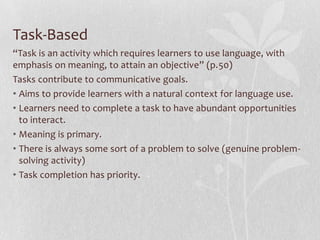
Task-Based
“Task is an activity which requires learners to use language, with
emphasis on meaning, to attain an objective” (p.50)
Tasks contribute to communicative goals.
• Aims to provide learners with a natural context for language use.
• Learners need to complete a task to have abundant opportunities
  to interact.
• Meaning is primary.
• There is always some sort of a problem to solve (genuine problem-
  solving activity)
• Task completion has priority.
Watch and Evaluate
• http://www.youtube.com/watch?v=QirhNeIwQ0w&feature=related

http://www.youtube.com/watch?v=iGDxCg90Its


• Define some of the tenants of CLT and TBL through these videos.
  What are some of the principles/theories represented in these
  lessons? Do they fit into the descriptions you have read so far? Why?
  Why not? Do they seem to you more language/learner/learning
  centered?
Other approaches
• Learning-Centered
• Cooperative Learning
• Interactive Learning
• Whole Language Education
• Content-Based Instruction
• Lexical Approach
• Multiple Intelligences
Kumar’s 2006 article
• In your groups, please define these three main theoretical and
  pedagogical shifts in the field of TESOL. Our class facilitators will be
  mentoring you during the process of defining and discussing the
  main shifts.
• 1) From CLT to TBL
• 2) From Method based to Post-Method
• 3) From systemic discovery to critical discourse
SHIFT # 1: From CLT to Task-based…
 CLT develops as a response to the Audiolingual method
 Scholars find shortcomings with CLT: Prabhu (1987), Chick
  (1996), Shamim (1996), Li (1998), Yu (2001), etc.
 Holliday (1994) adapts the CLT by suggesting an appropriate methodology
  (method that is sensitive to sociocultural demands)
SHIFT # 2: From method to post-method
• Problem with method: “[method] reflects a particular view of the world
  and is articulated in the interests of unequal power relations”
  (Pennycook 1989)


• Prabhu – what really matters is the need for teachers to learn “to operate
  with some personal conceptualization of how their teaching leads to
  desired learning – with a notion of causation that has a measure of
  credibility for them”--sense of plausibility!
SHIFT # 3: From systemic discovery to critical
discourse
During 1990s, the TESOL profession took a “critical turn”
Teaching languages is also about ideologies. Teaching a language is
about creating cultural forms that give meaning to learners’ lived
experiences
Language teaching is a value-laden activity.

New ways of looking at classrooms: Participatory pedagogy
An important perspective to take with you
today…
“We have been awakened to the necessity of making methods-based
   pedagogies more sensitive to local exigencies, awakened to the
 opportunity afforded by postmethod pedagogies to help practicing
   teachers develop their own theory of practice, awakened to the
   multiplicity of learner identities, awakened to the complexity of
  teacher beliefs, and awakened to the vitality of macrostructures–
social, cultural, political, and historical– that shape and reshape the
            microstructures of our pedagogical enterprise.”
                                (Kuma 75)
CREATE YOUR GROUP’S VISUAL
VISUAL ART ON LANGUAGE
EDUCATION:

IN GROUPS OF THREE, DRAW A
METAPHOR FOR YOUR DEFINITION
OF TEACHER AND CLASSROOM FROM
A POST-METHOD PEDAGOGY
PERSPECTIVE
What is your definition of a language
teacher?
How do you define classrooms and
classroom interaction?

Week 4 post method section2

  • 1.
    POST-METHOD ERA  UnderstandingPost-method pedagogy: Transcending the limitations of the concept of method  Communicative language teaching. Task based language teaching WEEK 4
  • 2.
    Agenda • Your voiceson the readings • Discussion of Task-based vs Communicative language learning • Discussion of Kumar’s article on shifting trends in TESOL
  • 3.
    Tips for writingsuccessful and meaningful blogs 1. Avoid sentences like “I really like Kumar’s Chapter 4” Delve into the ideas and theories in the articles, not your overall responses. 2. Synthesize the readings. Try to find a common theme in all readings. Don’t only focus on one reading each week. 3. Ask meaningful questions. Move beyond reading for comprehension, read for critical knowledge building by asking good questions to yourself as a pre-service teacher and to your fellow classmates. 4. Write about what makes you passionate in the readings. Quality is more important than quantity. Create a log that is worthwhile reading in the future. That will help you see your own evolving teacher knowledge and identity. 5. See blogs as important identity construction sites not as a simple class assignments (where it’s always easy to cut corners by just typing stuff that’s not impactful to you and others) 6. Finally, BLOG regularly. Blogs are part of your course requirement and count as part of your final grade.
  • 4.
  • 5.
    Nate says… • Ifeel that Brown closed this chapter quite nicely, with addressing the dynamic nature of the classroom. While all the approaches throughout the chapter seemed very beneficial to learners, no one approach should not be adopted. This reminded me of the similar mindset towards methods. Just like with methods, a teacher must keep in mind that theoretical stances are always changing and student needs are all different. There are different approaches for different circumstances.
  • 6.
    Melissa says… • Browndiscusses the concept of "post method" and taps into the different approaches within a language classroom. First, he discusses that it is better to focus on the approach the teacher uses for language teaching (effective tasks and techniques) instead of a method for all. As future teachers, we have to be aware of the learner's context and offer the appropriate blend of tasks for each student. Before entering the education program, I had ignored and was oblivious about the fact that a learner's needs and geographical, social, and political contexts play a vital part on teaching and learning. We need to consider their context and apply our teaching to their specific needs to appropriately educate them. Now, I have learned to be more focused on the learners' background and specific needs, apply it to the approach I am going to use, as well as reflect on my own experiences and practice, to effectively teach every diverse student I will come across in the future.
  • 7.
    Melisa adds… • Kumar(the article) suggests that creating a new method is not the way to go, but instead it is to find a new way to help and advise teachers to create a sense of plausibility. Method should not be considered valuable anymore. Post method pedagogy helps language teachers be cautious and value the learner's context, carefully assess and treat the learner, and appropriately work with diverse students with aid from "local assessments of students' strategies for learning". And finally, he discusses critical discourse emphasizing on the importance of "extending the educational space to the social, cultural, political language use", not just settling on teaching the pragmatic domains of language use. It is to consider the culture and knowledge within the personal experiences of the students and teachers. Teachers have to create a sense of awareness on beliefs, identities and overall structure within the classroom environment.
  • 8.
    Lauren says… • Inthe beginning of his essay Kuma describes the modern way we should be thinking about TESOL practices. He states that before 1990 TESOL was in a period of awareness but now we are in a period of awakening. I like how he says this, as teachers we learn so many pedagogies, methods and techniques we need to take what we think is best look at our students and figure out what is most beneficial for our classroom. We should not just be aware of these teachings we should be “awakened”, figure out how to put these practices into action.
  • 9.
    Ryann says… • Iwant to call attention to a statement Brown makes on page 41. He states, that the problem with the term "method"is that it connotes a fixes set of classroom practices that serve as a prescription. That a method can be applied to any classroom to cure the issues despite context and leads to learning. As we have discussed in class, teaching calls for a pedagogy of particularity. Can we really diagnose what is needed in a classroom and prescribe a remedy? There is not a method for all. As much as we may want an "easy solution" TESOL is complex and as Brown state son page 44, out approaches to language teaching must be designed for specific contexts of teaching.
  • 10.
    Ryan says… • Whilereading I thought about how useful many ELL students may see CLT. I'm sure many ELLs would enjoy what is described as purposeful lessons that they can use day-to-day which promotes communicative fluency while still improving grammar. CLT focuses on meaningful exchanges outside of the classroom and is said to use creative classroom activities including games, role playing scenarios etc. to practice this communicative capacity and motivate students. While reading this article, this method sounds wonderful and effective. However, research found three serious doubts on the efficacy of CLT including its authenticity, acceptability and adaptability. Based on classroom observations it has been found that the application of this method really isn't up to par and there is actually very little communicated in the L2 classroom as learners did not have genuine interaction in the classroom. CLT appears to be based off exaggerated claims and misrepresented ideas. Kumar also states that this method lacked adaptability meaning it could not be adapted for various contexts of language teaching to meet different sociocultural demands. Kumar suggests that this pedagogy is center-based and out of sync with local linguistic, educational, social, political and cultural needs (64).
  • 11.
    Brown chapter 3 •To assume a gap between theory and practice is dysfunctional indeed!: The Dysfunction of the Theory-Practice Relationship • What were your responses to the questions on page 44?
  • 12.
    Communicative Language Teaching •In your groups, define some of the principles of CLT
  • 13.
    CLT • In the1970s, educators began to question if they were really achieving the goal of language classes. Some observed that studenst were producing accurate sentences, but they were not usin the language in appropriate context for appropriate communicative purposes. • In 1980s there was a shift from focused based linguistic centered approach to a Communicative Approach which highlighted the importance of communicative competence (Hymes, 1971) • The main goal of teaching a language is to communicate in the target language.
  • 14.
    Main principles ofCLT • Communication is purposeful. Language is for communication. Students use language with a communicative intent. • The use of authentic and real world contexts. Materials should help students to develop strategies for understanding language a it is actually used. • Teacher is a facilitator: Monitors student performance and acts as an advisor • Students are communicators. They are actively engaged in negotiating meaning. • Both fluency and accuracy are important. Teachers’ job is to provide appropriate feedback.
  • 15.
    Versions of CLT •Indirect approach: Incidental learning without a specific focus on form, rules and language principles (String version of CLT). • Direct approach: Carefully structured tasks for learners. Aid ;learners to develop communicative strategies.
  • 16.
    Watch and Evaluate •http://www.youtube.com/watch?v=QirhNeIwQ0w&feature=related http://www.youtube.com/watch?v=iGDxCg90Its • Define some of the tenants of CLT and TBL through these videos. What are some of the principles/theories represented in these lessons? Do they fit into the descriptions you have read so far? Why? Why not? Do they seem to you more language/learner/learning centered?
  • 17.
    Task-based learning • Inyour groups, define some of the principles of task based learning.
  • 18.
    Task-Based “Task is anactivity which requires learners to use language, with emphasis on meaning, to attain an objective” (p.50) Tasks contribute to communicative goals. • Aims to provide learners with a natural context for language use. • Learners need to complete a task to have abundant opportunities to interact. • Meaning is primary. • There is always some sort of a problem to solve (genuine problem- solving activity) • Task completion has priority.
  • 20.
    Watch and Evaluate •http://www.youtube.com/watch?v=QirhNeIwQ0w&feature=related http://www.youtube.com/watch?v=iGDxCg90Its • Define some of the tenants of CLT and TBL through these videos. What are some of the principles/theories represented in these lessons? Do they fit into the descriptions you have read so far? Why? Why not? Do they seem to you more language/learner/learning centered?
  • 21.
    Other approaches • Learning-Centered •Cooperative Learning • Interactive Learning • Whole Language Education • Content-Based Instruction • Lexical Approach • Multiple Intelligences
  • 22.
    Kumar’s 2006 article •In your groups, please define these three main theoretical and pedagogical shifts in the field of TESOL. Our class facilitators will be mentoring you during the process of defining and discussing the main shifts. • 1) From CLT to TBL • 2) From Method based to Post-Method • 3) From systemic discovery to critical discourse
  • 23.
    SHIFT # 1:From CLT to Task-based…  CLT develops as a response to the Audiolingual method  Scholars find shortcomings with CLT: Prabhu (1987), Chick (1996), Shamim (1996), Li (1998), Yu (2001), etc.  Holliday (1994) adapts the CLT by suggesting an appropriate methodology (method that is sensitive to sociocultural demands)
  • 24.
    SHIFT # 2:From method to post-method • Problem with method: “[method] reflects a particular view of the world and is articulated in the interests of unequal power relations” (Pennycook 1989) • Prabhu – what really matters is the need for teachers to learn “to operate with some personal conceptualization of how their teaching leads to desired learning – with a notion of causation that has a measure of credibility for them”--sense of plausibility!
  • 25.
    SHIFT # 3:From systemic discovery to critical discourse During 1990s, the TESOL profession took a “critical turn” Teaching languages is also about ideologies. Teaching a language is about creating cultural forms that give meaning to learners’ lived experiences Language teaching is a value-laden activity. New ways of looking at classrooms: Participatory pedagogy
  • 26.
    An important perspectiveto take with you today… “We have been awakened to the necessity of making methods-based pedagogies more sensitive to local exigencies, awakened to the opportunity afforded by postmethod pedagogies to help practicing teachers develop their own theory of practice, awakened to the multiplicity of learner identities, awakened to the complexity of teacher beliefs, and awakened to the vitality of macrostructures– social, cultural, political, and historical– that shape and reshape the microstructures of our pedagogical enterprise.” (Kuma 75)
  • 27.
    CREATE YOUR GROUP’SVISUAL VISUAL ART ON LANGUAGE EDUCATION: IN GROUPS OF THREE, DRAW A METAPHOR FOR YOUR DEFINITION OF TEACHER AND CLASSROOM FROM A POST-METHOD PEDAGOGY PERSPECTIVE What is your definition of a language teacher? How do you define classrooms and classroom interaction?