El profesor de lenguas extranjeras enEl profesor de lenguas extranjeras en
Colombia: Entre la era postmétodo y elColombia: Entre la era postmétodo y el
Programa Nacional de InglésPrograma Nacional de Inglés
Yamith José Fandiño ParraYamith José Fandiño Parra
Bogotá, Julio 26 de 2014Bogotá, Julio 26 de 2014
EsquemaEsquema
0. Introducción
I. Conceptos
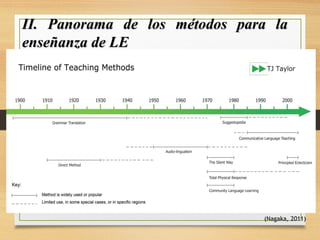
II. Panorama métodos de enseñanza de LE
III. Era posmétodo
IV. Debate sobre bilingüismo
V. ¿Ahora qué sigue?
IntroducciónIntroducción
• No es el desafío lo que define quiénes somos ni qué somos
capaces de ser, sino cómo afrontamos ese desafío: podemos
prender fuego a las ruinas o construir un camino a través de
ellas, paso a paso, hacia la libertad (Bach, 1991, p. 194).
IntroducciónIntroducción
• Today, language teaching is not easily categorized into methods and
trends. Instead, each teacher is called on to develop a sound overall approach to
various language classrooms.
• This approach is a principled basis upon which the teacher can choose
particular designs and techniques for teaching a foreign language in a particular
context (Brown, 2000a).
I. ConceptosI. Conceptos
¿Qué es la metodología para la enseñanza?
•Pedagogical practices in general (including theoretical underpinning and related
research). Whatever considerations are involved in how to teach are methodological (Brown,
2000b).
•The methodology of teaching English stands in relation with several challenges
or problems: What to teach?, What to teach for?, and How to teach? The answers to these
questions determine the nature of the problems to be dealt with (Tamura, 2006).
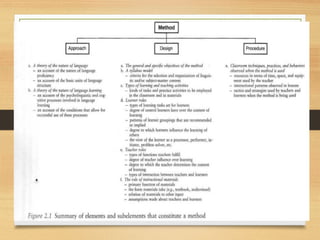
¿Qué es el método: enfoque, diseño y procedimiento? (Richards &
Rodgers, 2001)
•Method: An umbrella term for the specification and interrelation of theory and practice.
•Approach: Theories about the nature of language (structural, functional, interactional)
and language learning (psycholinguistic and cognitive processes or physical and
human conditions).
•design: An instructional system that considers objectives, content choice and
organization (syllabus), learning activities, role of learners and teachers, and role
of materials.
•Procedure: The actual moment-to-moment techniques, practices, and behaviors that operate
in teaching a language. It concerns with how lessons are integrated to present,
practice, and evaluate language.
II. Panorama de los métodos para laII. Panorama de los métodos para la
enseñanza de LEenseñanza de LE
(Nagaka, 2011)
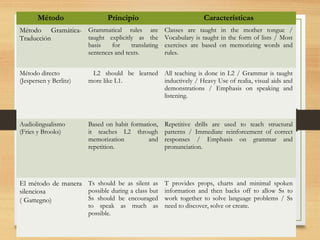
Método Principio Características
Método Gramática-
Traducción
Grammatical rules are
taught explicitly as the
basis for translating
sentences and texts.
Classes are taught in the mother tongue /
Vocabulary is taught in the form of lists / Most
exercises are based on memorizing words and
rules.
Método directo
(Jespersen y Berlitz)
L2 should be learned
more like L1.
All teaching is done in L2 / Grammar is taught
inductively / Heavy Use of realia, visual aids and
demonstrations / Emphasis on speaking and
listening.
Audiolingualismo
(Fries y Brooks)
Based on habit formation,
it teaches L2 through
memorization and
repetition.
Repetitive drills are used to teach structural
patterns / Immediate reinforcement of correct
responses / Emphasis on grammar and
pronunciation.
El método de manera
silenciosa
( Gattegno)
Ts should be as silent as
possible during a class but
Ss should be encouraged
to speak as much as
possible.
T provides props, charts and minimal spoken
information and then backs off to allow Ss to
work together to solve language problems / Ss
need to discover, solve or create.
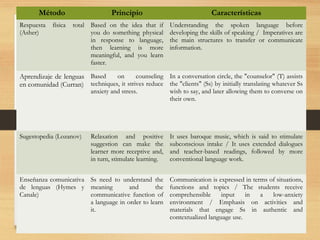
Método Principio Características
Respuesta física total
(Asher)
Based on the idea that if
you do something physical
in response to language,
then learning is more
meaningful, and you learn
faster.
Understanding the spoken language before
developing the skills of speaking / Imperatives are
the main structures to transfer or communicate
information.
Aprendizaje de lenguas
en comunidad (Curran)
Based on counseling
techniques, it strives reduce
anxiety and stress.
In a conversation circle, the "counselor" (T) assists
the "clients" (Ss) by initially translating whatever Ss
wish to say, and later allowing them to converse on
their own.
Sugestopedia (Lozanov) Relaxation and positive
suggestion can make the
learner more receptive and,
in turn, stimulate learning.
It uses baroque music, which is said to stimulate
subconscious intake / It uses extended dialogues
and teacher-based readings, followed by more
conventional language work.
Enseñanza comunicativa
de lenguas (Hymes y
Canale)
Ss need to understand the
meaning and the
communicative function of
a language in order to learn
it.
Communication is expressed in terms of situations,
functions and topics / The students receive
comprehensible input in a low-anxiety
environment / Emphasis on activities and
materials that engage Ss in authentic and
contextualized language use.
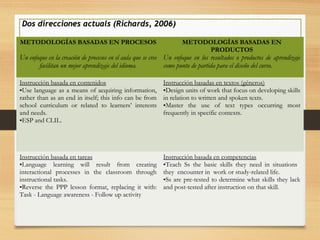
METODOLOGÍAS BASADAS EN PROCESOS
Un enfoque en la creación de procesos en el aula que se cree
facilitan un mejor aprendizaje del idioma.
METODOLOGÍAS BASADAS EN
PRODUCTOS
Un enfoque en los resultados o productos de aprendizaje
como punto de partida para el diseño del curso.
Instrucción basada en contenidos
•Use language as a means of acquiring information,
rather than as an end in itself; this info can be from
school curriculum or related to learners’ interests
and needs.
•ESP and CLIL.
Instrucción basadas en textos (géneros)
•Design units of work that focus on developing skills
in relation to written and spoken texts.
•Master the use of text types occurring most
frequently in specific contexts.
Instrucción basada en tareas
•Language learning will result from creating
interactional processes in the classroom through
instructional tasks.
•Reverse the PPP lesson format, replacing it with:
Task - Language awareness - Follow up activity
Instrucción basada en competencias
•Teach Ss the basic skills they need in situations
they encounter in work or study-related life.
•Ss are pre-tested to determine what skills they lack
and post-tested after instruction on that skill.
Dos direcciones actuals (Richards, 2006)Dos direcciones actuals (Richards, 2006)
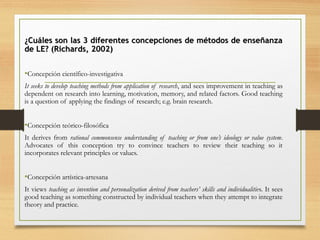
¿Cuáles son las 3 diferentes concepciones de métodos de enseñanza¿Cuáles son las 3 diferentes concepciones de métodos de enseñanza
de LE? (Richards, 2002)de LE? (Richards, 2002)
•Concepción científico-investigativa
It seeks to develop teaching methods from application of research, and sees improvement in teaching as
dependent on research into learning, motivation, memory, and related factors. Good teaching
is a question of applying the findings of research; e.g. brain research.
•Concepción teórico-filosófica
It derives from rational commonsense understanding of teaching or from one’s ideology or value system.
Advocates of this conception try to convince teachers to review their teaching so it
incorporates relevant principles or values.
•Concepción artística-artesana
It views teaching as invention and personalization derived from teachers’ skills and individualities. It sees
good teaching as something constructed by individual teachers when they attempt to integrate
theory and practice.
III. Era posmétodo o el enfoque porIII. Era posmétodo o el enfoque por
principios.principios.
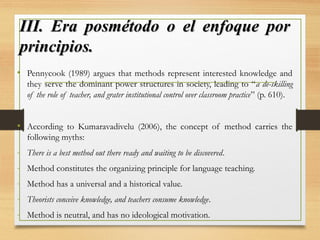
• Pennycook (1989) argues that methods represent interested knowledge and
they serve the dominant power structures in society, leading to “a de-skilling
of the role of teacher, and grater institutional control over classroom practice” (p. 610).
• According to Kumaravadivelu (2006), the concept of method carries the
following myths:
- There is a best method out there ready and waiting to be discovered.
- Method constitutes the organizing principle for language teaching.
- Method has a universal and a historical value.
- Theorists conceive knowledge, and teachers consume knowledge.
- Method is neutral, and has no ideological motivation.
• A shift from transmission, product-oriented theories to
constructivist, process-oriented theories of learning, teaching,
and teacher learning… [it] makes teachers a primary source of
knowledge about teaching (Crandall, 2000, pp. 34-35).
• The postmethod condition is a more democratic approach to
language teaching profession since it assigns a voice to practitioners
and respects the type of knowledge they possess (Akbari, 2005, p. 5).
• … instead of looking for which language teaching method is the best to
follow, the language teacher must find the most effective strategies and
techniques to enrich her or his teaching repertoire (Khatib & Fat’hi,
2012).
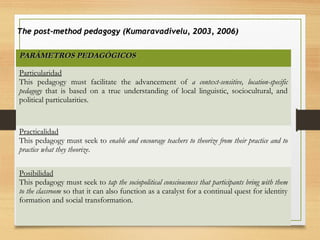
PARÁMETROS PEDAGÓGICOSPARÁMETROS PEDAGÓGICOS
Particularidad
This pedagogy must facilitate the advancement of a context-sensitive, location-specific
pedagogy that is based on a true understanding of local linguistic, sociocultural, and
political particularities.
Practicalidad
This pedagogy must seek to enable and encourage teachers to theorize from their practice and to
practice what they theorize.
Posibilidad
This pedagogy must seek to tap the sociopolitical consciousness that participants bring with them
to the classroom so that it can also function as a catalyst for a continual quest for identity
formation and social transformation.
The post-method pedagogy (Kumaravadivelu, 2003, 2006)The post-method pedagogy (Kumaravadivelu, 2003, 2006)
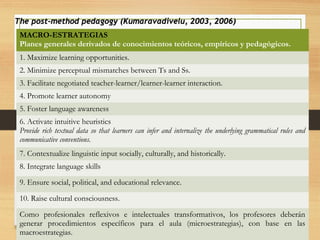
MACRO-ESTRATEGIAS
Planes generales derivados de conocimientos teóricos, empíricos y pedagógicos.
1. Maximize learning opportunities.
2. Minimize perceptual mismatches between Ts and Ss.
3. Facilitate negotiated teacher-learner/learner-learner interaction.
4. Promote learner autonomy
5. Foster language awareness
6. Activate intuitive heuristics
Provide rich textual data so that learners can infer and internalize the underlying grammatical rules and
communicative conventions.
7. Contextualize linguistic input socially, culturally, and historically.
8. Integrate language skills
9. Ensure social, political, and educational relevance.
10. Raise cultural consciousness.
Como profesionales reflexivos e intelectuales transformativos, los profesores deberán
generar procedimientos específicos para el aula (microestrategias), con base en las
macroestrategias.
The post-method pedagogy (Kumaravadivelu, 2003, 2006)The post-method pedagogy (Kumaravadivelu, 2003, 2006)
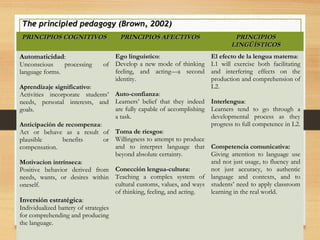
The principled pedagogy (Brown, 2002)The principled pedagogy (Brown, 2002)
PRINCIPIOS COGNITIVOSPRINCIPIOS COGNITIVOS PRINCIPIOS AFECTIVOSPRINCIPIOS AFECTIVOS PRINCIPIOSPRINCIPIOS
LINGÜÍSTICOSLINGÜÍSTICOS
Automaticidad:
Unconscious processing of
language forms.
Aprendizaje significativo:
Activities incorporate students’
needs, personal interests, and
goals.
Anticipación de recompenza:
Act or behave as a result of
plausible benefits or
compensation.
Motivacion intrínseca:
Positive behavior derived from
needs, wants, or desires within
oneself.
Inversión estratégica:
Individualized battery of strategies
for comprehending and producing
the language.
Ego linguístico:  
Develop a new mode of thinking
feeling, and acting—a second
identity.  
Auto-confianza:  
Learners’ belief that they indeed
are fully capable of accomplishing
a task.
Toma de riesgos:  
Willingness to attempt to produce
and to interpret language that
beyond absolute certainty.
Conección lengua-cultura:  
Teaching a complex system of
cultural customs, values, and ways
of thinking, feeling, and acting.
El efecto de la lengua materna:
L1 will exercise both facilitating
and interfering effects on the
production and comprehension of
L2.
Interlengua:
Learners tend to go through a
developmental process as they
progress to full competence in L2.
Competencia comunicativa:
Giving attention to language use
and not just usage, to fluency and
not just accuracy, to authentic
language and contexts, and to
students’ need to apply classroom
learning in the real world.
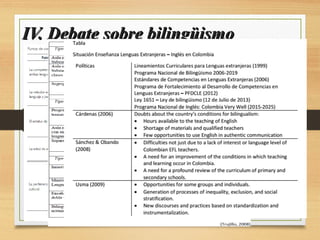
IV. Debate sobre bilingüismoIV. Debate sobre bilingüismo
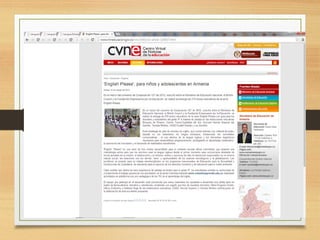
V. ¿Ahora qué sigue? (MEN,V. ¿Ahora qué sigue? (MEN, 2014)2014)
• No es el desafío lo que define quiénes somos ni qué
somos capaces de ser, sino cómo afrontamos ese
desafío: podemos prender fuego a las ruinas o
construir un camino a través de ellas, paso a paso,
hacia la libertad (Bach, 1991, p. 194).
ReferenciasReferencias
Akbari, R. (2005). Recent Developments in Foreign Language Teaching. ROSHD FLT, 20 (76), 25-32.
Bach, R. (1991). Nada es azar. Buenos Aires: VERLAP S.A.
Bermúdez, J., & Fandiño, Y. (2012). El fenómeno bilingüe: perspectivas y tendencias en bilingüismo. Revista de la Universidad de la Salle, 59, 99-124.
Brown, D. (2000a). Principles of language learning and teaching (4th edition). New York: Longman.
Brown, D. (2000b). Teaching by principles: an interactive approach to language pedagogy (2nd edition). USA: Longman.
Brown, D. (2002). English language teaching in the post-method era: toward better diagnosis, treatment, and assessment. In J. Richards & W. Renandya (Eds.), Methodology
in language teaching: an anthology of current practice (pp. 9-18). Cambridge: CUP.
Crandall, J. A. (2000). Language teacher education. Annual Review of Applied Linguistics, 20, 34-55.
Harmer, J- (2001). The practice of English language teaching (3rd edition). USA: Longman.
Khatib, M., & Fat’hi, J. (2012). Postmethod pedagogy and ELT teachers. Journal of academic and applied studies, 2(2), 22-29.
Kumaravadivelu, B. (2003). Beyond Methods: Macrostrategies for language teaching. USA: Yale University Press.
Kumaravadivelu, B. (2006). Understanding language teaching: From method to postmethod. New Jersey: Lawrence Erlbaum Associates.
Ministerio de educación nacional (2014). PROGRAMA NACIONAL DE INGLÉS 2015-2025 Documento de Socialización. Bogotá: MEN.
Nagaka. (2011). Methods and Approaches in English Language Teaching [online image]. Retrieved July 23, 2014 from http://www.timetoast.com/timelines/methods-and-
approaches-in-english-language-teaching
Pennycook, A. (1989). The concept of method, interested knowledge, and the politics of language teaching. TESOL Quarterly, 23 (4), 589-618.
Richards, J. (2002). Theories of teaching in language teaching. In J. Richards & W. Renandya (Eds.), Methodology in language teaching: an anthology of current practice
(pp. 19-26). Cambridge: CUP.
Richards, J. (2006). Communicative language teaching today. Cambridge: CUP:
Richards, J., & Rodgers, T. (2001). Approaches and methods in language teaching. Cambridge: CUP.
Tamura, E. (2006). Concepts on the methodology of English teaching. The economic journal of Takasaki City University of Economics, 48(3), 169-188.
Trujillo, F. (2008). Plurilingüismo en el aula: las lenguas de los estudiantes. En I. Ballano (coord., I Jornadas sobre Lenguas, Currículo y Alumnado Inmigrante (pp. 61-70).
Bilbao: Publicaciones de la Universidad de Deusto.

El profesor de lenguas extranjeras: era postmétodo y programa nacional de inglés

  • 1.
    El profesor delenguas extranjeras enEl profesor de lenguas extranjeras en Colombia: Entre la era postmétodo y elColombia: Entre la era postmétodo y el Programa Nacional de InglésPrograma Nacional de Inglés Yamith José Fandiño ParraYamith José Fandiño Parra Bogotá, Julio 26 de 2014Bogotá, Julio 26 de 2014
  • 2.
    EsquemaEsquema 0. Introducción I. Conceptos II.Panorama métodos de enseñanza de LE III. Era posmétodo IV. Debate sobre bilingüismo V. ¿Ahora qué sigue?
  • 3.
    IntroducciónIntroducción • No esel desafío lo que define quiénes somos ni qué somos capaces de ser, sino cómo afrontamos ese desafío: podemos prender fuego a las ruinas o construir un camino a través de ellas, paso a paso, hacia la libertad (Bach, 1991, p. 194).
  • 4.
    IntroducciónIntroducción • Today, languageteaching is not easily categorized into methods and trends. Instead, each teacher is called on to develop a sound overall approach to various language classrooms. • This approach is a principled basis upon which the teacher can choose particular designs and techniques for teaching a foreign language in a particular context (Brown, 2000a).
  • 5.
    I. ConceptosI. Conceptos ¿Quées la metodología para la enseñanza? •Pedagogical practices in general (including theoretical underpinning and related research). Whatever considerations are involved in how to teach are methodological (Brown, 2000b). •The methodology of teaching English stands in relation with several challenges or problems: What to teach?, What to teach for?, and How to teach? The answers to these questions determine the nature of the problems to be dealt with (Tamura, 2006).
  • 6.
    ¿Qué es elmétodo: enfoque, diseño y procedimiento? (Richards & Rodgers, 2001) •Method: An umbrella term for the specification and interrelation of theory and practice. •Approach: Theories about the nature of language (structural, functional, interactional) and language learning (psycholinguistic and cognitive processes or physical and human conditions). •design: An instructional system that considers objectives, content choice and organization (syllabus), learning activities, role of learners and teachers, and role of materials. •Procedure: The actual moment-to-moment techniques, practices, and behaviors that operate in teaching a language. It concerns with how lessons are integrated to present, practice, and evaluate language.
  • 8.
    II. Panorama delos métodos para laII. Panorama de los métodos para la enseñanza de LEenseñanza de LE (Nagaka, 2011)
  • 9.
    Método Principio Características MétodoGramática- Traducción Grammatical rules are taught explicitly as the basis for translating sentences and texts. Classes are taught in the mother tongue / Vocabulary is taught in the form of lists / Most exercises are based on memorizing words and rules. Método directo (Jespersen y Berlitz) L2 should be learned more like L1. All teaching is done in L2 / Grammar is taught inductively / Heavy Use of realia, visual aids and demonstrations / Emphasis on speaking and listening. Audiolingualismo (Fries y Brooks) Based on habit formation, it teaches L2 through memorization and repetition. Repetitive drills are used to teach structural patterns / Immediate reinforcement of correct responses / Emphasis on grammar and pronunciation. El método de manera silenciosa ( Gattegno) Ts should be as silent as possible during a class but Ss should be encouraged to speak as much as possible. T provides props, charts and minimal spoken information and then backs off to allow Ss to work together to solve language problems / Ss need to discover, solve or create.
  • 10.
    Método Principio Características Respuestafísica total (Asher) Based on the idea that if you do something physical in response to language, then learning is more meaningful, and you learn faster. Understanding the spoken language before developing the skills of speaking / Imperatives are the main structures to transfer or communicate information. Aprendizaje de lenguas en comunidad (Curran) Based on counseling techniques, it strives reduce anxiety and stress. In a conversation circle, the "counselor" (T) assists the "clients" (Ss) by initially translating whatever Ss wish to say, and later allowing them to converse on their own. Sugestopedia (Lozanov) Relaxation and positive suggestion can make the learner more receptive and, in turn, stimulate learning. It uses baroque music, which is said to stimulate subconscious intake / It uses extended dialogues and teacher-based readings, followed by more conventional language work. Enseñanza comunicativa de lenguas (Hymes y Canale) Ss need to understand the meaning and the communicative function of a language in order to learn it. Communication is expressed in terms of situations, functions and topics / The students receive comprehensible input in a low-anxiety environment / Emphasis on activities and materials that engage Ss in authentic and contextualized language use.
  • 11.
    METODOLOGÍAS BASADAS ENPROCESOS Un enfoque en la creación de procesos en el aula que se cree facilitan un mejor aprendizaje del idioma. METODOLOGÍAS BASADAS EN PRODUCTOS Un enfoque en los resultados o productos de aprendizaje como punto de partida para el diseño del curso. Instrucción basada en contenidos •Use language as a means of acquiring information, rather than as an end in itself; this info can be from school curriculum or related to learners’ interests and needs. •ESP and CLIL. Instrucción basadas en textos (géneros) •Design units of work that focus on developing skills in relation to written and spoken texts. •Master the use of text types occurring most frequently in specific contexts. Instrucción basada en tareas •Language learning will result from creating interactional processes in the classroom through instructional tasks. •Reverse the PPP lesson format, replacing it with: Task - Language awareness - Follow up activity Instrucción basada en competencias •Teach Ss the basic skills they need in situations they encounter in work or study-related life. •Ss are pre-tested to determine what skills they lack and post-tested after instruction on that skill. Dos direcciones actuals (Richards, 2006)Dos direcciones actuals (Richards, 2006)
  • 12.
    ¿Cuáles son las3 diferentes concepciones de métodos de enseñanza¿Cuáles son las 3 diferentes concepciones de métodos de enseñanza de LE? (Richards, 2002)de LE? (Richards, 2002) •Concepción científico-investigativa It seeks to develop teaching methods from application of research, and sees improvement in teaching as dependent on research into learning, motivation, memory, and related factors. Good teaching is a question of applying the findings of research; e.g. brain research. •Concepción teórico-filosófica It derives from rational commonsense understanding of teaching or from one’s ideology or value system. Advocates of this conception try to convince teachers to review their teaching so it incorporates relevant principles or values. •Concepción artística-artesana It views teaching as invention and personalization derived from teachers’ skills and individualities. It sees good teaching as something constructed by individual teachers when they attempt to integrate theory and practice.
  • 13.
    III. Era posmétodoo el enfoque porIII. Era posmétodo o el enfoque por principios.principios. • Pennycook (1989) argues that methods represent interested knowledge and they serve the dominant power structures in society, leading to “a de-skilling of the role of teacher, and grater institutional control over classroom practice” (p. 610). • According to Kumaravadivelu (2006), the concept of method carries the following myths: - There is a best method out there ready and waiting to be discovered. - Method constitutes the organizing principle for language teaching. - Method has a universal and a historical value. - Theorists conceive knowledge, and teachers consume knowledge. - Method is neutral, and has no ideological motivation.
  • 14.
    • A shiftfrom transmission, product-oriented theories to constructivist, process-oriented theories of learning, teaching, and teacher learning… [it] makes teachers a primary source of knowledge about teaching (Crandall, 2000, pp. 34-35). • The postmethod condition is a more democratic approach to language teaching profession since it assigns a voice to practitioners and respects the type of knowledge they possess (Akbari, 2005, p. 5). • … instead of looking for which language teaching method is the best to follow, the language teacher must find the most effective strategies and techniques to enrich her or his teaching repertoire (Khatib & Fat’hi, 2012).
  • 15.
    PARÁMETROS PEDAGÓGICOSPARÁMETROS PEDAGÓGICOS Particularidad Thispedagogy must facilitate the advancement of a context-sensitive, location-specific pedagogy that is based on a true understanding of local linguistic, sociocultural, and political particularities. Practicalidad This pedagogy must seek to enable and encourage teachers to theorize from their practice and to practice what they theorize. Posibilidad This pedagogy must seek to tap the sociopolitical consciousness that participants bring with them to the classroom so that it can also function as a catalyst for a continual quest for identity formation and social transformation. The post-method pedagogy (Kumaravadivelu, 2003, 2006)The post-method pedagogy (Kumaravadivelu, 2003, 2006)
  • 16.
    MACRO-ESTRATEGIAS Planes generales derivadosde conocimientos teóricos, empíricos y pedagógicos. 1. Maximize learning opportunities. 2. Minimize perceptual mismatches between Ts and Ss. 3. Facilitate negotiated teacher-learner/learner-learner interaction. 4. Promote learner autonomy 5. Foster language awareness 6. Activate intuitive heuristics Provide rich textual data so that learners can infer and internalize the underlying grammatical rules and communicative conventions. 7. Contextualize linguistic input socially, culturally, and historically. 8. Integrate language skills 9. Ensure social, political, and educational relevance. 10. Raise cultural consciousness. Como profesionales reflexivos e intelectuales transformativos, los profesores deberán generar procedimientos específicos para el aula (microestrategias), con base en las macroestrategias. The post-method pedagogy (Kumaravadivelu, 2003, 2006)The post-method pedagogy (Kumaravadivelu, 2003, 2006)
  • 17.
    The principled pedagogy(Brown, 2002)The principled pedagogy (Brown, 2002) PRINCIPIOS COGNITIVOSPRINCIPIOS COGNITIVOS PRINCIPIOS AFECTIVOSPRINCIPIOS AFECTIVOS PRINCIPIOSPRINCIPIOS LINGÜÍSTICOSLINGÜÍSTICOS Automaticidad: Unconscious processing of language forms. Aprendizaje significativo: Activities incorporate students’ needs, personal interests, and goals. Anticipación de recompenza: Act or behave as a result of plausible benefits or compensation. Motivacion intrínseca: Positive behavior derived from needs, wants, or desires within oneself. Inversión estratégica: Individualized battery of strategies for comprehending and producing the language. Ego linguístico:   Develop a new mode of thinking feeling, and acting—a second identity.   Auto-confianza:   Learners’ belief that they indeed are fully capable of accomplishing a task. Toma de riesgos:   Willingness to attempt to produce and to interpret language that beyond absolute certainty. Conección lengua-cultura:   Teaching a complex system of cultural customs, values, and ways of thinking, feeling, and acting. El efecto de la lengua materna: L1 will exercise both facilitating and interfering effects on the production and comprehension of L2. Interlengua: Learners tend to go through a developmental process as they progress to full competence in L2. Competencia comunicativa: Giving attention to language use and not just usage, to fluency and not just accuracy, to authentic language and contexts, and to students’ need to apply classroom learning in the real world.
  • 18.
    IV. Debate sobrebilingüismoIV. Debate sobre bilingüismo
  • 19.
    V. ¿Ahora quésigue? (MEN,V. ¿Ahora qué sigue? (MEN, 2014)2014)
  • 21.
    • No esel desafío lo que define quiénes somos ni qué somos capaces de ser, sino cómo afrontamos ese desafío: podemos prender fuego a las ruinas o construir un camino a través de ellas, paso a paso, hacia la libertad (Bach, 1991, p. 194).
  • 22.
    ReferenciasReferencias Akbari, R. (2005).Recent Developments in Foreign Language Teaching. ROSHD FLT, 20 (76), 25-32. Bach, R. (1991). Nada es azar. Buenos Aires: VERLAP S.A. Bermúdez, J., & Fandiño, Y. (2012). El fenómeno bilingüe: perspectivas y tendencias en bilingüismo. Revista de la Universidad de la Salle, 59, 99-124. Brown, D. (2000a). Principles of language learning and teaching (4th edition). New York: Longman. Brown, D. (2000b). Teaching by principles: an interactive approach to language pedagogy (2nd edition). USA: Longman. Brown, D. (2002). English language teaching in the post-method era: toward better diagnosis, treatment, and assessment. In J. Richards & W. Renandya (Eds.), Methodology in language teaching: an anthology of current practice (pp. 9-18). Cambridge: CUP. Crandall, J. A. (2000). Language teacher education. Annual Review of Applied Linguistics, 20, 34-55. Harmer, J- (2001). The practice of English language teaching (3rd edition). USA: Longman. Khatib, M., & Fat’hi, J. (2012). Postmethod pedagogy and ELT teachers. Journal of academic and applied studies, 2(2), 22-29. Kumaravadivelu, B. (2003). Beyond Methods: Macrostrategies for language teaching. USA: Yale University Press. Kumaravadivelu, B. (2006). Understanding language teaching: From method to postmethod. New Jersey: Lawrence Erlbaum Associates. Ministerio de educación nacional (2014). PROGRAMA NACIONAL DE INGLÉS 2015-2025 Documento de Socialización. Bogotá: MEN. Nagaka. (2011). Methods and Approaches in English Language Teaching [online image]. Retrieved July 23, 2014 from http://www.timetoast.com/timelines/methods-and- approaches-in-english-language-teaching Pennycook, A. (1989). The concept of method, interested knowledge, and the politics of language teaching. TESOL Quarterly, 23 (4), 589-618. Richards, J. (2002). Theories of teaching in language teaching. In J. Richards & W. Renandya (Eds.), Methodology in language teaching: an anthology of current practice (pp. 19-26). Cambridge: CUP. Richards, J. (2006). Communicative language teaching today. Cambridge: CUP: Richards, J., & Rodgers, T. (2001). Approaches and methods in language teaching. Cambridge: CUP. Tamura, E. (2006). Concepts on the methodology of English teaching. The economic journal of Takasaki City University of Economics, 48(3), 169-188. Trujillo, F. (2008). Plurilingüismo en el aula: las lenguas de los estudiantes. En I. Ballano (coord., I Jornadas sobre Lenguas, Currículo y Alumnado Inmigrante (pp. 61-70). Bilbao: Publicaciones de la Universidad de Deusto.