TEFL I
SEMESTER 5
Pre-method, method era and
post-method of Language
Teaching
Why do we need to know the history of
language teaching?
 Key to the understanding of the way things are and
why they are that way.
 Teachers may better comprehend the forces that
influence their profession
CLASSICAL PERIOD (17th , 18th and 19th centuries)
EDUCATION AS AN ARM OF THEOCRACY
Purpose of education to teach religious
orthodoxy and good moral character
FOREİGN LANGUAGE LEARNİNG ASSOCIATED
WITH THE LEARNİNG OF GREEK AND LATİN
purpose of learning a foreign language to
promote speakers’ intellectuality
1850’s: Classical method came to be known as
Grammar Translation Method
1840’s to 1940’s: Grammar Translation
 Emphasis on learnıng to read & wrıte
 Focus on grammatical rules, syntactic structures, rote
memorization of voc. and translation of literary texts
 Vocabulary is taught in the form of lists of isolated words
 Long, elaborate explanations of the intricacies of grammar
are given
 Medium of instruction was the mother tongue (L1)
 No provision for the oral use of language
 Speaking and listening were mediated via “conversation
classes”, add-ons to the main course
Characteristics of Grammar Translation Method
1. The goal of foreign language study is to learn a
language in order to read its literature
2. Reading and writing are the major focus, little or no
attention is paid to speaking and listening.
3. The sentence is the basic unit of teaching and
learning practice.
4. Accuracy is emphasized.
5. Grammar is taught deductively.
6. The students’ native language is the medium of
instruction.
 GTM dominated European and foreign language
teaching from the 1840s to the 1940s.
 It was criticized by language specialists, such as Gouin,
Marcel, and Pendergast stated that language learning
was facilitated through using language to accomplish
events consisting of a sequence of related actions.
 That’s why GTM should be revitalized or reformed in
accordance with the students’ needs to communicate
in the target language, not only focus on reading and
writing but also focus on speaking and listening.
Early Mid-20th Century
 Demand for ability to speak a foreign language
 Reformers reconsidering the nature of langauge
and learning
 Three Reformers (the way children learned
languages was relevant to how adults learned
languages)
 C. Marcel
 F. Gouin
 T. Pendergast
Early Mid- 20th Century
 Marcel
 Emphasized the importance of understanding meaning in
language learning
 Pendergast
 Proposed the first structural syllabus (arranging grammatical
structures so that the easiest was taught first)
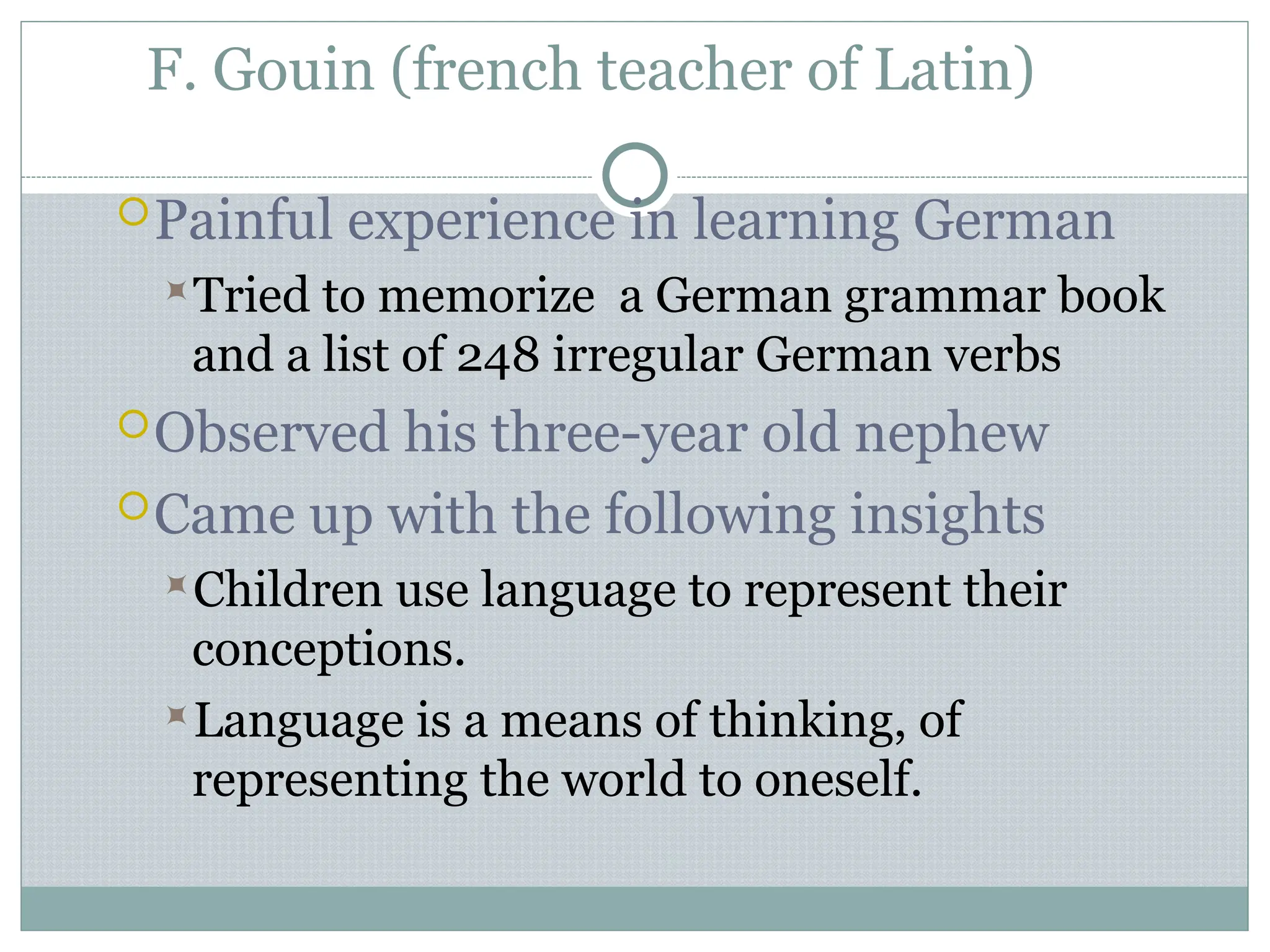
F. Gouin (french teacher of Latin)
Painful experience in learning German
Tried to memorize a German grammar book
and a list of 248 irregular German verbs
Observed his three-year old nephew
Came up with the following insights
Children use language to represent their
conceptions.
Language is a means of thinking, of
representing the world to oneself.
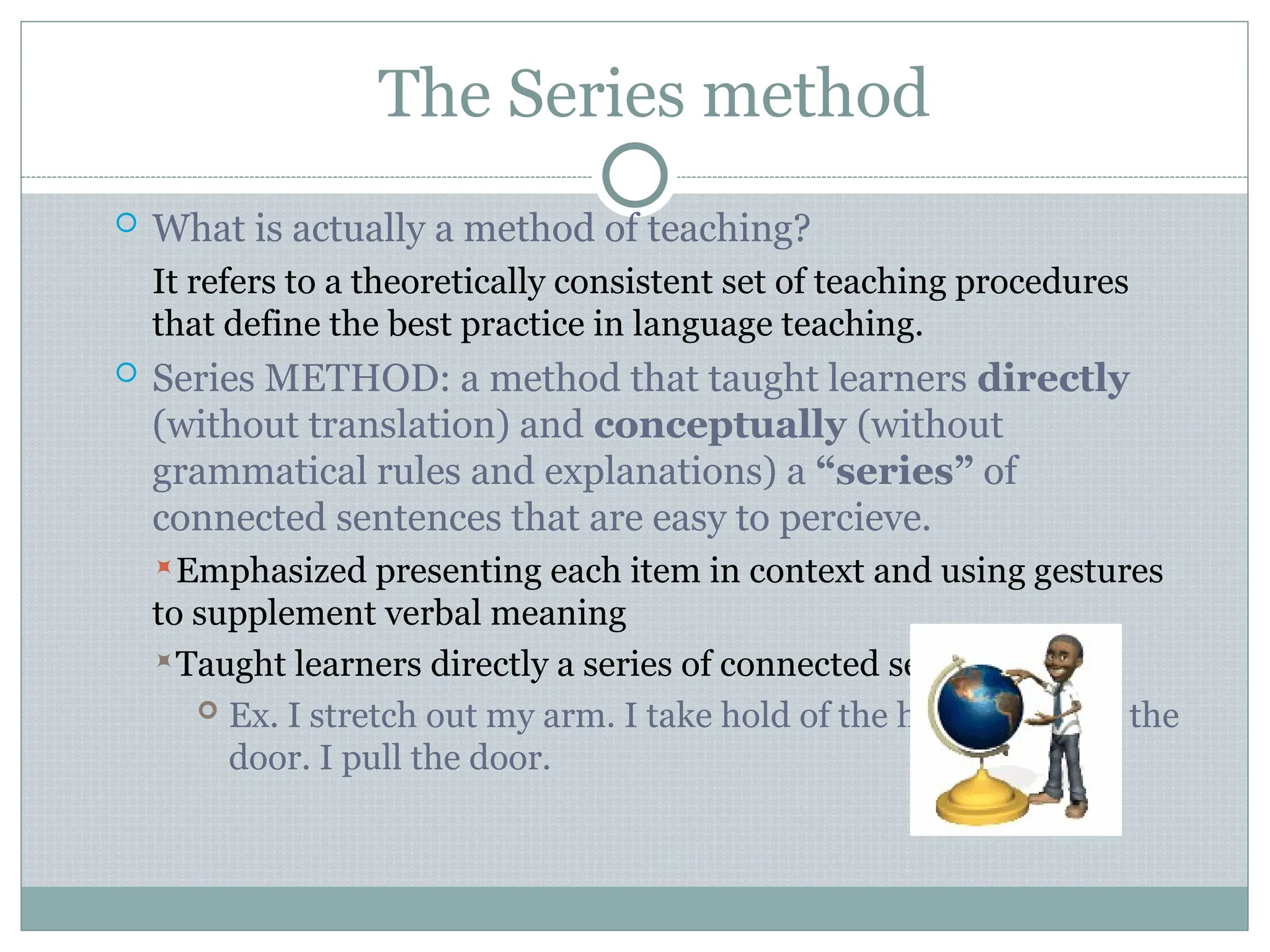
The Series method
 What is actually a method of teaching?
It refers to a theoretically consistent set of teaching procedures
that define the best practice in language teaching.
 Series METHOD: a method that taught learners directly
(without translation) and conceptually (without
grammatical rules and explanations) a “series” of
connected sentences that are easy to percieve.
Emphasized presenting each item in context and using gestures
to supplement verbal meaning
Taught learners directly a series of connected sentences.
 Ex. I stretch out my arm. I take hold of the handle. I open the
door. I pull the door.
The Reform Movement of Language Teaching
 The spoken language is primary and that this should be
reflected in oral-based methodology.
 The findings of phonetics should be applied to teaching
and to teacher training.
 Learners should hear the language first, before seeing it
in written form.
 Words should be presented in sentences
 The rules of grammar should be taught only after the
students have practiced the grammar point in the context.
 Translation should avoided.
Direct Method
 It is known widely as natural method.
 A language could best be taught by using it actively
in the classroom rather than using analytical
procedures that focus on explanation of grammar
rules.
 Teachers should encourage the students to directly
and spontaneously communicate by using foreign
language in the classroom.
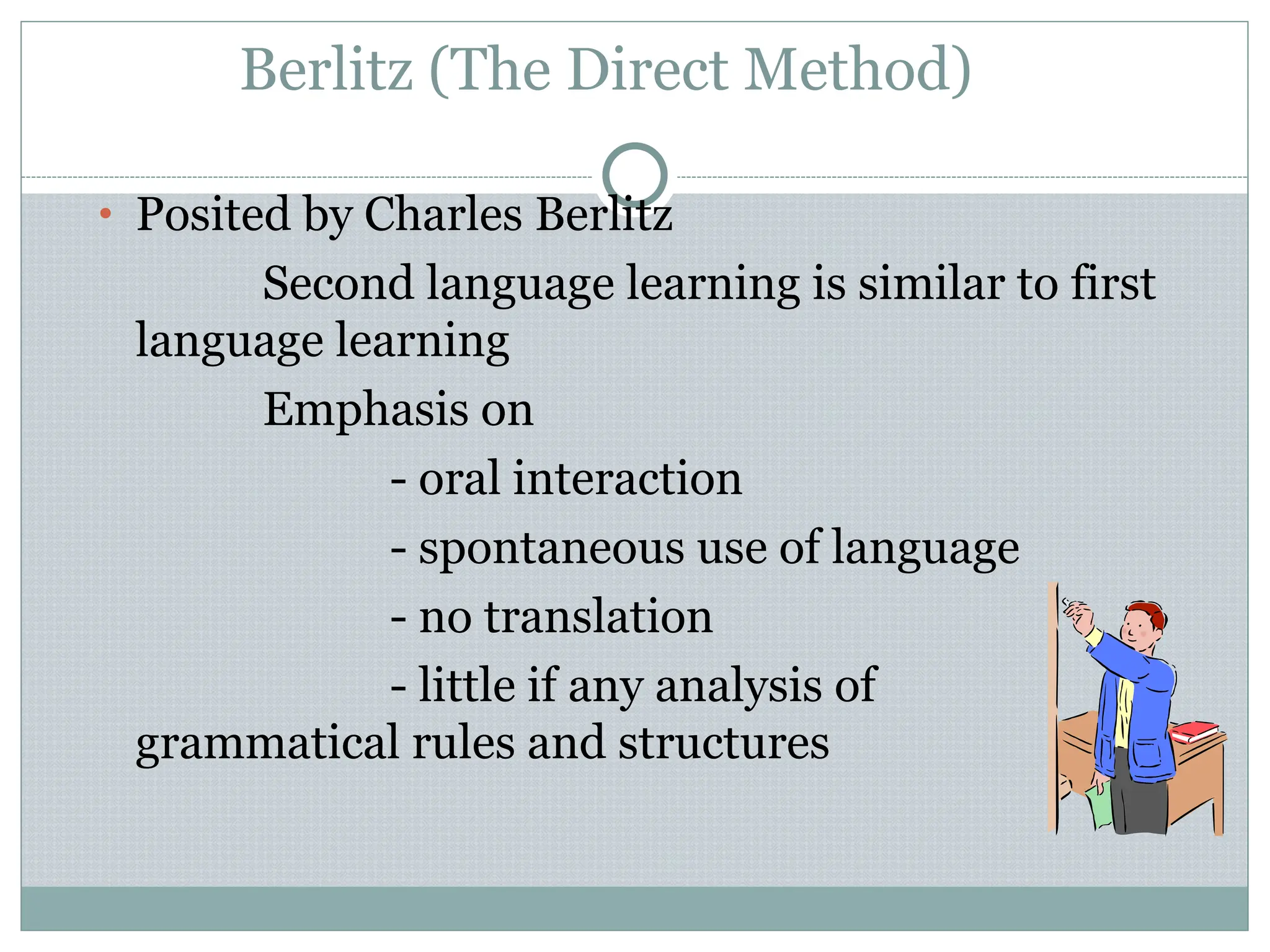
Berlitz (The Direct Method)
• Posited by Charles Berlitz
Second language learning is similar to first
language learning
Emphasis on
- oral interaction
- spontaneous use of language
- no translation
- little if any analysis of
grammatical rules and structures
The Methods Era
 One of the lasting legacies of the DI was the notion of
method itself.
Drawbacks of Direct Method
It required teachers who are
native speakers or who have
native-like fluency in the foreign
language. It depends on the
teachers’ skills, rather than on
textbook.
Post-Method Era
 Methods are actually top down imposition of
experts’ views of teaching and teachers have
to apply the method and adapt their teaching
style to make it conform to the method.
 Methods fail to address the broader context
of teaching and learning and focus only on
one small part of a more complex set of
elements.
Expert’s view of the method
Browns stated that the term method is
best replaced by the term pedagogy.
Method implies a static set of
procedures, whereas pedagogy suggests
the dynamic interplay between
teachers, learners, and instructional
materials during the process of
teaching and learning.
Why are methods no longer the milestone of
language teaching?
 Methods are to prescriptive
 Generally methods are quite distinctive in the early,
beginning stages of language course and rather
indistinguishable from each other at later stages.
 Methods are laden with “interested knowledge” – the
quasi empirical or mercenary agendas of their
proponents.
 When method is thought can be tested by scientific
quantification to determine which one is best, but it is
discovered that it cannot be verified by empirical
validation.
Diagnosis, Treatment, and Assessment
 Teacher should diagnose appropriate
curricular treatment for those specific
learners in their distinctive context and for
their particular goal.
 It enables teachers to assess what went
right and what went wrong in a lesson.
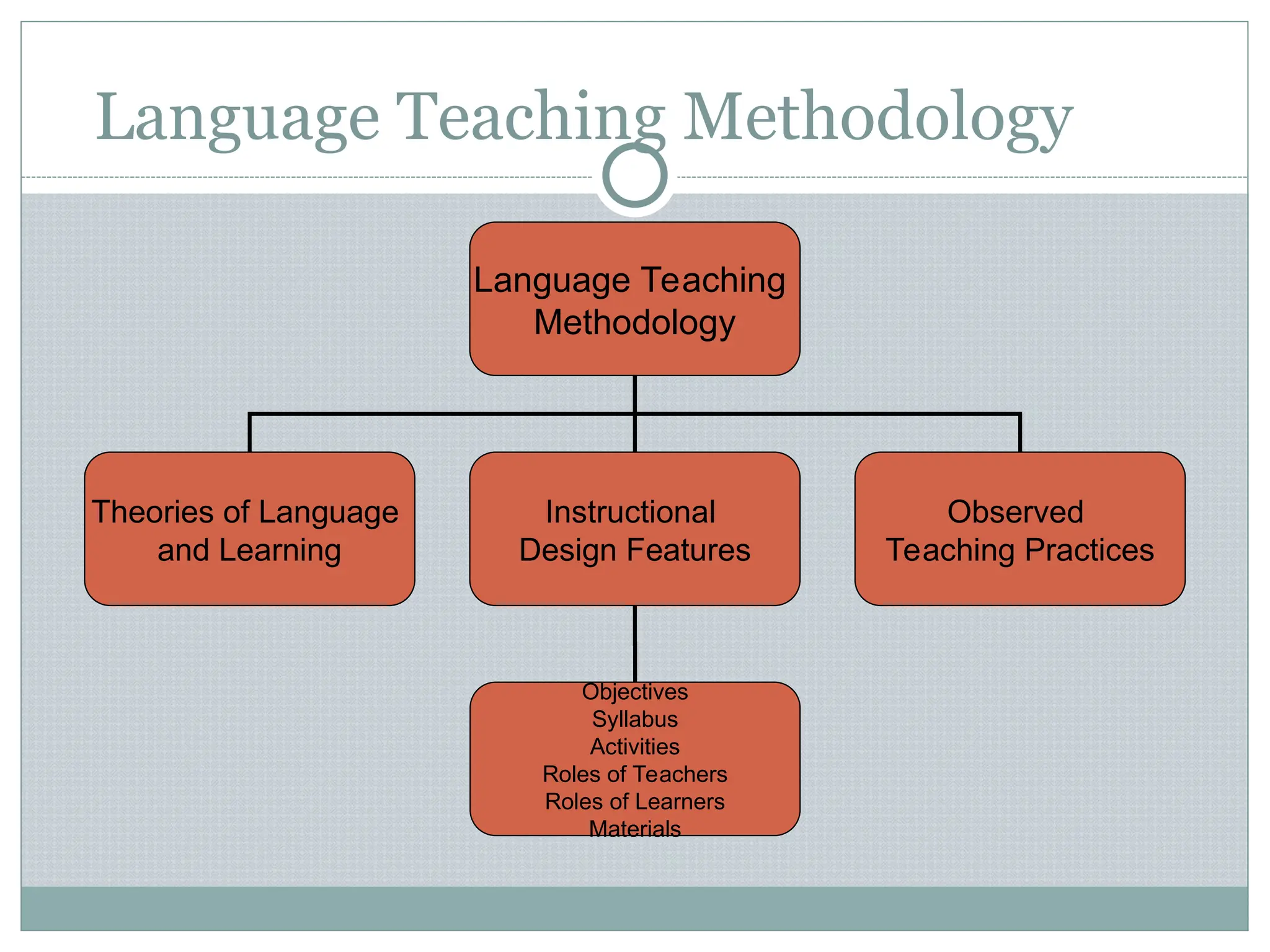
Language Teaching Methodology
Language Teaching
Methodology
Theories of Language
and Learning
Instructional
Design Features
Observed
Teaching Practices
Objectives
Syllabus
Activities
Roles of Teachers
Roles of Learners
Materials
Theories of Language and Learning
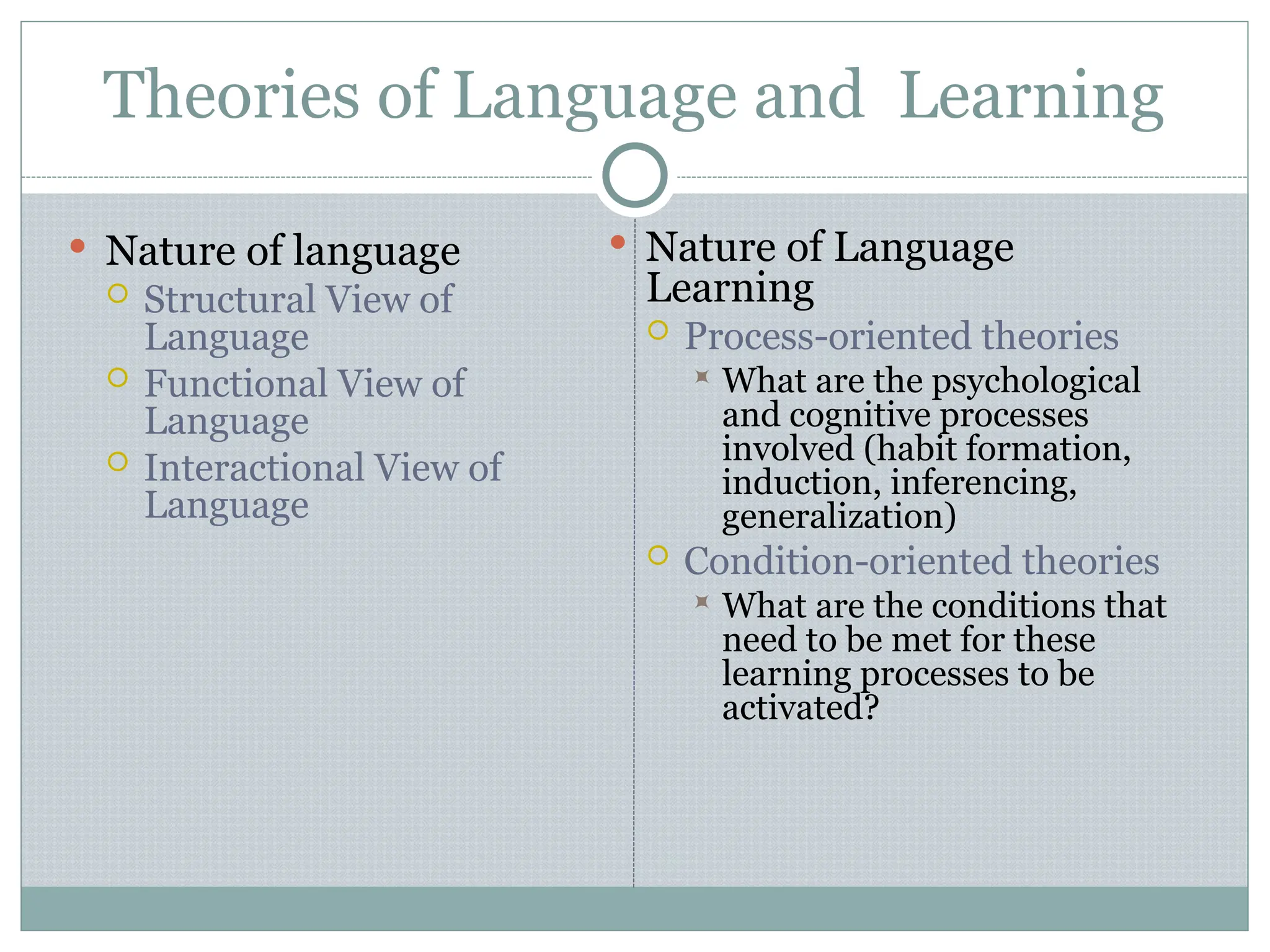
 Nature of language
 Structural View of
Language
 Functional View of
Language
 Interactional View of
Language
 Nature of Language
Learning
 Process-oriented theories
 What are the psychological
and cognitive processes
involved (habit formation,
induction, inferencing,
generalization)
 Condition-oriented theories
 What are the conditions that
need to be met for these
learning processes to be
activated?
Language and Learning
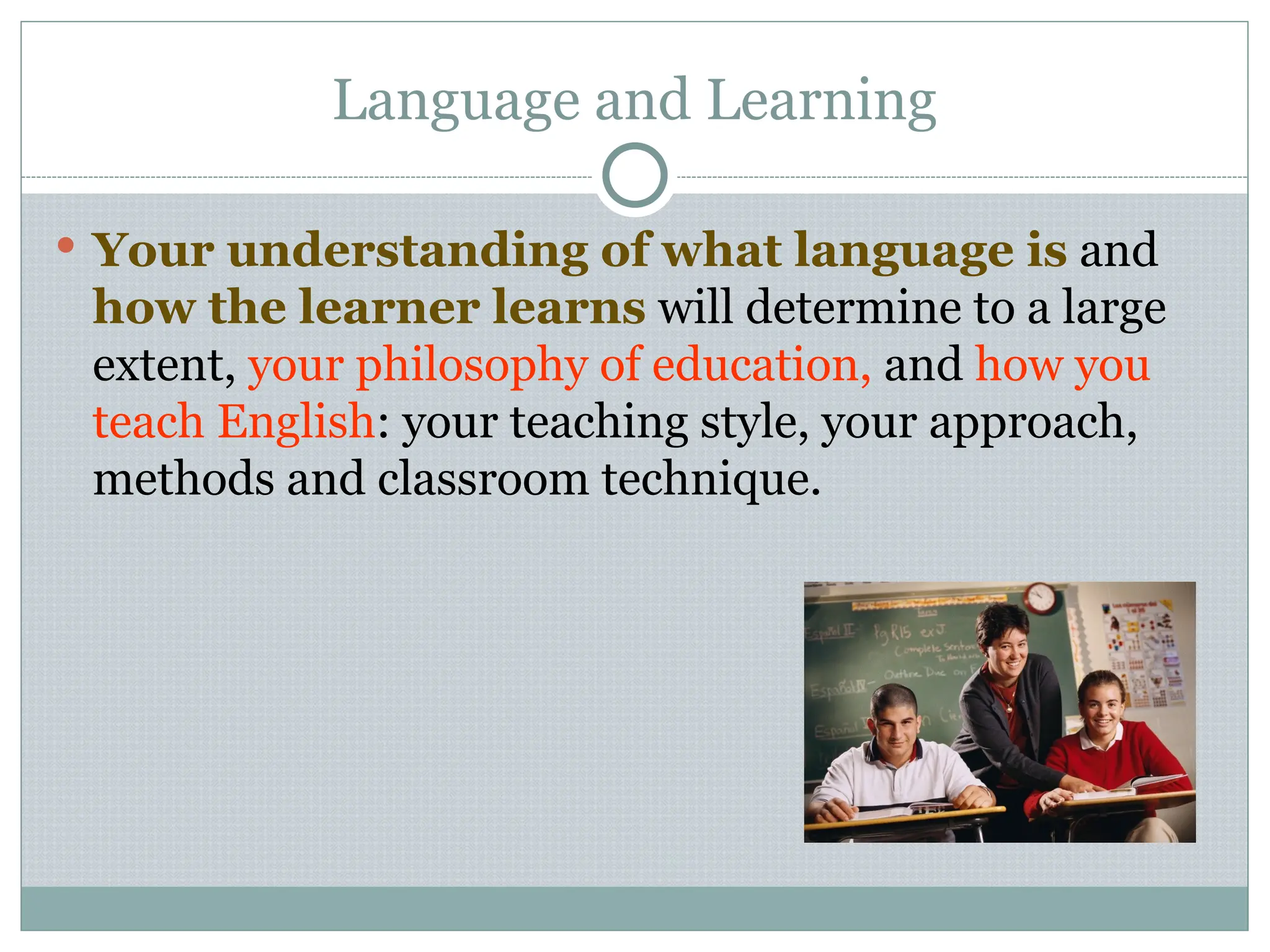
 Your understanding of what language is and
how the learner learns will determine to a large
extent, your philosophy of education, and how you
teach English: your teaching style, your approach,
methods and classroom technique.
What is language?
 Definition of language:
 A language is considered to be a system of
communicating with other people using sounds,
symbols and words in expressing a meaning, idea or
thought.
What is language?
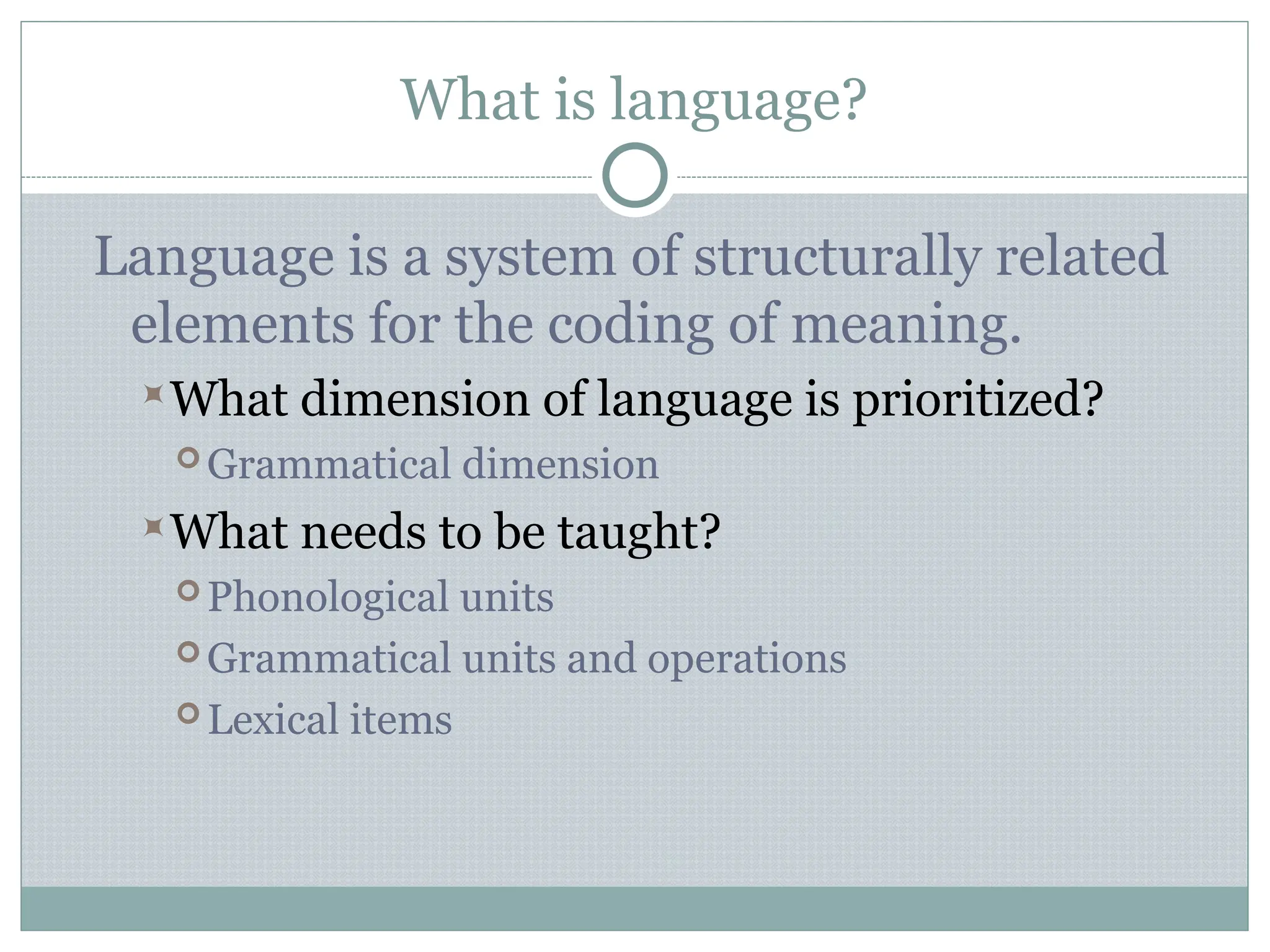
Language is a system of structurally related
elements for the coding of meaning.
What dimension of language is prioritized?
 Grammatical dimension
What needs to be taught?
 Phonological units
 Grammatical units and operations
 Lexical items
What is language for?
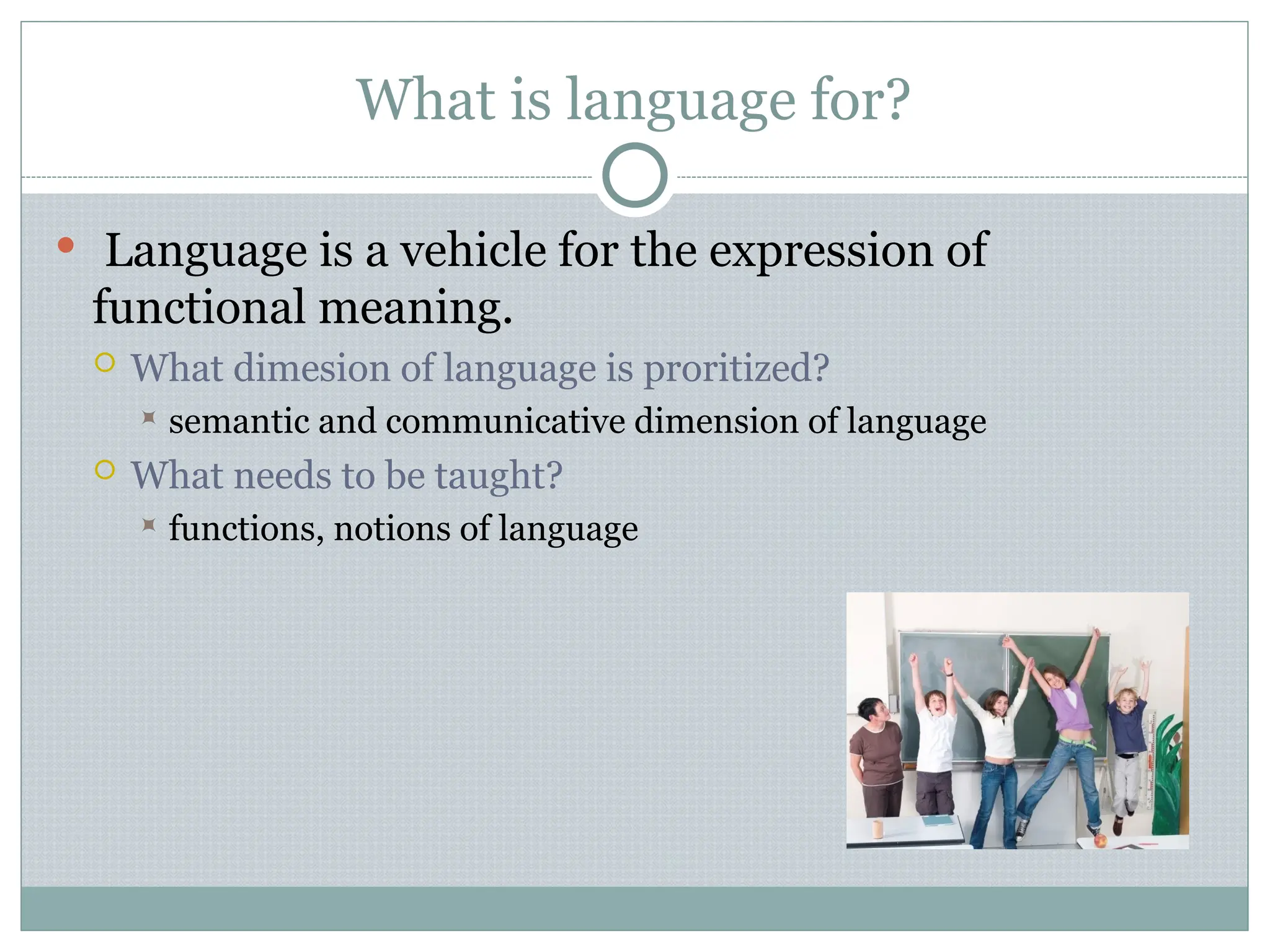
 Language is a vehicle for the expression of
functional meaning.
 What dimesion of language is proritized?
 semantic and communicative dimension of language
 What needs to be taught?
 functions, notions of language
What is language for?
 Language is a vehicle for the realization of
interpersonal relations and for the performance of
social transactions between individuals
 What dimension of language is prioritized?
 Interactive dimension of language
 What needs to be taught?
 Patterns of moves, acts negotiation and interaction found in
conversational exchanges.
Elements and Sub-elements of Method
 Approach
 Assumptions and beliefs
about language teaching and
learning
 Design
 Objectives
 Syllabus
 Activities
 Roles of Teachers
 Roles of Learners
 Materials
 Procedure
 Implementational Phase
 A method is theoretically
related to an approach, is
organizationally
determined by a design,
and is practically realized
in procedure
Approach, Methods, Methodology, Technique
 According to Blackwell Encyclopedic Dictionary of Applied Linguistics (
http://www.blackwellreference.com/public/tocnode?id=g9780631214823_chunk_
g97806312148235_ss1-22
) as a technical term was first proposed by Anthony in his article ‘Approach, method
and technique’ first published in 1963. He was concerned with two problems: (1)
how to relate language teaching theory and practice to each other; (2) how to
describe this relationship. His solution is conveyed in his title, the term ‘approach’
encapsulating the theory underlying practice:I view an approach … as a set of
correlative assumptions dealing with the nature of language and the nature of
language teaching and learning. An approach is axiomatic. It describes the nature of
the subject matter to be taught. It states a point of view, a philosophy. (Anthony,
1965: 5)Approach as a ‘set of correlative assumptions’ contrasts with method as ‘an
overall plan for the orderly presentation of language material’ (p. 6). Moreover, ‘a
method is procedural.’ A technique, on the other hand, ‘is implementational’, ‘a
particular trick, stratagem, or contrivance used to accomplish an immediate
objective’ (p. 7).An approach to language teaching and learning represents an
outline conception of the way in which these should proceed, a seedbed from which
a method springs, but is not yet a strategy specifying details of classroom practice.
There must also be a logical fit between approach and method as, an ‘overall plan …
no part of which contradicts, and all of which is based upon the selected approach’.
Approach
 Is the assumptions dealing with the nature of
language, and language teaching and learning.
 The nature of subject matter.
 Within one approach, there could be many methods.
Methods
 Overall plan for orderly presentation of language
material.
 Procedural
 Theory is put into practice.
 Choices are made about the particular skills to be
taught, content to be taught, and the order in which
the content will be presented.
Methodology
 A particular procedure or set of procedures
Techniques
 Trick, stratagem to accomplish an objective.
 Must be consistent with a method and in harmony
with an approach.
 Classroom procedures are described.

1. Pre-method era, method era, and post-method era of English Language Teaching.ppt

  • 1.
    TEFL I SEMESTER 5 Pre-method,method era and post-method of Language Teaching
  • 2.
    Why do weneed to know the history of language teaching?  Key to the understanding of the way things are and why they are that way.  Teachers may better comprehend the forces that influence their profession
  • 3.
    CLASSICAL PERIOD (17th, 18th and 19th centuries) EDUCATION AS AN ARM OF THEOCRACY Purpose of education to teach religious orthodoxy and good moral character FOREİGN LANGUAGE LEARNİNG ASSOCIATED WITH THE LEARNİNG OF GREEK AND LATİN purpose of learning a foreign language to promote speakers’ intellectuality 1850’s: Classical method came to be known as Grammar Translation Method
  • 4.
    1840’s to 1940’s:Grammar Translation  Emphasis on learnıng to read & wrıte  Focus on grammatical rules, syntactic structures, rote memorization of voc. and translation of literary texts  Vocabulary is taught in the form of lists of isolated words  Long, elaborate explanations of the intricacies of grammar are given  Medium of instruction was the mother tongue (L1)  No provision for the oral use of language  Speaking and listening were mediated via “conversation classes”, add-ons to the main course
  • 5.
    Characteristics of GrammarTranslation Method 1. The goal of foreign language study is to learn a language in order to read its literature 2. Reading and writing are the major focus, little or no attention is paid to speaking and listening. 3. The sentence is the basic unit of teaching and learning practice. 4. Accuracy is emphasized. 5. Grammar is taught deductively. 6. The students’ native language is the medium of instruction.
  • 6.
     GTM dominatedEuropean and foreign language teaching from the 1840s to the 1940s.  It was criticized by language specialists, such as Gouin, Marcel, and Pendergast stated that language learning was facilitated through using language to accomplish events consisting of a sequence of related actions.  That’s why GTM should be revitalized or reformed in accordance with the students’ needs to communicate in the target language, not only focus on reading and writing but also focus on speaking and listening.
  • 7.
    Early Mid-20th Century Demand for ability to speak a foreign language  Reformers reconsidering the nature of langauge and learning  Three Reformers (the way children learned languages was relevant to how adults learned languages)  C. Marcel  F. Gouin  T. Pendergast
  • 8.
    Early Mid- 20thCentury  Marcel  Emphasized the importance of understanding meaning in language learning  Pendergast  Proposed the first structural syllabus (arranging grammatical structures so that the easiest was taught first)
  • 9.
    F. Gouin (frenchteacher of Latin) Painful experience in learning German Tried to memorize a German grammar book and a list of 248 irregular German verbs Observed his three-year old nephew Came up with the following insights Children use language to represent their conceptions. Language is a means of thinking, of representing the world to oneself.
  • 10.
    The Series method What is actually a method of teaching? It refers to a theoretically consistent set of teaching procedures that define the best practice in language teaching.  Series METHOD: a method that taught learners directly (without translation) and conceptually (without grammatical rules and explanations) a “series” of connected sentences that are easy to percieve. Emphasized presenting each item in context and using gestures to supplement verbal meaning Taught learners directly a series of connected sentences.  Ex. I stretch out my arm. I take hold of the handle. I open the door. I pull the door.
  • 11.
    The Reform Movementof Language Teaching  The spoken language is primary and that this should be reflected in oral-based methodology.  The findings of phonetics should be applied to teaching and to teacher training.  Learners should hear the language first, before seeing it in written form.  Words should be presented in sentences  The rules of grammar should be taught only after the students have practiced the grammar point in the context.  Translation should avoided.
  • 12.
    Direct Method  Itis known widely as natural method.  A language could best be taught by using it actively in the classroom rather than using analytical procedures that focus on explanation of grammar rules.  Teachers should encourage the students to directly and spontaneously communicate by using foreign language in the classroom.
  • 13.
    Berlitz (The DirectMethod) • Posited by Charles Berlitz Second language learning is similar to first language learning Emphasis on - oral interaction - spontaneous use of language - no translation - little if any analysis of grammatical rules and structures
  • 14.
    The Methods Era One of the lasting legacies of the DI was the notion of method itself.
  • 15.
    Drawbacks of DirectMethod It required teachers who are native speakers or who have native-like fluency in the foreign language. It depends on the teachers’ skills, rather than on textbook.
  • 16.
    Post-Method Era  Methodsare actually top down imposition of experts’ views of teaching and teachers have to apply the method and adapt their teaching style to make it conform to the method.  Methods fail to address the broader context of teaching and learning and focus only on one small part of a more complex set of elements.
  • 17.
    Expert’s view ofthe method Browns stated that the term method is best replaced by the term pedagogy. Method implies a static set of procedures, whereas pedagogy suggests the dynamic interplay between teachers, learners, and instructional materials during the process of teaching and learning.
  • 18.
    Why are methodsno longer the milestone of language teaching?  Methods are to prescriptive  Generally methods are quite distinctive in the early, beginning stages of language course and rather indistinguishable from each other at later stages.  Methods are laden with “interested knowledge” – the quasi empirical or mercenary agendas of their proponents.  When method is thought can be tested by scientific quantification to determine which one is best, but it is discovered that it cannot be verified by empirical validation.
  • 19.
    Diagnosis, Treatment, andAssessment  Teacher should diagnose appropriate curricular treatment for those specific learners in their distinctive context and for their particular goal.  It enables teachers to assess what went right and what went wrong in a lesson.
  • 20.
    Language Teaching Methodology LanguageTeaching Methodology Theories of Language and Learning Instructional Design Features Observed Teaching Practices Objectives Syllabus Activities Roles of Teachers Roles of Learners Materials
  • 21.
    Theories of Languageand Learning  Nature of language  Structural View of Language  Functional View of Language  Interactional View of Language  Nature of Language Learning  Process-oriented theories  What are the psychological and cognitive processes involved (habit formation, induction, inferencing, generalization)  Condition-oriented theories  What are the conditions that need to be met for these learning processes to be activated?
  • 22.
    Language and Learning Your understanding of what language is and how the learner learns will determine to a large extent, your philosophy of education, and how you teach English: your teaching style, your approach, methods and classroom technique.
  • 23.
    What is language? Definition of language:  A language is considered to be a system of communicating with other people using sounds, symbols and words in expressing a meaning, idea or thought.
  • 24.
    What is language? Languageis a system of structurally related elements for the coding of meaning. What dimension of language is prioritized?  Grammatical dimension What needs to be taught?  Phonological units  Grammatical units and operations  Lexical items
  • 25.
    What is languagefor?  Language is a vehicle for the expression of functional meaning.  What dimesion of language is proritized?  semantic and communicative dimension of language  What needs to be taught?  functions, notions of language
  • 26.
    What is languagefor?  Language is a vehicle for the realization of interpersonal relations and for the performance of social transactions between individuals  What dimension of language is prioritized?  Interactive dimension of language  What needs to be taught?  Patterns of moves, acts negotiation and interaction found in conversational exchanges.
  • 27.
    Elements and Sub-elementsof Method  Approach  Assumptions and beliefs about language teaching and learning  Design  Objectives  Syllabus  Activities  Roles of Teachers  Roles of Learners  Materials  Procedure  Implementational Phase  A method is theoretically related to an approach, is organizationally determined by a design, and is practically realized in procedure
  • 28.
    Approach, Methods, Methodology,Technique  According to Blackwell Encyclopedic Dictionary of Applied Linguistics ( http://www.blackwellreference.com/public/tocnode?id=g9780631214823_chunk_ g97806312148235_ss1-22 ) as a technical term was first proposed by Anthony in his article ‘Approach, method and technique’ first published in 1963. He was concerned with two problems: (1) how to relate language teaching theory and practice to each other; (2) how to describe this relationship. His solution is conveyed in his title, the term ‘approach’ encapsulating the theory underlying practice:I view an approach … as a set of correlative assumptions dealing with the nature of language and the nature of language teaching and learning. An approach is axiomatic. It describes the nature of the subject matter to be taught. It states a point of view, a philosophy. (Anthony, 1965: 5)Approach as a ‘set of correlative assumptions’ contrasts with method as ‘an overall plan for the orderly presentation of language material’ (p. 6). Moreover, ‘a method is procedural.’ A technique, on the other hand, ‘is implementational’, ‘a particular trick, stratagem, or contrivance used to accomplish an immediate objective’ (p. 7).An approach to language teaching and learning represents an outline conception of the way in which these should proceed, a seedbed from which a method springs, but is not yet a strategy specifying details of classroom practice. There must also be a logical fit between approach and method as, an ‘overall plan … no part of which contradicts, and all of which is based upon the selected approach’.
  • 29.
    Approach  Is theassumptions dealing with the nature of language, and language teaching and learning.  The nature of subject matter.  Within one approach, there could be many methods.
  • 30.
    Methods  Overall planfor orderly presentation of language material.  Procedural  Theory is put into practice.  Choices are made about the particular skills to be taught, content to be taught, and the order in which the content will be presented.
  • 31.
    Methodology  A particularprocedure or set of procedures
  • 32.
    Techniques  Trick, stratagemto accomplish an objective.  Must be consistent with a method and in harmony with an approach.  Classroom procedures are described.