Reconceptualizing ELT:
Principles, strategies, and
reflection from
postmethodpedagogy
Yamith José Fandiño Parra
September 2020
INTRODUCTION
Teachers can change lives with just the right mix of chalk and
challenges.
– Joyce Meyer
I like a teacher who gives you something to take home to think
about besides homework.
– Lily Tomlin
 How do you interpret these two quotes? What do they say about
teachers and their work?
 Based on these quotes, what do you think teacher education in
ELT should incorporate or involve?
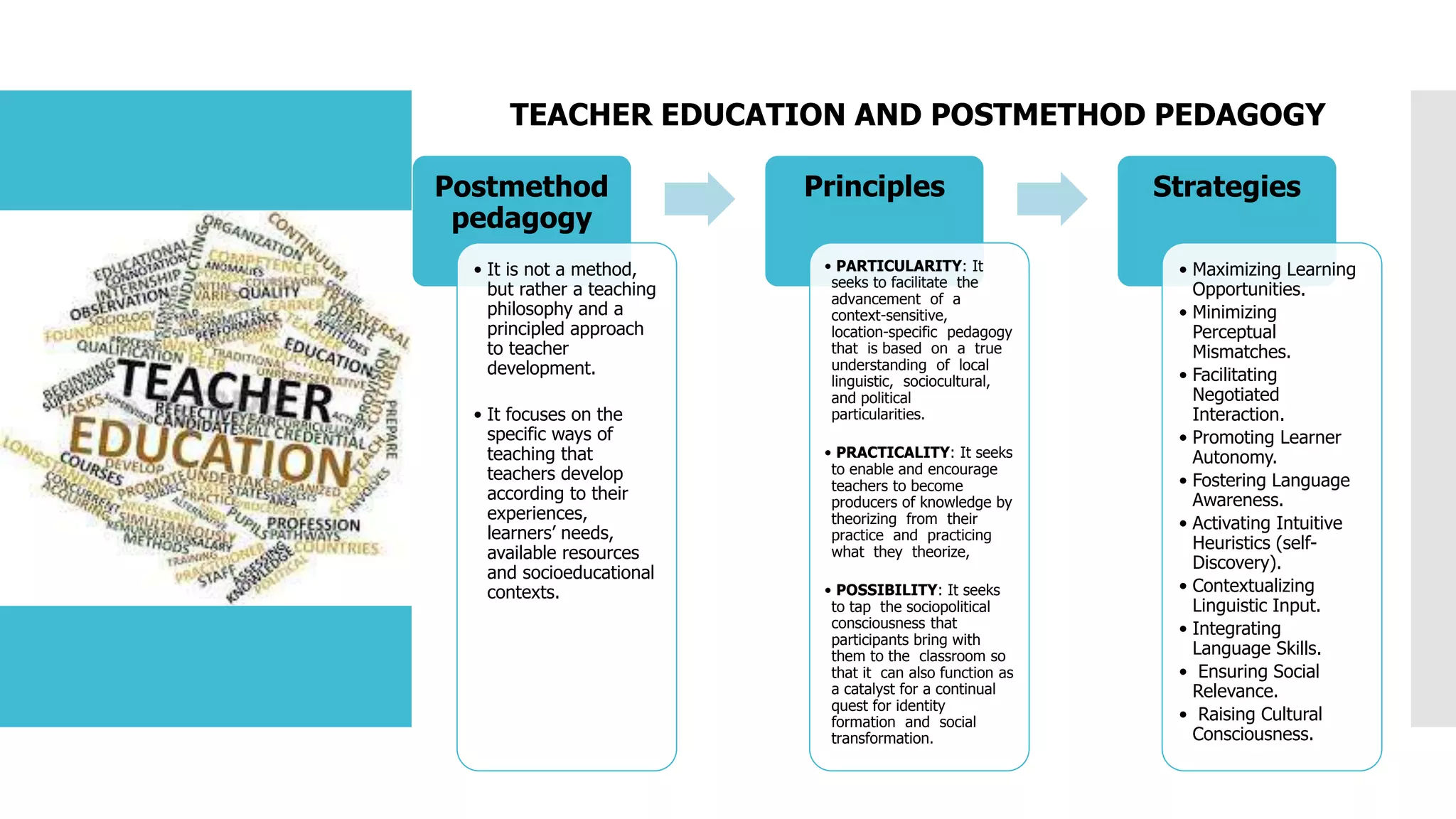
TEACHER EDUCATION AND POSTMETHOD PEDAGOGY
Postmethod
pedagogy
• It is not a method,
but rather a teaching
philosophy and a
principled approach
to teacher
development.
• It focuses on the
specific ways of
teaching that
teachers develop
according to their
experiences,
learners’ needs,
available resources
and socioeducational
contexts.
Principles
• PARTICULARITY: It
seeks to facilitate the
advancement of a
context-sensitive,
location-specific pedagogy
that is based on a true
understanding of local
linguistic, sociocultural,
and political
particularities.
• PRACTICALITY: It seeks
to enable and encourage
teachers to become
producers of knowledge by
theorizing from their
practice and practicing
what they theorize,
• POSSIBILITY: It seeks
to tap the sociopolitical
consciousness that
participants bring with
them to the classroom so
that it can also function as
a catalyst for a continual
quest for identity
formation and social
transformation.
Strategies
• Maximizing Learning
Opportunities.
• Minimizing
Perceptual
Mismatches.
• Facilitating
Negotiated
Interaction.
• Promoting Learner
Autonomy.
• Fostering Language
Awareness.
• Activating Intuitive
Heuristics (self-
Discovery).
• Contextualizing
Linguistic Input.
• Integrating
Language Skills.
• Ensuring Social
Relevance.
• Raising Cultural
Consciousness.
TEACHER EDUCATION AND POSTMETHOD PEDAGOGY
To what extent do you agree or disagree with the following statements? Why?
 The success of teaching English as a foreign language is mainly related to
teachers’ language level and their command over the latest teaching
methods.
 Teacher education in EFL should focus not only on communicative and
methodological competences, but also on human decision making in
complex, dynamic social settings.
 Student teachers in EFL programs need to commit to constructing their
knowledge, using inquiry-based strategies and critically reflecting on their
perspectives.
References
Kumaravadively, B. (2002). Beyond methods: Macrostrategies for language
teaching. Yale university press.
Kumaravadivelu, B. (2001). Toward a Postmethod pedagogy. TESOL
QUARTERLY, 35(4), 537-560.
Fandiño, J. (2011). English teacher training programs focused on reflection.
Educación y Educadores, 14(2), 269-285.
Shafeie, S. (2016). Towards a post method pedagogy [online]. Available at
https://www.slideshare.net/SamanehShafeie/toward-a-post-method-pedagogy

Reconceptualizing ELT from the postmethod pedagogy

  • 1.
    Reconceptualizing ELT: Principles, strategies,and reflection from postmethodpedagogy Yamith José Fandiño Parra September 2020
  • 2.
    INTRODUCTION Teachers can changelives with just the right mix of chalk and challenges. – Joyce Meyer I like a teacher who gives you something to take home to think about besides homework. – Lily Tomlin  How do you interpret these two quotes? What do they say about teachers and their work?  Based on these quotes, what do you think teacher education in ELT should incorporate or involve?
  • 3.
    TEACHER EDUCATION ANDPOSTMETHOD PEDAGOGY Postmethod pedagogy • It is not a method, but rather a teaching philosophy and a principled approach to teacher development. • It focuses on the specific ways of teaching that teachers develop according to their experiences, learners’ needs, available resources and socioeducational contexts. Principles • PARTICULARITY: It seeks to facilitate the advancement of a context-sensitive, location-specific pedagogy that is based on a true understanding of local linguistic, sociocultural, and political particularities. • PRACTICALITY: It seeks to enable and encourage teachers to become producers of knowledge by theorizing from their practice and practicing what they theorize, • POSSIBILITY: It seeks to tap the sociopolitical consciousness that participants bring with them to the classroom so that it can also function as a catalyst for a continual quest for identity formation and social transformation. Strategies • Maximizing Learning Opportunities. • Minimizing Perceptual Mismatches. • Facilitating Negotiated Interaction. • Promoting Learner Autonomy. • Fostering Language Awareness. • Activating Intuitive Heuristics (self- Discovery). • Contextualizing Linguistic Input. • Integrating Language Skills. • Ensuring Social Relevance. • Raising Cultural Consciousness.
  • 4.
    TEACHER EDUCATION ANDPOSTMETHOD PEDAGOGY
  • 5.
    TEACHER EDUCATION ANDPOSTMETHOD PEDAGOGY
  • 6.
    TEACHER EDUCATION ANDPOSTMETHOD PEDAGOGY
  • 7.
    TEACHER EDUCATION ANDPOSTMETHOD PEDAGOGY
  • 8.
    TEACHER EDUCATION ANDPOSTMETHOD PEDAGOGY
  • 9.
    TEACHER EDUCATION ANDPOSTMETHOD PEDAGOGY
  • 10.
    TEACHER EDUCATION ANDPOSTMETHOD PEDAGOGY
  • 11.
    TEACHER EDUCATION ANDPOSTMETHOD PEDAGOGY To what extent do you agree or disagree with the following statements? Why?  The success of teaching English as a foreign language is mainly related to teachers’ language level and their command over the latest teaching methods.  Teacher education in EFL should focus not only on communicative and methodological competences, but also on human decision making in complex, dynamic social settings.  Student teachers in EFL programs need to commit to constructing their knowledge, using inquiry-based strategies and critically reflecting on their perspectives.
  • 12.
    References Kumaravadively, B. (2002).Beyond methods: Macrostrategies for language teaching. Yale university press. Kumaravadivelu, B. (2001). Toward a Postmethod pedagogy. TESOL QUARTERLY, 35(4), 537-560. Fandiño, J. (2011). English teacher training programs focused on reflection. Educación y Educadores, 14(2), 269-285. Shafeie, S. (2016). Towards a post method pedagogy [online]. Available at https://www.slideshare.net/SamanehShafeie/toward-a-post-method-pedagogy