Systems of the language 1
                                             Grammar


  Action Research Project
Joanne Abos-Padilla Velásquez
    Andrea Castillo Bilchi
   Lorena Salazar Betancur
     Diego Ulloa Iglesias
  Profesora: Roxanna Correa
         DID0412-1
       May 4th, 2011
Systems of the language 2
                                                                                     Grammar

                                         Introduction


         The following essay is going to contrast an observed class with the theory itself from a
grammar class. All this comparison is going to be presented according to an interview asked to
the teacher who carried out the observed grammar class. The topics evaluated were the
following: if the approach used must be inductive or deductive; if in a CLT classroom should be
grammatical explanations and technical terminology; at the moment of teaching grammar
must students have grammar only classes?; if teachers must correct grammatical errors; which
strategies are best for learning grammar; which sequence does the teacher use to conduct his
or her class; seventh, which drills (meaningful, mechanical, communicative) does the teacher
use. The results of this project are given contrasting an interview of the teacher observed and
the observation of the class. Besides, was compared with the theory in the analysis part of this
essay.
Systems of the language 3
                                                                                    Grammar

                                      Theoretical Issues


        Harmer (1983) states that “the grammar of the language is the description of the ways
in which words can change their forms and can be combined into sentences in that language.”
If grammar rules are too carelessly violated, communication may suffer” (p.12) In the English
grammatical system, a sentence can be transformed, structured and formulated. The
knowledge of combining small units to make a sentence is called competence, and its
realization is called performance. On the other hand, Newmark (1975) refers to grammar as
“neither necessary nor sufficient for learning to use a language.” (p. 165) we need grammar in
order to learn how English is used, but is not enough. It is also necessary vocabulary and
pronunciation, and the three systems are equally important in the English learning process.
According to Thornbury (1999) a deductive approach is the one that ‘’starts with the
presentation of a rule and is followed by examples in which the rule is applied’’. Meanwhile an
Inductive approach ‘’starts with some examples from which a rule is inferred’’(P.29) Deductive
approach is more related to grammar translation, which is commonly taught in the student’s
mother tongue what is not good at all because leads the students to have almost no
opportunities to practice the foreign language they are learning.        On the other hand,
Thornbury (1999) refers to the deductive approach as something not necessarily dependent
on translation; there are many student grammar practice books that have all exercises and
explanations in English. The Inductive approach is basically the way in which students discover
by themselves the rules through examples. It requires the students to be exposed to certain
examples first, to then comprehend the rules. According to Thornbury (1999) is also called
‘’learning through experience’’. (P.29) Grammar goes beyond than just structured sentences; it
helps people to comprehend better a specific language. According to Littlewood (N.D.),
grammar has three important reasons to be:
            1. The use of grammar makes the communication among people socially
                acceptable.

            2. Grammar lead people to talk about decontextualized things, it means to talk
                about things that probable are not present in the specific moment of the
                conversation.

            3. Littlewood (N.D.) states that ‘’Grammar enables speakers to convey messages
                that are more subtle and abstract than would otherwise be possible’’. (P. 5)
Systems of the language 4
                                                                                      Grammar

        Grammatical errors are commonly done by students, especially when students are
learning a second or foreign language. For teachers the first step is to identify student’s errors
then to classify them into different types such as lexical, grammatical, discourse and
pronunciation errors. One of the most important things about correcting errors is how to
correct students. Thornbury (1999) states that it is known that few people like being wrong,
not many people like being corrected either, therefore it is very important in the way that
teachers correct students, furthermore we know that there seems to be no way of learning a
language without being wrong. Thornbury (1999) argues that there is the case of the
negative feedback that is just saying that the student is wrong, what can provoke a de-
motivation in the student development, meanwhile there also exist the ambiguous feedback
from the teachers that can cause a misunderstanding in the students, because probably they
won’t know if they are wrong or not, and finally there are also the positive feedback in which
the students are told that they are doing right.


        According to Brown (2000) grammar lessons must not be taught as a discrete skill
because they require the grammatical techniques into general language courses. The class
must be a general language class with some grammatical techniques to support the language.
In some conditions, grammar only classes can give to grammar a useful function. Some of
these conditions are when the grammar class is in the program of the class, it is used in
context to make meaningful language or in the performances of the students outside the
grammar only classes. The strategies than can be useful in the learning grammar process
according to The National Capital Language Resource Center, Washington, DC (2003-2004) are:
“relate knowledge needs to learning goals”, where it is important to identify the declarative
and procedural knowledge in order to recognize to which goal students are referring to. “Apply
higher order thinking skills”, here it is important to teach students the way in which the
language works because this gives them the chances to equate it with other languages that
they know. It would help them to create a critical thinking and analytical skills to comprehend
the language. When we “provide plentiful, appropriate language input”, is necessary to have in
mind that students use procedural and declarative knowledge. Therefore students must be
aware of the relationships that exist among from, meaning and use of some grammar rules.
According to the strategy “use predicting skills”, students must focus in which type of
communication task they are being given. It means to have a look at the tenses uses, the
sentence structure and length and all patterns that can contribute to make some
communicative task different to another. In the “limit expectations for drills”, The mechanical
Systems of the language 5
                                                                                      Grammar

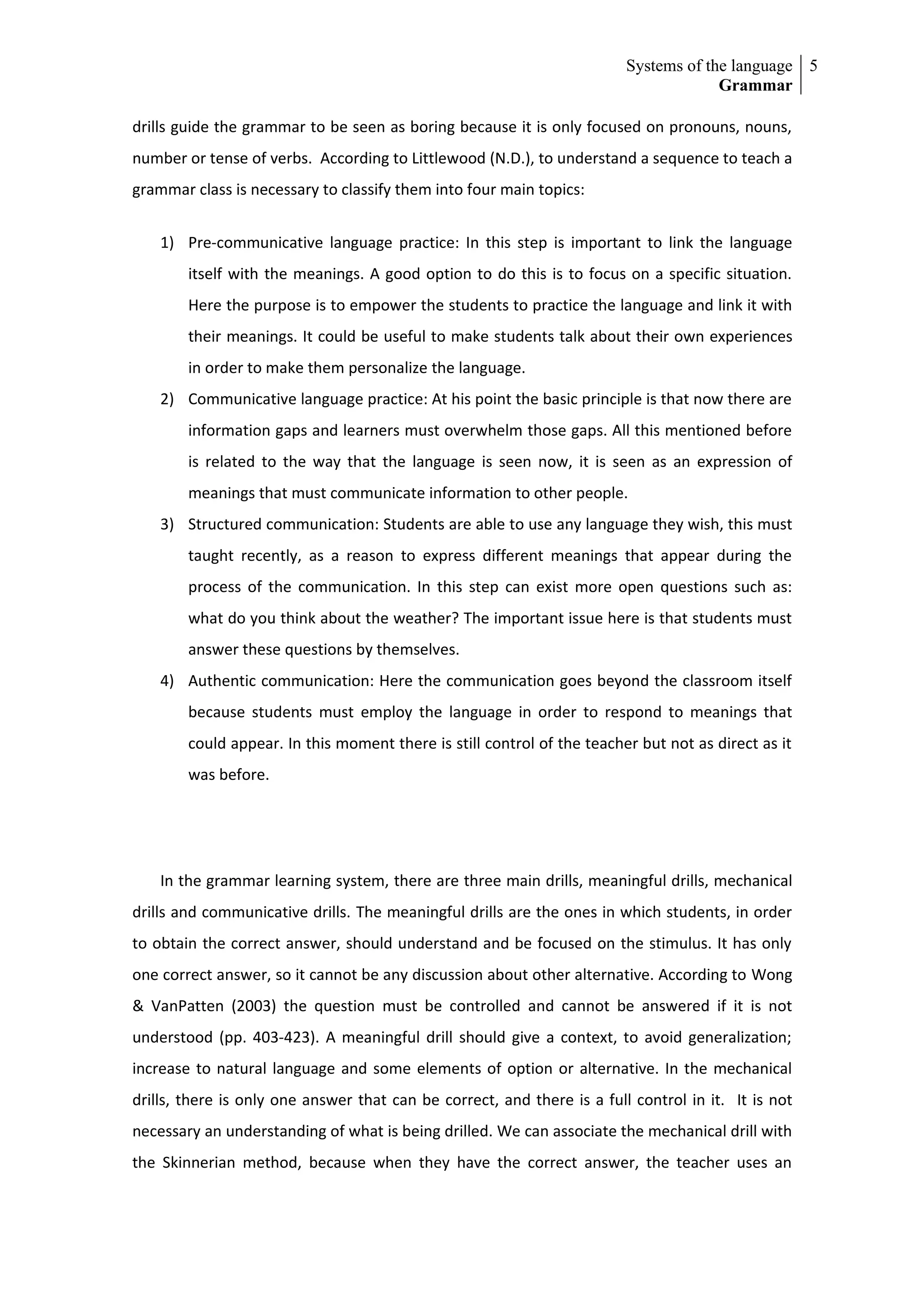
drills guide the grammar to be seen as boring because it is only focused on pronouns, nouns,
number or tense of verbs. According to Littlewood (N.D.), to understand a sequence to teach a
grammar class is necessary to classify them into four main topics:


    1) Pre-communicative language practice: In this step is important to link the language
        itself with the meanings. A good option to do this is to focus on a specific situation.
        Here the purpose is to empower the students to practice the language and link it with
        their meanings. It could be useful to make students talk about their own experiences
        in order to make them personalize the language.
    2) Communicative language practice: At his point the basic principle is that now there are
        information gaps and learners must overwhelm those gaps. All this mentioned before
        is related to the way that the language is seen now, it is seen as an expression of
        meanings that must communicate information to other people.
    3) Structured communication: Students are able to use any language they wish, this must
        taught recently, as a reason to express different meanings that appear during the
        process of the communication. In this step can exist more open questions such as:
        what do you think about the weather? The important issue here is that students must
        answer these questions by themselves.
    4) Authentic communication: Here the communication goes beyond the classroom itself
        because students must employ the language in order to respond to meanings that
        could appear. In this moment there is still control of the teacher but not as direct as it
        was before.


    In the grammar learning system, there are three main drills, meaningful drills, mechanical
drills and communicative drills. The meaningful drills are the ones in which students, in order
to obtain the correct answer, should understand and be focused on the stimulus. It has only
one correct answer, so it cannot be any discussion about other alternative. According to Wong
& VanPatten (2003) the question must be controlled and cannot be answered if it is not
understood (pp. 403-423). A meaningful drill should give a context, to avoid generalization;
increase to natural language and some elements of option or alternative. In the mechanical
drills, there is only one answer that can be correct, and there is a full control in it. It is not
necessary an understanding of what is being drilled. We can associate the mechanical drill with
the Skinnerian method, because when they have the correct answer, the teacher uses an
Systems of the language 6
                                                                                    Grammar

automatic reinforcement in order to learn the word as a habit. Fernando Rubio, Amber Passey
and Selene Campbell states that “one can substitute words from the drill with no sense words
and still be able to complete it correctly” (2004) In the communicative drills we can have more
than one correct answer, but the grammatical structures must be formed in a correct way. The
grammar we learn must be transfer to the suitable context or situations. Not all the
participants know the answer. The communicative drill is a good situation to practice real
English, but produces a lack of motivation to comprehend the meaning because the phrases
the students practice are not created by themselves.
Systems of the language 7
                                                                                   Grammar


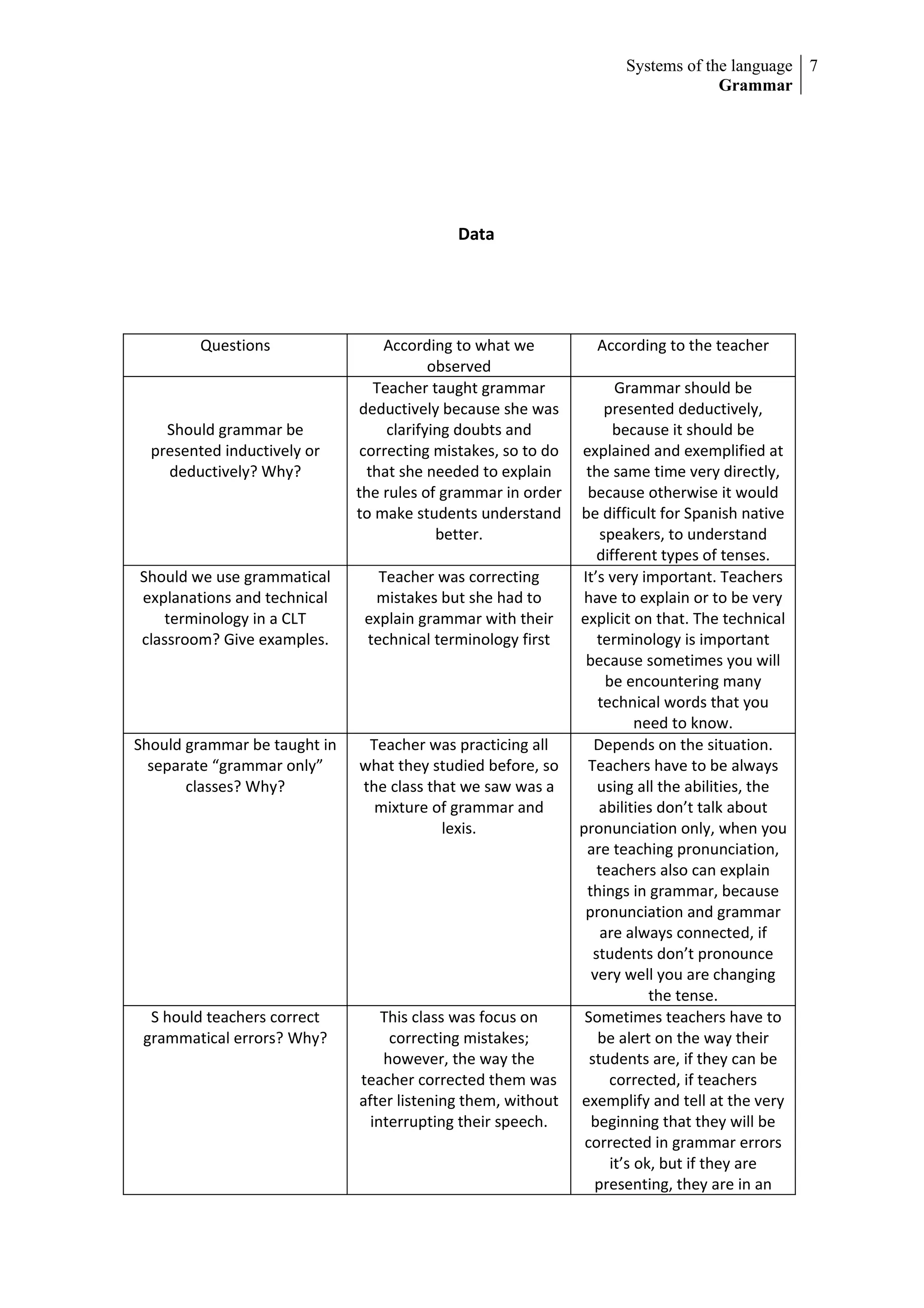
                                            Data


         Questions                According to what we           According to the teacher
                                          observed
                                 Teacher taught grammar                Grammar should be
                              deductively because she was            presented deductively,
    Should grammar be              clarifying doubts and               because it should be
  presented inductively or     correcting mistakes, so to do   explained and exemplified at
    deductively? Why?           that she needed to explain      the same time very directly,
                              the rules of grammar in order     because otherwise it would
                              to make students understand      be difficult for Spanish native
                                           better.                 speakers, to understand
                                                                   different types of tenses.
Should we use grammatical        Teacher was correcting        It’s very important. Teachers
explanations and technical      mistakes but she had to         have to explain or to be very
   terminology in a CLT        explain grammar with their      explicit on that. The technical
classroom? Give examples.      technical terminology first         terminology is important
                                                                because sometimes you will
                                                                     be encountering many
                                                                   technical words that you
                                                                           need to know.
Should grammar be taught in    Teacher was practicing all         Depends on the situation.
  separate “grammar only”     what they studied before, so      Teachers have to be always
       classes? Why?          the class that we saw was a          using all the abilities, the
                                mixture of grammar and             abilities don’t talk about
                                          lexis.               pronunciation only, when you
                                                                are teaching pronunciation,
                                                                   teachers also can explain
                                                                things in grammar, because
                                                                pronunciation and grammar
                                                                    are always connected, if
                                                                  students don’t pronounce
                                                                 very well you are changing
                                                                             the tense.
  S hould teachers correct        This class was focus on       Sometimes teachers have to
 grammatical errors? Why?          correcting mistakes;            be alert on the way their
                                  however, the way the           students are, if they can be
                              teacher corrected them was              corrected, if teachers
                              after listening them, without    exemplify and tell at the very
                                interrupting their speech.       beginning that they will be
                                                                corrected in grammar errors
                                                                      it’s ok, but if they are
                                                                  presenting, they are in an
Systems of the language 8
                                                                                            Grammar

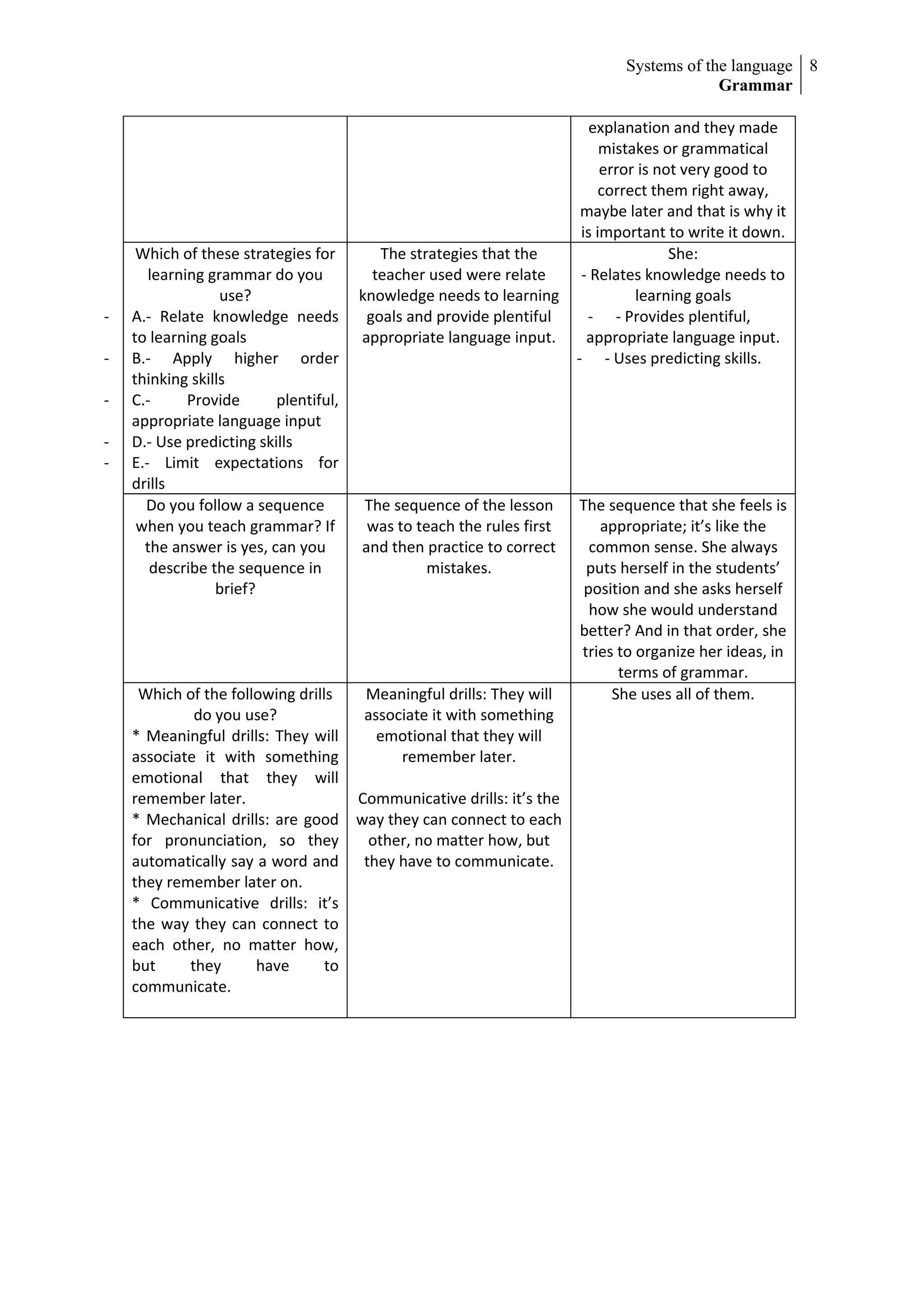
                                                                           explanation and they made
                                                                             mistakes or grammatical
                                                                             error is not very good to
                                                                             correct them right away,
                                                                         maybe later and that is why it
                                                                         is important to write it down.
     Which of these strategies for        The strategies that the                       She:
       learning grammar do you           teacher used were relate        - Relates knowledge needs to
                  use?                 knowledge needs to learning                learning goals
-   A.- Relate knowledge needs          goals and provide plentiful       - - Provides plentiful,
    to learning goals                  appropriate language input.        appropriate language input.
-   B.- Apply higher order                                              - - Uses predicting skills.
    thinking skills
-   C.-      Provide      plentiful,
    appropriate language input
-   D.- Use predicting skills
-   E.- Limit expectations for
    drills
      Do you follow a sequence         The sequence of the lesson       The sequence that she feels is
     when you teach grammar? If         was to teach the rules first       appropriate; it’s like the
      the answer is yes, can you       and then practice to correct       common sense. She always
       describe the sequence in                  mistakes.               puts herself in the students’
                 brief?                                                  position and she asks herself
                                                                          how she would understand
                                                                        better? And in that order, she
                                                                        tries to organize her ideas, in
                                                                              terms of grammar.
     Which of the following drills      Meaningful drills: They will         She uses all of them.
             do you use?                associate it with something
    * Meaningful drills: They will        emotional that they will
    associate it with something              remember later.
    emotional that they will
    remember later.                    Communicative drills: it’s the
    * Mechanical drills: are good      way they can connect to each
    for pronunciation, so they           other, no matter how, but
    automatically say a word and        they have to communicate.
    they remember later on.
    * Communicative drills: it’s
    the way they can connect to
    each other, no matter how,
    but     they      have       to
    communicate.
Systems of the language 9
                                                                                       Grammar


                                              Analysis


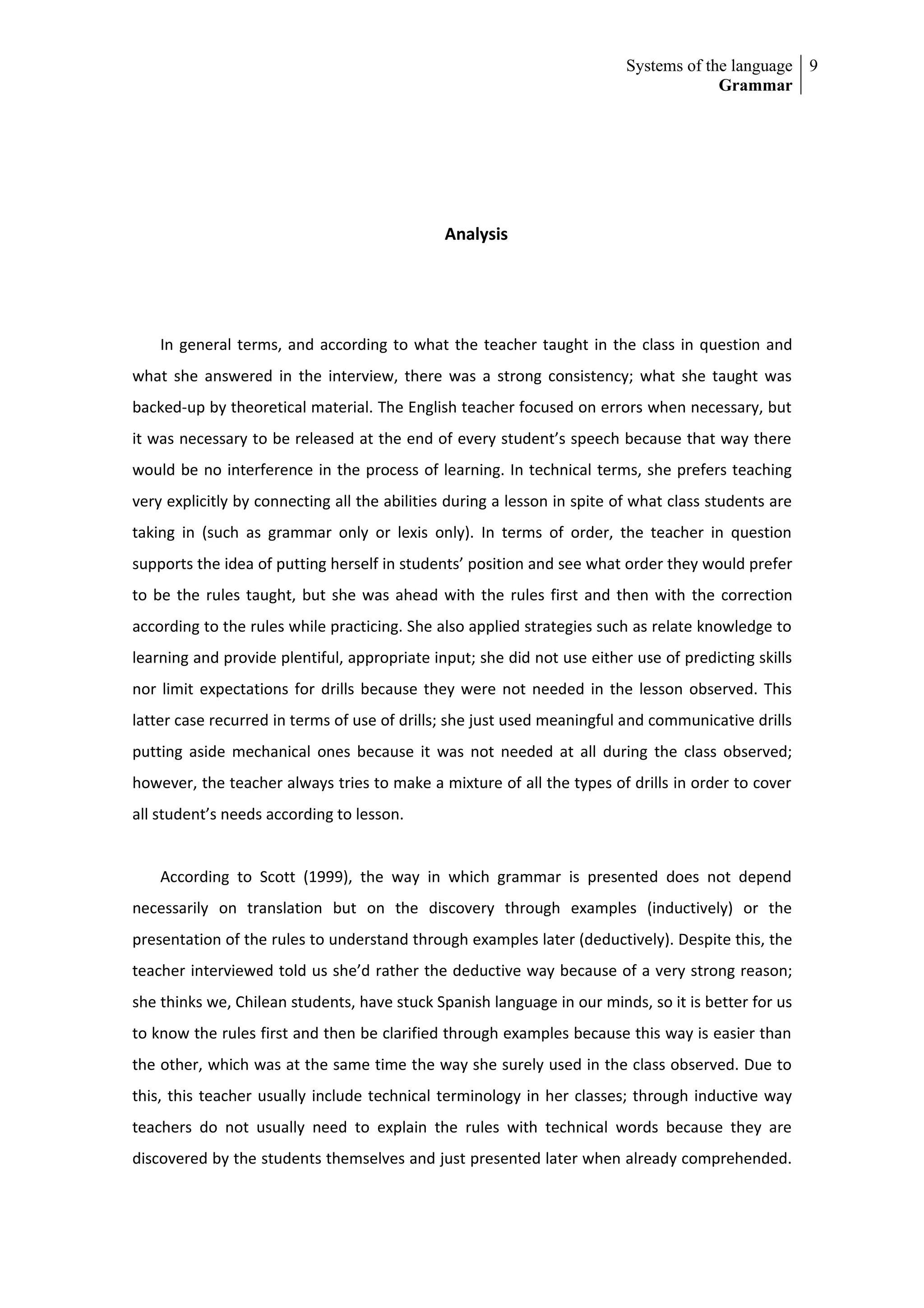
    In general terms, and according to what the teacher taught in the class in question and
what she answered in the interview, there was a strong consistency; what she taught was
backed-up by theoretical material. The English teacher focused on errors when necessary, but
it was necessary to be released at the end of every student’s speech because that way there
would be no interference in the process of learning. In technical terms, she prefers teaching
very explicitly by connecting all the abilities during a lesson in spite of what class students are
taking in (such as grammar only or lexis only). In terms of order, the teacher in question
supports the idea of putting herself in students’ position and see what order they would prefer
to be the rules taught, but she was ahead with the rules first and then with the correction
according to the rules while practicing. She also applied strategies such as relate knowledge to
learning and provide plentiful, appropriate input; she did not use either use of predicting skills
nor limit expectations for drills because they were not needed in the lesson observed. This
latter case recurred in terms of use of drills; she just used meaningful and communicative drills
putting aside mechanical ones because it was not needed at all during the class observed;
however, the teacher always tries to make a mixture of all the types of drills in order to cover
all student’s needs according to lesson.


    According to Scott (1999), the way in which grammar is presented does not depend
necessarily on translation but on the discovery through examples (inductively) or the
presentation of the rules to understand through examples later (deductively). Despite this, the
teacher interviewed told us she’d rather the deductive way because of a very strong reason;
she thinks we, Chilean students, have stuck Spanish language in our minds, so it is better for us
to know the rules first and then be clarified through examples because this way is easier than
the other, which was at the same time the way she surely used in the class observed. Due to
this, this teacher usually include technical terminology in her classes; through inductive way
teachers do not usually need to explain the rules with technical words because they are
discovered by the students themselves and just presented later when already comprehended.
Systems of the language 10
                                                                                    Grammar

According to what Scott states, the correction of errors during a lesson will depend on each
student, so teachers should be careful when correcting them. At the same time he also states
that there are three type of correcting: positive, ambiguous and negative which can be either
negative or positive depending on the teacher criteria, and which, in this case, the teacher has
chosen right for Scott; she told us it will depend on the aim of the lesson and also on the
students. Following the same line, and according to the results of the interview, we could state
that the teacher in question believes that almost the entire class is conditional upon students,
i.e.; the way of the grammar class is presented will depend on the way of learning of each
student.
Systems of the language 11
                                                                                       Grammar


                                             Conclusion


    The grammar system is very controversial because there are many ways to teach it. We
can teach it deductively or inductively, correcting the mistakes or not correcting them, with
three different drills, such as mechanical, meaningful and communicative, and with different
sequences, according to the teacher’s methodology to teach and the students’ way of learning.
In the class observed, we noticed that the teacher followed the theory given by many authors
in many ways. The teacher focused her attention in the students’ errors when it was
necessary, because it is important for her not to have interference in the students’ learning
process. She used all the possible strategies in the lesson and she asked her students their
opinion, putting herself in students’ position. She applied many strategies as well as drillings in
the practice, and she also told us in the interview all the strategies and drills she used in the
class. She used deductive learning because students have always Spanish language in their
minds and they need to know the rules and then practice with examples. The author’s theory,
as well as the teacher’s class and interview were related in many ways that is why this class is
successful with beginners in English language.
Systems of the language 12
                                                                               Grammar


                                       References


-   Brown, D. (2000). How to plan a lesson. Teaching by Principles: an interactive
    approach to language pedagogy. Logman.

-   Harmer, J. (1983). Describing the language: Grammar. The Practice of English
    Language Teaching, Logman. (pp. 12-16)


-   Littlewood, W. (N.D.) Grammar in a communicative approach. English Centre,
    University        of       Hong         Kong.        Retrieved      from:
    www.edb.gov.hk/FileManager/EN/.../grammar_communicative.doc


-    Newmark, L. (1979) ‘How not to interfere with language learning’ in Brumfit, C.J. and
    Johnson, K. (eds.) The Communicative Approach to Language Teaching, Oxford
    University Press, (pp.165)

-   Power, T. The Cognitive Approach. English language teaching & Brighton's local
    history. (N.D.) Retrieved from http://www.btinternet.com/~ted.power/esl0312.html


-   Rubio, F; Passey, A & Campbell S. (2004) Grammar in Disguise: The hidden agenda of
    communicative language teaching textbooks RAEL - Revista Electrónica de Lingüística
    Aplicada     3,    Universidad     de     Utah,    p.158-176.  Retrieved  from     :
    dialnet.unirioja.es/servlet/fichero_articulo?articulo=1396249&orden=28335


-   The National Capital Language Resource Center, Washington, DC (N.D) Strategies for
    learning grammar. The essentials of language teaching. Retrieved from:
    http://www.nclrc.org/essentials/grammar/stratgram.htm


-   Thornbury, S. (1999) How to teach Grammar. Logman.

-   Ur, P. (1996). Teaching grammar. A Course in Language Teaching (pp. 30-35). England:
    Cambridge University Press.
Systems of the language 13
                                                                        Grammar

-   Wong, W. & VanPatten, B. (2003). The evidence is IN: Drills are OUT.   Foreign
    Language Annals, 36, (pp.403-423)

Action Research Project

  • 1.
    Systems of thelanguage 1 Grammar Action Research Project Joanne Abos-Padilla Velásquez Andrea Castillo Bilchi Lorena Salazar Betancur Diego Ulloa Iglesias Profesora: Roxanna Correa DID0412-1 May 4th, 2011
  • 2.
    Systems of thelanguage 2 Grammar Introduction The following essay is going to contrast an observed class with the theory itself from a grammar class. All this comparison is going to be presented according to an interview asked to the teacher who carried out the observed grammar class. The topics evaluated were the following: if the approach used must be inductive or deductive; if in a CLT classroom should be grammatical explanations and technical terminology; at the moment of teaching grammar must students have grammar only classes?; if teachers must correct grammatical errors; which strategies are best for learning grammar; which sequence does the teacher use to conduct his or her class; seventh, which drills (meaningful, mechanical, communicative) does the teacher use. The results of this project are given contrasting an interview of the teacher observed and the observation of the class. Besides, was compared with the theory in the analysis part of this essay.
  • 3.
    Systems of thelanguage 3 Grammar Theoretical Issues Harmer (1983) states that “the grammar of the language is the description of the ways in which words can change their forms and can be combined into sentences in that language.” If grammar rules are too carelessly violated, communication may suffer” (p.12) In the English grammatical system, a sentence can be transformed, structured and formulated. The knowledge of combining small units to make a sentence is called competence, and its realization is called performance. On the other hand, Newmark (1975) refers to grammar as “neither necessary nor sufficient for learning to use a language.” (p. 165) we need grammar in order to learn how English is used, but is not enough. It is also necessary vocabulary and pronunciation, and the three systems are equally important in the English learning process. According to Thornbury (1999) a deductive approach is the one that ‘’starts with the presentation of a rule and is followed by examples in which the rule is applied’’. Meanwhile an Inductive approach ‘’starts with some examples from which a rule is inferred’’(P.29) Deductive approach is more related to grammar translation, which is commonly taught in the student’s mother tongue what is not good at all because leads the students to have almost no opportunities to practice the foreign language they are learning. On the other hand, Thornbury (1999) refers to the deductive approach as something not necessarily dependent on translation; there are many student grammar practice books that have all exercises and explanations in English. The Inductive approach is basically the way in which students discover by themselves the rules through examples. It requires the students to be exposed to certain examples first, to then comprehend the rules. According to Thornbury (1999) is also called ‘’learning through experience’’. (P.29) Grammar goes beyond than just structured sentences; it helps people to comprehend better a specific language. According to Littlewood (N.D.), grammar has three important reasons to be: 1. The use of grammar makes the communication among people socially acceptable. 2. Grammar lead people to talk about decontextualized things, it means to talk about things that probable are not present in the specific moment of the conversation. 3. Littlewood (N.D.) states that ‘’Grammar enables speakers to convey messages that are more subtle and abstract than would otherwise be possible’’. (P. 5)
  • 4.
    Systems of thelanguage 4 Grammar Grammatical errors are commonly done by students, especially when students are learning a second or foreign language. For teachers the first step is to identify student’s errors then to classify them into different types such as lexical, grammatical, discourse and pronunciation errors. One of the most important things about correcting errors is how to correct students. Thornbury (1999) states that it is known that few people like being wrong, not many people like being corrected either, therefore it is very important in the way that teachers correct students, furthermore we know that there seems to be no way of learning a language without being wrong. Thornbury (1999) argues that there is the case of the negative feedback that is just saying that the student is wrong, what can provoke a de- motivation in the student development, meanwhile there also exist the ambiguous feedback from the teachers that can cause a misunderstanding in the students, because probably they won’t know if they are wrong or not, and finally there are also the positive feedback in which the students are told that they are doing right. According to Brown (2000) grammar lessons must not be taught as a discrete skill because they require the grammatical techniques into general language courses. The class must be a general language class with some grammatical techniques to support the language. In some conditions, grammar only classes can give to grammar a useful function. Some of these conditions are when the grammar class is in the program of the class, it is used in context to make meaningful language or in the performances of the students outside the grammar only classes. The strategies than can be useful in the learning grammar process according to The National Capital Language Resource Center, Washington, DC (2003-2004) are: “relate knowledge needs to learning goals”, where it is important to identify the declarative and procedural knowledge in order to recognize to which goal students are referring to. “Apply higher order thinking skills”, here it is important to teach students the way in which the language works because this gives them the chances to equate it with other languages that they know. It would help them to create a critical thinking and analytical skills to comprehend the language. When we “provide plentiful, appropriate language input”, is necessary to have in mind that students use procedural and declarative knowledge. Therefore students must be aware of the relationships that exist among from, meaning and use of some grammar rules. According to the strategy “use predicting skills”, students must focus in which type of communication task they are being given. It means to have a look at the tenses uses, the sentence structure and length and all patterns that can contribute to make some communicative task different to another. In the “limit expectations for drills”, The mechanical
  • 5.
    Systems of thelanguage 5 Grammar drills guide the grammar to be seen as boring because it is only focused on pronouns, nouns, number or tense of verbs. According to Littlewood (N.D.), to understand a sequence to teach a grammar class is necessary to classify them into four main topics: 1) Pre-communicative language practice: In this step is important to link the language itself with the meanings. A good option to do this is to focus on a specific situation. Here the purpose is to empower the students to practice the language and link it with their meanings. It could be useful to make students talk about their own experiences in order to make them personalize the language. 2) Communicative language practice: At his point the basic principle is that now there are information gaps and learners must overwhelm those gaps. All this mentioned before is related to the way that the language is seen now, it is seen as an expression of meanings that must communicate information to other people. 3) Structured communication: Students are able to use any language they wish, this must taught recently, as a reason to express different meanings that appear during the process of the communication. In this step can exist more open questions such as: what do you think about the weather? The important issue here is that students must answer these questions by themselves. 4) Authentic communication: Here the communication goes beyond the classroom itself because students must employ the language in order to respond to meanings that could appear. In this moment there is still control of the teacher but not as direct as it was before. In the grammar learning system, there are three main drills, meaningful drills, mechanical drills and communicative drills. The meaningful drills are the ones in which students, in order to obtain the correct answer, should understand and be focused on the stimulus. It has only one correct answer, so it cannot be any discussion about other alternative. According to Wong & VanPatten (2003) the question must be controlled and cannot be answered if it is not understood (pp. 403-423). A meaningful drill should give a context, to avoid generalization; increase to natural language and some elements of option or alternative. In the mechanical drills, there is only one answer that can be correct, and there is a full control in it. It is not necessary an understanding of what is being drilled. We can associate the mechanical drill with the Skinnerian method, because when they have the correct answer, the teacher uses an
  • 6.
    Systems of thelanguage 6 Grammar automatic reinforcement in order to learn the word as a habit. Fernando Rubio, Amber Passey and Selene Campbell states that “one can substitute words from the drill with no sense words and still be able to complete it correctly” (2004) In the communicative drills we can have more than one correct answer, but the grammatical structures must be formed in a correct way. The grammar we learn must be transfer to the suitable context or situations. Not all the participants know the answer. The communicative drill is a good situation to practice real English, but produces a lack of motivation to comprehend the meaning because the phrases the students practice are not created by themselves.
  • 7.
    Systems of thelanguage 7 Grammar Data Questions According to what we According to the teacher observed Teacher taught grammar Grammar should be deductively because she was presented deductively, Should grammar be clarifying doubts and because it should be presented inductively or correcting mistakes, so to do explained and exemplified at deductively? Why? that she needed to explain the same time very directly, the rules of grammar in order because otherwise it would to make students understand be difficult for Spanish native better. speakers, to understand different types of tenses. Should we use grammatical Teacher was correcting It’s very important. Teachers explanations and technical mistakes but she had to have to explain or to be very terminology in a CLT explain grammar with their explicit on that. The technical classroom? Give examples. technical terminology first terminology is important because sometimes you will be encountering many technical words that you need to know. Should grammar be taught in Teacher was practicing all Depends on the situation. separate “grammar only” what they studied before, so Teachers have to be always classes? Why? the class that we saw was a using all the abilities, the mixture of grammar and abilities don’t talk about lexis. pronunciation only, when you are teaching pronunciation, teachers also can explain things in grammar, because pronunciation and grammar are always connected, if students don’t pronounce very well you are changing the tense. S hould teachers correct This class was focus on Sometimes teachers have to grammatical errors? Why? correcting mistakes; be alert on the way their however, the way the students are, if they can be teacher corrected them was corrected, if teachers after listening them, without exemplify and tell at the very interrupting their speech. beginning that they will be corrected in grammar errors it’s ok, but if they are presenting, they are in an
  • 8.
    Systems of thelanguage 8 Grammar explanation and they made mistakes or grammatical error is not very good to correct them right away, maybe later and that is why it is important to write it down. Which of these strategies for The strategies that the She: learning grammar do you teacher used were relate - Relates knowledge needs to use? knowledge needs to learning learning goals - A.- Relate knowledge needs goals and provide plentiful - - Provides plentiful, to learning goals appropriate language input. appropriate language input. - B.- Apply higher order - - Uses predicting skills. thinking skills - C.- Provide plentiful, appropriate language input - D.- Use predicting skills - E.- Limit expectations for drills Do you follow a sequence The sequence of the lesson The sequence that she feels is when you teach grammar? If was to teach the rules first appropriate; it’s like the the answer is yes, can you and then practice to correct common sense. She always describe the sequence in mistakes. puts herself in the students’ brief? position and she asks herself how she would understand better? And in that order, she tries to organize her ideas, in terms of grammar. Which of the following drills Meaningful drills: They will She uses all of them. do you use? associate it with something * Meaningful drills: They will emotional that they will associate it with something remember later. emotional that they will remember later. Communicative drills: it’s the * Mechanical drills: are good way they can connect to each for pronunciation, so they other, no matter how, but automatically say a word and they have to communicate. they remember later on. * Communicative drills: it’s the way they can connect to each other, no matter how, but they have to communicate.
  • 9.
    Systems of thelanguage 9 Grammar Analysis In general terms, and according to what the teacher taught in the class in question and what she answered in the interview, there was a strong consistency; what she taught was backed-up by theoretical material. The English teacher focused on errors when necessary, but it was necessary to be released at the end of every student’s speech because that way there would be no interference in the process of learning. In technical terms, she prefers teaching very explicitly by connecting all the abilities during a lesson in spite of what class students are taking in (such as grammar only or lexis only). In terms of order, the teacher in question supports the idea of putting herself in students’ position and see what order they would prefer to be the rules taught, but she was ahead with the rules first and then with the correction according to the rules while practicing. She also applied strategies such as relate knowledge to learning and provide plentiful, appropriate input; she did not use either use of predicting skills nor limit expectations for drills because they were not needed in the lesson observed. This latter case recurred in terms of use of drills; she just used meaningful and communicative drills putting aside mechanical ones because it was not needed at all during the class observed; however, the teacher always tries to make a mixture of all the types of drills in order to cover all student’s needs according to lesson. According to Scott (1999), the way in which grammar is presented does not depend necessarily on translation but on the discovery through examples (inductively) or the presentation of the rules to understand through examples later (deductively). Despite this, the teacher interviewed told us she’d rather the deductive way because of a very strong reason; she thinks we, Chilean students, have stuck Spanish language in our minds, so it is better for us to know the rules first and then be clarified through examples because this way is easier than the other, which was at the same time the way she surely used in the class observed. Due to this, this teacher usually include technical terminology in her classes; through inductive way teachers do not usually need to explain the rules with technical words because they are discovered by the students themselves and just presented later when already comprehended.
  • 10.
    Systems of thelanguage 10 Grammar According to what Scott states, the correction of errors during a lesson will depend on each student, so teachers should be careful when correcting them. At the same time he also states that there are three type of correcting: positive, ambiguous and negative which can be either negative or positive depending on the teacher criteria, and which, in this case, the teacher has chosen right for Scott; she told us it will depend on the aim of the lesson and also on the students. Following the same line, and according to the results of the interview, we could state that the teacher in question believes that almost the entire class is conditional upon students, i.e.; the way of the grammar class is presented will depend on the way of learning of each student.
  • 11.
    Systems of thelanguage 11 Grammar Conclusion The grammar system is very controversial because there are many ways to teach it. We can teach it deductively or inductively, correcting the mistakes or not correcting them, with three different drills, such as mechanical, meaningful and communicative, and with different sequences, according to the teacher’s methodology to teach and the students’ way of learning. In the class observed, we noticed that the teacher followed the theory given by many authors in many ways. The teacher focused her attention in the students’ errors when it was necessary, because it is important for her not to have interference in the students’ learning process. She used all the possible strategies in the lesson and she asked her students their opinion, putting herself in students’ position. She applied many strategies as well as drillings in the practice, and she also told us in the interview all the strategies and drills she used in the class. She used deductive learning because students have always Spanish language in their minds and they need to know the rules and then practice with examples. The author’s theory, as well as the teacher’s class and interview were related in many ways that is why this class is successful with beginners in English language.
  • 12.
    Systems of thelanguage 12 Grammar References - Brown, D. (2000). How to plan a lesson. Teaching by Principles: an interactive approach to language pedagogy. Logman. - Harmer, J. (1983). Describing the language: Grammar. The Practice of English Language Teaching, Logman. (pp. 12-16) - Littlewood, W. (N.D.) Grammar in a communicative approach. English Centre, University of Hong Kong. Retrieved from: www.edb.gov.hk/FileManager/EN/.../grammar_communicative.doc - Newmark, L. (1979) ‘How not to interfere with language learning’ in Brumfit, C.J. and Johnson, K. (eds.) The Communicative Approach to Language Teaching, Oxford University Press, (pp.165) - Power, T. The Cognitive Approach. English language teaching & Brighton's local history. (N.D.) Retrieved from http://www.btinternet.com/~ted.power/esl0312.html - Rubio, F; Passey, A & Campbell S. (2004) Grammar in Disguise: The hidden agenda of communicative language teaching textbooks RAEL - Revista Electrónica de Lingüística Aplicada 3, Universidad de Utah, p.158-176. Retrieved from : dialnet.unirioja.es/servlet/fichero_articulo?articulo=1396249&orden=28335 - The National Capital Language Resource Center, Washington, DC (N.D) Strategies for learning grammar. The essentials of language teaching. Retrieved from: http://www.nclrc.org/essentials/grammar/stratgram.htm - Thornbury, S. (1999) How to teach Grammar. Logman. - Ur, P. (1996). Teaching grammar. A Course in Language Teaching (pp. 30-35). England: Cambridge University Press.
  • 13.
    Systems of thelanguage 13 Grammar - Wong, W. & VanPatten, B. (2003). The evidence is IN: Drills are OUT. Foreign Language Annals, 36, (pp.403-423)