GSM Vs. CDMA
An Overview
Bhushan G. Jagyasi
Lecturer, Elex & Tele Comm Dept.
Thadomal Shahani Engineering College
Classification Of Existing Systems
Technologies
TDMA/FDMA CDMA
GSM (European Standard)
IS 136 (U.S Standard)
PDC (Japnese Standard)
IS 95 (U.S Standard)
Evolution Chart
Years
Service type
Multi
media
Voice
Analog
AMPS
Digital
IS 95
IS 136
GSM
IMT
2000
Wireless
Internet
Mobile
system
~ 24kbps ~64kbps ~2Mbps ~20Mbps
1980 1990 2000 2010
1G 2G 3G
4G
Narrow Band Wide Band
Broad Band
Access technology
Time Time Time
Freq Freq Freq
PN Code
FDMA TDMA CDMA
Comparison BetweenTechnologies
Digital
Mobile
technology
User’s
Dec-02
User’s
Dec-03
Growth
in2003
% Growth Share Of
Growth
CDMA 145.2 181.0 35.4 24.3% 15.6%
GSM 790.5 970.8 180.3 22.8% 79.5%
PDC 60.1 63.1 3.0 5.0% 1.3%
TDMA 107.4 113.0 5.5 5.1% 2.4%
3 GSM
(W CDMA)
0.2 2.8 2.6 1708.5% 1.2%
GLOBAL
USER
BASE
1103.7 1330.6 226.9 20.69% 100%
GSM
An Overview
GSM
The European TDMA Digital Cellular Standard
• Services Provided By GSM
1. Telephony
- Basic Teleservice
2. Other Services
-Emergency calling
-Voice Messaging
GSM
The European TDMA Digital Cellular Standard
Services Provided By GSM (Cont..)
3. Bearer Services
- Low Speed data transfer (upto 9.6 Kbps)
-Group 3 Fax and Sms
4. Suplementary Services
- call offering , call forwarding, call restriction,
call waiting, call hold.
- Multiparty teleconferencing, special schemes
GSM
The European TDMA Digital Cellular Standard
• General Architecture Of GSM
ME
SIMSIM
BTSBTS
BTSBTS
BSCBSC
BSCBSC
MSC
VLR
EIR
HLR
AuC
AUm
Abis
PSTN,
ISDN
Mobile
station
Base Station
Subsystem
Network
Subsystem
MS BSS NS
GSM
The European TDMA Digital Cellular Standard
• Mobile Station (MS): Two Blocks
– Mobile Equipment (ME)
– Subscribers Identity Module (SIM)
Function of Mobile Station:
1. Personal Mobility
SIMSIM SIM
GSM
The European TDMA Digital Cellular Standard
Function of Mobile Station:
1. Personal Mobility
SIM SIMSIM SIM
GSM
The European TDMA Digital Cellular Standard
• Mobile Station (MS): Two Blocks
– Mobile Equipment (ME)
– Subscribers Identity Module (SIM)
Function of Mobile Station:
1. Personal Mobility
2. IMEI (International Mobile
Equipment Identity)
3. IMSI (International Mobile
Subscriber Identity)
GSM
The European TDMA Digital Cellular Standard
• Base Station Subsystem (BSS)
– Base Transceiver Station (BTS)
– Base Station Controller (BSC)
BSC
GSM
The European TDMA Digital Cellular Standard
BSC
BSC: Base station Controller
1. It manages radio resources for
one or more BTS.
2. Allocation and Deallocation of
channels.
3. Transmitter power control.
4. Handoff control
BTS : Base Tranceiver station
1. It defines the cell .
2. It handles the radio link protocol with the mobile station
GSM
The European TDMA Digital Cellular Standard
• Network Subsystem
– MSC: Mobile Switching Center
– HLR: Home Location Register
– VLR: Visitor Location register
– AuC: Authentication Center
– EIR: Equipment Identity Register
BSCBSC MSC
VLR
EIR
HLR
AuC
PSTN,
ISDN
GSM
The European TDMA Digital Cellular Standard
• Mobile Switching center:(MSC)
– call set up/supervision/release
– call routing
– billing information colllection
– mobility management
– paging, alerting, echo cancellation
– connection to BSC, other MSC and other local
exchange networks
– Access to HLR and VLR
GSM
The European TDMA Digital Cellular Standard
• Home Location Register (HLR)
– One HLR per GSM operator
– Contains permanent database of all the
subscribers in the network
– contains MSRN(mobile station routing no.)
– It is reffered for every incomming call
GSM
The European TDMA Digital Cellular Standard
• Visitor Location Register(VLR)
– Temporary visitors database
– One VLR per MSC
• Authentication Center(AuC)
– Provides security
– Authentication and encryption
• Equipment Identity Register:
– Contains IMEI
GSM
The European TDMA Digital Cellular Standard
BSC
BSC
MSC
MSC
VLR
VLR
HLR GMSC
PSTN.
ISDN
Location Update
GSM
The European TDMA Digital Cellular Standard
• Mobile call originating
BSC
BSC
MSC
MSC
VLR
VLR
HLR GMSC
PSTN.
ISDN
GSM
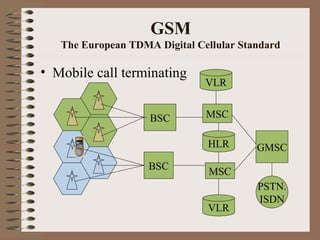
The European TDMA Digital Cellular Standard
• Mobile call terminating
BSC
BSC
MSC
MSC
VLR
VLR
HLR GMSC
PSTN.
ISDN
GSM
The European TDMA Digital Cellular Standard
• Handoff
BSCBSC BSC
MSC MSC
GMSC Handoff is of
3 types
1. Intra BSC
2 Inter BSC
3. Inter MSC
GSM
The European TDMA Digital Cellular Standard
• GSM Radio Aspects :
 Uplink(Mobile to base)
• 890-915 MHz (Total 25 MHz)
 Downlink ( Base to Mobile)
• 935-960 MHz (Total 25 MHz)
 Total 45 MHz spacing for duplex operation
 GSM uses TDMA and FDMA
GSM
The European TDMA Digital Cellular Standard
• GSM Using FDMA
Uplink Freq
890MHz 915Mhz
200KHz
1 2 3 4 5 124
Total Frequency range(Uplink)=25Mhz
Spacing between two carriers= 200kHz
No. of Carriers=25MHz/200KHz = 124
GSM
The European TDMA Digital Cellular Standard
• GSM Using TDMA
– TDMA Frame is divided into 8 time slots.
0 71 2 4 5
0 33 3 5 6 7
Time
Freq
Down
Link
carrier
Up Link
carrier
45MHz
200 KHz
Time slots
4.6 ms
0.57ms
3 6
5421
GSM
The European TDMA Digital Cellular Standard
• Classification of channels in GSM
• Two types
– Traffic channels (TCH)
– Control channels (CCH)
Channels are used to carry speech , data and
control information.
Traffic Channels are defined using 26 TDMA
frame multiframe.
GSM
The European TDMA Digital Cellular Standard
• Length of 26 TDMA frames = 120 msec
• Length of 1 TDMA frame =120/26
= 4.615 msec
• 1 TDMA frame consists of 8 burst frames
• Length of 1 burst frame = 0.577msec
• Out of 26 frames 
– 24 are TCH used for traffic
– 1 is SACCH used for control
– 1 is unused
GSM
The European TDMA Digital Cellular Standard
0 1 2 653 7
1 2 2524
4
0 10
3 57 57261
Data DataTraining
Tdma Frame
Frame Multiframe
Format of a single Burst
Duration=120ms
Duration=4.615ms
Duration=0.577ms
25
GSM
The European TDMA Digital Cellular Standard
• Speech coding
– Speech is digitized by PCM, o/p of PCM is
64Kb/s
– It is further reduced by Regular pulse excited-
Linear predictive coder, bit rate achieved
13kb/s for full rate (260 bits in 20 msec)
– Further encoded for error correction, 456 bits
per 20 msec, bit rate = 22.8 Kb/s
– 456 bits are divided into 8 blocks and
transmitted during 8 burst periods.
GSM
The European TDMA Digital Cellular Standard
• Classification of Channels
• 1 Traffic (TCH)
– Speech
• Full rate 22.8 kb/s
• Half rate 11.4 kb/s
– Data
• 9.6kb/s
• 4.8kb/s
• 2.4kb/s
GSM
The European TDMA Digital Cellular Standard
• 2 Control (CCH)
– Broadcast (BCCH)
• Freq correction (FCCH)
• Synchronization (SCH)
– Common (CCH)
• Paging (PCH)
• Access grant (AGCH)
• Random Access (RACH)
– Dedicated (DCCH)
• Fast Associative (FACCH)
• Slow Associative (SACCH)
• Stand alone (SDCCH)
GSM
The European TDMA Digital Cellular Standard
• GSM Security
A3 A8 A3 A8
EqualSRES
Kc
Ki Ki
Random no
Ki Ki
SRES
Kc
MS NETWORK
Code Division Multiple
Access
(CDMA)
An Overview
CDMA
• Classification of CDMA Systems
CDMA
one
CDMA
2000
IS95 IS95B JSTD 008
Narrow Band
Wide Band
CDMA SYSTEMS
CDMA
• Multiple Access in CDMA:
– Each user is assigned a unique PN code.
– Each user transmits its information by
spreading with unique code.
– Direct Sequence spread spectrum is used.
– Users are seperated by code not by time slot
and freq slot.
CDMA
• Concept of CDMA
Users share same
bandwidth
User axis shows
cumulative signal strength
of all users Code 1
Code2
Code 3
Code 4
Freq
User
CDMA
• Spread Spectrum and Multiple Access:
– Spread Spectrum
• In Spread spectrum data is transmitted with BW in
excess to minimum BW necessary to send it.
• Spread spectrum is achieved by spreading with PN
code at transmitter . Same code is used to despread
the received signal at reciever
– How do we get increased spectrum
X
Narrow band
inputsignal
Wide band
code seq
Wide band
Spreaded seq
CDMA
• Advantages of spread spectrum:
– Multipath Rejection
– Immunity to interference and jamming
– Multiple access
Code 1
Code2
Code 3
Code 4
Freq
User
CDMA
• Comparison between CDMA and
TDMA/FDMA:
 In TDMA Band width available for transmission
is small which leads to compromise in quality of
transmission. Whereas in CDMA systems entire
spectrum is used which enhances voice quality.
 In TDMA/FDMA, cell design requires more
frequency planning which is tough job. Whereas
in CDMA frequency planning is minimal.
 TDMA is Band limited system. CDMA is Power
limited system
CDMA
• Types of Codes used in CDMA:
– Walsh code
• Orthogonal codes
• In IS 95A and IS 95B 64 Walsh codes are used
• In CDMA 2000 128 Walsh codes are used
– Short PN code(16 bit)
• Used to identify the BS and hence the cell
– Long PN code(42 bit code)
• Used to identify mobile station on reverse link
CDMA
• Formation of channels (IS 95)
– PN Code( Chip code) has rate of 1.23 MHz
– Chip rate = 1.23 MHz (spread BW)
Link
Forward Link
(BS to MS)
Reverse link
(MS to BS)
CDMA
• Forward Link (BS to MS)
Forward CDMA Channels
PILOT SYNC PAGE PAGE TRAFFIC TRAFFIC
TRAFFIC
DATA
POWER
CNTRL
SUB CH
W0 W32 W1 W7 W9 W0
CDMA
• Reverse Link Channel (BS to MS)
– Here CDMA ch does not follow strictly orthogonal
rule.
– It consists of 242
logical channels. 42 bit long PN code
is used to distinguish between channels.
Reverse CDMA Channels
Access
Ch 1
Access
Ch n
Traffic
Ch 1
Traffic
Ch m
m mobiles tryin to gain access
to system
m mobiles engaged in calls
CDMA
• Other key Factors
– Diversity
• Time diversity
• Frequency diversity
• Space(Path) diversity
– Power Control
– Handoff: It supports Soft Handoff
CDMA
• Soft Handoff
Signal
strength
Distance
Thanks

Gsm cdma1

  • 1.
    GSM Vs. CDMA AnOverview Bhushan G. Jagyasi Lecturer, Elex & Tele Comm Dept. Thadomal Shahani Engineering College
  • 2.
    Classification Of ExistingSystems Technologies TDMA/FDMA CDMA GSM (European Standard) IS 136 (U.S Standard) PDC (Japnese Standard) IS 95 (U.S Standard)
  • 3.
    Evolution Chart Years Service type Multi media Voice Analog AMPS Digital IS95 IS 136 GSM IMT 2000 Wireless Internet Mobile system ~ 24kbps ~64kbps ~2Mbps ~20Mbps 1980 1990 2000 2010 1G 2G 3G 4G Narrow Band Wide Band Broad Band
  • 4.
    Access technology Time TimeTime Freq Freq Freq PN Code FDMA TDMA CDMA
  • 5.
    Comparison BetweenTechnologies Digital Mobile technology User’s Dec-02 User’s Dec-03 Growth in2003 % GrowthShare Of Growth CDMA 145.2 181.0 35.4 24.3% 15.6% GSM 790.5 970.8 180.3 22.8% 79.5% PDC 60.1 63.1 3.0 5.0% 1.3% TDMA 107.4 113.0 5.5 5.1% 2.4% 3 GSM (W CDMA) 0.2 2.8 2.6 1708.5% 1.2% GLOBAL USER BASE 1103.7 1330.6 226.9 20.69% 100%
  • 6.
  • 7.
    GSM The European TDMADigital Cellular Standard • Services Provided By GSM 1. Telephony - Basic Teleservice 2. Other Services -Emergency calling -Voice Messaging
  • 8.
    GSM The European TDMADigital Cellular Standard Services Provided By GSM (Cont..) 3. Bearer Services - Low Speed data transfer (upto 9.6 Kbps) -Group 3 Fax and Sms 4. Suplementary Services - call offering , call forwarding, call restriction, call waiting, call hold. - Multiparty teleconferencing, special schemes
  • 9.
    GSM The European TDMADigital Cellular Standard • General Architecture Of GSM ME SIMSIM BTSBTS BTSBTS BSCBSC BSCBSC MSC VLR EIR HLR AuC AUm Abis PSTN, ISDN Mobile station Base Station Subsystem Network Subsystem MS BSS NS
  • 10.
    GSM The European TDMADigital Cellular Standard • Mobile Station (MS): Two Blocks – Mobile Equipment (ME) – Subscribers Identity Module (SIM) Function of Mobile Station: 1. Personal Mobility
  • 11.
    SIMSIM SIM GSM The EuropeanTDMA Digital Cellular Standard Function of Mobile Station: 1. Personal Mobility SIM SIMSIM SIM
  • 12.
    GSM The European TDMADigital Cellular Standard • Mobile Station (MS): Two Blocks – Mobile Equipment (ME) – Subscribers Identity Module (SIM) Function of Mobile Station: 1. Personal Mobility 2. IMEI (International Mobile Equipment Identity) 3. IMSI (International Mobile Subscriber Identity)
  • 13.
    GSM The European TDMADigital Cellular Standard • Base Station Subsystem (BSS) – Base Transceiver Station (BTS) – Base Station Controller (BSC) BSC
  • 14.
    GSM The European TDMADigital Cellular Standard BSC BSC: Base station Controller 1. It manages radio resources for one or more BTS. 2. Allocation and Deallocation of channels. 3. Transmitter power control. 4. Handoff control BTS : Base Tranceiver station 1. It defines the cell . 2. It handles the radio link protocol with the mobile station
  • 15.
    GSM The European TDMADigital Cellular Standard • Network Subsystem – MSC: Mobile Switching Center – HLR: Home Location Register – VLR: Visitor Location register – AuC: Authentication Center – EIR: Equipment Identity Register BSCBSC MSC VLR EIR HLR AuC PSTN, ISDN
  • 16.
    GSM The European TDMADigital Cellular Standard • Mobile Switching center:(MSC) – call set up/supervision/release – call routing – billing information colllection – mobility management – paging, alerting, echo cancellation – connection to BSC, other MSC and other local exchange networks – Access to HLR and VLR
  • 17.
    GSM The European TDMADigital Cellular Standard • Home Location Register (HLR) – One HLR per GSM operator – Contains permanent database of all the subscribers in the network – contains MSRN(mobile station routing no.) – It is reffered for every incomming call
  • 18.
    GSM The European TDMADigital Cellular Standard • Visitor Location Register(VLR) – Temporary visitors database – One VLR per MSC • Authentication Center(AuC) – Provides security – Authentication and encryption • Equipment Identity Register: – Contains IMEI
  • 19.
    GSM The European TDMADigital Cellular Standard BSC BSC MSC MSC VLR VLR HLR GMSC PSTN. ISDN Location Update
  • 20.
    GSM The European TDMADigital Cellular Standard • Mobile call originating BSC BSC MSC MSC VLR VLR HLR GMSC PSTN. ISDN
  • 21.
    GSM The European TDMADigital Cellular Standard • Mobile call terminating BSC BSC MSC MSC VLR VLR HLR GMSC PSTN. ISDN
  • 22.
    GSM The European TDMADigital Cellular Standard • Handoff BSCBSC BSC MSC MSC GMSC Handoff is of 3 types 1. Intra BSC 2 Inter BSC 3. Inter MSC
  • 23.
    GSM The European TDMADigital Cellular Standard • GSM Radio Aspects :  Uplink(Mobile to base) • 890-915 MHz (Total 25 MHz)  Downlink ( Base to Mobile) • 935-960 MHz (Total 25 MHz)  Total 45 MHz spacing for duplex operation  GSM uses TDMA and FDMA
  • 24.
    GSM The European TDMADigital Cellular Standard • GSM Using FDMA Uplink Freq 890MHz 915Mhz 200KHz 1 2 3 4 5 124 Total Frequency range(Uplink)=25Mhz Spacing between two carriers= 200kHz No. of Carriers=25MHz/200KHz = 124
  • 25.
    GSM The European TDMADigital Cellular Standard • GSM Using TDMA – TDMA Frame is divided into 8 time slots. 0 71 2 4 5 0 33 3 5 6 7 Time Freq Down Link carrier Up Link carrier 45MHz 200 KHz Time slots 4.6 ms 0.57ms 3 6 5421
  • 26.
    GSM The European TDMADigital Cellular Standard • Classification of channels in GSM • Two types – Traffic channels (TCH) – Control channels (CCH) Channels are used to carry speech , data and control information. Traffic Channels are defined using 26 TDMA frame multiframe.
  • 27.
    GSM The European TDMADigital Cellular Standard • Length of 26 TDMA frames = 120 msec • Length of 1 TDMA frame =120/26 = 4.615 msec • 1 TDMA frame consists of 8 burst frames • Length of 1 burst frame = 0.577msec • Out of 26 frames  – 24 are TCH used for traffic – 1 is SACCH used for control – 1 is unused
  • 28.
    GSM The European TDMADigital Cellular Standard 0 1 2 653 7 1 2 2524 4 0 10 3 57 57261 Data DataTraining Tdma Frame Frame Multiframe Format of a single Burst Duration=120ms Duration=4.615ms Duration=0.577ms 25
  • 29.
    GSM The European TDMADigital Cellular Standard • Speech coding – Speech is digitized by PCM, o/p of PCM is 64Kb/s – It is further reduced by Regular pulse excited- Linear predictive coder, bit rate achieved 13kb/s for full rate (260 bits in 20 msec) – Further encoded for error correction, 456 bits per 20 msec, bit rate = 22.8 Kb/s – 456 bits are divided into 8 blocks and transmitted during 8 burst periods.
  • 30.
    GSM The European TDMADigital Cellular Standard • Classification of Channels • 1 Traffic (TCH) – Speech • Full rate 22.8 kb/s • Half rate 11.4 kb/s – Data • 9.6kb/s • 4.8kb/s • 2.4kb/s
  • 31.
    GSM The European TDMADigital Cellular Standard • 2 Control (CCH) – Broadcast (BCCH) • Freq correction (FCCH) • Synchronization (SCH) – Common (CCH) • Paging (PCH) • Access grant (AGCH) • Random Access (RACH) – Dedicated (DCCH) • Fast Associative (FACCH) • Slow Associative (SACCH) • Stand alone (SDCCH)
  • 32.
    GSM The European TDMADigital Cellular Standard • GSM Security A3 A8 A3 A8 EqualSRES Kc Ki Ki Random no Ki Ki SRES Kc MS NETWORK
  • 33.
  • 34.
    CDMA • Classification ofCDMA Systems CDMA one CDMA 2000 IS95 IS95B JSTD 008 Narrow Band Wide Band CDMA SYSTEMS
  • 35.
    CDMA • Multiple Accessin CDMA: – Each user is assigned a unique PN code. – Each user transmits its information by spreading with unique code. – Direct Sequence spread spectrum is used. – Users are seperated by code not by time slot and freq slot.
  • 36.
    CDMA • Concept ofCDMA Users share same bandwidth User axis shows cumulative signal strength of all users Code 1 Code2 Code 3 Code 4 Freq User
  • 37.
    CDMA • Spread Spectrumand Multiple Access: – Spread Spectrum • In Spread spectrum data is transmitted with BW in excess to minimum BW necessary to send it. • Spread spectrum is achieved by spreading with PN code at transmitter . Same code is used to despread the received signal at reciever – How do we get increased spectrum X Narrow band inputsignal Wide band code seq Wide band Spreaded seq
  • 38.
    CDMA • Advantages ofspread spectrum: – Multipath Rejection – Immunity to interference and jamming – Multiple access Code 1 Code2 Code 3 Code 4 Freq User
  • 39.
    CDMA • Comparison betweenCDMA and TDMA/FDMA:  In TDMA Band width available for transmission is small which leads to compromise in quality of transmission. Whereas in CDMA systems entire spectrum is used which enhances voice quality.  In TDMA/FDMA, cell design requires more frequency planning which is tough job. Whereas in CDMA frequency planning is minimal.  TDMA is Band limited system. CDMA is Power limited system
  • 40.
    CDMA • Types ofCodes used in CDMA: – Walsh code • Orthogonal codes • In IS 95A and IS 95B 64 Walsh codes are used • In CDMA 2000 128 Walsh codes are used – Short PN code(16 bit) • Used to identify the BS and hence the cell – Long PN code(42 bit code) • Used to identify mobile station on reverse link
  • 41.
    CDMA • Formation ofchannels (IS 95) – PN Code( Chip code) has rate of 1.23 MHz – Chip rate = 1.23 MHz (spread BW) Link Forward Link (BS to MS) Reverse link (MS to BS)
  • 42.
    CDMA • Forward Link(BS to MS) Forward CDMA Channels PILOT SYNC PAGE PAGE TRAFFIC TRAFFIC TRAFFIC DATA POWER CNTRL SUB CH W0 W32 W1 W7 W9 W0
  • 43.
    CDMA • Reverse LinkChannel (BS to MS) – Here CDMA ch does not follow strictly orthogonal rule. – It consists of 242 logical channels. 42 bit long PN code is used to distinguish between channels. Reverse CDMA Channels Access Ch 1 Access Ch n Traffic Ch 1 Traffic Ch m m mobiles tryin to gain access to system m mobiles engaged in calls
  • 44.
    CDMA • Other keyFactors – Diversity • Time diversity • Frequency diversity • Space(Path) diversity – Power Control – Handoff: It supports Soft Handoff
  • 45.
  • 46.