SHAH DARSHIL HARESHKUMAR
17MVD0091
DIGITAL DESIGN WITH FPGA
ASSIGNMENT I
SIVANANTHAM S
VIT UNIVERSITY
Aim:
To design, simulate and implement basic gates circuit using schematic and
Verilog HDL.
Software Details:
For design Functional Simulation: Quartus II, ModelSim
For design Synthesis: Quartus II
For design Implementation: Quartus II
1. And gate
a) Verilog code
module and_gate(a,b,y);
input a,b;
output y;
assign y = a & b;
endmodule
Verilog Code (Gate Level):
module andgate(a,b,y);
input a,b;
output y;
wire y;
and(y,a,b);
endmodule
b) Output waveform:
Task: 1 Design and Implementation of Basic gates using Verilog HDL
coding
2. OR gate
a) Verilog code:
module OR_gate(a,b,y);
input a,b;
output y;
assign y = a | b;
endmodule
Verilog Code(Gate Level):
module orgate(a,b,y);
input a,b;
output y;
wire y;
or(y,a,b);
endmodule
b) Output waveform:
3. XOR gate
a) Verilog code:
module XOR_gate(a,b,y);
input a,b;
output y;
assign y = a ^ b;
endmodule
Verilog code:
module XOR_gate(a,b,y);
input a,b;
output y;
xor (y , a , b);
endmodule
a) Output waveform:
4. NAND gate
a) Verilog code:
module nand_gate(a,b,y);
input a,b;
output y;
assign y = ~a | ~b;
endmodule
Verilog code:
module nand_gate(a,b,y);
input a,b;
output y;
or o1( y ,~a , ~b);
endmodule
a) Output waveform:
5. NOR gate
a) Verilog code:
module nor_gate(a,b,y);
input a,b;
output y;
assign y = ~a & ~b;
endmodule
Verilog code:
module nor_gate(a,b,y);
input a,b;
output y;
and (y , ~a , ~b);
endmodule
a) Output waveform:
6. EXNOR gate
a) Verilog code:
module exnor_gate(a,b,y);
input a,b;
output y;
assign y = a ~^ b;
endmodule
Verilog code:
module exnor_gate(a,b,y);
input a,b;
output y;
xnor (y , a , b);
endmodule
a) Output waveform:
Common test bench:
module tb_and_gate;
reg A,B;
wire Y;
and_gate a1 (A,B,Y);
initial begin
A =0;
B= 0;
end
always #25 A =~A;
always #50 B =~B;
endmodule
Aim:
To design, simulate and implement combinational circuits using schematic and
Verilog HDL.
Software Details:
For design Functional Simulation: Quartus II, ModelSim
For design Synthesis: Quartus II
For design Implementation: Quartus II
1. Half subtractor
a) Verilog code:
module hsubb(a,b,d,bo);
input a,b;
output d,bo;
wire d,bo;
assign d = a ^ b;
assign bo = ~a & b;
endmodule
Verilog Code(Gate Level):
module half_sub(a,b,d,b0);
input a,b;
output d,b0;
wire d,b0;
xor (d,a,b);
and(b0,~a,b);
endmodule
Task: 2 Design and Implementation of combinational circuit using
Verilog HDL coding
b) Test bench
module hsubb_tb();
reg a1,b1;
wire d1,bo1;
hsubb h1(a1,b1,d1,bo1);
initial
begin
a1=0;
b1=0;
end
always #50 a1=~a1;
always #100 b1=~b1;
endmodule
c) Wave forms:
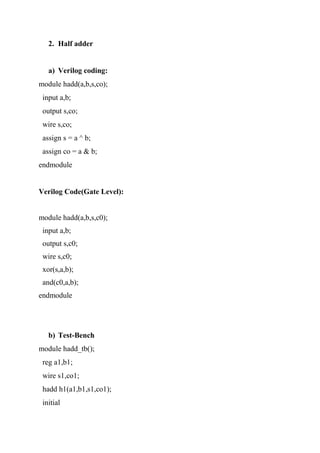
2. Half adder
a) Verilog coding:
module hadd(a,b,s,co);
input a,b;
output s,co;
wire s,co;
assign s = a ^ b;
assign co = a & b;
endmodule
Verilog Code(Gate Level):
module hadd(a,b,s,c0);
input a,b;
output s,c0;
wire s,c0;
xor(s,a,b);
and(c0,a,b);
endmodule
b) Test-Bench
module hadd_tb();
reg a1,b1;
wire s1,co1;
hadd h1(a1,b1,s1,co1);
initial
begin
a1=0;
b1=0;
end
always #50 a1=~a1;
always #100 b1=~b1;
endmodule
c) Output waveform:
3. Full adder
Verilog coding:
module fadd(a,b,cin,s,cout);
input a,b,cin;
output s,cout;
wire s,cout;
wire w1,w2,w3,w4;
xor x1(w1,a,b);
xor x2(s,w1,cin);
and a1(w2,a,b);
and a2(w3,b,cin);
and a3(w4,a,cin);
or o1(cout,w2,w3,w4);
endmodule
Verilog Code(Data Flow):
module fadd_d(a,b,c,sum,carry);
input a,b,c;
output sum,carry;
assign sum = a^b^c;
assign carry = (a&b)|(b&c)|(a&c);
endmodule
Test-bench:
module fadd_tb();
reg a1,b1,cin1;
wire s1,co1;
fadd f1(a1,b1,cin1,s1,co1);
initial
begin
a1=0;
b1=0;
cin1=0;
end
always #50 a1=~a1;
always #100 b1=~b1;
always #150 cin1=~cin1;
endmodule
Output wave-Form:
4. Full subtractor:
a) Verilog Coding:
module fadd(a,b,cin,d,borrow);
input a,b,cin;
output d,borrow;
wire d,borrow;
wire w1,w2,w3,w4;
xor x1(w1,a,b);
xor x2(d,w1,cin);
and a1(w2,~a,b);
and a2(w3,b,cin);
and a3(w4,~a,cin);
or o1(borrow,w2,w3,w4);
Verilog Code(Data Flow):
module full_subtractor ( a ,b ,c ,diff ,borrow );
output diff ;
output borrow ;
input a ;
input b ;
input c ;
assign diff = a ^ b ^ c;
assign borrow = ((~a) & b) | (b & c) | (c & (~a));
endmodule
b) Test-Bench
module fsubb_tb();
reg a1,b1,cin1;
wire d1,bo1;
fadd f1(a1,b1,cin1,d1,bo1);
initial
begin
a1=0;
b1=0;
cin1=0;
end
always #50 a1=~a1;
always #100 b1=~b1;
always #150 cin1=~cin1;
endmodule
c) Output waveform:
5. 3:8 decoder
a) Verilog coding:
module decoder(i, y);
input [2:0] i;
output [7:0] y;
assign y[7] = (i[2] & i[1] & i[0]);
assign y[6] = (i[2] & i[1] & ~i[0]);
assign y[5] = (i[2] & ~i[1] & i[0]);
assign y[4] = (i[2] & ~i[1] & ~i[0]);
assign y[3] = (~i[2] & i[1] & i[0]);
assign y[2] = (~i[2] & i[1] & ~i[0]);
assign y[1] = (~i[2] & ~i[1] & i[0]);
assign y[0] = (~i[2] & ~i[1] & ~i[0]);
endmodule
b) Test bench :
module decoder_tb();
reg [2:0]i1;
wire [7:0]y1;
decoder d1(i1, y1);
initial
begin
i1[0]=0;
i1[1]=0;
i1[2]=0;
end
always #50 i1[0]=~i1[0];
always #100 i1[1]=~i1[1];
always #200 i1[2]=~i1[2];
endmodule
c) Output waveforms
6. 8:3 encoder
a) Verilog coding:
module encoder(i, y);
input [7:0] i;
output [2:0] y;
assign y[2]= (i[4] + i[5] +i[6] + i[7]);
assign y[1]= (i[2] + i[3] +i[6] + i[7]);
assign y[0]= (i[1] + i[3] +i[5] + i[7]);
endmodule
b) Test bench
module encoder_tb();
reg [7:0]i1;
wire [2:0]y1;
encoder d1(i1, y1);
initial
begin
i1=8'b10000000;
i1=8'b01000000;
i1=8'b00100000;
i1=8'b00010000;
i1=8'b00001000;
i1=8'b00000100;
i1=8'b00000010;
i1=8'b00000001;
end
endmodule
c) Output waveform:
7. 2-bit Comparator
a) Verilog coding
module comparator(a,b,l,e,g);
input a,b;
output l,e,g;
wire l,e,g;
and a1(l, ~a, b);
xnor x1(e, a, b);
and a2(g, a, ~b);
endmodule
b) Test-Bench
module comparator_tb();
reg a1,b1;
wire l1,e1,g1;
comparator c1(a1,b1,l1,e1,g1);
initial
begin
a1=0;
b1=0;
end
always #100 a1=~a1;
always #50 b1=~b1;
endmodule
c) Output waveform:
8. Priority encoder:
a) Verilog coding:
module p_encoder(d,y);
input [3:0]d;
output [1:0]y;
assign y[1] = (d[3]+ (~d[2] * d[1]));
assign y[0] = (d[2] + d[3]);
endmodule
Verilog coding:
module Priority_enCode(Gate Level)r(d3,d2,d1,d0,y1,y0,y);
input d3,d2,d1,d0;
output y1,y0,y;
wire y1,y0,y,w1,w2;
not(w1,d2);
and(w2,w1,d1);
or(y0,w2,d3);
or(y1,d3,d2);
or(y,y1,d1,d0);
endmodule
a) Test bench
module p_encoder_tb();
reg [3:0]d1;
wire[1:0]y1;
p_encoder p1(d1,y1);
initial
begin
#10 d1=4'b1000;
#10 d1=4'b0100;
#10 d1=4'b0010;
#10 d1=4'b0001;
#10 $stop;
end
endmodule
b) Output waveform
9. 4:1 Mux
a) Verilog coding:
module mux(y,i0,i1,i2,i3,s1,s0);
input i0,i1,i2,i3;
input s1,s0;
output y;
assign y =(~s1 & ~s0 & i0) | (~s1 & s0 & i1) | (s1 & ~s0 & i2) | (s1 & s0 & i3);
endmodule
Verilog Code(Gate Level):
module mux4_to_1(out,i0,i1,i2,i3,s1,s0);
output out;
input i0,i1,i2,i3,s1,s0;
wire s1n,s0n;
wire y0,y1,y2,y3;
not (s1n,s1);
not (s0n,s0);
and(y0,i0,s1n,s0n);
and(y1,i1,s1n,s0);
and(y2,i2,s1,s0n);
and(y3,i3,s1,s0);
or(out,y0,y1,y2,y3);
endmodule
b) Test-Bench
module mux4_1_tb();
reg i00,i11,i22,i33,s11,s00;
wire y1;
mux m1(y1,i00,i11,i22,i33,s11,s00);
initial
begin
i00=0;
i11=0;
i22=0;
i33=0;
s00=1;
s11=1;
end
always #200 i00=~i00;
always #100 i11=~i11;
always #50 i22=~i22;
always #25 i33=~i33;
always #800 s00=~s00;
always #3200 s11=~s11;
endmodule
c) Output waveform
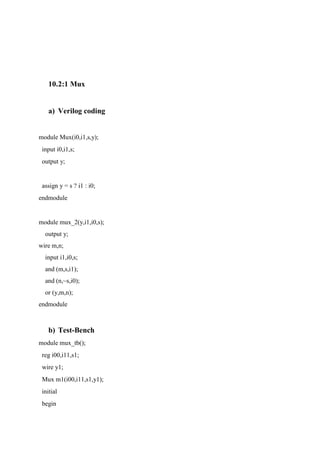
10.2:1 Mux
a) Verilog coding
module Mux(i0,i1,s,y);
input i0,i1,s;
output y;
assign y = s ? i1 : i0;
endmodule
module mux_2(y,i1,i0,s);
output y;
wire m,n;
input i1,i0,s;
and (m,s,i1);
and (n,~s,i0);
or (y,m,n);
endmodule
b) Test-Bench
module mux_tb();
reg i00,i11,s1;
wire y1;
Mux m1(i00,i11,s1,y1);
initial
begin
i00=0;
i11=0;
s1=0;
end
always #50 i00=~i00;
always #100 i11=~i11;
always #400 s1=~s1;
endmodule
c) Output waveform
11. 8_1Mux using 4_1 and 2_1 mux
a) Verilog coding:
module mux_top(a,b,c);
input [7:0]a;
input [2:0]b;
output c;
wire w1,w2;
mux d1(w1,a[0],a[1],a[2],a[3],b[1],b[0]);
mux d2(w2,a[4],a[5],a[6],a[7],b[1],b[0]);
Mux d3(w1,w2,b[2],c);
endmodule
b) Test-Bench:
module mux8_1_tb();
reg [7:0]a1;
reg [2:0]b1;
wire c1;
mux_top m1(a1,b1,c1);
initial
begin
a1[0]=0;
a1[1]=0;
b1[0]=0;
b1[1]=0;
b1[2]=0;
end
always #25 a1[0]=~a1[0];
always #50 a1[1]=~a1[1];
always #100 b1[0]=~b1[0];
always #200 b1[1]=~b1[1];
always #400 b1[2]=~b1[2];
endmodule
c) Output waveform:
We can observe that the my output is follow input a[0] and a[1]
respectively.
12. Demux1_4
a) Verilog coding
module demux(I,S,Y);
input [1:0]S;
input I;
output [3:0]Y;
assign Y[0]= (~S[1] & ~S[0] & I);
assign Y[1]= (~S[1] & S[0] & I);
assign Y[2]= (S[1] & ~S[0] & I);
assign Y[3]= (S[1] & S[0] & I);
endmodule
Verilog Code(Gate Level):
module demux_4(a,b,d,y0,y1,y2,y3);
output y0,y1,y2,y3;
input a,b,d;
wire w1,w2;
not(w1,a);
not(w2,b);
and(y0,w1,w2,d);
and(y1,w1,b,d);
and(y2,a,w2,d);
and(y3,a,b,d);
endmodule
b) Test bench
module demux_tb();
reg [1:0]S1;
reg I1;
wire [3:0]Y1;
demux D1(I1,S1,Y1);
initial
begin
I1=1;
S1[1]=0;
S1[0]=0;
end
always #100 S1[1]=~S1[1];
always #50 S1[0]=~S1[0];
endmodule
c) Output waveform
13.Demux1_2
a) Verilog coding:
module demux1_2(i,s,y0,y1);
input i,s;
output y0,y1;
wire y0,y1;
assign y0 = (~s&i);
assign y1 = (s&i);
endmodule
Verilog Code(Gate Level):
module demux_2(s,d,y1,y0);
input s,d;
output y1,y0;
wire y1,y0,w1;
not(w1,s);
and(y1,d,s);
and(y0,w1,d);
endmodule
b) Test-bench
module demux1_2_tb();
reg i1,s1;
wire y00,y11;
demux1_2 m1(i1,s1,y00,y11);
initial
begin
i1=1;
s1=0;
end
always #100 s1=~s1;
endmodule
c) Output waveform:
14. 1_8 demux
a) Verilog coding:
module demux1_8(i,s2,s1,s0,y0,y1,y2,y3,y4,y5,y6,y7);
input i,s2,s1,s0;
output y0,y1,y2,y3,y4,y5,y6,y7;
wire y0,y1,y2,y3,y4,y5,y6,y7;
assign y7 = (s2 & s1 & s0 & i);
assign y6 = (s2 & s1 & ~s0& i);
assign y5 = (s2 & ~s1 & s0& i);
assign y4 = (s2 & ~s1 & ~s0& i);
assign y3 = (~s2 & s1 & s0& i);
assign y2 = (~s2 & s1 & ~s0& i);
assign y1 = (~s2 & ~s1 & s0& i);
assign y0 = (~s2 & ~s1 & ~s0& i);
endmodule
b) Test bench
module demux1_8_tb();
reg i1,s22,s11,s00;
wire y00,y11,y22,y33,y44,y55,y66,y77;
demux1_8 m2(i1,s22,s11,s00,y00,y11,y22,y33,y44,y55,y66,y77);
initial
begin
i1=1;
s11=0;
s22=0;
s00=0;
end
always #50 s00=~s00;
always #100 s11=~s11;
always #200 s22=~s22;
endmodule
c) Output waveforms:
Aim:
To design, simulate and implement code converters using schematic and
Verilog HDL.
Software Details:
For design Functional Simulation: Quartus II, ModelSim
For design Synthesis: Quartus II
For design Implementation: Quartus II
1. Binary to BCD
a) Verilog coding:
module B_TO_BCD(a,s);
input [3:0]a;
output[4:0]s;
assign s[4] = (a[1] & a[3]) | (a[3] & a[2]);
assign s[3] = (~a[1] & ~a[2] & a[3]);
assign s[2] = (a[2] & a[1]) | (a[2] & ~a[3]);
assign s[1] = (a[1] & ~a[3]) | (~a[1] & a[3] & a[2]);
assign s[0] = a[0];
endmodule
Task: 3 Design and Implementation of code converters using Verilog
HDL coding
b) Test bench
module B_TO_BCD_TB();
reg [3:0]a1;
wire [4:0]s1;
B_TO_BCD m1(a1,s1);
initial
begin
#10 a1=4'b0000;
#10 a1=4'b0001;
#10 a1=4'b0010;
#10 a1=4'b0011;
#10 a1=4'b0100;
#10 a1=4'b0101;
#10 a1=4'b0110;
#10 a1=4'b0111;
#10 a1=4'b1000;
#10 a1=4'b1001;
#10 a1=4'b1010;
#10 a1=4'b1011;
#10 a1=4'b1100;
#10 a1=4'b1101;
#10 a1=4'b1110;
#10 a1=4'b1111;
#100 $stop;
end
endmodule
c) Waveform:
2. BCD to Binary
a) Verilog code:
module BCD_TO_B(b,a);
input [4:0]b;
output[4:0]a;
assign a[4] = (b[3] & b[4]) | (b[1] & b[2] & b[4]);
assign a[3] = (b[3] & ~b[4]) | (~b[2] & ~b[3] & b[4]) | (~b[1] & ~b[3] & b[4]);
assign a[2] = (b[2] & ~b[4]) | (~b[1] & b[2]) | (b[1] & ~b[2] & b[4]);
assign a[1] = (b[1] ^ b[4]);
assign a[0] = b[0];
endmodule
b) Test bench
module BCD_TO_B_TB();
reg [4:0]b1;
wire [4:0]a1;
BCD_TO_B m1(b1,a1);
initial
begin
#10 b1=5'b00000;
#10 b1=5'b00001;
#10 b1=5'b00010;
#10 b1=5'b00011;
#10 b1=5'b00100;
#10 b1=5'b00101;
#10 b1=5'b00110;
#10 b1=5'b00111;
#10 b1=5'b01000;
#10 b1=5'b01001;
#10 b1=5'b10000;
#10 b1=5'b10001;
#10 b1=5'b10010;
#10 b1=5'b10011;
#10 b1=5'b10100;
#10 b1=5'b10101;
#100 $stop;
end
endmodule
c) Waveform:
3. Binary To Gray
a) Verilog code:
module B_TO_G(b,g);
output [3:0]g;
input [3:0]b;
xor x1(g[0],b[0],b[1]);
xor x2(g[1],b[1],b[2]);
xor x3(g[2],b[2],b[3]);
and a1(g[3],b[3],1'b1);
endmodule
b) Test bench:
module B_TO_G_TB();
reg [3:0]b1;
wire [3:0]g1;
B_TO_G m1(b1,g1);
initial
begin
#10 b1=4'b0000;
#10 b1=4'b0001;
#10 b1=4'b0010;
#10 b1=4'b0011;
#10 b1=4'b0100;
#10 b1=4'b0101;
#10 b1=4'b0110;
#10 b1=4'b0111;
#10 b1=4'b1000;
#10 b1=4'b1001;
#10 b1=4'b1010;
#10 b1=4'b1011;
#10 b1=4'b1100;
#10 b1=4'b1101;
#10 b1=4'b1110;
#10 b1=4'b1111;
#100 $stop;
end
endmodule
c) Waveforms:
4. Gray to Binary:
a) Verilog code:
module G_TO_B(g,b);
output [3:0]b;
input [3:0]g;
xor x1(b[0],b[1],g[0]);
xor x2(b[1],b[2],g[1]);
xor x3(b[2],b[3],g[2]);
and a1(b[3],g[3],1'b1);
endmodule
b) Test bench
module G_TO_B_TB();
reg [3:0]g1;
wire [3:0]b1;
G_TO_B m1(g1,b1);
initial
begin
#10 g1=4'b0000;
#10 g1=4'b0001;
#10 g1=4'b0010;
#10 g1=4'b0011;
#10 g1=4'b0100;
#10 g1=4'b0101;
#10 g1=4'b0110;
#10 g1=4'b0111;
#10 g1=4'b1000;
#10 g1=4'b1001;
#10 g1=4'b1010;
#10 g1=4'b1011;
#10 g1=4'b1100;
#10 g1=4'b1101;
#10 g1=4'b1110;
#10 g1=4'b1111;
#100 $stop;
end
endmodule
c) Waveforms:
5. Excess-3 To BCD
a) Verilog code:
module E_TO_BCD(e,b);
input [3:0]e;
output [3:0]b;
assign b[3] = (e[0] & e[1] & e[3]) | (e[2] & e[3]);
assign b[2] = (~e[0] & e[1] & e[3]) | (e[0] & e[1] & e[2]) | (~e[1] & ~e[2]);
assign b[1] = (e[1] ^ e[0]);
assign b[0] = ~e[0];
endmodule
b) Test-bench
module E_TO_BCD_TB();
reg [3:0]e1;
wire [3:0]b1;
E_TO_BCD m1(e1,b1);
initial
begin
#10 e1=4'b0011;
#10 e1=4'b0100;
#10 e1=4'b0101;
#10 e1=4'b0110;
#10 e1=4'b0111;
#10 e1=4'b1000;
#10 e1=4'b1001;
#10 e1=4'b1010;
#10 e1=4'b1011;
#10 e1=4'b1100;
#100 $stop;
end
endmodule
c) Waveforms
6. BCD To Excess-3
a) Verilog code:
module B_TO_E(b,e);
input [3:0]b;
output [3:0]e;
assign e[3]= b[3] | (b[2] & b[1]) | (b[2] & b[0]);
assign e[2]= (~b[2] & b[1]) | (~b[2] & b[0]) | (b[2] & ~b[1] & ~b[0]);
assign e[1]= (b[1] & b[0]) | (~b[1] & ~b[0]);
assign e[0]= ~b[0] ;
endmodule
b) Test-bench
module B_TO_E_TB();
reg [3:0]b1;
wire [3:0]e1;
B_TO_E m1(b1,e1);
initial
begin
#10 b1=4'b0000;
#10 b1=4'b0001;
#10 b1=4'b0010;
#10 b1=4'b0011;
#10 b1=4'b0100;
#10 b1=4'b0101;
#10 b1=4'b0110;
#10 b1=4'b0111;
#10 b1=4'b1000;
#10 b1=4'b1001;
#100 $stop;
end
endmodule
c) Waveforms:
Aim:
To design, simulate and implement Ripple carry adder using schematic and
Verilog HDL.
Software Details:
For design Functional Simulation: Quartus II, ModelSim
For design Synthesis: Quartus II
For design Implementation: Quartus II
a) RC_Verilog Code:
module RC_adder(a2,b2,cin2,s2,cout2);
input [3:0]a2,b2;
wire c1,c2,c3;
input cin2;
output [3:0]s2;
output cout2;
FA f1(a2[0],b2[0],cin2,s2[0],c1);
FA f2(a2[1],b2[1],c1,s2[1],c2);
FA f3(a2[2],b2[2],c2,s2[2],c3);
FA f4(a2[3],b2[3],c3,s2[3],cout2);
Endmodule
b) FA_Verilog code:
Task: 4 Design and Implementation of Combinational Circuits using
Verilog HDL coding
module FA(a,b,cin,s,cout);
input a,b,cin;
output s,cout;
wire s,cout;
wire w1,w2,w3,w4;
xor x1(w1,a,b);
xor x2(s,w1,cin);
and a1(w2,a,b);
and a2(w3,cin,b);
and a3(w4,a,cin);
or o1(cout,w2,w3,w4);
endmodule
c) Test bench:
module RC_FA_TB();
reg [3:0]a2,b2;
reg cin2;
wire [3:0]s2;
wire cout2;
RC_adder f11(a2,b2,cin2,s2,cout2);
initial
begin
cin2=0;
#10 a2=4'b1100; b2=4'b0001;
#10 a2=4'b1100; b2=4'b1001;
#10 $stop;
end
endmodule
d) Waveforms:
Scanned by CamScanner
w c
Scanned by CamScanner

Task i

  • 1.
    SHAH DARSHIL HARESHKUMAR 17MVD0091 DIGITALDESIGN WITH FPGA ASSIGNMENT I SIVANANTHAM S VIT UNIVERSITY
  • 2.
    Aim: To design, simulateand implement basic gates circuit using schematic and Verilog HDL. Software Details: For design Functional Simulation: Quartus II, ModelSim For design Synthesis: Quartus II For design Implementation: Quartus II 1. And gate a) Verilog code module and_gate(a,b,y); input a,b; output y; assign y = a & b; endmodule Verilog Code (Gate Level): module andgate(a,b,y); input a,b; output y; wire y; and(y,a,b); endmodule b) Output waveform: Task: 1 Design and Implementation of Basic gates using Verilog HDL coding
  • 3.
    2. OR gate a)Verilog code: module OR_gate(a,b,y); input a,b; output y; assign y = a | b; endmodule Verilog Code(Gate Level): module orgate(a,b,y); input a,b; output y; wire y; or(y,a,b); endmodule
  • 4.
    b) Output waveform: 3.XOR gate a) Verilog code: module XOR_gate(a,b,y); input a,b; output y; assign y = a ^ b; endmodule Verilog code: module XOR_gate(a,b,y); input a,b; output y; xor (y , a , b); endmodule
  • 5.
    a) Output waveform: 4.NAND gate a) Verilog code: module nand_gate(a,b,y); input a,b; output y; assign y = ~a | ~b; endmodule Verilog code: module nand_gate(a,b,y); input a,b; output y;
  • 6.
    or o1( y,~a , ~b); endmodule a) Output waveform: 5. NOR gate a) Verilog code: module nor_gate(a,b,y); input a,b; output y; assign y = ~a & ~b; endmodule Verilog code: module nor_gate(a,b,y);
  • 7.
    input a,b; output y; and(y , ~a , ~b); endmodule a) Output waveform: 6. EXNOR gate a) Verilog code: module exnor_gate(a,b,y); input a,b; output y; assign y = a ~^ b; endmodule Verilog code: module exnor_gate(a,b,y); input a,b;
  • 8.
    output y; xnor (y, a , b); endmodule a) Output waveform: Common test bench: module tb_and_gate; reg A,B; wire Y; and_gate a1 (A,B,Y); initial begin A =0; B= 0; end always #25 A =~A; always #50 B =~B; endmodule
  • 9.
    Aim: To design, simulateand implement combinational circuits using schematic and Verilog HDL. Software Details: For design Functional Simulation: Quartus II, ModelSim For design Synthesis: Quartus II For design Implementation: Quartus II 1. Half subtractor a) Verilog code: module hsubb(a,b,d,bo); input a,b; output d,bo; wire d,bo; assign d = a ^ b; assign bo = ~a & b; endmodule Verilog Code(Gate Level): module half_sub(a,b,d,b0); input a,b; output d,b0; wire d,b0; xor (d,a,b); and(b0,~a,b); endmodule Task: 2 Design and Implementation of combinational circuit using Verilog HDL coding
  • 10.
    b) Test bench modulehsubb_tb(); reg a1,b1; wire d1,bo1; hsubb h1(a1,b1,d1,bo1); initial begin a1=0; b1=0; end always #50 a1=~a1; always #100 b1=~b1; endmodule c) Wave forms:
  • 11.
    2. Half adder a)Verilog coding: module hadd(a,b,s,co); input a,b; output s,co; wire s,co; assign s = a ^ b; assign co = a & b; endmodule Verilog Code(Gate Level): module hadd(a,b,s,c0); input a,b; output s,c0; wire s,c0; xor(s,a,b); and(c0,a,b); endmodule b) Test-Bench module hadd_tb(); reg a1,b1; wire s1,co1; hadd h1(a1,b1,s1,co1); initial
  • 12.
    begin a1=0; b1=0; end always #50 a1=~a1; always#100 b1=~b1; endmodule c) Output waveform: 3. Full adder Verilog coding: module fadd(a,b,cin,s,cout);
  • 13.
    input a,b,cin; output s,cout; wires,cout; wire w1,w2,w3,w4; xor x1(w1,a,b); xor x2(s,w1,cin); and a1(w2,a,b); and a2(w3,b,cin); and a3(w4,a,cin); or o1(cout,w2,w3,w4); endmodule Verilog Code(Data Flow): module fadd_d(a,b,c,sum,carry); input a,b,c; output sum,carry; assign sum = a^b^c; assign carry = (a&b)|(b&c)|(a&c); endmodule Test-bench: module fadd_tb(); reg a1,b1,cin1; wire s1,co1; fadd f1(a1,b1,cin1,s1,co1); initial begin a1=0; b1=0; cin1=0; end always #50 a1=~a1;
  • 14.
    always #100 b1=~b1; always#150 cin1=~cin1; endmodule Output wave-Form: 4. Full subtractor: a) Verilog Coding: module fadd(a,b,cin,d,borrow); input a,b,cin; output d,borrow; wire d,borrow; wire w1,w2,w3,w4; xor x1(w1,a,b); xor x2(d,w1,cin); and a1(w2,~a,b); and a2(w3,b,cin);
  • 15.
    and a3(w4,~a,cin); or o1(borrow,w2,w3,w4); VerilogCode(Data Flow): module full_subtractor ( a ,b ,c ,diff ,borrow ); output diff ; output borrow ; input a ; input b ; input c ; assign diff = a ^ b ^ c; assign borrow = ((~a) & b) | (b & c) | (c & (~a)); endmodule b) Test-Bench module fsubb_tb(); reg a1,b1,cin1; wire d1,bo1; fadd f1(a1,b1,cin1,d1,bo1); initial begin a1=0; b1=0; cin1=0; end always #50 a1=~a1; always #100 b1=~b1; always #150 cin1=~cin1; endmodule c) Output waveform:
  • 16.
    5. 3:8 decoder a)Verilog coding: module decoder(i, y); input [2:0] i; output [7:0] y; assign y[7] = (i[2] & i[1] & i[0]); assign y[6] = (i[2] & i[1] & ~i[0]); assign y[5] = (i[2] & ~i[1] & i[0]); assign y[4] = (i[2] & ~i[1] & ~i[0]); assign y[3] = (~i[2] & i[1] & i[0]); assign y[2] = (~i[2] & i[1] & ~i[0]); assign y[1] = (~i[2] & ~i[1] & i[0]); assign y[0] = (~i[2] & ~i[1] & ~i[0]); endmodule
  • 17.
    b) Test bench: module decoder_tb(); reg [2:0]i1; wire [7:0]y1; decoder d1(i1, y1); initial begin i1[0]=0; i1[1]=0; i1[2]=0; end always #50 i1[0]=~i1[0]; always #100 i1[1]=~i1[1]; always #200 i1[2]=~i1[2]; endmodule c) Output waveforms 6. 8:3 encoder
  • 18.
    a) Verilog coding: moduleencoder(i, y); input [7:0] i; output [2:0] y; assign y[2]= (i[4] + i[5] +i[6] + i[7]); assign y[1]= (i[2] + i[3] +i[6] + i[7]); assign y[0]= (i[1] + i[3] +i[5] + i[7]); endmodule b) Test bench module encoder_tb(); reg [7:0]i1; wire [2:0]y1; encoder d1(i1, y1); initial begin i1=8'b10000000; i1=8'b01000000; i1=8'b00100000; i1=8'b00010000; i1=8'b00001000; i1=8'b00000100; i1=8'b00000010; i1=8'b00000001; end endmodule c) Output waveform:
  • 19.
    7. 2-bit Comparator a)Verilog coding module comparator(a,b,l,e,g); input a,b; output l,e,g; wire l,e,g; and a1(l, ~a, b); xnor x1(e, a, b); and a2(g, a, ~b); endmodule b) Test-Bench
  • 20.
    module comparator_tb(); reg a1,b1; wirel1,e1,g1; comparator c1(a1,b1,l1,e1,g1); initial begin a1=0; b1=0; end always #100 a1=~a1; always #50 b1=~b1; endmodule c) Output waveform:
  • 21.
    8. Priority encoder: a)Verilog coding: module p_encoder(d,y); input [3:0]d; output [1:0]y; assign y[1] = (d[3]+ (~d[2] * d[1])); assign y[0] = (d[2] + d[3]); endmodule Verilog coding: module Priority_enCode(Gate Level)r(d3,d2,d1,d0,y1,y0,y); input d3,d2,d1,d0; output y1,y0,y; wire y1,y0,y,w1,w2; not(w1,d2); and(w2,w1,d1); or(y0,w2,d3); or(y1,d3,d2); or(y,y1,d1,d0); endmodule a) Test bench module p_encoder_tb(); reg [3:0]d1; wire[1:0]y1; p_encoder p1(d1,y1);
  • 22.
    initial begin #10 d1=4'b1000; #10 d1=4'b0100; #10d1=4'b0010; #10 d1=4'b0001; #10 $stop; end endmodule b) Output waveform 9. 4:1 Mux
  • 23.
    a) Verilog coding: modulemux(y,i0,i1,i2,i3,s1,s0); input i0,i1,i2,i3; input s1,s0; output y; assign y =(~s1 & ~s0 & i0) | (~s1 & s0 & i1) | (s1 & ~s0 & i2) | (s1 & s0 & i3); endmodule Verilog Code(Gate Level): module mux4_to_1(out,i0,i1,i2,i3,s1,s0); output out; input i0,i1,i2,i3,s1,s0; wire s1n,s0n; wire y0,y1,y2,y3; not (s1n,s1); not (s0n,s0); and(y0,i0,s1n,s0n); and(y1,i1,s1n,s0); and(y2,i2,s1,s0n); and(y3,i3,s1,s0); or(out,y0,y1,y2,y3); endmodule b) Test-Bench module mux4_1_tb(); reg i00,i11,i22,i33,s11,s00; wire y1; mux m1(y1,i00,i11,i22,i33,s11,s00);
  • 24.
    initial begin i00=0; i11=0; i22=0; i33=0; s00=1; s11=1; end always #200 i00=~i00; always#100 i11=~i11; always #50 i22=~i22; always #25 i33=~i33; always #800 s00=~s00; always #3200 s11=~s11; endmodule c) Output waveform
  • 25.
    10.2:1 Mux a) Verilogcoding module Mux(i0,i1,s,y); input i0,i1,s; output y; assign y = s ? i1 : i0; endmodule module mux_2(y,i1,i0,s); output y; wire m,n; input i1,i0,s; and (m,s,i1); and (n,~s,i0); or (y,m,n); endmodule b) Test-Bench module mux_tb(); reg i00,i11,s1; wire y1; Mux m1(i00,i11,s1,y1); initial begin
  • 26.
    i00=0; i11=0; s1=0; end always #50 i00=~i00; always#100 i11=~i11; always #400 s1=~s1; endmodule c) Output waveform 11. 8_1Mux using 4_1 and 2_1 mux
  • 27.
    a) Verilog coding: modulemux_top(a,b,c); input [7:0]a; input [2:0]b; output c; wire w1,w2; mux d1(w1,a[0],a[1],a[2],a[3],b[1],b[0]); mux d2(w2,a[4],a[5],a[6],a[7],b[1],b[0]); Mux d3(w1,w2,b[2],c); endmodule b) Test-Bench: module mux8_1_tb(); reg [7:0]a1; reg [2:0]b1; wire c1; mux_top m1(a1,b1,c1); initial begin a1[0]=0; a1[1]=0; b1[0]=0; b1[1]=0; b1[2]=0; end always #25 a1[0]=~a1[0]; always #50 a1[1]=~a1[1]; always #100 b1[0]=~b1[0]; always #200 b1[1]=~b1[1];
  • 28.
    always #400 b1[2]=~b1[2]; endmodule c)Output waveform: We can observe that the my output is follow input a[0] and a[1] respectively. 12. Demux1_4 a) Verilog coding module demux(I,S,Y); input [1:0]S; input I; output [3:0]Y; assign Y[0]= (~S[1] & ~S[0] & I); assign Y[1]= (~S[1] & S[0] & I); assign Y[2]= (S[1] & ~S[0] & I); assign Y[3]= (S[1] & S[0] & I);
  • 29.
    endmodule Verilog Code(Gate Level): moduledemux_4(a,b,d,y0,y1,y2,y3); output y0,y1,y2,y3; input a,b,d; wire w1,w2; not(w1,a); not(w2,b); and(y0,w1,w2,d); and(y1,w1,b,d); and(y2,a,w2,d); and(y3,a,b,d); endmodule b) Test bench module demux_tb(); reg [1:0]S1; reg I1; wire [3:0]Y1; demux D1(I1,S1,Y1); initial begin I1=1; S1[1]=0; S1[0]=0; end always #100 S1[1]=~S1[1]; always #50 S1[0]=~S1[0]; endmodule c) Output waveform
  • 30.
    13.Demux1_2 a) Verilog coding: moduledemux1_2(i,s,y0,y1); input i,s; output y0,y1; wire y0,y1; assign y0 = (~s&i); assign y1 = (s&i); endmodule Verilog Code(Gate Level): module demux_2(s,d,y1,y0); input s,d; output y1,y0; wire y1,y0,w1; not(w1,s);
  • 31.
    and(y1,d,s); and(y0,w1,d); endmodule b) Test-bench module demux1_2_tb(); regi1,s1; wire y00,y11; demux1_2 m1(i1,s1,y00,y11); initial begin i1=1; s1=0; end always #100 s1=~s1; endmodule c) Output waveform:
  • 32.
    14. 1_8 demux a)Verilog coding: module demux1_8(i,s2,s1,s0,y0,y1,y2,y3,y4,y5,y6,y7); input i,s2,s1,s0; output y0,y1,y2,y3,y4,y5,y6,y7; wire y0,y1,y2,y3,y4,y5,y6,y7; assign y7 = (s2 & s1 & s0 & i); assign y6 = (s2 & s1 & ~s0& i); assign y5 = (s2 & ~s1 & s0& i); assign y4 = (s2 & ~s1 & ~s0& i); assign y3 = (~s2 & s1 & s0& i); assign y2 = (~s2 & s1 & ~s0& i); assign y1 = (~s2 & ~s1 & s0& i); assign y0 = (~s2 & ~s1 & ~s0& i); endmodule b) Test bench
  • 33.
    module demux1_8_tb(); reg i1,s22,s11,s00; wirey00,y11,y22,y33,y44,y55,y66,y77; demux1_8 m2(i1,s22,s11,s00,y00,y11,y22,y33,y44,y55,y66,y77); initial begin i1=1; s11=0; s22=0; s00=0; end always #50 s00=~s00; always #100 s11=~s11; always #200 s22=~s22; endmodule c) Output waveforms:
  • 34.
    Aim: To design, simulateand implement code converters using schematic and Verilog HDL. Software Details: For design Functional Simulation: Quartus II, ModelSim For design Synthesis: Quartus II For design Implementation: Quartus II 1. Binary to BCD a) Verilog coding: module B_TO_BCD(a,s); input [3:0]a; output[4:0]s; assign s[4] = (a[1] & a[3]) | (a[3] & a[2]); assign s[3] = (~a[1] & ~a[2] & a[3]); assign s[2] = (a[2] & a[1]) | (a[2] & ~a[3]); assign s[1] = (a[1] & ~a[3]) | (~a[1] & a[3] & a[2]); assign s[0] = a[0]; endmodule Task: 3 Design and Implementation of code converters using Verilog HDL coding
  • 35.
    b) Test bench moduleB_TO_BCD_TB(); reg [3:0]a1; wire [4:0]s1; B_TO_BCD m1(a1,s1); initial begin #10 a1=4'b0000; #10 a1=4'b0001; #10 a1=4'b0010; #10 a1=4'b0011; #10 a1=4'b0100; #10 a1=4'b0101; #10 a1=4'b0110; #10 a1=4'b0111; #10 a1=4'b1000; #10 a1=4'b1001; #10 a1=4'b1010; #10 a1=4'b1011; #10 a1=4'b1100; #10 a1=4'b1101; #10 a1=4'b1110; #10 a1=4'b1111; #100 $stop; end endmodule
  • 36.
    c) Waveform: 2. BCDto Binary a) Verilog code: module BCD_TO_B(b,a); input [4:0]b; output[4:0]a; assign a[4] = (b[3] & b[4]) | (b[1] & b[2] & b[4]); assign a[3] = (b[3] & ~b[4]) | (~b[2] & ~b[3] & b[4]) | (~b[1] & ~b[3] & b[4]); assign a[2] = (b[2] & ~b[4]) | (~b[1] & b[2]) | (b[1] & ~b[2] & b[4]); assign a[1] = (b[1] ^ b[4]); assign a[0] = b[0]; endmodule
  • 37.
    b) Test bench moduleBCD_TO_B_TB(); reg [4:0]b1; wire [4:0]a1; BCD_TO_B m1(b1,a1); initial begin #10 b1=5'b00000; #10 b1=5'b00001; #10 b1=5'b00010; #10 b1=5'b00011; #10 b1=5'b00100; #10 b1=5'b00101; #10 b1=5'b00110; #10 b1=5'b00111; #10 b1=5'b01000; #10 b1=5'b01001; #10 b1=5'b10000; #10 b1=5'b10001; #10 b1=5'b10010; #10 b1=5'b10011; #10 b1=5'b10100; #10 b1=5'b10101; #100 $stop; end endmodule
  • 38.
    c) Waveform: 3. BinaryTo Gray a) Verilog code: module B_TO_G(b,g); output [3:0]g; input [3:0]b; xor x1(g[0],b[0],b[1]); xor x2(g[1],b[1],b[2]); xor x3(g[2],b[2],b[3]); and a1(g[3],b[3],1'b1); endmodule b) Test bench:
  • 39.
    module B_TO_G_TB(); reg [3:0]b1; wire[3:0]g1; B_TO_G m1(b1,g1); initial begin #10 b1=4'b0000; #10 b1=4'b0001; #10 b1=4'b0010; #10 b1=4'b0011; #10 b1=4'b0100; #10 b1=4'b0101; #10 b1=4'b0110; #10 b1=4'b0111; #10 b1=4'b1000; #10 b1=4'b1001; #10 b1=4'b1010; #10 b1=4'b1011; #10 b1=4'b1100; #10 b1=4'b1101; #10 b1=4'b1110; #10 b1=4'b1111; #100 $stop; end endmodule c) Waveforms:
  • 40.
    4. Gray toBinary: a) Verilog code: module G_TO_B(g,b); output [3:0]b; input [3:0]g; xor x1(b[0],b[1],g[0]); xor x2(b[1],b[2],g[1]); xor x3(b[2],b[3],g[2]); and a1(b[3],g[3],1'b1); endmodule b) Test bench
  • 41.
    module G_TO_B_TB(); reg [3:0]g1; wire[3:0]b1; G_TO_B m1(g1,b1); initial begin #10 g1=4'b0000; #10 g1=4'b0001; #10 g1=4'b0010; #10 g1=4'b0011; #10 g1=4'b0100; #10 g1=4'b0101; #10 g1=4'b0110; #10 g1=4'b0111; #10 g1=4'b1000; #10 g1=4'b1001; #10 g1=4'b1010; #10 g1=4'b1011; #10 g1=4'b1100; #10 g1=4'b1101; #10 g1=4'b1110; #10 g1=4'b1111; #100 $stop; end endmodule c) Waveforms:
  • 42.
    5. Excess-3 ToBCD a) Verilog code: module E_TO_BCD(e,b); input [3:0]e; output [3:0]b; assign b[3] = (e[0] & e[1] & e[3]) | (e[2] & e[3]); assign b[2] = (~e[0] & e[1] & e[3]) | (e[0] & e[1] & e[2]) | (~e[1] & ~e[2]); assign b[1] = (e[1] ^ e[0]); assign b[0] = ~e[0]; endmodule b) Test-bench
  • 43.
    module E_TO_BCD_TB(); reg [3:0]e1; wire[3:0]b1; E_TO_BCD m1(e1,b1); initial begin #10 e1=4'b0011; #10 e1=4'b0100; #10 e1=4'b0101; #10 e1=4'b0110; #10 e1=4'b0111; #10 e1=4'b1000; #10 e1=4'b1001; #10 e1=4'b1010; #10 e1=4'b1011; #10 e1=4'b1100; #100 $stop; end endmodule c) Waveforms
  • 44.
    6. BCD ToExcess-3 a) Verilog code: module B_TO_E(b,e); input [3:0]b; output [3:0]e; assign e[3]= b[3] | (b[2] & b[1]) | (b[2] & b[0]); assign e[2]= (~b[2] & b[1]) | (~b[2] & b[0]) | (b[2] & ~b[1] & ~b[0]); assign e[1]= (b[1] & b[0]) | (~b[1] & ~b[0]); assign e[0]= ~b[0] ; endmodule b) Test-bench
  • 45.
    module B_TO_E_TB(); reg [3:0]b1; wire[3:0]e1; B_TO_E m1(b1,e1); initial begin #10 b1=4'b0000; #10 b1=4'b0001; #10 b1=4'b0010; #10 b1=4'b0011; #10 b1=4'b0100; #10 b1=4'b0101; #10 b1=4'b0110; #10 b1=4'b0111; #10 b1=4'b1000; #10 b1=4'b1001; #100 $stop; end endmodule
  • 46.
  • 47.
    Aim: To design, simulateand implement Ripple carry adder using schematic and Verilog HDL. Software Details: For design Functional Simulation: Quartus II, ModelSim For design Synthesis: Quartus II For design Implementation: Quartus II a) RC_Verilog Code: module RC_adder(a2,b2,cin2,s2,cout2); input [3:0]a2,b2; wire c1,c2,c3; input cin2; output [3:0]s2; output cout2; FA f1(a2[0],b2[0],cin2,s2[0],c1); FA f2(a2[1],b2[1],c1,s2[1],c2); FA f3(a2[2],b2[2],c2,s2[2],c3); FA f4(a2[3],b2[3],c3,s2[3],cout2); Endmodule b) FA_Verilog code: Task: 4 Design and Implementation of Combinational Circuits using Verilog HDL coding
  • 48.
    module FA(a,b,cin,s,cout); input a,b,cin; outputs,cout; wire s,cout; wire w1,w2,w3,w4; xor x1(w1,a,b); xor x2(s,w1,cin); and a1(w2,a,b); and a2(w3,cin,b); and a3(w4,a,cin); or o1(cout,w2,w3,w4); endmodule c) Test bench: module RC_FA_TB(); reg [3:0]a2,b2; reg cin2; wire [3:0]s2; wire cout2; RC_adder f11(a2,b2,cin2,s2,cout2); initial begin cin2=0; #10 a2=4'b1100; b2=4'b0001; #10 a2=4'b1100; b2=4'b1001; #10 $stop; end endmodule d) Waveforms:
  • 50.
  • 51.
  • 52.
  • 53.
  • 54.
  • 55.
  • 56.
  • 57.
  • 58.
  • 59.
  • 60.