1
Verilog HDL Introduction
Presented By
Y. Sravan Kumar, M.Tech, (Ph.D.)
Assistant Professor
2
Outline
• Introduction
• Circuit Modeling
• Gate-level Modeling
• Data-level Modeling
• Behavioral Modeling
• Testing & Simulation
3
Introduction
• What is Verilog HDL?
Verilog HDL is a Hardware Description
Language that can be used to model a
digital system at many levels of
abstraction:
–Algorithmic-level
–Gate-level
–Switch-level
4
Where can we use Verilog HDL?
• Verilog is designed for circuit verification and
simulation, for timing analysis, for test
analysis (testability analysis and fault
grading) and for logic synthesis.
• For example, before you get to the structural
level of your design, you want to make sure
the logical paths of your design is faultless
and meets the spec.
10/10/2023 Brigette Huang - Autumn 2002 5
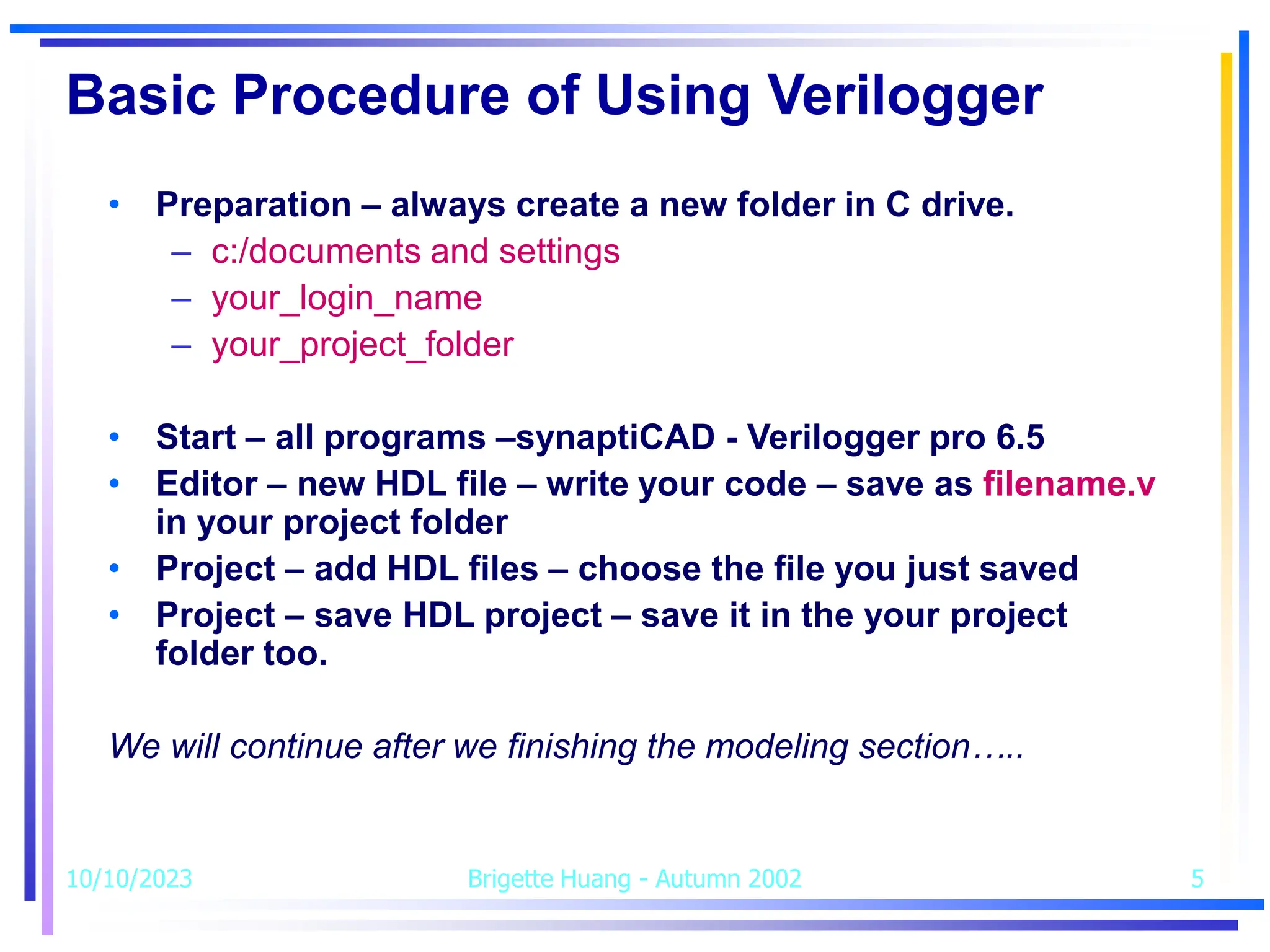
Basic Procedure of Using Verilogger
• Preparation – always create a new folder in C drive.
– c:/documents and settings
– your_login_name
– your_project_folder
• Start – all programs –synaptiCAD - Verilogger pro 6.5
• Editor – new HDL file – write your code – save as filename.v
in your project folder
• Project – add HDL files – choose the file you just saved
• Project – save HDL project – save it in the your project
folder too.
We will continue after we finishing the modeling section…..
6
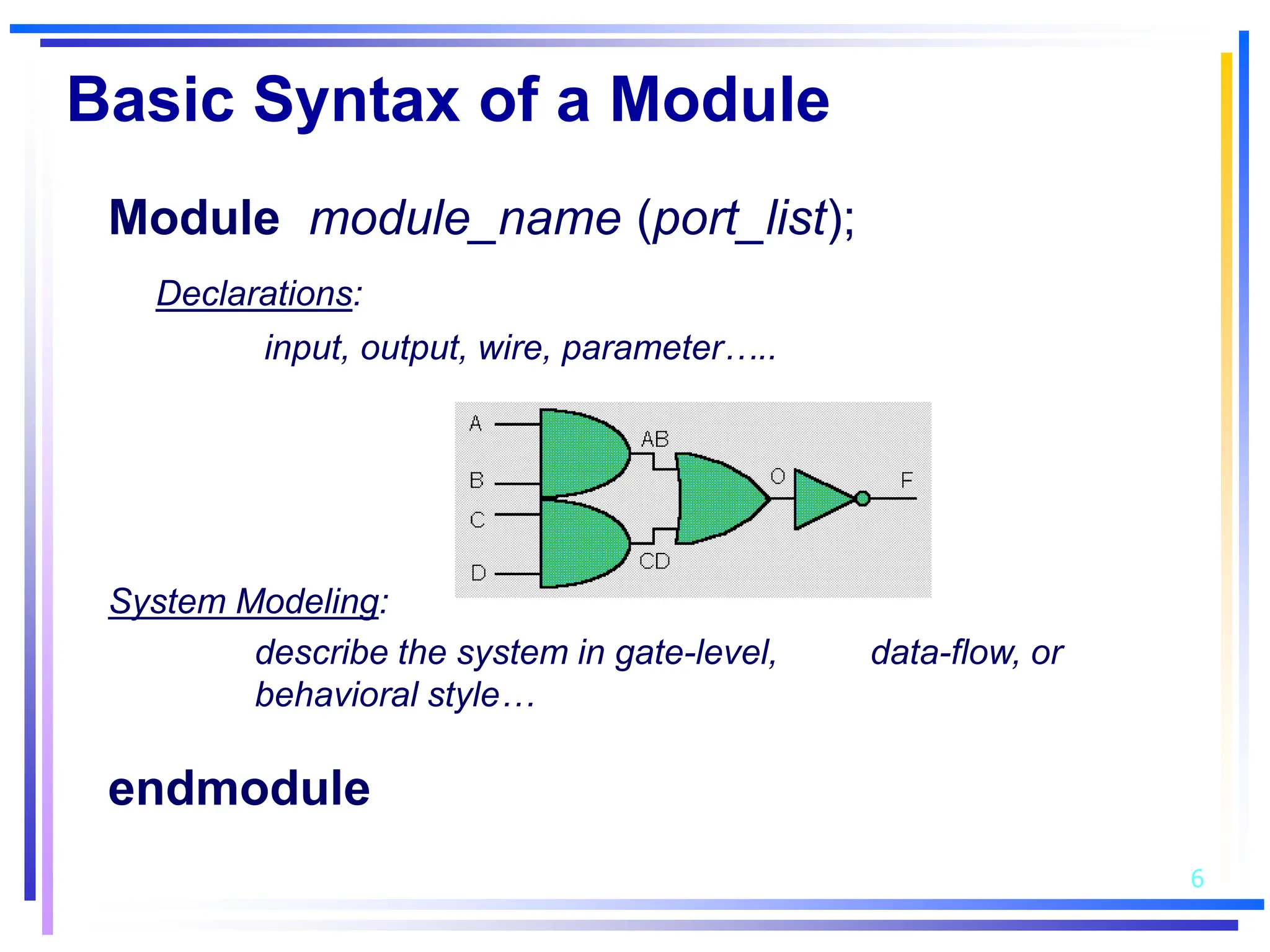
Basic Syntax of a Module
Module module_name (port_list);
Declarations:
input, output, wire, parameter…..
System Modeling:
describe the system in gate-level, data-flow, or
behavioral style…
endmodule
7
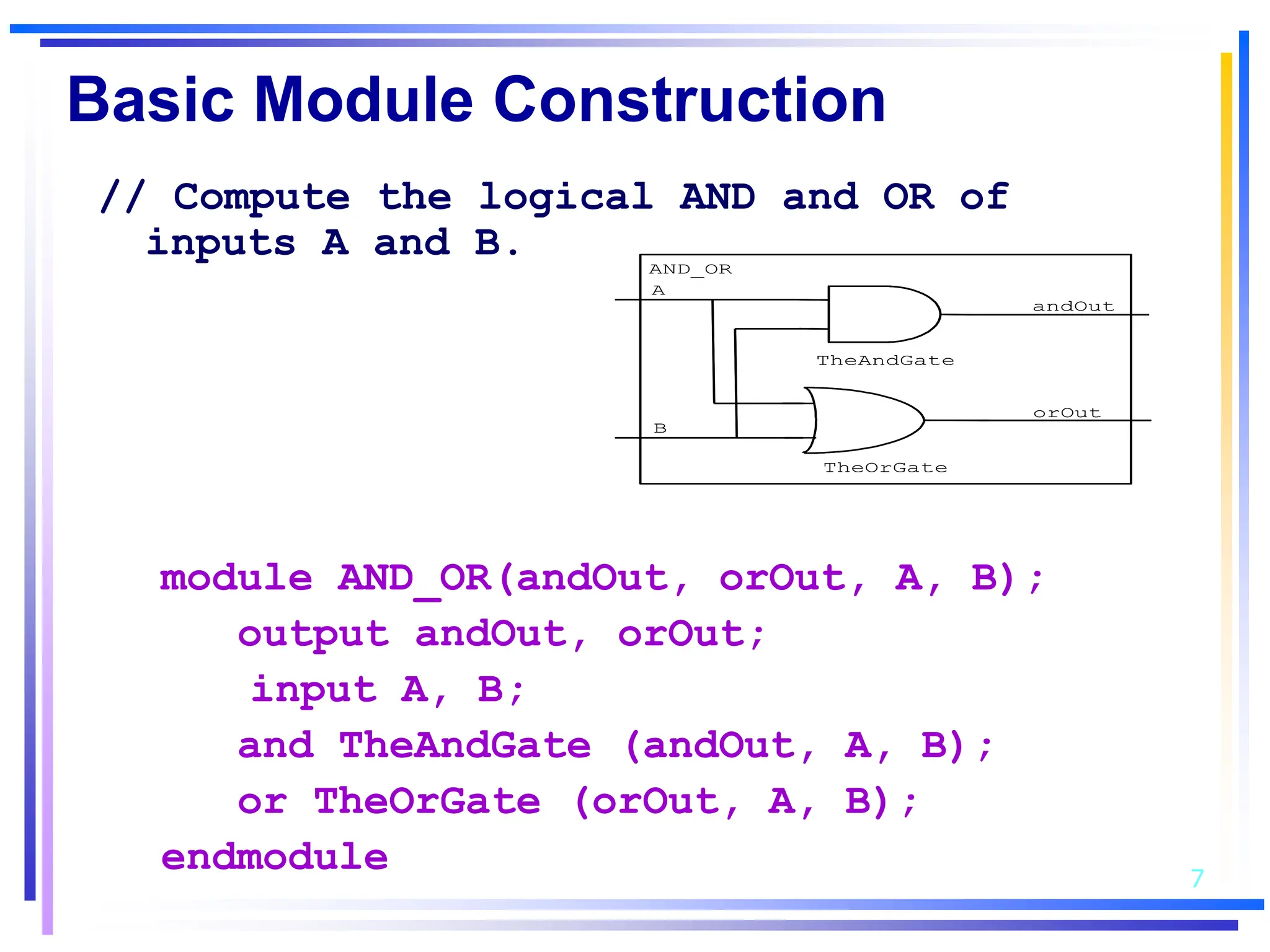
Basic Module Construction
// Compute the logical AND and OR of
inputs A and B.
module AND_OR(andOut, orOut, A, B);
output andOut, orOut;
input A, B;
and TheAndGate (andOut, A, B);
or TheOrGate (orOut, A, B);
endmodule
AND_OR
andOut
orOut
A
B
TheAndGate
TheOrGate
AND_OR
andOut
orOut
A
B
TheAndGate
TheOrGate
8
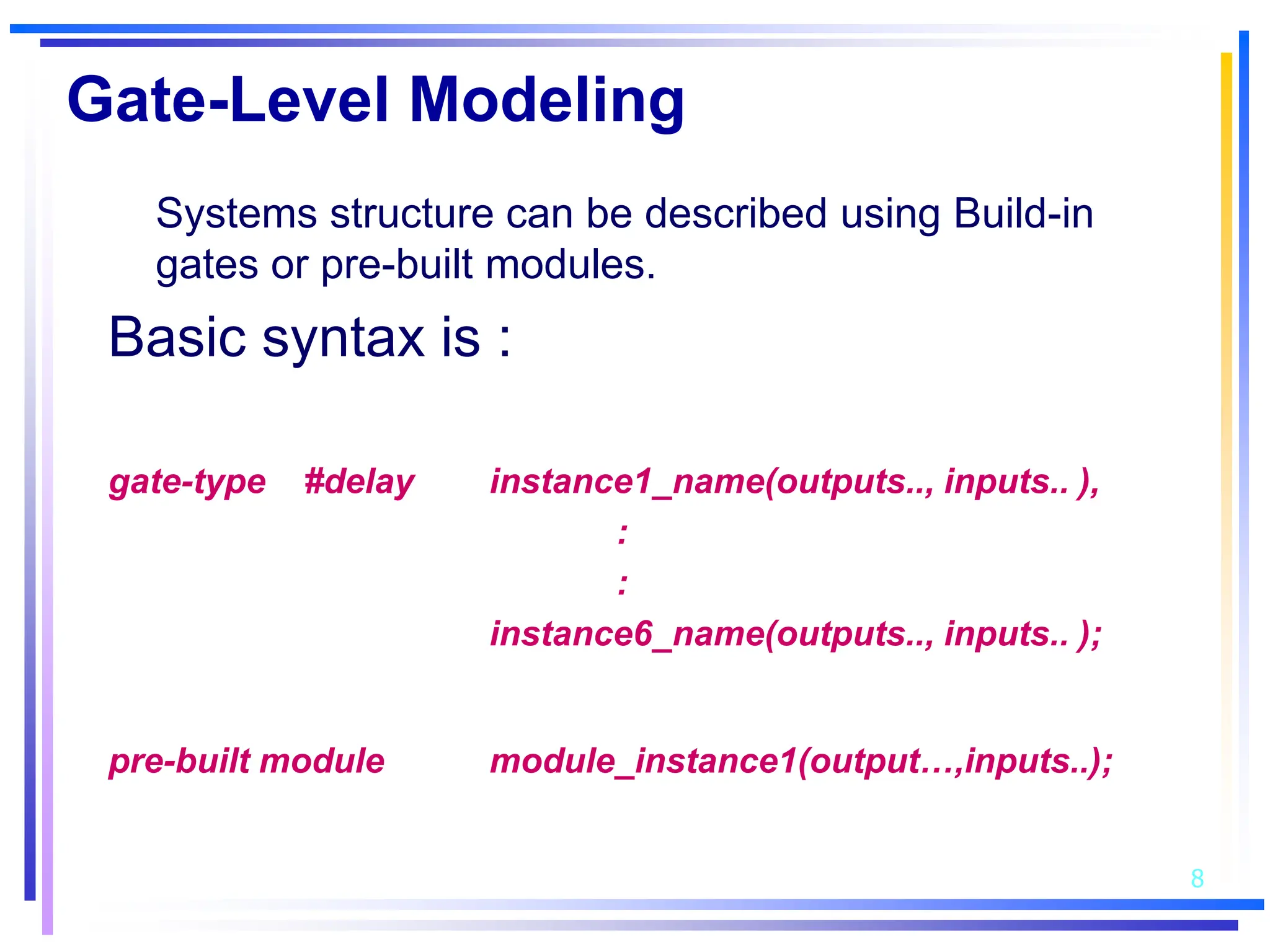
Gate-Level Modeling
Systems structure can be described using Build-in
gates or pre-built modules.
Basic syntax is :
gate-type #delay instance1_name(outputs.., inputs.. ),
:
:
instance6_name(outputs.., inputs.. );
pre-built module module_instance1(output…,inputs..);
9
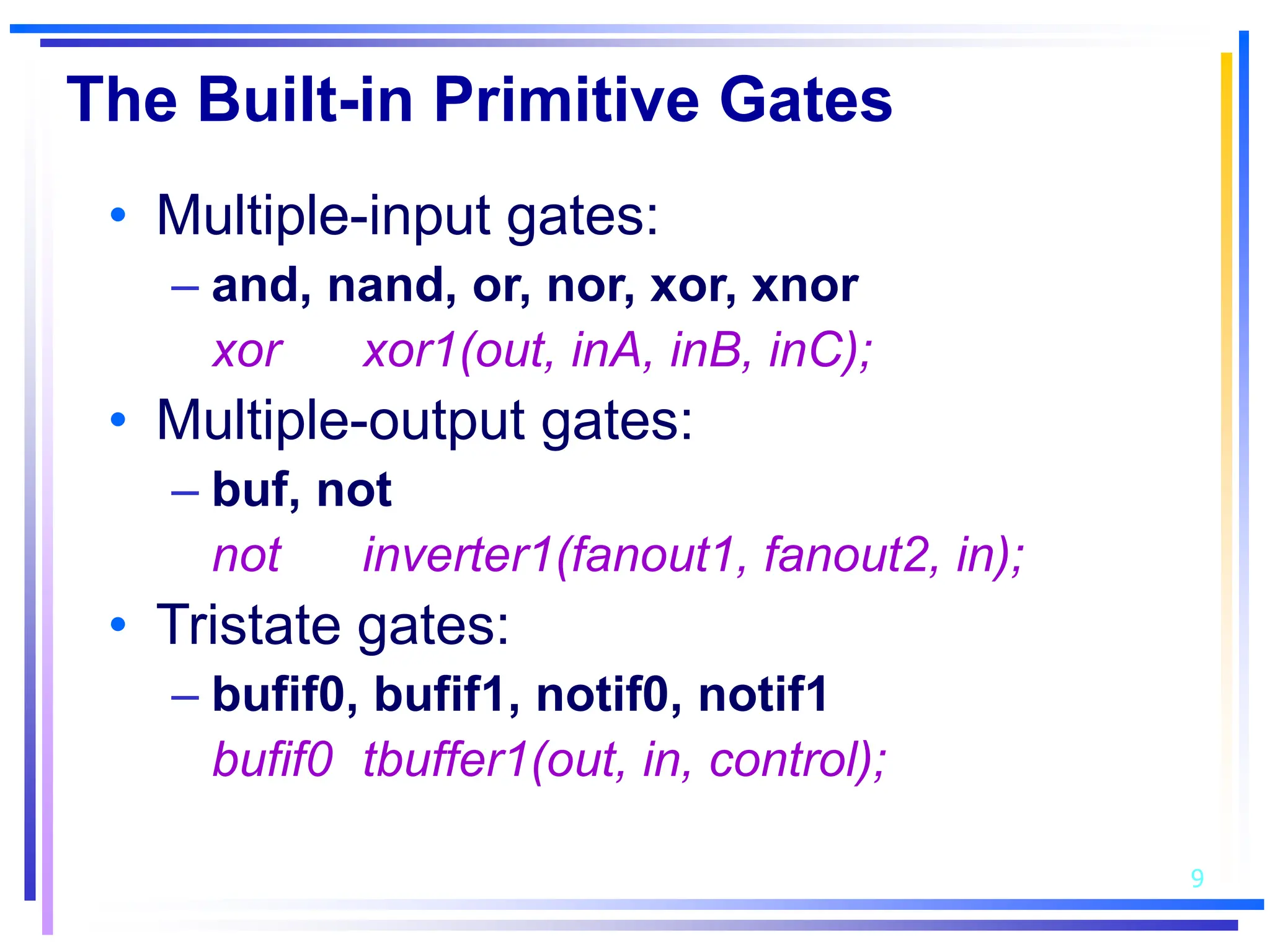
The Built-in Primitive Gates
• Multiple-input gates:
– and, nand, or, nor, xor, xnor
xor xor1(out, inA, inB, inC);
• Multiple-output gates:
– buf, not
not inverter1(fanout1, fanout2, in);
• Tristate gates:
– bufif0, bufif1, notif0, notif1
bufif0 tbuffer1(out, in, control);
10
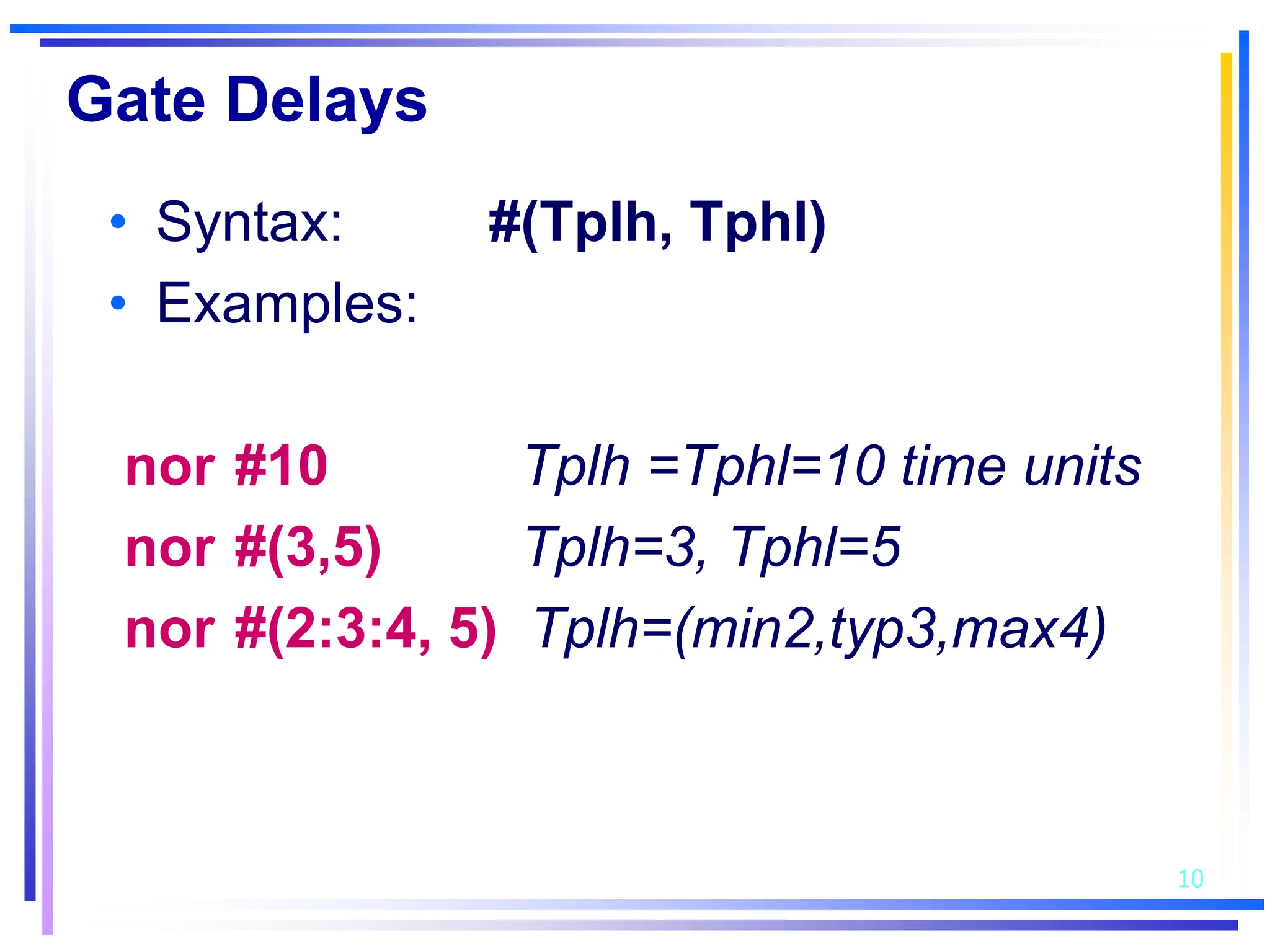
Gate Delays
• Syntax: #(Tplh, Tphl)
• Examples:
nor #10 Tplh =Tphl=10 time units
nor #(3,5) Tplh=3, Tphl=5
nor #(2:3:4, 5) Tplh=(min2,typ3,max4)
11
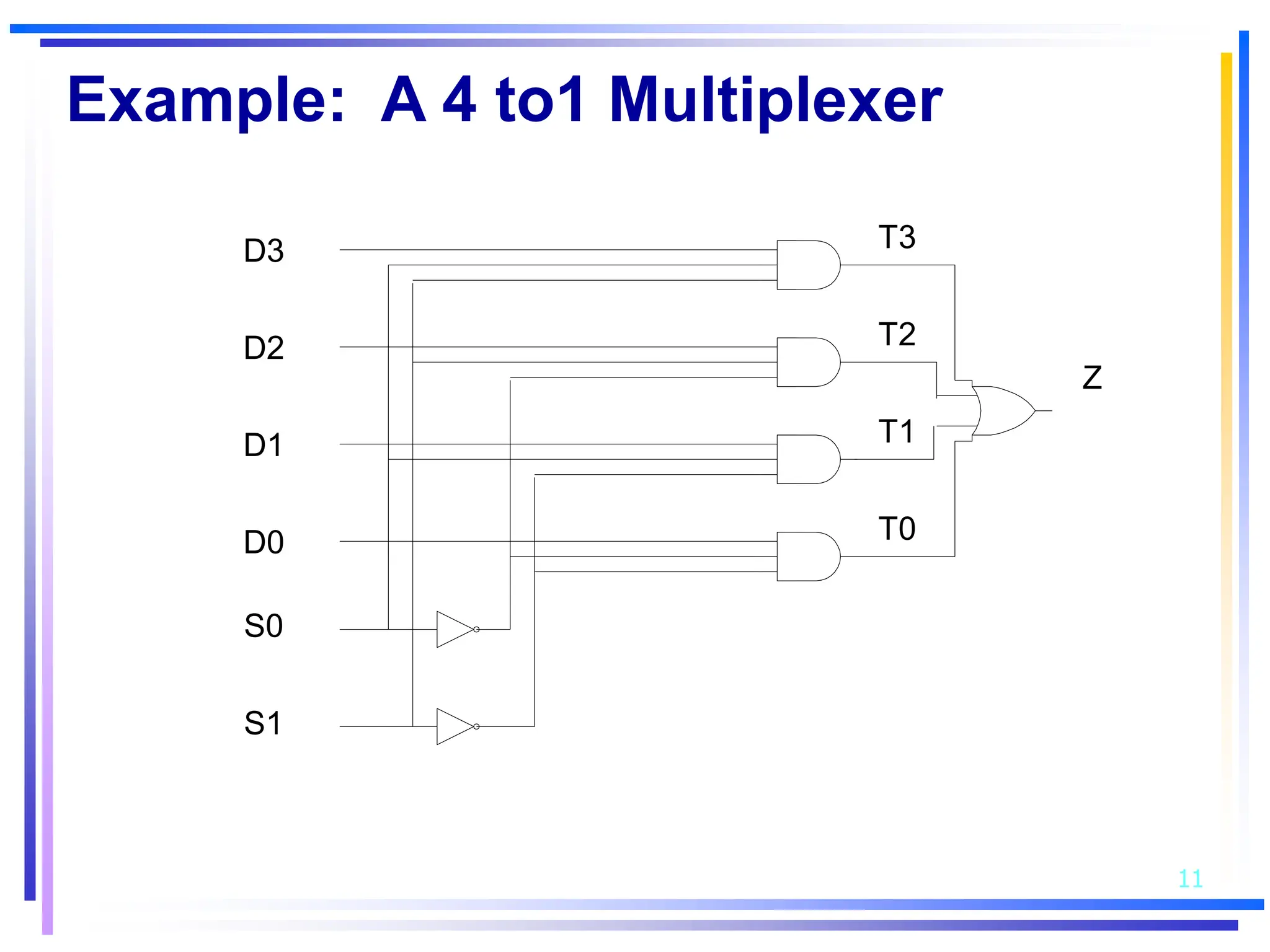
Example: A 4 to1 Multiplexer
D3
D0
D1
D2
S0
S1
Z
T3
T0
T1
T2
12
Simple Example
module Mux4_1 (Z, D,S);
output Z;
input [3:0] D;
input [1:0] S;
wire S0b, S1b, T0, T1, T2, T3;
not #5 inv0(S0b, S[0]),
inv1(S1b, S[1]);
and #10 and0(T0, D[0], S1b, S0b),
and1(T1, D[1], S1b, S[0]),
and2(T2, D[2], S[1], S0b),
and3(T3, D[3], S[0], S[1]);
or #10 or1(Z, T0,T1,T2,T3);
endmodule
13
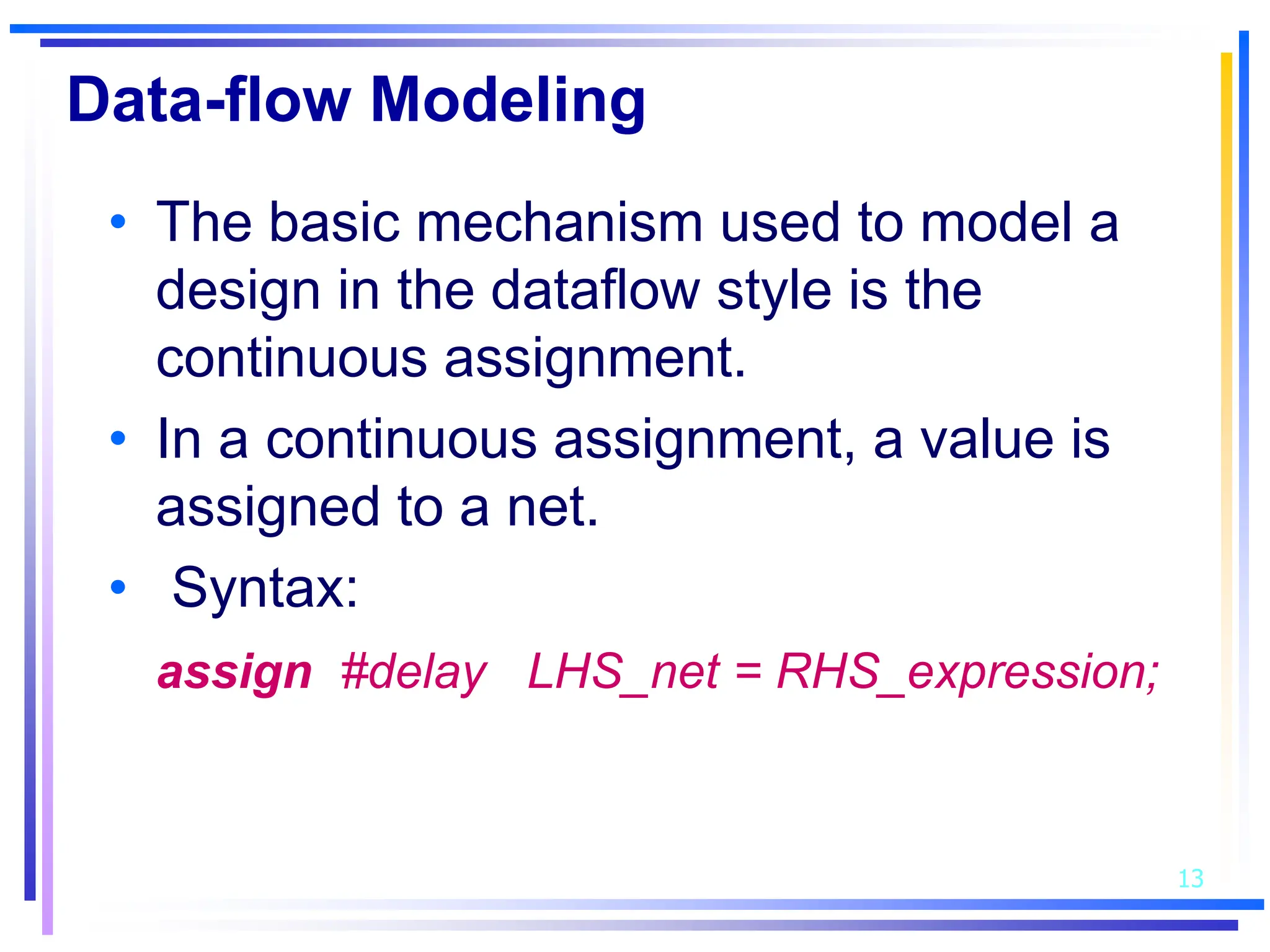
Data-flow Modeling
• The basic mechanism used to model a
design in the dataflow style is the
continuous assignment.
• In a continuous assignment, a value is
assigned to a net.
• Syntax:
assign #delay LHS_net = RHS_expression;
10/10/2023 Brigette Huang - Autumn 2002 14
Example: 2 to 4 Decoder
A
B
EN
Z[0]
Z[1]
Z[2]
Z[3]
15
Example
module Decoder 2_4(A,B,EN,Z);
Input A,B,EN;
output [0:3] Z;
wire Ab, Bb;
assign #1 Ab=~A;
assign #1 Bb=~B;
assign #2 Z[0]=~(Ab & Bb & EN);
assign #2 Z[1]=~(Ab & B & EN);
assign #2 Z[2]=~(A & Bb & EN);
assign #2 Z[3]=~(A & B & EN);
endmodule
16
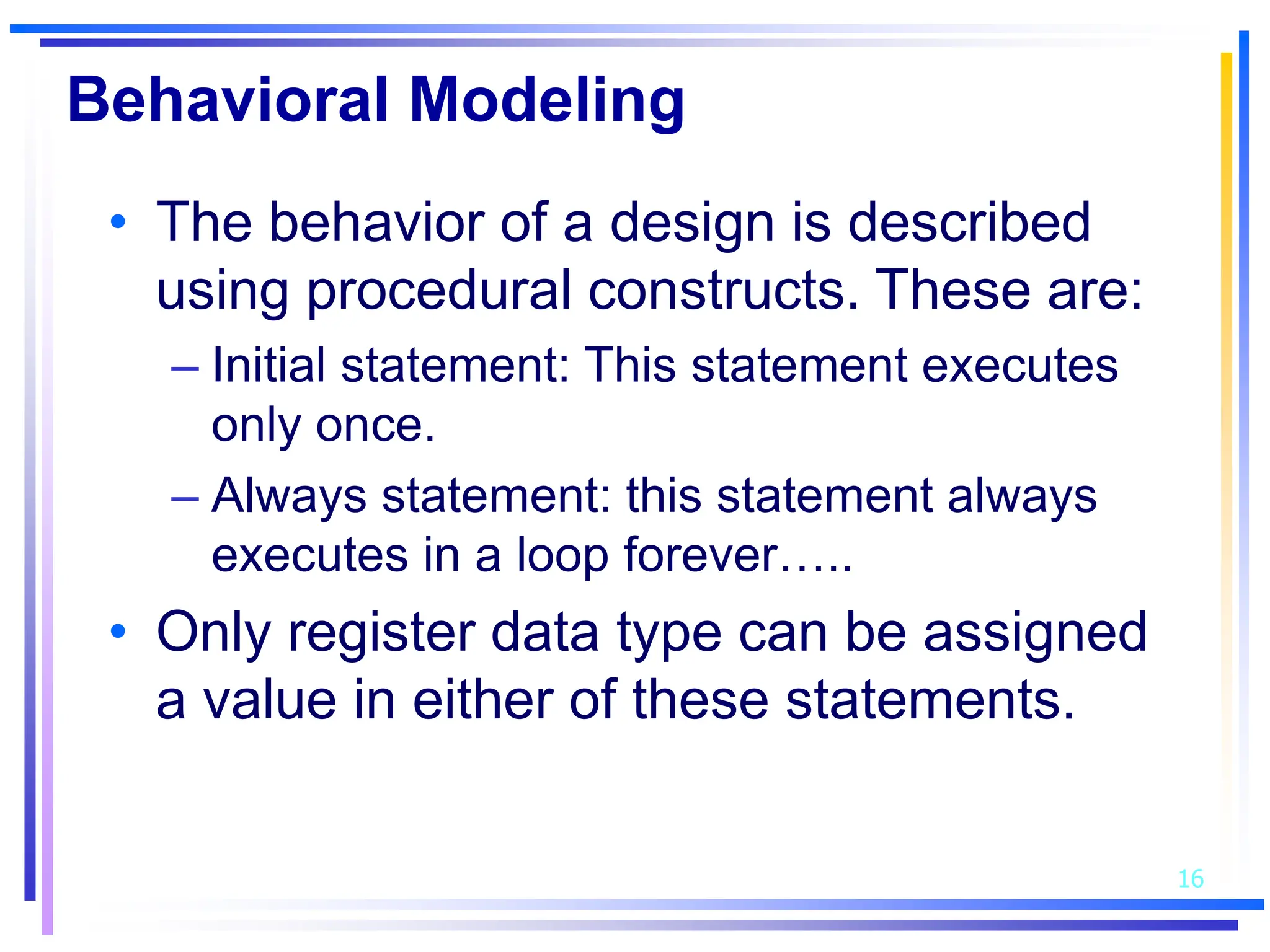
Behavioral Modeling
• The behavior of a design is described
using procedural constructs. These are:
– Initial statement: This statement executes
only once.
– Always statement: this statement always
executes in a loop forever…..
• Only register data type can be assigned
a value in either of these statements.
17
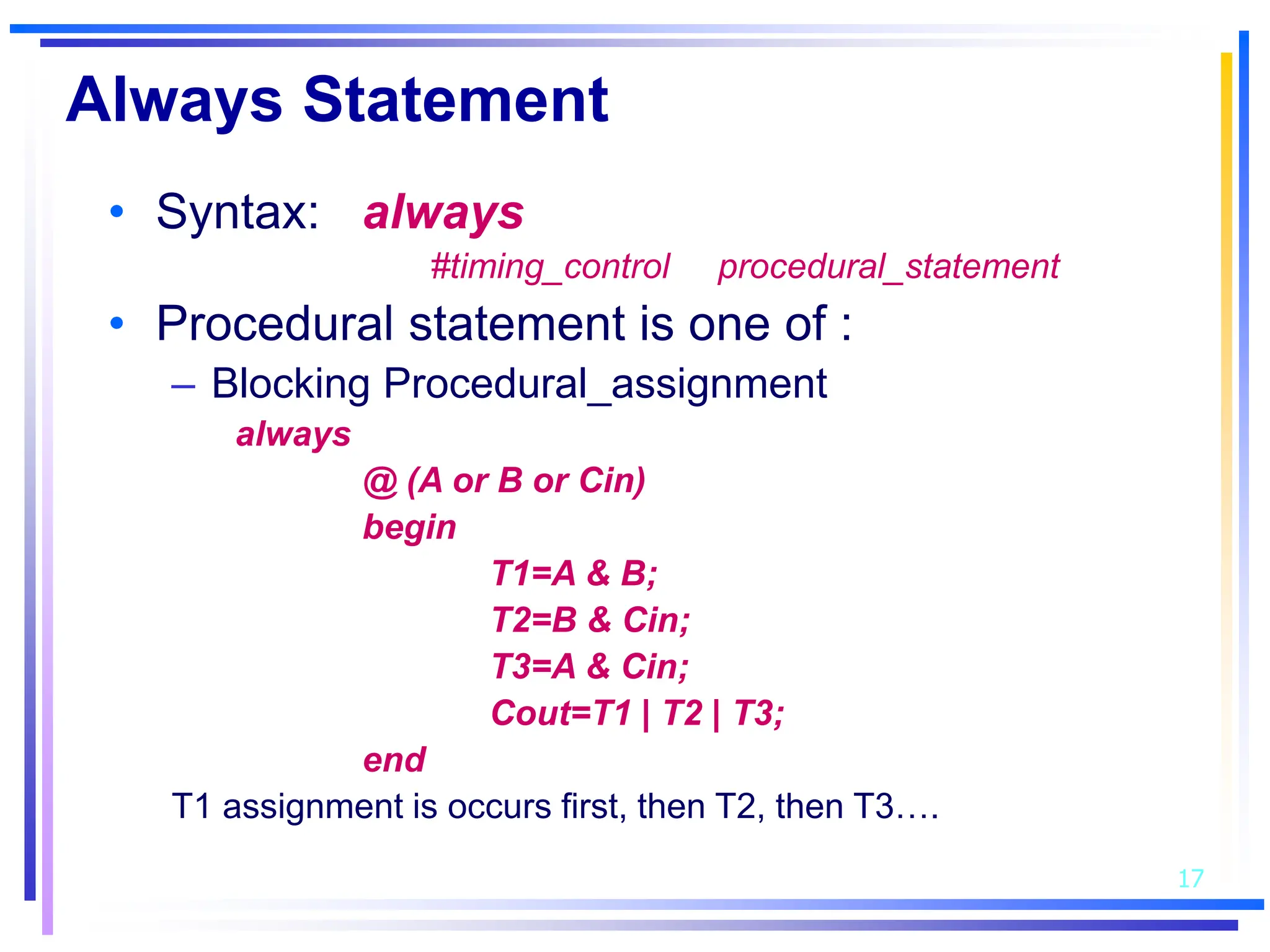
Always Statement
• Syntax: always
#timing_control procedural_statement
• Procedural statement is one of :
– Blocking Procedural_assignment
always
@ (A or B or Cin)
begin
T1=A & B;
T2=B & Cin;
T3=A & Cin;
Cout=T1 | T2 | T3;
end
T1 assignment is occurs first, then T2, then T3….
18
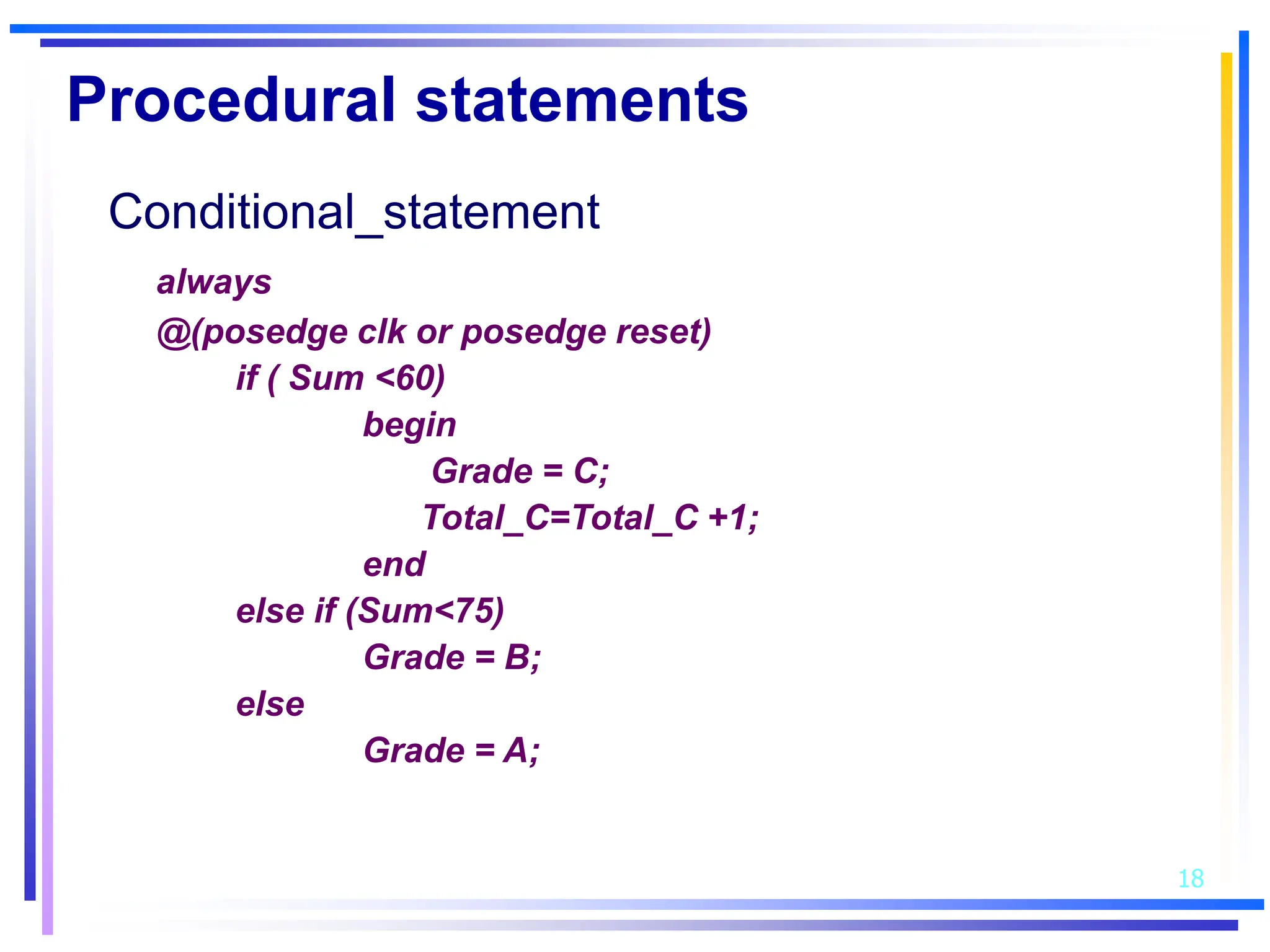
Procedural statements
Conditional_statement
always
@(posedge clk or posedge reset)
if ( Sum <60)
begin
Grade = C;
Total_C=Total_C +1;
end
else if (Sum<75)
Grade = B;
else
Grade = A;
19
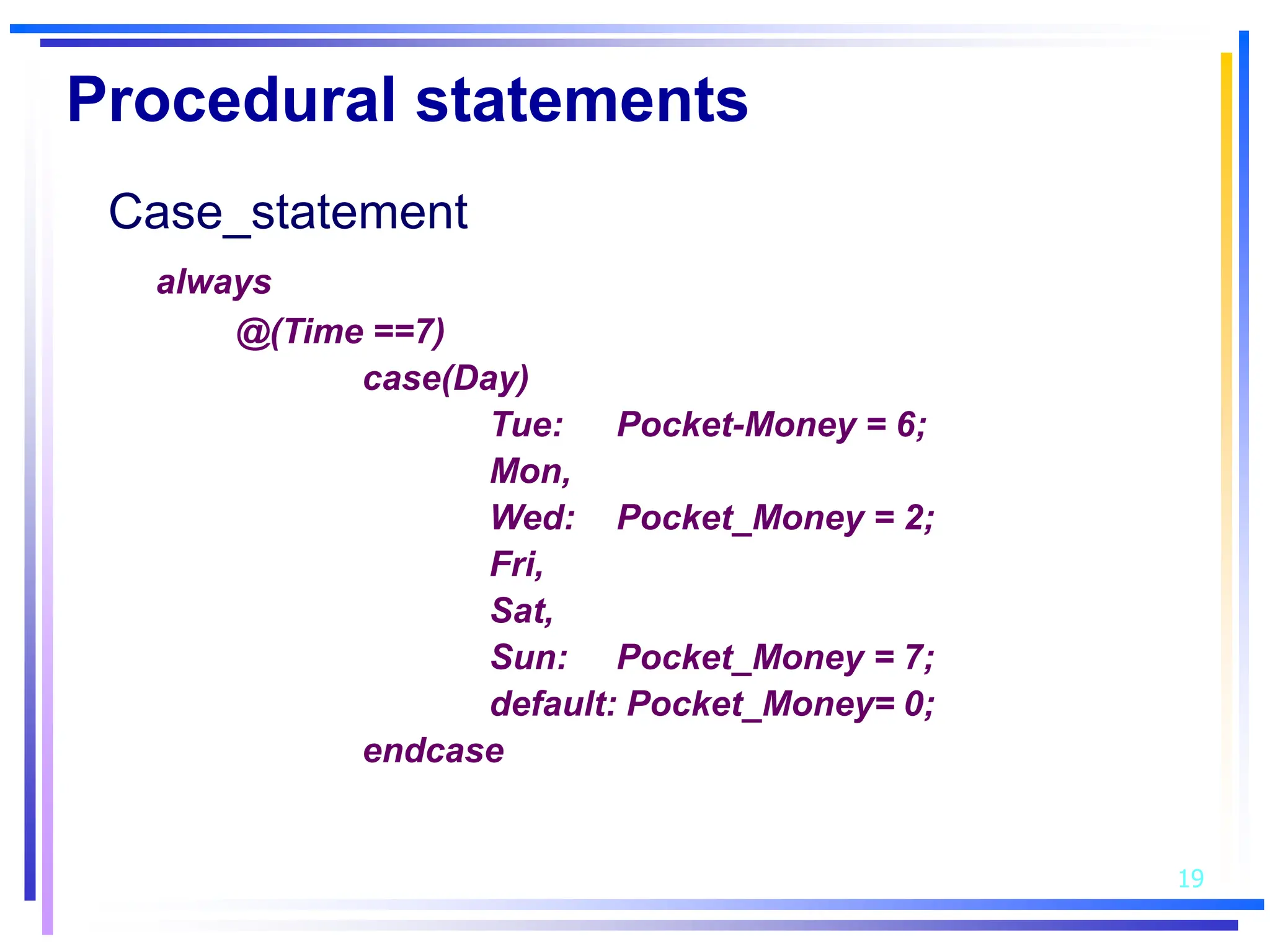
Procedural statements
Case_statement
always
@(Time ==7)
case(Day)
Tue: Pocket-Money = 6;
Mon,
Wed: Pocket_Money = 2;
Fri,
Sat,
Sun: Pocket_Money = 7;
default: Pocket_Money= 0;
endcase

VerilogHDL.ppt

  • 1.
    1 Verilog HDL Introduction PresentedBy Y. Sravan Kumar, M.Tech, (Ph.D.) Assistant Professor
  • 2.
    2 Outline • Introduction • CircuitModeling • Gate-level Modeling • Data-level Modeling • Behavioral Modeling • Testing & Simulation
  • 3.
    3 Introduction • What isVerilog HDL? Verilog HDL is a Hardware Description Language that can be used to model a digital system at many levels of abstraction: –Algorithmic-level –Gate-level –Switch-level
  • 4.
    4 Where can weuse Verilog HDL? • Verilog is designed for circuit verification and simulation, for timing analysis, for test analysis (testability analysis and fault grading) and for logic synthesis. • For example, before you get to the structural level of your design, you want to make sure the logical paths of your design is faultless and meets the spec.
  • 5.
    10/10/2023 Brigette Huang- Autumn 2002 5 Basic Procedure of Using Verilogger • Preparation – always create a new folder in C drive. – c:/documents and settings – your_login_name – your_project_folder • Start – all programs –synaptiCAD - Verilogger pro 6.5 • Editor – new HDL file – write your code – save as filename.v in your project folder • Project – add HDL files – choose the file you just saved • Project – save HDL project – save it in the your project folder too. We will continue after we finishing the modeling section…..
  • 6.
    6 Basic Syntax ofa Module Module module_name (port_list); Declarations: input, output, wire, parameter….. System Modeling: describe the system in gate-level, data-flow, or behavioral style… endmodule
  • 7.
    7 Basic Module Construction //Compute the logical AND and OR of inputs A and B. module AND_OR(andOut, orOut, A, B); output andOut, orOut; input A, B; and TheAndGate (andOut, A, B); or TheOrGate (orOut, A, B); endmodule AND_OR andOut orOut A B TheAndGate TheOrGate AND_OR andOut orOut A B TheAndGate TheOrGate
  • 8.
    8 Gate-Level Modeling Systems structurecan be described using Build-in gates or pre-built modules. Basic syntax is : gate-type #delay instance1_name(outputs.., inputs.. ), : : instance6_name(outputs.., inputs.. ); pre-built module module_instance1(output…,inputs..);
  • 9.
    9 The Built-in PrimitiveGates • Multiple-input gates: – and, nand, or, nor, xor, xnor xor xor1(out, inA, inB, inC); • Multiple-output gates: – buf, not not inverter1(fanout1, fanout2, in); • Tristate gates: – bufif0, bufif1, notif0, notif1 bufif0 tbuffer1(out, in, control);
  • 10.
    10 Gate Delays • Syntax:#(Tplh, Tphl) • Examples: nor #10 Tplh =Tphl=10 time units nor #(3,5) Tplh=3, Tphl=5 nor #(2:3:4, 5) Tplh=(min2,typ3,max4)
  • 11.
    11 Example: A 4to1 Multiplexer D3 D0 D1 D2 S0 S1 Z T3 T0 T1 T2
  • 12.
    12 Simple Example module Mux4_1(Z, D,S); output Z; input [3:0] D; input [1:0] S; wire S0b, S1b, T0, T1, T2, T3; not #5 inv0(S0b, S[0]), inv1(S1b, S[1]); and #10 and0(T0, D[0], S1b, S0b), and1(T1, D[1], S1b, S[0]), and2(T2, D[2], S[1], S0b), and3(T3, D[3], S[0], S[1]); or #10 or1(Z, T0,T1,T2,T3); endmodule
  • 13.
    13 Data-flow Modeling • Thebasic mechanism used to model a design in the dataflow style is the continuous assignment. • In a continuous assignment, a value is assigned to a net. • Syntax: assign #delay LHS_net = RHS_expression;
  • 14.
    10/10/2023 Brigette Huang- Autumn 2002 14 Example: 2 to 4 Decoder A B EN Z[0] Z[1] Z[2] Z[3]
  • 15.
    15 Example module Decoder 2_4(A,B,EN,Z); InputA,B,EN; output [0:3] Z; wire Ab, Bb; assign #1 Ab=~A; assign #1 Bb=~B; assign #2 Z[0]=~(Ab & Bb & EN); assign #2 Z[1]=~(Ab & B & EN); assign #2 Z[2]=~(A & Bb & EN); assign #2 Z[3]=~(A & B & EN); endmodule
  • 16.
    16 Behavioral Modeling • Thebehavior of a design is described using procedural constructs. These are: – Initial statement: This statement executes only once. – Always statement: this statement always executes in a loop forever….. • Only register data type can be assigned a value in either of these statements.
  • 17.
    17 Always Statement • Syntax:always #timing_control procedural_statement • Procedural statement is one of : – Blocking Procedural_assignment always @ (A or B or Cin) begin T1=A & B; T2=B & Cin; T3=A & Cin; Cout=T1 | T2 | T3; end T1 assignment is occurs first, then T2, then T3….
  • 18.
    18 Procedural statements Conditional_statement always @(posedge clkor posedge reset) if ( Sum <60) begin Grade = C; Total_C=Total_C +1; end else if (Sum<75) Grade = B; else Grade = A;
  • 19.
    19 Procedural statements Case_statement always @(Time ==7) case(Day) Tue:Pocket-Money = 6; Mon, Wed: Pocket_Money = 2; Fri, Sat, Sun: Pocket_Money = 7; default: Pocket_Money= 0; endcase