TELEMEDICINE
Presented By:
Darshil Shah (IU1241090051)
Sachin Jain (IU1241090018)
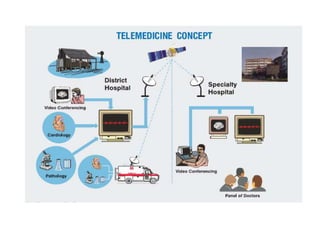
What is Telemedicine?
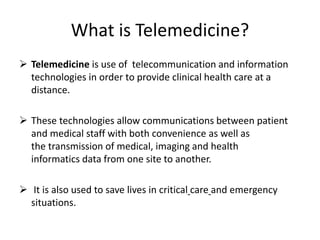
 Telemedicine is use of telecommunication and information
technologies in order to provide clinical health care at a
distance.
 These technologies allow communications between patient
and medical staff with both convenience as well as
the transmission of medical, imaging and health
informatics data from one site to another.
 It is also used to save lives in critical care and emergency
situations.
Core principles of telemedicine
 Is only a tool (like a stethoscope)
 Must be physician directed
 Must be integrated into established clinical operations and
routines
 Physician-patient relationships must be preserved
How it works
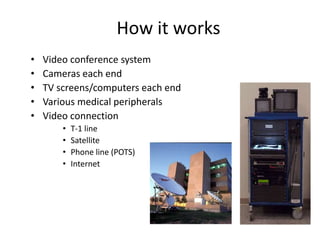
• Video conference system
• Cameras each end
• TV screens/computers each end
• Various medical peripherals
• Video connection
• T-1 line
• Satellite
• Phone line (POTS)
• Internet
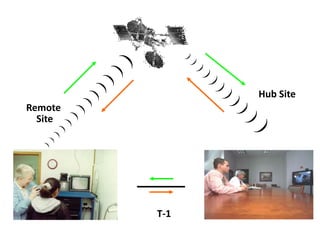
Hub Site
Remote
Site
T-1
Connectivity
 T-1 dedicated phone line
 Satellite
 ISDN
 High speed DSL/Cable
 ATM
 POTS
 LAN/WAN
 Internet, or IP-based
The barriers
 Equipment costs
 Connectivity costs
 Reimbursement
Getting better
 Declining equipment costs
 Shared connectivity
 Enhanced reimbursement (still an issue for nursing homes)
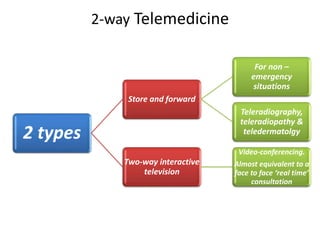
2-way Telemedicine
2 types
Store and forward
For non –
emergency
situations
Teleradiography,
teleradiopathy &
teledermatolgy
Two-way interactive
television
Video-conferencing.
Almost equivalent to a
face to face ‘real time’
consultation
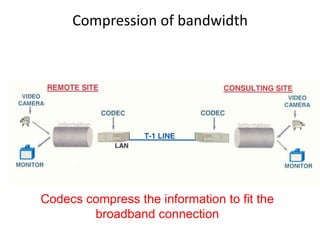
Compression of bandwidth
Codecs compress the information to fit the
broadband connection
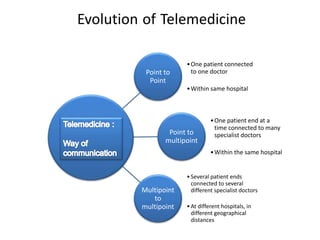
Evolution of Telemedicine
Point to
Point
•One patient connected
to one doctor
•Within same hospital
Point to
multipoint
•One patient end at a
time connected to many
specialist doctors
•Within the same hospital
Multipoint
to
multipoint
•Several patient ends
connected to several
different specialist doctors
•At different hospitals, in
different geographical
distances
Exchange of Information at a Distance
• Voice
• Image
• Video
• Graphics
• Elements of Medical Records
• Commands to a surgical robot
Technologies Involved
• Medical Instrumentation
Sensing Bio-medical Signals,
Medical Imaging, Measurement of Physical
Parameters e.g. Body Temperature, Pressure etc.
• Telecommunication Technology
Trans-receiver on different communication
channels and network such as, on wired network,
wireless medium etc.
• Information Technology
Information representation, storage,
retrieval, processing, and presentation.
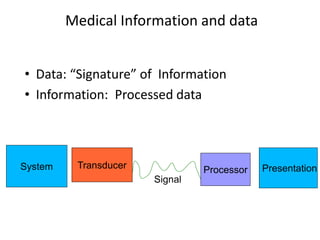
Medical Information and data
• Data: “Signature” of Information
• Information: Processed data
System Transducer
Signal
Processor Presentation
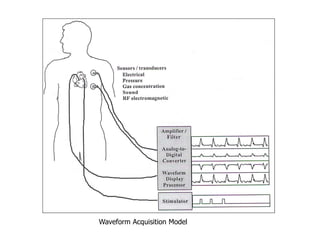
Waveform Acquisition Model
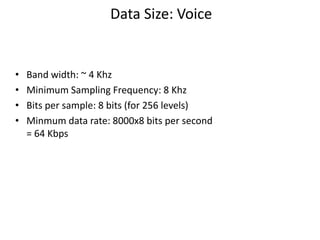
Data Size: Voice
• Band width: ~ 4 Khz
• Minimum Sampling Frequency: 8 Khz
• Bits per sample: 8 bits (for 256 levels)
• Minmum data rate: 8000x8 bits per second
= 64 Kbps
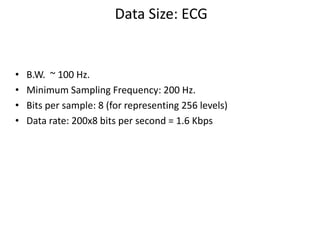
Data Size: ECG
• B.W. ~ 100 Hz.
• Minimum Sampling Frequency: 200 Hz.
• Bits per sample: 8 (for representing 256 levels)
• Data rate: 200x8 bits per second = 1.6 Kbps
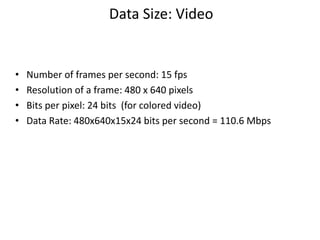
Data Size: Video
• Number of frames per second: 15 fps
• Resolution of a frame: 480 x 640 pixels
• Bits per pixel: 24 bits (for colored video)
• Data Rate: 480x640x15x24 bits per second = 110.6 Mbps
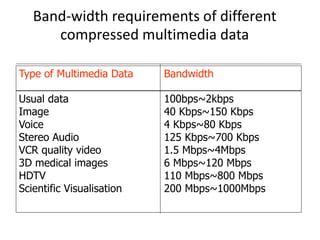
Band-width requirements of different
compressed multimedia data
Type of Multimedia Data Bandwidth
Usual data 100bps~2kbps
Image 40 Kbps~150 Kbps
Voice 4 Kbps~80 Kbps
Stereo Audio 125 Kbps~700 Kbps
VCR quality video 1.5 Mbps~4Mbps
3D medical images 6 Mbps~120 Mbps
HDTV 110 Mbps~800 Mbps
Scientific Visualisation 200 Mbps~1000Mbps
Communication Channels
Communication
Links
Satellite Wireles LAN GSM/CDMA/3GGPRS
Terrestrial
Wireless
POTS Leased lines ISDN LAN
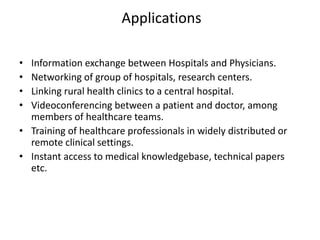
Applications
• Information exchange between Hospitals and Physicians.
• Networking of group of hospitals, research centers.
• Linking rural health clinics to a central hospital.
• Videoconferencing between a patient and doctor, among
members of healthcare teams.
• Training of healthcare professionals in widely distributed or
remote clinical settings.
• Instant access to medical knowledgebase, technical papers
etc.
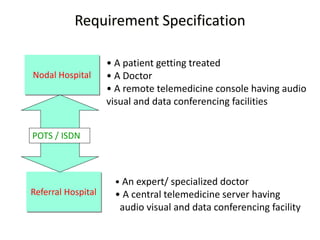
Requirement Specification
Nodal Hospital
Referral Hospital
• A patient getting treated
• A Doctor
• A remote telemedicine console having audio
visual and data conferencing facilities
• An expert/ specialized doctor
• A central telemedicine server having
audio visual and data conferencing facility
POTS / ISDN
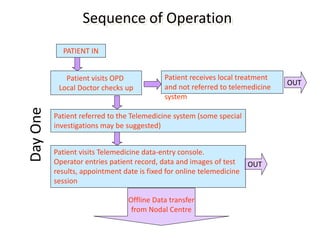
Sequence of Operation
PATIENT IN
Patient visits OPD
Local Doctor checks up
Patient receives local treatment
and not referred to telemedicine
system
Patient referred to the Telemedicine system (some special
investigations may be suggested)
Patient visits Telemedicine data-entry console.
Operator entries patient record, data and images of test
results, appointment date is fixed for online telemedicine
session
OUT
OUT
Offline Data transfer
from Nodal Centre
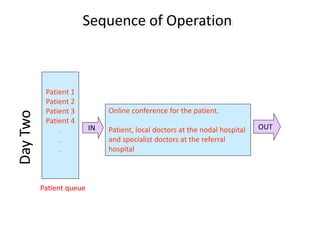
Sequence of Operation
Patient 1
Patient 2
Patient 3
Patient 4
.
.
.
Online conference for the patient.
Patient, local doctors at the nodal hospital
and specialist doctors at the referral
hospital
Patient queue
IN OUT
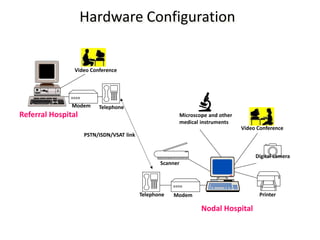
Hardware Configuration
Digital camera
Referral Hospital
Nodal Hospital
PSTN/ISDN/VSAT link
Scanner
PrinterModem
Modem
Microscope and other
medical instruments
Video Conference
Video Conference
Telephone
Telephone
Software Modules
Offline Activities
Online Activities
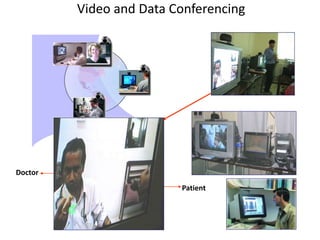
Doctor
Patient
Video and Data Conferencing
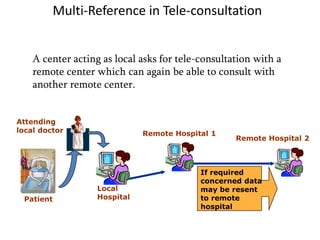
Multi-Reference in Tele-consultation
A center acting as local asks for tele-consultation with a
remote center which can again be able to consult with
another remote center.
If required
concerned data
may be resent
to remote
hospital
Patient
Local
Hospital
Attending
local doctor Remote Hospital 1
Remote Hospital 2
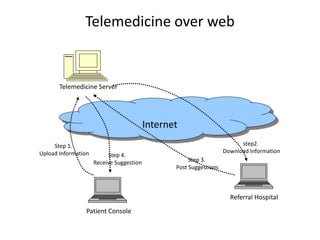
Internet
Patient Console
Referral Hospital
Step 1.
Upload Information
step2.
Download Information
Step 3.
Post Suggestions
Telemedicine Server
Step 4.
Receive Suggestion
Telemedicine over web
Mobile Healthcare
• Client interfaces for PDA and mobile phone.
• SMS based Emergency messaging system.
• Developing instruments with mobile interfaces.
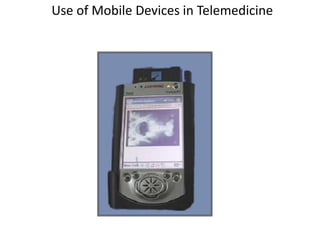
Use of Mobile Devices in Telemedicine
Limitations Of Handheld Devices
• Limitation of computational resources
a. Limited memory capacity
b. Slow execution speed
• Small screen size
Solutions
• Client Server based approach
• Data filtering
• Partitioned image display for large images
• Buffer management
Wireless Medical Information Access Server
• Patient data browsing
a. Text data
b. Image data
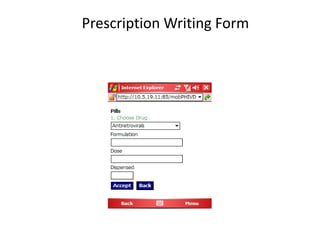
• Prescribing drugs and advice
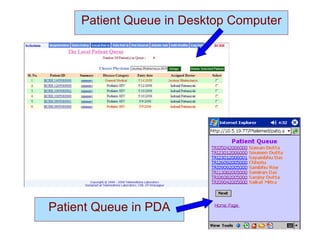
Patient Queue in PDA
Patient Queue in Desktop Computer
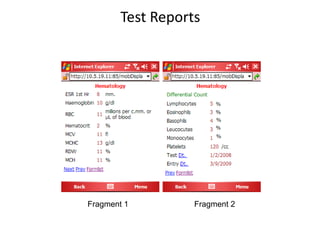
Test Reports
Fragment 1 Fragment 2
Prescription Writing Form
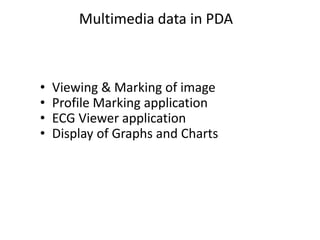
Multimedia data in PDA
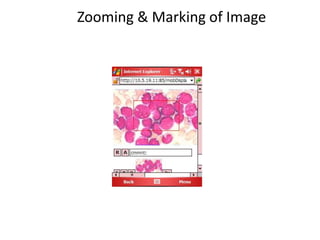
• Viewing & Marking of image
• Profile Marking application
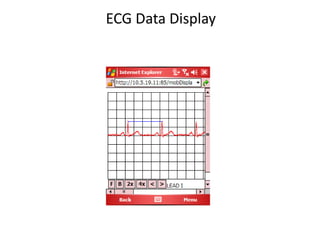
• ECG Viewer application
• Display of Graphs and Charts
Zooming & Marking of Image
ECG Data Display
Emergency Messaging Service using i-medik
• Sends SMS to doctors’ cell phones to inform him/her about
any emergency or patient referral.
• Follows the same multi-tier architecture
• EMS server resides outside the firewall intercepting
incoming -outgoing messages
Benefits of Telemedicine
• Improved Access
Covers previously unserved or underserved areas.
• Improved quality of care
Enhanced decision making through collaborative efforts.
• Reduced isolation of healthcare professionals
Peer and professional contacts for patient consultations and
continuing education.
• Reduced costs
Decreased necessity for travel and optimum uses of resources.
Conclusion
• Telemedicine being increasingly used for providing health care
services.
• Effective and efficient in managing resources and time for
delivery of health care.
• Telemedicine systems are evolving:
Peer to peer ► Centralized Server based ► Distributed
Systems.
• Looking for a great healthy future of our public health care
system in our country.
SUPPORT
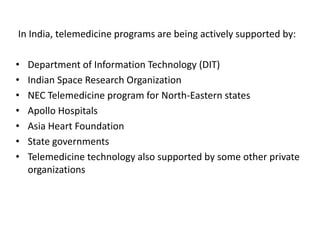
In India, telemedicine programs are being actively supported by:
• Department of Information Technology (DIT)
• Indian Space Research Organization
• NEC Telemedicine program for North-Eastern states
• Apollo Hospitals
• Asia Heart Foundation
• State governments
• Telemedicine technology also supported by some other private
organizations
References
 www.facweb.iitkgp.ernet.in/~jay/JMANU221003.ppt
 http://www.telemedicine.com/whatis.html
 https://www.ttuhsc.edu/telemedicine/documents/telemedicine_
aahsa.ppt
 www.fgse.nova.edu/itde/faculty/simonson/ppt/telemedicine.ppt
 www.powershow.com/.../Telemedicine_System_powerpoint_ppt
_present...
Telemedicine

Telemedicine

  • 1.
    TELEMEDICINE Presented By: Darshil Shah(IU1241090051) Sachin Jain (IU1241090018)
  • 2.
    What is Telemedicine? Telemedicine is use of telecommunication and information technologies in order to provide clinical health care at a distance.  These technologies allow communications between patient and medical staff with both convenience as well as the transmission of medical, imaging and health informatics data from one site to another.  It is also used to save lives in critical care and emergency situations.
  • 3.
    Core principles oftelemedicine  Is only a tool (like a stethoscope)  Must be physician directed  Must be integrated into established clinical operations and routines  Physician-patient relationships must be preserved
  • 4.
    How it works •Video conference system • Cameras each end • TV screens/computers each end • Various medical peripherals • Video connection • T-1 line • Satellite • Phone line (POTS) • Internet
  • 5.
  • 6.
    Connectivity  T-1 dedicatedphone line  Satellite  ISDN  High speed DSL/Cable  ATM  POTS  LAN/WAN  Internet, or IP-based
  • 7.
    The barriers  Equipmentcosts  Connectivity costs  Reimbursement
  • 8.
    Getting better  Decliningequipment costs  Shared connectivity  Enhanced reimbursement (still an issue for nursing homes)
  • 9.
    2-way Telemedicine 2 types Storeand forward For non – emergency situations Teleradiography, teleradiopathy & teledermatolgy Two-way interactive television Video-conferencing. Almost equivalent to a face to face ‘real time’ consultation
  • 10.
    Compression of bandwidth Codecscompress the information to fit the broadband connection
  • 11.
    Evolution of Telemedicine Pointto Point •One patient connected to one doctor •Within same hospital Point to multipoint •One patient end at a time connected to many specialist doctors •Within the same hospital Multipoint to multipoint •Several patient ends connected to several different specialist doctors •At different hospitals, in different geographical distances
  • 12.
    Exchange of Informationat a Distance • Voice • Image • Video • Graphics • Elements of Medical Records • Commands to a surgical robot
  • 13.
    Technologies Involved • MedicalInstrumentation Sensing Bio-medical Signals, Medical Imaging, Measurement of Physical Parameters e.g. Body Temperature, Pressure etc. • Telecommunication Technology Trans-receiver on different communication channels and network such as, on wired network, wireless medium etc. • Information Technology Information representation, storage, retrieval, processing, and presentation.
  • 14.
    Medical Information anddata • Data: “Signature” of Information • Information: Processed data System Transducer Signal Processor Presentation
  • 15.
  • 16.
    Data Size: Voice •Band width: ~ 4 Khz • Minimum Sampling Frequency: 8 Khz • Bits per sample: 8 bits (for 256 levels) • Minmum data rate: 8000x8 bits per second = 64 Kbps
  • 17.
    Data Size: ECG •B.W. ~ 100 Hz. • Minimum Sampling Frequency: 200 Hz. • Bits per sample: 8 (for representing 256 levels) • Data rate: 200x8 bits per second = 1.6 Kbps
  • 18.
    Data Size: Video •Number of frames per second: 15 fps • Resolution of a frame: 480 x 640 pixels • Bits per pixel: 24 bits (for colored video) • Data Rate: 480x640x15x24 bits per second = 110.6 Mbps
  • 19.
    Band-width requirements ofdifferent compressed multimedia data Type of Multimedia Data Bandwidth Usual data 100bps~2kbps Image 40 Kbps~150 Kbps Voice 4 Kbps~80 Kbps Stereo Audio 125 Kbps~700 Kbps VCR quality video 1.5 Mbps~4Mbps 3D medical images 6 Mbps~120 Mbps HDTV 110 Mbps~800 Mbps Scientific Visualisation 200 Mbps~1000Mbps
  • 20.
    Communication Channels Communication Links Satellite WirelesLAN GSM/CDMA/3GGPRS Terrestrial Wireless POTS Leased lines ISDN LAN
  • 21.
    Applications • Information exchangebetween Hospitals and Physicians. • Networking of group of hospitals, research centers. • Linking rural health clinics to a central hospital. • Videoconferencing between a patient and doctor, among members of healthcare teams. • Training of healthcare professionals in widely distributed or remote clinical settings. • Instant access to medical knowledgebase, technical papers etc.
  • 22.
    Requirement Specification Nodal Hospital ReferralHospital • A patient getting treated • A Doctor • A remote telemedicine console having audio visual and data conferencing facilities • An expert/ specialized doctor • A central telemedicine server having audio visual and data conferencing facility POTS / ISDN
  • 23.
    Sequence of Operation PATIENTIN Patient visits OPD Local Doctor checks up Patient receives local treatment and not referred to telemedicine system Patient referred to the Telemedicine system (some special investigations may be suggested) Patient visits Telemedicine data-entry console. Operator entries patient record, data and images of test results, appointment date is fixed for online telemedicine session OUT OUT Offline Data transfer from Nodal Centre
  • 24.
    Sequence of Operation Patient1 Patient 2 Patient 3 Patient 4 . . . Online conference for the patient. Patient, local doctors at the nodal hospital and specialist doctors at the referral hospital Patient queue IN OUT
  • 25.
    Hardware Configuration Digital camera ReferralHospital Nodal Hospital PSTN/ISDN/VSAT link Scanner PrinterModem Modem Microscope and other medical instruments Video Conference Video Conference Telephone Telephone
  • 26.
  • 27.
  • 28.
    Multi-Reference in Tele-consultation Acenter acting as local asks for tele-consultation with a remote center which can again be able to consult with another remote center. If required concerned data may be resent to remote hospital Patient Local Hospital Attending local doctor Remote Hospital 1 Remote Hospital 2
  • 29.
    Internet Patient Console Referral Hospital Step1. Upload Information step2. Download Information Step 3. Post Suggestions Telemedicine Server Step 4. Receive Suggestion Telemedicine over web
  • 30.
    Mobile Healthcare • Clientinterfaces for PDA and mobile phone. • SMS based Emergency messaging system. • Developing instruments with mobile interfaces.
  • 31.
    Use of MobileDevices in Telemedicine
  • 32.
    Limitations Of HandheldDevices • Limitation of computational resources a. Limited memory capacity b. Slow execution speed • Small screen size
  • 33.
    Solutions • Client Serverbased approach • Data filtering • Partitioned image display for large images • Buffer management
  • 34.
    Wireless Medical InformationAccess Server • Patient data browsing a. Text data b. Image data • Prescribing drugs and advice
  • 35.
    Patient Queue inPDA Patient Queue in Desktop Computer
  • 36.
  • 37.
  • 38.
    Multimedia data inPDA • Viewing & Marking of image • Profile Marking application • ECG Viewer application • Display of Graphs and Charts
  • 39.
  • 40.
  • 41.
    Emergency Messaging Serviceusing i-medik • Sends SMS to doctors’ cell phones to inform him/her about any emergency or patient referral. • Follows the same multi-tier architecture • EMS server resides outside the firewall intercepting incoming -outgoing messages
  • 42.
    Benefits of Telemedicine •Improved Access Covers previously unserved or underserved areas. • Improved quality of care Enhanced decision making through collaborative efforts. • Reduced isolation of healthcare professionals Peer and professional contacts for patient consultations and continuing education. • Reduced costs Decreased necessity for travel and optimum uses of resources.
  • 43.
    Conclusion • Telemedicine beingincreasingly used for providing health care services. • Effective and efficient in managing resources and time for delivery of health care. • Telemedicine systems are evolving: Peer to peer ► Centralized Server based ► Distributed Systems. • Looking for a great healthy future of our public health care system in our country.
  • 45.
    SUPPORT In India, telemedicineprograms are being actively supported by: • Department of Information Technology (DIT) • Indian Space Research Organization • NEC Telemedicine program for North-Eastern states • Apollo Hospitals • Asia Heart Foundation • State governments • Telemedicine technology also supported by some other private organizations
  • 47.
    References  www.facweb.iitkgp.ernet.in/~jay/JMANU221003.ppt  http://www.telemedicine.com/whatis.html https://www.ttuhsc.edu/telemedicine/documents/telemedicine_ aahsa.ppt  www.fgse.nova.edu/itde/faculty/simonson/ppt/telemedicine.ppt  www.powershow.com/.../Telemedicine_System_powerpoint_ppt _present...