RVS Chaitanya Koppala
Introduction
 In the past most drugs have been discovered either by
identifying the active ingredient from traditional
remedies or by serendipitous discovery.
 But now we know diseases are controlled at molecular
and physiological level.
 Also shape of an molecule at atomic level is well
understood.
 Information of Human Genome
History of Drug Discovery
: Pre 1919
• Herbal Drugs
• Serendiptious discoveries
1920s, 30s
• Vitamins
• Vaccines
1940s
• Antibiotic Era
• R&D Boost due to WW2
1950s
• New technology,
• Discovery of DNA
1960s
• Breakthrough in Etiology
1970s
• Rise of Biotechnology
• Use of IT
1980s
• Commercialization of
Drug Discovery
• Combinatorial Chemistry
1990s
• Robotics
• Automation
Registration:
 The Ministry of health & Family Welfare and the
Ministry of Chemicals & Fertilizers have major role in
regulation of IPM.
 NDA must be submitted to DCGI
 Phase III study reported to CDL, Kolkata
 Package inserted approved by DCI
 Marketing approval from FDA
 ~$800 M spent to bring a new drug to market.
 $182 Billion spent on Pharma R&D in 2016
 Share of CROs in research operations is 27%
 World CRO market is 16.3 B (Indian share $500 M)
Market Scenerio:
Top CROs (By Revenue)
Contract Research Organizations Firm focus on
Quintiles Clinical development to marketing
Covance Clinical research
Parexel Biopharma, medical devices, diagnostics
InVentiv Health Clinical development to marketing
Icon Genomic sciences and oncology
PRA Health Sciences Biologics and bioanalytics
PPD Drug development process
Charles River Laboratories Pharmaceutical and agricultures services
Chiltern Clinical data managment
INC research Late stage clinical trials
Top CROs (India)
Contract Research Organizations Location
Actimus Biosciences Hyderabad
Advinus Therapeutics Bangalore
Aurigene Discovery technologies Bangalore
Chembiotek Kolkata
GVK Biosciences Hyderabad
Jubilant Organosys Bangalore
Ranbaxy Life Sciences Mumbai
Reliance Life Sciences Mumbai
Suven Life Sciences Hyderabad
Syngene Bangalore
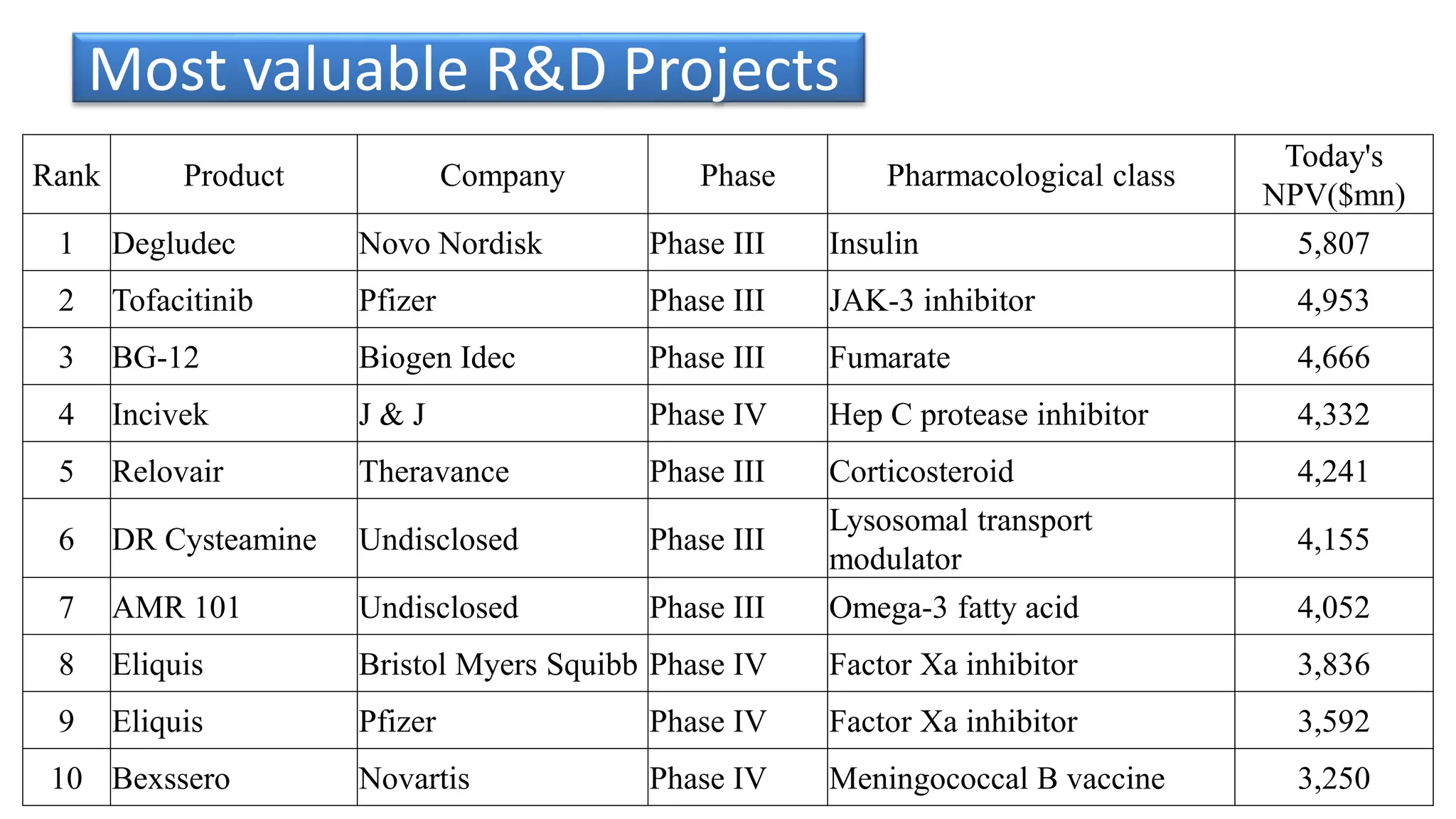
Most valuable R&D Projects
Rank Product Company Phase Pharmacological class
Today's
NPV($mn)
1 Degludec Novo Nordisk Phase III Insulin 5,807
2 Tofacitinib Pfizer Phase III JAK-3 inhibitor 4,953
3 BG-12 Biogen Idec Phase III Fumarate 4,666
4 Incivek J & J Phase IV Hep C protease inhibitor 4,332
5 Relovair Theravance Phase III Corticosteroid 4,241
6 DR Cysteamine Undisclosed Phase III
Lysosomal transport
modulator
4,155
7 AMR 101 Undisclosed Phase III Omega-3 fatty acid 4,052
8 Eliquis Bristol Myers Squibb Phase IV Factor Xa inhibitor 3,836
9 Eliquis Pfizer Phase IV Factor Xa inhibitor 3,592
10 Bexssero Novartis Phase IV Meningococcal B vaccine 3,250
Top Companies by R&D Expense:
Sr. No. Company R & D spend ($bn) ,2010
1 Novartis 7.9
2 Merck & Co 8.1
3 Roche 7.8
4 GlaxoSmithKline 5.7
5 Sanofi 5.8
6 Pfizer 9.1
7 Johnson & Johnson 4.5
8 Eli Lilly 4.7
9 AstraZeneca 4.2
10 Takeda 3.4
11 Bayer 2.3
12 Bristol-Myers Squibb 3.3
13 Boehringer Ingelheim 3.1
14 Amgen 2.8
15 Novo Nordisk 1.7
Drug Development Cost Break-up
R&D Function %
Discovery/Basic Research
Synthesis & Extraction 10.0
Biological Screening & testing 14.2
Preclinical Testing
Toxicology & Safety testing 4.5
Pharmaceutical Dosage Formulation 7.3
Clinical Trials
Phase I, II, III 29.1
Phase IV 11.7
Manufacturing & QC 8.3
IND & NDA 4.1
Bioavailability 1.8
Others 9.0
Total 100.0
10,000
COMPOUNDS
250
COMPOUNDS 5 COMPOUNDS
1 FDA
APPROVED
DRUG
~6.5 YEARS ~7 YEARS ~1.5 YEARS
DRUG
DISCOVERY
PRECLINICAL
CLINICAL TRIALS FDA
REVIEW
Drug Discovery &
Development-Timeline
Drug Discovery
Drugs Discovery methods:
Random Screening
Molecular Manipulation
Molecular Designing
Drug Metabolites
Serendipity
Target
Selection
• Cellular and
Genetic
Targets
• Genomics
• Proteomics
• Bioinformatics
Lead
Discovery
• Synthesis and
Isolation
• Combinatorial
Chemistry
• Assay
development
• High-
Throughput
Screening
Medicinal
Chemistry
• Library
Development
• SAR Studies
• In Silico
Screening
• Chemical
Synthesis
In Vitro
Studies
• Drug Affinity
and
Selectivity
• Cell Disease
Models
• MOA
• Lead
Candidate
Refinement
In Vivo
Studies
• Animal
models of
Disease States
• Behavioural
Studies
• Functional
Imaging
• Ex-Vivo
Studies
Clinical
Trials and
Therapeutics
Target Selection Lead
Discovery
Medicinal
Chemistry
In Vitro
Studies
In Vivo
Studies
Clinical
Trials
Cellular &
Genetic Targets
Genomics
Proteomics
Bioinformatics
Target Selection
 The decision to focus on finding an agent with a particular biological
action that is anticipated to have therapeutic utility.
 Target identification: targets that are involved in disease progression.
 Target validation: to prove that manipulating the molecular target can
provide therapeutic benefit for patients.
Target Selection Lead
Discovery
Medicinal
Chemistry
In Vitro
Studies
In Vivo
Studies
Clinical
Trials
Cellular &
Genetic Targets
Genomics
Proteomics
Bioinformatics
Target Selection
Biochemical Classes of Drug Targets
 G-protein coupled receptors - 45%
 Enzymes - 28%
 Hormones and factors - 11%
 Ion channels - 5%
 Nuclear receptors - 2%
Techniques for Target Identification
Target Selection Lead
Discovery
Medicinal
Chemistry
In Vitro
Studies
In Vivo
Studies
Clinical
Trials
Cellular &
Genetic Targets
Genomics
Proteomics
Bioinformatics
Cellular & Genetic Targets:
 Involves the identification of the function of a potential therapeutic
drug target and its role in the disease process.
 For small-molecule drugs, this step in the process involves
identification of the target receptors or enzymes
 Where as for some biologic approaches the focus is at the gene or
transcription level.
 Drugs usually act on either cellular or genetic chemicals in the body,
known as targets, which are believed to be associated with disease.
Target Selection Lead
Discovery
Medicinal
Chemistry
In Vitro
Studies
In Vivo
Studies
Clinical
Trials
Cellular &
Genetic Targets
Genomics
Proteomics
Bioinformatics
Genomics:
The study of genes and their function. Genomics aims to
understand the structure of the genome, including the mapping
genes and sequencing the DNA.
Seeks to exploit the findings from the sequencing of the human
and other genomes to find new drug targets.
Human Genome consists of a sequence of around 3 billion
nucleotides (the A C G T bases) which in turn probably encode
35,000 – 50,000 genes.
Target Selection Lead
Discovery
Medicinal
Chemistry
In Vitro
Studies
In Vivo
Studies
Clinical
Trials
Cellular &
Genetic Targets
Genomics
Proteomics
Bioinformatics
Genomics:
 Drew’s et al estimates that the number of genes implicated
in disease, both those due to defects in single genes and
those arising from combinations of genes, is about 1,000
 He proposes that the number of potential drug targets may
lie between 5,000 and 10,000.
 Single Nucleotide Polymorphism (SNP) libraries: are used to
compare the genomes from both healthy and sick people
and to identify where their genomes vary.
Target Selection Lead
Discovery
Medicinal
Chemistry
In Vitro
Studies
In Vivo
Studies
Clinical
Trials
Cellular &
Genetic Targets
Genomics
Proteomics
Bioinformatics
Proteomics:
 It is the study of the proteome, the complete set of proteins
produced by a species, using the technologies of large – scale
protein separation and identification.
 It is also at the protein level that disease processes become
manifest, and at which most (91%) drugs act.
 Therefore, the analysis of proteins (including protein-protein,
protein-nucleic acid, and protein ligand interactions) will be utmost
importance to target discovery.
Target Selection Lead
Discovery
Medicinal
Chemistry
In Vitro
Studies
In Vivo
Studies
Clinical
Trials
Cellular &
Genetic Targets
Genomics
Proteomics
Bioinformatics
Proteomics:
 Proteomics is the systematic high-throughput separation
and characterization of proteins within biological
systems.
 Target identification with proteomics is performed by
comparing the protein expression levels in normal and
diseased tissues.
 2D PAGE is used to separate the proteins, which are
subsequently identified and fully characterized with LC-
MS/MS.
Target Selection Lead
Discovery
Medicinal
Chemistry
In Vitro
Studies
In Vivo
Studies
Clinical
Trials
Cellular &
Genetic Targets
Genomics
Proteomics
Bioinformatics
Bioinformatics:
Bioinformatics is a branch of molecular biology that involves extensive
analysis of biological data using computers, for the purpose of enhancing
biological research.
It plays a key role in various stages of the drug discovery process
including
 Target identification
 Computer screening of chemical compounds
 Pharmacogenomics
Target Selection Lead
Discovery
Medicinal
Chemistry
In Vitro
Studies
In Vivo
Studies
Clinical
Trials
Cellular &
Genetic Targets
Genomics
Proteomics
Bioinformatics
Bioinformatics:
 Bioinformatics methods are used to transform the raw
sequence into meaningful information
 Can compare the entire genome of pathogenic and non-
pathogenic strains of a microbe
 Using gene expression micro arrays and gene chip
technologies,
 single device can be used to evaluate and compare the
expression of up to 20000 genes of healthy and diseased
individuals at once
Target Selection Lead
Discovery
Medicinal
Chemistry
In Vitro
Studies
In Vivo
Studies
Clinical
Trials
Synthesis and
Isolation
Combinatorial
Chemistry
Assay
Development
High
Throughput
Screening
Lead Discovery:
 Identification of small molecule modulators
of protein function
 The process of transforming these into high-
content lead series.
Target Selection Lead
Discovery
Medicinal
Chemistry
In Vitro
Studies
In Vivo
Studies
Clinical
Trials
Synthesis and
Isolation
Combinatorial
Chemistry
Assay
Development
High
Throughput
Screening
Synthesis and Isolation:
 Separation of mixture
 Separation of impurities
 In vitro chemical synthesis
 Biosynthetic intermediate
Target Selection Lead
Discovery
Medicinal
Chemistry
In Vitro
Studies
In Vivo
Studies
Clinical
Trials
Synthesis and
Isolation
Combinatorial
Chemistry
Assay
Development
High
Throughput
Screening
Combinatorial Chemistry:
Rapid synthesis of or computer simulation of large no. of
different but structurally related molecules
 Search new leads
 Optimization of target affinity & selectivity.
 ADME properties
 Reduce toxicity and eliminate side effects
Target Selection Lead
Discovery
Medicinal
Chemistry
In Vitro
Studies
In Vivo
Studies
Clinical
Trials
Synthesis and
Isolation
Combinatorial
Chemistry
Assay
Development
High
Throughput
Screening
Assay Development
• Used for measuring the activity of a drug.
• Discriminate between compounds.
• Evaluate:
• Expressed protein targets.
• Enzyme/ substrate interactions.
Target Selection Lead
Discovery
Medicinal
Chemistry
In Vitro
Studies
In Vivo
Studies
Clinical
Trials
Synthesis and
Isolation
Combinatorial
Chemistry
Assay
Development
High
Throughput
Screening
High throughput screening:
 Screening of drug target against selection of
chemicals.
 Identification of highly target specific
compounds.
Target Selection Lead
Discovery
Medicinal
Chemistry
In Vitro
Studies
In Vivo
Studies
Clinical
Trials
Synthesis and
Isolation
Combinatorial
Chemistry
Assay
Development
High
Throughput
Screening
High throughput screening:
Target Selection Lead
Discovery
Medicinal
Chemistry
In Vitro
Studies
In Vivo
Studies
Clinical
Trials
Library
Development
SAR Studies
In Silico
Screening
Chemical
Synthesis
Medicinal Chemistry:
 It’s a discipline at the intersection of synthetic
organic chemistry and pharmacology.
 Focuses on small organic molecules (and not on
biologics and inorganic compounds)
 Used in
• Drug discovery (hits)
• Lead optimization (hit to lead)
• Process chemistry and development
Target Selection Lead
Discovery
Medicinal
Chemistry
In Vitro
Studies
In Vivo
Studies
Clinical
Trials
Library
Development
SAR Studies
In Silico
Screening
Chemical
Synthesis
Library Development:
 Collection of stored chemicals along with
associated database.
 Assists in High Throughput Screening
 Helps in screening of drug target (hit)
 Based on organic chemistry
Target Selection Lead
Discovery
Medicinal
Chemistry
In Vitro
Studies
In Vivo
Studies
Clinical
Trials
Library
Development
SAR Studies
In Silico
Screening
Chemical
Synthesis
SAR Studies:
 Helps identify pharmacophore
 The pharmacophore is the precise section of
the molecule that is responsible for biological
activity
 Enables to prepare more active compound
 Allow elimination of excessive functionality
Target Selection Lead
Discovery
Medicinal
Chemistry
In Vitro
Studies
In Vivo
Studies
Clinical
Trials
Library
Development
SAR Studies
In Silico
Screening
Chemical
Synthesis
SAR Studies:
Morphine Molecule
Target Selection Lead
Discovery
Medicinal
Chemistry
In Vitro
Studies
In Vivo
Studies
Clinical
Trials
Library
Development
SAR Studies
In Silico
Screening
Chemical
Synthesis
In silico screening:
 Computer simulated screening of chemicals
 Helps in finding structures that are most
likely to bind to drug target.
 Filter enormous Chemical space
 Economic than HTS
Target Selection Lead
Discovery
Medicinal
Chemistry
In Vitro
Studies
In Vivo
Studies
Clinical
Trials
Library
Development
SAR Studies
In Silico
Screening
Chemical
Synthesis
Chemical Synthesis:
 Involve production of lead compound in suitable
quantity and quality to allow large scale animal and
eventual, extensive human clinical trials
 Optimization of chemical route for bulk industrial
production.
 Suitable drug formulation
Target Selection Lead
Discovery
Medicinal
Chemistry
In Vitro
Studies
In Vivo
Studies
Clinical
Trials
Drug Affinity
and Selectivity
Cell Disease
Models
MOA
Lead Candidate
Refinement
In Vitro Studies:
 (In glass) studies using component of organism i.e. test tube
experiments (simulated experiments)
 Examples-
• Cells derived from multicellular organisms
• Subcellular components (Ribosomes, mitochondria)
• Cellular/ subcellular extracts (wheat germ, reticulocyte
extract)
• Purified molecules (DNA,RNA)
Target Selection Lead
Discovery
Medicinal
Chemistry
In Vitro
Studies
In Vivo
Studies
Clinical
Trials
Drug Affinity
and Selectivity
Cell Disease
Models
MOA
Lead Candidate
Refinement
In Vitro Studies:
Advantages:
• Studies can be completed in short period of time.
• Reduces risk in post clinical trials
• permits an enormous level of simplification of the system
• investigator can focus on a small number of components
Target Selection Lead
Discovery
Medicinal
Chemistry
In Vitro
Studies
In Vivo
Studies
Clinical
Trials
Drug Affinity
and Selectivity
Cell Disease
Models
MOA
Lead Candidate
Refinement
Drug affinity and selectivity
• Drug affinity is the ability of drug to bind to its biological
target (receptor, enzyme, transport system, etc.)
• Selectivity- Drug should bind to specific receptor site on the
cell (eg. Aspirin)
Target Selection Lead
Discovery
Medicinal
Chemistry
In Vitro
Studies
In Vivo
Studies
Clinical
Trials
Drug Affinity
and Selectivity
Cell Disease
Models
MOA
Lead Candidate
Refinement
• Isogenic human disease models- are a family of cells that are
selected or engineered to accurately model the genetics of a specific
patient population, in vitro
• Stem cell disease models-Adult or embryonic stem cells carrying
or induced to carry defective genes can be investigated in vitro to
understand latent molecular mechanisms and disease characteristics
Cell disease models
Target Selection Lead
Discovery
Medicinal
Chemistry
In Vitro
Studies
In Vivo
Studies
Clinical
Trials
Drug Affinity
and Selectivity
Cell Disease
Models
MOA
Lead Candidate
Refinement
 Optimizing chemical hits for clinical trial is commonly referred
to as lead optimization
 The refinement in structure is necessary in order to improve
• Potency
• Oral Availability
• Selectivity
• Pharmacokinetic properties
• Safety (ADME properties)
Lead Candidate refinement
Target Selection Lead
Discovery
Medicinal
Chemistry
In Vitro
Studies
In Vivo
Studies
Clinical
Trials
Animal models of
Disease States
Behavioural
Studies
Functional
Imaging
Ex-Vivo Studies
In vivo studies
 Its experimentation using a whole, living organism.
 Gives information about,
• Metabolic profile
• Toxicology
• Drug interaction
Target Selection Lead
Discovery
Medicinal
Chemistry
In Vitro
Studies
In Vivo
Studies
Clinical
Trials
Animal models of
Disease States
Behavioural
Studies
Functional
Imaging
Ex-Vivo Studies
Animal models of disease states
 Test conditions involving induced disease or
injury similar to human conditions.
 Must be equivalent in mechanism of cause.
 Can predict human toxicity in 71% of the
cases.
Eg. SCID mice-HIV
NOD mice- Diabetes
Danio rerio- Gene function
Target Selection Lead
Discovery
Medicinal
Chemistry
In Vitro
Studies
In Vivo
Studies
Clinical
Trials
Animal models of
Disease States
Behavioural
Studies
Functional
Imaging
Ex-Vivo Studies
Behavioural Studies
 Tools to investigate behavioural results of drugs.
 Used to observe depression and mental disorders.
 However self esteem and suicidality are hard to induce.
 Example:
 Despair based- Forced swimming/ Tail suspension
 Reward based
 Anxiety Based
Target Selection Lead
Discovery
Medicinal
Chemistry
In Vitro
Studies
In Vivo
Studies
Clinical
Trials
Animal models of
Disease States
Behavioural
Studies
Functional
Imaging
Ex-Vivo Studies
Functional Imaging:
 Method of detecting or measuring changes in
metabolism, blood flow, regional chemical
composition, and absorption.
 Tracers or probes used.
 Modalities Used-
 MRI
 CT-Scan
Target Selection Lead
Discovery
Medicinal
Chemistry
In Vitro
Studies
In Vivo
Studies
Clinical
Trials
Animal models of
Disease States
Behavioural
Studies
Functional
Imaging
Ex-Vivo Studies
Ex-Vivo Studies:
 Experimentation on tissue in an artificial
environment outside the organism with the
minimum alteration of natural conditions.
 Counters ethical issues.
 Examples:
 Measurement of tissue properties
 Realistic models for surgery
Target Selection Lead
Discovery
Medicinal
Chemistry
In Vitro
Studies
In Vivo
Studies
Clinical
Trials
Phase-I
Phase-II
Phase-III
Phase-IV
Clinical trials:
 An investigational new drug application (IND) : outlines what the
sponsor of a new drug proposes for human testing in clinical trials.
 Phase 0
 Phase I studies
 Phase II studies
 Phase III studies
 Submission of New Drug Application (NDA) is the formal step asking
the FDA to consider a drug for marketing approval.
 FDA reviewers will approve the application or find it either
 "approvable" or "not approvable."
 Phase IV studies
Target Selection Lead
Discovery
Medicinal
Chemistry
In Vitro
Studies
In Vivo
Studies
Clinical
Trials
Phase-I
Phase-II
Phase-III
Phase-IV
Target Selection Lead
Discovery
Medicinal
Chemistry
In Vitro
Studies
In Vivo
Studies
Clinical
Trials
Phase-I
Phase-II
Phase-III
Phase-IV
Target Selection Lead
Discovery
Medicinal
Chemistry
In Vitro
Studies
In Vivo
Studies
Clinical
Trials
Phase-I
Phase-II
Phase-III
Phase-IV
Target Selection Lead
Discovery
Medicinal
Chemistry
In Vitro
Studies
In Vivo
Studies
Clinical
Trials
Phase-I
Phase-II
Phase-III
Phase-IV
Phase 0:
 Study of new drug in microdoses to derive PK information in human
before undertaking phase I studies is called PHASE O
 Microdose: Less than 1/100 of the dose of a test substance calculated
to produce pharmacological effect with a max dose ≤100 micrograms
 Objective: To obtain preliminary Pharmacokinetic data.
 Preclinical Data: Subacute toxicity study in one species by two routes
of administration.
Target Selection Lead
Discovery
Medicinal
Chemistry
In Vitro
Studies
In Vivo
Studies
Clinical
Trials
Phase-I
Phase-II
Phase-III
Phase-IV
Phase I:
 Clinical Pharmacologic Evaluation
 First stage of testing in human subjects.
 20-50 Healthy Volunteers
 Concerned With:
– Human Toxicity and Tolerated Dosage Range
– Pharmacokinetics
– Pharmacology/dynamics
Target Selection Lead
Discovery
Medicinal
Chemistry
In Vitro
Studies
In Vivo
Studies
Clinical
Trials
Phase-I
Phase-II
Phase-III
Phase-IV
Phase I:
Types of Phase-I Trials
• SAD (Single Ascending Dose)
• MAD (Multiple Ascending Dose)
• Food effect
Target Selection Lead
Discovery
Medicinal
Chemistry
In Vitro
Studies
In Vivo
Studies
Clinical
Trials
Phase-I
Phase-II
Phase-III
Phase-IV
Phase II:
• Controlled Clinical Evaluation.
• 50-300 Patients
• Controlled Single Blind Technique
• Concerned With:
– Safety
– Efficacy
– Drug Toxicity
– Drug Interaction
Target Selection Lead
Discovery
Medicinal
Chemistry
In Vitro
Studies
In Vivo
Studies
Clinical
Trials
Phase-I
Phase-II
Phase-III
Phase-IV
Phase II Types:
 Phase IIA: Designed to assess dosing requirements
 Phases IIB: Designed to study efficacy
Phase IIA Phase IIB
EARLY PHASE LATE PHASE
Pilot clinical trials Pivotal clinical trials
20-200 PATIENTS 50-300 PATIENTS
Not multicentric Multicentric
SINGLE BLIND comparison with a
standard drug
DOUBLE BLIND compared with a
placebo or standard drug
Target Selection Lead
Discovery
Medicinal
Chemistry
In Vitro
Studies
In Vivo
Studies
Clinical
Trials
Phase-I
Phase-II
Phase-III
Phase-IV
Phase III:
• Extended Clinical Trials.
• Most expensive & time consuming.
• 250-1000 Patients.
• Controlled Double Blind Technique.
• Concerned With:
– Safety, Efficacy
– Comparison with other Drugs
– Package Insert
Target Selection Lead
Discovery
Medicinal
Chemistry
In Vitro
Studies
In Vivo
Studies
Clinical
Trials
Phase-I
Phase-II
Phase-III
Phase-IV
Phase IIIa Phase IIIb
Prior to NDA After the NDA but prior to the
approval and launch.
Generates data on safety and efficacy These may supplement or complete the
earlier trials or may be directed to
Phase IV trials
Phase III Studies : End of Clinical Trial Activities
Sponsor: Expert Committee review of Efficacy, safety and potential
sales (Profit).
 Go-No Go decision to file new drug application with DCGI
 Expert review by DCGI’s Committee
 DCGI approval
 NCE marketed :Phase IV begins
Target Selection Lead
Discovery
Medicinal
Chemistry
In Vitro
Studies
In Vivo
Studies
Clinical
Trials
Phase-I
Phase-II
Phase-III
Phase-IV
Phase IV:
• Post Marketing Surveillance.
• Designed to detect any rare or long-term
adverse effects.
• Adverse Drug Reaction Monitoring.
• Pharmacovigilance.
10,000
COMPOUNDS
250
COMPOUNDS 5 COMPOUNDS
1 FDA
APPROVED
DRUG
~6.5 YEARS ~7 YEARS ~1.5 YEARS
DRUG
DISCOVERY
PRECLINICAL
CLINICAL TRIALS FDA
REVIEW
Drug Discovery &
Development-Timeline
Gene Therapy
• Technique for correcting
defective genes.
• It is the process of inserting
genes into cells to treat
diseases.
• Gene therapy is used to
correct a deficient phenotype.
Gene Therapy-Approaches
Germ line Gene Therapy
 Sperm or eggs, are modified by the introduction of functional genes, which
are integrated into their genomes.
 Change would be heritable and would be passed on to later generations.
Somatic Gene Therapy
 The therapeutic genes are transferred
Into the somatic cells of a patient.
 Change will not be inherited by the
patient's offspring or later generations.
Gene Therapy- Types
Ex Vivo Gene Therapy
 Transfer of therapeutic genes in cultured cells which
are then reintroduced into patient.
In Vivo Gene Therapy
 The direct delivery of genes into the cells of a
particular tissue is referred to as in vivo gene therapy.
Gene Therapy- Vectors
• Viruses
Retroviruses
Adenoviruses
Adeno-associated viruses
Herpes Simplex viruses
• Pure DNA Constructs
• Lipoplexes
• DNA Molecular Conjugates
• Human Artificial Chromosome
Recent Developments
• Nanotechnology + gene therapy yielded treatment to
torpedo cancer
• Results of world's first gene therapy for inherited
blindness show sight improvement
• New Method of Gene Therapy Alters Immune Cells for
Treatment of Advanced Melanoma
• Dual Gene Therapy Suppresses Lung Cancer in
Preclinical Test
Thank you

Drug discovery and development

  • 1.
  • 2.
    Introduction  In thepast most drugs have been discovered either by identifying the active ingredient from traditional remedies or by serendipitous discovery.  But now we know diseases are controlled at molecular and physiological level.  Also shape of an molecule at atomic level is well understood.  Information of Human Genome
  • 3.
    History of DrugDiscovery : Pre 1919 • Herbal Drugs • Serendiptious discoveries 1920s, 30s • Vitamins • Vaccines 1940s • Antibiotic Era • R&D Boost due to WW2 1950s • New technology, • Discovery of DNA 1960s • Breakthrough in Etiology 1970s • Rise of Biotechnology • Use of IT 1980s • Commercialization of Drug Discovery • Combinatorial Chemistry 1990s • Robotics • Automation
  • 4.
    Registration:  The Ministryof health & Family Welfare and the Ministry of Chemicals & Fertilizers have major role in regulation of IPM.  NDA must be submitted to DCGI  Phase III study reported to CDL, Kolkata  Package inserted approved by DCI  Marketing approval from FDA
  • 5.
     ~$800 Mspent to bring a new drug to market.  $182 Billion spent on Pharma R&D in 2016  Share of CROs in research operations is 27%  World CRO market is 16.3 B (Indian share $500 M) Market Scenerio:
  • 6.
    Top CROs (ByRevenue) Contract Research Organizations Firm focus on Quintiles Clinical development to marketing Covance Clinical research Parexel Biopharma, medical devices, diagnostics InVentiv Health Clinical development to marketing Icon Genomic sciences and oncology PRA Health Sciences Biologics and bioanalytics PPD Drug development process Charles River Laboratories Pharmaceutical and agricultures services Chiltern Clinical data managment INC research Late stage clinical trials
  • 7.
    Top CROs (India) ContractResearch Organizations Location Actimus Biosciences Hyderabad Advinus Therapeutics Bangalore Aurigene Discovery technologies Bangalore Chembiotek Kolkata GVK Biosciences Hyderabad Jubilant Organosys Bangalore Ranbaxy Life Sciences Mumbai Reliance Life Sciences Mumbai Suven Life Sciences Hyderabad Syngene Bangalore
  • 8.
    Most valuable R&DProjects Rank Product Company Phase Pharmacological class Today's NPV($mn) 1 Degludec Novo Nordisk Phase III Insulin 5,807 2 Tofacitinib Pfizer Phase III JAK-3 inhibitor 4,953 3 BG-12 Biogen Idec Phase III Fumarate 4,666 4 Incivek J & J Phase IV Hep C protease inhibitor 4,332 5 Relovair Theravance Phase III Corticosteroid 4,241 6 DR Cysteamine Undisclosed Phase III Lysosomal transport modulator 4,155 7 AMR 101 Undisclosed Phase III Omega-3 fatty acid 4,052 8 Eliquis Bristol Myers Squibb Phase IV Factor Xa inhibitor 3,836 9 Eliquis Pfizer Phase IV Factor Xa inhibitor 3,592 10 Bexssero Novartis Phase IV Meningococcal B vaccine 3,250
  • 9.
    Top Companies byR&D Expense: Sr. No. Company R & D spend ($bn) ,2010 1 Novartis 7.9 2 Merck & Co 8.1 3 Roche 7.8 4 GlaxoSmithKline 5.7 5 Sanofi 5.8 6 Pfizer 9.1 7 Johnson & Johnson 4.5 8 Eli Lilly 4.7 9 AstraZeneca 4.2 10 Takeda 3.4 11 Bayer 2.3 12 Bristol-Myers Squibb 3.3 13 Boehringer Ingelheim 3.1 14 Amgen 2.8 15 Novo Nordisk 1.7
  • 10.
    Drug Development CostBreak-up R&D Function % Discovery/Basic Research Synthesis & Extraction 10.0 Biological Screening & testing 14.2 Preclinical Testing Toxicology & Safety testing 4.5 Pharmaceutical Dosage Formulation 7.3 Clinical Trials Phase I, II, III 29.1 Phase IV 11.7 Manufacturing & QC 8.3 IND & NDA 4.1 Bioavailability 1.8 Others 9.0 Total 100.0
  • 11.
    10,000 COMPOUNDS 250 COMPOUNDS 5 COMPOUNDS 1FDA APPROVED DRUG ~6.5 YEARS ~7 YEARS ~1.5 YEARS DRUG DISCOVERY PRECLINICAL CLINICAL TRIALS FDA REVIEW Drug Discovery & Development-Timeline
  • 12.
    Drug Discovery Drugs Discoverymethods: Random Screening Molecular Manipulation Molecular Designing Drug Metabolites Serendipity
  • 13.
    Target Selection • Cellular and Genetic Targets •Genomics • Proteomics • Bioinformatics Lead Discovery • Synthesis and Isolation • Combinatorial Chemistry • Assay development • High- Throughput Screening Medicinal Chemistry • Library Development • SAR Studies • In Silico Screening • Chemical Synthesis In Vitro Studies • Drug Affinity and Selectivity • Cell Disease Models • MOA • Lead Candidate Refinement In Vivo Studies • Animal models of Disease States • Behavioural Studies • Functional Imaging • Ex-Vivo Studies Clinical Trials and Therapeutics
  • 14.
    Target Selection Lead Discovery Medicinal Chemistry InVitro Studies In Vivo Studies Clinical Trials Cellular & Genetic Targets Genomics Proteomics Bioinformatics Target Selection  The decision to focus on finding an agent with a particular biological action that is anticipated to have therapeutic utility.  Target identification: targets that are involved in disease progression.  Target validation: to prove that manipulating the molecular target can provide therapeutic benefit for patients.
  • 15.
    Target Selection Lead Discovery Medicinal Chemistry InVitro Studies In Vivo Studies Clinical Trials Cellular & Genetic Targets Genomics Proteomics Bioinformatics Target Selection Biochemical Classes of Drug Targets  G-protein coupled receptors - 45%  Enzymes - 28%  Hormones and factors - 11%  Ion channels - 5%  Nuclear receptors - 2% Techniques for Target Identification
  • 16.
    Target Selection Lead Discovery Medicinal Chemistry InVitro Studies In Vivo Studies Clinical Trials Cellular & Genetic Targets Genomics Proteomics Bioinformatics Cellular & Genetic Targets:  Involves the identification of the function of a potential therapeutic drug target and its role in the disease process.  For small-molecule drugs, this step in the process involves identification of the target receptors or enzymes  Where as for some biologic approaches the focus is at the gene or transcription level.  Drugs usually act on either cellular or genetic chemicals in the body, known as targets, which are believed to be associated with disease.
  • 17.
    Target Selection Lead Discovery Medicinal Chemistry InVitro Studies In Vivo Studies Clinical Trials Cellular & Genetic Targets Genomics Proteomics Bioinformatics Genomics: The study of genes and their function. Genomics aims to understand the structure of the genome, including the mapping genes and sequencing the DNA. Seeks to exploit the findings from the sequencing of the human and other genomes to find new drug targets. Human Genome consists of a sequence of around 3 billion nucleotides (the A C G T bases) which in turn probably encode 35,000 – 50,000 genes.
  • 18.
    Target Selection Lead Discovery Medicinal Chemistry InVitro Studies In Vivo Studies Clinical Trials Cellular & Genetic Targets Genomics Proteomics Bioinformatics Genomics:  Drew’s et al estimates that the number of genes implicated in disease, both those due to defects in single genes and those arising from combinations of genes, is about 1,000  He proposes that the number of potential drug targets may lie between 5,000 and 10,000.  Single Nucleotide Polymorphism (SNP) libraries: are used to compare the genomes from both healthy and sick people and to identify where their genomes vary.
  • 19.
    Target Selection Lead Discovery Medicinal Chemistry InVitro Studies In Vivo Studies Clinical Trials Cellular & Genetic Targets Genomics Proteomics Bioinformatics Proteomics:  It is the study of the proteome, the complete set of proteins produced by a species, using the technologies of large – scale protein separation and identification.  It is also at the protein level that disease processes become manifest, and at which most (91%) drugs act.  Therefore, the analysis of proteins (including protein-protein, protein-nucleic acid, and protein ligand interactions) will be utmost importance to target discovery.
  • 20.
    Target Selection Lead Discovery Medicinal Chemistry InVitro Studies In Vivo Studies Clinical Trials Cellular & Genetic Targets Genomics Proteomics Bioinformatics Proteomics:  Proteomics is the systematic high-throughput separation and characterization of proteins within biological systems.  Target identification with proteomics is performed by comparing the protein expression levels in normal and diseased tissues.  2D PAGE is used to separate the proteins, which are subsequently identified and fully characterized with LC- MS/MS.
  • 21.
    Target Selection Lead Discovery Medicinal Chemistry InVitro Studies In Vivo Studies Clinical Trials Cellular & Genetic Targets Genomics Proteomics Bioinformatics Bioinformatics: Bioinformatics is a branch of molecular biology that involves extensive analysis of biological data using computers, for the purpose of enhancing biological research. It plays a key role in various stages of the drug discovery process including  Target identification  Computer screening of chemical compounds  Pharmacogenomics
  • 22.
    Target Selection Lead Discovery Medicinal Chemistry InVitro Studies In Vivo Studies Clinical Trials Cellular & Genetic Targets Genomics Proteomics Bioinformatics Bioinformatics:  Bioinformatics methods are used to transform the raw sequence into meaningful information  Can compare the entire genome of pathogenic and non- pathogenic strains of a microbe  Using gene expression micro arrays and gene chip technologies,  single device can be used to evaluate and compare the expression of up to 20000 genes of healthy and diseased individuals at once
  • 23.
    Target Selection Lead Discovery Medicinal Chemistry InVitro Studies In Vivo Studies Clinical Trials Synthesis and Isolation Combinatorial Chemistry Assay Development High Throughput Screening Lead Discovery:  Identification of small molecule modulators of protein function  The process of transforming these into high- content lead series.
  • 24.
    Target Selection Lead Discovery Medicinal Chemistry InVitro Studies In Vivo Studies Clinical Trials Synthesis and Isolation Combinatorial Chemistry Assay Development High Throughput Screening Synthesis and Isolation:  Separation of mixture  Separation of impurities  In vitro chemical synthesis  Biosynthetic intermediate
  • 25.
    Target Selection Lead Discovery Medicinal Chemistry InVitro Studies In Vivo Studies Clinical Trials Synthesis and Isolation Combinatorial Chemistry Assay Development High Throughput Screening Combinatorial Chemistry: Rapid synthesis of or computer simulation of large no. of different but structurally related molecules  Search new leads  Optimization of target affinity & selectivity.  ADME properties  Reduce toxicity and eliminate side effects
  • 26.
    Target Selection Lead Discovery Medicinal Chemistry InVitro Studies In Vivo Studies Clinical Trials Synthesis and Isolation Combinatorial Chemistry Assay Development High Throughput Screening Assay Development • Used for measuring the activity of a drug. • Discriminate between compounds. • Evaluate: • Expressed protein targets. • Enzyme/ substrate interactions.
  • 27.
    Target Selection Lead Discovery Medicinal Chemistry InVitro Studies In Vivo Studies Clinical Trials Synthesis and Isolation Combinatorial Chemistry Assay Development High Throughput Screening High throughput screening:  Screening of drug target against selection of chemicals.  Identification of highly target specific compounds.
  • 28.
    Target Selection Lead Discovery Medicinal Chemistry InVitro Studies In Vivo Studies Clinical Trials Synthesis and Isolation Combinatorial Chemistry Assay Development High Throughput Screening High throughput screening:
  • 29.
    Target Selection Lead Discovery Medicinal Chemistry InVitro Studies In Vivo Studies Clinical Trials Library Development SAR Studies In Silico Screening Chemical Synthesis Medicinal Chemistry:  It’s a discipline at the intersection of synthetic organic chemistry and pharmacology.  Focuses on small organic molecules (and not on biologics and inorganic compounds)  Used in • Drug discovery (hits) • Lead optimization (hit to lead) • Process chemistry and development
  • 30.
    Target Selection Lead Discovery Medicinal Chemistry InVitro Studies In Vivo Studies Clinical Trials Library Development SAR Studies In Silico Screening Chemical Synthesis Library Development:  Collection of stored chemicals along with associated database.  Assists in High Throughput Screening  Helps in screening of drug target (hit)  Based on organic chemistry
  • 31.
    Target Selection Lead Discovery Medicinal Chemistry InVitro Studies In Vivo Studies Clinical Trials Library Development SAR Studies In Silico Screening Chemical Synthesis SAR Studies:  Helps identify pharmacophore  The pharmacophore is the precise section of the molecule that is responsible for biological activity  Enables to prepare more active compound  Allow elimination of excessive functionality
  • 32.
    Target Selection Lead Discovery Medicinal Chemistry InVitro Studies In Vivo Studies Clinical Trials Library Development SAR Studies In Silico Screening Chemical Synthesis SAR Studies: Morphine Molecule
  • 33.
    Target Selection Lead Discovery Medicinal Chemistry InVitro Studies In Vivo Studies Clinical Trials Library Development SAR Studies In Silico Screening Chemical Synthesis In silico screening:  Computer simulated screening of chemicals  Helps in finding structures that are most likely to bind to drug target.  Filter enormous Chemical space  Economic than HTS
  • 34.
    Target Selection Lead Discovery Medicinal Chemistry InVitro Studies In Vivo Studies Clinical Trials Library Development SAR Studies In Silico Screening Chemical Synthesis Chemical Synthesis:  Involve production of lead compound in suitable quantity and quality to allow large scale animal and eventual, extensive human clinical trials  Optimization of chemical route for bulk industrial production.  Suitable drug formulation
  • 35.
    Target Selection Lead Discovery Medicinal Chemistry InVitro Studies In Vivo Studies Clinical Trials Drug Affinity and Selectivity Cell Disease Models MOA Lead Candidate Refinement In Vitro Studies:  (In glass) studies using component of organism i.e. test tube experiments (simulated experiments)  Examples- • Cells derived from multicellular organisms • Subcellular components (Ribosomes, mitochondria) • Cellular/ subcellular extracts (wheat germ, reticulocyte extract) • Purified molecules (DNA,RNA)
  • 36.
    Target Selection Lead Discovery Medicinal Chemistry InVitro Studies In Vivo Studies Clinical Trials Drug Affinity and Selectivity Cell Disease Models MOA Lead Candidate Refinement In Vitro Studies: Advantages: • Studies can be completed in short period of time. • Reduces risk in post clinical trials • permits an enormous level of simplification of the system • investigator can focus on a small number of components
  • 37.
    Target Selection Lead Discovery Medicinal Chemistry InVitro Studies In Vivo Studies Clinical Trials Drug Affinity and Selectivity Cell Disease Models MOA Lead Candidate Refinement Drug affinity and selectivity • Drug affinity is the ability of drug to bind to its biological target (receptor, enzyme, transport system, etc.) • Selectivity- Drug should bind to specific receptor site on the cell (eg. Aspirin)
  • 38.
    Target Selection Lead Discovery Medicinal Chemistry InVitro Studies In Vivo Studies Clinical Trials Drug Affinity and Selectivity Cell Disease Models MOA Lead Candidate Refinement • Isogenic human disease models- are a family of cells that are selected or engineered to accurately model the genetics of a specific patient population, in vitro • Stem cell disease models-Adult or embryonic stem cells carrying or induced to carry defective genes can be investigated in vitro to understand latent molecular mechanisms and disease characteristics Cell disease models
  • 39.
    Target Selection Lead Discovery Medicinal Chemistry InVitro Studies In Vivo Studies Clinical Trials Drug Affinity and Selectivity Cell Disease Models MOA Lead Candidate Refinement  Optimizing chemical hits for clinical trial is commonly referred to as lead optimization  The refinement in structure is necessary in order to improve • Potency • Oral Availability • Selectivity • Pharmacokinetic properties • Safety (ADME properties) Lead Candidate refinement
  • 40.
    Target Selection Lead Discovery Medicinal Chemistry InVitro Studies In Vivo Studies Clinical Trials Animal models of Disease States Behavioural Studies Functional Imaging Ex-Vivo Studies In vivo studies  Its experimentation using a whole, living organism.  Gives information about, • Metabolic profile • Toxicology • Drug interaction
  • 41.
    Target Selection Lead Discovery Medicinal Chemistry InVitro Studies In Vivo Studies Clinical Trials Animal models of Disease States Behavioural Studies Functional Imaging Ex-Vivo Studies Animal models of disease states  Test conditions involving induced disease or injury similar to human conditions.  Must be equivalent in mechanism of cause.  Can predict human toxicity in 71% of the cases. Eg. SCID mice-HIV NOD mice- Diabetes Danio rerio- Gene function
  • 42.
    Target Selection Lead Discovery Medicinal Chemistry InVitro Studies In Vivo Studies Clinical Trials Animal models of Disease States Behavioural Studies Functional Imaging Ex-Vivo Studies Behavioural Studies  Tools to investigate behavioural results of drugs.  Used to observe depression and mental disorders.  However self esteem and suicidality are hard to induce.  Example:  Despair based- Forced swimming/ Tail suspension  Reward based  Anxiety Based
  • 43.
    Target Selection Lead Discovery Medicinal Chemistry InVitro Studies In Vivo Studies Clinical Trials Animal models of Disease States Behavioural Studies Functional Imaging Ex-Vivo Studies Functional Imaging:  Method of detecting or measuring changes in metabolism, blood flow, regional chemical composition, and absorption.  Tracers or probes used.  Modalities Used-  MRI  CT-Scan
  • 44.
    Target Selection Lead Discovery Medicinal Chemistry InVitro Studies In Vivo Studies Clinical Trials Animal models of Disease States Behavioural Studies Functional Imaging Ex-Vivo Studies Ex-Vivo Studies:  Experimentation on tissue in an artificial environment outside the organism with the minimum alteration of natural conditions.  Counters ethical issues.  Examples:  Measurement of tissue properties  Realistic models for surgery
  • 45.
    Target Selection Lead Discovery Medicinal Chemistry InVitro Studies In Vivo Studies Clinical Trials Phase-I Phase-II Phase-III Phase-IV Clinical trials:  An investigational new drug application (IND) : outlines what the sponsor of a new drug proposes for human testing in clinical trials.  Phase 0  Phase I studies  Phase II studies  Phase III studies  Submission of New Drug Application (NDA) is the formal step asking the FDA to consider a drug for marketing approval.  FDA reviewers will approve the application or find it either  "approvable" or "not approvable."  Phase IV studies
  • 46.
    Target Selection Lead Discovery Medicinal Chemistry InVitro Studies In Vivo Studies Clinical Trials Phase-I Phase-II Phase-III Phase-IV
  • 47.
    Target Selection Lead Discovery Medicinal Chemistry InVitro Studies In Vivo Studies Clinical Trials Phase-I Phase-II Phase-III Phase-IV
  • 48.
    Target Selection Lead Discovery Medicinal Chemistry InVitro Studies In Vivo Studies Clinical Trials Phase-I Phase-II Phase-III Phase-IV
  • 49.
    Target Selection Lead Discovery Medicinal Chemistry InVitro Studies In Vivo Studies Clinical Trials Phase-I Phase-II Phase-III Phase-IV Phase 0:  Study of new drug in microdoses to derive PK information in human before undertaking phase I studies is called PHASE O  Microdose: Less than 1/100 of the dose of a test substance calculated to produce pharmacological effect with a max dose ≤100 micrograms  Objective: To obtain preliminary Pharmacokinetic data.  Preclinical Data: Subacute toxicity study in one species by two routes of administration.
  • 50.
    Target Selection Lead Discovery Medicinal Chemistry InVitro Studies In Vivo Studies Clinical Trials Phase-I Phase-II Phase-III Phase-IV Phase I:  Clinical Pharmacologic Evaluation  First stage of testing in human subjects.  20-50 Healthy Volunteers  Concerned With: – Human Toxicity and Tolerated Dosage Range – Pharmacokinetics – Pharmacology/dynamics
  • 51.
    Target Selection Lead Discovery Medicinal Chemistry InVitro Studies In Vivo Studies Clinical Trials Phase-I Phase-II Phase-III Phase-IV Phase I: Types of Phase-I Trials • SAD (Single Ascending Dose) • MAD (Multiple Ascending Dose) • Food effect
  • 52.
    Target Selection Lead Discovery Medicinal Chemistry InVitro Studies In Vivo Studies Clinical Trials Phase-I Phase-II Phase-III Phase-IV Phase II: • Controlled Clinical Evaluation. • 50-300 Patients • Controlled Single Blind Technique • Concerned With: – Safety – Efficacy – Drug Toxicity – Drug Interaction
  • 53.
    Target Selection Lead Discovery Medicinal Chemistry InVitro Studies In Vivo Studies Clinical Trials Phase-I Phase-II Phase-III Phase-IV Phase II Types:  Phase IIA: Designed to assess dosing requirements  Phases IIB: Designed to study efficacy Phase IIA Phase IIB EARLY PHASE LATE PHASE Pilot clinical trials Pivotal clinical trials 20-200 PATIENTS 50-300 PATIENTS Not multicentric Multicentric SINGLE BLIND comparison with a standard drug DOUBLE BLIND compared with a placebo or standard drug
  • 54.
    Target Selection Lead Discovery Medicinal Chemistry InVitro Studies In Vivo Studies Clinical Trials Phase-I Phase-II Phase-III Phase-IV Phase III: • Extended Clinical Trials. • Most expensive & time consuming. • 250-1000 Patients. • Controlled Double Blind Technique. • Concerned With: – Safety, Efficacy – Comparison with other Drugs – Package Insert
  • 55.
    Target Selection Lead Discovery Medicinal Chemistry InVitro Studies In Vivo Studies Clinical Trials Phase-I Phase-II Phase-III Phase-IV Phase IIIa Phase IIIb Prior to NDA After the NDA but prior to the approval and launch. Generates data on safety and efficacy These may supplement or complete the earlier trials or may be directed to Phase IV trials Phase III Studies : End of Clinical Trial Activities Sponsor: Expert Committee review of Efficacy, safety and potential sales (Profit).  Go-No Go decision to file new drug application with DCGI  Expert review by DCGI’s Committee  DCGI approval  NCE marketed :Phase IV begins
  • 56.
    Target Selection Lead Discovery Medicinal Chemistry InVitro Studies In Vivo Studies Clinical Trials Phase-I Phase-II Phase-III Phase-IV Phase IV: • Post Marketing Surveillance. • Designed to detect any rare or long-term adverse effects. • Adverse Drug Reaction Monitoring. • Pharmacovigilance.
  • 57.
    10,000 COMPOUNDS 250 COMPOUNDS 5 COMPOUNDS 1FDA APPROVED DRUG ~6.5 YEARS ~7 YEARS ~1.5 YEARS DRUG DISCOVERY PRECLINICAL CLINICAL TRIALS FDA REVIEW Drug Discovery & Development-Timeline
  • 58.
    Gene Therapy • Techniquefor correcting defective genes. • It is the process of inserting genes into cells to treat diseases. • Gene therapy is used to correct a deficient phenotype.
  • 59.
    Gene Therapy-Approaches Germ lineGene Therapy  Sperm or eggs, are modified by the introduction of functional genes, which are integrated into their genomes.  Change would be heritable and would be passed on to later generations. Somatic Gene Therapy  The therapeutic genes are transferred Into the somatic cells of a patient.  Change will not be inherited by the patient's offspring or later generations.
  • 60.
    Gene Therapy- Types ExVivo Gene Therapy  Transfer of therapeutic genes in cultured cells which are then reintroduced into patient. In Vivo Gene Therapy  The direct delivery of genes into the cells of a particular tissue is referred to as in vivo gene therapy.
  • 61.
    Gene Therapy- Vectors •Viruses Retroviruses Adenoviruses Adeno-associated viruses Herpes Simplex viruses • Pure DNA Constructs • Lipoplexes • DNA Molecular Conjugates • Human Artificial Chromosome
  • 62.
    Recent Developments • Nanotechnology+ gene therapy yielded treatment to torpedo cancer • Results of world's first gene therapy for inherited blindness show sight improvement • New Method of Gene Therapy Alters Immune Cells for Treatment of Advanced Melanoma • Dual Gene Therapy Suppresses Lung Cancer in Preclinical Test
  • 63.