Vascular Access Salvage:
Nephrology Perspective
Tamer ElSaid, MD
Ain Shams University
The Problem!
• Steady increase in no. of ESRD patients
requiring RRT (usually being Hemodialysis).
• We need an adequate vascular access (VA) to
be able to deliver this extracorporeal blood
purification treatment (HD)
• VA and it’s associated complications,
constitute the most common cause of
morbidity, hospitalization, and cost among
those patients
Complications of hemodialysis
vascular access
1.Stenosis
2.Thrombosis
3.Aneurysmal formation.
4.Venous hypertension
5.Infection
6.Steal phenomenon
7.Heart failure
Monitoring and Surveillance of VA!
Monitoring
• This term refers to the examination and evaluation of the vascular
access by means of physical examination to detect physical signs that
would suggest the presence of pathology.
Surveillance
• This term refers to periodic evaluation of the vascular access by
means of tests, which may involve special instrumentation, for which
an abnormal test result suggests the presence of pathology.
Diagnostic Testing
• This term refers to testing that is prompted by some abnormality or
other medical indication and which is undertaken to diagnose the
presence of pathology (i.e.,angiography).
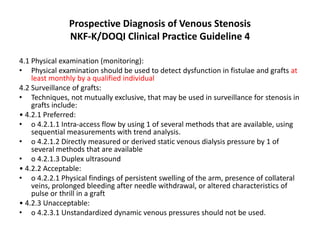
Prospective Diagnosis of Venous Stenosis
NKF-K/DOQI Clinical Practice Guideline 4
4.1 Physical examination (monitoring):
• Physical examination should be used to detect dysfunction in fistulae and grafts at
least monthly by a qualified individual
4.2 Surveillance of grafts:
• Techniques, not mutually exclusive, that may be used in surveillance for stenosis in
grafts include:
• 4.2.1 Preferred:
• o 4.2.1.1 Intra-access flow by using 1 of several methods that are available, using
sequential measurements with trend analysis.
• o 4.2.1.2 Directly measured or derived static venous dialysis pressure by 1 of
several methods that are available
• o 4.2.1.3 Duplex ultrasound
• 4.2.2 Acceptable:
• o 4.2.2.1 Physical findings of persistent swelling of the arm, presence of collateral
veins, prolonged bleeding after needle withdrawal, or altered characteristics of
pulse or thrill in a graft
• 4.2.3 Unacceptable:
• o 4.2.3.1 Unstandardized dynamic venous pressures should not be used.
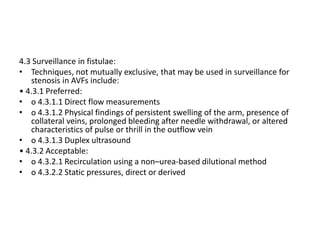
4.3 Surveillance in fistulae:
• Techniques, not mutually exclusive, that may be used in surveillance for
stenosis in AVFs include:
• 4.3.1 Preferred:
• o 4.3.1.1 Direct flow measurements
• o 4.3.1.2 Physical findings of persistent swelling of the arm, presence of
collateral veins, prolonged bleeding after needle withdrawal, or altered
characteristics of pulse or thrill in the outflow vein
• o 4.3.1.3 Duplex ultrasound
• 4.3.2 Acceptable:
• o 4.3.2.1 Recirculation using a non–urea-based dilutional method
• o 4.3.2.2 Static pressures, direct or derived
The Main Goal In Managing A Failing
VA!
“Prospective Diagnosis of Venous Stenosis”
• It is important that all hemodialysis facilities
have in place a system designed to detect
venous stenosis so that it can be diagnosed
and treated prospectively
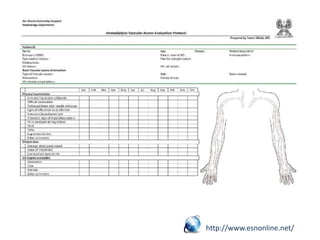
http://www.esnonline.net/
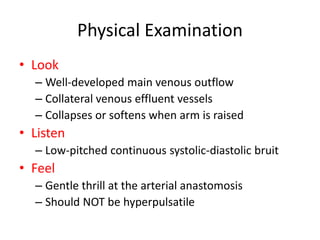
Physical Examination
• Look
– Well-developed main venous outflow
– Collateral venous effluent vessels
– Collapses or softens when arm is raised
• Listen
– Low-pitched continuous systolic-diastolic bruit
• Feel
– Gentle thrill at the arterial anastomosis
– Should NOT be hyperpulsatile
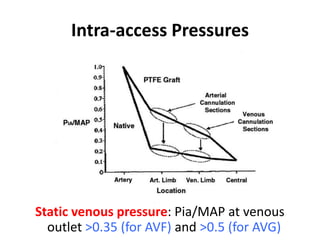
Intra-access Pressures
Static venous pressure: Pia/MAP at venous
outlet >0.35 (for AVF) and >0.5 (for AVG)
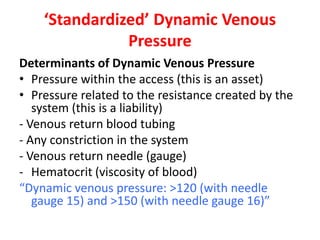
‘Standardized’ Dynamic Venous
Pressure
Determinants of Dynamic Venous Pressure
• Pressure within the access (this is an asset)
• Pressure related to the resistance created by the
system (this is a liability)
- Venous return blood tubing
- Any constriction in the system
- Venous return needle (gauge)
- Hematocrit (viscosity of blood)
“Dynamic venous pressure: >120 (with needle
gauge 15) and >150 (with needle gauge 16)”
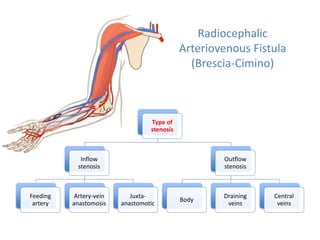
Radiocephalic
Arteriovenous Fistula
(Brescia-Cimino)
Type of
stenosis
Inflow
stenosis
Feeding
artery
Artery-vein
anastomosis
Juxta-
anastomotic
Outflow
stenosis
Body
Draining
veins
Central
veins
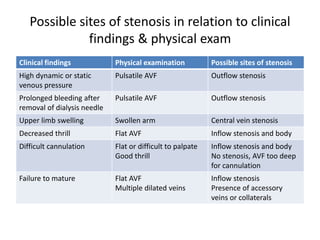
Possible sites of stenosis in relation to clinical
findings & physical exam
Clinical findings Physical examination Possible sites of stenosis
High dynamic or static
venous pressure
Pulsatile AVF Outflow stenosis
Prolonged bleeding after
removal of dialysis needle
Pulsatile AVF Outflow stenosis
Upper limb swelling Swollen arm Central vein stenosis
Decreased thrill Flat AVF Inflow stenosis and body
Difficult cannulation Flat or difficult to palpate
Good thrill
Inflow stenosis and body
No stenosis, AVF too deep
for cannulation
Failure to mature Flat AVF
Multiple dilated veins
Inflow stenosis
Presence of accessory
veins or collaterals
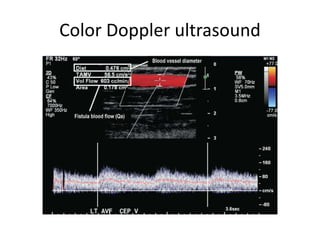
Color Doppler ultrasound
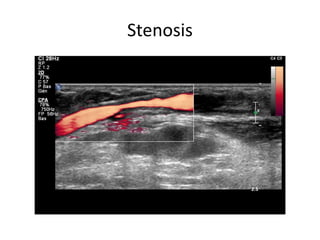
Stenosis
• Angiogram
- Identifies anatomic abnormalities
- Allows for pre-emptive percutaneous
interventions (e.g. angioplasty and/or stent
placement)
- Guides surgical intervention
Finally ‘Test’ to evaluate!
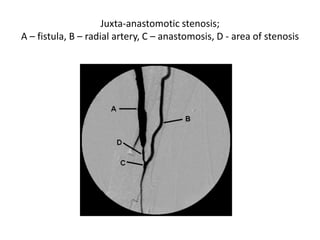
Juxta-anastomotic stenosis;
A – fistula, B – radial artery, C – anastomosis, D - area of stenosis
AV access salvage
• Balloon angioplasty for short segment of stenosis
(inflow, intra-access, outflow)
• Balloon angioplasty/stenting for central vein stenosis
• Mechanical thrombectomy or pharmacologic
thrombolysis
• Graft interposition for long segments of stenosis
• Ligation of side branches/stealing branches
• Covered stents or resection for aneurysms
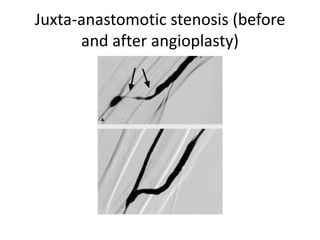
Juxta-anastomotic stenosis (before
and after angioplasty)
BASIC TOOLS
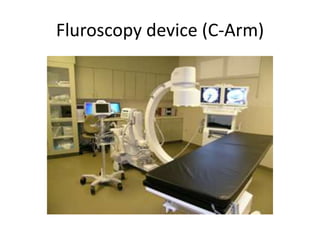
Fluroscopy device (C-Arm)
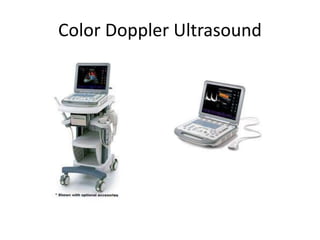
Color Doppler Ultrasound
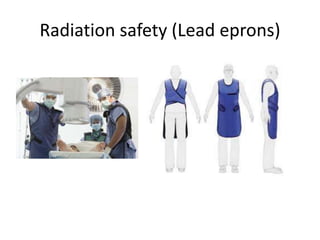
Radiation safety (Lead eprons)
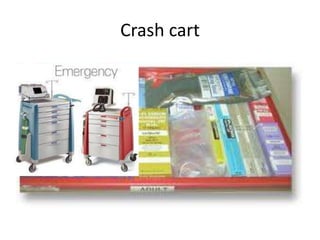
Crash cart
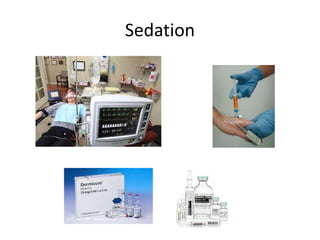
Sedation
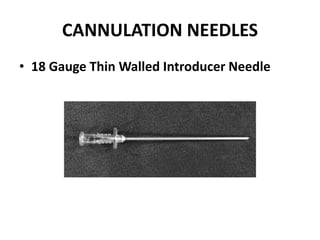
CANNULATION NEEDLES
• 18 Gauge Thin Walled Introducer Needle
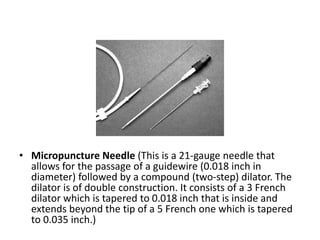
• Micropuncture Needle (This is a 21-gauge needle that
allows for the passage of a guidewire (0.018 inch in
diameter) followed by a compound (two-step) dilator. The
dilator is of double construction. It consists of a 3 French
dilator which is tapered to 0.018 inch that is inside and
extends beyond the tip of a 5 French one which is tapered
to 0.035 inch.)
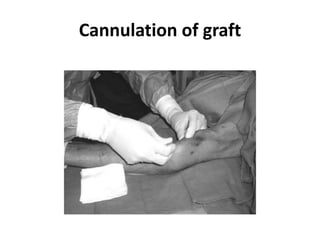
Cannulation of graft
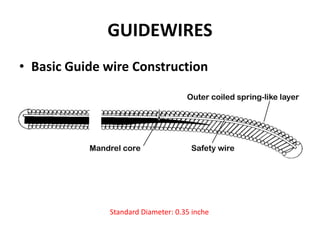
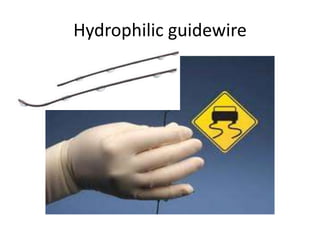
GUIDEWIRES
• Basic Guide wire Construction
Standard Diameter: 0.35 inche
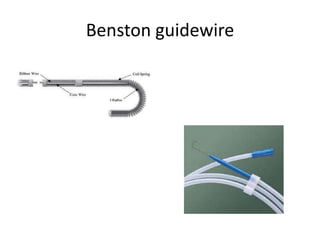
Benston guidewire
Hydrophilic guidewire
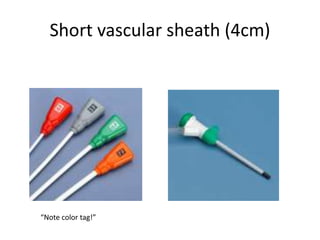
Short vascular sheath (4cm)
“Note color tag!”
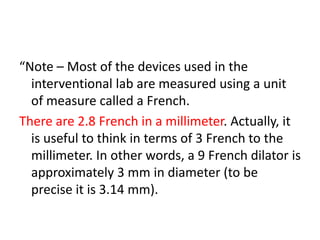
“Note – Most of the devices used in the
interventional lab are measured using a unit
of measure called a French.
There are 2.8 French in a millimeter. Actually, it
is useful to think in terms of 3 French to the
millimeter. In other words, a 9 French dilator is
approximately 3 mm in diameter (to be
precise it is 3.14 mm).
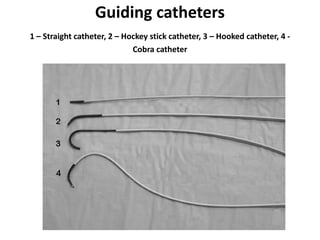
Guiding catheters
1 – Straight catheter, 2 – Hockey stick catheter, 3 – Hooked catheter, 4 -
Cobra catheter
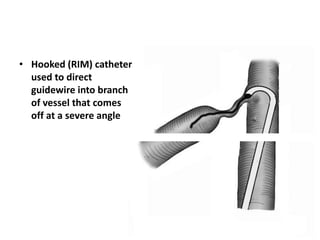
• Hooked (RIM) catheter
used to direct
guidewire into branch
of vessel that comes
off at a severe angle
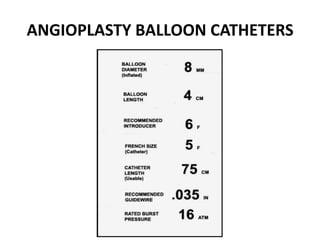
ANGIOPLASTY BALLOON CATHETERS
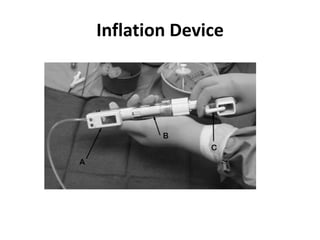
Inflation Device
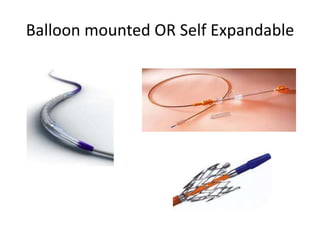
Balloon mounted OR Self Expandable
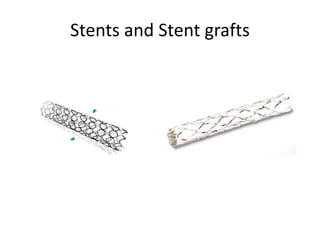
Stents and Stent grafts
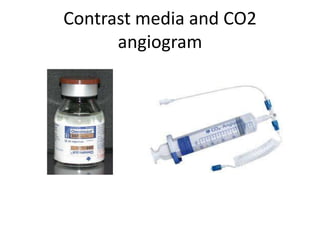
Contrast media and CO2
angiogram
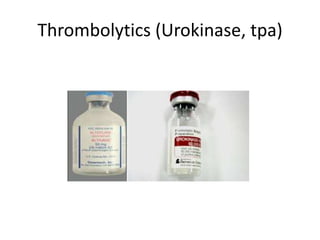
Thrombolytics (Urokinase, tpa)
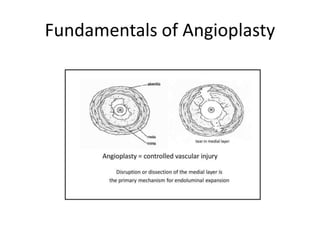
Fundamentals of Angioplasty
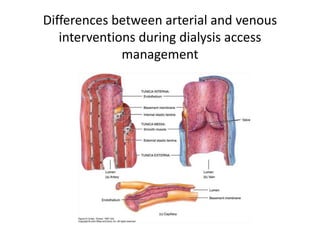
Differences between arterial and venous
interventions during dialysis access
management
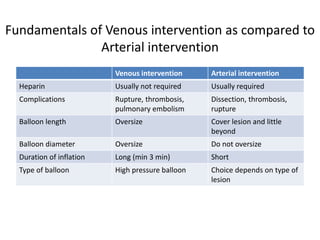
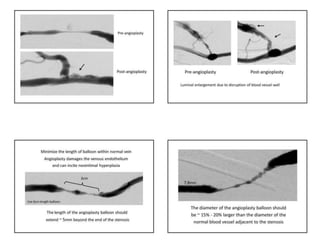
Fundamentals of Venous intervention as compared to
Arterial intervention
Venous intervention Arterial intervention
Heparin Usually not required Usually required
Complications Rupture, thrombosis,
pulmonary embolism
Dissection, thrombosis,
rupture
Balloon length Oversize Cover lesion and little
beyond
Balloon diameter Oversize Do not oversize
Duration of inflation Long (min 3 min) Short
Type of balloon High pressure balloon Choice depends on type of
lesion
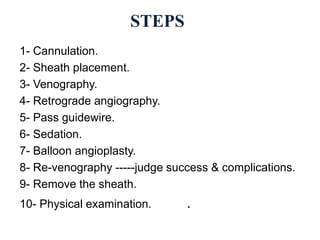
TECHNIQUE
1- Cannulation.
2- Sheath placement.
3- Venography.
4- Retrograde angiography.
5- Pass guidewire.
6- Sedation.
7- Balloon angioplasty.
8- Re-venography -----judge success & complications.
9- Remove the sheath.
10- Physical examination. .
STEPS
Indications for stent placement
1. Central vein stenosis where there is acute
elastic recoil of the vein (>50%) after
angioplasty OR recurrence of stenosis within
3 months period.
2. angioplasty induced vascular rupture,
patients with surgically inaccessible lesion, or
contraindication to surgery
CASES
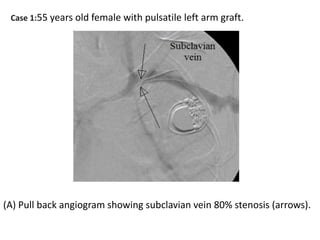
(A) Pull back angiogram showing subclavian vein 80% stenosis (arrows).
Case 1:55 years old female with pulsatile left arm graft.
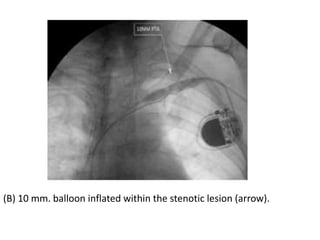
(B) 10 mm. balloon inflated within the stenotic lesion (arrow).
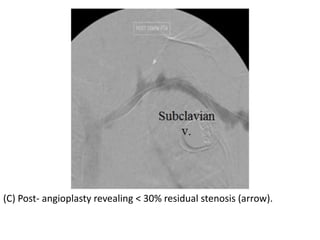
(C) Post- angioplasty revealing < 30% residual stenosis (arrow).
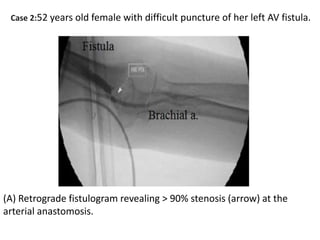
(A) Retrograde fistulogram revealing > 90% stenosis (arrow) at the
arterial anastomosis.
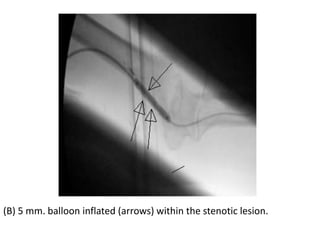
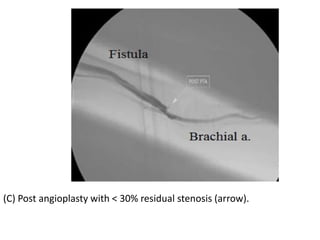
Case 2:52 years old female with difficult puncture of her left AV fistula.
(B) 5 mm. balloon inflated (arrows) within the stenotic lesion.
(C) Post angioplasty with < 30% residual stenosis (arrow).
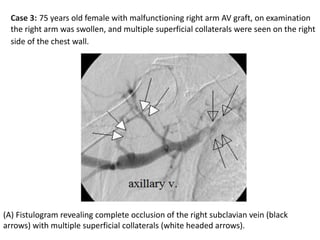
(A) Fistulogram revealing complete occlusion of the right subclavian vein (black
arrows) with multiple superficial collaterals (white headed arrows).
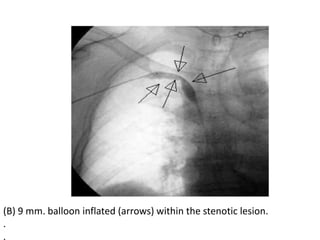
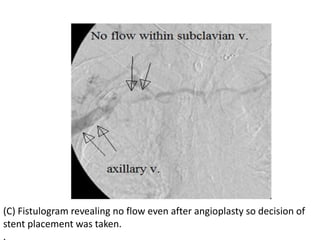
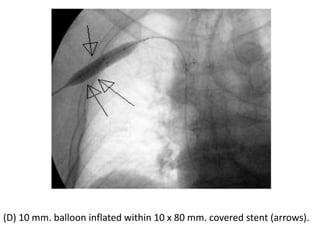
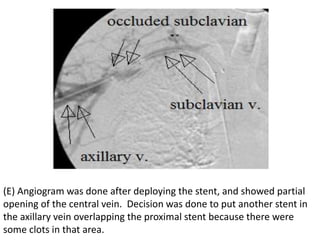
Case 3: 75 years old female with malfunctioning right arm AV graft, on examination
the right arm was swollen, and multiple superficial collaterals were seen on the right
side of the chest wall.
(B) 9 mm. balloon inflated (arrows) within the stenotic lesion.
.
.
(C) Fistulogram revealing no flow even after angioplasty so decision of
stent placement was taken.
.
(D) 10 mm. balloon inflated within 10 x 80 mm. covered stent (arrows).
(E) Angiogram was done after deploying the stent, and showed partial
opening of the central vein. Decision was done to put another stent in
the axillary vein overlapping the proximal stent because there were
some clots in that area.
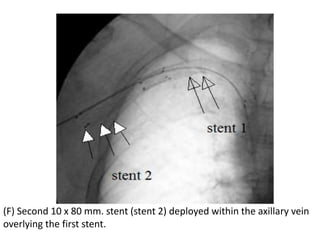
(F) Second 10 x 80 mm. stent (stent 2) deployed within the axillary vein
overlying the first stent.
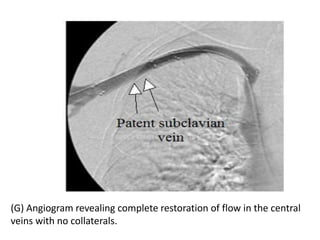
(G) Angiogram revealing complete restoration of flow in the central
veins with no collaterals.
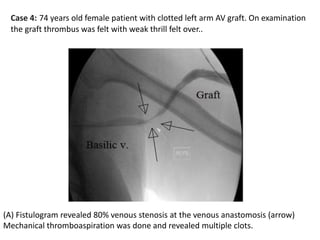
(A) Fistulogram revealed 80% venous stenosis at the venous anastomosis (arrow)
Mechanical thromboaspiration was done and revealed multiple clots.
Case 4: 74 years old female patient with clotted left arm AV graft. On examination
the graft thrombus was felt with weak thrill felt over..
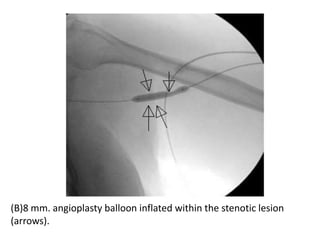
(B)8 mm. angioplasty balloon inflated within the stenotic lesion
(arrows).
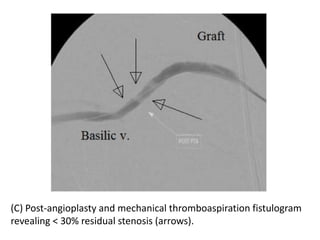
(C) Post-angioplasty and mechanical thromboaspiration fistulogram
revealing < 30% residual stenosis (arrows).
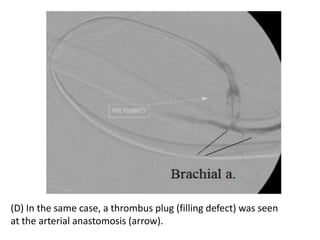
(D) In the same case, a thrombus plug (filling defect) was seen
at the arterial anastomosis (arrow).
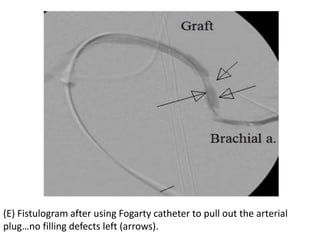
(E) Fistulogram after using Fogarty catheter to pull out the arterial
plug…no filling defects left (arrows).
THANK YOU

Tamer elsaid mansouraoct2019

  • 1.
    Vascular Access Salvage: NephrologyPerspective Tamer ElSaid, MD Ain Shams University
  • 2.
    The Problem! • Steadyincrease in no. of ESRD patients requiring RRT (usually being Hemodialysis). • We need an adequate vascular access (VA) to be able to deliver this extracorporeal blood purification treatment (HD) • VA and it’s associated complications, constitute the most common cause of morbidity, hospitalization, and cost among those patients
  • 3.
    Complications of hemodialysis vascularaccess 1.Stenosis 2.Thrombosis 3.Aneurysmal formation. 4.Venous hypertension 5.Infection 6.Steal phenomenon 7.Heart failure
  • 4.
    Monitoring and Surveillanceof VA! Monitoring • This term refers to the examination and evaluation of the vascular access by means of physical examination to detect physical signs that would suggest the presence of pathology. Surveillance • This term refers to periodic evaluation of the vascular access by means of tests, which may involve special instrumentation, for which an abnormal test result suggests the presence of pathology. Diagnostic Testing • This term refers to testing that is prompted by some abnormality or other medical indication and which is undertaken to diagnose the presence of pathology (i.e.,angiography).
  • 5.
    Prospective Diagnosis ofVenous Stenosis NKF-K/DOQI Clinical Practice Guideline 4 4.1 Physical examination (monitoring): • Physical examination should be used to detect dysfunction in fistulae and grafts at least monthly by a qualified individual 4.2 Surveillance of grafts: • Techniques, not mutually exclusive, that may be used in surveillance for stenosis in grafts include: • 4.2.1 Preferred: • o 4.2.1.1 Intra-access flow by using 1 of several methods that are available, using sequential measurements with trend analysis. • o 4.2.1.2 Directly measured or derived static venous dialysis pressure by 1 of several methods that are available • o 4.2.1.3 Duplex ultrasound • 4.2.2 Acceptable: • o 4.2.2.1 Physical findings of persistent swelling of the arm, presence of collateral veins, prolonged bleeding after needle withdrawal, or altered characteristics of pulse or thrill in a graft • 4.2.3 Unacceptable: • o 4.2.3.1 Unstandardized dynamic venous pressures should not be used.
  • 6.
    4.3 Surveillance infistulae: • Techniques, not mutually exclusive, that may be used in surveillance for stenosis in AVFs include: • 4.3.1 Preferred: • o 4.3.1.1 Direct flow measurements • o 4.3.1.2 Physical findings of persistent swelling of the arm, presence of collateral veins, prolonged bleeding after needle withdrawal, or altered characteristics of pulse or thrill in the outflow vein • o 4.3.1.3 Duplex ultrasound • 4.3.2 Acceptable: • o 4.3.2.1 Recirculation using a non–urea-based dilutional method • o 4.3.2.2 Static pressures, direct or derived
  • 7.
    The Main GoalIn Managing A Failing VA! “Prospective Diagnosis of Venous Stenosis” • It is important that all hemodialysis facilities have in place a system designed to detect venous stenosis so that it can be diagnosed and treated prospectively
  • 8.
  • 9.
    Physical Examination • Look –Well-developed main venous outflow – Collateral venous effluent vessels – Collapses or softens when arm is raised • Listen – Low-pitched continuous systolic-diastolic bruit • Feel – Gentle thrill at the arterial anastomosis – Should NOT be hyperpulsatile
  • 10.
    Intra-access Pressures Static venouspressure: Pia/MAP at venous outlet >0.35 (for AVF) and >0.5 (for AVG)
  • 11.
    ‘Standardized’ Dynamic Venous Pressure Determinantsof Dynamic Venous Pressure • Pressure within the access (this is an asset) • Pressure related to the resistance created by the system (this is a liability) - Venous return blood tubing - Any constriction in the system - Venous return needle (gauge) - Hematocrit (viscosity of blood) “Dynamic venous pressure: >120 (with needle gauge 15) and >150 (with needle gauge 16)”
  • 12.
  • 13.
    Possible sites ofstenosis in relation to clinical findings & physical exam Clinical findings Physical examination Possible sites of stenosis High dynamic or static venous pressure Pulsatile AVF Outflow stenosis Prolonged bleeding after removal of dialysis needle Pulsatile AVF Outflow stenosis Upper limb swelling Swollen arm Central vein stenosis Decreased thrill Flat AVF Inflow stenosis and body Difficult cannulation Flat or difficult to palpate Good thrill Inflow stenosis and body No stenosis, AVF too deep for cannulation Failure to mature Flat AVF Multiple dilated veins Inflow stenosis Presence of accessory veins or collaterals
  • 14.
  • 15.
  • 16.
    • Angiogram - Identifiesanatomic abnormalities - Allows for pre-emptive percutaneous interventions (e.g. angioplasty and/or stent placement) - Guides surgical intervention Finally ‘Test’ to evaluate!
  • 17.
    Juxta-anastomotic stenosis; A –fistula, B – radial artery, C – anastomosis, D - area of stenosis
  • 18.
    AV access salvage •Balloon angioplasty for short segment of stenosis (inflow, intra-access, outflow) • Balloon angioplasty/stenting for central vein stenosis • Mechanical thrombectomy or pharmacologic thrombolysis • Graft interposition for long segments of stenosis • Ligation of side branches/stealing branches • Covered stents or resection for aneurysms
  • 19.
  • 20.
  • 21.
  • 22.
  • 23.
  • 24.
  • 25.
  • 26.
    CANNULATION NEEDLES • 18Gauge Thin Walled Introducer Needle
  • 27.
    • Micropuncture Needle(This is a 21-gauge needle that allows for the passage of a guidewire (0.018 inch in diameter) followed by a compound (two-step) dilator. The dilator is of double construction. It consists of a 3 French dilator which is tapered to 0.018 inch that is inside and extends beyond the tip of a 5 French one which is tapered to 0.035 inch.)
  • 28.
  • 29.
    GUIDEWIRES • Basic Guidewire Construction Standard Diameter: 0.35 inche
  • 30.
  • 31.
  • 32.
    Short vascular sheath(4cm) “Note color tag!”
  • 33.
    “Note – Mostof the devices used in the interventional lab are measured using a unit of measure called a French. There are 2.8 French in a millimeter. Actually, it is useful to think in terms of 3 French to the millimeter. In other words, a 9 French dilator is approximately 3 mm in diameter (to be precise it is 3.14 mm).
  • 34.
    Guiding catheters 1 –Straight catheter, 2 – Hockey stick catheter, 3 – Hooked catheter, 4 - Cobra catheter
  • 35.
    • Hooked (RIM)catheter used to direct guidewire into branch of vessel that comes off at a severe angle
  • 36.
  • 37.
  • 38.
    Balloon mounted ORSelf Expandable
  • 39.
  • 40.
    Contrast media andCO2 angiogram
  • 41.
  • 42.
  • 43.
    Differences between arterialand venous interventions during dialysis access management
  • 44.
    Fundamentals of Venousintervention as compared to Arterial intervention Venous intervention Arterial intervention Heparin Usually not required Usually required Complications Rupture, thrombosis, pulmonary embolism Dissection, thrombosis, rupture Balloon length Oversize Cover lesion and little beyond Balloon diameter Oversize Do not oversize Duration of inflation Long (min 3 min) Short Type of balloon High pressure balloon Choice depends on type of lesion
  • 46.
  • 47.
    1- Cannulation. 2- Sheathplacement. 3- Venography. 4- Retrograde angiography. 5- Pass guidewire. 6- Sedation. 7- Balloon angioplasty. 8- Re-venography -----judge success & complications. 9- Remove the sheath. 10- Physical examination. . STEPS
  • 48.
    Indications for stentplacement 1. Central vein stenosis where there is acute elastic recoil of the vein (>50%) after angioplasty OR recurrence of stenosis within 3 months period. 2. angioplasty induced vascular rupture, patients with surgically inaccessible lesion, or contraindication to surgery
  • 49.
  • 50.
    (A) Pull backangiogram showing subclavian vein 80% stenosis (arrows). Case 1:55 years old female with pulsatile left arm graft.
  • 51.
    (B) 10 mm.balloon inflated within the stenotic lesion (arrow).
  • 52.
    (C) Post- angioplastyrevealing < 30% residual stenosis (arrow).
  • 53.
    (A) Retrograde fistulogramrevealing > 90% stenosis (arrow) at the arterial anastomosis. Case 2:52 years old female with difficult puncture of her left AV fistula.
  • 54.
    (B) 5 mm.balloon inflated (arrows) within the stenotic lesion.
  • 55.
    (C) Post angioplastywith < 30% residual stenosis (arrow).
  • 56.
    (A) Fistulogram revealingcomplete occlusion of the right subclavian vein (black arrows) with multiple superficial collaterals (white headed arrows). Case 3: 75 years old female with malfunctioning right arm AV graft, on examination the right arm was swollen, and multiple superficial collaterals were seen on the right side of the chest wall.
  • 57.
    (B) 9 mm.balloon inflated (arrows) within the stenotic lesion. . .
  • 58.
    (C) Fistulogram revealingno flow even after angioplasty so decision of stent placement was taken. .
  • 59.
    (D) 10 mm.balloon inflated within 10 x 80 mm. covered stent (arrows).
  • 60.
    (E) Angiogram wasdone after deploying the stent, and showed partial opening of the central vein. Decision was done to put another stent in the axillary vein overlapping the proximal stent because there were some clots in that area.
  • 61.
    (F) Second 10x 80 mm. stent (stent 2) deployed within the axillary vein overlying the first stent.
  • 62.
    (G) Angiogram revealingcomplete restoration of flow in the central veins with no collaterals.
  • 63.
    (A) Fistulogram revealed80% venous stenosis at the venous anastomosis (arrow) Mechanical thromboaspiration was done and revealed multiple clots. Case 4: 74 years old female patient with clotted left arm AV graft. On examination the graft thrombus was felt with weak thrill felt over..
  • 64.
    (B)8 mm. angioplastyballoon inflated within the stenotic lesion (arrows).
  • 65.
    (C) Post-angioplasty andmechanical thromboaspiration fistulogram revealing < 30% residual stenosis (arrows).
  • 66.
    (D) In thesame case, a thrombus plug (filling defect) was seen at the arterial anastomosis (arrow).
  • 67.
    (E) Fistulogram afterusing Fogarty catheter to pull out the arterial plug…no filling defects left (arrows).
  • 68.