TAVI

Dr Vijay Amaranath,DM
   NIMS,Hyderabad.
Bird’s Eye View
   Review the concept of TAVI
   Evaluation of patients considered for TAVI
   Review of evidence
   Identify future applications
Introduction
 Rising life expectancy results in an increase of
  degenerative aortic stenosis
 most frequent acquired heart valve disease
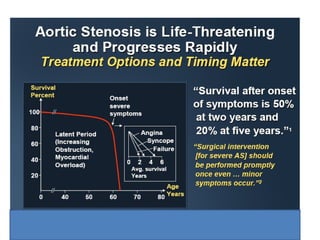
  and if untreated is associated with high
  mortality.
Operative Mortality for AVR
    AVR in octogenarians                                          STS2001   UKCSR       EHS
      • 220 pts                                                      (%)     1999-2001   2001
      • Op mortality 13% if AVR                                              (%)         (%)
      • Op mortality 24% if AVR + CABG
                                                           AVR
      • Morbidity 60%                                                3.7        3.1       2.7
      • Survival 85%, 80%, 73% (1,3,5 yrs)
                                                           AVR +
                                                           CABG      6.3         7        4.3
    Benefits of AVR in octogenarians
      • 81% no/mild disability for daily
        activities
      • 93% feel less disabled
      • 93% reassured to have access to
        treatment despite their age


Eur J Cardio Thorac Surg 2007;31:600-606. Eur J Cardio
Thorac Surg 2007;31: 1099-1105. Euro J Cardiothorac Surg
2006; 30: 722-727
Many patients are not surgically treated!

                           Severe AS* - Percent of Patients Treated


J Heart Valve Dis2006;15:312-321; Circulation 2005;
 European Heart Journal 2003;24:1231-1243;
 Heart 1999;82:143-148
Transcatheter Aortic Valve Implantation (TAVI)
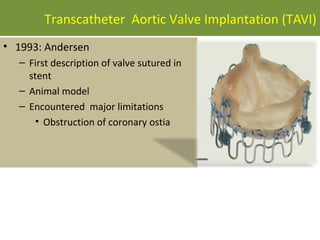
• 1993: Andersen
  – First description of valve sutured in
    stent
  – Animal model
  – Encountered major limitations
      • Obstruction of coronary ostia
First human implantation: Alain Cribier
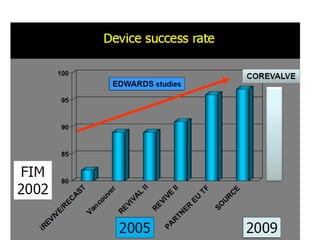
         April 16, 2002 ( France)


  Bovine pericardium valve
     23mm in diameter
balloon-expandable valves
 first generation :
  Cribier-Edwards valve
 Second generation
   Edwards SAPIEN THV
  bovine pericardium that
  is firmly mounted
  within a tubular,
  slotted, stainless steel
  balloon-expandable
  stent
‘Sapien’ device
•
                         ‘Sapien XT’ device
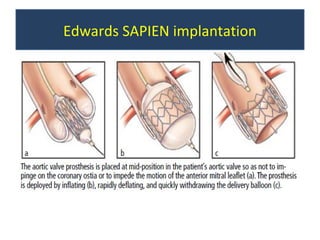
    Balloon deployment
                         •   Fewer rows and columns
•   Transapical
    deployment also      •   Shorter stent size
•   Leaflets in open     •   More radial strength grater
    mode, more chance        durability
    for AR               •   More closed form, less
                             chance for AR
CoreValve Revalving device
      first implantation in 2005 - Grube et al
• first-generation : bovine pericardial tissue and
  was constrained with 25F delivery catheter.
• second-generation : porcine pericardial tissue
  within a 21 F catheter .
multi-level self-expanding Nitinol frame
• upper third - low radial force : sits prosthesis
  in the aortic root
• middle third - high hoop strength ,valve
  leaflets are attached ,avoid impinging the
  coronaries.
• lower third - high radial force and sits within
  the left ventricular outflow tract.
Procedure & Hardware
Indications


Logistic EuroSCORE >20% or STS Score > 10.
 Logistic EuroSCORE >20% or STS Score > 10.
Work up
Role of imaging in pre-procedural and post procedural assessment
oversizing relative to the aortic annulus
(I)Anchoring to prevent migration
(II) sealing to prevent paravalvular aortic regurgitation
(III)proper valve functioning to prevent patient-prosthesis mismatch
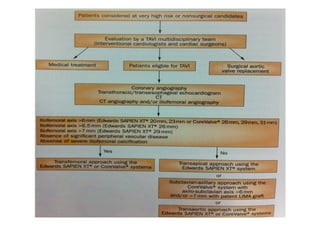
Patient Evaluation
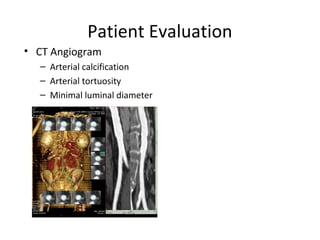
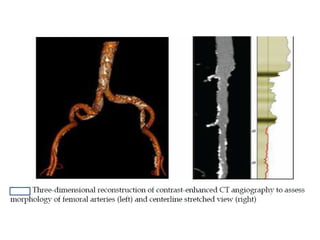
• CT Angiogram
  – Arterial calcification
  – Arterial tortuosity
  – Minimal luminal diameter
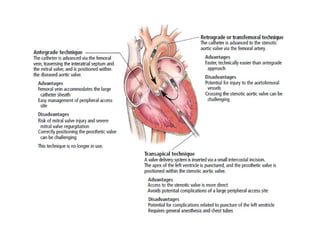
• Vascular access
   – Sites
      • Transfemoral
      • Transapical
             –   Left ant. thoracotomy
             –   More direct, shorter catheter
             –   Septal hypertrophy
             –   Ascendra2, Sapien valve           Percutaneous
                                                    Percutaneous
      • Transaortic                                or Cut-down
                                                    or Cut-down
             –   Upper partial sternotomy          technique
                                                    technique
             –   Mini-sternotomy 2/3 RICS
             –   Aorta 5 cm above valve
             –   Less painful, familiar approach
             –   Manipulation of ascending aorta
      • Subclavian
Approaches
BAV
•   Balloon aortic valvuloplasty: 20x30
    mm (for # 23) or 23x30 mm (for #
    26)
•   Appropriate angiographic projection
    in line with the plane of annulus
    [LAO200/Cran200]
•   midpoint of balloon at the annular
    level PACE INFLATE CHECK
    DEFLATE stop pacing
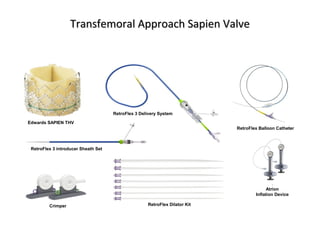
Transfemoral Approach Sapien Valve


                                     RetroFlex 3 Delivery System

Edwards SAPIEN THV
                                                                            RetroFlex Balloon Catheter


 RetroFlex 3 introducer Sheath Set


                                                                                          Atrion
                                                                                    Inflation Device

         Crimper                                    RetroFlex Dilator Kit


                                                                            41
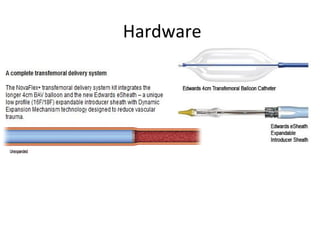
Hardware


Dilator set     Inflation device   Crimper
Hardware
Transfemoral Approach
  Valve Deployment


RV pacing: 200/min


         Aortic
        Pressure
Edwards SAPIEN implantation
Ascendra™ Transapical Approach


                                                       Ascendra™ Introducer Sheath Set


       Edwards SAPIEN™ THV
                                              Ascendra™ Delivery System


Atrion Inflation Device

                                            Ascendra™ Valvuloplasy Catheter


          Crimper                                                 47
Transapical Approach
Direct left
ventricular puncture
Transapical Approach

Placement and valve
deployment
Transapical Approach
three stages of CoreValve deployment.
transfemoral approach
Subclavian approach
closure device such as Prostar XLTM
(Abbott
Occlusive iliac dissection
Iliac artery rupture…
…repaired with a covered stent
Transapical Approach
 lung injury,
  pneumothorax, or
  pleural bleeding

 respiratory compromise
  and prolonged
  ventilation

 cardiac tamponade
Complications & Management
Causes of hypotension after TAVI
  ••Vascularcomplications—iliac rupture
   Vascular complications—iliac rupture

  ••Ventricularrupture
   Ventricular rupture

  ••Acutevalve dysfunction
   Acute valve dysfunction

  ••Coronaryartery obstruction
   Coronary artery obstruction

  ••Multiplerapid pacing episodes in pts with poor LV function
   Multiple rapid pacing episodes in pts with poor LV function

  ••‘Suicidal’LV in severe LVH [After removing AV obstruction LV
   ‘Suicidal’ LV in severe LVH [After removing AV obstruction LV
  decompresses to such an extent that the subvalvular hypertrophy
   decompresses to such an extent that the subvalvular hypertrophy
  obstructs outflow] treated with fluids & avoiding diuretics
   obstructs outflow] treated with fluids & avoiding diuretics
Coronary obstruction
           • Displacing an unusually
             bulky, calcified native
             leaflet over a coronary
             ostium
           • height of the coronary
             ostia, and dimensions of
             the sinus of Valsalva.

         ostia should be minimally located 14 mm
         away from the leaflets insertion.
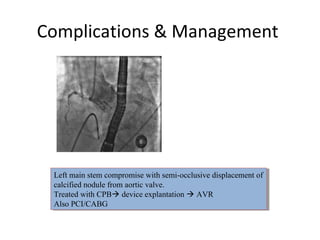
Complications & Management


 Left main stem compromise with semi-occlusive displacement of
  Left main stem compromise with semi-occlusive displacement of
 calcified nodule from aortic valve.
  calcified nodule from aortic valve.
 Treated with CPB device explantation  AVR
  Treated with CPB device explantation  AVR
 Also PCI/CABG
  Also PCI/CABG
(A) Left main coronary artery occlusion resulting from a bulky leaflet displaced over
the ostium. (B) Successful percutaneous intervention restored left coronary
flow.
Mitral valve injury
• transvenous, transseptal approach

• antegrade apical approach : avulsion of a mitral
  chordae

• ventricular end of a transcatheter prosthesis can be
  expected to contact the anterior mitral curtain
Complications & Management
Significant annular rupture
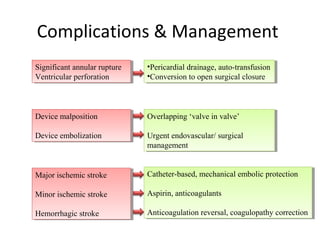
 Significant annular rupture   ••Pericardialdrainage, auto-transfusion
                                Pericardial drainage, auto-transfusion
Ventricular perforation
 Ventricular perforation       ••Conversionto open surgical closure
                                Conversion to open surgical closure


Device malposition
Device malposition             Overlapping ‘valve in valve’
                               Overlapping ‘valve in valve’

Device embolization
Device embolization            Urgent endovascular/ surgical
                               Urgent endovascular/ surgical
                               management
                               management


Major ischemic stroke
Major ischemic stroke          Catheter-based, mechanical embolic protection
                               Catheter-based, mechanical embolic protection

Minor ischemic stroke
Minor ischemic stroke          Aspirin, anticoagulants
                               Aspirin, anticoagulants

Hemorrhagic stroke
Hemorrhagic stroke             Anticoagulation reversal, coagulopathy correction
                               Anticoagulation reversal, coagulopathy correction
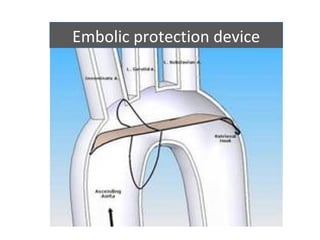
Stroke
• atheroembolism
• Calcific embolism from the aortic valve
• air embolism ; prolonged hypotension, and
  dissection of arch vessels
Embolic protection device
Heart block


•   Incidence of CHB requiring permanent pacemaker implantation has been
    higher with the CoreValve (19.2% to 42.5%) than with the Sapien valve
    (1.8% to 8.5%) [larger profile and extension low into the LVOT
•   Occurrence of CHB/LBBB
     –   BAV 46%
     –   Balloon/prosthesis positioning &wire-crossing of the aortic valve 25%
     –   Prosthesis expansion 29%.
•   Pre-existing RBBB risk factor for CHB
Complications & Management
              Aortic Regurgitation
              ••Typicallyparavalvular mild or
               Typically paravalvular mild or
              mild-moderate severity
               mild-moderate severity
              ••Mostof AR disappears or reduces
               Most of AR disappears or reduces
              at 11yr follow-up [13% absent, 80%
               at yr follow-up [13% absent, 80%
              mild AR]
               mild AR]
Complications & Management

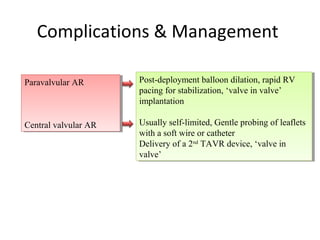
Paravalvular AR
 Paravalvular AR      Post-deployment balloon dilation, rapid RV
                       Post-deployment balloon dilation, rapid RV
                      pacing for stabilization, ‘valve in valve’
                       pacing for stabilization, ‘valve in valve’
                      implantation
                       implantation

Central valvular AR
Central valvular AR   Usually self-limited, Gentle probing of leaflets
                       Usually self-limited, Gentle probing of leaflets
                      with aasoft wire or catheter
                       with soft wire or catheter
                      Delivery of aa2nd TAVR device, ‘valve in
                       Delivery of 2nd TAVR device, ‘valve in
                      valve’
                       valve’
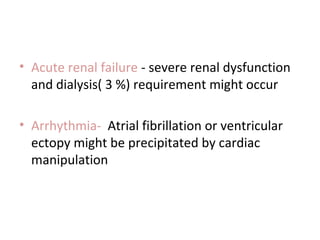
• Acute renal failure - severe renal dysfunction
  and dialysis( 3 %) requirement might occur

• Arrhythmia- Atrial fibrillation or ventricular
  ectopy might be precipitated by cardiac
  manipulation
Medications post-TAVI
Aspirin for life and clopidogrel for 3 months

patient on anticoagulation
 Warfarin plus clopidogrel for 1 month post-
 TAVI, followed by Warfarin plus Aspirin for 1
 year and then continue Warfarin only.
ONGOING TRIALS
PARTNER II Trial: Placement of
AoRTic TraNscathetER Valves Trial
 Edwards SAPIEN XTTM device and
  delivery systems: NovaFlex (transfemoral
  access) and Ascendra2 (transapical access) in
  patients with symptomatic, calcific, severe
  aortic stenosis.
 intermediate risk [ STS score of 4-8% ]
SURTAVI
• Safety and Efficacy Study of the Medtronic
  CoreValve® System in the Treatment of
  Severe, Symptomatic Aortic Stenosis in
  Intermediate Risk Subjects Who Need Aortic
  Valve Replacement (SURTAVI).

intermediate risk [ STS score of 3-8% ]
Danish study

 Irrespective of risk score randomized to TAVI
  vs SAVR
TAVI in Degenerated Bioprostheses


• Aortic
  – Capable with CoreValve and Sapien
  – Bioprosthesis only
  – Annular/Size diameter
     • CoreValve: not in annulus < 21mm
• Mitral
  – Transapical approach
  – Sapien only
• Pulmonary
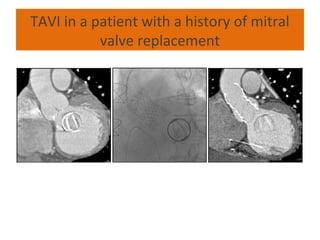
TAVI in a patient with a history of mitral
           valve replacement
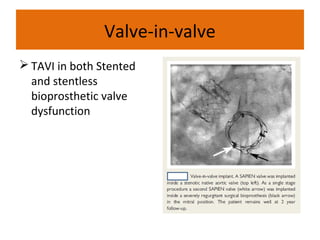
Valve-in-valve
 TAVI in both Stented
  and stentless
  bioprosthetic valve
  dysfunction
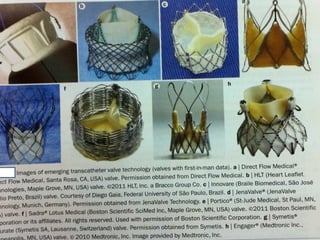
newly approved transapical
         devices
•   What is the durability?
•   What is the role of TAVI in low-gradient AS?
•   Which institutions should be qualified to perform TAVI?
•    TAVI for prosthesis degeneration?
•   Will there be a use of catheter valve implantation in
    lower risk population?
TAVI is currently the treatment
 of choice for patients considered
 not to be candidates for SAVR
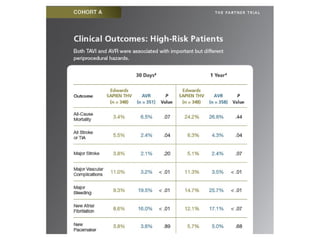
 and proven alternative in high
 risk cases .
Thank You

TAVI

  • 1.
  • 2.
    Bird’s Eye View  Review the concept of TAVI  Evaluation of patients considered for TAVI  Review of evidence  Identify future applications
  • 3.
    Introduction  Rising lifeexpectancy results in an increase of degenerative aortic stenosis  most frequent acquired heart valve disease and if untreated is associated with high mortality.
  • 6.
    Operative Mortality forAVR  AVR in octogenarians STS2001 UKCSR EHS • 220 pts (%) 1999-2001 2001 • Op mortality 13% if AVR (%) (%) • Op mortality 24% if AVR + CABG AVR • Morbidity 60% 3.7 3.1 2.7 • Survival 85%, 80%, 73% (1,3,5 yrs) AVR + CABG 6.3 7 4.3  Benefits of AVR in octogenarians • 81% no/mild disability for daily activities • 93% feel less disabled • 93% reassured to have access to treatment despite their age Eur J Cardio Thorac Surg 2007;31:600-606. Eur J Cardio Thorac Surg 2007;31: 1099-1105. Euro J Cardiothorac Surg 2006; 30: 722-727
  • 7.
    Many patients arenot surgically treated! Severe AS* - Percent of Patients Treated J Heart Valve Dis2006;15:312-321; Circulation 2005; European Heart Journal 2003;24:1231-1243; Heart 1999;82:143-148
  • 8.
    Transcatheter Aortic ValveImplantation (TAVI) • 1993: Andersen – First description of valve sutured in stent – Animal model – Encountered major limitations • Obstruction of coronary ostia
  • 9.
    First human implantation:Alain Cribier April 16, 2002 ( France) Bovine pericardium valve 23mm in diameter
  • 10.
    balloon-expandable valves  firstgeneration : Cribier-Edwards valve  Second generation Edwards SAPIEN THV bovine pericardium that is firmly mounted within a tubular, slotted, stainless steel balloon-expandable stent
  • 12.
    ‘Sapien’ device • ‘Sapien XT’ device Balloon deployment • Fewer rows and columns • Transapical deployment also • Shorter stent size • Leaflets in open • More radial strength grater mode, more chance durability for AR • More closed form, less chance for AR
  • 13.
    CoreValve Revalving device first implantation in 2005 - Grube et al • first-generation : bovine pericardial tissue and was constrained with 25F delivery catheter. • second-generation : porcine pericardial tissue within a 21 F catheter .
  • 16.
    multi-level self-expanding Nitinolframe • upper third - low radial force : sits prosthesis in the aortic root • middle third - high hoop strength ,valve leaflets are attached ,avoid impinging the coronaries. • lower third - high radial force and sits within the left ventricular outflow tract.
  • 18.
  • 19.
    Indications Logistic EuroSCORE >20%or STS Score > 10. Logistic EuroSCORE >20% or STS Score > 10.
  • 22.
    Work up Role ofimaging in pre-procedural and post procedural assessment
  • 31.
    oversizing relative tothe aortic annulus (I)Anchoring to prevent migration (II) sealing to prevent paravalvular aortic regurgitation (III)proper valve functioning to prevent patient-prosthesis mismatch
  • 32.
    Patient Evaluation • CTAngiogram – Arterial calcification – Arterial tortuosity – Minimal luminal diameter
  • 37.
    • Vascular access – Sites • Transfemoral • Transapical – Left ant. thoracotomy – More direct, shorter catheter – Septal hypertrophy – Ascendra2, Sapien valve Percutaneous Percutaneous • Transaortic or Cut-down or Cut-down – Upper partial sternotomy technique technique – Mini-sternotomy 2/3 RICS – Aorta 5 cm above valve – Less painful, familiar approach – Manipulation of ascending aorta • Subclavian
  • 38.
  • 39.
    BAV • Balloon aortic valvuloplasty: 20x30 mm (for # 23) or 23x30 mm (for # 26) • Appropriate angiographic projection in line with the plane of annulus [LAO200/Cran200] • midpoint of balloon at the annular level PACE INFLATE CHECK DEFLATE stop pacing
  • 41.
    Transfemoral Approach SapienValve RetroFlex 3 Delivery System Edwards SAPIEN THV RetroFlex Balloon Catheter RetroFlex 3 introducer Sheath Set Atrion Inflation Device Crimper RetroFlex Dilator Kit 41
  • 42.
    Hardware Dilator set Inflation device Crimper
  • 43.
  • 44.
    Transfemoral Approach Valve Deployment RV pacing: 200/min Aortic Pressure
  • 45.
  • 46.
  • 47.
    Ascendra™ Transapical Approach Ascendra™ Introducer Sheath Set Edwards SAPIEN™ THV Ascendra™ Delivery System Atrion Inflation Device Ascendra™ Valvuloplasy Catheter Crimper 47
  • 48.
  • 49.
  • 50.
  • 51.
    three stages ofCoreValve deployment.
  • 52.
  • 53.
  • 56.
    closure device suchas Prostar XLTM (Abbott
  • 61.
  • 62.
  • 63.
    …repaired with acovered stent
  • 64.
    Transapical Approach  lunginjury, pneumothorax, or pleural bleeding  respiratory compromise and prolonged ventilation  cardiac tamponade
  • 65.
    Complications & Management Causesof hypotension after TAVI ••Vascularcomplications—iliac rupture Vascular complications—iliac rupture ••Ventricularrupture Ventricular rupture ••Acutevalve dysfunction Acute valve dysfunction ••Coronaryartery obstruction Coronary artery obstruction ••Multiplerapid pacing episodes in pts with poor LV function Multiple rapid pacing episodes in pts with poor LV function ••‘Suicidal’LV in severe LVH [After removing AV obstruction LV ‘Suicidal’ LV in severe LVH [After removing AV obstruction LV decompresses to such an extent that the subvalvular hypertrophy decompresses to such an extent that the subvalvular hypertrophy obstructs outflow] treated with fluids & avoiding diuretics obstructs outflow] treated with fluids & avoiding diuretics
  • 66.
    Coronary obstruction • Displacing an unusually bulky, calcified native leaflet over a coronary ostium • height of the coronary ostia, and dimensions of the sinus of Valsalva. ostia should be minimally located 14 mm away from the leaflets insertion.
  • 67.
    Complications & Management Left main stem compromise with semi-occlusive displacement of Left main stem compromise with semi-occlusive displacement of calcified nodule from aortic valve. calcified nodule from aortic valve. Treated with CPB device explantation  AVR Treated with CPB device explantation  AVR Also PCI/CABG Also PCI/CABG
  • 68.
    (A) Left maincoronary artery occlusion resulting from a bulky leaflet displaced over the ostium. (B) Successful percutaneous intervention restored left coronary flow.
  • 69.
    Mitral valve injury •transvenous, transseptal approach • antegrade apical approach : avulsion of a mitral chordae • ventricular end of a transcatheter prosthesis can be expected to contact the anterior mitral curtain
  • 70.
    Complications & Management Significantannular rupture Significant annular rupture ••Pericardialdrainage, auto-transfusion Pericardial drainage, auto-transfusion Ventricular perforation Ventricular perforation ••Conversionto open surgical closure Conversion to open surgical closure Device malposition Device malposition Overlapping ‘valve in valve’ Overlapping ‘valve in valve’ Device embolization Device embolization Urgent endovascular/ surgical Urgent endovascular/ surgical management management Major ischemic stroke Major ischemic stroke Catheter-based, mechanical embolic protection Catheter-based, mechanical embolic protection Minor ischemic stroke Minor ischemic stroke Aspirin, anticoagulants Aspirin, anticoagulants Hemorrhagic stroke Hemorrhagic stroke Anticoagulation reversal, coagulopathy correction Anticoagulation reversal, coagulopathy correction
  • 71.
    Stroke • atheroembolism • Calcificembolism from the aortic valve • air embolism ; prolonged hypotension, and dissection of arch vessels
  • 72.
  • 73.
    Heart block • Incidence of CHB requiring permanent pacemaker implantation has been higher with the CoreValve (19.2% to 42.5%) than with the Sapien valve (1.8% to 8.5%) [larger profile and extension low into the LVOT • Occurrence of CHB/LBBB – BAV 46% – Balloon/prosthesis positioning &wire-crossing of the aortic valve 25% – Prosthesis expansion 29%. • Pre-existing RBBB risk factor for CHB
  • 74.
    Complications & Management Aortic Regurgitation ••Typicallyparavalvular mild or Typically paravalvular mild or mild-moderate severity mild-moderate severity ••Mostof AR disappears or reduces Most of AR disappears or reduces at 11yr follow-up [13% absent, 80% at yr follow-up [13% absent, 80% mild AR] mild AR]
  • 75.
    Complications & Management ParavalvularAR Paravalvular AR Post-deployment balloon dilation, rapid RV Post-deployment balloon dilation, rapid RV pacing for stabilization, ‘valve in valve’ pacing for stabilization, ‘valve in valve’ implantation implantation Central valvular AR Central valvular AR Usually self-limited, Gentle probing of leaflets Usually self-limited, Gentle probing of leaflets with aasoft wire or catheter with soft wire or catheter Delivery of aa2nd TAVR device, ‘valve in Delivery of 2nd TAVR device, ‘valve in valve’ valve’
  • 76.
    • Acute renalfailure - severe renal dysfunction and dialysis( 3 %) requirement might occur • Arrhythmia- Atrial fibrillation or ventricular ectopy might be precipitated by cardiac manipulation
  • 77.
    Medications post-TAVI Aspirin forlife and clopidogrel for 3 months patient on anticoagulation Warfarin plus clopidogrel for 1 month post- TAVI, followed by Warfarin plus Aspirin for 1 year and then continue Warfarin only.
  • 87.
  • 88.
    PARTNER II Trial:Placement of AoRTic TraNscathetER Valves Trial  Edwards SAPIEN XTTM device and delivery systems: NovaFlex (transfemoral access) and Ascendra2 (transapical access) in patients with symptomatic, calcific, severe aortic stenosis.  intermediate risk [ STS score of 4-8% ]
  • 89.
    SURTAVI • Safety andEfficacy Study of the Medtronic CoreValve® System in the Treatment of Severe, Symptomatic Aortic Stenosis in Intermediate Risk Subjects Who Need Aortic Valve Replacement (SURTAVI). intermediate risk [ STS score of 3-8% ]
  • 90.
    Danish study  Irrespectiveof risk score randomized to TAVI vs SAVR
  • 91.
    TAVI in DegeneratedBioprostheses • Aortic – Capable with CoreValve and Sapien – Bioprosthesis only – Annular/Size diameter • CoreValve: not in annulus < 21mm • Mitral – Transapical approach – Sapien only • Pulmonary
  • 92.
    TAVI in apatient with a history of mitral valve replacement
  • 93.
    Valve-in-valve  TAVI inboth Stented and stentless bioprosthetic valve dysfunction
  • 94.
  • 98.
    What is the durability? • What is the role of TAVI in low-gradient AS? • Which institutions should be qualified to perform TAVI? • TAVI for prosthesis degeneration? • Will there be a use of catheter valve implantation in lower risk population?
  • 99.
    TAVI is currentlythe treatment of choice for patients considered not to be candidates for SAVR and proven alternative in high risk cases .
  • 100.