Transition of Pediatric Renal
Transplant Recipients
Mind the Gap
Pediatric Renal Transplantation Unit, Cairo University
Prof. Fatina Fadel
Prof. Hafez Bazaraa
»Why?
»When?
»Why not?
»How?
»Issues
»Recommendations
BACKGROUND
<
» Pediatric patients are different
» A dedicated pediatric program is
important
» Pediatric transplantation program
based in pediatric hospitals
(Cairo University 2009-2019)
» Adult nephrology is a separate facility
Transition: Why?
» Patients grow
» Pediatric hospitals & pediatricians are
not meant to care for adults
» Adults cannot be admitted/ subjected to
procedures at pediatric hospitals
» We cannot follow patients and then
refer them elsewhere when they need
admission or intervention
Transition: Why?
Our patients must eventually go to
adult service
Transition: When?
» Hospital admission rule: 13yrs
» No distinct adolescent care units
» Legal adulthood 18-21 yrs
»Why?
»When?
»Why not?
»How?
»Issues
»Recommendations
Transition: Why NOT?
» Patient, parent & care-provider comfort
zone
» Many are stable; no specific needs
» Unwillingness to receive patients with
an extensive background elsewhere
» Difference in independency vs support
between adult/ Ped. Units
» Difference in medication financing/
insurance change
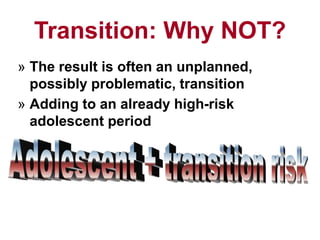
Transition: Why NOT?
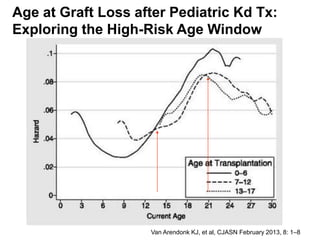
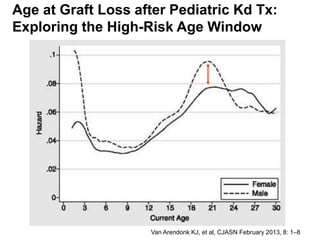
» The result is often an unplanned,
possibly problematic, transition
» Adding to an already high-risk
adolescent period
Van Arendonk KJ, et al, CJASN February 2013, 8: 1–8
Age at Graft Loss after Pediatric Kd Tx:
Exploring the High-Risk Age Window
Van Arendonk KJ, et al, CJASN February 2013, 8: 1–8
Age at Graft Loss after Pediatric Kd Tx:
Exploring the High-Risk Age Window
»Why?
»When?
»Why not?
»How?
»Issues
»Recommendations
Transition: HOW?
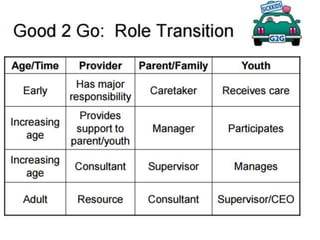
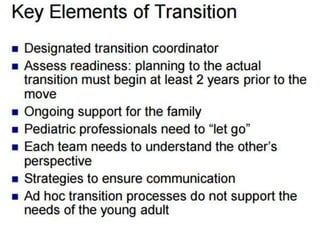
Watson AR, BRITISH JOURNAL OF RENAL MEDICINE 2011; 16 (1): 15 - 18
Fredericks EM and Lopez MJ, Clinical Liver Disease, 2013. 2, (5): 223-226
Transfer changes in health care
providers, clinic locations, or both
Transition active process that
addresses the medical, psychosocial,
and educational/vocational needs of
adolescents as they prepare to move
from child-centered health care to adult-
centered health care
Transition: HOW?
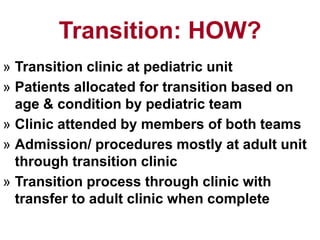
» Transition clinic at pediatric unit
» Patients allocated for transition based on
age & condition by pediatric team
» Clinic attended by members of both teams
» Admission/ procedures mostly at adult unit
through transition clinic
» Transition process through clinic with
transfer to adult clinic when complete
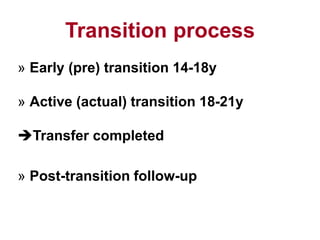
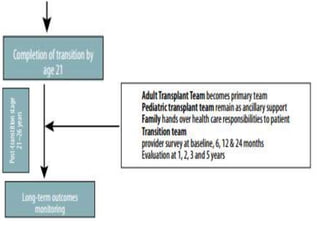
Transition process
» Early (pre) transition 14-18y
» Active (actual) transition 18-21y
Transfer completed
» Post-transition follow-up
Transition: ISSUES?
» Backlog of older adolescent patients
with tendency to a rushed transition
» Patient/ parent non-familiarity with adult
services & procedures
» Insurance policy changes
» Medical conditions requiring active
management
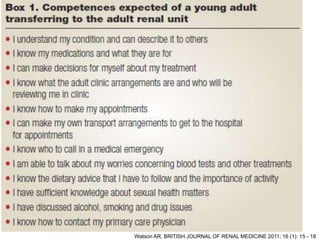
Watson AR, BRITISH JOURNAL OF RENAL MEDICINE 2011; 16 (1): 15 - 18
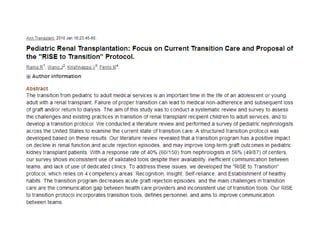
Raina R, et al, Ann Transplant, 2018; 23: 45-60
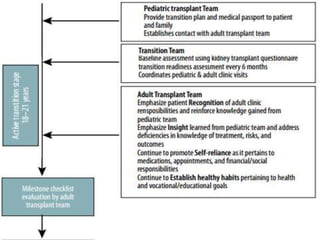
Identified 4 competency areas to educate patient prior
to transition
Adolescent Transition to Adult Care in Solid Organ Transplantation:
A consensus conference report
Bell LE, et al, American Journal of Transplantation 2008; 8: 2230–2242
Raina R, et al, Ann Transplant, 2018; 23: 45-60
»Why?
»When?
»Why not?
»How?
»Issues
»Recommendations
Transition:
Recommendations
» Reviewing condition & care plan before
transition
» Phased transition based on age, time &
progress
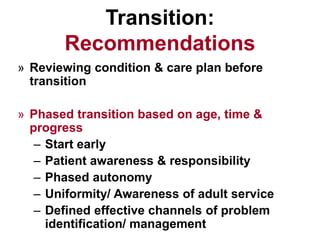
Transition:
Recommendations
» Reviewing condition & care plan before
transition
» Phased transition based on age, time &
progress
– Start early
– Patient awareness & responsibility
– Phased autonomy
– Uniformity/ Awareness of adult service
– Defined effective channels of problem
identification/ management
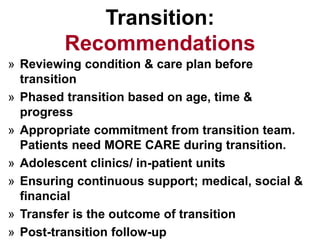
Transition:
Recommendations
» Reviewing condition & care plan before
transition
» Phased transition based on age, time &
progress
» Appropriate commitment from transition team.
Patients need MORE CARE during transition.
» Adolescent clinics/ in-patient units
» Ensuring continuous support; medical, social &
financial
» Transfer is the outcome of transition
» Post-transition follow-up
Transitoining in kidney tx final version2

Transitoining in kidney tx final version2

  • 1.
    Transition of PediatricRenal Transplant Recipients Mind the Gap Pediatric Renal Transplantation Unit, Cairo University Prof. Fatina Fadel Prof. Hafez Bazaraa
  • 2.
  • 3.
    BACKGROUND < » Pediatric patientsare different » A dedicated pediatric program is important » Pediatric transplantation program based in pediatric hospitals (Cairo University 2009-2019) » Adult nephrology is a separate facility
  • 4.
    Transition: Why? » Patientsgrow » Pediatric hospitals & pediatricians are not meant to care for adults » Adults cannot be admitted/ subjected to procedures at pediatric hospitals » We cannot follow patients and then refer them elsewhere when they need admission or intervention
  • 5.
    Transition: Why? Our patientsmust eventually go to adult service
  • 6.
    Transition: When? » Hospitaladmission rule: 13yrs » No distinct adolescent care units » Legal adulthood 18-21 yrs
  • 7.
  • 8.
    Transition: Why NOT? »Patient, parent & care-provider comfort zone » Many are stable; no specific needs » Unwillingness to receive patients with an extensive background elsewhere » Difference in independency vs support between adult/ Ped. Units » Difference in medication financing/ insurance change
  • 13.
    Transition: Why NOT? »The result is often an unplanned, possibly problematic, transition » Adding to an already high-risk adolescent period
  • 17.
    Van Arendonk KJ,et al, CJASN February 2013, 8: 1–8 Age at Graft Loss after Pediatric Kd Tx: Exploring the High-Risk Age Window
  • 18.
    Van Arendonk KJ,et al, CJASN February 2013, 8: 1–8 Age at Graft Loss after Pediatric Kd Tx: Exploring the High-Risk Age Window
  • 20.
  • 21.
  • 22.
    Watson AR, BRITISHJOURNAL OF RENAL MEDICINE 2011; 16 (1): 15 - 18
  • 23.
    Fredericks EM andLopez MJ, Clinical Liver Disease, 2013. 2, (5): 223-226 Transfer changes in health care providers, clinic locations, or both Transition active process that addresses the medical, psychosocial, and educational/vocational needs of adolescents as they prepare to move from child-centered health care to adult- centered health care
  • 25.
    Transition: HOW? » Transitionclinic at pediatric unit » Patients allocated for transition based on age & condition by pediatric team » Clinic attended by members of both teams » Admission/ procedures mostly at adult unit through transition clinic » Transition process through clinic with transfer to adult clinic when complete
  • 26.
    Transition process » Early(pre) transition 14-18y » Active (actual) transition 18-21y Transfer completed » Post-transition follow-up
  • 29.
    Transition: ISSUES? » Backlogof older adolescent patients with tendency to a rushed transition » Patient/ parent non-familiarity with adult services & procedures » Insurance policy changes » Medical conditions requiring active management
  • 31.
    Watson AR, BRITISHJOURNAL OF RENAL MEDICINE 2011; 16 (1): 15 - 18
  • 34.
    Raina R, etal, Ann Transplant, 2018; 23: 45-60 Identified 4 competency areas to educate patient prior to transition
  • 35.
    Adolescent Transition toAdult Care in Solid Organ Transplantation: A consensus conference report Bell LE, et al, American Journal of Transplantation 2008; 8: 2230–2242
  • 36.
    Raina R, etal, Ann Transplant, 2018; 23: 45-60
  • 38.
    Raina R, etal, Ann Transplant, 2018; 23: 45-60
  • 39.
  • 40.
    Transition: Recommendations » Reviewing condition& care plan before transition » Phased transition based on age, time & progress
  • 41.
    Transition: Recommendations » Reviewing condition& care plan before transition » Phased transition based on age, time & progress – Start early – Patient awareness & responsibility – Phased autonomy – Uniformity/ Awareness of adult service – Defined effective channels of problem identification/ management
  • 42.
    Transition: Recommendations » Reviewing condition& care plan before transition » Phased transition based on age, time & progress » Appropriate commitment from transition team. Patients need MORE CARE during transition. » Adolescent clinics/ in-patient units » Ensuring continuous support; medical, social & financial » Transfer is the outcome of transition » Post-transition follow-up