1
Course title: Industrial Pharmacy-I
Course code: 612-T
Course In-charge: Ms. Ayesha Kiran
2
3 3
1
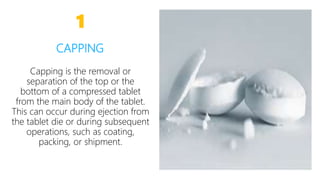
Capping is the removal or
separation of the top or the
bottom of a compressed tablet
from the main body of the tablet.
This can occur during ejection from
the tablet die or during subsequent
operations, such as coating,
packing, or shipment.
CAPPING
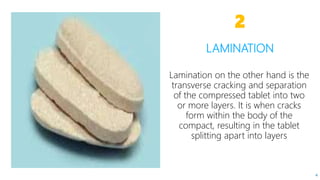
Lamination on the other hand is the
transverse cracking and separation
of the compressed tablet into two
or more layers. It is when cracks
form within the body of the
compact, resulting in the tablet
splitting apart into layers
LAMINATION
2
4
CAUSES OF CAPPING AND LAMINATION
HOW DO YOU SOLVE IT:
7
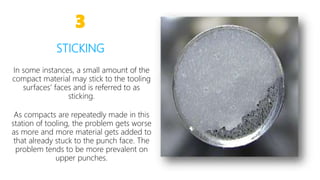
In some instances, a small amount of the
compact material may stick to the tooling
surfaces’ faces and is referred to as
sticking.
As compacts are repeatedly made in this
station of tooling, the problem gets worse
as more and more material gets added to
that already stuck to the punch face. The
problem tends to be more prevalent on
upper punches.
3
STICKING
CAUSES OF STICKING
HOW TO PREVENT STICKING
dwell time
9
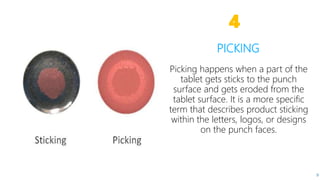
Picking happens when a part of the
tablet gets sticks to the punch
surface and gets eroded from the
tablet surface. It is a more specific
term that describes product sticking
within the letters, logos, or designs
on the punch faces.
PICKING
4
CAUSES OF PICKING
HOW TO PREVENT PICKING
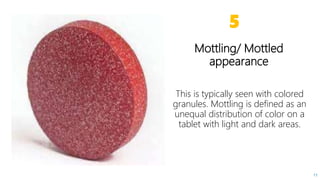
This is typically seen with colored
granules. Mottling is defined as an
unequal distribution of color on a
tablet with light and dark areas.
Mottling/ Mottled
appearance
5
11
CAUSES OF MOTTLING
HOW TO PREVENT MOTTLING
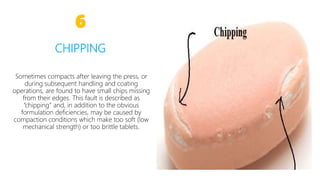
Sometimes compacts after leaving the press, or
during subsequent handling and coating
operations, are found to have small chips missing
from their edges. This fault is described as
“chipping” and, in addition to the obvious
formulation deficiencies, may be caused by
compaction conditions which make too soft (low
mechanical strength) or too brittle tablets.
6
CHIPPING
13
CAUSES OF CHIPPING
HOW TO PREVENT CHIPPING
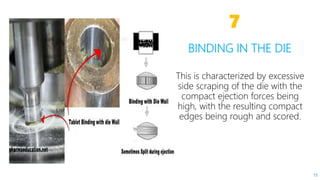
This is characterized by excessive
side scraping of the die with the
compact ejection forces being
high, with the resulting compact
edges being rough and scored.
BINDING IN THE DIE
7
15
CAUSES OF BINDING IN THE DIE
HOW TO PREVENT BINDING IN THE DIE
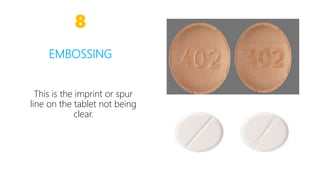
This is the imprint or spur
line on the tablet not being
clear.
8
EMBOSSING
17
CAUSES OF EMBOSSING
HOW TO PREVENT EMBOSSING
The higher the compaction pressure then the denser the compact will be,
and hence the higher the resulting tensile strength of the compact.
Consequently, too low a compaction pressure will lead to low tensile
strength or “soft” and crumbly compacts.
LOW TENSILE STRENGTH
9
19
CAUSES Of LOW TENSILE STRENGTH
The over lubrication can be caused by:
• Too high an initial level of the lubricant,
• Excessive shear during the lubrication stage,
• Excessive lubrication time.
An additional cause can be the weakening of the inter granular bonds by air entrapment,
even when this is not sufficient to cause capping.
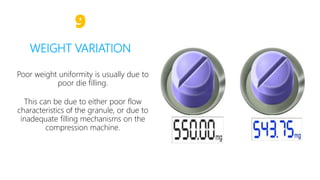
Poor weight uniformity is usually due to
poor die filling.
This can be due to either poor flow
characteristics of the granule, or due to
inadequate filling mechanisms on the
compression machine.
9
WEIGHT VARIATION
21
• Granules or powders that are too large, too fine or contain a large proportion of fine material,
or are incorrectly lubricated or have components with widely differing densities or sizes, may all
contribute to weight variation.
• If it is due to poor granule flow then the addition of glidants, such as silica or talc, can be
employed.
• Some particles may acquire a frictional electrostatic charge when handled and this mutual
repulsion of the particles and may be sufficient to impede die filling.
• Talc (at up to 1%) or sodium lauryl sulphate (at up to 2%) are substances which have been used
to reduce this charging and which can also have lubricant and anti-adherent properties.
• Lubricants, such as magnesium stearate, may or may not promote granule flow, depending on
the level at which they are used higher levels tending to impede flow.
https://www.lfatabletpresses.com/articles/common-tablet-defects-
that-can-be-avoided-easily
https://pharmaeducation.net/manufacturing-defects-of-tablets/
https://www.pharmapproach.com/common-tablet-defects-causes-
and-remedies/
REFERENCES
Neal Creative ©
THANK YOU

PROBLEMS (1).pptx

  • 1.
    1 Course title: IndustrialPharmacy-I Course code: 612-T Course In-charge: Ms. Ayesha Kiran
  • 2.
  • 3.
    3 3 1 Capping isthe removal or separation of the top or the bottom of a compressed tablet from the main body of the tablet. This can occur during ejection from the tablet die or during subsequent operations, such as coating, packing, or shipment. CAPPING
  • 4.
    Lamination on theother hand is the transverse cracking and separation of the compressed tablet into two or more layers. It is when cracks form within the body of the compact, resulting in the tablet splitting apart into layers LAMINATION 2 4
  • 5.
    CAUSES OF CAPPINGAND LAMINATION
  • 6.
    HOW DO YOUSOLVE IT:
  • 7.
    7 In some instances,a small amount of the compact material may stick to the tooling surfaces’ faces and is referred to as sticking. As compacts are repeatedly made in this station of tooling, the problem gets worse as more and more material gets added to that already stuck to the punch face. The problem tends to be more prevalent on upper punches. 3 STICKING
  • 8.
    CAUSES OF STICKING HOWTO PREVENT STICKING dwell time
  • 9.
    9 Picking happens whena part of the tablet gets sticks to the punch surface and gets eroded from the tablet surface. It is a more specific term that describes product sticking within the letters, logos, or designs on the punch faces. PICKING 4
  • 10.
    CAUSES OF PICKING HOWTO PREVENT PICKING
  • 11.
    This is typicallyseen with colored granules. Mottling is defined as an unequal distribution of color on a tablet with light and dark areas. Mottling/ Mottled appearance 5 11
  • 12.
    CAUSES OF MOTTLING HOWTO PREVENT MOTTLING
  • 13.
    Sometimes compacts afterleaving the press, or during subsequent handling and coating operations, are found to have small chips missing from their edges. This fault is described as “chipping” and, in addition to the obvious formulation deficiencies, may be caused by compaction conditions which make too soft (low mechanical strength) or too brittle tablets. 6 CHIPPING 13
  • 14.
    CAUSES OF CHIPPING HOWTO PREVENT CHIPPING
  • 15.
    This is characterizedby excessive side scraping of the die with the compact ejection forces being high, with the resulting compact edges being rough and scored. BINDING IN THE DIE 7 15
  • 16.
    CAUSES OF BINDINGIN THE DIE HOW TO PREVENT BINDING IN THE DIE
  • 17.
    This is theimprint or spur line on the tablet not being clear. 8 EMBOSSING 17
  • 18.
    CAUSES OF EMBOSSING HOWTO PREVENT EMBOSSING
  • 19.
    The higher thecompaction pressure then the denser the compact will be, and hence the higher the resulting tensile strength of the compact. Consequently, too low a compaction pressure will lead to low tensile strength or “soft” and crumbly compacts. LOW TENSILE STRENGTH 9 19
  • 20.
    CAUSES Of LOWTENSILE STRENGTH The over lubrication can be caused by: • Too high an initial level of the lubricant, • Excessive shear during the lubrication stage, • Excessive lubrication time. An additional cause can be the weakening of the inter granular bonds by air entrapment, even when this is not sufficient to cause capping.
  • 21.
    Poor weight uniformityis usually due to poor die filling. This can be due to either poor flow characteristics of the granule, or due to inadequate filling mechanisms on the compression machine. 9 WEIGHT VARIATION 21
  • 22.
    • Granules orpowders that are too large, too fine or contain a large proportion of fine material, or are incorrectly lubricated or have components with widely differing densities or sizes, may all contribute to weight variation. • If it is due to poor granule flow then the addition of glidants, such as silica or talc, can be employed. • Some particles may acquire a frictional electrostatic charge when handled and this mutual repulsion of the particles and may be sufficient to impede die filling. • Talc (at up to 1%) or sodium lauryl sulphate (at up to 2%) are substances which have been used to reduce this charging and which can also have lubricant and anti-adherent properties. • Lubricants, such as magnesium stearate, may or may not promote granule flow, depending on the level at which they are used higher levels tending to impede flow.
  • 23.
  • 24.