Defects in Tablet Sugar Coating

             AACP
             Bangalore
TABLET COATING

โ€ข Tablet coating is the application of coating
 material to the exterior of a tablet with the
 intention of conferring benefits and properties to
 a dosage form over the uncoated variety.
Why To Coat ??

โ€ข Bitter taste or unpleasant odour.
โ€ข Protecting the drug from surroundings (Stability).
โ€ข Handling & ease of ingesting by patients.
โ€ข Mechanical protection from breakage.
โ€ข Light incompatibility or Environmental Oxidation.
โ€ข In-elegent core.
โ€ข modifying the drug release profile.
โ€ข Product identity.
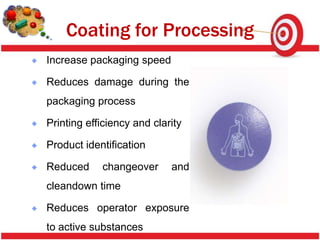
Coating for Processing
Increase packaging speed

Reduces damage during the
packaging process

Printing efficiency and clarity

Product identification

Reduced     changeover      and
cleandown time

Reduces operator exposure
to active substances
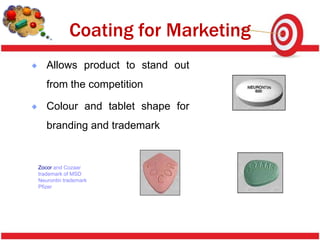
Coating for Marketing
   Allows product to stand out
   from the competition

   Colour and tablet shape for
   branding and trademark


Zocor and Cozaar
trademark of MSD
Neurontin trademark
Pfizer
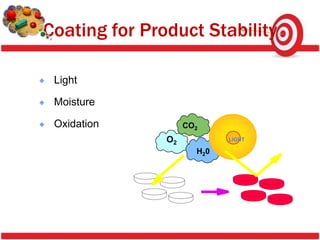
Coating for Product Stability

 Light

 Moisture

 Oxidation          CO2
                            2

               O2               LIGHT

                      H20
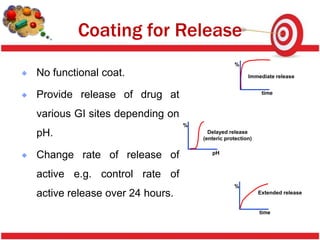
Coating for Release
                                                %
No functional coat.                                   Immediate release


Provide release of drug at                                  time


various GI sites depending on
                                %
pH.                                   Delayed release
                                    (enteric protection)


Change rate of release of              pH


active e.g. control rate of
                                                %
active release over 24 hours.                              Extended release


                                                           time
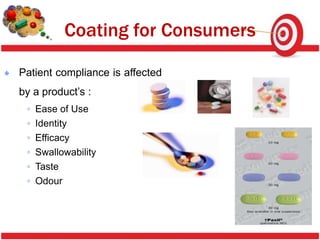
Coating for Consumers

Patient compliance is affected
by a productโ€™s :
 โ—ฆ   Ease of Use
 โ—ฆ   Identity
 โ—ฆ   Efficacy
 โ—ฆ   Swallowability
 โ—ฆ   Taste
 โ—ฆ   Odour
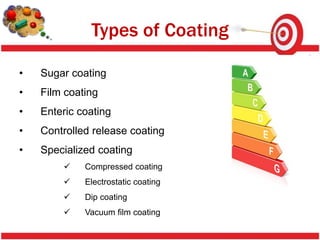
Types of Coating

โ€ข   Sugar coating
โ€ข   Film coating
โ€ข   Enteric coating
โ€ข   Controlled release coating
โ€ข   Specialized coating
        ๏ƒผ    Compressed coating
        ๏ƒผ    Electrostatic coating
        ๏ƒผ    Dip coating
        ๏ƒผ    Vacuum film coating
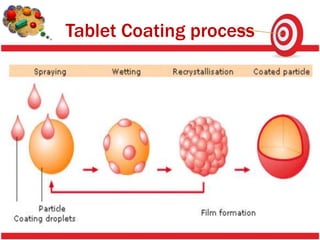
Tablet Coating process
Sugar Coating
SUGAR COATING
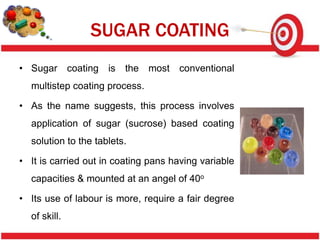
โ€ข Sugar coating is the most conventional
  multistep coating process.

โ€ข As the name suggests, this process involves
  application of sugar (sucrose) based coating
  solution to the tablets.

โ€ข It is carried out in coating pans having variable
  capacities & mounted at an angel of 40o

โ€ข Its use of labour is more, require a fair degree
  of skill.
Advantages of S.C.

cheap, safe coating material

cheap coating machine

good patient compliance

can be reprocessed

require less hardness core
Disadvantages of S.C

time consuming process.

high weight gain.

increase in packaging &
shipping.

required trained personnel.

Imprinting problems.
Materials for S.C.

Sugar & itโ€™s Subtituents   Glucose, lactose, isomalt, sugar alcohols

Binders                    Acacia, gelatin, PVP


Coloring agents            Water soluble (dyes), water insoluble (lakes)


Anti- Adherents            Talcum, colloidal silica


Fillers                    CaCO3, CaSO4, starch, talcum, TiO2

Polishing Agents           beeswax, carnauba wax, paraffin


Other agents               Flavouring agents, surfactants
Steps involved in S.C.

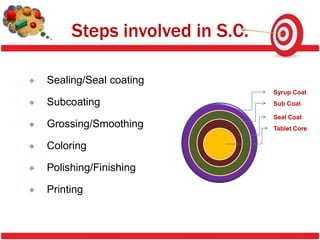
Sealing/Seal coating
                              Syrup Coat
Subcoating                    Sub Coat

                              Seal Coat
Grossing/Smoothing            Tablet Core

Coloring

Polishing/Finishing

Printing
Steps involved in S.Cโ€ฆโ€ฆ
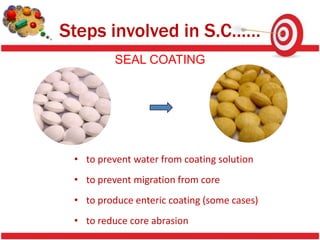
          SEAL COATING


 โ€ข to prevent water from coating solution
 โ€ข to prevent migration from core
 โ€ข to produce enteric coating (some cases)
 โ€ข to reduce core abrasion
Steps involved in S.Cโ€ฆโ€ฆ
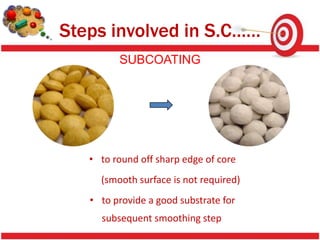
         SUBCOATING


   โ€ข to round off sharp edge of core
     (smooth surface is not required)
   โ€ข to provide a good substrate for
     subsequent smoothing step
Steps involved in S.Cโ€ฆโ€ฆ
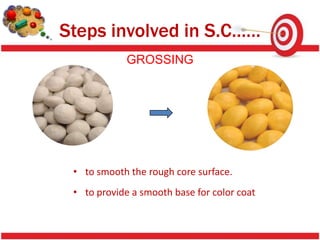
             GROSSING


 โ€ข to smooth the rough core surface.
 โ€ข to provide a smooth base for color coat
Steps involved in S.Cโ€ฆโ€ฆ
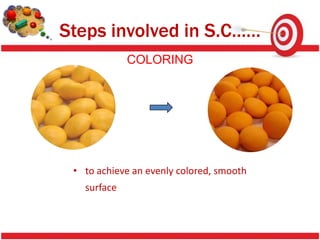
             COLORING


 โ€ข to achieve an evenly colored, smooth
   surface
Steps involved in S.Cโ€ฆโ€ฆ
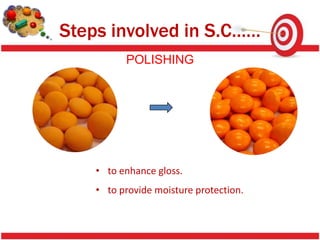
          POLISHING


    โ€ข to enhance gloss.
    โ€ข to provide moisture protection.
Coating Defects
Coating Defects
                           CHIPPING
โ€ข   Involves increased brittleness of the tablet.

โ€ข   Causes :
    High degree of attrition associated with the coating process
    like:
              ๏ƒผ excessive use of fillers & pigments
              ๏ƒผ low amount of polymers
โ€ข   Remedy :
    Increase hardness of the film by increasing the molecular
    weight grade of polymer.
Coating Defects
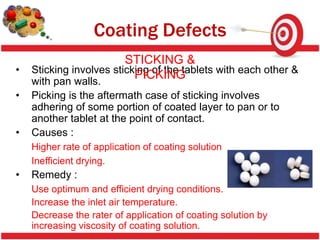
                       STICKING &
โ€ข Sticking involves sticking of the tablets with each other &
  with pan walls.
                         PICKING
โ€ข   Picking is the aftermath case of sticking involves
    adhering of some portion of coated layer to pan or to
    another tablet at the point of contact.
โ€ข   Causes :
    Higher rate of application of coating solution
    Inefficient drying.
โ€ข   Remedy :
    Use optimum and efficient drying conditions.
    Increase the inlet air temperature.
    Decrease the rater of application of coating solution by
    increasing viscosity of coating solution.
Coating Defects
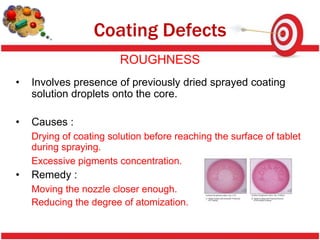
                         ROUGHNESS
โ€ข   Involves presence of previously dried sprayed coating
    solution droplets onto the core.

โ€ข   Causes :
    Drying of coating solution before reaching the surface of tablet
    during spraying.
    Excessive pigments concentration.
โ€ข   Remedy :
    Moving the nozzle closer enough.
    Reducing the degree of atomization.
Coating Defects
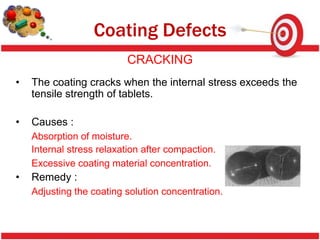
                          CRACKING
โ€ข   The coating cracks when the internal stress exceeds the
    tensile strength of tablets.

โ€ข   Causes :
    Absorption of moisture.
    Internal stress relaxation after compaction.
    Excessive coating material concentration.
โ€ข   Remedy :
    Adjusting the coating solution concentration.
Coating Defects
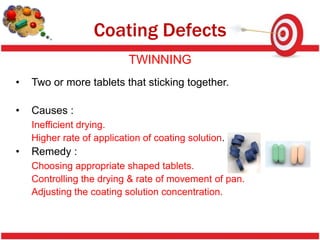
                           TWINNING
โ€ข   Two or more tablets that sticking together.

โ€ข   Causes :
    Inefficient drying.
    Higher rate of application of coating solution.
โ€ข   Remedy :
    Choosing appropriate shaped tablets.
    Controlling the drying & rate of movement of pan.
    Adjusting the coating solution concentration.
Coating Defects
                   BLOOMING/HAZING
โ€ข   The polish of product to take on a fogged appearance.

โ€ข   Causes :
    High temperature during formulation.
    Exposure to high humidity conditions.

โ€ข   Remedy :
    Controlling humidity conditions.
    Formulation temperature monitoring.
Coating Defects
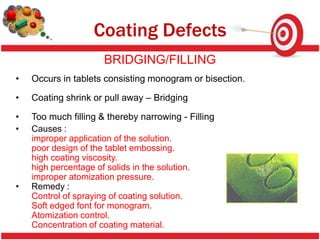
                      BRIDGING/FILLING
โ€ข   Occurs in tablets consisting monogram or bisection.

โ€ข   Coating shrink or pull away โ€“ Bridging

โ€ข   Too much filling & thereby narrowing - Filling
โ€ข   Causes :
    improper application of the solution.
    poor design of the tablet embossing.
    high coating viscosity.
    high percentage of solids in the solution.
    improper atomization pressure.
โ€ข   Remedy :
    Control of spraying of coating solution.
    Soft edged font for monogram.
    Atomization control.
    Concentration of coating material.
Coating Defects
                         BLISTERING
โ€ข   An un-smooth coated surface shows a number of
    uneven spots called blisters.

โ€ข   Causes :
    Effect of temperature on the strength, elasticity and adhesion
    of the coat.

โ€ข   Remedy :
    Use mild drying condition.
Coating Defects
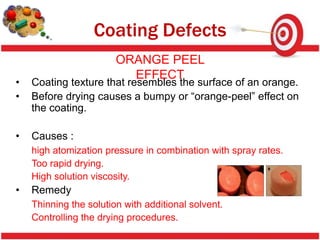
                        ORANGE PEEL
                          EFFECT
โ€ข   Coating texture that resembles the surface of an orange.
โ€ข   Before drying causes a bumpy or โ€œorange-peelโ€ effect on
    the coating.

โ€ข   Causes :
    high atomization pressure in combination with spray rates.
    Too rapid drying.
    High solution viscosity.
โ€ข   Remedy
    Thinning the solution with additional solvent.
    Controlling the drying procedures.
Coating Defects
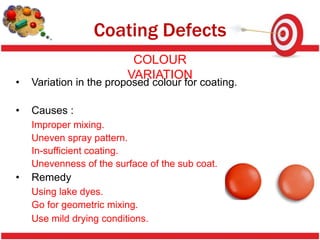
                           COLOUR
                          VARIATION
โ€ข   Variation in the proposed colour for coating.

โ€ข   Causes :
    Improper mixing.
    Uneven spray pattern.
    In-sufficient coating.
    Unevenness of the surface of the sub coat.
โ€ข   Remedy
    Using lake dyes.
    Go for geometric mixing.
    Use mild drying conditions.
tablet defects

tablet defects

  • 1.
    Defects in TabletSugar Coating AACP Bangalore
  • 2.
    TABLET COATING โ€ข Tabletcoating is the application of coating material to the exterior of a tablet with the intention of conferring benefits and properties to a dosage form over the uncoated variety.
  • 3.
    Why To Coat?? โ€ข Bitter taste or unpleasant odour. โ€ข Protecting the drug from surroundings (Stability). โ€ข Handling & ease of ingesting by patients. โ€ข Mechanical protection from breakage. โ€ข Light incompatibility or Environmental Oxidation. โ€ข In-elegent core. โ€ข modifying the drug release profile. โ€ข Product identity.
  • 4.
    Coating for Processing Increasepackaging speed Reduces damage during the packaging process Printing efficiency and clarity Product identification Reduced changeover and cleandown time Reduces operator exposure to active substances
  • 5.
    Coating for Marketing Allows product to stand out from the competition Colour and tablet shape for branding and trademark Zocor and Cozaar trademark of MSD Neurontin trademark Pfizer
  • 6.
    Coating for ProductStability Light Moisture Oxidation CO2 2 O2 LIGHT H20
  • 7.
    Coating for Release % No functional coat. Immediate release Provide release of drug at time various GI sites depending on % pH. Delayed release (enteric protection) Change rate of release of pH active e.g. control rate of % active release over 24 hours. Extended release time
  • 8.
    Coating for Consumers Patientcompliance is affected by a productโ€™s : โ—ฆ Ease of Use โ—ฆ Identity โ—ฆ Efficacy โ—ฆ Swallowability โ—ฆ Taste โ—ฆ Odour
  • 9.
    Types of Coating โ€ข Sugar coating โ€ข Film coating โ€ข Enteric coating โ€ข Controlled release coating โ€ข Specialized coating ๏ƒผ Compressed coating ๏ƒผ Electrostatic coating ๏ƒผ Dip coating ๏ƒผ Vacuum film coating
  • 10.
  • 11.
  • 12.
    SUGAR COATING โ€ข Sugarcoating is the most conventional multistep coating process. โ€ข As the name suggests, this process involves application of sugar (sucrose) based coating solution to the tablets. โ€ข It is carried out in coating pans having variable capacities & mounted at an angel of 40o โ€ข Its use of labour is more, require a fair degree of skill.
  • 13.
    Advantages of S.C. cheap,safe coating material cheap coating machine good patient compliance can be reprocessed require less hardness core
  • 14.
    Disadvantages of S.C timeconsuming process. high weight gain. increase in packaging & shipping. required trained personnel. Imprinting problems.
  • 15.
    Materials for S.C. Sugar& itโ€™s Subtituents Glucose, lactose, isomalt, sugar alcohols Binders Acacia, gelatin, PVP Coloring agents Water soluble (dyes), water insoluble (lakes) Anti- Adherents Talcum, colloidal silica Fillers CaCO3, CaSO4, starch, talcum, TiO2 Polishing Agents beeswax, carnauba wax, paraffin Other agents Flavouring agents, surfactants
  • 16.
    Steps involved inS.C. Sealing/Seal coating Syrup Coat Subcoating Sub Coat Seal Coat Grossing/Smoothing Tablet Core Coloring Polishing/Finishing Printing
  • 17.
    Steps involved inS.Cโ€ฆโ€ฆ SEAL COATING โ€ข to prevent water from coating solution โ€ข to prevent migration from core โ€ข to produce enteric coating (some cases) โ€ข to reduce core abrasion
  • 18.
    Steps involved inS.Cโ€ฆโ€ฆ SUBCOATING โ€ข to round off sharp edge of core (smooth surface is not required) โ€ข to provide a good substrate for subsequent smoothing step
  • 19.
    Steps involved inS.Cโ€ฆโ€ฆ GROSSING โ€ข to smooth the rough core surface. โ€ข to provide a smooth base for color coat
  • 20.
    Steps involved inS.Cโ€ฆโ€ฆ COLORING โ€ข to achieve an evenly colored, smooth surface
  • 21.
    Steps involved inS.Cโ€ฆโ€ฆ POLISHING โ€ข to enhance gloss. โ€ข to provide moisture protection.
  • 22.
  • 23.
    Coating Defects CHIPPING โ€ข Involves increased brittleness of the tablet. โ€ข Causes : High degree of attrition associated with the coating process like: ๏ƒผ excessive use of fillers & pigments ๏ƒผ low amount of polymers โ€ข Remedy : Increase hardness of the film by increasing the molecular weight grade of polymer.
  • 24.
    Coating Defects STICKING & โ€ข Sticking involves sticking of the tablets with each other & with pan walls. PICKING โ€ข Picking is the aftermath case of sticking involves adhering of some portion of coated layer to pan or to another tablet at the point of contact. โ€ข Causes : Higher rate of application of coating solution Inefficient drying. โ€ข Remedy : Use optimum and efficient drying conditions. Increase the inlet air temperature. Decrease the rater of application of coating solution by increasing viscosity of coating solution.
  • 25.
    Coating Defects ROUGHNESS โ€ข Involves presence of previously dried sprayed coating solution droplets onto the core. โ€ข Causes : Drying of coating solution before reaching the surface of tablet during spraying. Excessive pigments concentration. โ€ข Remedy : Moving the nozzle closer enough. Reducing the degree of atomization.
  • 26.
    Coating Defects CRACKING โ€ข The coating cracks when the internal stress exceeds the tensile strength of tablets. โ€ข Causes : Absorption of moisture. Internal stress relaxation after compaction. Excessive coating material concentration. โ€ข Remedy : Adjusting the coating solution concentration.
  • 27.
    Coating Defects TWINNING โ€ข Two or more tablets that sticking together. โ€ข Causes : Inefficient drying. Higher rate of application of coating solution. โ€ข Remedy : Choosing appropriate shaped tablets. Controlling the drying & rate of movement of pan. Adjusting the coating solution concentration.
  • 28.
    Coating Defects BLOOMING/HAZING โ€ข The polish of product to take on a fogged appearance. โ€ข Causes : High temperature during formulation. Exposure to high humidity conditions. โ€ข Remedy : Controlling humidity conditions. Formulation temperature monitoring.
  • 29.
    Coating Defects BRIDGING/FILLING โ€ข Occurs in tablets consisting monogram or bisection. โ€ข Coating shrink or pull away โ€“ Bridging โ€ข Too much filling & thereby narrowing - Filling โ€ข Causes : improper application of the solution. poor design of the tablet embossing. high coating viscosity. high percentage of solids in the solution. improper atomization pressure. โ€ข Remedy : Control of spraying of coating solution. Soft edged font for monogram. Atomization control. Concentration of coating material.
  • 30.
    Coating Defects BLISTERING โ€ข An un-smooth coated surface shows a number of uneven spots called blisters. โ€ข Causes : Effect of temperature on the strength, elasticity and adhesion of the coat. โ€ข Remedy : Use mild drying condition.
  • 31.
    Coating Defects ORANGE PEEL EFFECT โ€ข Coating texture that resembles the surface of an orange. โ€ข Before drying causes a bumpy or โ€œorange-peelโ€ effect on the coating. โ€ข Causes : high atomization pressure in combination with spray rates. Too rapid drying. High solution viscosity. โ€ข Remedy Thinning the solution with additional solvent. Controlling the drying procedures.
  • 32.
    Coating Defects COLOUR VARIATION โ€ข Variation in the proposed colour for coating. โ€ข Causes : Improper mixing. Uneven spray pattern. In-sufficient coating. Unevenness of the surface of the sub coat. โ€ข Remedy Using lake dyes. Go for geometric mixing. Use mild drying conditions.