Defects/ Processing problems in
Tablet dosage form
PREPARED BY
MS. SHITAL TRIVEDI
ASSISTANT PROFESSOR,
L.J.INSTITUTE OF PHARMACY
1
Processing problems/Tablet defects:
Sources: Formulation, compression equipment, or a combination of the
two.
1. Capping & Lamination:
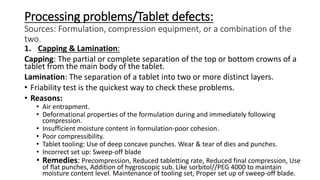
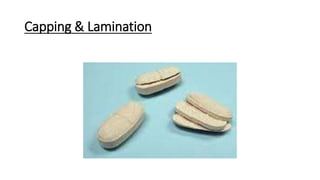
Capping: The partial or complete separation of the top or bottom crowns of a
tablet from the main body of the tablet.
Lamination: The separation of a tablet into two or more distinct layers.
• Friability test is the quickest way to check these problems.
• Reasons:
• Air entrapment.
• Deformational properties of the formulation during and immediately following
compression.
• Insufficient moisture content in formulation-poor cohesion.
• Poor compressibility.
• Tablet tooling: Use of deep concave punches. Wear & tear of dies and punches.
• Incorrect set up: Sweep-off blade
• Remedies: Precompression, Reduced tabletting rate, Reduced final compression, Use
of flat punches, Addition of hygroscopic sub. Like sorbitol//PEG 4000 to maintain
moisture content level. Maintenance of tooling set, Proper set up of sweep-off blade.
Capping & Lamination
Picking & Sticking:
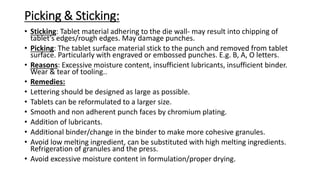
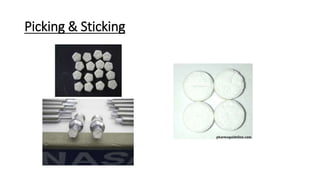
• Sticking: Tablet material adhering to the die wall- may result into chipping of
tablet’s edges/rough edges. May damage punches.
• Picking: The tablet surface material stick to the punch and removed from tablet
surface. Particularly with engraved or embossed punches. E.g. B, A, O letters.
• Reasons: Excessive moisture content, insufficient lubricants, insufficient binder.
Wear & tear of tooling..
• Remedies:
• Lettering should be designed as large as possible.
• Tablets can be reformulated to a larger size.
• Smooth and non adherent punch faces by chromium plating.
• Addition of lubricants.
• Additional binder/change in the binder to make more cohesive granules.
• Avoid low melting ingredient, can be substituted with high melting ingredients.
Refrigeration of granules and the press.
• Avoid excessive moisture content in formulation/proper drying.
Picking & Sticking
Mottling:
• Mottling: An unequal distribution of color on a tablet, with light or
dark areas on the tablet surface.
• Reasons:
• Color difference between drug & other excipients.
• Improper distribution of colorants.
• Migration of color dye to the surface of granules during drying.
• Remedies: Change in solvent system, change in binder system
reduced drying temperature, size reduction of color particles.
• E.g. Avoid adding colored adhesive gel solution, instead incorporate
fine powder adhesives into the product before adding the granulating
fluid, or to disperse a dry color additive during powder blending step.
Mottling
Double impression:
• This problem is only related to the punches that have monogram or
other engraving on them.
• If lower punches are monogrammed then free movement of lower
punch can produce double imprint on the bottom of the tablet.
• If upper punches are monogrammed and free rotating then (in double
compression process) precompression stage and final compression
stage may produce double impression.
• Remedy:
• Use of Keyed punches( Antiturning devices as an integral part of
machine design)
Double impression
Weight variation:
• Anything that can alter the die filling process can alter tablet weight and result into weight variation.
• Reasons:
• Granule size & size distribution:- may change the fill weight in each die. Large granules may produce high
percentage weight variation.
• Poor flow of bulk/blend:
• Poor mixing of lubricant & glidants.
• Depending on the geometry of hopper-Bridging/arching & rat-holing may occur which are the causes for
poor flow of blend.
• Excessive flow from hopper.
• Lower Punch length Variation.
• Remedies:
• Addition of glidants.
• Induced die feeders & feed frames that accommodate excess flow.
• Hopper with vibrators attached to its sides.
• Caution: Flow promoters can cause segregation of large and small particles- weight variation & poor content
uniformity.
Hardness:
• Same causes as weight variation.
• Hardness depends on weight/volume of the material in die and space
between lower & upper punches at the moment of compression.
Variation in these, causes variation in hardness.
Film defects/Defects in coated tablets:
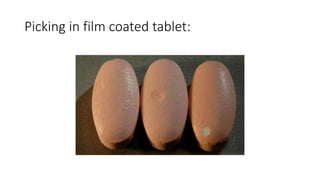
1. Sticking & Picking:
Causes:
Over wetting or excessive film tackiness(poor formulation)…on drying,
it gives a ‘picked’ appearance, resulting in a small exposed area of the
core.
Remedies:
A reduction in the liquid application rate.
Increase in the drying temperature & air volume.
Reformulation of coating composition
Picking in film coated tablet:
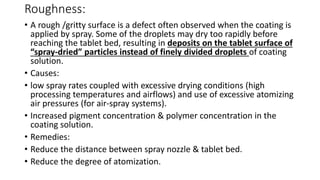
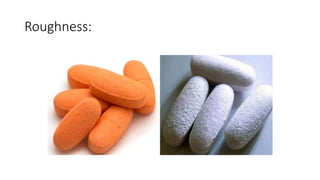
Roughness:
• A rough /gritty surface is a defect often observed when the coating is
applied by spray. Some of the droplets may dry too rapidly before
reaching the tablet bed, resulting in deposits on the tablet surface of
“spray-dried” particles instead of finely divided droplets of coating
solution.
• Causes:
• low spray rates coupled with excessive drying conditions (high
processing temperatures and airflows) and use of excessive atomizing
air pressures (for air-spray systems).
• Increased pigment concentration & polymer concentration in the
coating solution.
• Remedies:
• Reduce the distance between spray nozzle & tablet bed.
• Reduce the degree of atomization.
Roughness:
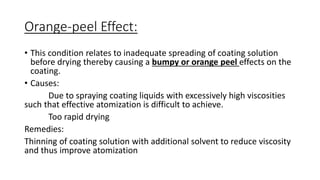
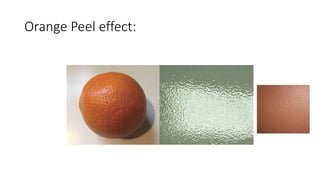
Orange-peel Effect:
• This condition relates to inadequate spreading of coating solution
before drying thereby causing a bumpy or orange peel effects on the
coating.
• Causes:
Due to spraying coating liquids with excessively high viscosities
such that effective atomization is difficult to achieve.
Too rapid drying
Remedies:
Thinning of coating solution with additional solvent to reduce viscosity
and thus improve atomization
Orange Peel effect:
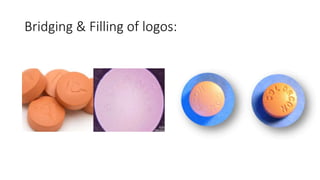
Bridging & Filling:
Bridging…Causes:
Poor Formulation: During drying, the film may shrink & pull away from the sharp
corners of an intagliation/bisect, resulting in a “bridging” of the surface
depression….obscured monogram/bisect.
Remedies:
Increased plasticizer content or change in plasticizer can decrease bridging.
Filling ….Causes:
Application of too much coating solution, results in a thick film that fills & narrows
the monogram/bisect.
If the solution is applied too fast, overwetting may cause the liquid to quickly fill &
be retained in the monogram.
Remedies:
Monitoring of the fluid application rate and thorough mixing of the tablets in the
pan prevent filling.
Bridging & Filling of logos:
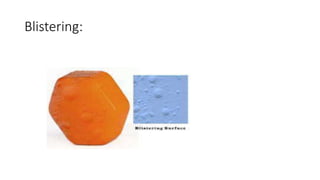
Blistering:
• Local detachment of the film from the substrate(tablet surface).
• Causes:
• Too rapid evaporation of the solvent from the core & the effect of
high temperature on the strength, elasticity, & adhesion of the film
may result in blistering.
• Remedies:
• Use of milder drying conditions.
Blistering:
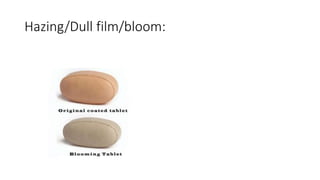
Hazing/Dull film/bloom:
• Causes:
• Too high processing temperature for a particular formulation.
• Dulling is evident when cellulosic polymers are applied out of
aqueous media at high processing temperatures.
• It can also occur If the coated tablets are exposed to high humidity
conditions & partial solvation of film results.
• Remedies:
• Reduce processing temperatures.
Hazing/Dull film/bloom:
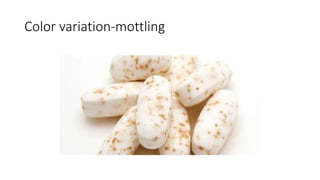
Color variation:
• Causes: Processing conditions and formulation.
• Improper mixing, uneven spray pattern, & insufficient coating.
• Migration of soluble dyes, plasticizers, & other additives during drying
may give the coating a mottled/spotted appearance.
• Remedies:
• Use of lake dyes to eliminate dye migration.
• Reformulation with different plasticizers & additives—best way to
solve film instabilities caused by the ingredients.
Color variation-mottling
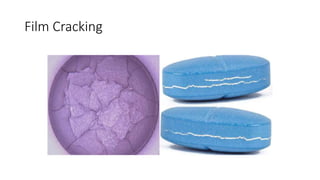
Cracking:
• Causes: If internal stresses in the film exceed the tensile strength of
the film.
• Remedies:
• To increase tensile strength: Use high molecular weight polymers or
polymer blends.
• To reduce internal stresses in film: Adjust type of plasticizer and
concentration, pigment type & concentration.
Film Cracking
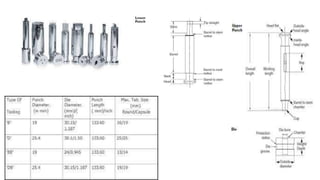
Tablet Tooling:
• BB tooling: Most common.
5.25 inch punch length, 0.75 inch barrel diameter, 1 inch punch
head diameter.
• B tooling: Identical to BB, except lower punch is only 3 9/16 inches long.
• D tooling- for larger tablets.
5.25 inch punch length, 1 inch barrel diameter, 11/4 inch punch
head diameter.
• Dies: 0.945 inch OD- round tablet with 7/16 inch round tablet or 9/16 inch
capsule shaped tablet
or 13/16 inch OD—9/16 inch round tablet or ¾ inch capsule shaped
tablet.
Tablet machine’s output depends on no. of tooling sets, no. of compression
stations and rotational speed of machine.
30
1. The Theory and Practice of Industrial Pharmacy by Leon Lachman, A.lieberman
2. Google Images
THANK YOU
References:

Defects or processing problems in tablet dosage form.

  • 1.
    Defects/ Processing problemsin Tablet dosage form PREPARED BY MS. SHITAL TRIVEDI ASSISTANT PROFESSOR, L.J.INSTITUTE OF PHARMACY 1
  • 2.
    Processing problems/Tablet defects: Sources:Formulation, compression equipment, or a combination of the two. 1. Capping & Lamination: Capping: The partial or complete separation of the top or bottom crowns of a tablet from the main body of the tablet. Lamination: The separation of a tablet into two or more distinct layers. • Friability test is the quickest way to check these problems. • Reasons: • Air entrapment. • Deformational properties of the formulation during and immediately following compression. • Insufficient moisture content in formulation-poor cohesion. • Poor compressibility. • Tablet tooling: Use of deep concave punches. Wear & tear of dies and punches. • Incorrect set up: Sweep-off blade • Remedies: Precompression, Reduced tabletting rate, Reduced final compression, Use of flat punches, Addition of hygroscopic sub. Like sorbitol//PEG 4000 to maintain moisture content level. Maintenance of tooling set, Proper set up of sweep-off blade.
  • 3.
  • 4.
    Picking & Sticking: •Sticking: Tablet material adhering to the die wall- may result into chipping of tablet’s edges/rough edges. May damage punches. • Picking: The tablet surface material stick to the punch and removed from tablet surface. Particularly with engraved or embossed punches. E.g. B, A, O letters. • Reasons: Excessive moisture content, insufficient lubricants, insufficient binder. Wear & tear of tooling.. • Remedies: • Lettering should be designed as large as possible. • Tablets can be reformulated to a larger size. • Smooth and non adherent punch faces by chromium plating. • Addition of lubricants. • Additional binder/change in the binder to make more cohesive granules. • Avoid low melting ingredient, can be substituted with high melting ingredients. Refrigeration of granules and the press. • Avoid excessive moisture content in formulation/proper drying.
  • 5.
  • 6.
    Mottling: • Mottling: Anunequal distribution of color on a tablet, with light or dark areas on the tablet surface. • Reasons: • Color difference between drug & other excipients. • Improper distribution of colorants. • Migration of color dye to the surface of granules during drying. • Remedies: Change in solvent system, change in binder system reduced drying temperature, size reduction of color particles. • E.g. Avoid adding colored adhesive gel solution, instead incorporate fine powder adhesives into the product before adding the granulating fluid, or to disperse a dry color additive during powder blending step.
  • 7.
  • 8.
    Double impression: • Thisproblem is only related to the punches that have monogram or other engraving on them. • If lower punches are monogrammed then free movement of lower punch can produce double imprint on the bottom of the tablet. • If upper punches are monogrammed and free rotating then (in double compression process) precompression stage and final compression stage may produce double impression. • Remedy: • Use of Keyed punches( Antiturning devices as an integral part of machine design)
  • 9.
  • 10.
    Weight variation: • Anythingthat can alter the die filling process can alter tablet weight and result into weight variation. • Reasons: • Granule size & size distribution:- may change the fill weight in each die. Large granules may produce high percentage weight variation. • Poor flow of bulk/blend: • Poor mixing of lubricant & glidants. • Depending on the geometry of hopper-Bridging/arching & rat-holing may occur which are the causes for poor flow of blend. • Excessive flow from hopper. • Lower Punch length Variation. • Remedies: • Addition of glidants. • Induced die feeders & feed frames that accommodate excess flow. • Hopper with vibrators attached to its sides. • Caution: Flow promoters can cause segregation of large and small particles- weight variation & poor content uniformity.
  • 11.
    Hardness: • Same causesas weight variation. • Hardness depends on weight/volume of the material in die and space between lower & upper punches at the moment of compression. Variation in these, causes variation in hardness.
  • 12.
    Film defects/Defects incoated tablets: 1. Sticking & Picking: Causes: Over wetting or excessive film tackiness(poor formulation)…on drying, it gives a ‘picked’ appearance, resulting in a small exposed area of the core. Remedies: A reduction in the liquid application rate. Increase in the drying temperature & air volume. Reformulation of coating composition
  • 13.
    Picking in filmcoated tablet:
  • 14.
    Roughness: • A rough/gritty surface is a defect often observed when the coating is applied by spray. Some of the droplets may dry too rapidly before reaching the tablet bed, resulting in deposits on the tablet surface of “spray-dried” particles instead of finely divided droplets of coating solution. • Causes: • low spray rates coupled with excessive drying conditions (high processing temperatures and airflows) and use of excessive atomizing air pressures (for air-spray systems). • Increased pigment concentration & polymer concentration in the coating solution. • Remedies: • Reduce the distance between spray nozzle & tablet bed. • Reduce the degree of atomization.
  • 15.
  • 16.
    Orange-peel Effect: • Thiscondition relates to inadequate spreading of coating solution before drying thereby causing a bumpy or orange peel effects on the coating. • Causes: Due to spraying coating liquids with excessively high viscosities such that effective atomization is difficult to achieve. Too rapid drying Remedies: Thinning of coating solution with additional solvent to reduce viscosity and thus improve atomization
  • 17.
  • 18.
    Bridging & Filling: Bridging…Causes: PoorFormulation: During drying, the film may shrink & pull away from the sharp corners of an intagliation/bisect, resulting in a “bridging” of the surface depression….obscured monogram/bisect. Remedies: Increased plasticizer content or change in plasticizer can decrease bridging. Filling ….Causes: Application of too much coating solution, results in a thick film that fills & narrows the monogram/bisect. If the solution is applied too fast, overwetting may cause the liquid to quickly fill & be retained in the monogram. Remedies: Monitoring of the fluid application rate and thorough mixing of the tablets in the pan prevent filling.
  • 19.
  • 20.
    Blistering: • Local detachmentof the film from the substrate(tablet surface). • Causes: • Too rapid evaporation of the solvent from the core & the effect of high temperature on the strength, elasticity, & adhesion of the film may result in blistering. • Remedies: • Use of milder drying conditions.
  • 21.
  • 22.
    Hazing/Dull film/bloom: • Causes: •Too high processing temperature for a particular formulation. • Dulling is evident when cellulosic polymers are applied out of aqueous media at high processing temperatures. • It can also occur If the coated tablets are exposed to high humidity conditions & partial solvation of film results. • Remedies: • Reduce processing temperatures.
  • 23.
  • 24.
    Color variation: • Causes:Processing conditions and formulation. • Improper mixing, uneven spray pattern, & insufficient coating. • Migration of soluble dyes, plasticizers, & other additives during drying may give the coating a mottled/spotted appearance. • Remedies: • Use of lake dyes to eliminate dye migration. • Reformulation with different plasticizers & additives—best way to solve film instabilities caused by the ingredients.
  • 25.
  • 26.
    Cracking: • Causes: Ifinternal stresses in the film exceed the tensile strength of the film. • Remedies: • To increase tensile strength: Use high molecular weight polymers or polymer blends. • To reduce internal stresses in film: Adjust type of plasticizer and concentration, pigment type & concentration.
  • 27.
  • 28.
    Tablet Tooling: • BBtooling: Most common. 5.25 inch punch length, 0.75 inch barrel diameter, 1 inch punch head diameter. • B tooling: Identical to BB, except lower punch is only 3 9/16 inches long. • D tooling- for larger tablets. 5.25 inch punch length, 1 inch barrel diameter, 11/4 inch punch head diameter. • Dies: 0.945 inch OD- round tablet with 7/16 inch round tablet or 9/16 inch capsule shaped tablet or 13/16 inch OD—9/16 inch round tablet or ¾ inch capsule shaped tablet. Tablet machine’s output depends on no. of tooling sets, no. of compression stations and rotational speed of machine.
  • 30.
    30 1. The Theoryand Practice of Industrial Pharmacy by Leon Lachman, A.lieberman 2. Google Images THANK YOU References: