CAUSES OF TABLET DEFECTS
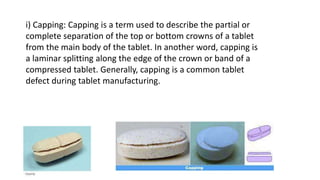
i) Capping: Capping is a term used to describe the partial or
complete separation of the top or bottom crowns of a tablet
from the main body of the tablet. In another word, capping is
a laminar splitting along the edge of the crown or band of a
compressed tablet. Generally, capping is a common tablet
defect during tablet manufacturing.
Capping
Causes
• A large number of fines in
granules
• Too dry and low moisture
content (result is the loss of
proper binding action).
• Not properly dried granules
thoroughly
• Less Amount of binder or
improper binder and lubricant.
Remedies
• Use 100 to 200 mesh screens to
remove fines
• Moisten the granules.
• Dry granules properly.
• Add more Amount binder and
lubricant.
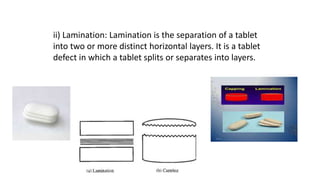
ii) Lamination: Lamination is the separation of a tablet
into two or more distinct horizontal layers. It is a tablet
defect in which a tablet splits or separates into layers.
Lamination
Causes
• Oily or waxy materials in
granules
• Too much hydrophobic lubricant
• Magnesium-stearate
• High quantity of fine powder
materials in the granules
Remedies
• add adsorbent or absorbent
• less Amount of lubricant or
change the type of lubricant
• Use granular or less fine material
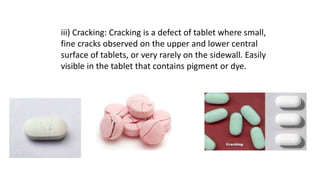
iii) Cracking: Cracking is a defect of tablet where small,
fine cracks observed on the upper and lower central
surface of tablets, or very rarely on the sidewall. Easily
visible in the tablet that contains pigment or dye.
Cracking
Causes
• Large size of granules
• Too dry granules.
• Inadequate binder
• Granulation is too cold.
Remedies
• Add fines and reduce granule
size.
• Moisten the granules properly
and add the proper amount of
binder(dry binder).
• Compress at room temperature.
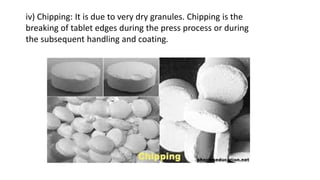
iv) Chipping: It is due to very dry granules. Chipping is the
breaking of tablet edges during the press process or during
the subsequent handling and coating.
Chipping
Causes
• Sticking on punches faces.
• Too dry granules.
• Too much binding causes are
chipping at the bottom.
Remedies
• Increase lubrication.
• Dry the granules properly.
• Moisten the granules to
plasticize. Add hygroscopic
substances, or use a dry binder.
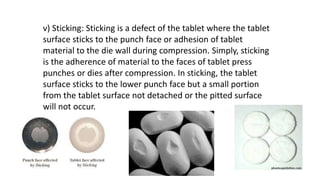
v) Sticking: Sticking is a defect of the tablet where the tablet
surface sticks to the punch face or adhesion of tablet
material to the die wall during compression. Simply, sticking
is the adherence of material to the faces of tablet press
punches or dies after compression. In sticking, the tablet
surface sticks to the lower punch face but a small portion
from the tablet surface not detached or the pitted surface
will not occur.
Sticking
Causes
• Less dry granules.
• Improper lubrication.
• Too much binder.
• Hygroscopic granular materials.
• Oily or waxy materials.
• Week granules or too soft.
Remedies
• Dry the granules properly and do a
moisture analysis to determine
limits.
• Add more Amount lubricant to the
formulation.
• Compress under control humidity.
• Modify the mixing process and add
an absorbent.
• Optimize the Amount of binder and
granulation technique.
vi) Picking: Picking is the term used when a small amount of
material from a tablet is sticking to and being removed from
the tablet-surface by a punch. It is the removal of material
from the surface of tablet and its adherence to the face of
punch.
Picking
Picking
• Excessive moisture in granules.
• Not well lubricated.
• The low melting substance may
soften from the heat of
compression and leads to picking.
• A high concentration of low
melting point medicament.
• During compression, granules are
not too warm.
• Too much Amount of a binder.
Picking
• Dry granules properly and determine
optimum limits
• Use colloidal silica(lubrication agent)
as a polishing agent to prevent
materials adhere to punch skin.
• Use high materials-point materials.
• Keep granules at optimum
temperature and compress them at
room temperature.
• Reduce the Amount of binder. Use a
dry binder.
vii) Binding: These problems (v, vi, vii) are due to more
amount of binder in the granules or wet granules.
Binding is tablet defect where a tablet adheres, seize
or tear in the die or a film is formed on the die area
and hindered the ejection of the tablet or splits during
the molding/pressing process. The powder adheres to
punch edges and dies punches may bind in dies
difficult ejection.
Causes Remedies
Too moist granules. Dry the granules properly.
Excessive binder. Use proper amount of binder.
Inadequate lubrication. Increase or change lubricant
Too hard granules for the
lubricant to be effective.
Modify granulation. Reduce granular size.
Granular material very abrasive
and cutting into dies.
If coarse granules, reduce its size.
Use wear-resistant dies.
Hygroscopic Ingredients Process under low humidity conditions
Causes and remedies of binding related to
formulation
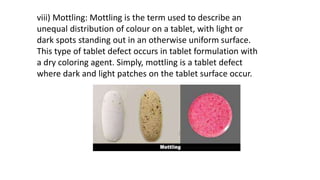
viii) Mottling: Mottling is the term used to describe an
unequal distribution of colour on a tablet, with light or
dark spots standing out in an otherwise uniform surface.
This type of tablet defect occurs in tablet formulation with
a dry coloring agent. Simply, mottling is a tablet defect
where dark and light patches on the tablet surface occur.
Causes of Mottling
• A colored drug is used along with colorless or white-colored
materials.
• This is due to the migration of color to the surface of granules during
the drying process.
• Not proper mixing of dye, especially during direct compression.
• Improper mixing of a colored binder solution.
Remedies for Mottling
• Reduces drying temperature, and changes the binder and solvent.
• Prevent segregation by mixing properly and reducing the size if it is of
a large size.
• During the powder blending step, add dry color additives, then finally
add powdered adhesives such as acacia and tragacanth.
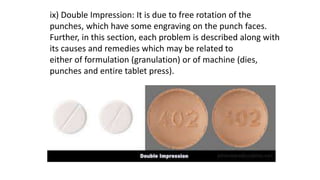
ix) Double Impression: It is due to free rotation of the
punches, which have some engraving on the punch faces.
Further, in this section, each problem is described along with
its causes and remedies which may be related to
either of formulation (granulation) or of machine (dies,
punches and entire tablet press).
Double impression
Causes
• Free rotation of upper or lower
punch during the ejection of
tablets.
Remedies
• Inset a key alongside the punch
to prevent free rotation.
• Never press anti-turning devices,
which prevent punch rotation.
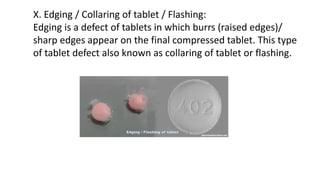
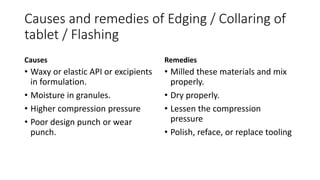
X. Edging / Collaring of tablet / Flashing:
Edging is a defect of tablets in which burrs (raised edges)/
sharp edges appear on the final compressed tablet. This type
of tablet defect also known as collaring of tablet or flashing.
Causes and remedies of Edging / Collaring of
tablet / Flashing
Causes
• Waxy or elastic API or excipients
in formulation.
• Moisture in granules.
• Higher compression pressure
• Poor design punch or wear
punch.
Remedies
• Milled these materials and mix
properly.
• Dry properly.
• Lessen the compression
pressure
• Polish, reface, or replace tooling

tablet defect causes.pptx

  • 1.
  • 2.
    i) Capping: Cappingis a term used to describe the partial or complete separation of the top or bottom crowns of a tablet from the main body of the tablet. In another word, capping is a laminar splitting along the edge of the crown or band of a compressed tablet. Generally, capping is a common tablet defect during tablet manufacturing.
  • 3.
    Capping Causes • A largenumber of fines in granules • Too dry and low moisture content (result is the loss of proper binding action). • Not properly dried granules thoroughly • Less Amount of binder or improper binder and lubricant. Remedies • Use 100 to 200 mesh screens to remove fines • Moisten the granules. • Dry granules properly. • Add more Amount binder and lubricant.
  • 4.
    ii) Lamination: Laminationis the separation of a tablet into two or more distinct horizontal layers. It is a tablet defect in which a tablet splits or separates into layers.
  • 5.
    Lamination Causes • Oily orwaxy materials in granules • Too much hydrophobic lubricant • Magnesium-stearate • High quantity of fine powder materials in the granules Remedies • add adsorbent or absorbent • less Amount of lubricant or change the type of lubricant • Use granular or less fine material
  • 6.
    iii) Cracking: Crackingis a defect of tablet where small, fine cracks observed on the upper and lower central surface of tablets, or very rarely on the sidewall. Easily visible in the tablet that contains pigment or dye.
  • 7.
    Cracking Causes • Large sizeof granules • Too dry granules. • Inadequate binder • Granulation is too cold. Remedies • Add fines and reduce granule size. • Moisten the granules properly and add the proper amount of binder(dry binder). • Compress at room temperature.
  • 8.
    iv) Chipping: Itis due to very dry granules. Chipping is the breaking of tablet edges during the press process or during the subsequent handling and coating.
  • 10.
    Chipping Causes • Sticking onpunches faces. • Too dry granules. • Too much binding causes are chipping at the bottom. Remedies • Increase lubrication. • Dry the granules properly. • Moisten the granules to plasticize. Add hygroscopic substances, or use a dry binder.
  • 11.
    v) Sticking: Stickingis a defect of the tablet where the tablet surface sticks to the punch face or adhesion of tablet material to the die wall during compression. Simply, sticking is the adherence of material to the faces of tablet press punches or dies after compression. In sticking, the tablet surface sticks to the lower punch face but a small portion from the tablet surface not detached or the pitted surface will not occur.
  • 12.
    Sticking Causes • Less drygranules. • Improper lubrication. • Too much binder. • Hygroscopic granular materials. • Oily or waxy materials. • Week granules or too soft. Remedies • Dry the granules properly and do a moisture analysis to determine limits. • Add more Amount lubricant to the formulation. • Compress under control humidity. • Modify the mixing process and add an absorbent. • Optimize the Amount of binder and granulation technique.
  • 13.
    vi) Picking: Pickingis the term used when a small amount of material from a tablet is sticking to and being removed from the tablet-surface by a punch. It is the removal of material from the surface of tablet and its adherence to the face of punch.
  • 14.
    Picking Picking • Excessive moisturein granules. • Not well lubricated. • The low melting substance may soften from the heat of compression and leads to picking. • A high concentration of low melting point medicament. • During compression, granules are not too warm. • Too much Amount of a binder. Picking • Dry granules properly and determine optimum limits • Use colloidal silica(lubrication agent) as a polishing agent to prevent materials adhere to punch skin. • Use high materials-point materials. • Keep granules at optimum temperature and compress them at room temperature. • Reduce the Amount of binder. Use a dry binder.
  • 15.
    vii) Binding: Theseproblems (v, vi, vii) are due to more amount of binder in the granules or wet granules. Binding is tablet defect where a tablet adheres, seize or tear in the die or a film is formed on the die area and hindered the ejection of the tablet or splits during the molding/pressing process. The powder adheres to punch edges and dies punches may bind in dies difficult ejection.
  • 17.
    Causes Remedies Too moistgranules. Dry the granules properly. Excessive binder. Use proper amount of binder. Inadequate lubrication. Increase or change lubricant Too hard granules for the lubricant to be effective. Modify granulation. Reduce granular size. Granular material very abrasive and cutting into dies. If coarse granules, reduce its size. Use wear-resistant dies. Hygroscopic Ingredients Process under low humidity conditions Causes and remedies of binding related to formulation
  • 18.
    viii) Mottling: Mottlingis the term used to describe an unequal distribution of colour on a tablet, with light or dark spots standing out in an otherwise uniform surface. This type of tablet defect occurs in tablet formulation with a dry coloring agent. Simply, mottling is a tablet defect where dark and light patches on the tablet surface occur.
  • 19.
    Causes of Mottling •A colored drug is used along with colorless or white-colored materials. • This is due to the migration of color to the surface of granules during the drying process. • Not proper mixing of dye, especially during direct compression. • Improper mixing of a colored binder solution.
  • 20.
    Remedies for Mottling •Reduces drying temperature, and changes the binder and solvent. • Prevent segregation by mixing properly and reducing the size if it is of a large size. • During the powder blending step, add dry color additives, then finally add powdered adhesives such as acacia and tragacanth.
  • 21.
    ix) Double Impression:It is due to free rotation of the punches, which have some engraving on the punch faces. Further, in this section, each problem is described along with its causes and remedies which may be related to either of formulation (granulation) or of machine (dies, punches and entire tablet press).
  • 22.
    Double impression Causes • Freerotation of upper or lower punch during the ejection of tablets. Remedies • Inset a key alongside the punch to prevent free rotation. • Never press anti-turning devices, which prevent punch rotation.
  • 23.
    X. Edging /Collaring of tablet / Flashing: Edging is a defect of tablets in which burrs (raised edges)/ sharp edges appear on the final compressed tablet. This type of tablet defect also known as collaring of tablet or flashing.
  • 24.
    Causes and remediesof Edging / Collaring of tablet / Flashing Causes • Waxy or elastic API or excipients in formulation. • Moisture in granules. • Higher compression pressure • Poor design punch or wear punch. Remedies • Milled these materials and mix properly. • Dry properly. • Lessen the compression pressure • Polish, reface, or replace tooling