DATA
 Raw facts, texts or numbers.
 Building Blocks of any research
 Raw facts & figures.
 Found on Forms of: Transcripts, Maps,
Photographs,
Videotapes
CONSIDERATIONS IN DATA COLLECTION PLAN
 Objective:
Researcher should consider the objective of collection.
 Scope:
Researcher should know what to collect & from whom.
It determines the nature of data.
 Sources of Data:
On the basis of nature & objective of research Sources are determined
Primary & Secondary Sources.
 Method of Data Collection:
Selection of Appropriate method.
 Unit of Data Collection:
Similar data collection unit should be same for entire set of data.
 Degree of Accuracy:
Level of significance should be determined by researcher.
TYPES OF DATA.
 Primary Data
First hand Data .
Collected through Questionnaire, observation , GD, interview etc.
 Secondary Data
Ready made data (developed by others)
involves published & unpublished sources.
• Qualitative Data
Called Categorical data
Based on attributes, qualities or characteristics.
• Quantitative Data
Data collected in the forms of numbers.
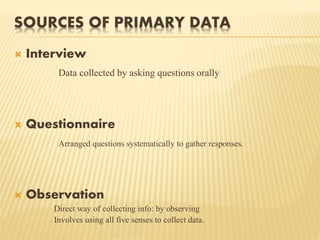
SOURCES OF PRIMARY DATA
 Interview
Data collected by asking questions orally
 Questionnaire
Arranged questions systematically to gather responses.
 Observation
Direct way of collecting info: by observing
Involves using all five senses to collect data.
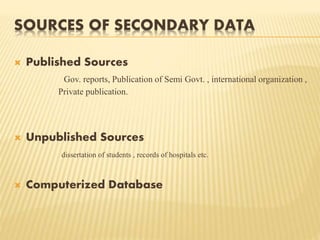
SOURCES OF SECONDARY DATA
 Published Sources
Gov. reports, Publication of Semi Govt. , international organization ,
Private publication.
 Unpublished Sources
dissertation of students , records of hospitals etc.
 Computerized Database
 Reliability
 Supplement data
 Reference
 Comparison
 Resolving the research problem
 Collecting primary data
USES OF SECONDARY DATA
ADVANTAGES OF SECONDARY DATA
 Easy to generalize
 Economy
 Quick
 Helps to cross check
 Reliability
 Determination of reliability of secondary
data is very difficult
 Chances of manipulation
 Inherent limitation.
 Do not match the need of situation
 Difficult to find rationality
DISADVANTAGES OF SECONDARY DATA
A Questionnaire is a formal
list of questions designed to
gather responses from
respondents on a given
topic, issues or event.
QUESTIONNAIRE
 Clear & Precise.
 Use of Natural & family Language
 Unbiasedness
 Avoid double barreled questions
 State explicit alternatives
 Reliable & valid
 Length of questionnaire
 Match the objectives
 Consider the competence of participants
 Pilot study & improving the questionnaire
PRINCIPLES OF QUESTIONNAIRE WRITING

Data Collection & Analysis

  • 2.
    DATA  Raw facts,texts or numbers.  Building Blocks of any research  Raw facts & figures.  Found on Forms of: Transcripts, Maps, Photographs, Videotapes
  • 3.
    CONSIDERATIONS IN DATACOLLECTION PLAN  Objective: Researcher should consider the objective of collection.  Scope: Researcher should know what to collect & from whom. It determines the nature of data.  Sources of Data: On the basis of nature & objective of research Sources are determined Primary & Secondary Sources.
  • 4.
     Method ofData Collection: Selection of Appropriate method.  Unit of Data Collection: Similar data collection unit should be same for entire set of data.  Degree of Accuracy: Level of significance should be determined by researcher.
  • 5.
    TYPES OF DATA. Primary Data First hand Data . Collected through Questionnaire, observation , GD, interview etc.  Secondary Data Ready made data (developed by others) involves published & unpublished sources.
  • 6.
    • Qualitative Data CalledCategorical data Based on attributes, qualities or characteristics. • Quantitative Data Data collected in the forms of numbers.
  • 7.
    SOURCES OF PRIMARYDATA  Interview Data collected by asking questions orally  Questionnaire Arranged questions systematically to gather responses.  Observation Direct way of collecting info: by observing Involves using all five senses to collect data.
  • 8.
    SOURCES OF SECONDARYDATA  Published Sources Gov. reports, Publication of Semi Govt. , international organization , Private publication.  Unpublished Sources dissertation of students , records of hospitals etc.  Computerized Database
  • 9.
     Reliability  Supplementdata  Reference  Comparison  Resolving the research problem  Collecting primary data USES OF SECONDARY DATA
  • 10.
    ADVANTAGES OF SECONDARYDATA  Easy to generalize  Economy  Quick  Helps to cross check  Reliability
  • 11.
     Determination ofreliability of secondary data is very difficult  Chances of manipulation  Inherent limitation.  Do not match the need of situation  Difficult to find rationality DISADVANTAGES OF SECONDARY DATA
  • 12.
    A Questionnaire isa formal list of questions designed to gather responses from respondents on a given topic, issues or event. QUESTIONNAIRE
  • 13.
     Clear &Precise.  Use of Natural & family Language  Unbiasedness  Avoid double barreled questions  State explicit alternatives  Reliable & valid  Length of questionnaire  Match the objectives  Consider the competence of participants  Pilot study & improving the questionnaire PRINCIPLES OF QUESTIONNAIRE WRITING