T-Cell Maturation, Activation,
and Differentiation
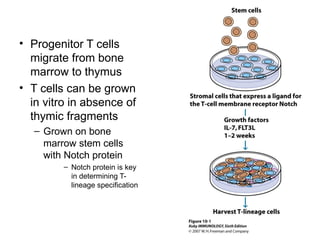
• Progenitor T cells
migrate from bone
marrow to thymus
• T cells can be grown
in vitro in absence of
thymic fragments
– Grown on bone
marrow stem cells
with Notch protein
– Notch protein is key
in determining T-
lineage specification
• Progenitor T cells migrate to thymus
• At about 8th
or 9th
week of gestation in humans
• T cell maturation involves rearrangements
of the germ-line TCR genes
• In thymus, thymocytes proliferate and
differentiate
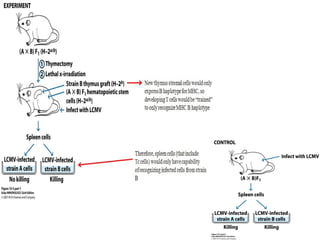
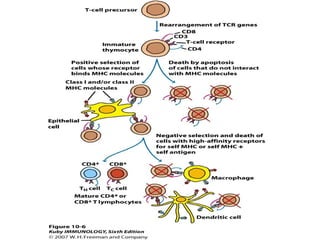
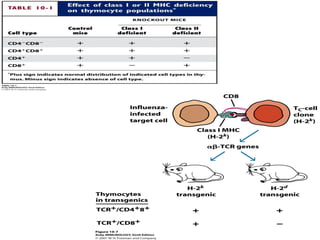
• Selection process in thymus
– Positive selection
• Survival of only T cells whose TCRs recognize
self-MHC molecules
– Negative selection
• Eliminates T cells that react too strongly with self
MHC or MHC with self-peptides
T-cell Development
• Begins with arrival of small numbers of
lymphoid precursors migrating from blood
to thymus
• When they do arrive in thymus, T-cell precursors
don’t express signature surface markers (CD3,
CD4, and CD8)
• Do not express RAG-1 or RAG-2 that are
necessary for gene rearrangement
T-cell Development
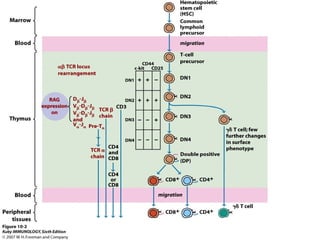
• During 3 week development, differentiating
T cells pass through stages of
development based on surface
phenotypes
DN = Double
negative
CD4- and
CD8-
DP = Double
positive
CD4+ and
CD8+
C-kit –
receptor for
stem cell
growth factor
CD44 – an
adhesion
molecule
CD25 - alpha
chain of IL-2
receptor
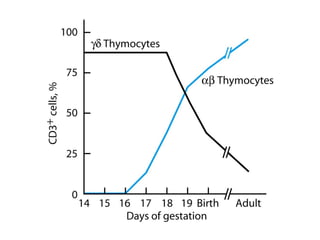
• T cell development is expensive for host
• 98% of all thymocytes do not mature, die by
apoptosis within thymus
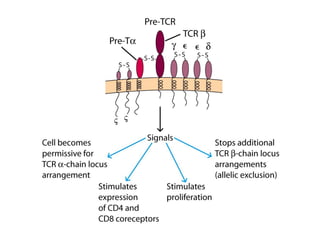
Insertion of rearranged
TCR genes suppress
other gene
rearrangements in these
mice
T cell Activation
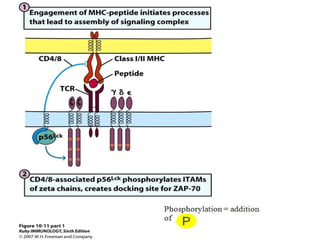
• Initiated by TCR-CD3 complex with
processed antigen on MHC molecule
• CD8+ cells with Class I
• CD4+ cells with Class II
• Initiates cascade of biochemical events
• Inducing resting T cell to enter cell cycle,
proliferate, differentiate into memory and effector T
cells
T cell Activation
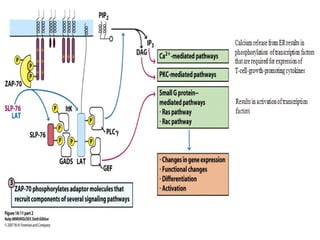
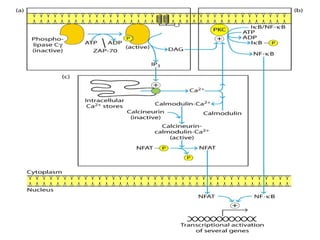
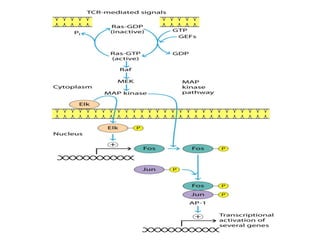
• Cascade of biochemical events leading to
gene expression:
– Interaction of signal and molecule (example:
TCR + MHC and antigen)
– Generation of “second messenger” that
diffuses to other areas of cell
– Protein kinases and protein phosphatases are
activated or inhibitied
– Signals are amplified by enzyme cascades
T cell Activation
• Gene products after activation
• Immediate genes (1/2 hour of recognition)
– Transcription factors (c-Myc, NFAT, NF-κB)
• Early genes (1-2 hours from recognition)
– IL-2, IL2R, IL-6, IFN-γ
• Late genes (more than 2 days later)
– Encode adhesion molecules
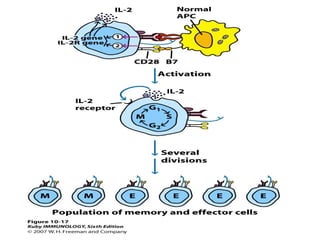
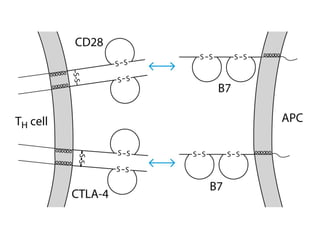
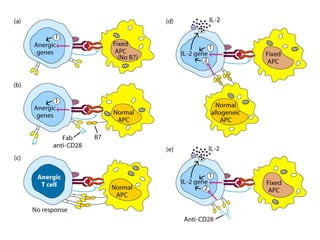
“Signal 1 and 2”- TCR activation
isn’t the whole story
• TCR activation is necessary, but not
sufficient, to produce activation. It is called
“signal 1”.
• The T cell also needs “signal 2”- CD28-B7
interaction.
• Its absence produces clonal anergy
Control! CTLA 4 acts to
prevent overstimulation!
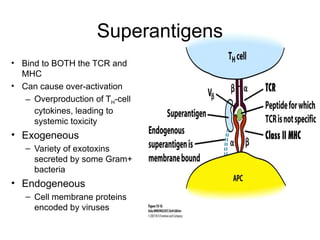
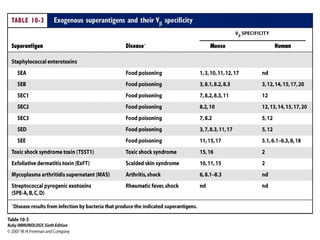
Superantigens
• Bind to BOTH the TCR and
MHC
• Can cause over-activation
– Overproduction of TH-cell
cytokines, leading to
systemic toxicity
• Exogeneous
– Variety of exotoxins
secreted by some Gram+
bacteria
• Endogeneous
– Cell membrane proteins
encoded by viruses
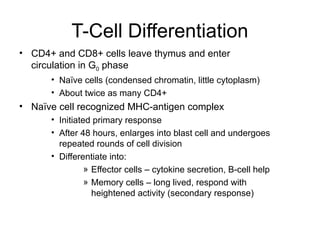
T-Cell Differentiation
• CD4+ and CD8+ cells leave thymus and enter
circulation in G0 phase
• Naïve cells (condensed chromatin, little cytoplasm)
• About twice as many CD4+
• Naïve cell recognized MHC-antigen complex
• Initiated primary response
• After 48 hours, enlarges into blast cell and undergoes
repeated rounds of cell division
• Differentiate into:
» Effector cells – cytokine secretion, B-cell help
» Memory cells – long lived, respond with
heightened activity (secondary response)
Treg Cells
• Shown to inhibit proliferation of other T
cells in vitro
• CD4+CD25+
• Shown to inhibit development of
autoimmune diseases
Cell Death and T Cell Populations
• Apoptosis plays critical role
– Deletion of potentially autoreactive
thymocytes
– Deletion of T cell populations after activation
• Fas and FasL pathway to induce self death

T cell development is an important event in immune system.

  • 1.
  • 2.
    • Progenitor Tcells migrate from bone marrow to thymus • T cells can be grown in vitro in absence of thymic fragments – Grown on bone marrow stem cells with Notch protein – Notch protein is key in determining T- lineage specification
  • 3.
    • Progenitor Tcells migrate to thymus • At about 8th or 9th week of gestation in humans • T cell maturation involves rearrangements of the germ-line TCR genes • In thymus, thymocytes proliferate and differentiate
  • 4.
    • Selection processin thymus – Positive selection • Survival of only T cells whose TCRs recognize self-MHC molecules – Negative selection • Eliminates T cells that react too strongly with self MHC or MHC with self-peptides
  • 5.
    T-cell Development • Beginswith arrival of small numbers of lymphoid precursors migrating from blood to thymus • When they do arrive in thymus, T-cell precursors don’t express signature surface markers (CD3, CD4, and CD8) • Do not express RAG-1 or RAG-2 that are necessary for gene rearrangement
  • 6.
    T-cell Development • During3 week development, differentiating T cells pass through stages of development based on surface phenotypes
  • 7.
    DN = Double negative CD4-and CD8- DP = Double positive CD4+ and CD8+ C-kit – receptor for stem cell growth factor CD44 – an adhesion molecule CD25 - alpha chain of IL-2 receptor
  • 8.
    • T celldevelopment is expensive for host • 98% of all thymocytes do not mature, die by apoptosis within thymus
  • 13.
    Insertion of rearranged TCRgenes suppress other gene rearrangements in these mice
  • 14.
    T cell Activation •Initiated by TCR-CD3 complex with processed antigen on MHC molecule • CD8+ cells with Class I • CD4+ cells with Class II • Initiates cascade of biochemical events • Inducing resting T cell to enter cell cycle, proliferate, differentiate into memory and effector T cells
  • 15.
    T cell Activation •Cascade of biochemical events leading to gene expression: – Interaction of signal and molecule (example: TCR + MHC and antigen) – Generation of “second messenger” that diffuses to other areas of cell – Protein kinases and protein phosphatases are activated or inhibitied – Signals are amplified by enzyme cascades
  • 16.
    T cell Activation •Gene products after activation • Immediate genes (1/2 hour of recognition) – Transcription factors (c-Myc, NFAT, NF-κB) • Early genes (1-2 hours from recognition) – IL-2, IL2R, IL-6, IFN-γ • Late genes (more than 2 days later) – Encode adhesion molecules
  • 22.
    “Signal 1 and2”- TCR activation isn’t the whole story • TCR activation is necessary, but not sufficient, to produce activation. It is called “signal 1”. • The T cell also needs “signal 2”- CD28-B7 interaction. • Its absence produces clonal anergy
  • 23.
    Control! CTLA 4acts to prevent overstimulation!
  • 25.
    Superantigens • Bind toBOTH the TCR and MHC • Can cause over-activation – Overproduction of TH-cell cytokines, leading to systemic toxicity • Exogeneous – Variety of exotoxins secreted by some Gram+ bacteria • Endogeneous – Cell membrane proteins encoded by viruses
  • 27.
    T-Cell Differentiation • CD4+and CD8+ cells leave thymus and enter circulation in G0 phase • Naïve cells (condensed chromatin, little cytoplasm) • About twice as many CD4+ • Naïve cell recognized MHC-antigen complex • Initiated primary response • After 48 hours, enlarges into blast cell and undergoes repeated rounds of cell division • Differentiate into: » Effector cells – cytokine secretion, B-cell help » Memory cells – long lived, respond with heightened activity (secondary response)
  • 28.
    Treg Cells • Shownto inhibit proliferation of other T cells in vitro • CD4+CD25+ • Shown to inhibit development of autoimmune diseases
  • 29.
    Cell Death andT Cell Populations • Apoptosis plays critical role – Deletion of potentially autoreactive thymocytes – Deletion of T cell populations after activation • Fas and FasL pathway to induce self death