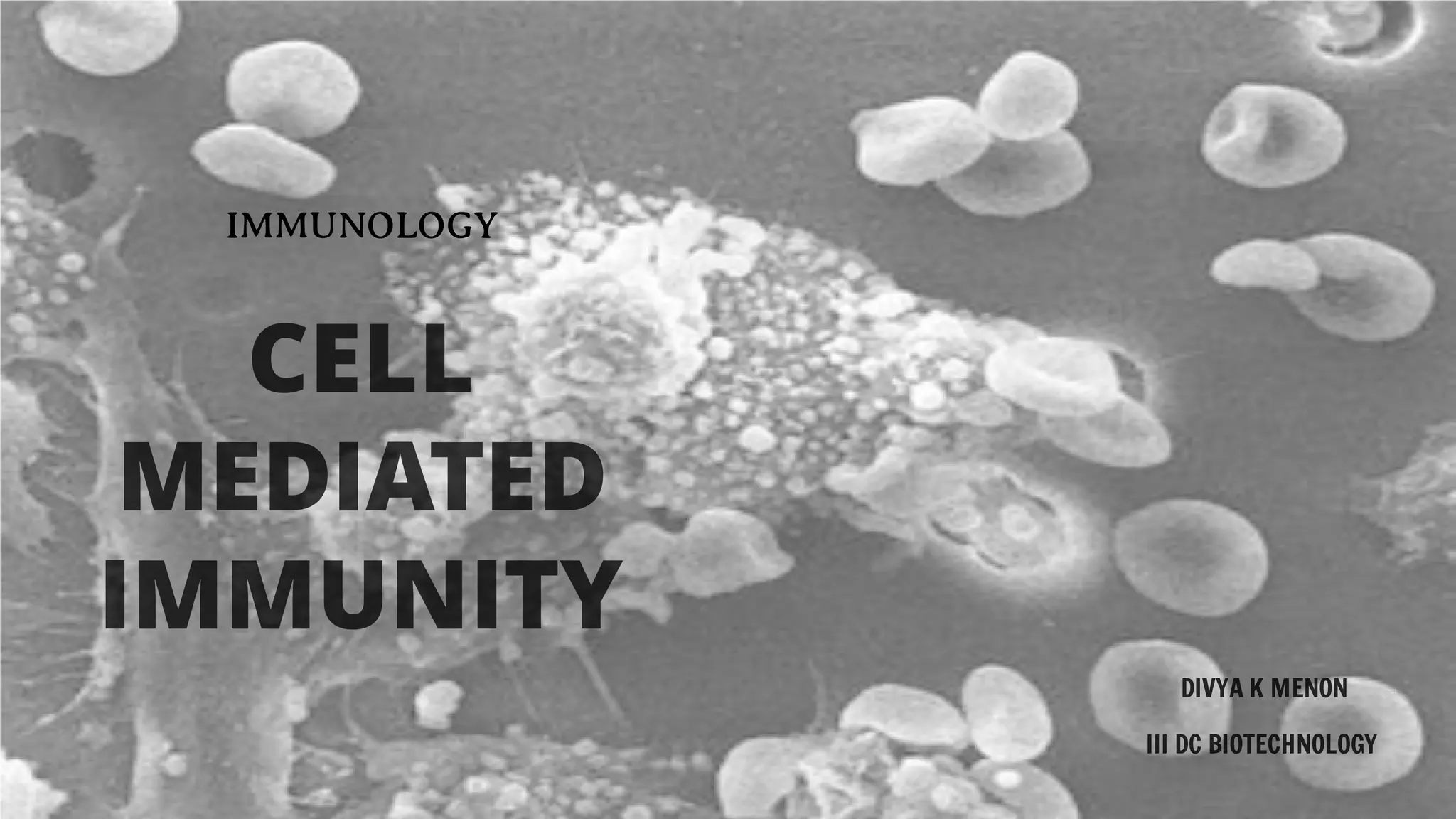
Cell mediated immunity is defined as a type of immune response that is mediated by T lymphocytes. The process involves Antigen Presenting Cells(APCs),Major histocompatibility complex (MHCs) and the action of Cytokines to produce an immune response.
WHAT IS IMMUNOLOGY?
Immunologyis the branch of biology and medicine that studies
the immune system, it's functions, and it's role in defending
against disease. It encompasses the study of the body's defense
mechanisms against infection and other pathologies,including
both innate and adaptive immunity.
Louis Pasteur is known as the father of Immunology.
Immunology is categorised into the following types:
¤ Diagnostic Immunology
¤ Clinical Immunology
¤ Eco Immunology
¤ Cancer Immunology
¤ Reproductive Immunology
¤ Developmental Immunology
4.
IMMUNE SYSTEM ANDIMMUNITY
The immune system is the body's defense system that
protects us from harmful microorganisms like bacteria,
viruses,fungi,and parasites. It is made up of various
cells,tissues and organs that work together to detect
and destroy foreign invaders. The immune response
are of two types - Innate immunity and Adaptive
immunity.
The result of a well functioning immune system is
immunity - the ability to resist infections.
Immune system and immunity are crucial for keeping
the body healthy and are the basis for how vaccines
and immune therapies work.
5.
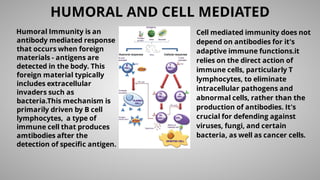
Humoral Immunity isan
antibody mediated response
that occurs when foreign
materials - antigens are
detected in the body. This
foreign material typically
includes extracellular
invaders such as
bacteria.This mechanism is
primarily driven by B cell
lymphocytes, a type of
immune cell that produces
amtibodies after the
detection of specific antigen.
HUMORAL AND CELL MEDIATED
Cell mediated immunity does not
depend on antibodies for it's
adaptive immune functions.it
relies on the direct action of
immune cells, particularly T
lymphocytes, to eliminate
intracellular pathogens and
abnormal cells, rather than the
production of antibodies. It's
crucial for defending against
viruses, fungi, and certain
bacteria, as well as cancer cells.
Cell mediated immunityworks through the coordinated action of several
immune responses.The main cell's involved in this are the T
lymphocytes ,which kill the infected or abnormal cells and help regulate the
immune response. And the T lymphocytes are activated by the help of
Antigen presenting cells (APC),which display foreign antigens using Major
histocompatability complex (MHC) molecules.Once they are activated ,they
communicate and functions with the help of cytokines, which are chemical
messengers.
8.
T - LYMPHOCYTE
Alsoknown as T cell, it is a type of lymphocytes ( a type of WBC) that plays an important
role in the immune system. T cells are born from hematopoietic stem cells, found in the
bone marrow. Developing T cells, then migrate to the thymus gland to develop (or mature)
and react highly specifically agains
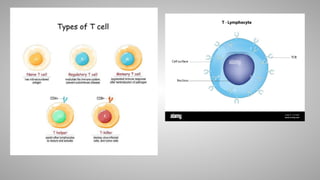
t the particular type of antigen that initiated their development. There are three main
groups of T- lymphocytes, and they are cytotoxic/killer cells, Helper T cells, and Suppressor
cells.
CYTOTOXIC T CELL~ Also known as Tc, CD8+ and killer T cell. They destroy virus-infected
cells and tumor cells, and are also implicated in transplant rejection. These cells are
defined by the expression of the CD8 protein on their cell surface. Cytotoxic T cells
recognize their targets by binding to short peptides (8-11 amino acids in length) associated
with MHC class I molecules, present on the surface of all nucleated cells. They also produce
the key cytokines IL-2 and IFNγ. These cytokines influence the effector functions of other
cells, in particular macrophages and NK cells.
9.
HELPER T CELLS~A type of white blood cell that serves as a key mediator of immune function.
Helper T cells play a central role in normal immune responses by producing factors that
activate virtually all the other immune system cells. These cells include B cells, which produce
antibodies needed to fight infection; cytotoxic T cells, which kill cells carrying infectious
agents; and macrophages and other effector cells, which attack invading pathogens
(disease-causing agents). Helper T cells express a protein called CD4 on their surface. This
protein plays a critical role in helper T cell activation by binding class II major
histocompatibility complex (MHC) molecules, which specialize in helping the immune system
recognize foreign substances.
SUPPRESSOR CELLS ~ Also known as Regulatory T cells and Tregs. They are a specialized subset
of white blood cells that play a crucial role in maintaining immune system balance and
preventing excessive or inappropriate immune responses. They act as immune system
regulators, preventing the body's own immune cells from attacking healthy tissues
(autoimmunity) and limiting inflammatory responses.
MEMORY T CELLS ~ They are a type of specialized immune cell that provides long-lasting
protection against previously encountered pathogens. They are formed after an initial
immune response and remain in the body to quickly recognize and respond to the same
pathogen if it enters again, leading to a more rapid and effective immune response
11.
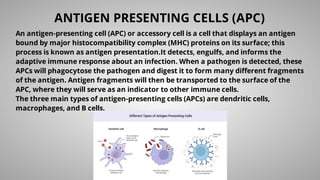
ANTIGEN PRESENTING CELLS(APC)
An antigen-presenting cell (APC) or accessory cell is a cell that displays an antigen
bound by major histocompatibility complex (MHC) proteins on its surface; this
process is known as antigen presentation.It detects, engulfs, and informs the
adaptive immune response about an infection. When a pathogen is detected, these
APCs will phagocytose the pathogen and digest it to form many different fragments
of the antigen. Antigen fragments will then be transported to the surface of the
APC, where they will serve as an indicator to other immune cells.
The three main types of antigen-presenting cells (APCs) are dendritic cells,
macrophages, and B cells.
12.
MAJOR HISTOCOMPATIBILITY COMPLEX(MHC)
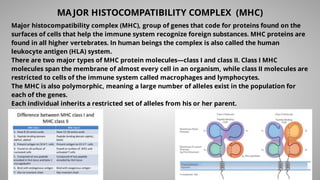
Major histocompatibility complex (MHC), group of genes that code for proteins found on the
surfaces of cells that help the immune system recognize foreign substances. MHC proteins are
found in all higher vertebrates. In human beings the complex is also called the human
leukocyte antigen (HLA) system.
There are two major types of MHC protein molecules—class I and class II. Class I MHC
molecules span the membrane of almost every cell in an organism, while class II molecules are
restricted to cells of the immune system called macrophages and lymphocytes.
The MHC is also polymorphic, meaning a large number of alleles exist in the population for
each of the genes.
Each individual inherits a restricted set of alleles from his or her parent.
13.
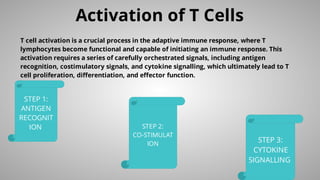
Activation of TCells
T cell activation is a crucial process in the adaptive immune response, where T
lymphocytes become functional and capable of initiating an immune response. This
activation requires a series of carefully orchestrated signals, including antigen
recognition, costimulatory signals, and cytokine signalling, which ultimately lead to T
cell proliferation, differentiation, and effector function.
STEP 1:
ANTIGEN
RECOGNIT
ION STEP 2:
CO-STIMULAT
ION
STEP 3:
CYTOKINE
SIGNALLING
14.
T-cell receptors (TCRs)on T lymphocytes
recognize only antigen fragments
presented by APCs through MHC
molecules. Unlike B cells, T cells cannot
detect free antigens. This process, called
MHC restriction, ensures specificity.
CD8⁺ T cells recognize antigens with
MHC class I, while CD4⁺ T cells recognize
those with MHC class II, allowing the
immune system to target infected or
abnormal cells accurately.
Co-stimulation is a secondary signal which immune cells
rely on to activate an immune response in the presence of an
antigen-presenting cell. In the case of T cells, two stimuli are
required to fully activate their immune response. The
co-stimulatory signal, is antigen nonspecific and is provided
by the interaction between co-stimulatory molecules
expressed on the membrane of the APC and the T cell. This
interaction promotes and enhances the TCR signaling, but
can also be bi-directional. The co-stimulatory signal is
necessary for T cell proliferation, differentiation and
survival. Activation of T cells without co-stimulation may
lead to the unresponsiveness of the T cell (also called
anergy), apoptosis or the acquisition of the immune
tolerance
After T cell activation, cytokines like IL-2 trigger clonal expansion, where the activated T cell
multiplies into identical effector and memory cells. Depending on the cytokine signals received,
helper T cells can differentiate into Th1 (promoting cell-mediated responses via IFN-γ) or Th2
(supporting humoral immunity via IL-4, IL-5). Cytotoxic T lymphocytes (CTLs) arise from CD8⁺ T
cells and directly kill infected cells. This finely tuned process ensures the immune system
generates the right type of response.
☛ ☛
☛
15.
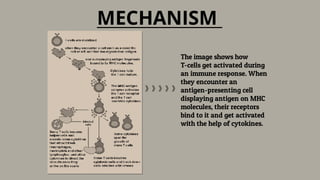
MECHANISM
The image showshow
T-cells get activated during
an immune response. When
they encounter an
antigen-presenting cell
displaying antigen on MHC
molecules, their receptors
bind to it and get activated
with the help of cytokines.
》》》》》
16.
FUNCTIONS
Defense against intracellularpathogens : CMI is essential for clearing cells that
have been infected by viruses, intracellular bacteria, or fungi.
Tumor surveillance : CMI helps detect and destroy cancer cells that arise in the
body. Cytotoxic T cells recognize cancer-specific antigens on the surface of tumor
cells and eliminate them, preventing tumor growth and metastasis.
Regulation of immune responses: : T cells, especially regulatory T cells, play a role
in suppressing or controlling the immune response, preventing excessive
inflammation and autoimmunity.
Long-term immunityCMI responses generate memory T cells that can quickly
recognize and respond to the same pathogen if encountered again in the future.
17.
CONCLUSION
• Cell-mediated immunityis a vital part of the adaptive immune system
involving T lymphocytes. Through antigen recognition, activation, and
cytokine signaling, T cells multiply and carry out targeted responses.
Helper and cytotoxic T cells coordinate to eliminate infected cells,
providing strong defense and lasting protection against intracellular
pathogens.
18.
REFERENCE
1.Cavanagh, M. (Originalauthor), & Gwyer Findlay, E. (Updated). (2022). T-cell activation. British Society
for Immunology. Retrieved August 11, 2025, from
https://www.immunology.org/public-information/bitesized-immunology/systems-processes/t-cell
-activation
2. Wikipedia Contributors. (n.d.). Cell-mediated immunity. In Wikipedia, The Free Encyclopedia.
Retrieved August 11, 2025, from https://en.wikipedia.org/wiki/Cell-mediated_immunity.
3. Kaiser, G. (2023, November 2). 14.1: Cell-Mediated Immunity – An Overview. In Microbiology (Kaiser).
LibreTexts. Retrieved August 11, 2025
Zoho Show
To createbeautiful presentations, download Zoho Show from Play Store https://zoho.to/cy7
cell mediated (1).pdf
(This PDF has been generated using Zoho Show)




![Polymer [ बहुलक ] Chemistry Notes PDF - Irfanullah Mehar - JJ Sir Chemistry.pdf](https://cdn.slidesharecdn.com/ss_thumbnails/polymerchemistrynotespdf-irfanullahmehar-jjsirchemistry-260210172118-3f9b37f7-thumbnail.jpg?width=640&height=640&fit=bounds)


