T-CELLS
Dr. Mukhtar Ahmed, MSc
Family Physician
Associate Dean @ EAMC
Contents
Introduction
T cell types
T-Cell Development
T-Cell Activation
Differentiation and Memory
Introduction
T cell: A type of white blood cell that is of key
importance to the immune system and is at the
core of adaptive immunity, the system that tailors
the body's immune response to specific pathogens.
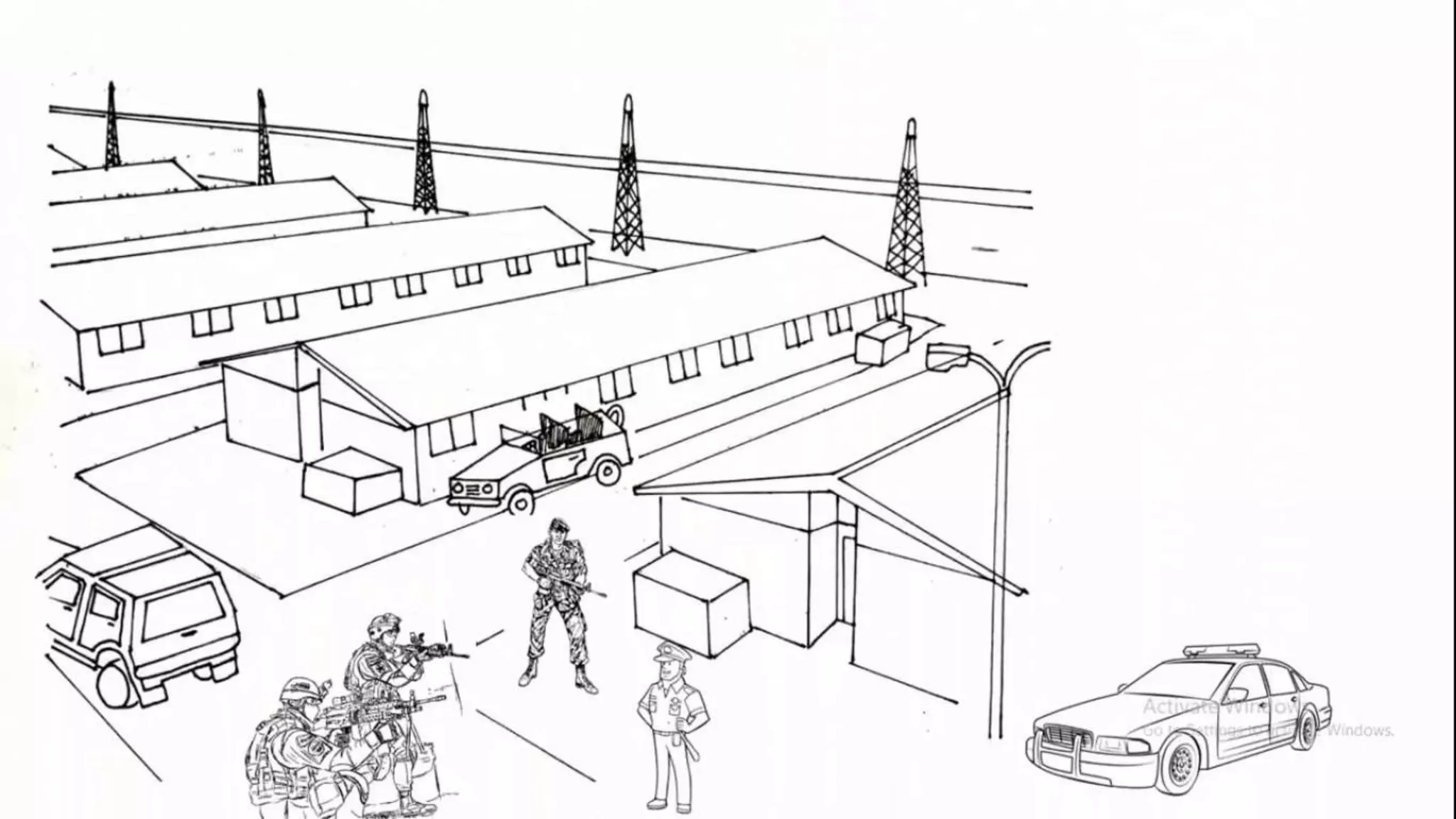
The T cells are like soldiers who search out and
destroy the targeted invaders.
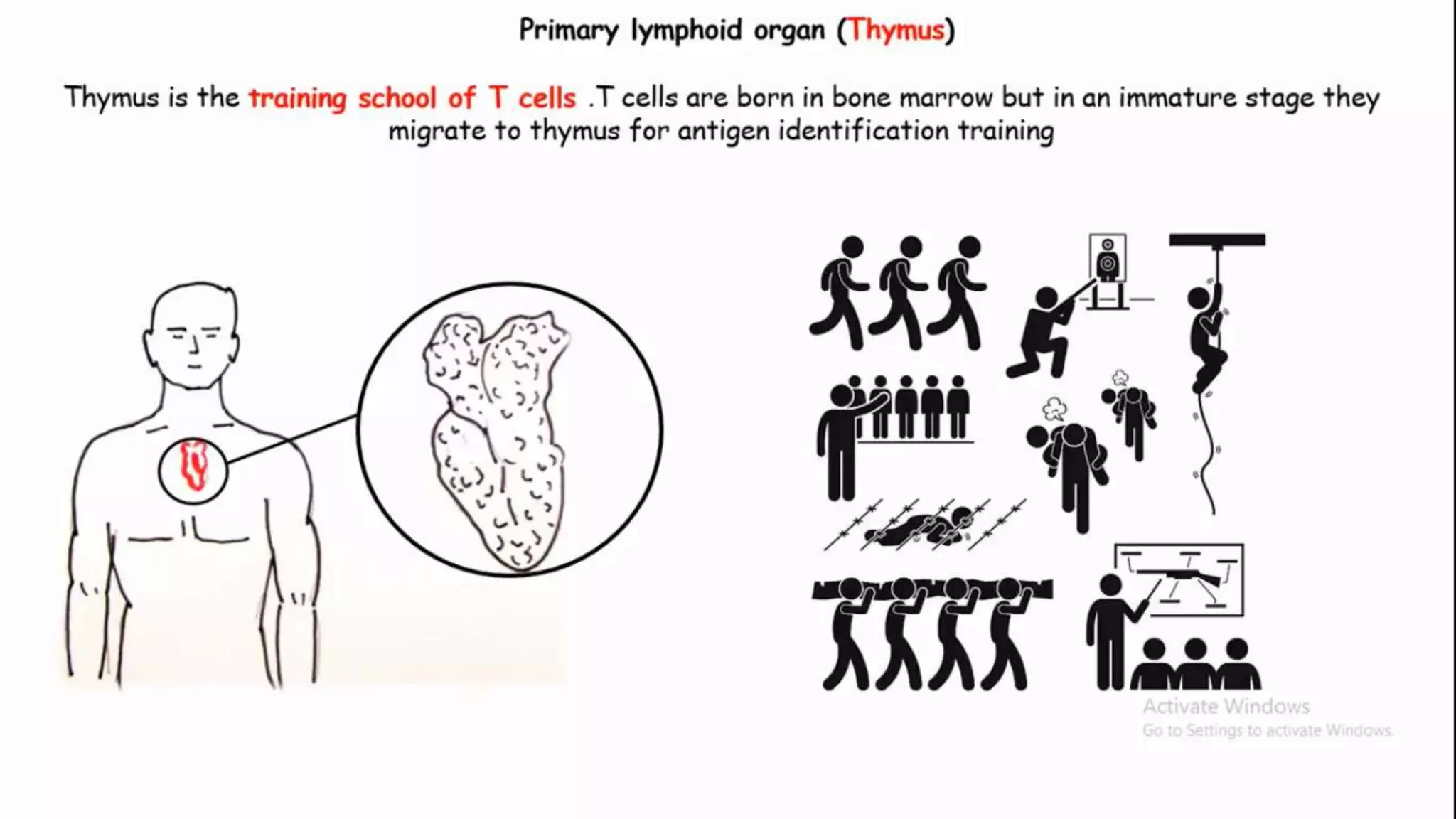
 Immature T cells (termed T-stem cells) migrate to the
thymus gland in the neck, where they mature and
differentiate into various types of mature T cells and
become active in the immune system in response to a
hormone called thymosin and other factors.
 T-cells that are potentially activated against the body's own
tissues are normally killed or changed ("down-regulated")
during this maturational process.
 There are several different types of mature T cells.
 Not all of their functions are known.
 T cells can produce substances called cytokines such as the
interleukins which further stimulate the immune response.
 T-cell activation is measured as a way to assess the health of
patients with HIV/AIDS and less frequently in other disorders.
Types of T cell
Effector T cells include the categories of helper, killer,
memory, and regulatory T cells.
Helper T cells recruit other lymphocytes in an
immune response.
Cytotoxic, or killer, T cells destroy infected cells.
T cells are grouped into a series of subsets based on their
function.
CD4 and CD8 T cells are selected in the thymus, but
undergo further differentiation in the periphery to
specialized cells which have different functions.
T cell subsets were initially defined by function, but also
have associated gene or protein expression patterns.
Helper CD4+ T cells
 T helper cells (TH cells) assist other lymphocytes, including
maturation of B cells into plasma cells and memory B cells, and
activation of cytotoxic T cells and macrophages.
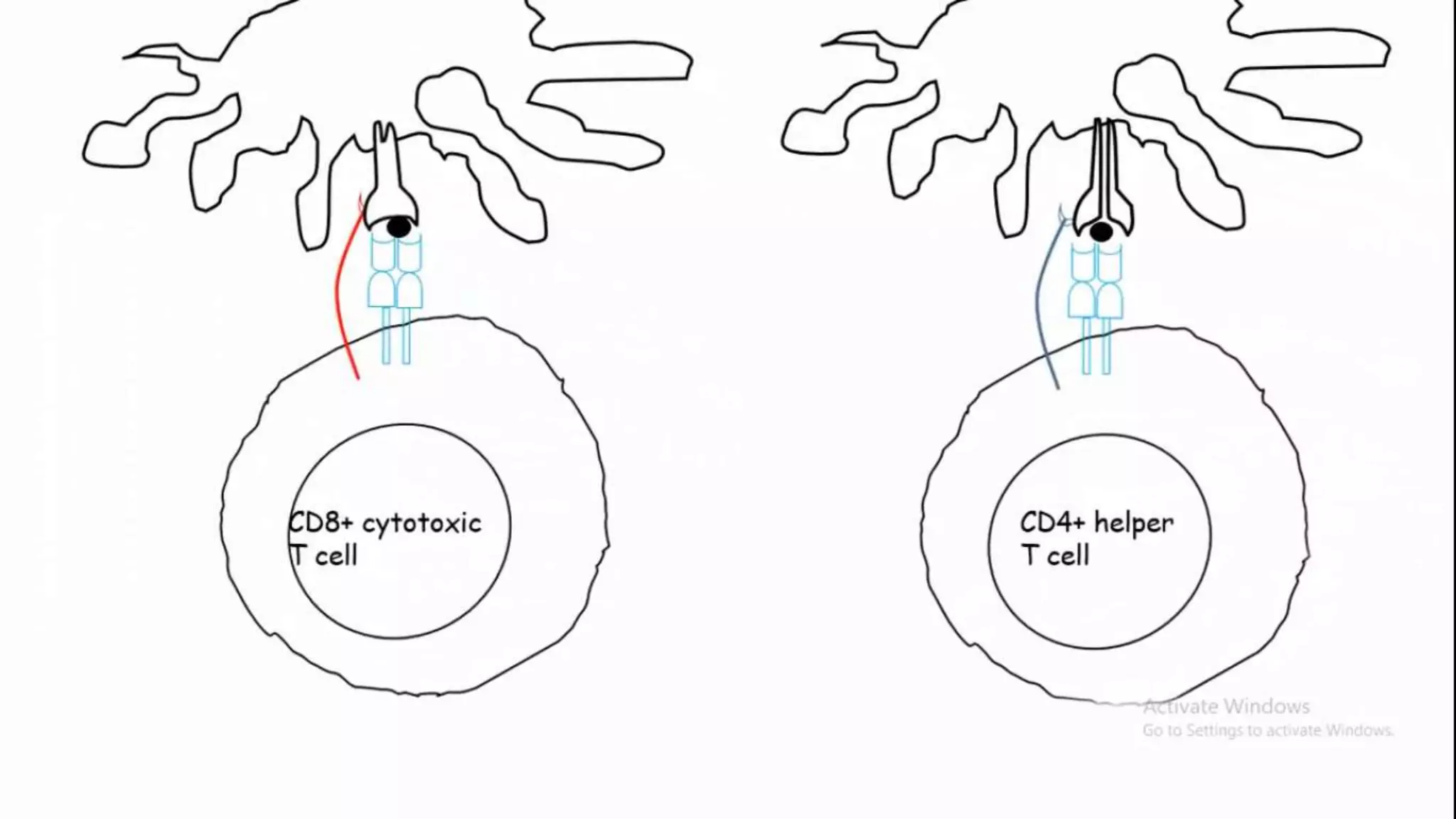
 These cells are also known as CD4+ T cells as they express
the CD4 on their surfaces.
 Helper T cells become activated when they are presented
with peptide antigens by MHC class II molecules, which are
expressed on the surface of antigen-presenting cells (APCs).
Once activated, they divide rapidly and
secrete cytokines that regulate or assist the immune
response.
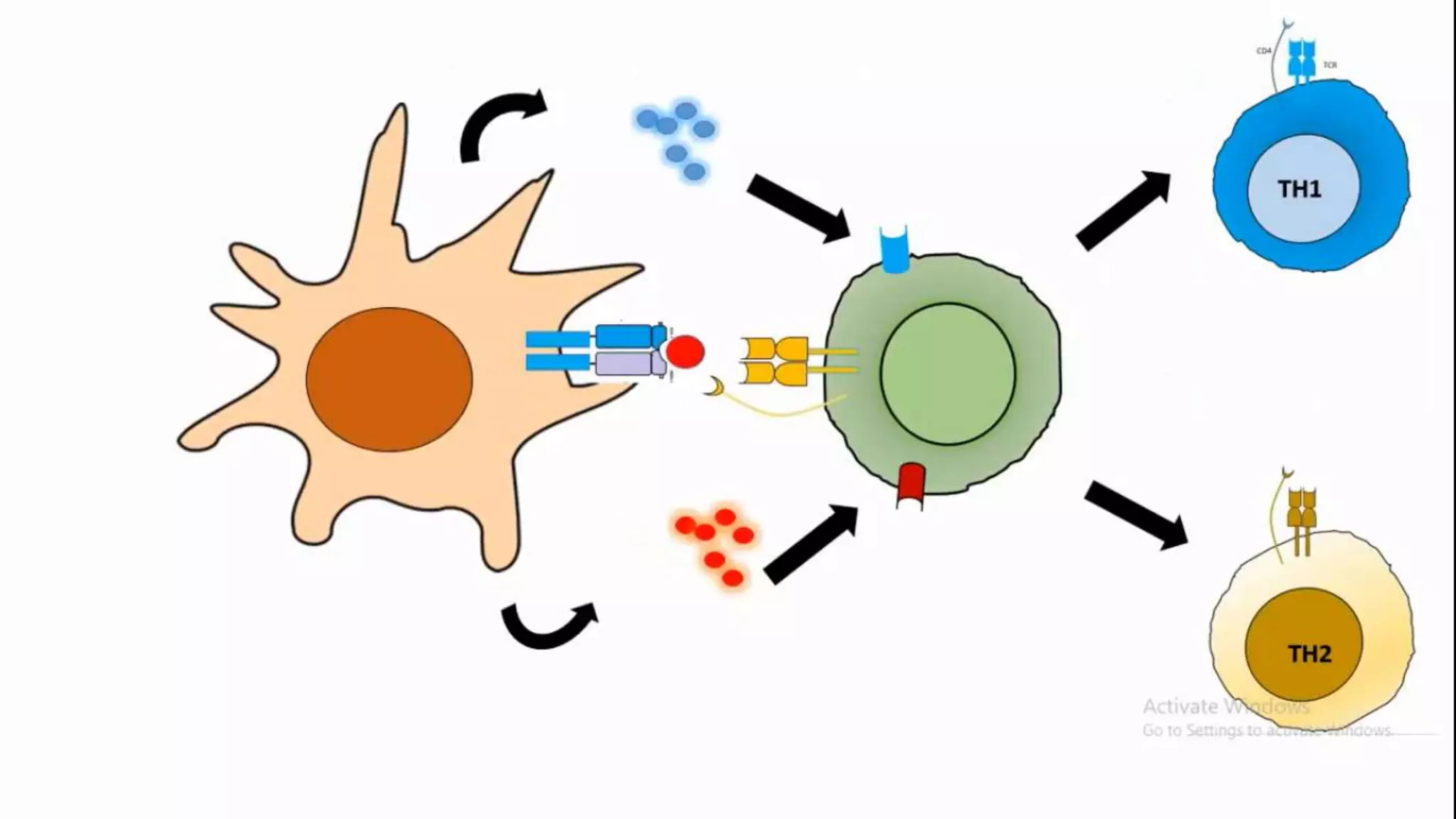
These cells can differentiate into one of several
subtypes, which have different roles.
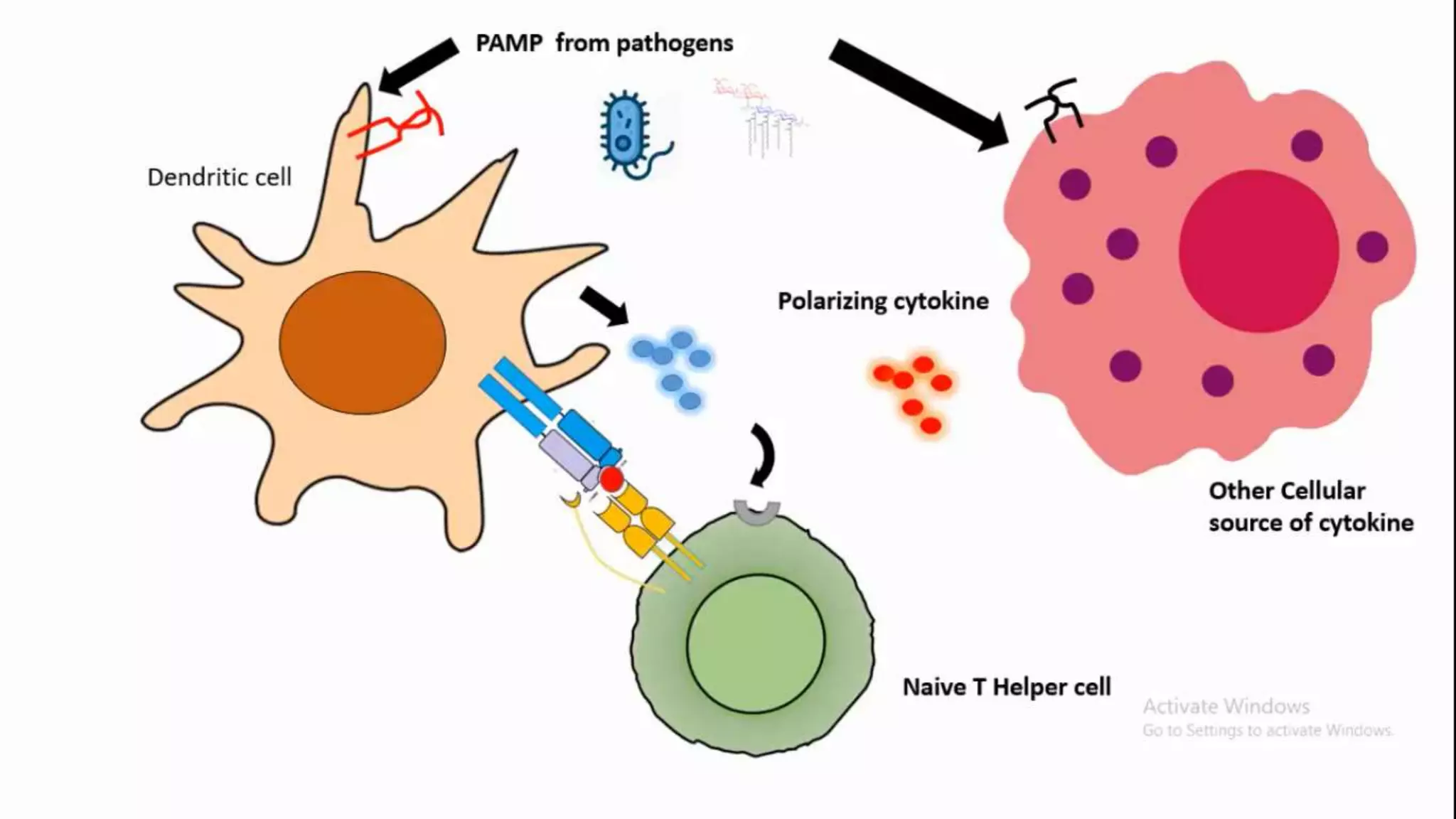
Cytokines direct T cells into particular subtypes.
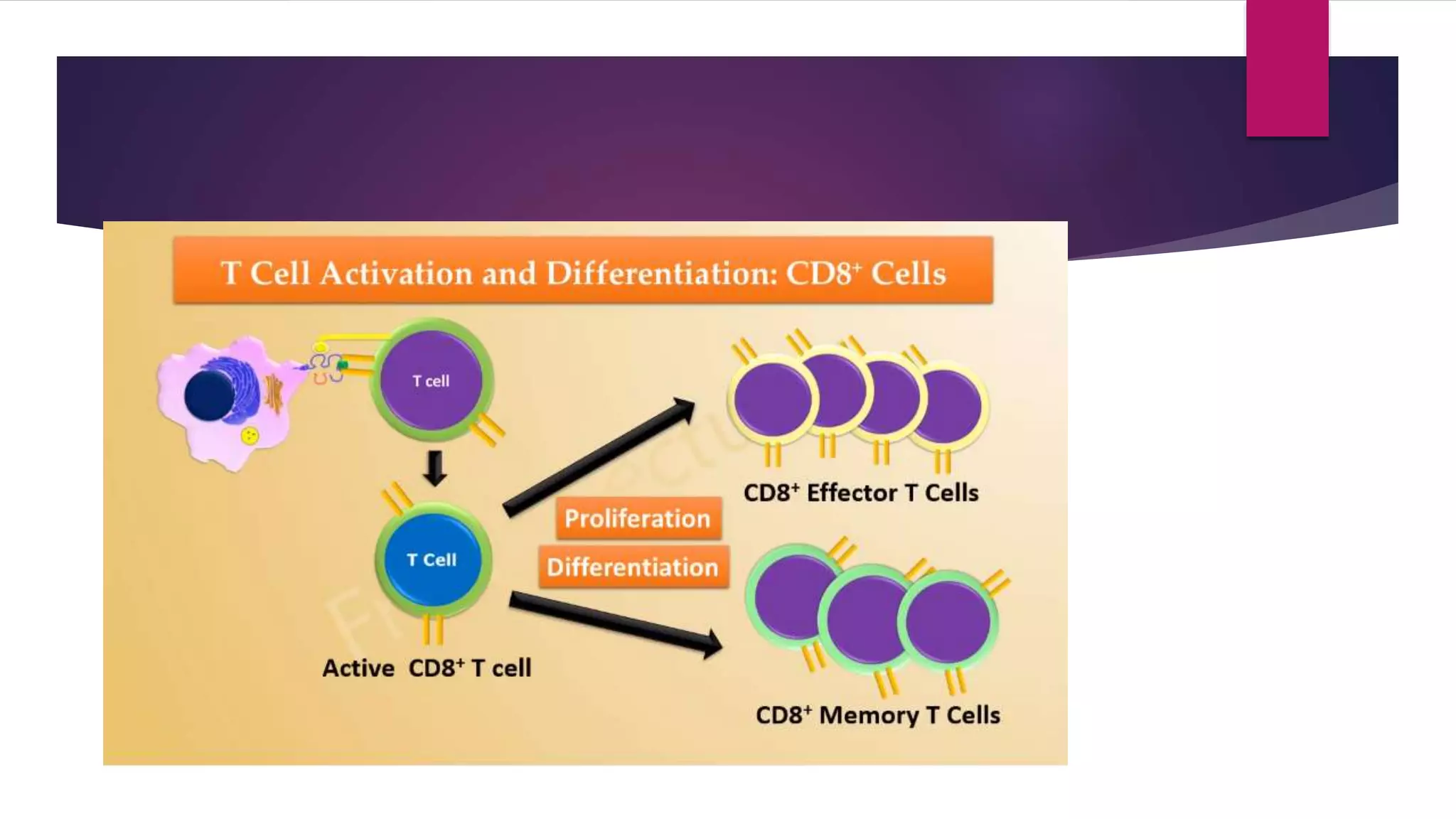
Cytotoxic CD8+ T cells
 Cytotoxic T cells (TC cells, CTLs, T-killer cells, killer T cells) destroy virus-
infected cells and tumor cells, and are also implicated in transplant rejection.
 These cells are defined by the expression of CD8+ on the cell surface.
 These cells recognize their targets by binding to MHC class I molecules,
present on the surface of all nucleated cells.
 CD8+ T cells also produce the key cytokines IL-2 and IFNγ, which influence
the effector functions of other cells, in particular macrophages and NK cells.
Memory T cells
 Memory T cells are a subset of infection- and cancer-fighting T
cells (also known as a T lymphocyte) that have previously
encountered and responded to their cognate antigen; thus, the
term antigen-experienced T cell is often applied.
 Such T cells can recognize foreign invaders.
 Memory T cells may be either CD4+ or CD8+ .
Memory T cells
Memory T cells are long-lived and can expand quickly to
large Regulatory T cells maintain immunological
tolerance by shutting down T cell-mediated immunity
when an immune response is complete and suppressing
autoreactive T cells.
Gamma delta T cells
Gamma delta T cells (γδ T cells) represent a small subset
of T cells which possess a γδ TCR rather than the αβ TCR
on the cell surface.
The majority of T cells express αβ TCR chains.
This group of T cells is much less common in humans
and mice (about 2% of total T cells) and are found mostly
in the gut mucosa.
T cells develop
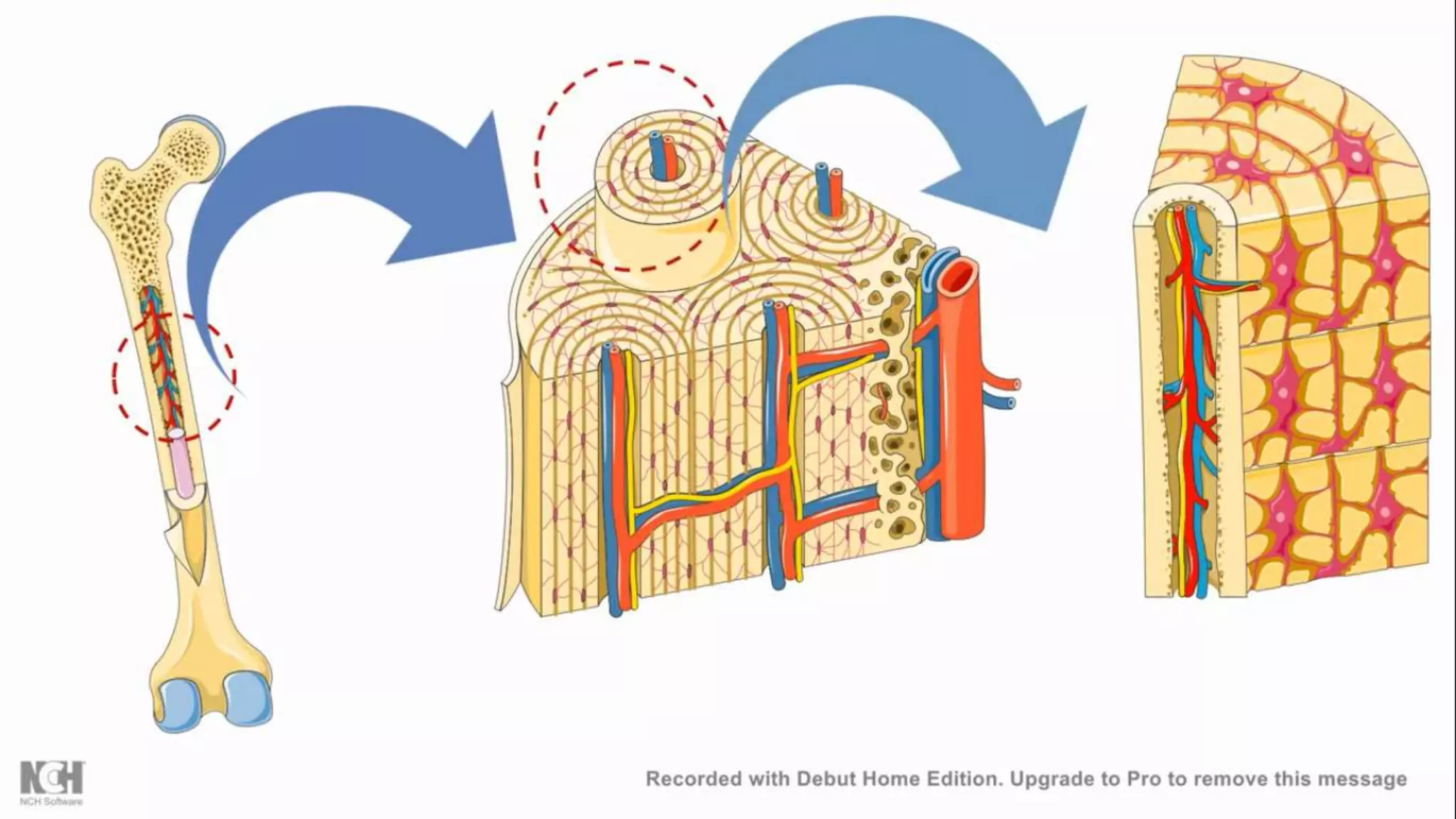
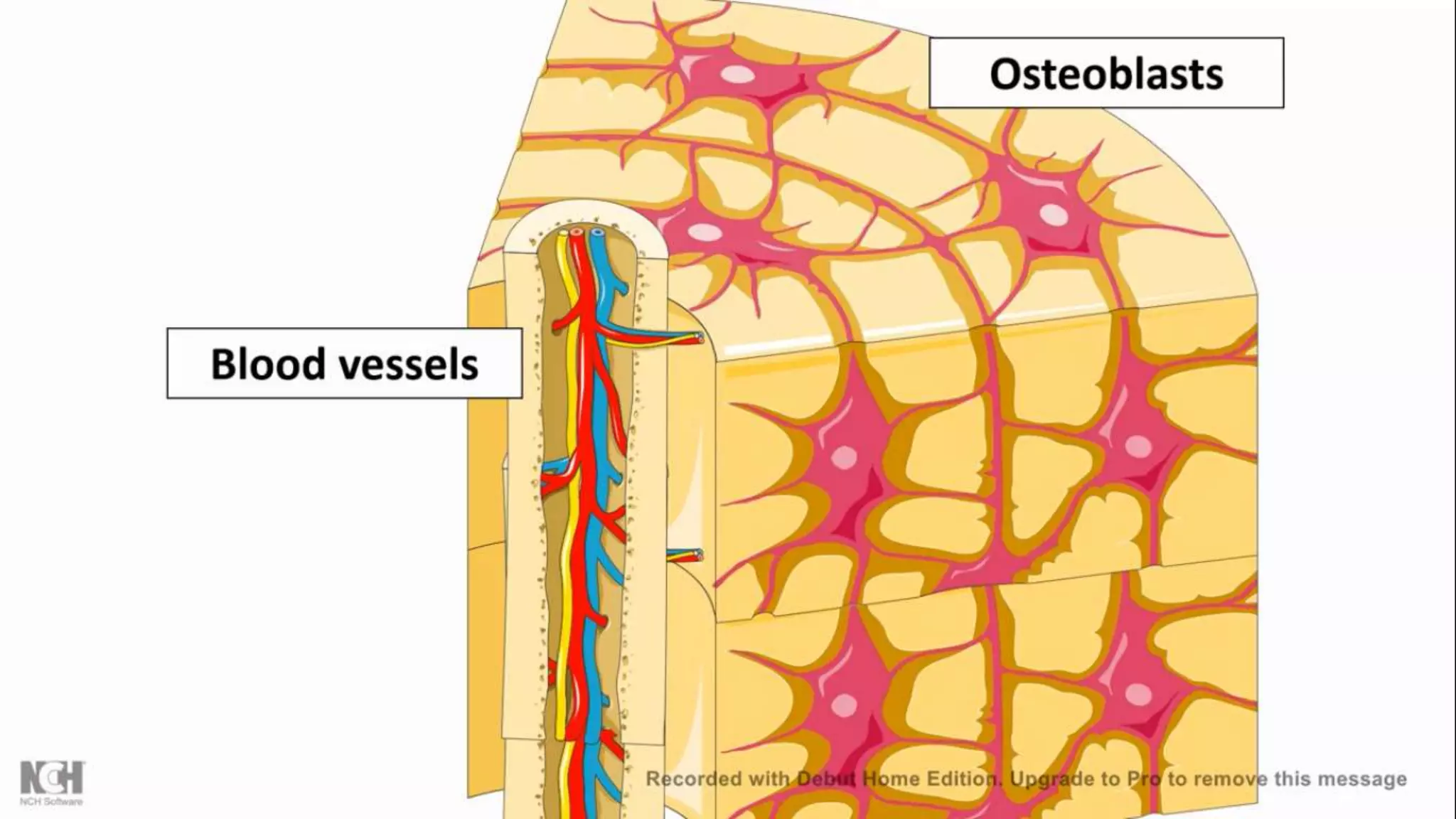
 T cells develop from hematopoietic stem cells (HSC) in the bone
marrow.
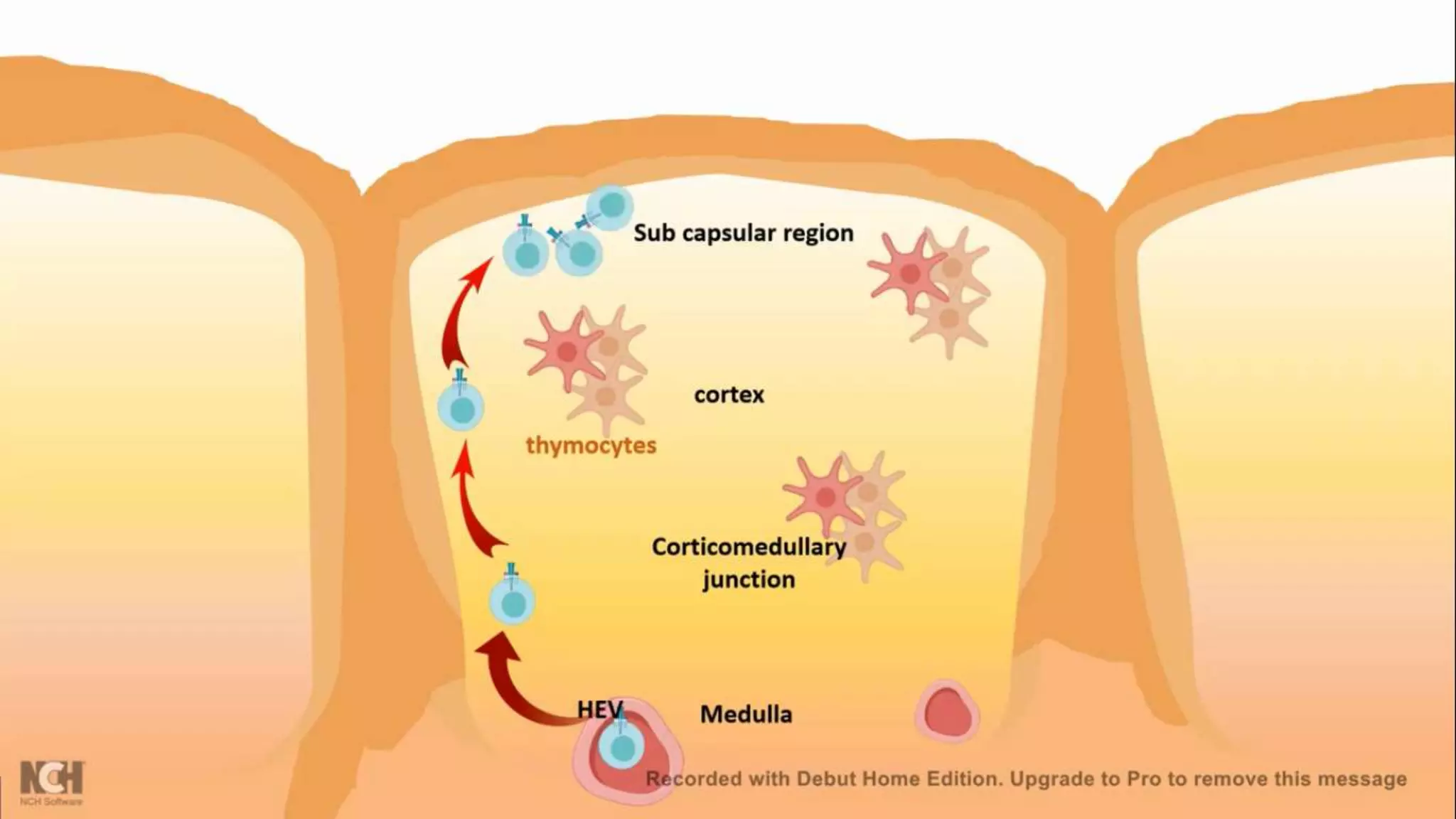
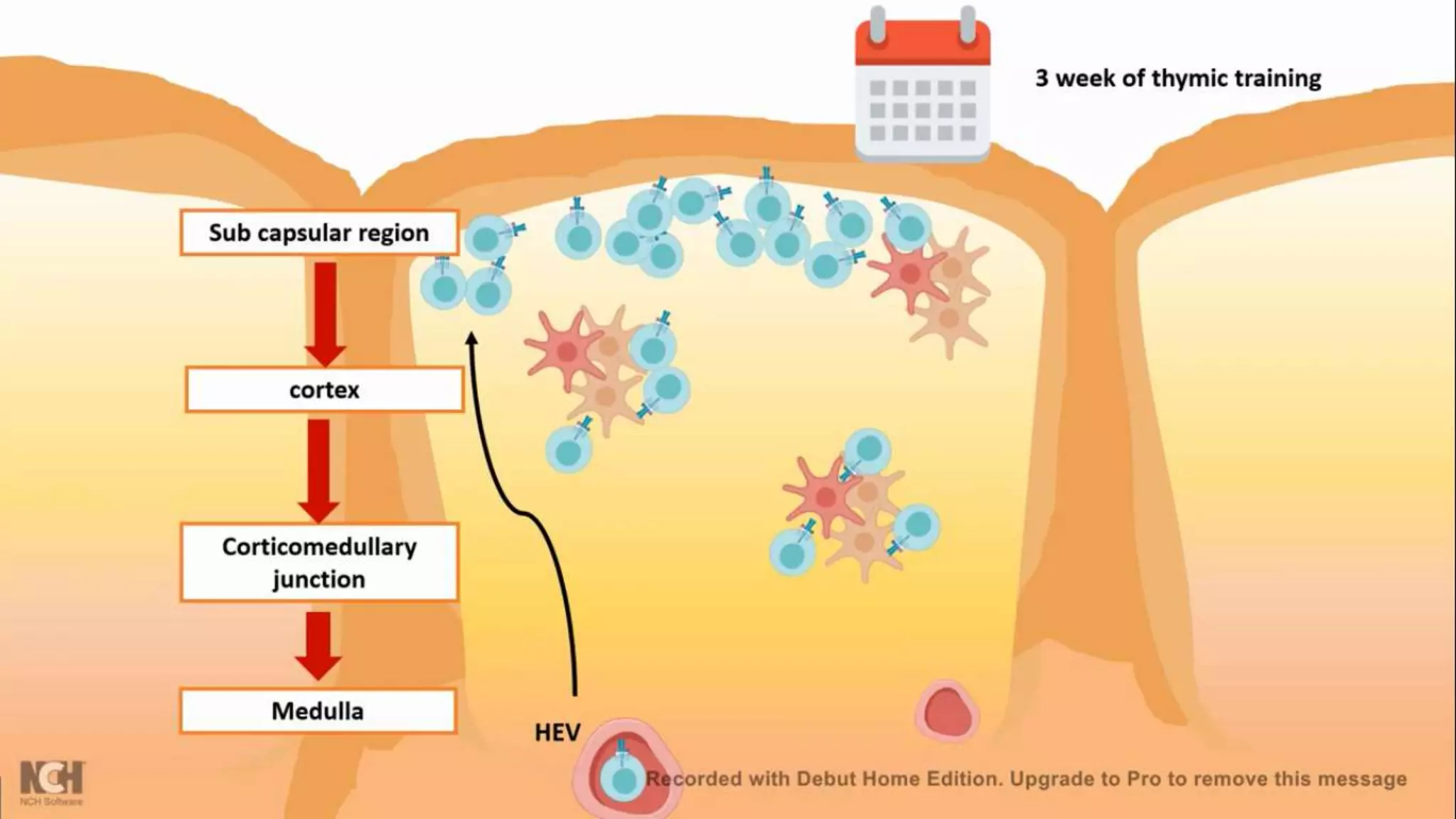
 Progenitors of those cells migrate to the thymus, here they are known
as thymocytes.
 Thymocytes mature in a series of steps based on development of cell
surface markers.
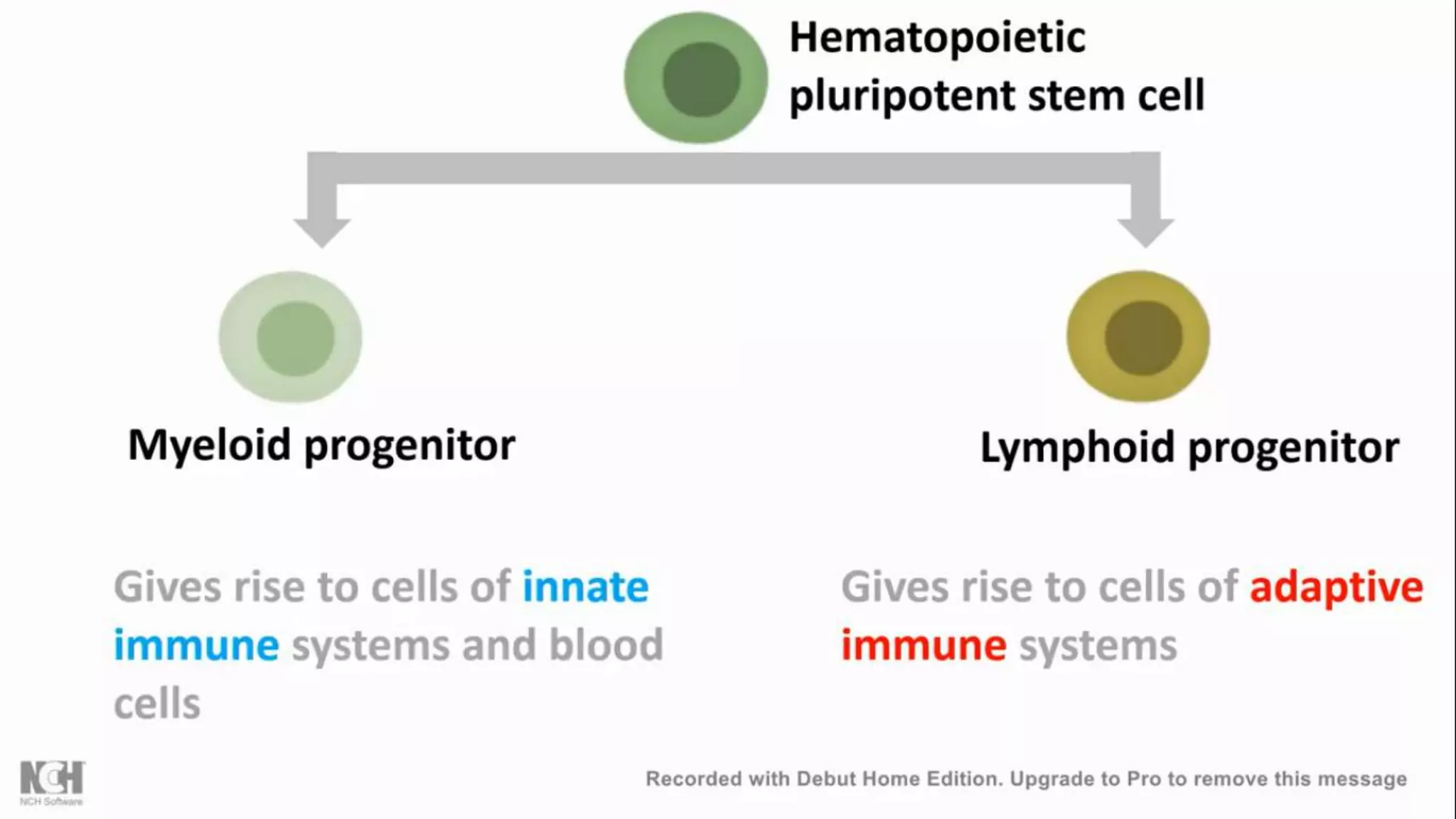
 The HSC then differentiate into multipotent progenitors (MPP) which
retain the potential to become both myeloid and lymphoid cells.
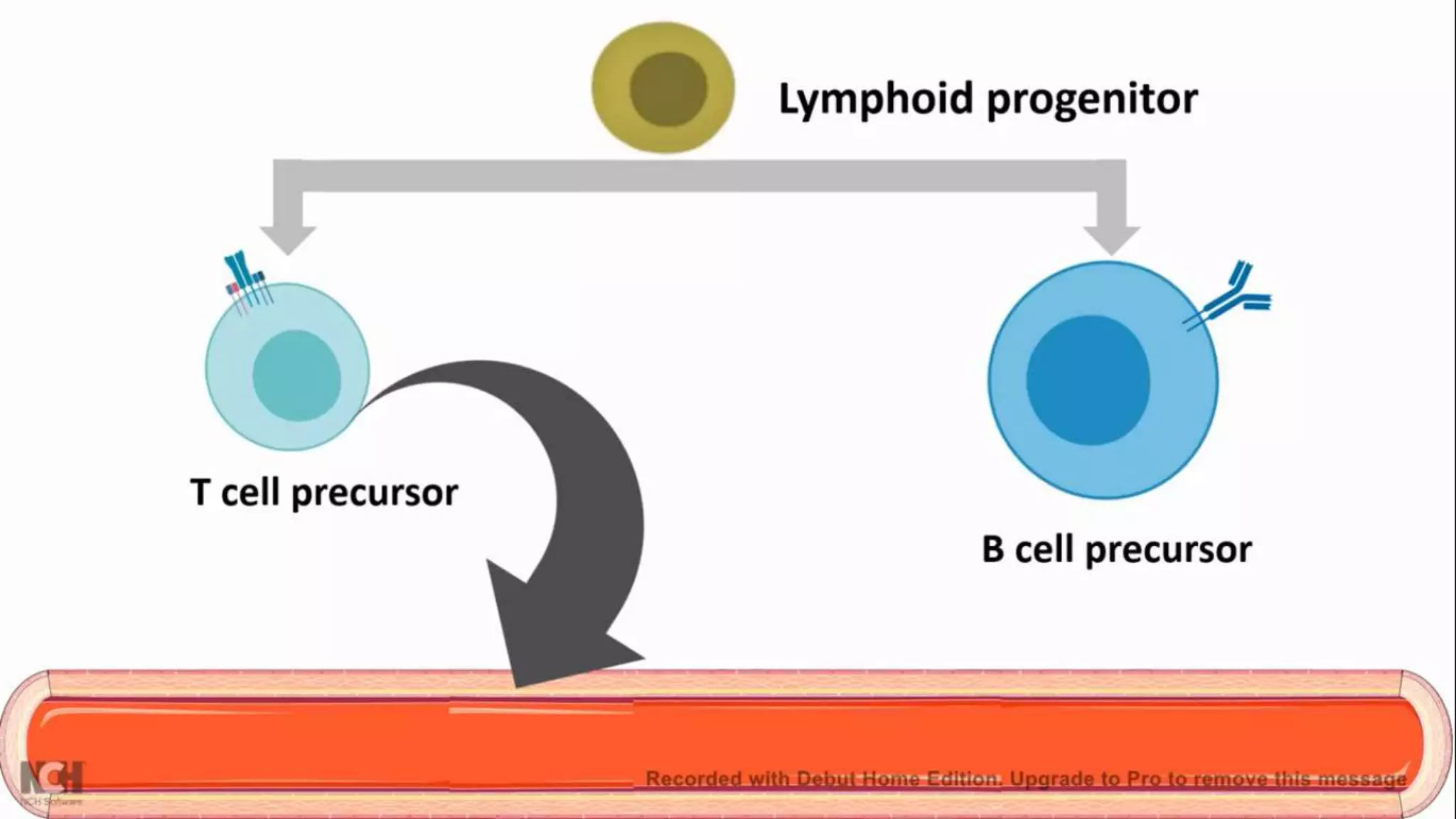
 The process of differentiation then proceeds to a common lymphoid
progenitor (CLP), which can only differentiate into T, B or NK cells
 Myeloid and lymphoid lineages both are involved in
dendritic cell(antigen-presenting cells) formation.
 Myeloid cells include monocytes, macrophages,
neutrophils, basophils, eosinophils, erythrocytes, and
megakaryocytes to platelets.
 Lymphoid cells include T cells, B cells, and natural
killer cells.
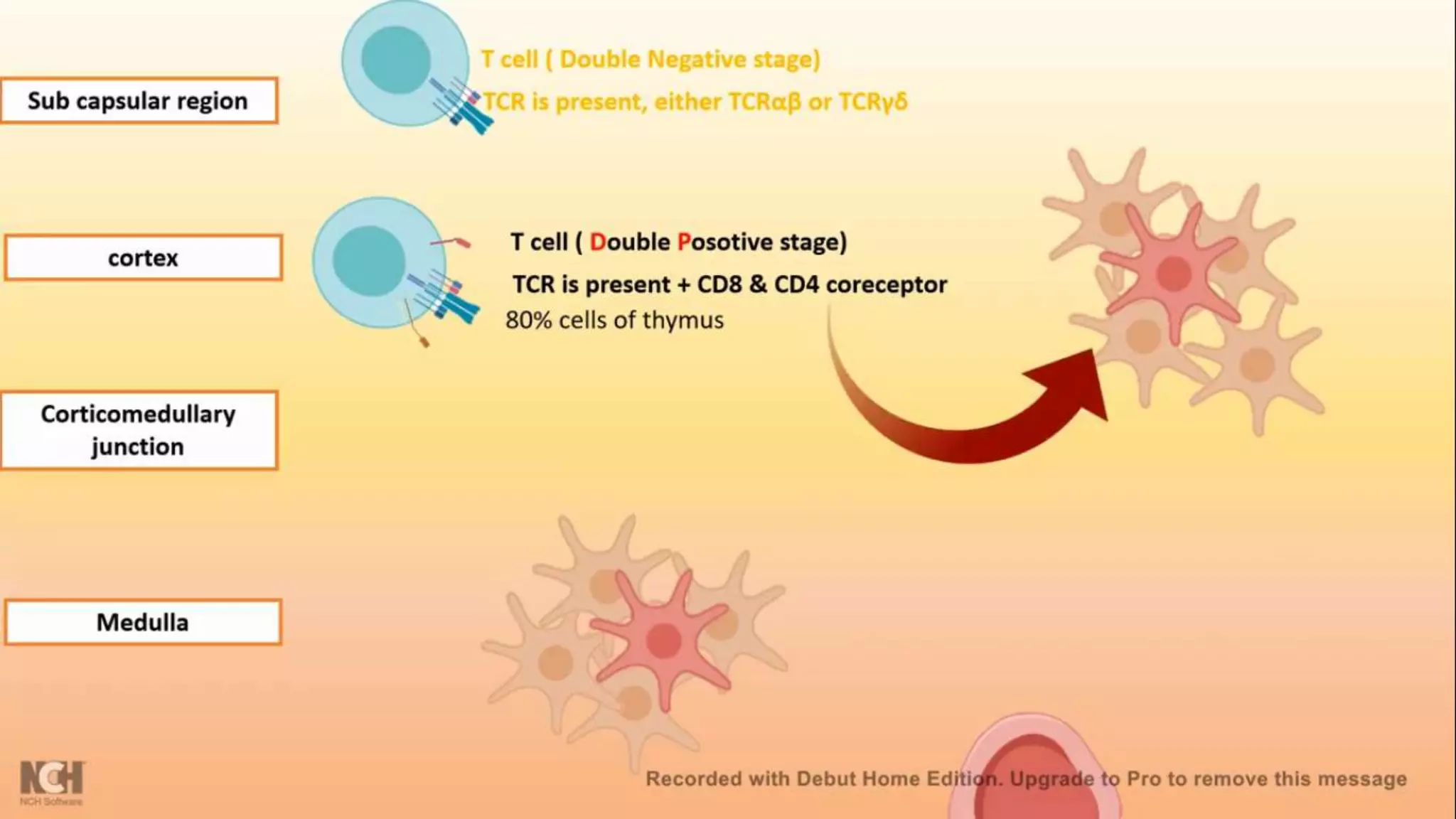
 Immature T cells do not express either the CD4 or CD8 antigen.
They are known as double-negative (DN) cells (CD4-CD8-).
 Through the process of development, they become double-
positive cells (CD4+CD8+), then mature into single-positive
(CD4+CD8- or CD4-CD8+) thymocytes and are released to
peripheral tissues.
 Most thymocytes die in the process of development.
 The remaining 2% become mature T cells.
Double-negative stage
The double-negative stage of T cell development is
divided further into 4 stages, DN1-DN4.
DN1 cells are heterogeneous and may give rise to
ɑβ T cells, γδ T cells, natural killer (NK) cells,
dendritic cells, macrophages, or B cells.
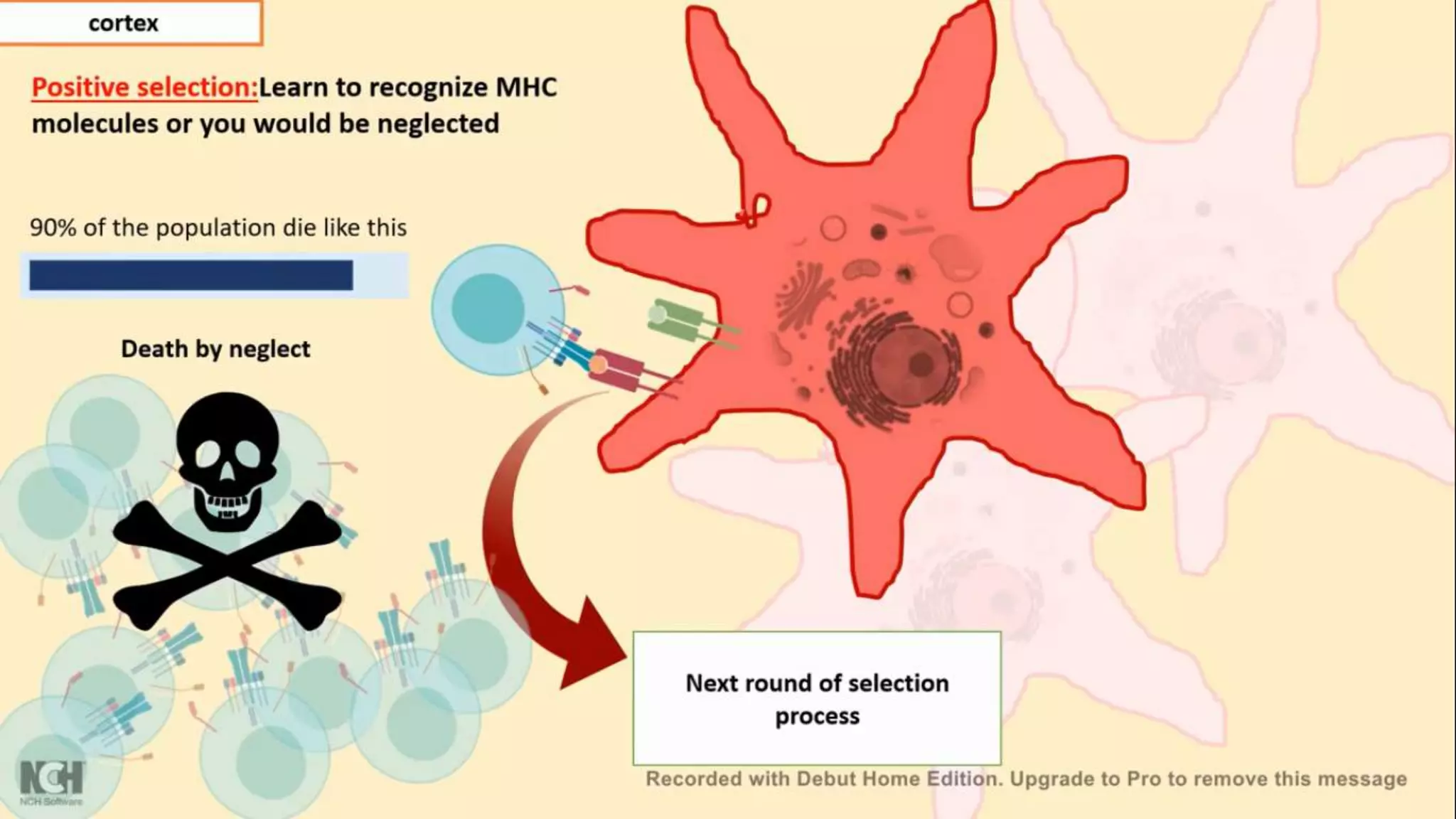
Double-positive stage
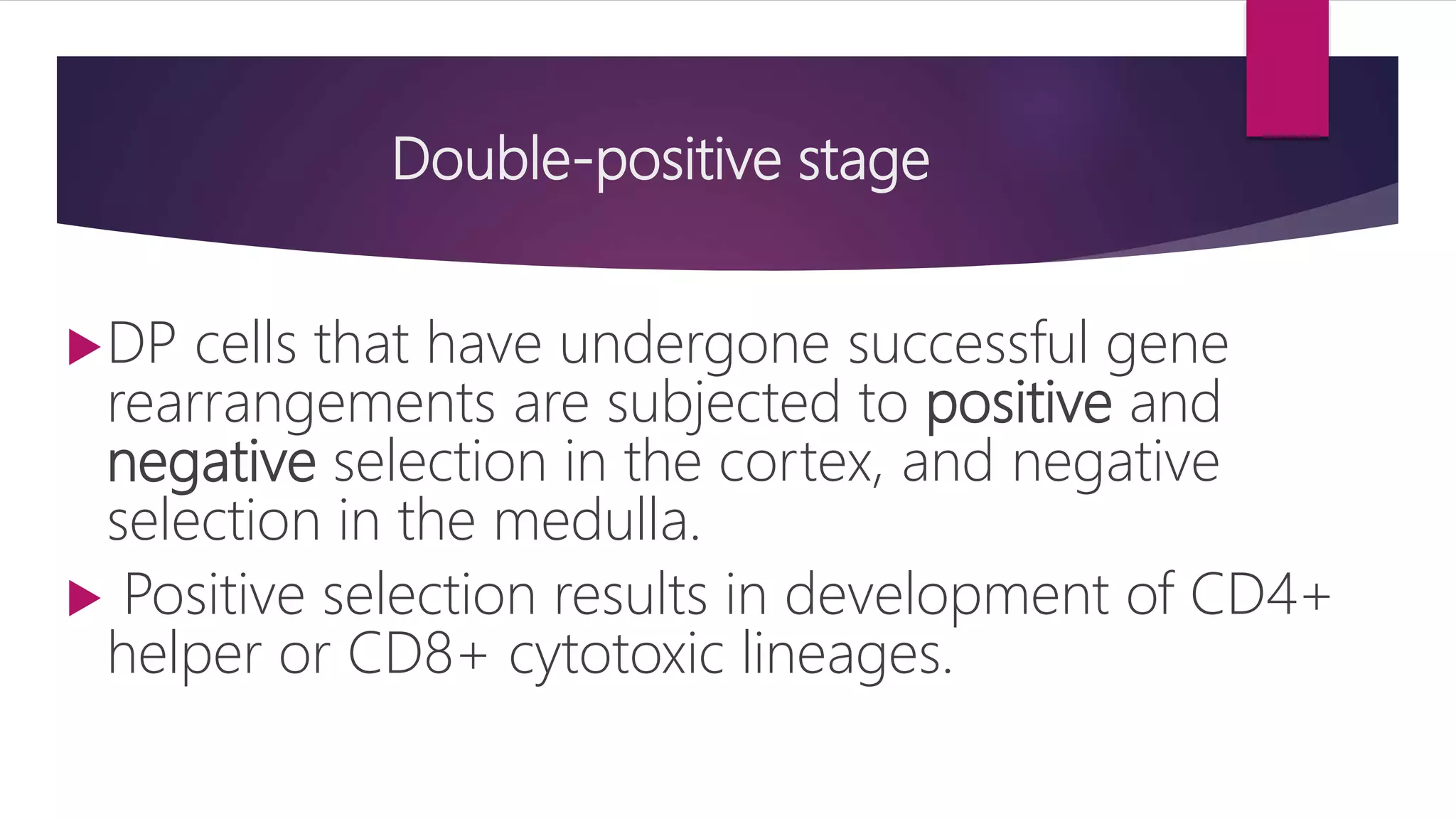
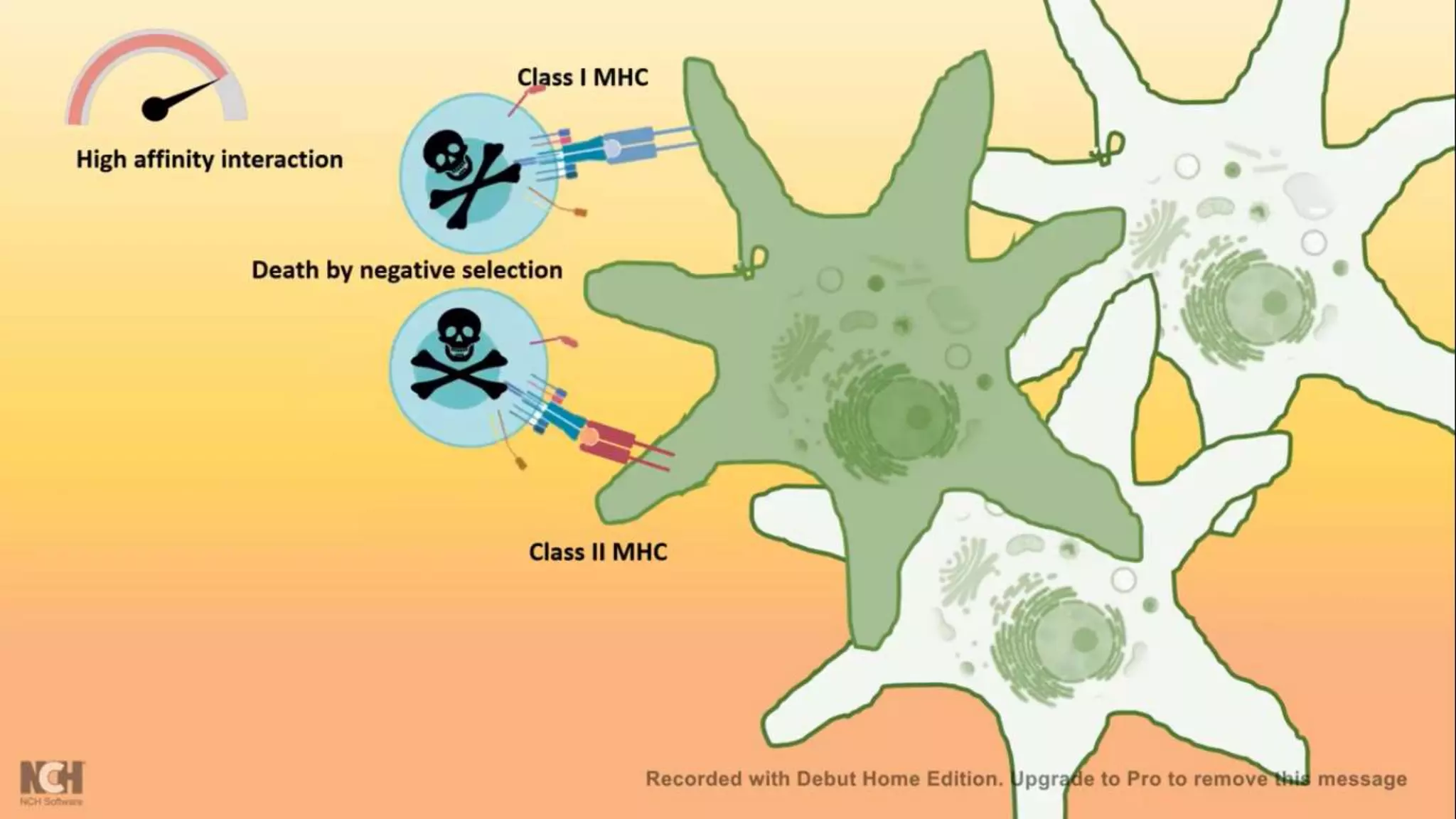
DP cells that have undergone successful gene
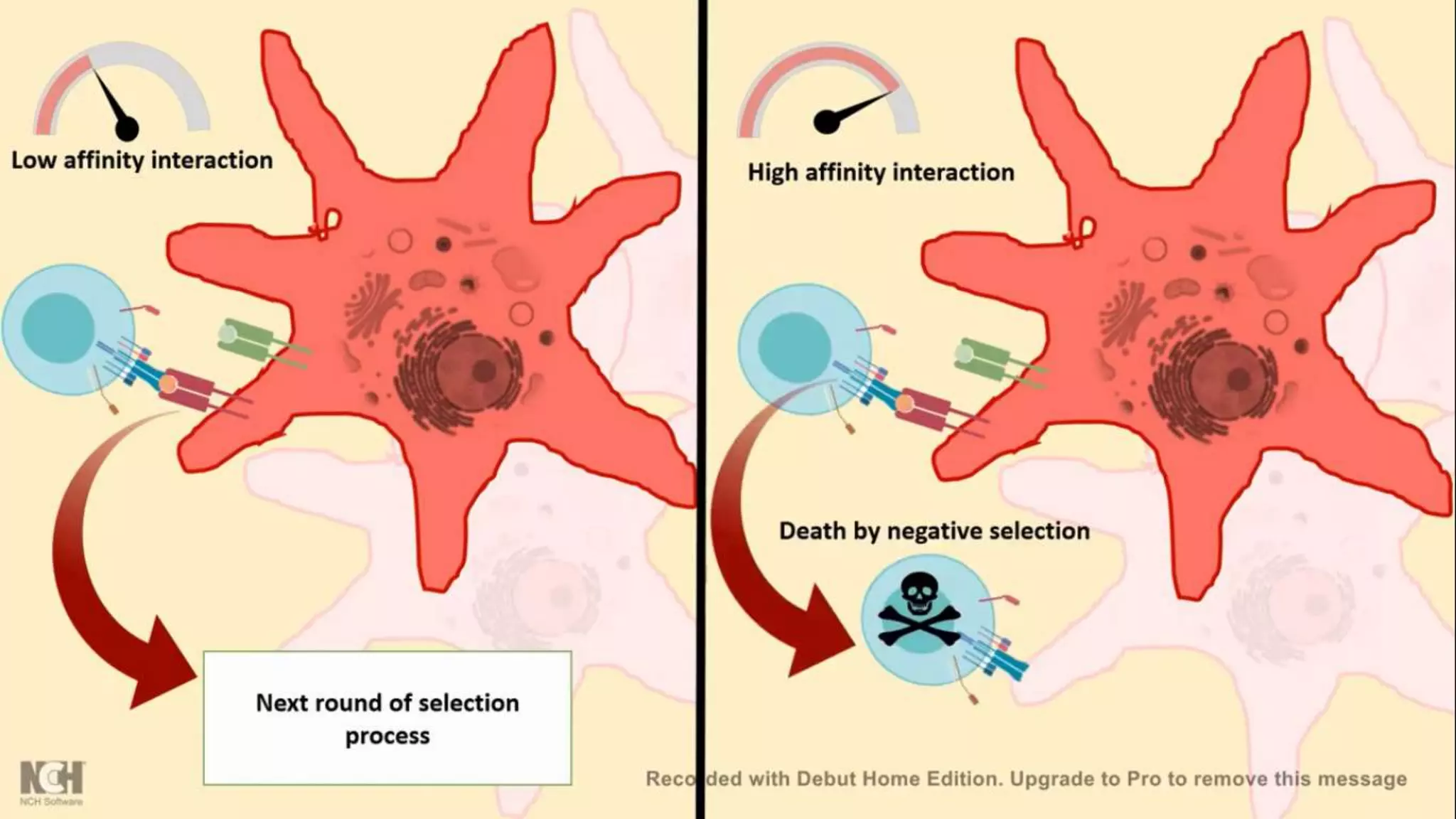
rearrangements are subjected to positive and
negative selection in the cortex, and negative
selection in the medulla.
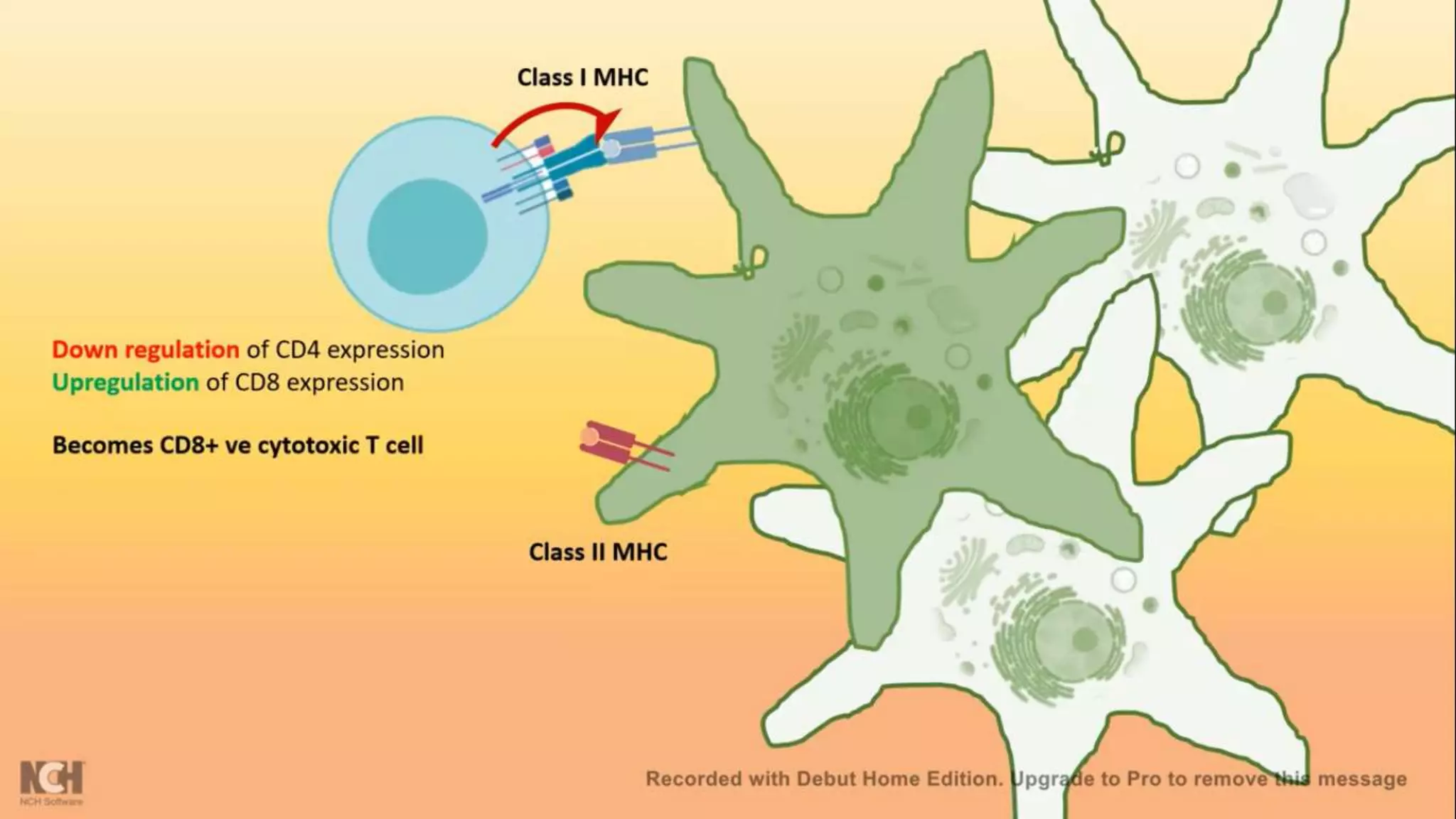
 Positive selection results in development of CD4+
helper or CD8+ cytotoxic lineages.
Mature CD4+ and CD8+ single-positive cells leave
the thymus and circulate in the blood stream.
γδ T cells do not undergo a positive selection
process the same way that ɑβ T cells do.
The thymic microenvironment
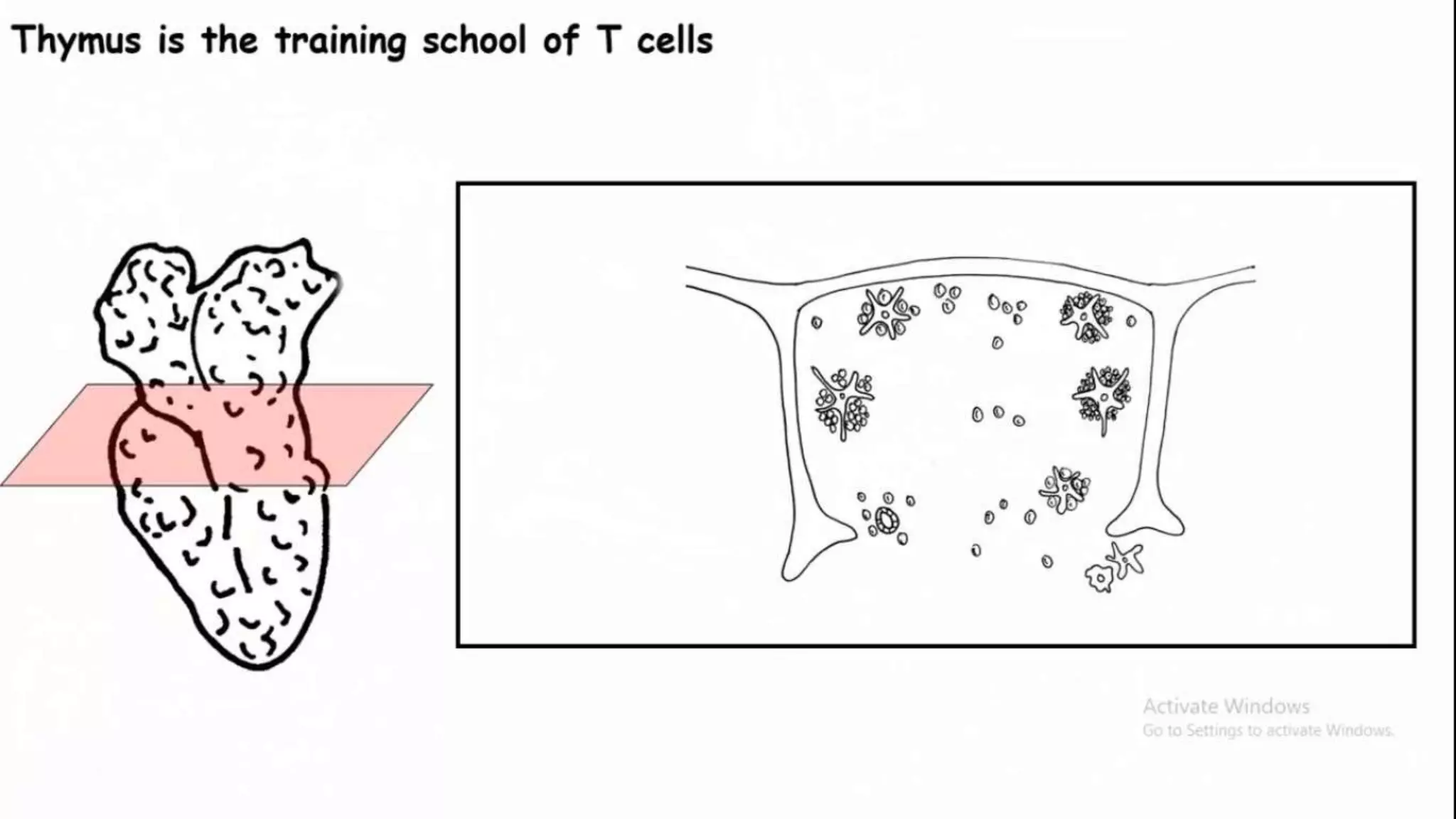
Thymic epithelial cells interact with thymocytes to
aid the development of T cells.
The thymic epithelium produces chemokines,
cytokines, and ligands which promote development
of progenitor cells.
Activation of T cells
 T cells are activated when the T cell receptor is engaged
combined with a costimulatory molecule such as CD28 by
the major histocompatibility complex (MHCII) peptide and
costimulatory molecules of the antigen presenting cells.
 Costimulation is necessary for T cell activation. Once
activated, the cell alters expression of its surface proteins
and its glycosylation profile.
T cell Activation
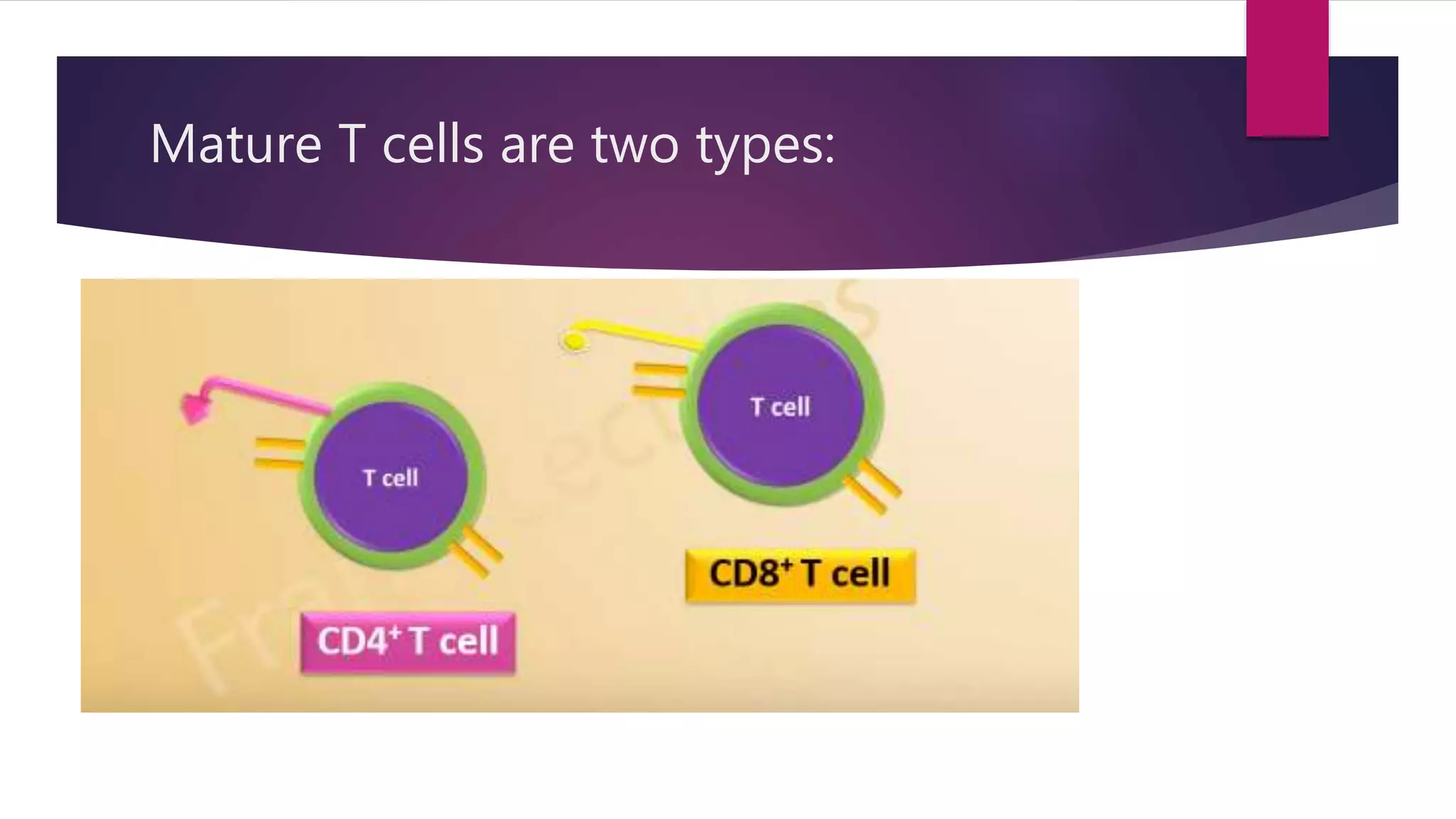
Mature T cells are two types:
T cell Activation: CD4+
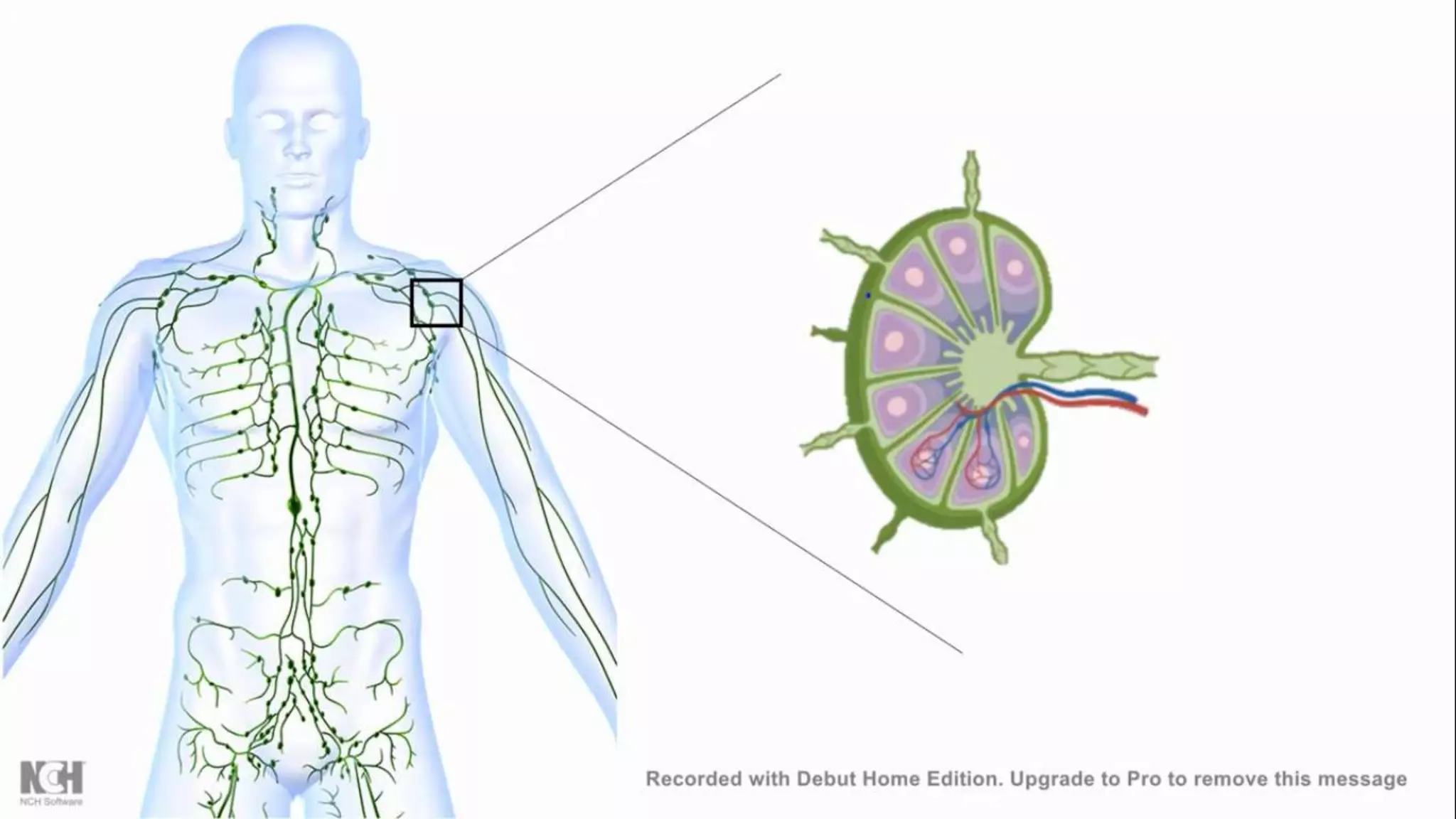
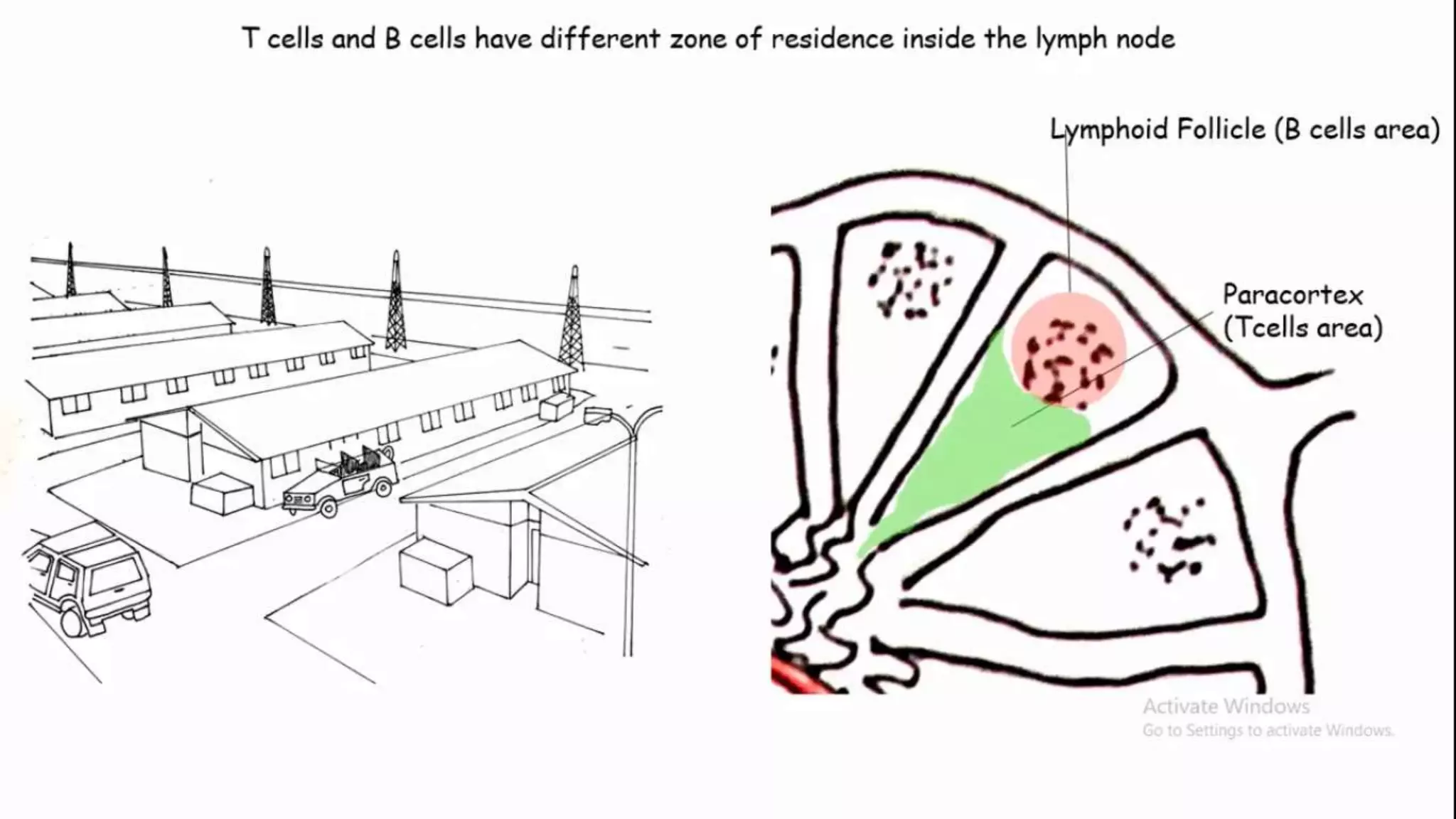
 These cells migrated from the site
of the infection to the lymph
nodes.
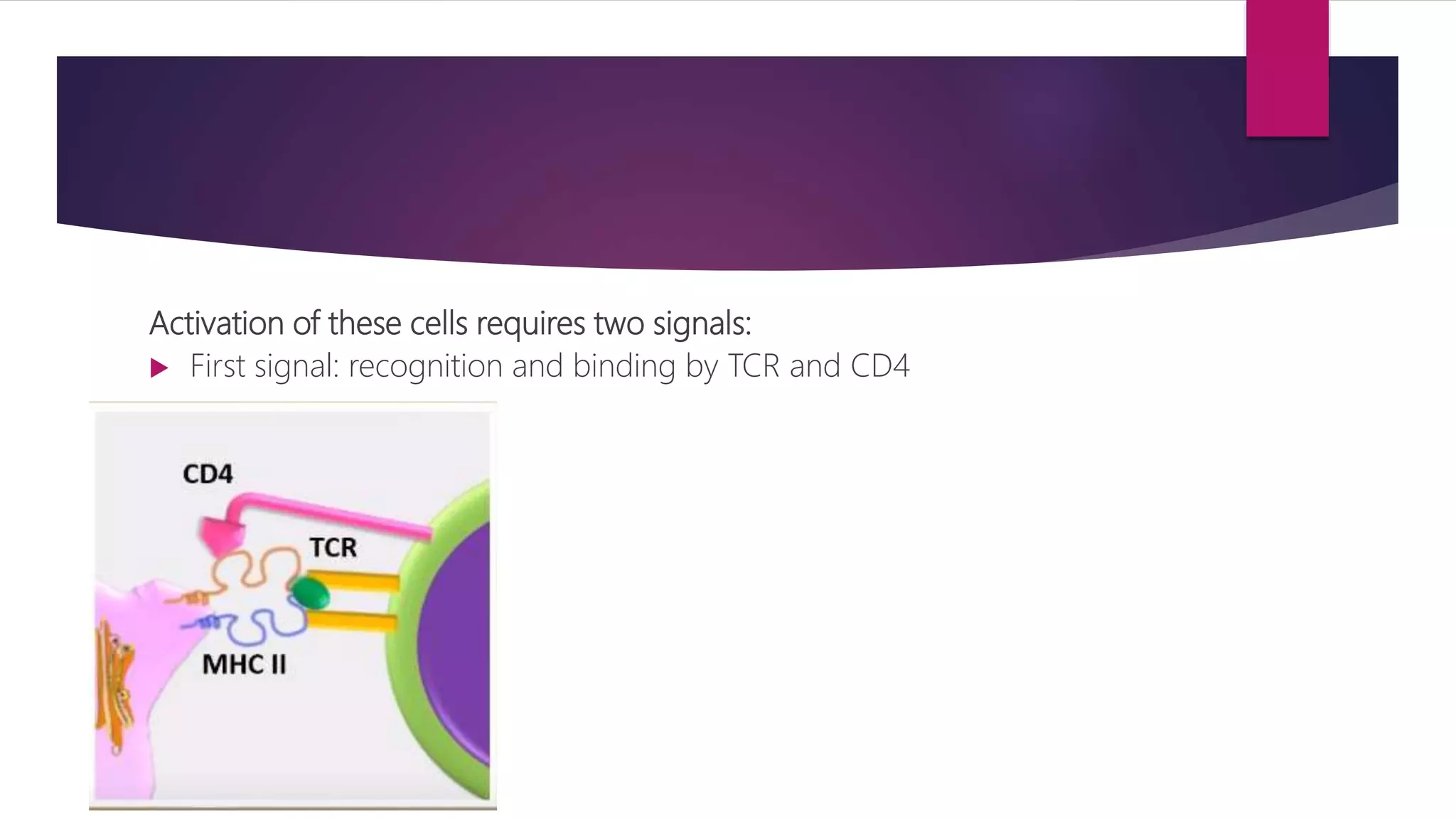
Activation of these cells requires two signals:
 First signal: recognition and binding by TCR and CD4
Second signal (costimutation)
 These two signals cause activation of T cells.
 Activated T cells synthesizes and secretes cytokine IL-2
Summary
T cells

T cells

  • 1.
    T-CELLS Dr. Mukhtar Ahmed,MSc Family Physician Associate Dean @ EAMC
  • 2.
    Contents Introduction T cell types T-CellDevelopment T-Cell Activation Differentiation and Memory
  • 3.
    Introduction T cell: Atype of white blood cell that is of key importance to the immune system and is at the core of adaptive immunity, the system that tailors the body's immune response to specific pathogens. The T cells are like soldiers who search out and destroy the targeted invaders.
  • 4.
     Immature Tcells (termed T-stem cells) migrate to the thymus gland in the neck, where they mature and differentiate into various types of mature T cells and become active in the immune system in response to a hormone called thymosin and other factors.  T-cells that are potentially activated against the body's own tissues are normally killed or changed ("down-regulated") during this maturational process.
  • 5.
     There areseveral different types of mature T cells.  Not all of their functions are known.  T cells can produce substances called cytokines such as the interleukins which further stimulate the immune response.  T-cell activation is measured as a way to assess the health of patients with HIV/AIDS and less frequently in other disorders. Types of T cell
  • 6.
    Effector T cellsinclude the categories of helper, killer, memory, and regulatory T cells. Helper T cells recruit other lymphocytes in an immune response. Cytotoxic, or killer, T cells destroy infected cells.
  • 7.
    T cells aregrouped into a series of subsets based on their function. CD4 and CD8 T cells are selected in the thymus, but undergo further differentiation in the periphery to specialized cells which have different functions. T cell subsets were initially defined by function, but also have associated gene or protein expression patterns.
  • 8.
    Helper CD4+ Tcells  T helper cells (TH cells) assist other lymphocytes, including maturation of B cells into plasma cells and memory B cells, and activation of cytotoxic T cells and macrophages.  These cells are also known as CD4+ T cells as they express the CD4 on their surfaces.  Helper T cells become activated when they are presented with peptide antigens by MHC class II molecules, which are expressed on the surface of antigen-presenting cells (APCs).
  • 9.
    Once activated, theydivide rapidly and secrete cytokines that regulate or assist the immune response. These cells can differentiate into one of several subtypes, which have different roles. Cytokines direct T cells into particular subtypes.
  • 10.
    Cytotoxic CD8+ Tcells  Cytotoxic T cells (TC cells, CTLs, T-killer cells, killer T cells) destroy virus- infected cells and tumor cells, and are also implicated in transplant rejection.  These cells are defined by the expression of CD8+ on the cell surface.  These cells recognize their targets by binding to MHC class I molecules, present on the surface of all nucleated cells.  CD8+ T cells also produce the key cytokines IL-2 and IFNγ, which influence the effector functions of other cells, in particular macrophages and NK cells.
  • 11.
    Memory T cells Memory T cells are a subset of infection- and cancer-fighting T cells (also known as a T lymphocyte) that have previously encountered and responded to their cognate antigen; thus, the term antigen-experienced T cell is often applied.  Such T cells can recognize foreign invaders.  Memory T cells may be either CD4+ or CD8+ .
  • 12.
    Memory T cells MemoryT cells are long-lived and can expand quickly to large Regulatory T cells maintain immunological tolerance by shutting down T cell-mediated immunity when an immune response is complete and suppressing autoreactive T cells.
  • 13.
    Gamma delta Tcells Gamma delta T cells (γδ T cells) represent a small subset of T cells which possess a γδ TCR rather than the αβ TCR on the cell surface. The majority of T cells express αβ TCR chains. This group of T cells is much less common in humans and mice (about 2% of total T cells) and are found mostly in the gut mucosa.
  • 14.
    T cells develop T cells develop from hematopoietic stem cells (HSC) in the bone marrow.  Progenitors of those cells migrate to the thymus, here they are known as thymocytes.  Thymocytes mature in a series of steps based on development of cell surface markers.  The HSC then differentiate into multipotent progenitors (MPP) which retain the potential to become both myeloid and lymphoid cells.  The process of differentiation then proceeds to a common lymphoid progenitor (CLP), which can only differentiate into T, B or NK cells
  • 15.
     Myeloid andlymphoid lineages both are involved in dendritic cell(antigen-presenting cells) formation.  Myeloid cells include monocytes, macrophages, neutrophils, basophils, eosinophils, erythrocytes, and megakaryocytes to platelets.  Lymphoid cells include T cells, B cells, and natural killer cells.
  • 16.
     Immature Tcells do not express either the CD4 or CD8 antigen. They are known as double-negative (DN) cells (CD4-CD8-).  Through the process of development, they become double- positive cells (CD4+CD8+), then mature into single-positive (CD4+CD8- or CD4-CD8+) thymocytes and are released to peripheral tissues.  Most thymocytes die in the process of development.  The remaining 2% become mature T cells.
  • 17.
    Double-negative stage The double-negativestage of T cell development is divided further into 4 stages, DN1-DN4. DN1 cells are heterogeneous and may give rise to ɑβ T cells, γδ T cells, natural killer (NK) cells, dendritic cells, macrophages, or B cells.
  • 18.
    Double-positive stage DP cellsthat have undergone successful gene rearrangements are subjected to positive and negative selection in the cortex, and negative selection in the medulla.  Positive selection results in development of CD4+ helper or CD8+ cytotoxic lineages.
  • 19.
    Mature CD4+ andCD8+ single-positive cells leave the thymus and circulate in the blood stream. γδ T cells do not undergo a positive selection process the same way that ɑβ T cells do.
  • 20.
    The thymic microenvironment Thymicepithelial cells interact with thymocytes to aid the development of T cells. The thymic epithelium produces chemokines, cytokines, and ligands which promote development of progenitor cells.
  • 21.
    Activation of Tcells  T cells are activated when the T cell receptor is engaged combined with a costimulatory molecule such as CD28 by the major histocompatibility complex (MHCII) peptide and costimulatory molecules of the antigen presenting cells.  Costimulation is necessary for T cell activation. Once activated, the cell alters expression of its surface proteins and its glycosylation profile.
  • 60.
  • 61.
    Mature T cellsare two types:
  • 62.
  • 63.
     These cellsmigrated from the site of the infection to the lymph nodes.
  • 64.
    Activation of thesecells requires two signals:  First signal: recognition and binding by TCR and CD4
  • 65.
  • 66.
  • 67.
     These twosignals cause activation of T cells.  Activated T cells synthesizes and secretes cytokine IL-2
  • 72.

Editor's Notes

  • #15 Myeloid and lymphoid lineages both are involved in dendritic cell formation. Myeloid cells include monocytes, macrophages, neutrophils, basophils, eosinophils, erythrocytes, and megakaryocytes to platelets. Lymphoid cells include T cells, B cells, and natural killer cells.
  • #23 Debut home edition