Topic
Models of Curriculum Planning
Present by
Hamna binate Ali
IER, University of the Punjab
Curriculum Planning
Curriculum planning is simply the design by
which school fulfill their responsibilities on
behalf of children and society as well.
Models
Models defined as:
“A simplified
representation of
reality which is
often depicted in
diagrammatic form”
Need of Models
Models serve as guideline to action.
Models are found in almost every form of
education.
The education profession has models of
instruction, of administration, of evaluation, of
supervision etc
Curriculum Models
Curriculum Models are designed to provide a
basis for decisions regarding the selection,
structuring and sequencing of the educational
experiences.
Major Curriculum Model
• Two major curriculum
models are the Tyler
and Taba.
• Each emphasizes
teacher planning and
assessment.
• The Tyler model
focuses on four
questions to
shape curriculum,
and the
Taba model is more
focused on teacher
input.
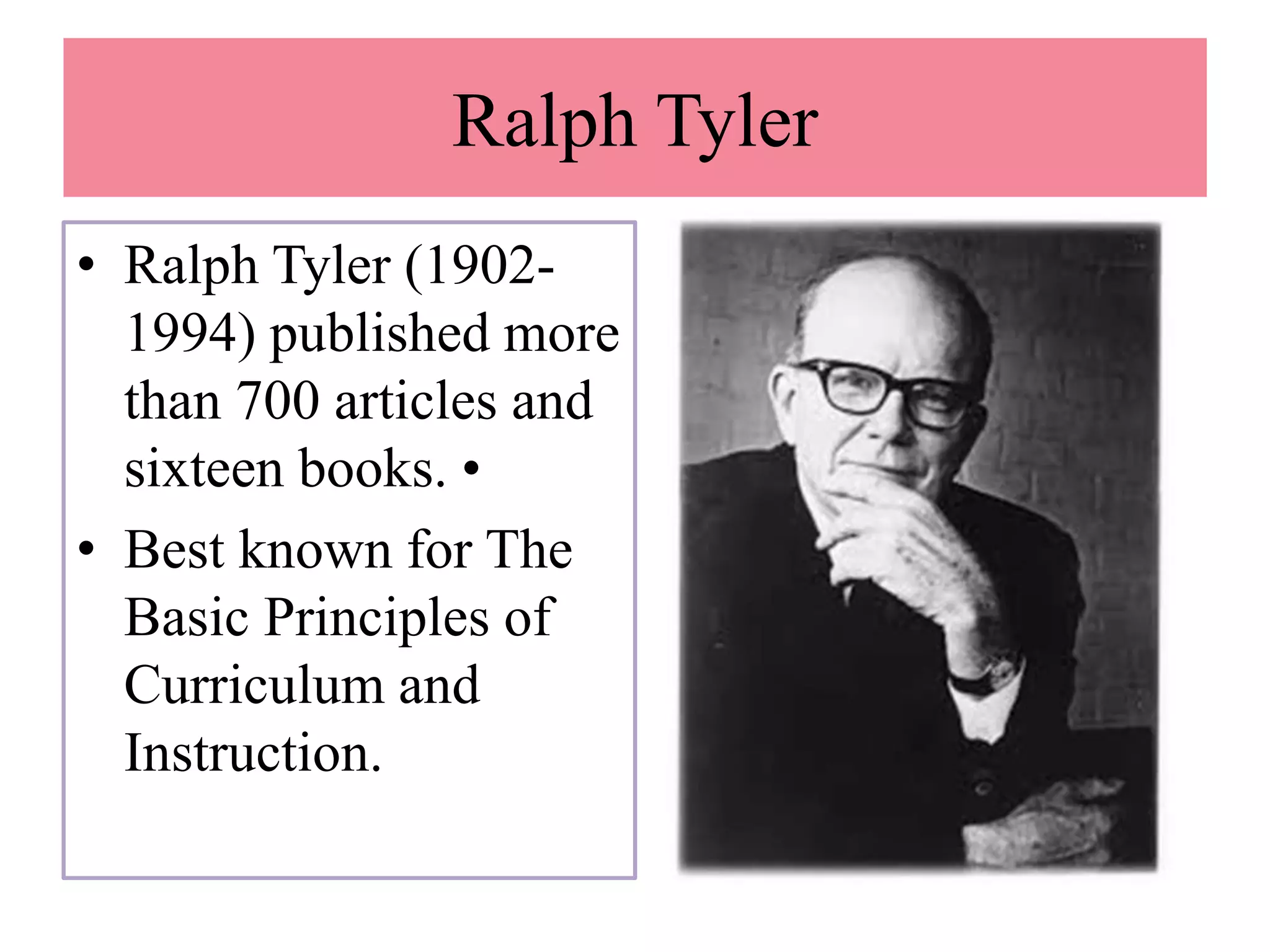
Ralph Tyler
• Ralph Tyler (1902-
1994) published more
than 700 articles and
sixteen books. •
• Best known for The
Basic Principles of
Curriculum and
Instruction.
The Tyler Model:
Four basic Principles
There are four major stages in the process of
curriculum development.
1) Goals and Objectives
2) Content
3) Learning
4) Evaluation
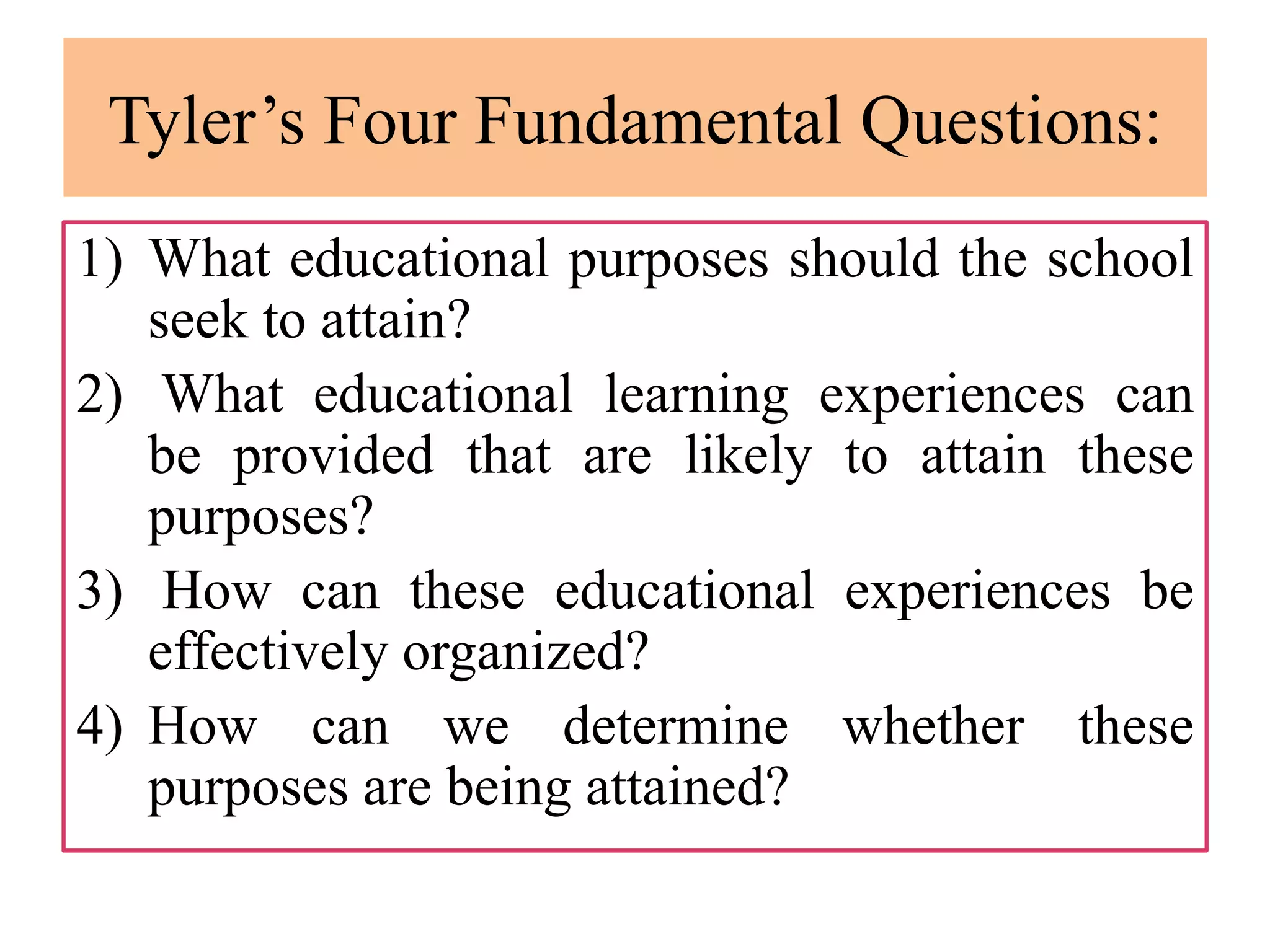
Tyler’s Four Fundamental Questions:
1) What educational purposes should the school
seek to attain?
2) What educational learning experiences can
be provided that are likely to attain these
purposes?
3) How can these educational experiences be
effectively organized?
4) How can we determine whether these
purposes are being attained?
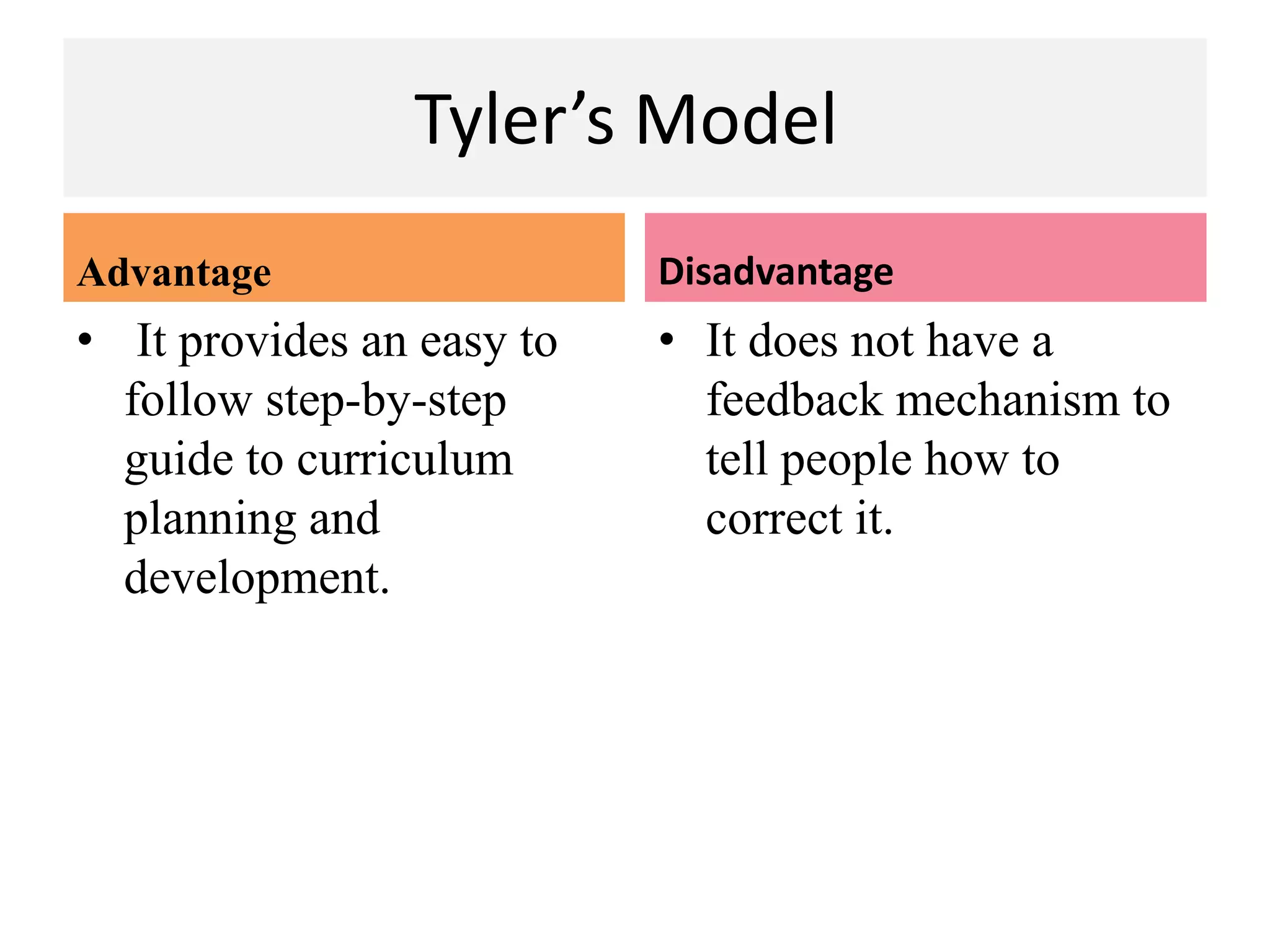
Tyler’s Model
Advantage
• It provides an easy to
follow step-by-step
guide to curriculum
planning and
development.
Disadvantage
• It does not have a
feedback mechanism to
tell people how to
correct it.
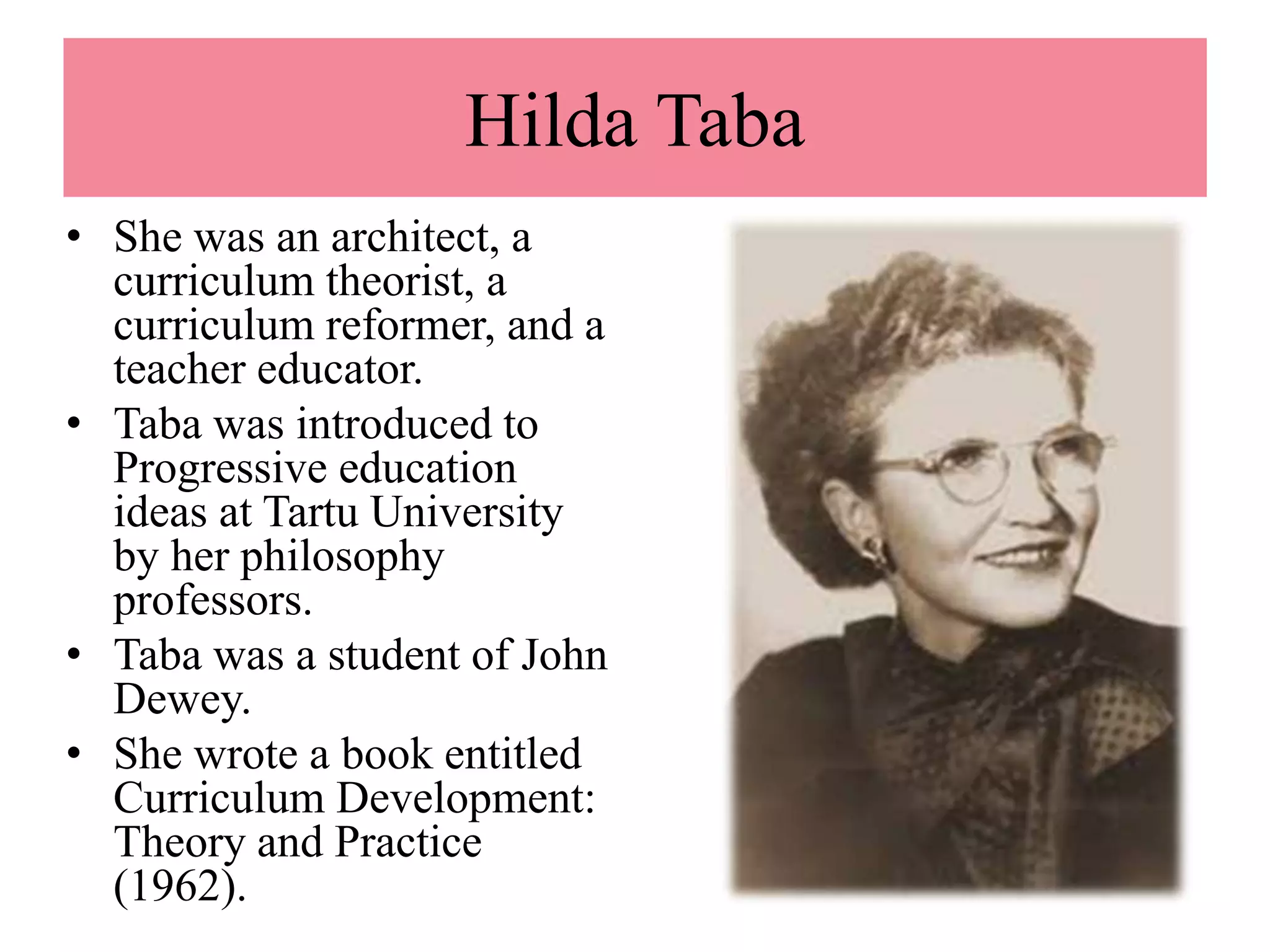
Hilda Taba
• She was an architect, a
curriculum theorist, a
curriculum reformer, and a
teacher educator.
• Taba was introduced to
Progressive education
ideas at Tartu University
by her philosophy
professors.
• Taba was a student of John
Dewey.
• She wrote a book entitled
Curriculum Development:
Theory and Practice
(1962).
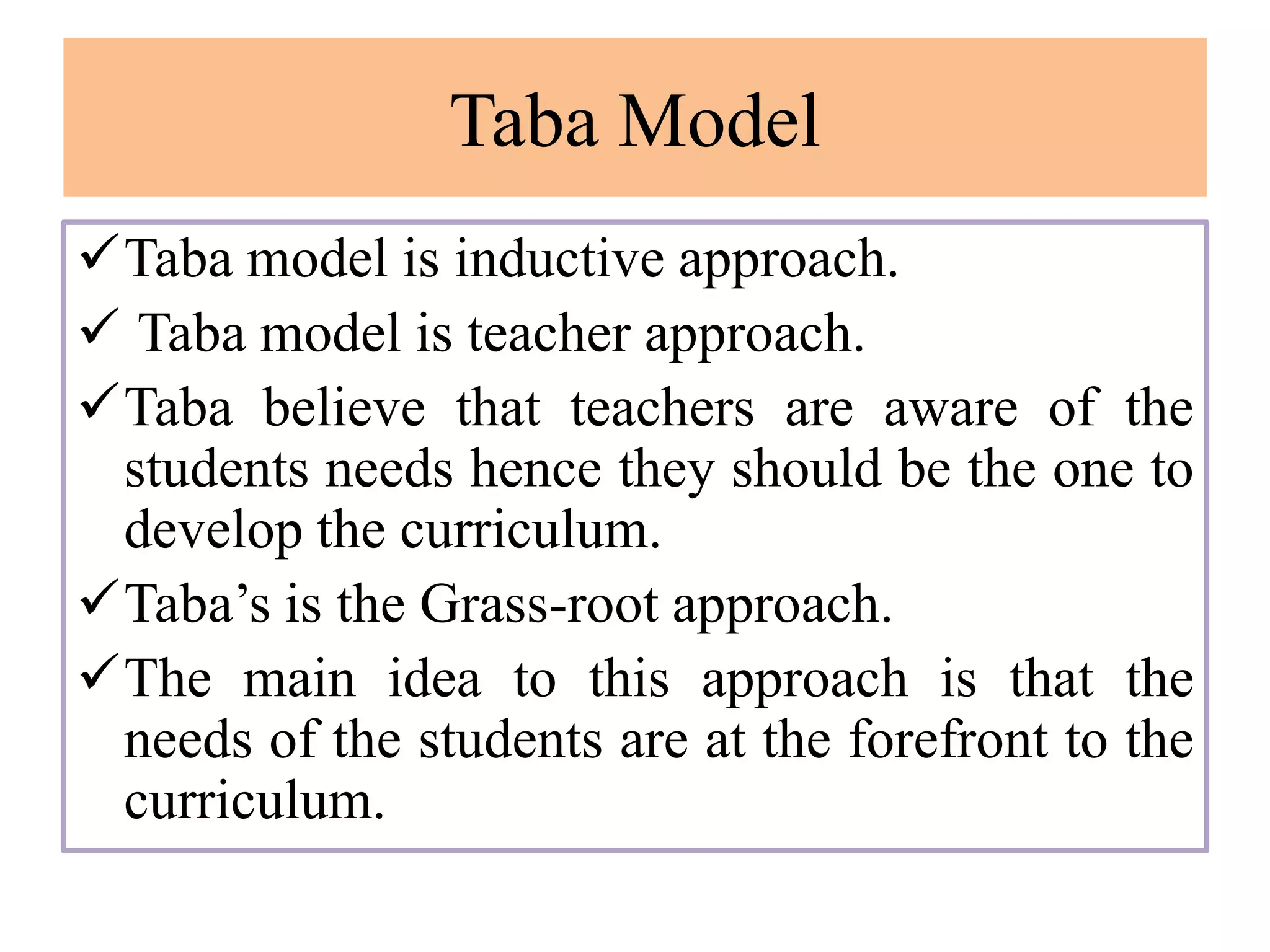
Taba Model
Taba model is inductive approach.
 Taba model is teacher approach.
Taba believe that teachers are aware of the
students needs hence they should be the one to
develop the curriculum.
Taba’s is the Grass-root approach.
The main idea to this approach is that the
needs of the students are at the forefront to the
curriculum.
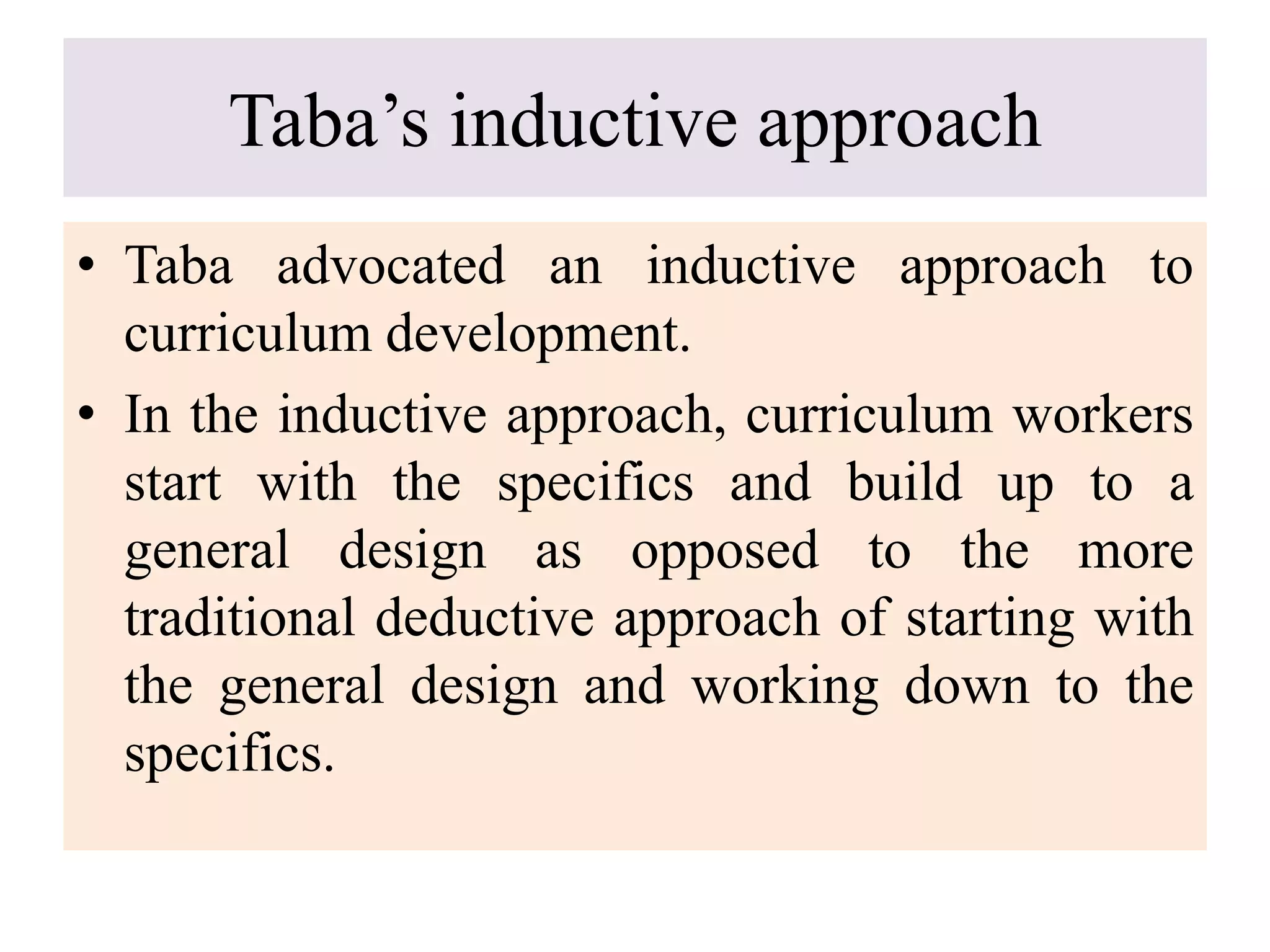
Taba’s inductive approach
• Taba advocated an inductive approach to
curriculum development.
• In the inductive approach, curriculum workers
start with the specifics and build up to a
general design as opposed to the more
traditional deductive approach of starting with
the general design and working down to the
specifics.
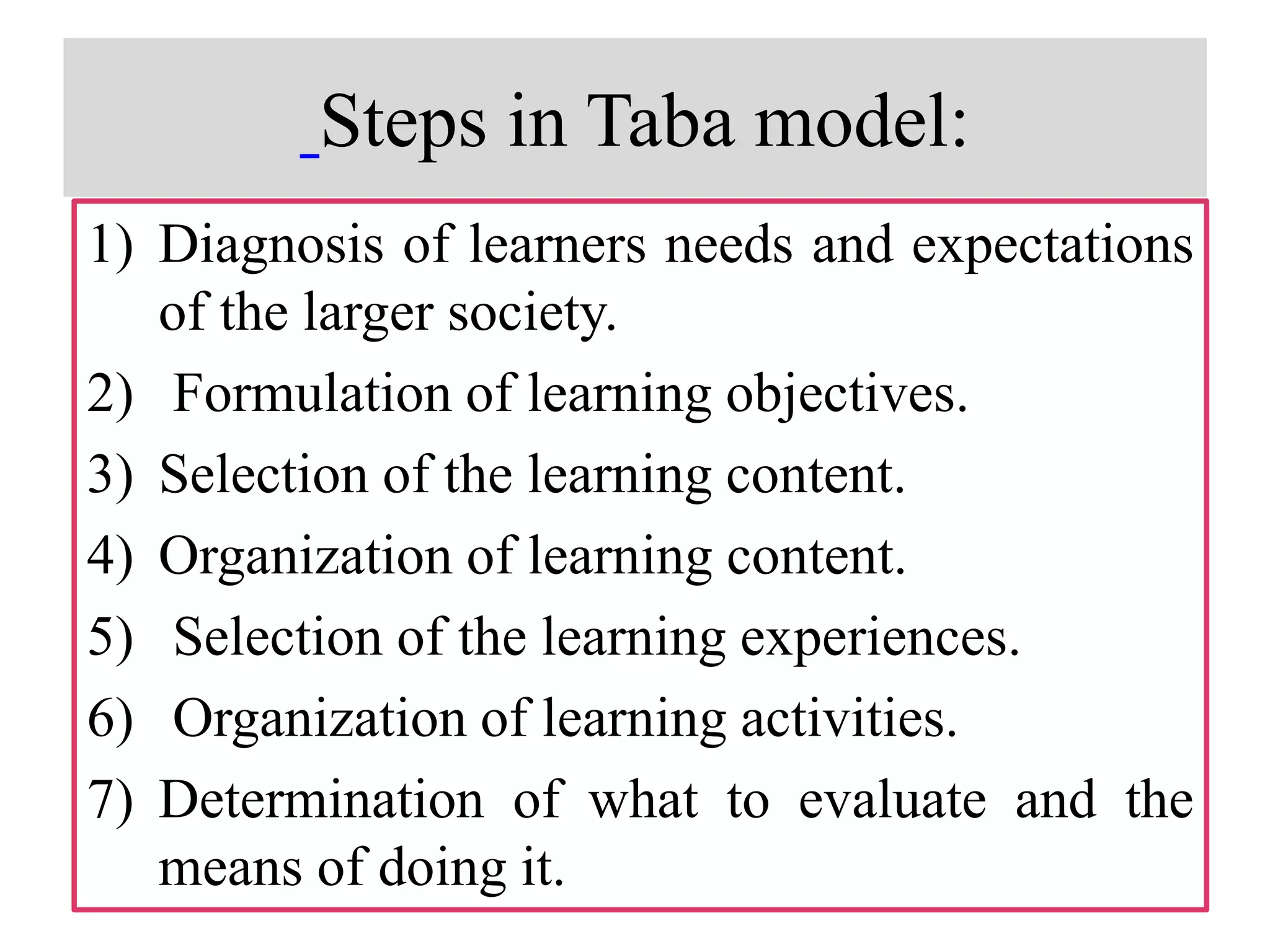
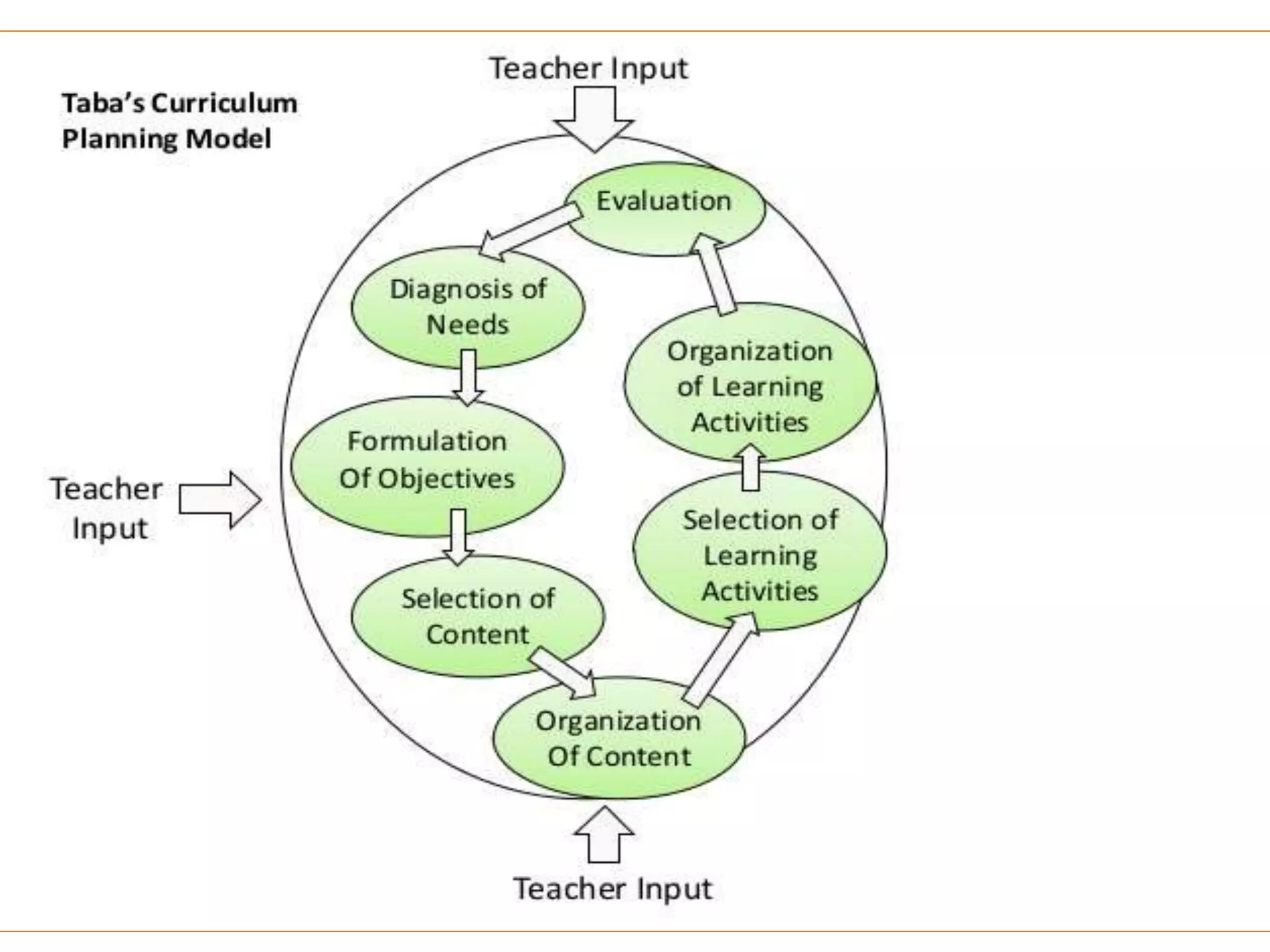
Steps in Taba model:
1) Diagnosis of learners needs and expectations
of the larger society.
2) Formulation of learning objectives.
3) Selection of the learning content.
4) Organization of learning content.
5) Selection of the learning experiences.
6) Organization of learning activities.
7) Determination of what to evaluate and the
means of doing it.
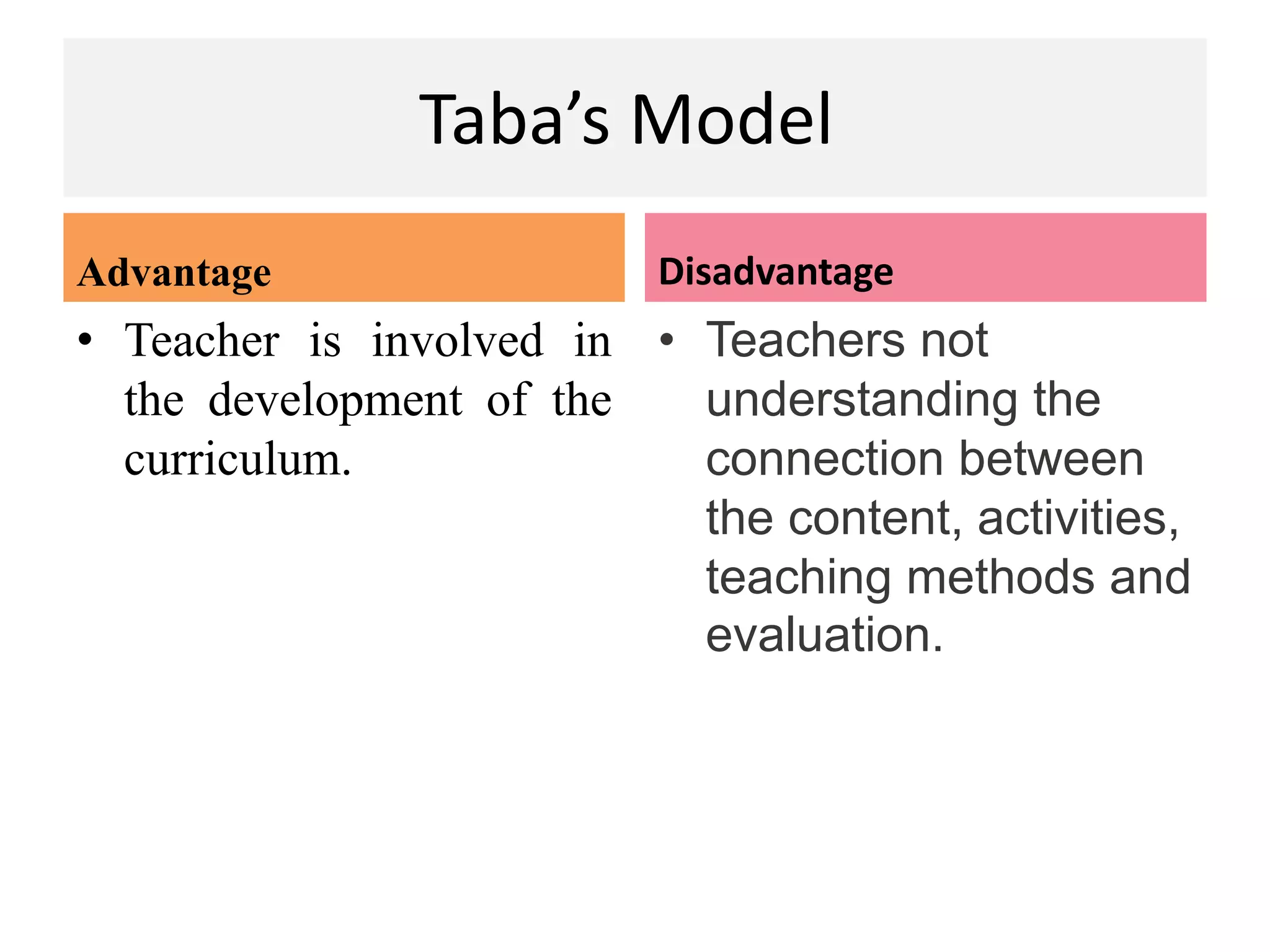
Taba’s Model
Advantage
• Teacher is involved in
the development of the
curriculum.
Disadvantage
• Teachers not
understanding the
connection between
the content, activities,
teaching methods and
evaluation.
References
• Johnson M, (1967). Definitions and models in curriculum theory,
Educational Theory, 17(2), 127-140.
• https://www.google.com/search?biw=1268&bih=565&tbm=isch&sa=1&ei
=lfeWWqnXBajgkgWov6SoCA&q=tyler+models+pic&oq=tyler+models+
pic&gs_l=psy-ab.3...18154.20924.0.21103.10.10.0.0.0.0.392.1119.3-
3.3.0....0...1c.1.64.psy-
ab..7.1.363...0i8i30k1j0i24k1.0.mVqcVu8K86Y#imgrc=bvL4y1QKyBcLJ
M:
• https://www.google.com/search?ei=0-
SWWtOGK8n4wALi9pGoDA&q=tyler+model&oq=tyler+model&gs_l=ps
y-ab.3..0i67k1l4j0l6.3877222.3878922.0.3879931.11.8.0.0.0.0.742.1099.3-
1j6-1.2.0....0...1c.1.64.psy-ab..9.2.1098....0.elwMTZRhbHI
Models of Curriculum planning

Models of Curriculum planning

  • 1.
    Topic Models of CurriculumPlanning Present by Hamna binate Ali IER, University of the Punjab
  • 2.
    Curriculum Planning Curriculum planningis simply the design by which school fulfill their responsibilities on behalf of children and society as well.
  • 3.
    Models Models defined as: “Asimplified representation of reality which is often depicted in diagrammatic form”
  • 4.
    Need of Models Modelsserve as guideline to action. Models are found in almost every form of education. The education profession has models of instruction, of administration, of evaluation, of supervision etc
  • 5.
    Curriculum Models Curriculum Modelsare designed to provide a basis for decisions regarding the selection, structuring and sequencing of the educational experiences.
  • 6.
    Major Curriculum Model •Two major curriculum models are the Tyler and Taba. • Each emphasizes teacher planning and assessment. • The Tyler model focuses on four questions to shape curriculum, and the Taba model is more focused on teacher input.
  • 7.
    Ralph Tyler • RalphTyler (1902- 1994) published more than 700 articles and sixteen books. • • Best known for The Basic Principles of Curriculum and Instruction.
  • 8.
    The Tyler Model: Fourbasic Principles There are four major stages in the process of curriculum development. 1) Goals and Objectives 2) Content 3) Learning 4) Evaluation
  • 9.
    Tyler’s Four FundamentalQuestions: 1) What educational purposes should the school seek to attain? 2) What educational learning experiences can be provided that are likely to attain these purposes? 3) How can these educational experiences be effectively organized? 4) How can we determine whether these purposes are being attained?
  • 10.
    Tyler’s Model Advantage • Itprovides an easy to follow step-by-step guide to curriculum planning and development. Disadvantage • It does not have a feedback mechanism to tell people how to correct it.
  • 11.
    Hilda Taba • Shewas an architect, a curriculum theorist, a curriculum reformer, and a teacher educator. • Taba was introduced to Progressive education ideas at Tartu University by her philosophy professors. • Taba was a student of John Dewey. • She wrote a book entitled Curriculum Development: Theory and Practice (1962).
  • 12.
    Taba Model Taba modelis inductive approach.  Taba model is teacher approach. Taba believe that teachers are aware of the students needs hence they should be the one to develop the curriculum. Taba’s is the Grass-root approach. The main idea to this approach is that the needs of the students are at the forefront to the curriculum.
  • 13.
    Taba’s inductive approach •Taba advocated an inductive approach to curriculum development. • In the inductive approach, curriculum workers start with the specifics and build up to a general design as opposed to the more traditional deductive approach of starting with the general design and working down to the specifics.
  • 14.
    Steps in Tabamodel: 1) Diagnosis of learners needs and expectations of the larger society. 2) Formulation of learning objectives. 3) Selection of the learning content. 4) Organization of learning content. 5) Selection of the learning experiences. 6) Organization of learning activities. 7) Determination of what to evaluate and the means of doing it.
  • 16.
    Taba’s Model Advantage • Teacheris involved in the development of the curriculum. Disadvantage • Teachers not understanding the connection between the content, activities, teaching methods and evaluation.
  • 17.
    References • Johnson M,(1967). Definitions and models in curriculum theory, Educational Theory, 17(2), 127-140. • https://www.google.com/search?biw=1268&bih=565&tbm=isch&sa=1&ei =lfeWWqnXBajgkgWov6SoCA&q=tyler+models+pic&oq=tyler+models+ pic&gs_l=psy-ab.3...18154.20924.0.21103.10.10.0.0.0.0.392.1119.3- 3.3.0....0...1c.1.64.psy- ab..7.1.363...0i8i30k1j0i24k1.0.mVqcVu8K86Y#imgrc=bvL4y1QKyBcLJ M: • https://www.google.com/search?ei=0- SWWtOGK8n4wALi9pGoDA&q=tyler+model&oq=tyler+model&gs_l=ps y-ab.3..0i67k1l4j0l6.3877222.3878922.0.3879931.11.8.0.0.0.0.742.1099.3- 1j6-1.2.0....0...1c.1.64.psy-ab..9.2.1098....0.elwMTZRhbHI