System Approach of
Production Function
System Approach of Production Function
  A system   is the combination of subsystems.
  Every system is the sub system of larger system.
 If we consider a global economic system, a national
 economy are sub systems.
 If we consider a national economy is a
 system, different industries are sub systems.
 When a industry is a system different organization or
 firms are sub system
 An organization is a combination of different
 components (Departments) working together to achieve
 specific goal(s).
 It is a set of different sub-systems ( departments). So it
 is called a system.
 Among the different Departments, production
 management is one of the them.
Contd……….
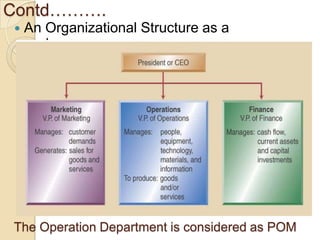
   An Organizational Structure as a
    system


The Operation Department is considered as POM
Contd……….
When    considering POM itself POM is system
 of different sub systems.
The components or sub systems are
 input, process, output, feedback and random
 fluctuations.
 Strong interaction makes the production
 function supportive to meet organizational
 goal(s).
The components of system always inter
 related and having interaction each other to
 achieve the same (organizational) goal(s).
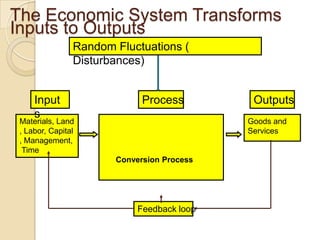
The Economic System Transforms
Inputs to Outputs
                Random Fluctuations (
                Disturbances)


     Input                   Process         Outputs
     s
 Materials, Land                            Goods and
 , Labor, Capital                           Services
 , Management,
  Time
                       Conversion Process


                            Feedback loop
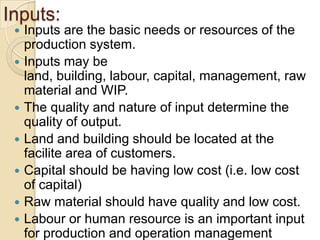
Inputs:
  Inputs are the basic needs or resources of the
   production system.
  Inputs may be
   land, building, labour, capital, management, raw
   material and WIP.
  The quality and nature of input determine the
   quality of output.
  Land and building should be located at the
   facilite area of customers.
  Capital should be having low cost (i.e. low cost
   of capital)
  Raw material should have quality and low cost.
  Labour or human resource is an important input
   for production and operation management
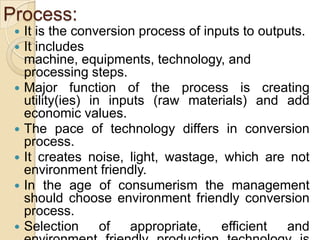
Process:
    It is the conversion process of inputs to outputs.
    It includes
     machine, equipments, technology, and
     processing steps.
    Major function of the process is creating
     utility(ies) in inputs (raw materials) and add
     economic values.
    The pace of technology differs in conversion
     process.
    It creates noise, light, wastage, which are not
     environment friendly.
    In the age of consumerism the management
     should choose environment friendly conversion
     process.
    Selection      of  appropriate,    efficient  and
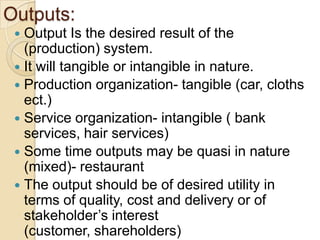
Outputs:
  Output Is the desired result of the
   (production) system.
  It will tangible or intangible in nature.
  Production organization- tangible (car, cloths
   ect.)
  Service organization- intangible ( bank
   services, hair services)
  Some time outputs may be quasi in nature
   (mixed)- restaurant
  The output should be of desired utility in
   terms of quality, cost and delivery or of
   stakeholder’s interest
   (customer, shareholders)
Random Fluctuations or
disturbances:
 It is the unplanned or               uncontrolled
   environmental influences in the conversion
   process that causes planned and actual
   output differ.
It may be categorized as:
 Internal             Factors-            Human
   Resources, Breakdown of machines, supply
   of raw materials ( controllable but unplanned)
External             Factors-          Electricity
   supply, flood, earthquake, government
   policies. ( Uncontrollable and unplanned)
Feedback:
 Feed back is the control mechanism of the
    production      function   which    support
    management         whether    organizational
    activities need adjustment??
 It has three phases:
  Set the goal
  Determine the actual result
  Comparison with the plane or actual result- (
    +, - or = )
  + or - result: need adjustment
Conclusion:
  POM    system is the part of organization that produces
   the organizational physical product or services.
  Inputs are the basic need of production functions.
  Conversion process is the process of creation of
   unility(ies) and economic value added to the inputs.
  Output is the desired physical product or services
   which fulfill the desired of the customer as well as
   stakeholders.
  Random       Fluctuations are the unplanned or
   uncontrolled       environmental    influences    which
   influence the production process.
  Feedback is the control mechanism of the production
   function.
 “Production Function is the system of conversion of
   inputs into outputs with addition of economic values
   and utility(ies).”
Any   Please

System approach of production function

  • 1.
  • 2.
    System Approach ofProduction Function  A system is the combination of subsystems.  Every system is the sub system of larger system. If we consider a global economic system, a national economy are sub systems. If we consider a national economy is a system, different industries are sub systems. When a industry is a system different organization or firms are sub system An organization is a combination of different components (Departments) working together to achieve specific goal(s). It is a set of different sub-systems ( departments). So it is called a system. Among the different Departments, production management is one of the them.
  • 3.
    Contd……….  An Organizational Structure as a system The Operation Department is considered as POM
  • 4.
    Contd………. When considering POM itself POM is system of different sub systems. The components or sub systems are input, process, output, feedback and random fluctuations.  Strong interaction makes the production function supportive to meet organizational goal(s). The components of system always inter related and having interaction each other to achieve the same (organizational) goal(s).
  • 5.
    The Economic SystemTransforms Inputs to Outputs Random Fluctuations ( Disturbances) Input Process Outputs s Materials, Land Goods and , Labor, Capital Services , Management, Time Conversion Process Feedback loop
  • 6.
    Inputs:  Inputsare the basic needs or resources of the production system.  Inputs may be land, building, labour, capital, management, raw material and WIP.  The quality and nature of input determine the quality of output.  Land and building should be located at the facilite area of customers.  Capital should be having low cost (i.e. low cost of capital)  Raw material should have quality and low cost.  Labour or human resource is an important input for production and operation management
  • 7.
    Process:  It is the conversion process of inputs to outputs.  It includes machine, equipments, technology, and processing steps.  Major function of the process is creating utility(ies) in inputs (raw materials) and add economic values.  The pace of technology differs in conversion process.  It creates noise, light, wastage, which are not environment friendly.  In the age of consumerism the management should choose environment friendly conversion process.  Selection of appropriate, efficient and
  • 8.
    Outputs:  OutputIs the desired result of the (production) system.  It will tangible or intangible in nature.  Production organization- tangible (car, cloths ect.)  Service organization- intangible ( bank services, hair services)  Some time outputs may be quasi in nature (mixed)- restaurant  The output should be of desired utility in terms of quality, cost and delivery or of stakeholder’s interest (customer, shareholders)
  • 9.
    Random Fluctuations or disturbances: It is the unplanned or uncontrolled environmental influences in the conversion process that causes planned and actual output differ. It may be categorized as:  Internal Factors- Human Resources, Breakdown of machines, supply of raw materials ( controllable but unplanned) External Factors- Electricity supply, flood, earthquake, government policies. ( Uncontrollable and unplanned)
  • 10.
    Feedback: Feed backis the control mechanism of the production function which support management whether organizational activities need adjustment?? It has three phases:  Set the goal  Determine the actual result  Comparison with the plane or actual result- ( +, - or = )  + or - result: need adjustment
  • 11.
    Conclusion:  POM system is the part of organization that produces the organizational physical product or services.  Inputs are the basic need of production functions.  Conversion process is the process of creation of unility(ies) and economic value added to the inputs.  Output is the desired physical product or services which fulfill the desired of the customer as well as stakeholders.  Random Fluctuations are the unplanned or uncontrolled environmental influences which influence the production process.  Feedback is the control mechanism of the production function. “Production Function is the system of conversion of inputs into outputs with addition of economic values and utility(ies).”
  • 12.
    Any Please