LIN101
Week 2
Session 1
SYNTAX
DR. RUSSELL RODRIGO
What is syntax?
The arrangement of words to
form phrases, clauses and
sentences; sentence construction;
the study of the principles and
processes by which sentences
are constructed; the rhythm of
sentences created by grammar
patterns.
2
Describe this image in a sentence
3
Mary
John
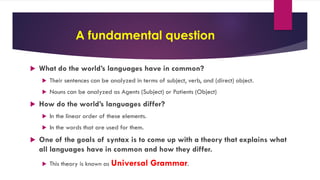
A fundamental question
 What do the world’s languages have in common?
 Their sentences can be analyzed in terms of subject, verb, and (direct) object.
 Nouns can be analyzed as Agents (Subject) or Patients (Object)
 How do the world’s languages differ?
 In the linear order of these elements.
 In the words that are used for them.
 One of the goals of syntax is to come up with a theory that explains what
all languages have in common and how they differ.
 This theory is known as Universal Grammar.
4
5
Maybe Human Grammar (HG) would be a
better term.
Chimpanzee
Grammar(CG)
Dolphin
Grammar(DG)
Blue Whale Grammar (BWG)
E.T. Grammar (ETG)
Another example of syntax
 Continuing with our previous concept, let’s turn it into a (direct) question …
1. Mary is kissing John.
2. Is Mary kissing John?
 Notice that the auxiliary verb is appears to move in front of Mary to form the
question, a phenomenon often referred to as subject-auxiliary inversion (SAI).
 Now let’s turn to indirect questions:
3. I wonder if Mary is kissing John. (no SAI)
4. I wonder whether Mary is kissing John. (no SAI)
5. **I wonder if is Mary kissing John. (bad with SAI)
6. *I wonder is Mary kissing John. (bad with SAI)6
Look at how much you know
 You know that (1-4) are ‘good’ or grammatical sentences of English.
 You know that (5-6) are ‘bad’ or ungrammatical sentences of English.
 You may not be able to verbalize this knowledge, however.
 Thus your knowledge of English grammar is tacit or implicit.
 One goal of syntax is to make this knowledge explicit.
 Another is to explain why some sentences are good while others are bad.
 To do so, we will need a theory of how grammar works, which again is known as
Universal Grammar.
The Analysis of Sentence
Structure
9
Syntax
 Properties of syntactic knowledge:
Humans can understand & produce an infinite number of sentences they never
heard before
“Some purple gnats are starting to tango on microwave”
Our grammar can understand and produce long sentences
“Bill said that he thought that the esteemed leader of the house had it in mind to tell
the unfortunate vice president that the calls that he made from the office in the
White House that he thought was private…..”
Determine the grammatical relations/functions in a sentence
Mary hired Bill. Vs. Bill hired Mary
“Syntax in The Great Gatsby”
Analyze the syntax in the passage
below.
 She laughed again, as if she said something very witty, and held my
hand for a moment, looking up into my face, promising that there was no
one in the world she so much wanted to see. That was a way she had"
(Fitzgerald 13).
 Using a similar syntax for effect, write two sentences about a sibling or
acquaintance. Write-Share
11
Syntax & meaning
 Non-sense sentences with clear syntax
Colorless green ideas sleep furiously.
A verb crumpled the milk.
I gave the question a scuba-diving egg.
*Furiously sleep ideas green colorless.
*Milk the crumpled
*the question I an egg scuba-diving gave.
 Sentences are composed of discrete units that are combined by rules.
These rules explain how speakers can store infinite knowledge in a finite
space- brain.
12
Generative Grammar
Noam Chomsky 1950s
Generative = a very explicit system of rules specifying
what combinations of basic elements result in well-formed
sentences.
Defines the syntactic structure of a language.
13
Generative Grammar
 “all and only”= all grammatical sentences and only grammatical
sentences
 Finite rules infinite number of well-formed sentences
 Productivity of language
 Phrase structure rules
 Transformational rules
14
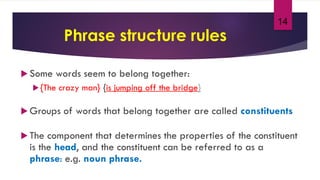
Phrase structure rules
 Some words seem to belong together:
{The crazy man} {is jumping off the bridge}
 Groups of words that belong together are called constituents
 The component that determines the properties of the constituent
is the head, and the constituent can be referred to as a
phrase: e.g. noun phrase.
15
Phrase Structure Rules
 If we look at phrases, some patterns emerge:
Det N
 the instructor = NP
Det N
 a friend = NP
Det N
 some homework = NP
Det N
 two classes = NP
16
Phrase Structure Rules
Some more patterns:
V Det N
 call the instructor= VP
V Det N
 meet a friend = VP
V Det N
 do some homework = VP
V Det N
 skip two classes = VP
17
Phrase Structure Rules
And yet more patterns:
Prep Det N
 with the instructor= PP
Prep Det N
 from a friend = PP
Prep Det N
 with some homework = PP
Prep Det N
 after two classes = PP
18
Phrase Structure Rules
 Rules for determining the structure of phrases
 Generate a lot of sentences from a small number of rules.
 The structure of a phrase will consist of one or more
constituents in a certain order.
 What does a NP consist of?
 “noun phrases have a Det and a N”
NP Det N
19
Lexical Rules
 We need lexical rules to specify which words can be used
when we rewrite constituents such as N.
PN {Mary, George}
N {girl, boy, dog}
Art
Pro
20
Phrase Structure Rules
 V Det N V Det N V Det N
run a marathon eat the food read the book
 V Prep Det N V Prep Det N
go to the store talk with a teacher
V Det N Prep Det N
take your sister to the library
 “Verb phrases have a V, (sometimes) an NP, and (sometimes) a PP”
 VP -> V (NP) (PP)
21
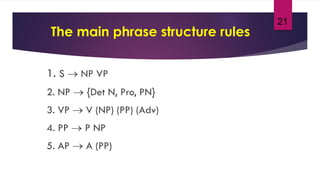
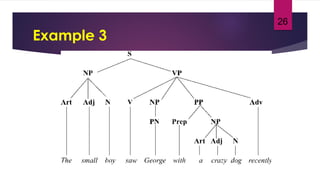
The main phrase structure rules
1. S  NP VP
2. NP  {Det N, Pro, PN}
3. VP  V (NP) (PP) (Adv)
4. PP  P NP
5. AP  A (PP)
22
Phrase Structure Rules & tree
diagrams
 NP  (Det) N
 PP  P NP The boy (NP)
The
NDet
boy
The boy in the yard.
NP
The
NDet
boy
PP
in
NPP
the
Det N
yard
23
Phrase Structure Rules
 VP  V (NP) (PP)
 S  NP VP
took the money (VP)
took
NPV
took the money from the bank
VP
took
NPV PP
from
NPP
the
Det N
bank
the
Det N
money
the
Det N
money
24Example (1)
The old tree swayed in the wind.
old
V PP
in
NPP
the
Det N
windThe
N
swayed
S
NP VP
Det Adj
tree
25Example (2)
The children put the toy in the box.
V PP
in
NPP
the
Det N
boxThe
N
put
S
NP VP
Det
children
NP
the
Det N
toy
26
Example 3
27
Exercise 1
 Rewrite the following sentences with Phrase Structure Rules. Hint: Locate
your principal NP and VP before beginning.
a) Miriam swims.
b) The dog is barking.
c) Peter told the truth.
d) The wicked witch spilled the potion.
e) The runner with the best time won the prize.
28
Exercise 2
 Draw a labeled tree diagram for the following English
phrases. (Hint: what part of speech is the leader for the
phrase?)
a. ancient pyramids
b. in the early evening
c. Drove a car
29
Exercise 3
 Draw phrase structure trees for the following sentences:
1. The puppy found the child
2. The ice melted
3. The hot sun melted the ice.
4. The house on the hill collapsed in the wind.
5. The boat sailed up the river.
6. A girl laughed at the monkey.

Week 2-syntax student copy

  • 1.
  • 2.
    What is syntax? Thearrangement of words to form phrases, clauses and sentences; sentence construction; the study of the principles and processes by which sentences are constructed; the rhythm of sentences created by grammar patterns. 2
  • 3.
    Describe this imagein a sentence 3 Mary John
  • 4.
    A fundamental question What do the world’s languages have in common?  Their sentences can be analyzed in terms of subject, verb, and (direct) object.  Nouns can be analyzed as Agents (Subject) or Patients (Object)  How do the world’s languages differ?  In the linear order of these elements.  In the words that are used for them.  One of the goals of syntax is to come up with a theory that explains what all languages have in common and how they differ.  This theory is known as Universal Grammar. 4
  • 5.
    5 Maybe Human Grammar(HG) would be a better term. Chimpanzee Grammar(CG) Dolphin Grammar(DG) Blue Whale Grammar (BWG) E.T. Grammar (ETG)
  • 6.
    Another example ofsyntax  Continuing with our previous concept, let’s turn it into a (direct) question … 1. Mary is kissing John. 2. Is Mary kissing John?  Notice that the auxiliary verb is appears to move in front of Mary to form the question, a phenomenon often referred to as subject-auxiliary inversion (SAI).  Now let’s turn to indirect questions: 3. I wonder if Mary is kissing John. (no SAI) 4. I wonder whether Mary is kissing John. (no SAI) 5. **I wonder if is Mary kissing John. (bad with SAI) 6. *I wonder is Mary kissing John. (bad with SAI)6
  • 7.
    Look at howmuch you know  You know that (1-4) are ‘good’ or grammatical sentences of English.  You know that (5-6) are ‘bad’ or ungrammatical sentences of English.  You may not be able to verbalize this knowledge, however.  Thus your knowledge of English grammar is tacit or implicit.  One goal of syntax is to make this knowledge explicit.  Another is to explain why some sentences are good while others are bad.  To do so, we will need a theory of how grammar works, which again is known as Universal Grammar.
  • 8.
    The Analysis ofSentence Structure
  • 9.
    9 Syntax  Properties ofsyntactic knowledge: Humans can understand & produce an infinite number of sentences they never heard before “Some purple gnats are starting to tango on microwave” Our grammar can understand and produce long sentences “Bill said that he thought that the esteemed leader of the house had it in mind to tell the unfortunate vice president that the calls that he made from the office in the White House that he thought was private…..” Determine the grammatical relations/functions in a sentence Mary hired Bill. Vs. Bill hired Mary
  • 10.
    “Syntax in TheGreat Gatsby” Analyze the syntax in the passage below.  She laughed again, as if she said something very witty, and held my hand for a moment, looking up into my face, promising that there was no one in the world she so much wanted to see. That was a way she had" (Fitzgerald 13).  Using a similar syntax for effect, write two sentences about a sibling or acquaintance. Write-Share
  • 11.
    11 Syntax & meaning Non-sense sentences with clear syntax Colorless green ideas sleep furiously. A verb crumpled the milk. I gave the question a scuba-diving egg. *Furiously sleep ideas green colorless. *Milk the crumpled *the question I an egg scuba-diving gave.  Sentences are composed of discrete units that are combined by rules. These rules explain how speakers can store infinite knowledge in a finite space- brain.
  • 12.
    12 Generative Grammar Noam Chomsky1950s Generative = a very explicit system of rules specifying what combinations of basic elements result in well-formed sentences. Defines the syntactic structure of a language.
  • 13.
    13 Generative Grammar  “alland only”= all grammatical sentences and only grammatical sentences  Finite rules infinite number of well-formed sentences  Productivity of language  Phrase structure rules  Transformational rules
  • 14.
    14 Phrase structure rules Some words seem to belong together: {The crazy man} {is jumping off the bridge}  Groups of words that belong together are called constituents  The component that determines the properties of the constituent is the head, and the constituent can be referred to as a phrase: e.g. noun phrase.
  • 15.
    15 Phrase Structure Rules If we look at phrases, some patterns emerge: Det N  the instructor = NP Det N  a friend = NP Det N  some homework = NP Det N  two classes = NP
  • 16.
    16 Phrase Structure Rules Somemore patterns: V Det N  call the instructor= VP V Det N  meet a friend = VP V Det N  do some homework = VP V Det N  skip two classes = VP
  • 17.
    17 Phrase Structure Rules Andyet more patterns: Prep Det N  with the instructor= PP Prep Det N  from a friend = PP Prep Det N  with some homework = PP Prep Det N  after two classes = PP
  • 18.
    18 Phrase Structure Rules Rules for determining the structure of phrases  Generate a lot of sentences from a small number of rules.  The structure of a phrase will consist of one or more constituents in a certain order.  What does a NP consist of?  “noun phrases have a Det and a N” NP Det N
  • 19.
    19 Lexical Rules  Weneed lexical rules to specify which words can be used when we rewrite constituents such as N. PN {Mary, George} N {girl, boy, dog} Art Pro
  • 20.
    20 Phrase Structure Rules V Det N V Det N V Det N run a marathon eat the food read the book  V Prep Det N V Prep Det N go to the store talk with a teacher V Det N Prep Det N take your sister to the library  “Verb phrases have a V, (sometimes) an NP, and (sometimes) a PP”  VP -> V (NP) (PP)
  • 21.
    21 The main phrasestructure rules 1. S  NP VP 2. NP  {Det N, Pro, PN} 3. VP  V (NP) (PP) (Adv) 4. PP  P NP 5. AP  A (PP)
  • 22.
    22 Phrase Structure Rules& tree diagrams  NP  (Det) N  PP  P NP The boy (NP) The NDet boy The boy in the yard. NP The NDet boy PP in NPP the Det N yard
  • 23.
    23 Phrase Structure Rules VP  V (NP) (PP)  S  NP VP took the money (VP) took NPV took the money from the bank VP took NPV PP from NPP the Det N bank the Det N money the Det N money
  • 24.
    24Example (1) The oldtree swayed in the wind. old V PP in NPP the Det N windThe N swayed S NP VP Det Adj tree
  • 25.
    25Example (2) The childrenput the toy in the box. V PP in NPP the Det N boxThe N put S NP VP Det children NP the Det N toy
  • 26.
  • 27.
    27 Exercise 1  Rewritethe following sentences with Phrase Structure Rules. Hint: Locate your principal NP and VP before beginning. a) Miriam swims. b) The dog is barking. c) Peter told the truth. d) The wicked witch spilled the potion. e) The runner with the best time won the prize.
  • 28.
    28 Exercise 2  Drawa labeled tree diagram for the following English phrases. (Hint: what part of speech is the leader for the phrase?) a. ancient pyramids b. in the early evening c. Drove a car
  • 29.
    29 Exercise 3  Drawphrase structure trees for the following sentences: 1. The puppy found the child 2. The ice melted 3. The hot sun melted the ice. 4. The house on the hill collapsed in the wind. 5. The boat sailed up the river. 6. A girl laughed at the monkey.