Qamar Aftab , Wasim Iqbal , Atta ul Mustfa
9996 11327 11378
 The Branch of linguistics which deals with the
study of how words are combined to form a
grammatical sentence.
 The arrangement of words and phrases to
create well-formed sentence in a language.
 It is the set of rules principles, and processes
that groven the structure of sentences in a
given language, usually including word order.
 Incorrect : While watching a movie, people who
text on their phone are very annoying.
 Correct : People who text on their phone while
watching a movie are very annoying.
 Incorrect : Happy about her upcoming
promotion, the trip home was full of singing.
 Correct : Happy about her upcoming
promotion, Sammie sang all the way home.
 Another set of common mistakes have to do with
punctuation.
 Incorrect : Come for a visit I have plenty of food.
 Correct : Come for a visit! I have plenty of food.
 The problem here is a run-on sentence. The
absence of punctuation makes the statement
appear vague and rushed. Breaking the words
into two sentences with an exclamation point
adds clarity and increases the impact of "Come
for a visit!"
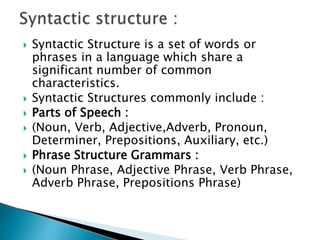
 Syntactic Structure is a set of words or
phrases in a language which share a
significant number of common
characteristics.
 Syntactic Structures commonly include :
 Parts of Speech :
 (Noun, Verb, Adjective,Adverb, Pronoun,
Determiner, Prepositions, Auxiliary, etc.)
 Phrase Structure Grammars :
 (Noun Phrase, Adjective Phrase, Verb Phrase,
Adverb Phrase, Prepositions Phrase)
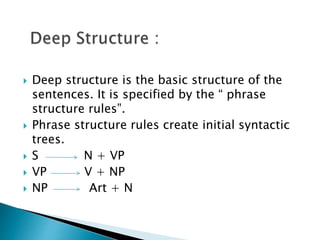
 Deep structure is the basic structure of the
sentences. It is specified by the “ phrase
structure rules”.
 Phrase structure rules create initial syntactic
trees.
 S N + VP
 VP V + NP
 NP Art + N
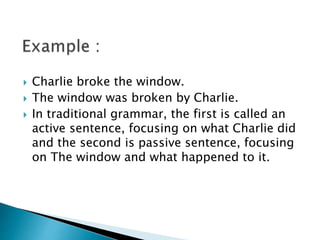
 Charlie broke the window.
 The window was broken by Charlie.
 In traditional grammar, the first is called an
active sentence, focusing on what Charlie did
and the second is passive sentence, focusing
on The window and what happened to it.
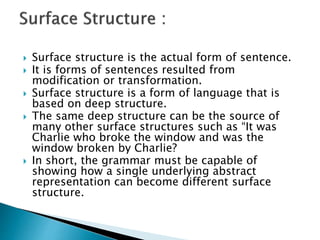
 Surface structure is the actual form of sentence.
 It is forms of sentences resulted from
modification or transformation.
 Surface structure is a form of language that is
based on deep structure.
 The same deep structure can be the source of
many other surface structures such as “It was
Charlie who broke the window and was the
window broken by Charlie?
 In short, the grammar must be capable of
showing how a single underlying abstract
representation can become different surface
structure.
 Same deep structure and different surface
structure.
 You push the chair (Active Sentence)
 The chair is pushed by you. (Passive
Sentence)
 Push the chair! (Imperative Sentence)
 Three Sentences have the same abstract
representation (deep structure) which is you
as a person push the chair.
 Same surface structure and different deep
structure.
 John saw the man with telescope.
 Who has the telescope? John or the Man
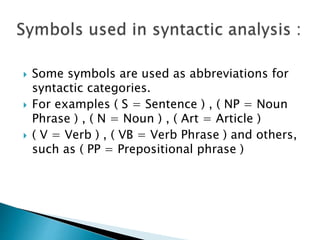
 Some symbols are used as abbreviations for
syntactic categories.
 For examples ( S = Sentence ) , ( NP = Noun
Phrase ) , ( N = Noun ) , ( Art = Article )
 ( V = Verb ) , ( VB = Verb Phrase ) and others,
such as ( PP = Prepositional phrase )
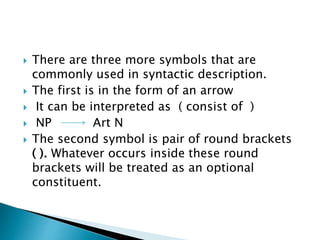
 There are three more symbols that are
commonly used in syntactic description.
 The first is in the form of an arrow
 It can be interpreted as ( consist of )
 NP Art N
 The second symbol is pair of round brackets
( ). Whatever occurs inside these round
brackets will be treated as an optional
constituent.
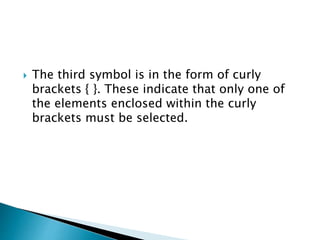
 The third symbol is in the form of curly
brackets { }. These indicate that only one of
the elements enclosed within the curly
brackets must be selected.
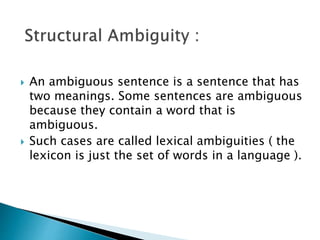
 An ambiguous sentence is a sentence that has
two meanings. Some sentences are ambiguous
because they contain a word that is
ambiguous.
 Such cases are called lexical ambiguities ( the
lexicon is just the set of words in a language ).
 By contrast, some sentences are ambiguous
without containing any ambiguous words.
 These cases can be explained when it is
observed that the sentence in question can be
given two distinct syntactic trees, leading to
what is called a structural ambiguity
 Annie bumped into a man with an umbrella.
 This sentence provides an example of
structural ambiguity. It has two distinct
underlying interpretations that have to be
represented differently in deep structure.
 The phrases can also be structurally
ambiguous, as in expressions like small boys
and girls. The underlying interpretations can
be either “ small boys and (small) girls” or
 “small boys and (all) girls”.
 When we use a tree diagram format, we can
think of it in two different ways.
 In one way we can simply treat it as a static
representation of the structure of the
sentence shown at the bottom of the
diagram.
 The second approach is very appealing
because it would enable us to generate a very
large number of sentences with what look like
a very small number of rules. These rules are
called phrase structure rules.
 NP Art N
 According to this rule, a noun phrase rewrite
either an article plus an optional adjective
plus a noun, or a pronoun , or a proper
noun.”
 Phrase structure rules generate structure. In
order to turn those structures into
recognizable English, we also need lexical
rules that specify which words can be used
when we rewrite constituents such as N.
 The very small set of phrase structure rules
just described is a sample of what a more
complex phrase structure grammar of
English, with many more parts, look like.
 These rules can be treated as a
representation of the underlying or deep
structures of sentence in English.
 This type of rule has a special symbol
and can be illustrated in the process of one
tree, on the right, being derived from the tree
on the left.
Movement Rules
Syntax presetation

Syntax presetation

  • 1.
    Qamar Aftab ,Wasim Iqbal , Atta ul Mustfa 9996 11327 11378
  • 2.
     The Branchof linguistics which deals with the study of how words are combined to form a grammatical sentence.  The arrangement of words and phrases to create well-formed sentence in a language.  It is the set of rules principles, and processes that groven the structure of sentences in a given language, usually including word order.
  • 3.
     Incorrect :While watching a movie, people who text on their phone are very annoying.  Correct : People who text on their phone while watching a movie are very annoying.  Incorrect : Happy about her upcoming promotion, the trip home was full of singing.  Correct : Happy about her upcoming promotion, Sammie sang all the way home.
  • 4.
     Another setof common mistakes have to do with punctuation.  Incorrect : Come for a visit I have plenty of food.  Correct : Come for a visit! I have plenty of food.  The problem here is a run-on sentence. The absence of punctuation makes the statement appear vague and rushed. Breaking the words into two sentences with an exclamation point adds clarity and increases the impact of "Come for a visit!"
  • 5.
     Syntactic Structureis a set of words or phrases in a language which share a significant number of common characteristics.  Syntactic Structures commonly include :  Parts of Speech :  (Noun, Verb, Adjective,Adverb, Pronoun, Determiner, Prepositions, Auxiliary, etc.)  Phrase Structure Grammars :  (Noun Phrase, Adjective Phrase, Verb Phrase, Adverb Phrase, Prepositions Phrase)
  • 6.
     Deep structureis the basic structure of the sentences. It is specified by the “ phrase structure rules”.  Phrase structure rules create initial syntactic trees.  S N + VP  VP V + NP  NP Art + N
  • 7.
     Charlie brokethe window.  The window was broken by Charlie.  In traditional grammar, the first is called an active sentence, focusing on what Charlie did and the second is passive sentence, focusing on The window and what happened to it.
  • 8.
     Surface structureis the actual form of sentence.  It is forms of sentences resulted from modification or transformation.  Surface structure is a form of language that is based on deep structure.  The same deep structure can be the source of many other surface structures such as “It was Charlie who broke the window and was the window broken by Charlie?  In short, the grammar must be capable of showing how a single underlying abstract representation can become different surface structure.
  • 9.
     Same deepstructure and different surface structure.  You push the chair (Active Sentence)  The chair is pushed by you. (Passive Sentence)  Push the chair! (Imperative Sentence)  Three Sentences have the same abstract representation (deep structure) which is you as a person push the chair.
  • 10.
     Same surfacestructure and different deep structure.  John saw the man with telescope.  Who has the telescope? John or the Man
  • 11.
     Some symbolsare used as abbreviations for syntactic categories.  For examples ( S = Sentence ) , ( NP = Noun Phrase ) , ( N = Noun ) , ( Art = Article )  ( V = Verb ) , ( VB = Verb Phrase ) and others, such as ( PP = Prepositional phrase )
  • 12.
     There arethree more symbols that are commonly used in syntactic description.  The first is in the form of an arrow  It can be interpreted as ( consist of )  NP Art N  The second symbol is pair of round brackets ( ). Whatever occurs inside these round brackets will be treated as an optional constituent.
  • 13.
     The thirdsymbol is in the form of curly brackets { }. These indicate that only one of the elements enclosed within the curly brackets must be selected.
  • 14.
     An ambiguoussentence is a sentence that has two meanings. Some sentences are ambiguous because they contain a word that is ambiguous.  Such cases are called lexical ambiguities ( the lexicon is just the set of words in a language ).
  • 15.
     By contrast,some sentences are ambiguous without containing any ambiguous words.  These cases can be explained when it is observed that the sentence in question can be given two distinct syntactic trees, leading to what is called a structural ambiguity
  • 16.
     Annie bumpedinto a man with an umbrella.  This sentence provides an example of structural ambiguity. It has two distinct underlying interpretations that have to be represented differently in deep structure.  The phrases can also be structurally ambiguous, as in expressions like small boys and girls. The underlying interpretations can be either “ small boys and (small) girls” or  “small boys and (all) girls”.
  • 17.
     When weuse a tree diagram format, we can think of it in two different ways.  In one way we can simply treat it as a static representation of the structure of the sentence shown at the bottom of the diagram.  The second approach is very appealing because it would enable us to generate a very large number of sentences with what look like a very small number of rules. These rules are called phrase structure rules.
  • 18.
     NP ArtN  According to this rule, a noun phrase rewrite either an article plus an optional adjective plus a noun, or a pronoun , or a proper noun.”
  • 19.
     Phrase structurerules generate structure. In order to turn those structures into recognizable English, we also need lexical rules that specify which words can be used when we rewrite constituents such as N.
  • 20.
     The verysmall set of phrase structure rules just described is a sample of what a more complex phrase structure grammar of English, with many more parts, look like.  These rules can be treated as a representation of the underlying or deep structures of sentence in English.  This type of rule has a special symbol and can be illustrated in the process of one tree, on the right, being derived from the tree on the left.
  • 21.