Introduction to
Lexico-Grammar
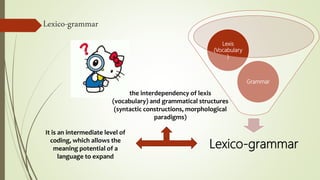
Lexico-grammar
Lexico-grammar
Grammar
Lexis
(Vocabulary
)
the interdependency of lexis
(vocabulary) and grammatical structures
(syntactic constructions, morphological
paradigms)
It is an intermediate level of
coding, which allows the
meaning potential of a
language to expand
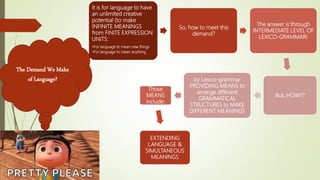
It is for language to have
an unlimited creative
potential (to make
INFINITE MEANINGS
from FINITE EXPRESSION
UNITS:
•For language to mean new things
•For language to mean anything
So, how to meet this
demand?
The answer is through
INTERMEDIATE LEVEL OF
LEXICO-GRAMMAR!
But, HOW??
by Lexico-grammar
PROVIDING MEANS to
arrange different
GRAMMATICAL
STRUCTURES to MAKE
DIFFERENT MEANINGS
Those
MEANS
include:
EXTENDING
LANGUAGE &
SIMULTANEOUS
MEANINGS
The Demand We Make
of Language?
Extending Language
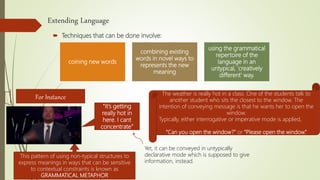
 Techniques that can be done involve:
For Instance
coining new words
combining existing
words in novel ways to
represents the new
meaning
using the grammatical
repertoire of the
language in an
untypical, 'creatively
different' way.
The weather is really hot in a class. One of the students talk to
another student who sits the closest to the window. The
intention of conveying message is that he wants her to open the
window.
Typically, either interrogative or imperative mode is applied,
“Can you open the window?” or “Please open the window.”
“It’s getting
really hot in
here. I cant
concentrate”
Yet, it can be conveyed in untypically
declarative mode which is supposed to give
information, instead.
This pattern of using non-typical structures to
express meanings in ways that can be sensitive
to contextual constraints is known as
GRAMMATICAL METAPHOR
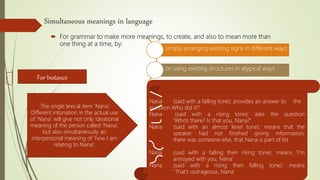
Simultaneous meanings in language
 For grammar to make more meanings, to create, and also to mean more than
one thing at a time, by:
simply arranging existing signs in different ways
or using existing structures in atypical ways
For Instance
The single lexical item ‘Nana’.
Different intonation in the actual use
of ‘Nana’ will give not only ideational
meaning of the person called ‘Nana’,
but also simultaneously an
interpersonal meaning of 'how I am
relating to Nana'.
Nana (said with a falling tone): provides an answer to the
question Who did it?'
Nana (said with a rising tone): asks the question
'Who's there? Is that you, Nana?'
Nana (said with an almost level tone): means that the
speaker had not finished giving information,
there was someone else, that Nana is part of list
Nana (said with a falling then rising tone): means ‘I’m
annoyed with you, Nana'
Nana {said with a rising then falling tone): means
‘That's outrageous, Nana'
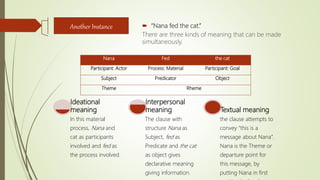
 “Nana fed the cat.”
There are three kinds of meaning that can be made
simultaneously.
Another Instance
Nana Fed the cat
Participant: Actor Process: Material Participant: Goal
Subject Predicator Object
Theme Rheme
In this material
process, Nana and
cat as participants
involved and fed as
the process involved.
Ideational
meaning
The clause with
structure Nana as
Subject, fed as
Predicate and the cat
as object gives
declarative meaning
giving information.
Interpersonal
meaning
the clause attempts to
convey “this is a
message about Nana”.
Nana is the Theme or
departure point for
this message, by
putting Nana in first
Textual meaning
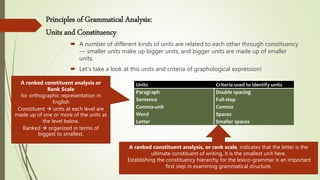
Principles of Grammatical Analysis:
Units and Constituency
 A number of different kinds of units are related to each other through constituency
— smaller units make up bigger units, and bigger units are made up of smaller
units.
 Let’s take a look at this units and criteria of graphological expression!
Units Criteria used to identify units
Paragraph
Sentence
Comma-unit
Word
Letter
Double spacing
Full-stop
Comma
Spaces
Smaller spaces
A ranked constituent analysis, or rank scale, indicates that the letter is the
ultimate constituent of writing, it is the smallest unit here.
Establishing the constituency hierarchy for the lexico-grammar is an important
first step in examining grammatical structure.
A ranked constituent analysis or
Rank Scale
for orthographic representation in
English
Constituent  units at each level are
made up of one or more of the units at
the level below.
Ranked  organized in terms of
biggest to smallest.
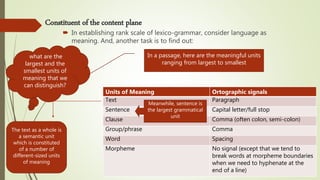
Constituent of the content plane
 In establishing rank scale of lexico-grammar, consider language as
meaning. And, another task is to find out:
what are the
largest and the
smallest units of
meaning that we
can distinguish?
Units of Meaning Ortographic signals
Text Paragraph
Sentence Capital letter/full stop
Clause Comma (often colon, semi-colon)
Group/phrase Comma
Word Spacing
Morpheme No signal (except that we tend to
break words at morpheme boundaries
when we need to hyphenate at the
end of a line)
In a passage, here are the meaningful units
ranging from largest to smallest
The text as a whole is
a semantic unit
which is constituted
of a number of
different-sized units
of meaning
Meanwhile, sentence is
the largest grammatical
unit
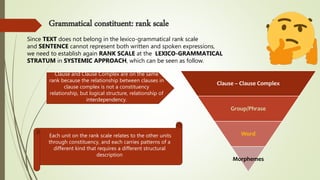
Grammatical constituent: rank scale
Clause – Clause Complex
Group/Phrase
Word
Morphemes
Since TEXT does not belong in the lexico-grammatical rank scale
and SENTENCE cannot represent both written and spoken expressions,
we need to establish again RANK SCALE at the LEXICO-GRAMMATICAL
STRATUM in SYSTEMIC APPROACH, which can be seen as follow.
Clause and Clause Complex are on the same
rank because the relationship between clauses in
clause complex is not a constituency
relationship, but logical structure, relationship of
interdependency.
Each unit on the rank scale relates to the other units
through constituency, and each carries patterns of a
different kind that requires a different structural
description
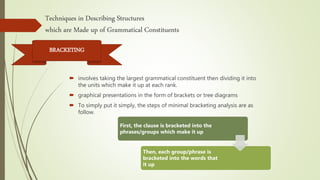
Techniques in Describing Structures
which are Made up of Grammatical Constituents
 involves taking the largest grammatical constituent then dividing it into
the units which make it up at each rank.
 graphical presentations in the form of brackets or tree diagrams
 To simply put it simply, the steps of minimal bracketing analysis are as
follow.
BRACKETING
First, the clause is bracketed into the
phrases/groups which make it up
Then, each group/phrase is
bracketed into the words that
it up
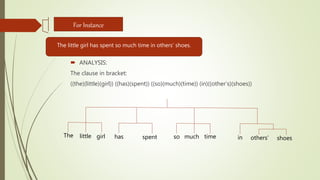
 ANALYSIS:
The clause in bracket:
((the)(little)(girl)) ((has)(spent)) ((so)(much)(time)) (in)((other’s)(shoes))
For Instance
The little girl has spent so much time in others’ shoes.
The little girl has spent so much time in others’ shoes
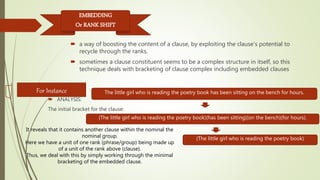
 a way of boosting the content of a clause, by exploiting the clause's potential to
recycle through the ranks.
 sometimes a clause constituent seems to be a complex structure in itself, so this
technique deals with bracketing of clause complex including embedded clauses
EMBEDDING
Or RANK SHIFT
 ANALYSIS:
The initial bracket for the clause:
For Instance The little girl who is reading the poetry book has been sitting on the bench for hours.
(The little girl who is reading the poetry book)(has been sitting)(on the bench)(for hours).
It reveals that it contains another clause within the nominal the
nominal group.
Here we have a unit of one rank (phrase/group) being made up
of a unit of the rank above (clause).
Thus, we deal with this by simply working through the minimal
bracketing of the embedded clause.
(The little girl who is reading the poetry book)
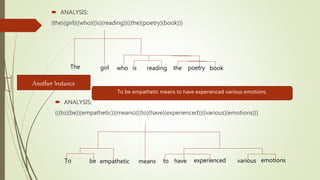
 ANALYSIS:
(the)(girl)((who)((is)(reading))((the)(poetry)(book)))
The girl who is reading the poetry book
Another Instance
To be empathetic means to have experienced various emotions.
 ANALYSIS:
(((to)(be))(empathetic))(means)(((to)(have)(experienced))((various)(emotions)))
To be empathetic means to have experienced various emotions
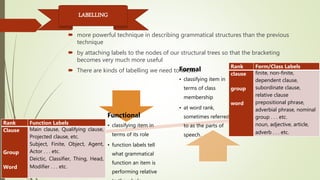
 more powerful technique in describing grammatical structures than the previous
technique
 by attaching labels to the nodes of our structural trees so that the bracketing
becomes very much more useful
 There are kinds of labelling we need to know:
LABELLING
Formal
• classifying item in
terms of class
membership
• at word rank,
sometimes referred
to as the parts of
speech.
Functional
• classifying item in
terms of its role
• function labels tell
what grammatical
function an item is
performing relative
Rank Form/Class Labels
clause
group
word
finite, non-finite,
dependent clause,
subordinate clause,
relative clause
prepositional phrase,
adverbial phrase, nominal
group . . . etc.
noun, adjective, article,
adverb . . . etc.
Rank Function Labels
Clause
Group
Word
Main clause, Qualifying clause,
Projected clause, etc.
Subject, Finite, Object, Agent,
Actor . . . etc.
Deictic, Classifier, Thing, Head,
Modifier . . . etc.
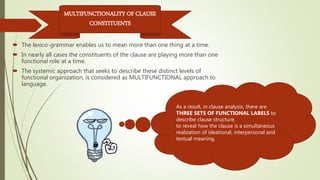
 The lexico-grammar enables us to mean more than one thing at a time.
 In nearly all cases the constituents of the clause are playing more than one
functional role at a time.
 The systemic approach that seeks to describe these distinct levels of
functional organization, is considered as MULTIFUNCTIONAL approach to
language.
MULTIFUNCTIONALITY OF CLAUSE
CONSTITUENTS
As a result, in clause analysis, there are
THREE SETS OF FUNCTIONAL LABELS to
describe clause structure,
to reveal how the clause is a simultaneous
realization of ideational, interpersonal and
textual meaning.
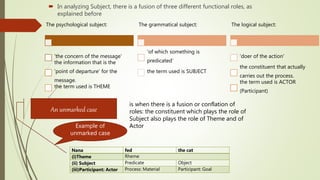
 In analyzing Subject, there is a fusion of three different functional roles, as
explained before
The psychological subject:
'the concern of the message'
the information that is the
'point of departure' for the
message.
the term used is THEME
The grammatical subject:
'of which something is
predicated’
the term used is SUBJECT
The logical subject:
'doer of the action'
the constituent that actually
carries out the process.
the term used is ACTOR
(Participant)
An unmarked case
is when there is a fusion or conflation of
roles: the constituent which plays the role of
Subject also plays the role of Theme and of
Actor
Nana fed the cat
(i)Theme Rheme
(ii) Subject Predicate Object
(iii)Participant: Actor Process: Material Participant: Goal
Example of
unmarked case
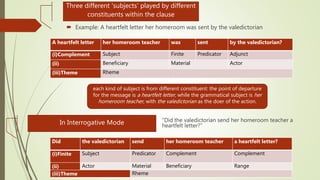
 Example: A heartfelt letter her homeroom was sent by the valedictorian
Three different 'subjects’ played by different
constituents within the clause
A heartfelt letter her homeroom teacher was sent by the valedictorian?
(i)Complement Subject Finite Predicator Adjunct
(ii) Beneficiary Material Actor
(iii)Theme Rheme
each kind of subject is from different constituent: the point of departure
for the message is a heartfelt letter, while the grammatical subject is her
homeroom teacher, with the valedictorian as the doer of the action.
In Interrogative Mode “Did the valedictorian send her homeroom teacher a
heartfelt letter?”
Did the valedictorian send her homeroom teacher a heartfelt letter?
(i)Finite Subject Predicator Complement Complement
(ii) Actor Material Beneficiary Range
(iii)Theme Rheme
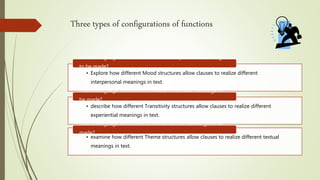
Three types of configurations of functions
• Explore how different Mood structures allow clauses to realize different
interpersonal meanings in text.
How is language structured to enable interpersonal meanings
to be made?
• describe how different Transitivity structures allow clauses to realize different
experiential meanings in text.
How is language structured to enable ideational meanings to
be made?
• examine how different Theme structures allow clauses to realize different textual
meanings in text.
How is language structured to enable textual meanings to be
made?
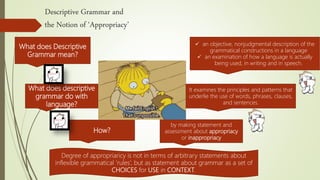
Descriptive Grammar and
the Notion of ‘Appropriacy’
What does Descriptive
Grammar mean?
 an objective, nonjudgmental description of the
grammatical constructions in a language
 an examination of how a language is actually
being used, in writing and in speech.
What does descriptive
grammar do with
language?
It examines the principles and patterns that
underlie the use of words, phrases, clauses,
and sentences.
How?
by making statement and
assessment about appropriacy
or inappropriacy
Degree of appropriaricy is not in terms of arbitrary statements about
inflexible grammatical ‘rules’, but as statement about grammar as a set of
CHOICES for USE in CONTEXT.

2. Introduction to Lexico-Grammar

  • 1.
  • 2.
    Lexico-grammar Lexico-grammar Grammar Lexis (Vocabulary ) the interdependency oflexis (vocabulary) and grammatical structures (syntactic constructions, morphological paradigms) It is an intermediate level of coding, which allows the meaning potential of a language to expand
  • 3.
    It is forlanguage to have an unlimited creative potential (to make INFINITE MEANINGS from FINITE EXPRESSION UNITS: •For language to mean new things •For language to mean anything So, how to meet this demand? The answer is through INTERMEDIATE LEVEL OF LEXICO-GRAMMAR! But, HOW?? by Lexico-grammar PROVIDING MEANS to arrange different GRAMMATICAL STRUCTURES to MAKE DIFFERENT MEANINGS Those MEANS include: EXTENDING LANGUAGE & SIMULTANEOUS MEANINGS The Demand We Make of Language?
  • 4.
    Extending Language  Techniquesthat can be done involve: For Instance coining new words combining existing words in novel ways to represents the new meaning using the grammatical repertoire of the language in an untypical, 'creatively different' way. The weather is really hot in a class. One of the students talk to another student who sits the closest to the window. The intention of conveying message is that he wants her to open the window. Typically, either interrogative or imperative mode is applied, “Can you open the window?” or “Please open the window.” “It’s getting really hot in here. I cant concentrate” Yet, it can be conveyed in untypically declarative mode which is supposed to give information, instead. This pattern of using non-typical structures to express meanings in ways that can be sensitive to contextual constraints is known as GRAMMATICAL METAPHOR
  • 5.
    Simultaneous meanings inlanguage  For grammar to make more meanings, to create, and also to mean more than one thing at a time, by: simply arranging existing signs in different ways or using existing structures in atypical ways For Instance The single lexical item ‘Nana’. Different intonation in the actual use of ‘Nana’ will give not only ideational meaning of the person called ‘Nana’, but also simultaneously an interpersonal meaning of 'how I am relating to Nana'. Nana (said with a falling tone): provides an answer to the question Who did it?' Nana (said with a rising tone): asks the question 'Who's there? Is that you, Nana?' Nana (said with an almost level tone): means that the speaker had not finished giving information, there was someone else, that Nana is part of list Nana (said with a falling then rising tone): means ‘I’m annoyed with you, Nana' Nana {said with a rising then falling tone): means ‘That's outrageous, Nana'
  • 6.
     “Nana fedthe cat.” There are three kinds of meaning that can be made simultaneously. Another Instance Nana Fed the cat Participant: Actor Process: Material Participant: Goal Subject Predicator Object Theme Rheme In this material process, Nana and cat as participants involved and fed as the process involved. Ideational meaning The clause with structure Nana as Subject, fed as Predicate and the cat as object gives declarative meaning giving information. Interpersonal meaning the clause attempts to convey “this is a message about Nana”. Nana is the Theme or departure point for this message, by putting Nana in first Textual meaning
  • 7.
    Principles of GrammaticalAnalysis: Units and Constituency  A number of different kinds of units are related to each other through constituency — smaller units make up bigger units, and bigger units are made up of smaller units.  Let’s take a look at this units and criteria of graphological expression! Units Criteria used to identify units Paragraph Sentence Comma-unit Word Letter Double spacing Full-stop Comma Spaces Smaller spaces A ranked constituent analysis, or rank scale, indicates that the letter is the ultimate constituent of writing, it is the smallest unit here. Establishing the constituency hierarchy for the lexico-grammar is an important first step in examining grammatical structure. A ranked constituent analysis or Rank Scale for orthographic representation in English Constituent  units at each level are made up of one or more of the units at the level below. Ranked  organized in terms of biggest to smallest.
  • 8.
    Constituent of thecontent plane  In establishing rank scale of lexico-grammar, consider language as meaning. And, another task is to find out: what are the largest and the smallest units of meaning that we can distinguish? Units of Meaning Ortographic signals Text Paragraph Sentence Capital letter/full stop Clause Comma (often colon, semi-colon) Group/phrase Comma Word Spacing Morpheme No signal (except that we tend to break words at morpheme boundaries when we need to hyphenate at the end of a line) In a passage, here are the meaningful units ranging from largest to smallest The text as a whole is a semantic unit which is constituted of a number of different-sized units of meaning Meanwhile, sentence is the largest grammatical unit
  • 9.
    Grammatical constituent: rankscale Clause – Clause Complex Group/Phrase Word Morphemes Since TEXT does not belong in the lexico-grammatical rank scale and SENTENCE cannot represent both written and spoken expressions, we need to establish again RANK SCALE at the LEXICO-GRAMMATICAL STRATUM in SYSTEMIC APPROACH, which can be seen as follow. Clause and Clause Complex are on the same rank because the relationship between clauses in clause complex is not a constituency relationship, but logical structure, relationship of interdependency. Each unit on the rank scale relates to the other units through constituency, and each carries patterns of a different kind that requires a different structural description
  • 10.
    Techniques in DescribingStructures which are Made up of Grammatical Constituents  involves taking the largest grammatical constituent then dividing it into the units which make it up at each rank.  graphical presentations in the form of brackets or tree diagrams  To simply put it simply, the steps of minimal bracketing analysis are as follow. BRACKETING First, the clause is bracketed into the phrases/groups which make it up Then, each group/phrase is bracketed into the words that it up
  • 11.
     ANALYSIS: The clausein bracket: ((the)(little)(girl)) ((has)(spent)) ((so)(much)(time)) (in)((other’s)(shoes)) For Instance The little girl has spent so much time in others’ shoes. The little girl has spent so much time in others’ shoes
  • 12.
     a wayof boosting the content of a clause, by exploiting the clause's potential to recycle through the ranks.  sometimes a clause constituent seems to be a complex structure in itself, so this technique deals with bracketing of clause complex including embedded clauses EMBEDDING Or RANK SHIFT  ANALYSIS: The initial bracket for the clause: For Instance The little girl who is reading the poetry book has been sitting on the bench for hours. (The little girl who is reading the poetry book)(has been sitting)(on the bench)(for hours). It reveals that it contains another clause within the nominal the nominal group. Here we have a unit of one rank (phrase/group) being made up of a unit of the rank above (clause). Thus, we deal with this by simply working through the minimal bracketing of the embedded clause. (The little girl who is reading the poetry book)
  • 13.
     ANALYSIS: (the)(girl)((who)((is)(reading))((the)(poetry)(book))) The girlwho is reading the poetry book Another Instance To be empathetic means to have experienced various emotions.  ANALYSIS: (((to)(be))(empathetic))(means)(((to)(have)(experienced))((various)(emotions))) To be empathetic means to have experienced various emotions
  • 14.
     more powerfultechnique in describing grammatical structures than the previous technique  by attaching labels to the nodes of our structural trees so that the bracketing becomes very much more useful  There are kinds of labelling we need to know: LABELLING Formal • classifying item in terms of class membership • at word rank, sometimes referred to as the parts of speech. Functional • classifying item in terms of its role • function labels tell what grammatical function an item is performing relative Rank Form/Class Labels clause group word finite, non-finite, dependent clause, subordinate clause, relative clause prepositional phrase, adverbial phrase, nominal group . . . etc. noun, adjective, article, adverb . . . etc. Rank Function Labels Clause Group Word Main clause, Qualifying clause, Projected clause, etc. Subject, Finite, Object, Agent, Actor . . . etc. Deictic, Classifier, Thing, Head, Modifier . . . etc.
  • 15.
     The lexico-grammarenables us to mean more than one thing at a time.  In nearly all cases the constituents of the clause are playing more than one functional role at a time.  The systemic approach that seeks to describe these distinct levels of functional organization, is considered as MULTIFUNCTIONAL approach to language. MULTIFUNCTIONALITY OF CLAUSE CONSTITUENTS As a result, in clause analysis, there are THREE SETS OF FUNCTIONAL LABELS to describe clause structure, to reveal how the clause is a simultaneous realization of ideational, interpersonal and textual meaning.
  • 16.
     In analyzingSubject, there is a fusion of three different functional roles, as explained before The psychological subject: 'the concern of the message' the information that is the 'point of departure' for the message. the term used is THEME The grammatical subject: 'of which something is predicated’ the term used is SUBJECT The logical subject: 'doer of the action' the constituent that actually carries out the process. the term used is ACTOR (Participant) An unmarked case is when there is a fusion or conflation of roles: the constituent which plays the role of Subject also plays the role of Theme and of Actor Nana fed the cat (i)Theme Rheme (ii) Subject Predicate Object (iii)Participant: Actor Process: Material Participant: Goal Example of unmarked case
  • 17.
     Example: Aheartfelt letter her homeroom was sent by the valedictorian Three different 'subjects’ played by different constituents within the clause A heartfelt letter her homeroom teacher was sent by the valedictorian? (i)Complement Subject Finite Predicator Adjunct (ii) Beneficiary Material Actor (iii)Theme Rheme each kind of subject is from different constituent: the point of departure for the message is a heartfelt letter, while the grammatical subject is her homeroom teacher, with the valedictorian as the doer of the action. In Interrogative Mode “Did the valedictorian send her homeroom teacher a heartfelt letter?” Did the valedictorian send her homeroom teacher a heartfelt letter? (i)Finite Subject Predicator Complement Complement (ii) Actor Material Beneficiary Range (iii)Theme Rheme
  • 18.
    Three types ofconfigurations of functions • Explore how different Mood structures allow clauses to realize different interpersonal meanings in text. How is language structured to enable interpersonal meanings to be made? • describe how different Transitivity structures allow clauses to realize different experiential meanings in text. How is language structured to enable ideational meanings to be made? • examine how different Theme structures allow clauses to realize different textual meanings in text. How is language structured to enable textual meanings to be made?
  • 19.
    Descriptive Grammar and theNotion of ‘Appropriacy’ What does Descriptive Grammar mean?  an objective, nonjudgmental description of the grammatical constructions in a language  an examination of how a language is actually being used, in writing and in speech. What does descriptive grammar do with language? It examines the principles and patterns that underlie the use of words, phrases, clauses, and sentences. How? by making statement and assessment about appropriacy or inappropriacy Degree of appropriaricy is not in terms of arbitrary statements about inflexible grammatical ‘rules’, but as statement about grammar as a set of CHOICES for USE in CONTEXT.