
ROLE OF ICT AND MARKETING CONCEPTS IN ACHIEVING GOOD
GOVERNANCE IN UTTAR PRADESH
***
Ph.D. In Management
Uttar Pradesh Technical University
Lucknow, Uttar Pradesh, India
Heera Lal
Under the Esteemed Supervision of
• Prof Jabir Ali (IIM Lucknow)
• Prof. D S Yadav (Dr BR Ambedkar Engineering College, Banda)
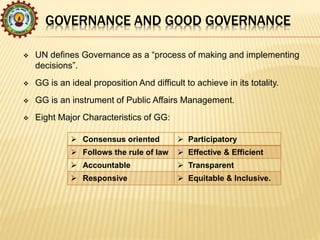
GOVERNANCE AND GOOD GOVERNANCE
 UN defines Governance as a “process of making and implementing
decisions”.
 GG is an ideal proposition And difficult to achieve in its totality.
 GG is an instrument of Public Affairs Management.
 Eight Major Characteristics of GG:
 Consensus oriented  Participatory
 Follows the rule of law  Effective & Efficient
 Accountable  Transparent
 Responsive  Equitable & Inclusive.
BACK GROUND
 Fast growing awareness and melting boundaries compel managers,
social workers and political actors to connect, engage and communicate
with the public and voters to the level of their satisfaction.
 To satisfy them, social and political actors have broadened their
boundaries by using Information & Communication Technology (ICT)
and marketing.
 ICT and marketing have affected and impacted all walks of life in the
society.
 Landscape, number, and fast desired speed of GG, compel public actors
to work in tandem with ICT and marketing for desired results.
 Indian Yoga Guru Baba Ram Dev is one of the best current practising
social marketers.
 President Barrack Obama and PM Modi have set precedent in political
marketing worldwide.
RESEARCH PROBLEM( GAP)
 Programmes, projects, ideas etc. for public welfare and overall development
of society and masses may be categorized as social products.
 Ministries/Departments/Sections create such social products.
 Government markets social products for no profit with a primary ambition of
achieving GG.
 While marketing, Government is not involving all 8 parameters as per GG
concept.
 And if involved they are not managed effectively.
 Thus Gaps in GG are cropped in. We aim to find it out in our research.
 Finding the GAP by analyzing the experiences/ perceptions of the citizens
vis-a-vis the conditions laid down by UN for GG.
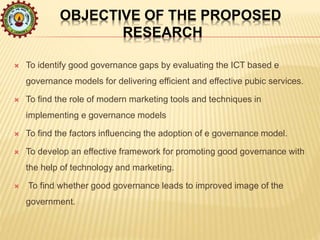
OBJECTIVE OF THE PROPOSED
RESEARCH
 To identify good governance gaps by evaluating the ICT based e
governance models for delivering efficient and effective pubic services.
 To find the role of modern marketing tools and techniques in
implementing e governance models
 To find the factors influencing the adoption of e governance model.
 To develop an effective framework for promoting good governance with
the help of technology and marketing.
 To find whether good governance leads to improved image of the
government.
IMPACT ON SOCIETY
1. Effect of IT and marketing can be used as tool and technique to
foster social marketing efforts in India.
2. This would help in improving the quality and quantity of our
governance.
3. It will develop a strong medium to evolve political marketing
initiative
4. To use it as an educational platform for further study.
5. Its findings would provide benefits of GG to the masses in most
effective and efficient manner.
6. Will save time and cost of the both Government and the citizens.
7. Easy accesses to Government services as and when required
(any time anywhere) for citizens
RESEARCH METHODOLOGY
1. Methods and techniques of data collections:
1. Primary Sources- Exploratory Questionnaire based Surveys
2. Secondary Sources-Web-Sources, Literature Review, References
2. Sampling Design: Stratified Random Sampling (e.g. Consumer
of Govt. Services, Users and Non-users of e-governance
models, etc.)
3. Classification and tabulation of data (Profiling based on
Location, Age, Gender, Literacy, Income-Strata etc. )
4. Statistical tools used for data analysis: SPSS (Special Package
for Social Sciences) software would be used for analyzing the
data covering -
1. Descriptive statistics 2. Correlation Analysis
3. ANOVA Analysis 4. Regression Analysis
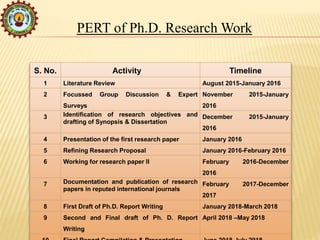
PERT of Ph.D. Research Work
S. No. Activity Timeline
1 Literature Review August 2015-January 2016
2 Focussed Group Discussion & Expert
Surveys
November 2015-January
2016
3 Identification of research objectives and
drafting of Synopsis & Dissertation
December 2015-January
2016
4 Presentation of the first research paper January 2016
5 Refining Research Proposal January 2016-February 2016
6 Working for research paper II February 2016-December
2016
7 Documentation and publication of research
papers in reputed international journals
February 2017-December
2017
8 First Draft of Ph.D. Report Writing January 2018-March 2018
9 Second and Final draft of Ph. D. Report
Writing
April 2018 –May 2018
REFERENCES AND WEB-LINKS
a) Heera Lal,“How to use social media in Indian election”,The south Asian time, pp 24-25,May 1,2010, NY,
USA
b) Henneberg, “Political marketing theory:Hendiadyoin or Oxymoron”, Working Paper, School of
Management, University of Bath, UK.
c) Kotler, Levy, “Broadening the concept of Marketing”, AMA, Journal of Marketing. Vol. 33, No1 (Jan,
1969) pp10-15
d) VivekBajpai, Dr. Sanjay Pandey, Mrs Shweta Vishwas, “Social Media Marketing: Strategies & Its
Impact”. Vol.1 Issue 7, July 2012
e) ICT and service, Service Innovation “ Transforming markets with ICT enabled service innovations – A
dynamic capability perspective”
f) http://unpan3.un.org/egovkb/en-us/Reports/UN-E-Government-Survey-2014
g) http://www.iamai.in
h) http://www.nasscom.in/
THANK YOU
***

SYNOPSIS PPT

  • 1.
    ROLE OF ICTAND MARKETING CONCEPTS IN ACHIEVING GOOD GOVERNANCE IN UTTAR PRADESH *** Ph.D. In Management Uttar Pradesh Technical University Lucknow, Uttar Pradesh, India Heera Lal Under the Esteemed Supervision of • Prof Jabir Ali (IIM Lucknow) • Prof. D S Yadav (Dr BR Ambedkar Engineering College, Banda)
  • 2.
    GOVERNANCE AND GOODGOVERNANCE  UN defines Governance as a “process of making and implementing decisions”.  GG is an ideal proposition And difficult to achieve in its totality.  GG is an instrument of Public Affairs Management.  Eight Major Characteristics of GG:  Consensus oriented  Participatory  Follows the rule of law  Effective & Efficient  Accountable  Transparent  Responsive  Equitable & Inclusive.
  • 3.
    BACK GROUND  Fastgrowing awareness and melting boundaries compel managers, social workers and political actors to connect, engage and communicate with the public and voters to the level of their satisfaction.  To satisfy them, social and political actors have broadened their boundaries by using Information & Communication Technology (ICT) and marketing.  ICT and marketing have affected and impacted all walks of life in the society.  Landscape, number, and fast desired speed of GG, compel public actors to work in tandem with ICT and marketing for desired results.  Indian Yoga Guru Baba Ram Dev is one of the best current practising social marketers.  President Barrack Obama and PM Modi have set precedent in political marketing worldwide.
  • 4.
    RESEARCH PROBLEM( GAP) Programmes, projects, ideas etc. for public welfare and overall development of society and masses may be categorized as social products.  Ministries/Departments/Sections create such social products.  Government markets social products for no profit with a primary ambition of achieving GG.  While marketing, Government is not involving all 8 parameters as per GG concept.  And if involved they are not managed effectively.  Thus Gaps in GG are cropped in. We aim to find it out in our research.  Finding the GAP by analyzing the experiences/ perceptions of the citizens vis-a-vis the conditions laid down by UN for GG.
  • 5.
    OBJECTIVE OF THEPROPOSED RESEARCH  To identify good governance gaps by evaluating the ICT based e governance models for delivering efficient and effective pubic services.  To find the role of modern marketing tools and techniques in implementing e governance models  To find the factors influencing the adoption of e governance model.  To develop an effective framework for promoting good governance with the help of technology and marketing.  To find whether good governance leads to improved image of the government.
  • 6.
    IMPACT ON SOCIETY 1.Effect of IT and marketing can be used as tool and technique to foster social marketing efforts in India. 2. This would help in improving the quality and quantity of our governance. 3. It will develop a strong medium to evolve political marketing initiative 4. To use it as an educational platform for further study. 5. Its findings would provide benefits of GG to the masses in most effective and efficient manner. 6. Will save time and cost of the both Government and the citizens. 7. Easy accesses to Government services as and when required (any time anywhere) for citizens
  • 7.
    RESEARCH METHODOLOGY 1. Methodsand techniques of data collections: 1. Primary Sources- Exploratory Questionnaire based Surveys 2. Secondary Sources-Web-Sources, Literature Review, References 2. Sampling Design: Stratified Random Sampling (e.g. Consumer of Govt. Services, Users and Non-users of e-governance models, etc.) 3. Classification and tabulation of data (Profiling based on Location, Age, Gender, Literacy, Income-Strata etc. ) 4. Statistical tools used for data analysis: SPSS (Special Package for Social Sciences) software would be used for analyzing the data covering - 1. Descriptive statistics 2. Correlation Analysis 3. ANOVA Analysis 4. Regression Analysis
  • 8.
    PERT of Ph.D.Research Work S. No. Activity Timeline 1 Literature Review August 2015-January 2016 2 Focussed Group Discussion & Expert Surveys November 2015-January 2016 3 Identification of research objectives and drafting of Synopsis & Dissertation December 2015-January 2016 4 Presentation of the first research paper January 2016 5 Refining Research Proposal January 2016-February 2016 6 Working for research paper II February 2016-December 2016 7 Documentation and publication of research papers in reputed international journals February 2017-December 2017 8 First Draft of Ph.D. Report Writing January 2018-March 2018 9 Second and Final draft of Ph. D. Report Writing April 2018 –May 2018
  • 9.
    REFERENCES AND WEB-LINKS a)Heera Lal,“How to use social media in Indian election”,The south Asian time, pp 24-25,May 1,2010, NY, USA b) Henneberg, “Political marketing theory:Hendiadyoin or Oxymoron”, Working Paper, School of Management, University of Bath, UK. c) Kotler, Levy, “Broadening the concept of Marketing”, AMA, Journal of Marketing. Vol. 33, No1 (Jan, 1969) pp10-15 d) VivekBajpai, Dr. Sanjay Pandey, Mrs Shweta Vishwas, “Social Media Marketing: Strategies & Its Impact”. Vol.1 Issue 7, July 2012 e) ICT and service, Service Innovation “ Transforming markets with ICT enabled service innovations – A dynamic capability perspective” f) http://unpan3.un.org/egovkb/en-us/Reports/UN-E-Government-Survey-2014 g) http://www.iamai.in h) http://www.nasscom.in/
  • 10.