Presented By
Rohit Kumar
Final Year, EEE
What is Governance?
 Governance is not synonymous to government
 It is about how governments and other social
organizations interact
 How they relate to citizens
 How decisions are taken in a complex world.
So it is the process of decision-making and the
process by which decisions are implemented
(or not implemented)
Good Governance
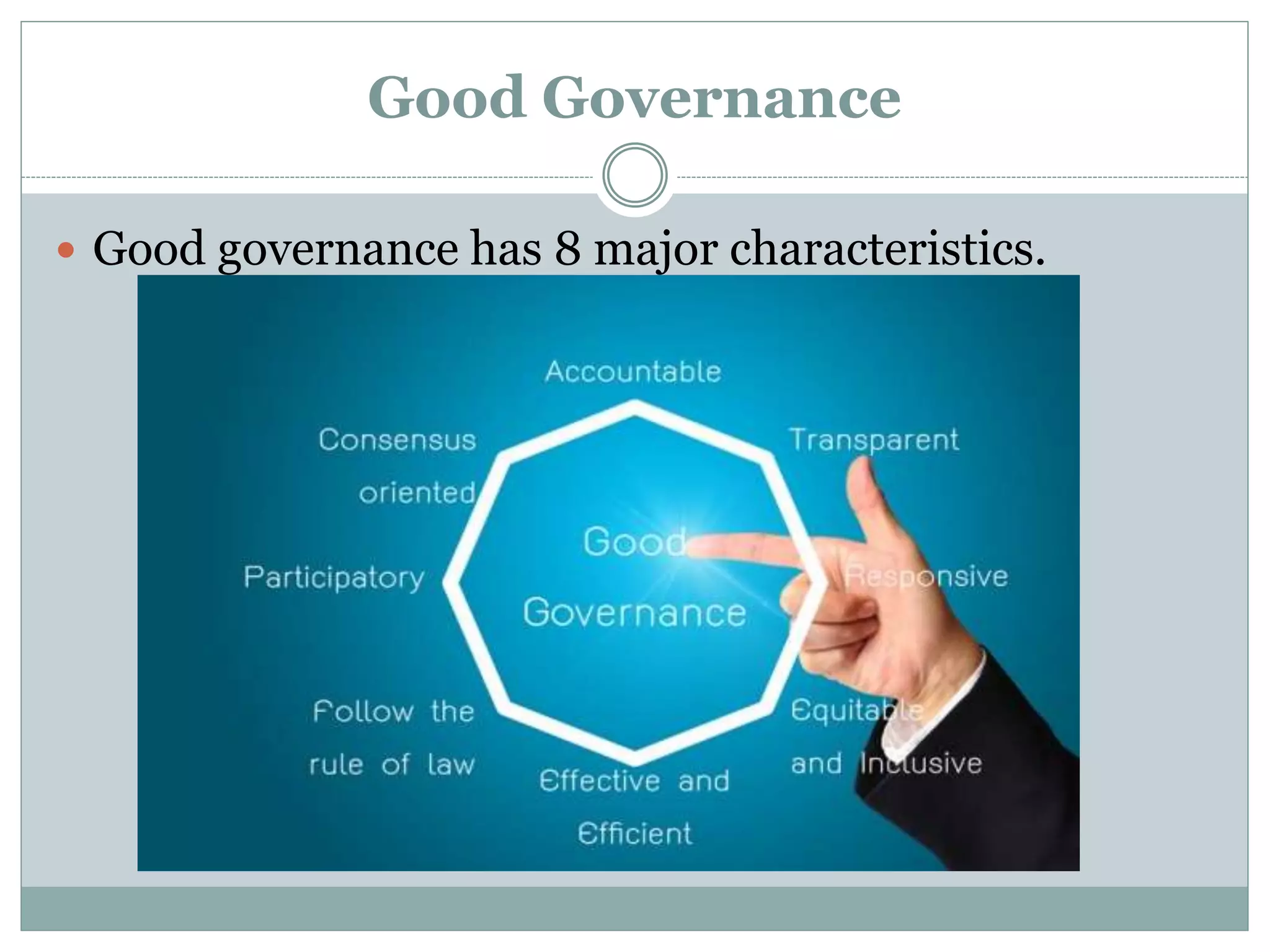
 Good governance has 8 major characteristics.
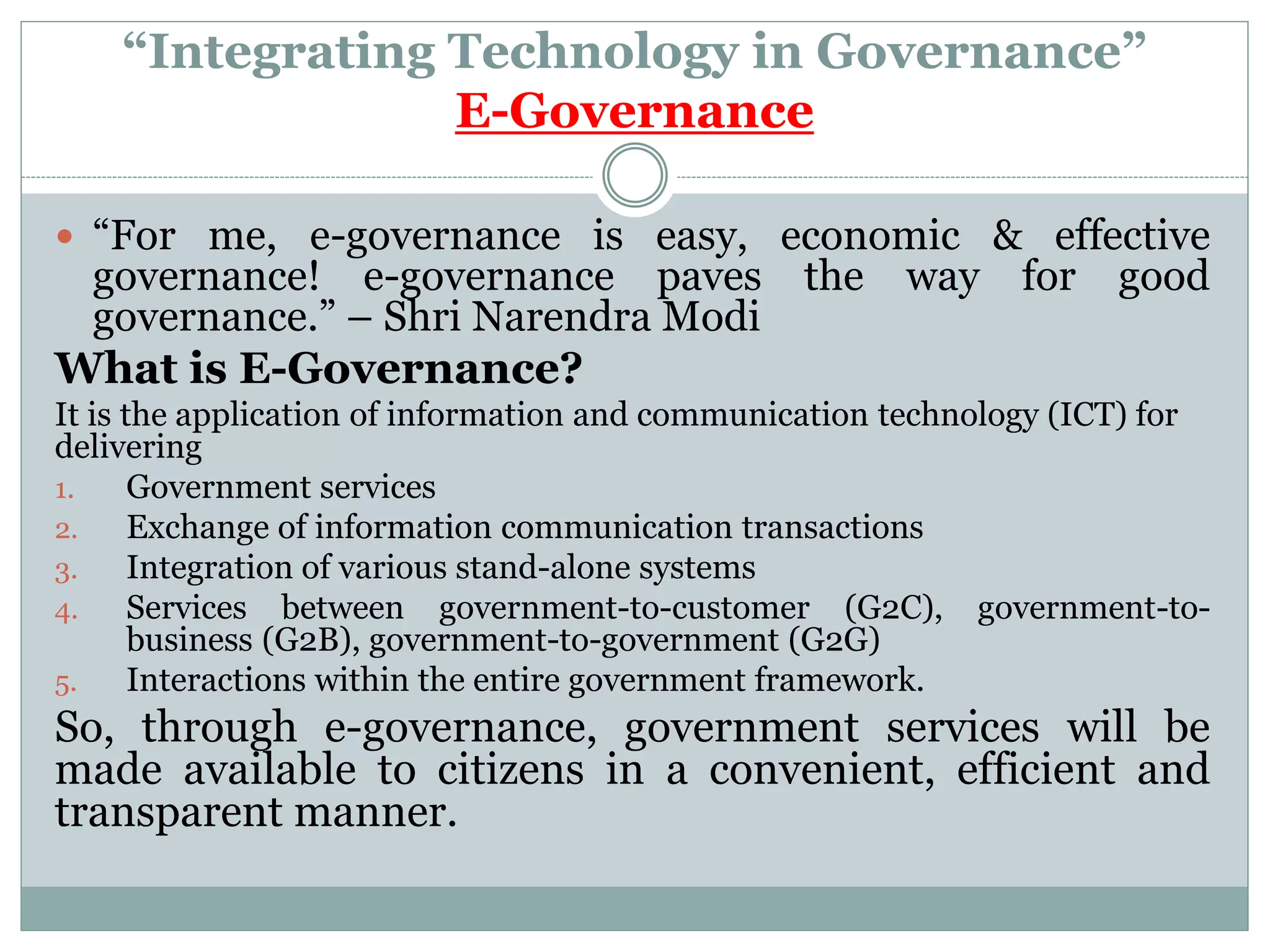
“Integrating Technology in Governance”
E-Governance
 “For me, e-governance is easy, economic & effective
governance! e-governance paves the way for good
governance.” – Shri Narendra Modi
What is E-Governance?
It is the application of information and communication technology (ICT) for
delivering
1. Government services
2. Exchange of information communication transactions
3. Integration of various stand-alone systems
4. Services between government-to-customer (G2C), government-to-
business (G2B), government-to-government (G2G)
5. Interactions within the entire government framework.
So, through e-governance, government services will be
made available to citizens in a convenient, efficient and
transparent manner.
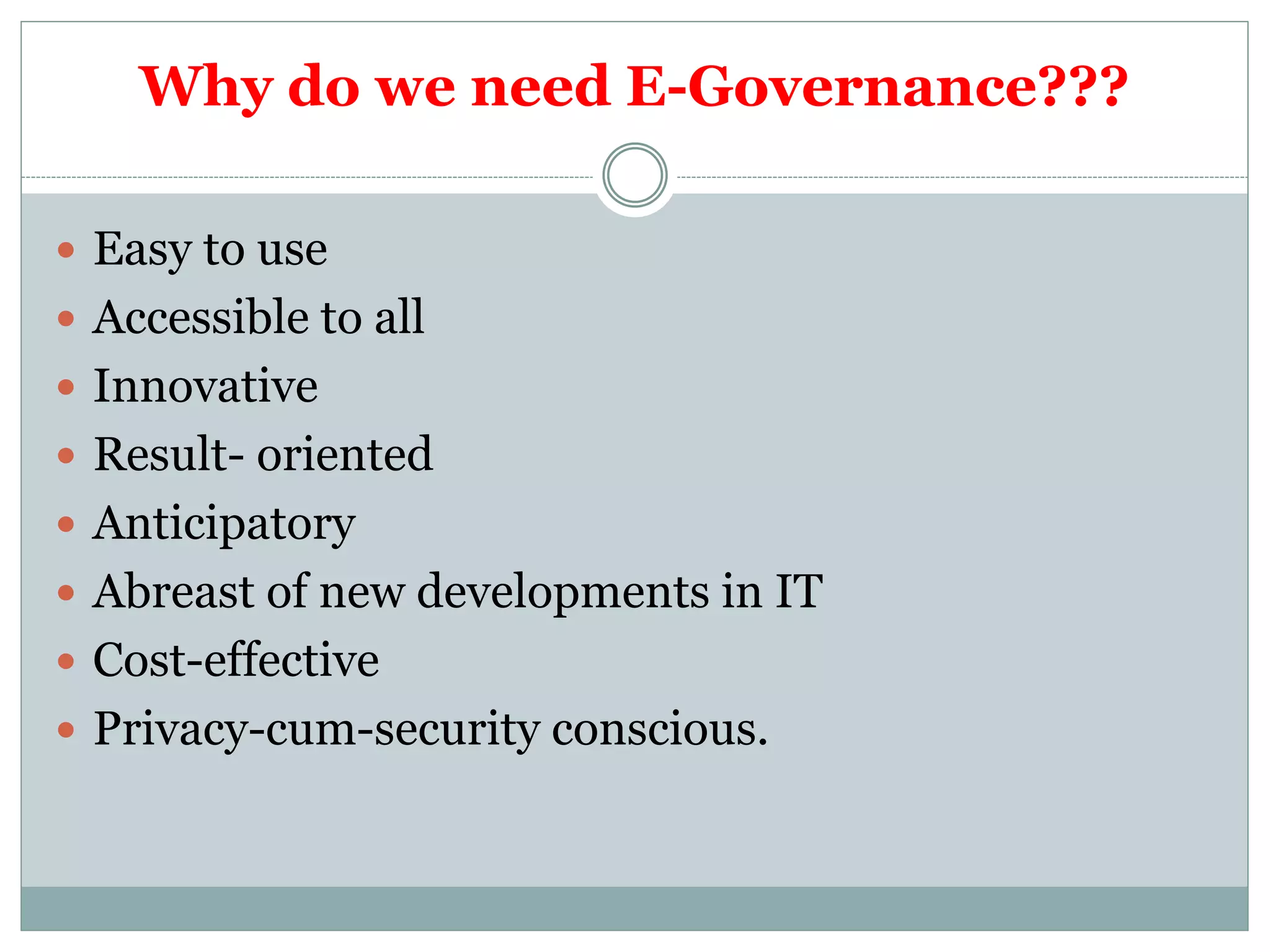
Why do we need E-Governance???
 Easy to use
 Accessible to all
 Innovative
 Result- oriented
 Anticipatory
 Abreast of new developments in IT
 Cost-effective
 Privacy-cum-security conscious.
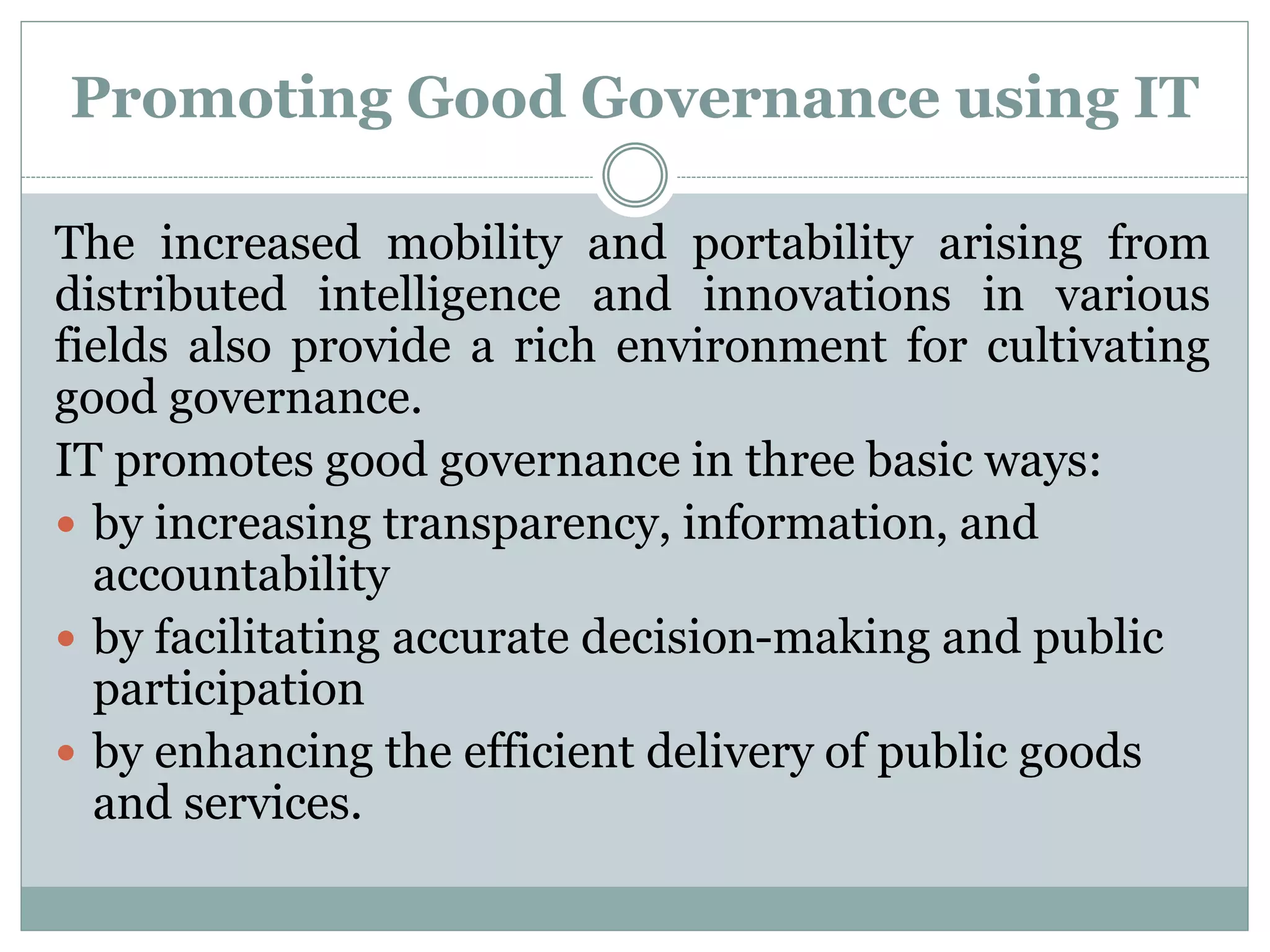
Promoting Good Governance using IT
The increased mobility and portability arising from
distributed intelligence and innovations in various
fields also provide a rich environment for cultivating
good governance.
IT promotes good governance in three basic ways:
 by increasing transparency, information, and
accountability
 by facilitating accurate decision-making and public
participation
 by enhancing the efficient delivery of public goods
and services.
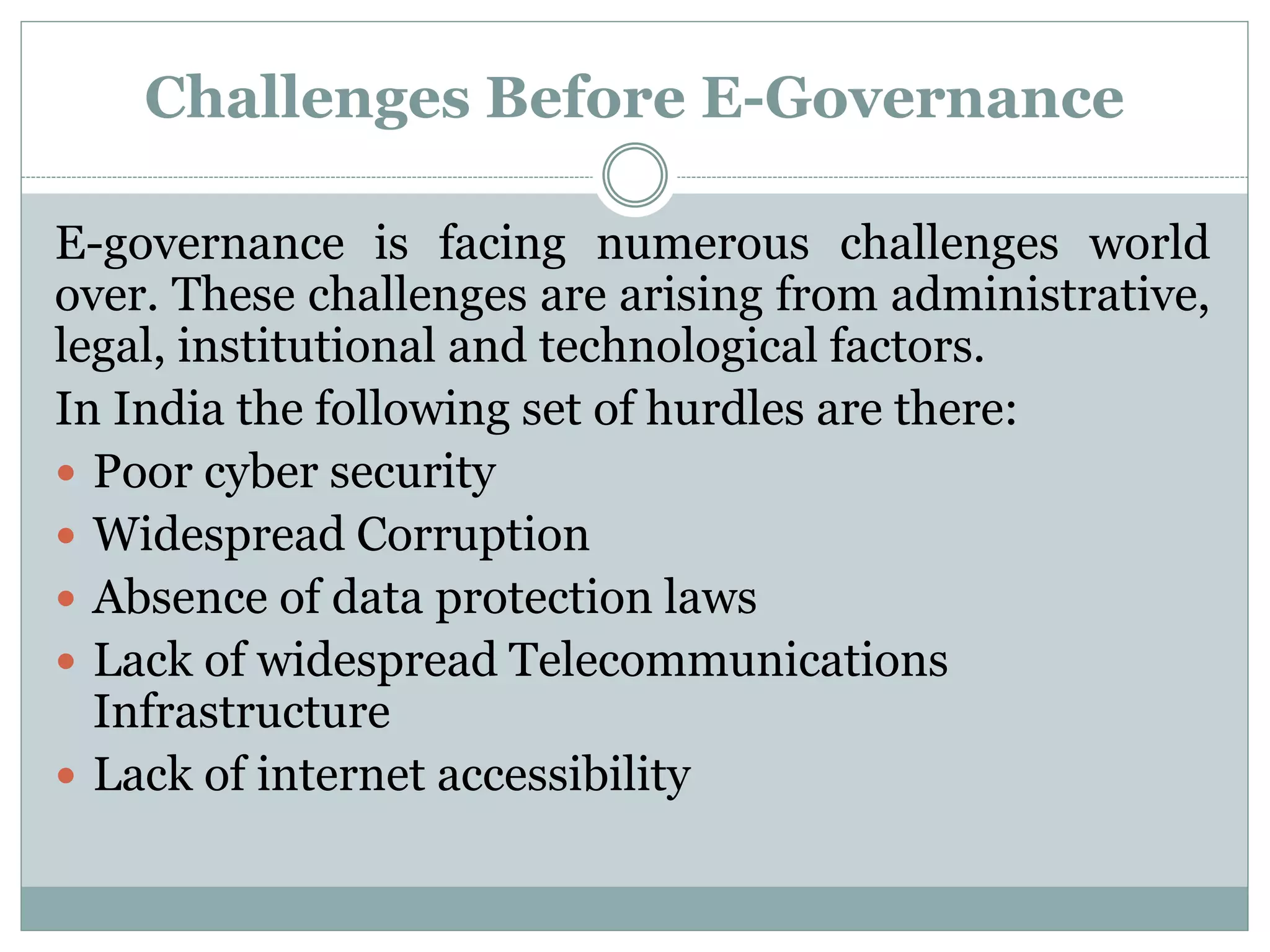
Challenges Before E-Governance
E-governance is facing numerous challenges world
over. These challenges are arising from administrative,
legal, institutional and technological factors.
In India the following set of hurdles are there:
 Poor cyber security
 Widespread Corruption
 Absence of data protection laws
 Lack of widespread Telecommunications
Infrastructure
 Lack of internet accessibility
Use Of Innovation And Technology For
Good Governance
 Government of Chhattisgarh that has used ICT based module to reform, to
improve its Public Distribution System (PDS) that also ensures a
transparent and accountable delivery mechanism.
 Karnataka State Government that has successfully eradicated corruption in
getting land records. Bhoomi is the Land Records computerization effort by
the Government of Karnataka.
 Gujarat Government’s e-Dhara, (renames e-Jamin) the computerized
system of land records has been a tremendous success. All 225 Talukas of
26 districts are connected by Gujarat state wide area network (GSWAN).
 A number of government services that were plagued with corruption delay
and were out of reach for people, are now operating successfully, after IT
was introduced. Securing a passport and driving licence were a major
project for an individual. The use of IT in booking of railway tickets has
ensured more transparency and comfort for the traveler.
The Gujrat Model
 WHO shows interest in Gujarat’s SMS model to
track fake medicines.
 E-Mamta: improving mother and child delivery
services using IT.
 E-GujCop: A unique initiative by the Gujarat Police
is keeping its citizens safe and secure.
 E-Health: Swastha Bharat. Ujjwal Bharat
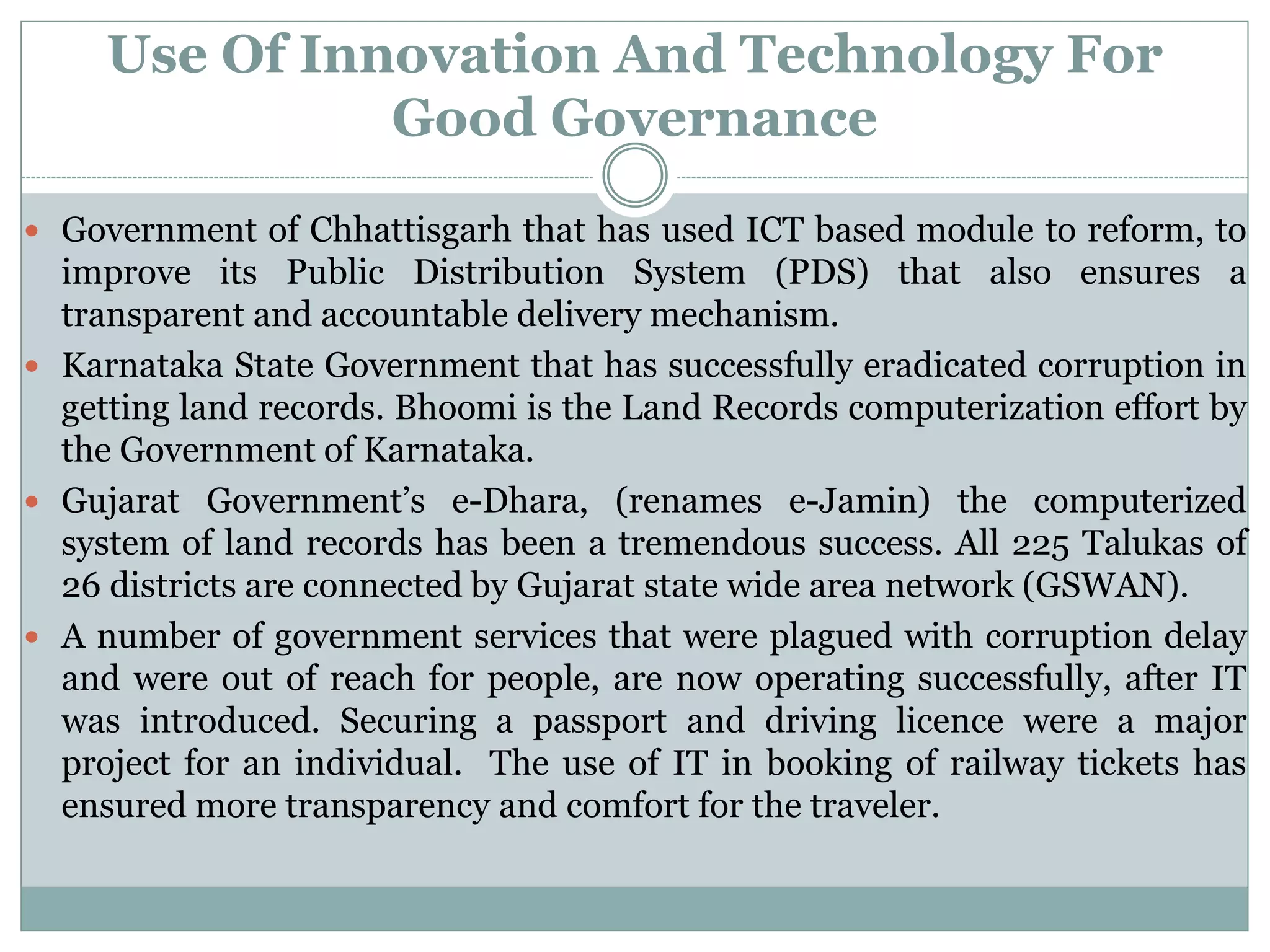
e-City Centers act as a
single-point interface for all
Government-to-Citizen
(G2C) Services
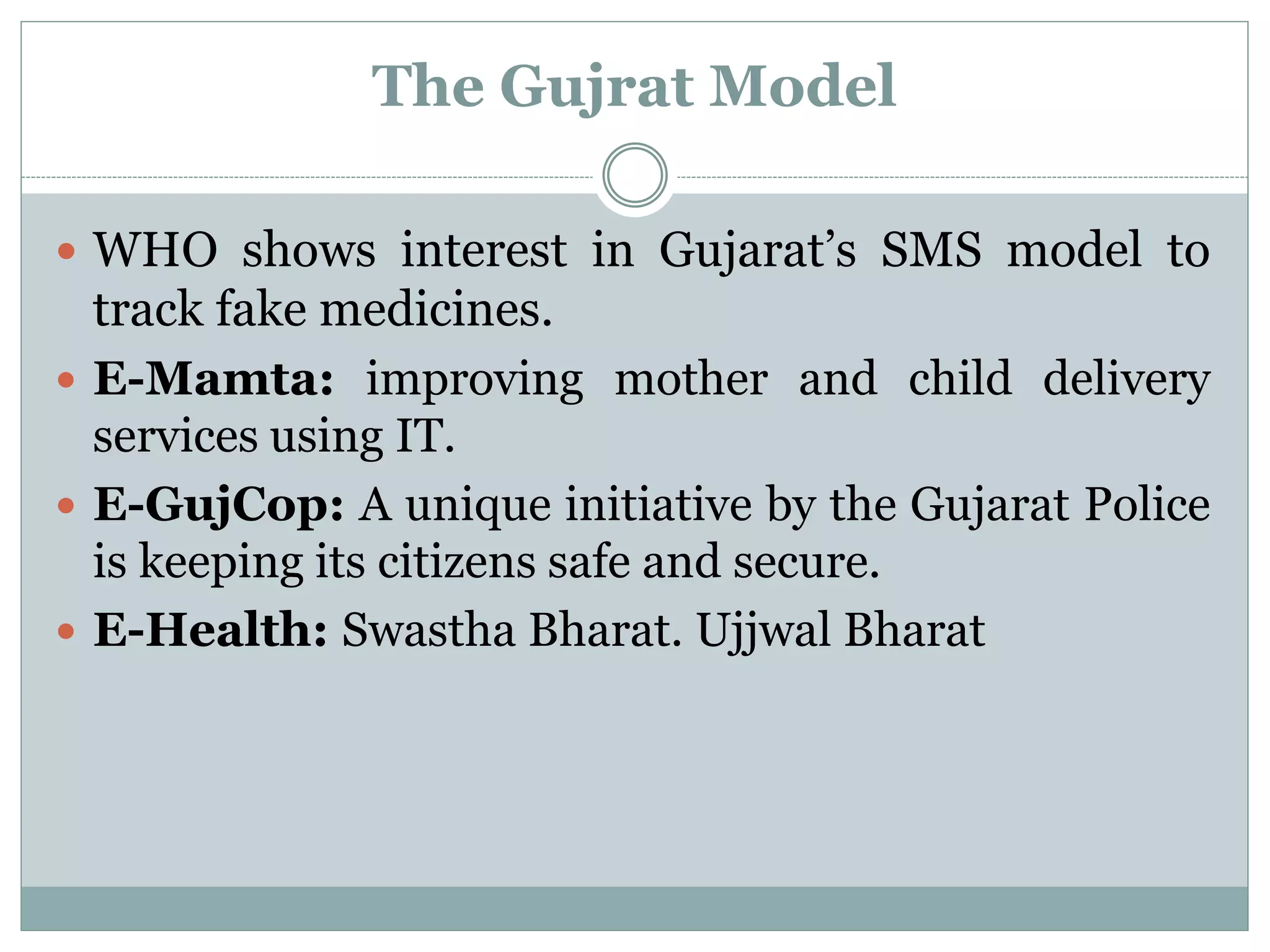
Rural citizens now have easy
access to Government-to-
Citizen (G2C) services
thanks to IT
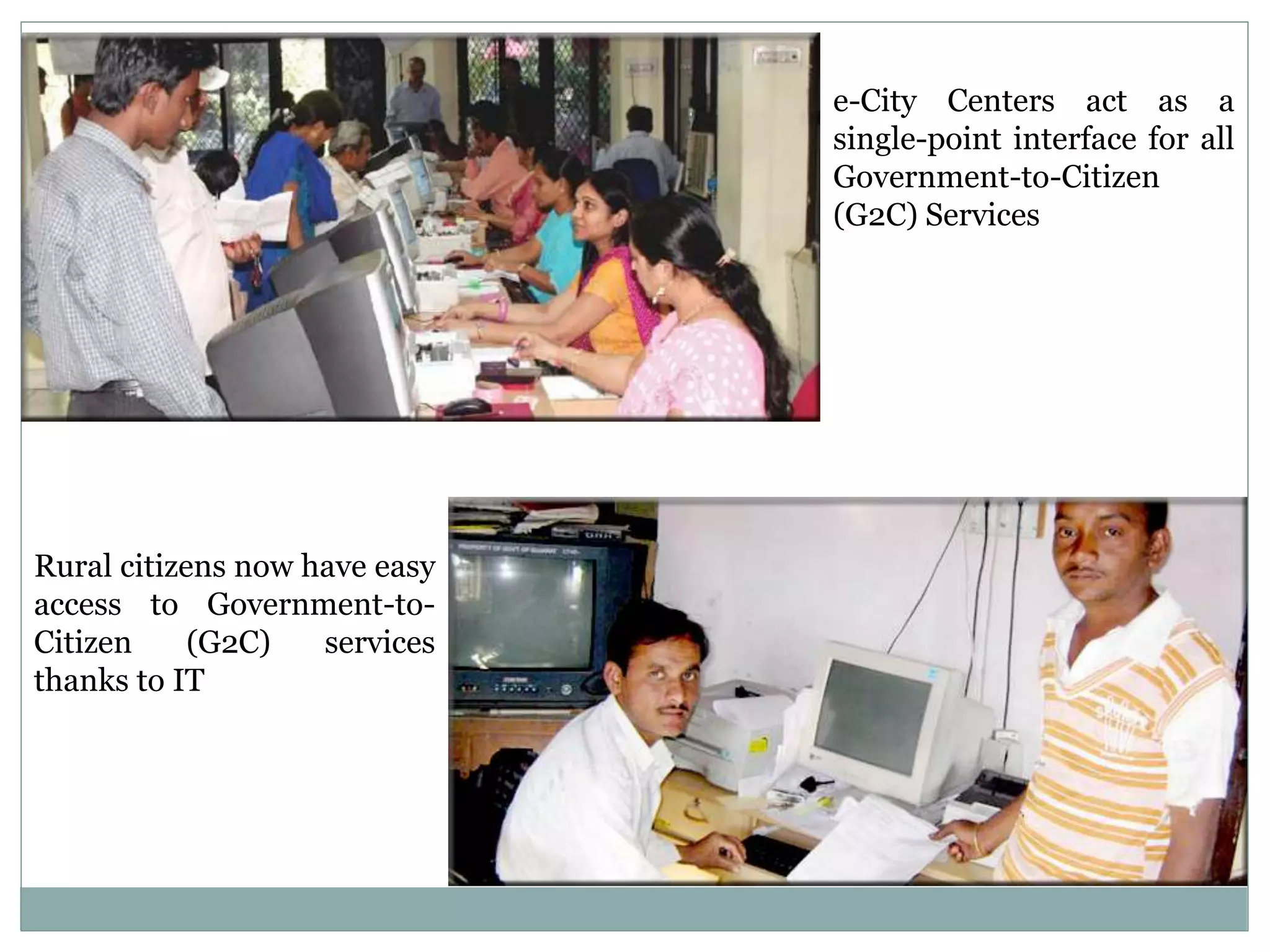
Rapid response time by 108
emergency services has
given great results in Gujarat
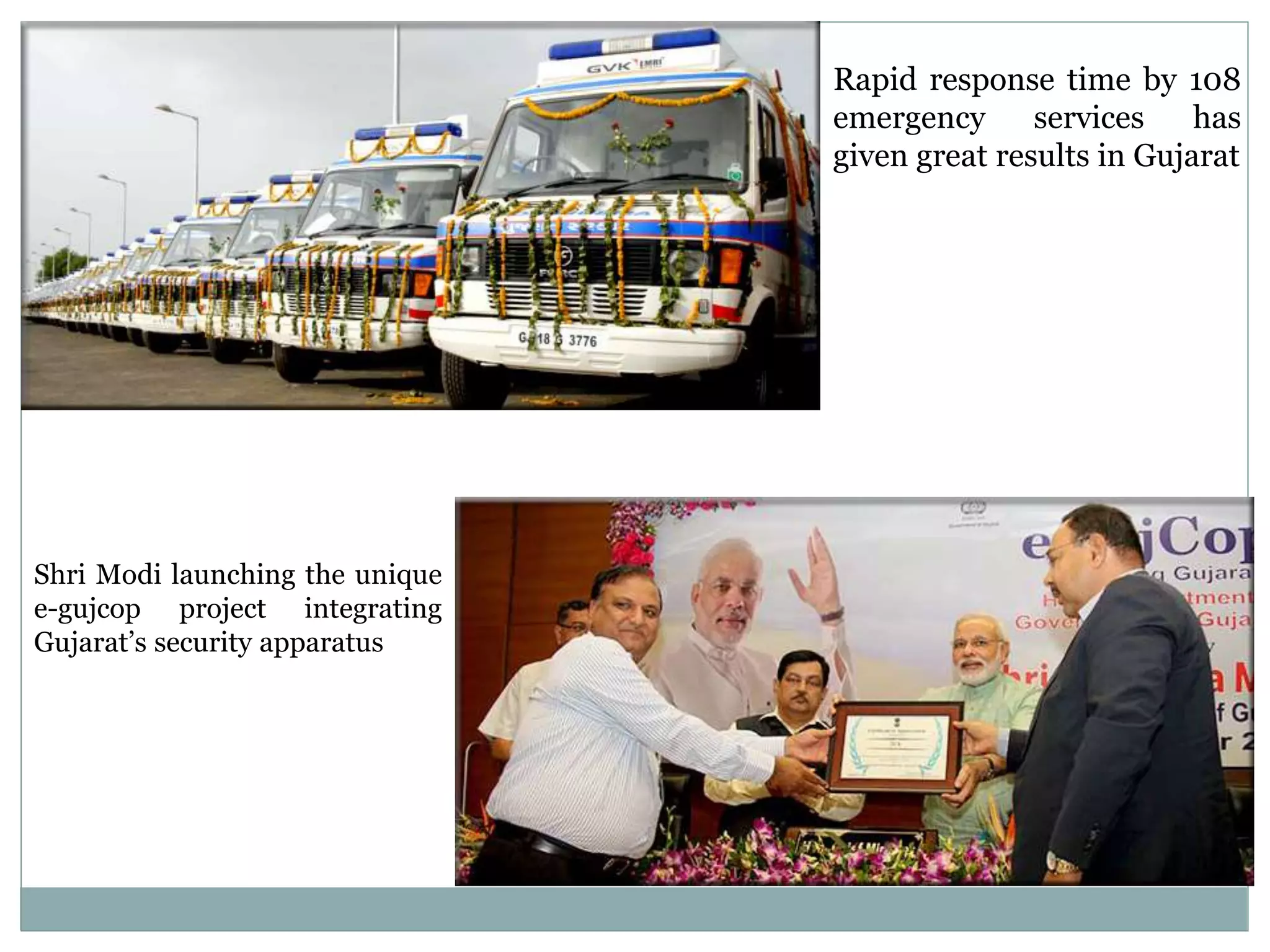
Shri Modi launching the unique
e-gujcop project integrating
Gujarat’s security apparatus
New Innovations
 Launch of unique web platform www.mygov.nic.in
 Passport and Driving License application procedure
made online
 The declarations of assets by Ministers and bureaucrats
made public on a web portal.
 Railway reservation and enquiry become more easier as
SMS will do the job
 New android app developed by CRIS for Railway inquiry
 Various other mobile apps like mpassport Seva, Voter
information search are available on the official website of
department of electronics and information technology :
Mobile Seva.
 Status of ADHAAR and Voter ID card can be checked
online.
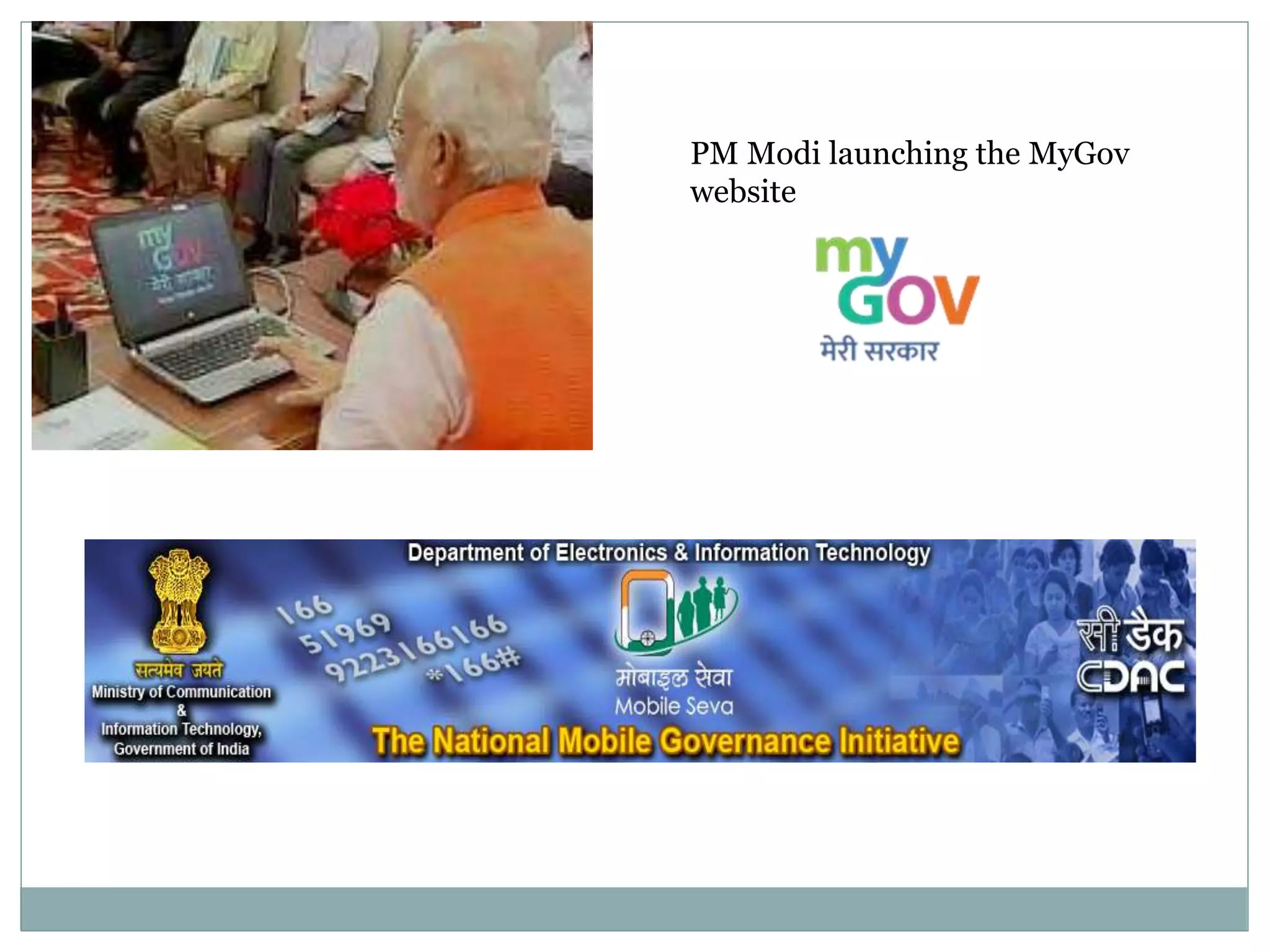
PM Modi launching the MyGov
website
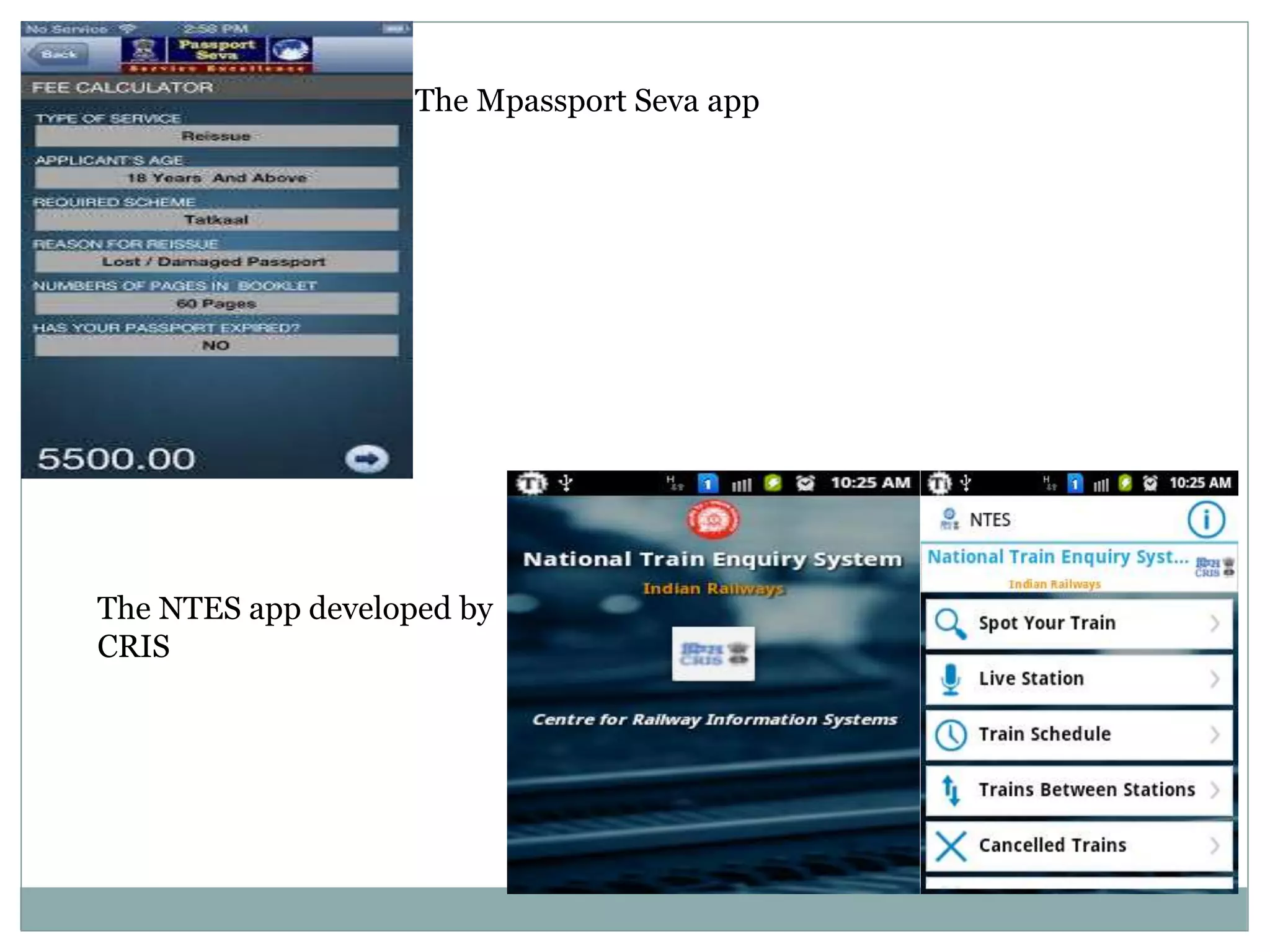
The Mpassport Seva app
The NTES app developed by
CRIS
CONCLUSION
 Various leaders, political, spiritual, academic and corporate have
spoken about the need to have good governance, as an essential
tool for development of a nation. Mahatma Gandhi said, “We
must become the change we want to see.” This is the message for
all those who wish to achieve good governance.
 Information Technology is a powerful tool that this generation of
policy makers and executers are blessed with. The opportunity to
use it for good governance exists, so does the danger of losing it.
It will be an interesting journey, amidst fast growing number of
mobile devices, broadband, new operating systems and
ingenious applications. Each of them is a platform to achieve
good governance.
References
 www.narendramodi.in/integrating-technology-in-
governance
 Wikipedia, the free encyclopedia
 Principles for Good Governance in the 21st century:
Policy Brief No.15 – August 2003 by John Graham
Bruce Amos
 Information Technology for Good Governance by
Francisco Magno and Ramonette Serafica

Good governance using e governance

  • 1.
  • 2.
    What is Governance? Governance is not synonymous to government  It is about how governments and other social organizations interact  How they relate to citizens  How decisions are taken in a complex world. So it is the process of decision-making and the process by which decisions are implemented (or not implemented)
  • 3.
    Good Governance  Goodgovernance has 8 major characteristics.
  • 5.
    “Integrating Technology inGovernance” E-Governance  “For me, e-governance is easy, economic & effective governance! e-governance paves the way for good governance.” – Shri Narendra Modi What is E-Governance? It is the application of information and communication technology (ICT) for delivering 1. Government services 2. Exchange of information communication transactions 3. Integration of various stand-alone systems 4. Services between government-to-customer (G2C), government-to- business (G2B), government-to-government (G2G) 5. Interactions within the entire government framework. So, through e-governance, government services will be made available to citizens in a convenient, efficient and transparent manner.
  • 6.
    Why do weneed E-Governance???  Easy to use  Accessible to all  Innovative  Result- oriented  Anticipatory  Abreast of new developments in IT  Cost-effective  Privacy-cum-security conscious.
  • 7.
    Promoting Good Governanceusing IT The increased mobility and portability arising from distributed intelligence and innovations in various fields also provide a rich environment for cultivating good governance. IT promotes good governance in three basic ways:  by increasing transparency, information, and accountability  by facilitating accurate decision-making and public participation  by enhancing the efficient delivery of public goods and services.
  • 8.
    Challenges Before E-Governance E-governanceis facing numerous challenges world over. These challenges are arising from administrative, legal, institutional and technological factors. In India the following set of hurdles are there:  Poor cyber security  Widespread Corruption  Absence of data protection laws  Lack of widespread Telecommunications Infrastructure  Lack of internet accessibility
  • 9.
    Use Of InnovationAnd Technology For Good Governance  Government of Chhattisgarh that has used ICT based module to reform, to improve its Public Distribution System (PDS) that also ensures a transparent and accountable delivery mechanism.  Karnataka State Government that has successfully eradicated corruption in getting land records. Bhoomi is the Land Records computerization effort by the Government of Karnataka.  Gujarat Government’s e-Dhara, (renames e-Jamin) the computerized system of land records has been a tremendous success. All 225 Talukas of 26 districts are connected by Gujarat state wide area network (GSWAN).  A number of government services that were plagued with corruption delay and were out of reach for people, are now operating successfully, after IT was introduced. Securing a passport and driving licence were a major project for an individual. The use of IT in booking of railway tickets has ensured more transparency and comfort for the traveler.
  • 10.
    The Gujrat Model WHO shows interest in Gujarat’s SMS model to track fake medicines.  E-Mamta: improving mother and child delivery services using IT.  E-GujCop: A unique initiative by the Gujarat Police is keeping its citizens safe and secure.  E-Health: Swastha Bharat. Ujjwal Bharat
  • 11.
    e-City Centers actas a single-point interface for all Government-to-Citizen (G2C) Services Rural citizens now have easy access to Government-to- Citizen (G2C) services thanks to IT
  • 12.
    Rapid response timeby 108 emergency services has given great results in Gujarat Shri Modi launching the unique e-gujcop project integrating Gujarat’s security apparatus
  • 14.
    New Innovations  Launchof unique web platform www.mygov.nic.in  Passport and Driving License application procedure made online  The declarations of assets by Ministers and bureaucrats made public on a web portal.  Railway reservation and enquiry become more easier as SMS will do the job  New android app developed by CRIS for Railway inquiry  Various other mobile apps like mpassport Seva, Voter information search are available on the official website of department of electronics and information technology : Mobile Seva.  Status of ADHAAR and Voter ID card can be checked online.
  • 15.
    PM Modi launchingthe MyGov website
  • 16.
    The Mpassport Sevaapp The NTES app developed by CRIS
  • 17.
    CONCLUSION  Various leaders,political, spiritual, academic and corporate have spoken about the need to have good governance, as an essential tool for development of a nation. Mahatma Gandhi said, “We must become the change we want to see.” This is the message for all those who wish to achieve good governance.  Information Technology is a powerful tool that this generation of policy makers and executers are blessed with. The opportunity to use it for good governance exists, so does the danger of losing it. It will be an interesting journey, amidst fast growing number of mobile devices, broadband, new operating systems and ingenious applications. Each of them is a platform to achieve good governance.
  • 18.
    References  www.narendramodi.in/integrating-technology-in- governance  Wikipedia,the free encyclopedia  Principles for Good Governance in the 21st century: Policy Brief No.15 – August 2003 by John Graham Bruce Amos  Information Technology for Good Governance by Francisco Magno and Ramonette Serafica