Graduate Report Presentation on
“Water Treatment Process”
ME – TCP, Year – I, Semester – I
Under the subject of
ITP
(Subject Code : 3714802)
SARVAJANIK COLLEGE OF ENGINEERING & TECHNOLOGY, SURAT
FACULTY OF CIVIL ENGINEERING
MASTER OF ENGINEERING (TOWN AND COUNTRY PLANNING)
Affiliated with
GUJARAT TECHNOLOGICAL UNIVERSITY
Introduction
Why it isneeded?
 To kill all pathogenic germs, which are harmful to human health
 To remove the unpleasant and objectionable taste and odours
from the water
 To remove dissolved gases ,colour of water
 To make water fit for domestic, industrial, and commercial uses.
 To remove micro organism and colloidal matters
3
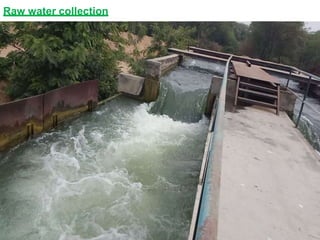
Raw water collection
03/28/17 water treatment 4
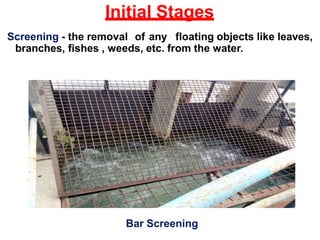
Initial Stages
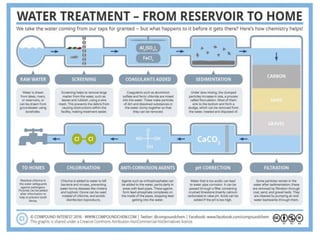
Screening - the removal of any floating objects like leaves,
branches, fishes , weeds, etc. from the water.
Bar Screening
03/28/17 water treatment 6
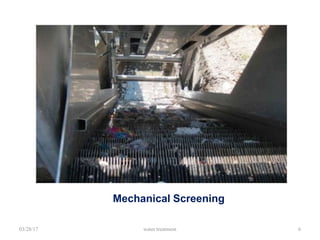
Mechanical Screening
03/28/17 water treatment 8
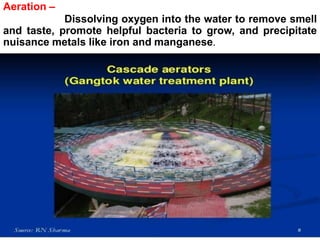
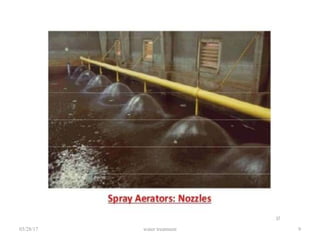
Aeration –
Dissolving oxygen into the water to remove smell
and taste, promote helpful bacteria to grow, and precipitate
nuisance metals like iron and manganese.
03/28/17 water treatment 9
03/28/17 water treatment 10
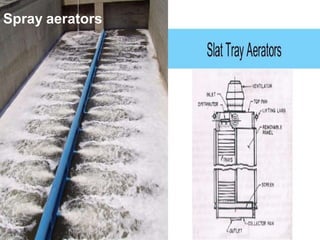
Spray aerators
03/28/17 water treatment 7
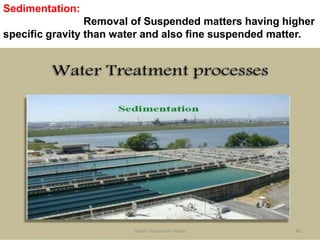
Sedimentation:
Removal of Suspended matters having higher
specific gravity than water and also fine suspended matter.
Major Clean Up
• Coagulation and flocculation - causes the agglomeration
and sedimentation of suspended solid particles through
the addition of a coagulating agent (usually aluminum
sulfate and/or iron sulfate) to the raw water along with a
polymer to help form a floc.
• Filtration- Remove Micro-organism and colloidal matter
• Disinfection---Pre-chlorination and dechlorination - mostly
to kill algae that would otherwise grow and clog the water
filters. Also kills much of the remaining unprotected
bacteria.
• Softening- To remove hardness
14
Theory of coagulation
Coagulation is the destabilization of colloids by addition of
chemicals that neutralize the negative charges
 The chemicals are known as coagulants
 Coagulation is essentially a chemical process
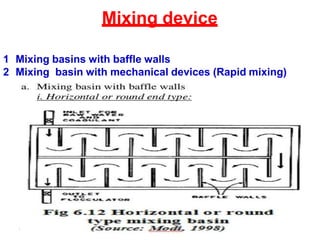
Mixing device
03/28/17 water treatment 20
1 Mixing basins with baffle walls
2 Mixing basin with mechanical devices (Rapid mixing)
water treatment
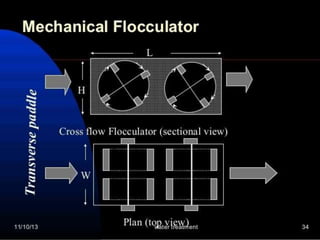
• Rapid or Flash mixing is the process by which a
coagulant is rapidly and uniformly dispersed through the
mass of water. This process usually occurs in a small basin
immediately preceding or at the head of the coagulation
basin. Generally, the detention period is 30 to 60 seconds and
the head loss is 20 to 60 cms of water. Here colloids are
destabilized and the nucleus for the floc is formed.
 Slow mixing brings the contacts between the finely
divided destabilised matter formed during rapid mixing.
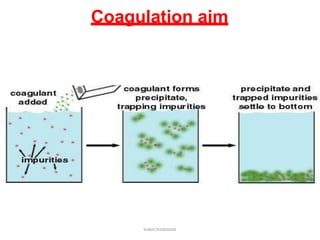
Coagulation aim
water treatment
What is Flocculation?
Flocculation is the agglomeration of destabilized particles
into a large size particles known as flocs which can be
effectively removed by sedimentation or flotation.
03/28/17 water treatment 24
03/28/17 water treatment 25
water treatment
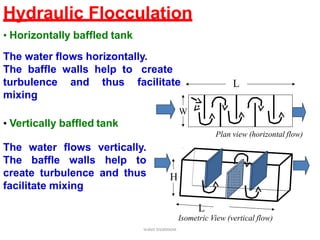
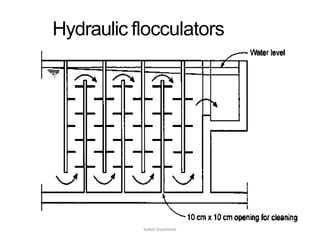
Hydraulic Flocculation
Plan view (horizontal flow)
• Vertically baffled tank
L
Isometric View (vertical flow)
L
W
H
• Horizontally baffled tank
The water flows horizontally.
The baffle walls help to create
turbulence and thus facilitate
mixing
The water flows vertically.
The baffle walls help to
create turbulence and thus
facilitate mixing
Hydraulic flocculators
water treatment
water treatment
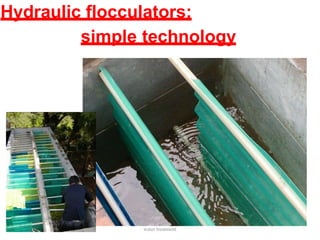
Hydraulic flocculators:
simple technology
Clarifier
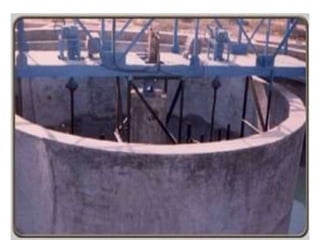
• After Flocculation Water enters the settling tank which is
commonly called Clarifier.
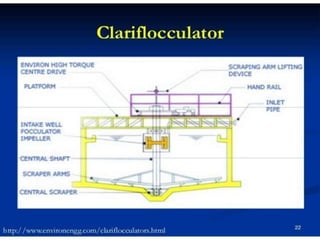
Clariflocculator
In modern practice, flocculator and clarifier are
whichprovided
chamber
in one unit called Clariflocculator in
is provided in the center and clarifier
compartment is formed by the periferical space.
water treatment
03/28/17 water treatment 36
03/28/17 water treatment 37
Filtration
water treatment
The process of passing the water through the bed of such
granular materials is known as filtration.
Types of filter
1- The slow sand gravity filter
2- Rapid sand filter
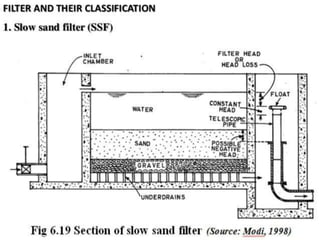
Slow sand filters are used in water purification for treating
raw water to produce a potable product. They are typically 1
to 2 metres deep, can be rectangular or cylindrical in cross
section and are used primarily to treat surface water.
Periodically clean by removing, cleaning and replacing the
upper few inches of biologically active sand.
water treatment
03/28/17 water treatment 40
Rapid sand filters
03/28/17 water treatment 42
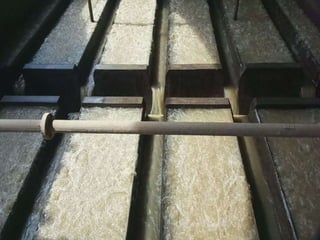
Rapid sand filtration is a purely physical
drinking water purification method. Rapid sand filters (RSF)
provide rapid and efficient removal of relatively large
suspended particles. Two types of RSF are typically used:
Rapid gravity
Rapid pressure sand filters
03/28/17 water treatment 43
•The biggest disadvantages of slow sand filter is that it
requires large area due to slow filtration rate.
•This Requirement make it uneconomical for places where
land is very costly in urban area. In order to reduce
requirement of space and to increase the rate of filtration , a
lot of research conducted which finally led to the developed
of rapid sand filter.
03/28/17 water treatment 44
Rapid sand filters have filter rates 40 times those of slow
sand filters. The major parts of a rapid sand filter are:
• Filter tank or filter box
• Filter sand or mixed-media
• Gravel support bed
• Under drain system
• Wash water troughs
• Filter bed agitators
03/28/17 water treatment 45
PRESSURE FILTERS
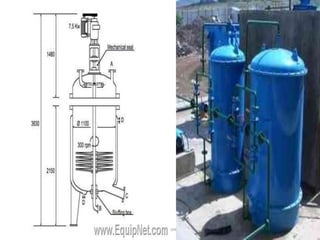
Pressure filters are used extensively in
iron and manganese removal plants. A pressure sand filter is
contained under pressure in a steel tank, which may be
vertical or horizontal, depending on the space available. As
with gravity filters, the media is usually sand or a
combination of media, and filtration rates are similar to
gravity filters. Groundwater is first aerated to oxidize the iron
or manganese, and then pumped through the filter to remove
the suspended material.
03/28/17 water treatment 46
03/28/17 water treatment 47

Water treatment process

  • 1.
    Graduate Report Presentationon “Water Treatment Process” ME – TCP, Year – I, Semester – I Under the subject of ITP (Subject Code : 3714802) SARVAJANIK COLLEGE OF ENGINEERING & TECHNOLOGY, SURAT FACULTY OF CIVIL ENGINEERING MASTER OF ENGINEERING (TOWN AND COUNTRY PLANNING) Affiliated with GUJARAT TECHNOLOGICAL UNIVERSITY
  • 2.
    Introduction Why it isneeded? To kill all pathogenic germs, which are harmful to human health  To remove the unpleasant and objectionable taste and odours from the water  To remove dissolved gases ,colour of water  To make water fit for domestic, industrial, and commercial uses.  To remove micro organism and colloidal matters 3
  • 4.
  • 5.
    Initial Stages Screening -the removal of any floating objects like leaves, branches, fishes , weeds, etc. from the water. Bar Screening
  • 6.
    03/28/17 water treatment6 Mechanical Screening
  • 7.
    03/28/17 water treatment8 Aeration – Dissolving oxygen into the water to remove smell and taste, promote helpful bacteria to grow, and precipitate nuisance metals like iron and manganese.
  • 8.
  • 9.
    03/28/17 water treatment10 Spray aerators
  • 10.
    03/28/17 water treatment7 Sedimentation: Removal of Suspended matters having higher specific gravity than water and also fine suspended matter.
  • 11.
    Major Clean Up •Coagulation and flocculation - causes the agglomeration and sedimentation of suspended solid particles through the addition of a coagulating agent (usually aluminum sulfate and/or iron sulfate) to the raw water along with a polymer to help form a floc. • Filtration- Remove Micro-organism and colloidal matter • Disinfection---Pre-chlorination and dechlorination - mostly to kill algae that would otherwise grow and clog the water filters. Also kills much of the remaining unprotected bacteria. • Softening- To remove hardness
  • 12.
    14 Theory of coagulation Coagulationis the destabilization of colloids by addition of chemicals that neutralize the negative charges  The chemicals are known as coagulants  Coagulation is essentially a chemical process
  • 13.
    Mixing device 03/28/17 watertreatment 20 1 Mixing basins with baffle walls 2 Mixing basin with mechanical devices (Rapid mixing)
  • 14.
    water treatment • Rapidor Flash mixing is the process by which a coagulant is rapidly and uniformly dispersed through the mass of water. This process usually occurs in a small basin immediately preceding or at the head of the coagulation basin. Generally, the detention period is 30 to 60 seconds and the head loss is 20 to 60 cms of water. Here colloids are destabilized and the nucleus for the floc is formed.  Slow mixing brings the contacts between the finely divided destabilised matter formed during rapid mixing.
  • 15.
  • 16.
    What is Flocculation? Flocculationis the agglomeration of destabilized particles into a large size particles known as flocs which can be effectively removed by sedimentation or flotation.
  • 17.
  • 18.
  • 19.
    water treatment Hydraulic Flocculation Planview (horizontal flow) • Vertically baffled tank L Isometric View (vertical flow) L W H • Horizontally baffled tank The water flows horizontally. The baffle walls help to create turbulence and thus facilitate mixing The water flows vertically. The baffle walls help to create turbulence and thus facilitate mixing
  • 20.
  • 21.
  • 22.
    Clarifier • After FlocculationWater enters the settling tank which is commonly called Clarifier. Clariflocculator In modern practice, flocculator and clarifier are whichprovided chamber in one unit called Clariflocculator in is provided in the center and clarifier compartment is formed by the periferical space. water treatment
  • 23.
  • 24.
  • 25.
    Filtration water treatment The processof passing the water through the bed of such granular materials is known as filtration. Types of filter 1- The slow sand gravity filter 2- Rapid sand filter
  • 26.
    Slow sand filtersare used in water purification for treating raw water to produce a potable product. They are typically 1 to 2 metres deep, can be rectangular or cylindrical in cross section and are used primarily to treat surface water. Periodically clean by removing, cleaning and replacing the upper few inches of biologically active sand. water treatment
  • 27.
  • 28.
    Rapid sand filters 03/28/17water treatment 42 Rapid sand filtration is a purely physical drinking water purification method. Rapid sand filters (RSF) provide rapid and efficient removal of relatively large suspended particles. Two types of RSF are typically used: Rapid gravity Rapid pressure sand filters
  • 29.
    03/28/17 water treatment43 •The biggest disadvantages of slow sand filter is that it requires large area due to slow filtration rate. •This Requirement make it uneconomical for places where land is very costly in urban area. In order to reduce requirement of space and to increase the rate of filtration , a lot of research conducted which finally led to the developed of rapid sand filter.
  • 30.
    03/28/17 water treatment44 Rapid sand filters have filter rates 40 times those of slow sand filters. The major parts of a rapid sand filter are: • Filter tank or filter box • Filter sand or mixed-media • Gravel support bed • Under drain system • Wash water troughs • Filter bed agitators
  • 31.
  • 32.
    PRESSURE FILTERS Pressure filtersare used extensively in iron and manganese removal plants. A pressure sand filter is contained under pressure in a steel tank, which may be vertical or horizontal, depending on the space available. As with gravity filters, the media is usually sand or a combination of media, and filtration rates are similar to gravity filters. Groundwater is first aerated to oxidize the iron or manganese, and then pumped through the filter to remove the suspended material. 03/28/17 water treatment 46
  • 33.