ICT-enabled Services for  Agricultural Development in India For academic purpose only Dr A.S.Charyulu National Institute of Agricultural Extension Management (MANAGE) Hyderabad, India.
What is ICT? ICT includes any communication device or application, encompassing: Telephone Radio Television Cellular phone Computers Networks Satellite systems  Hardware and software The Internet and its applications, WWW, Portals Various services and applications-videoconferencing and distance learning.
Digital Revolution What is “Digital”? What is “Revolution”? Digital Revolution: Digitization  of information Major  advances in ICT  (over the past two decades)  Rapid growth in  telecommunication networks  (such as the Internet)
Advances in ICTs Convergence  of technologies Miniaturization Speed of  processing  data Increase of  storage  capacity Increase of  bandwidth Networking –  wireless  technologies
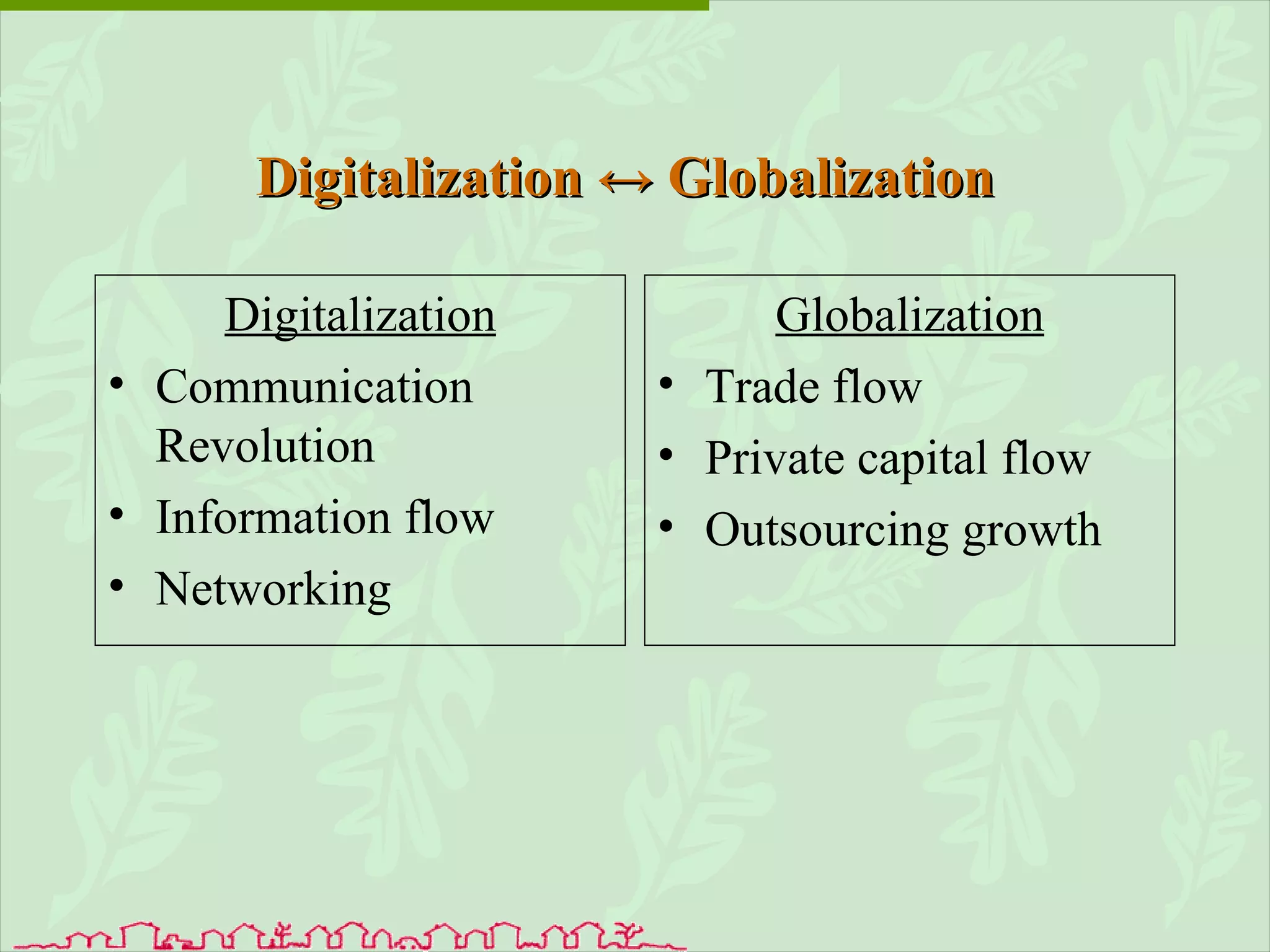
Digitalization ↔ Globalization   Digitalization Communication Revolution  Information flow Networking Globalization Trade flow Private capital flow Outsourcing growth
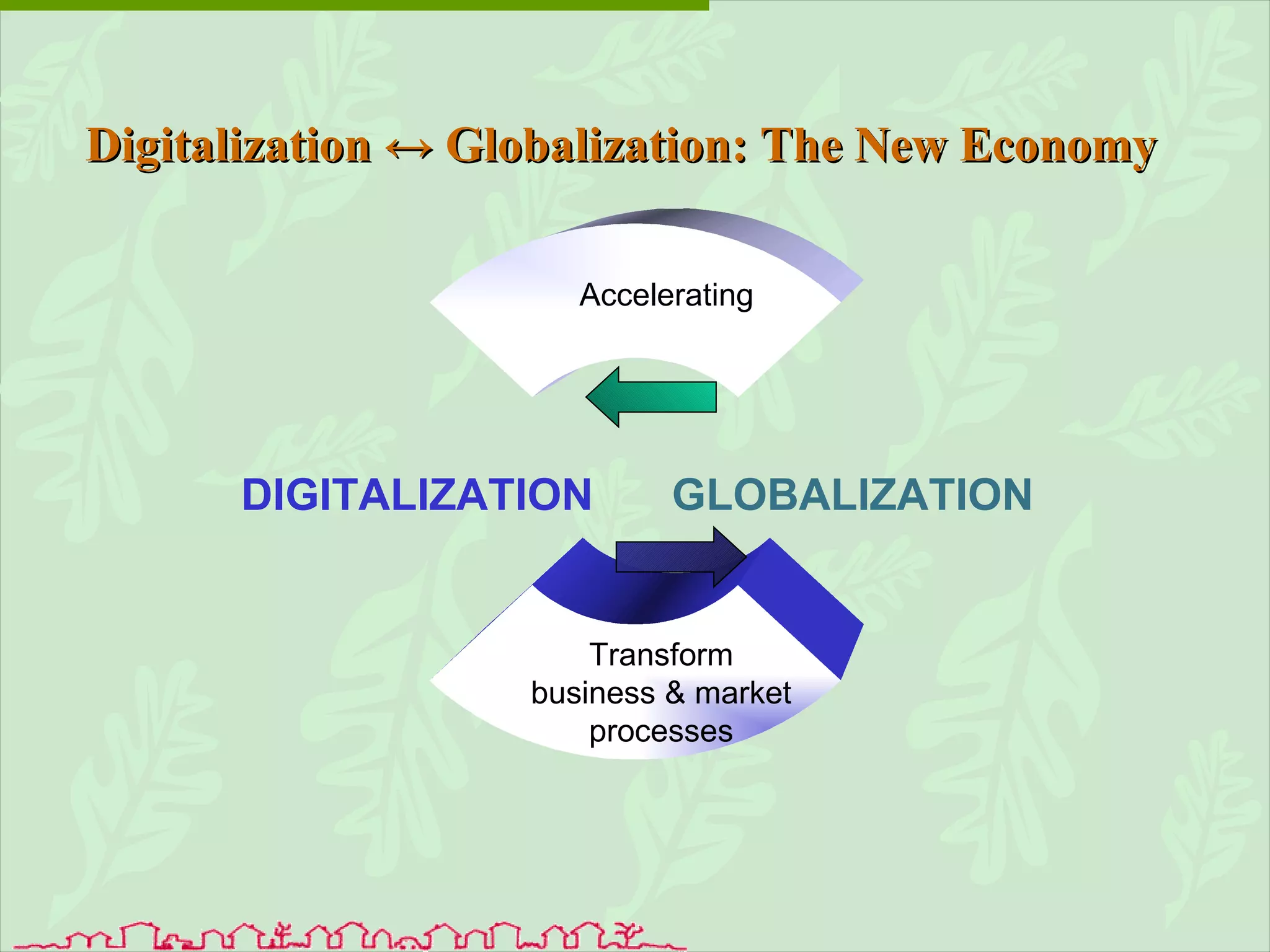
Digitalization ↔ Globalization: The New Economy   Transform business & market processes Accelerating GLOBALIZATION DIGITALIZATION
 
The Digital Divide Difference  between: those who have  access  and  effective  use of  technology , and those who either  lack  it or  don’t use  it effectively. Types of Divide : The  Global Divide  (among countries ) The  Social divide   (within countries)
The Global Divide: The disparity,  among countries , between those who have access to ICT and use them effectively and those who don’t have access or don’t use them effectively. The Social Divide: The disparity,  within   a country , between those who have access to ICT and use them effectively and those who don’t have access or don’t use them effectively. The Digital Divide
The Digital Divide Haves and have-nots based on the followiing facts: Technical aspects (infrastructure, ability, bandwidth) Gender: fewer girls involved Politics: ICT a threat for countries that do not want free flow of information Language: a dominance of English and Western languages: limits access to information Literacy: both illiteracy and IT-illiteracy affect access.
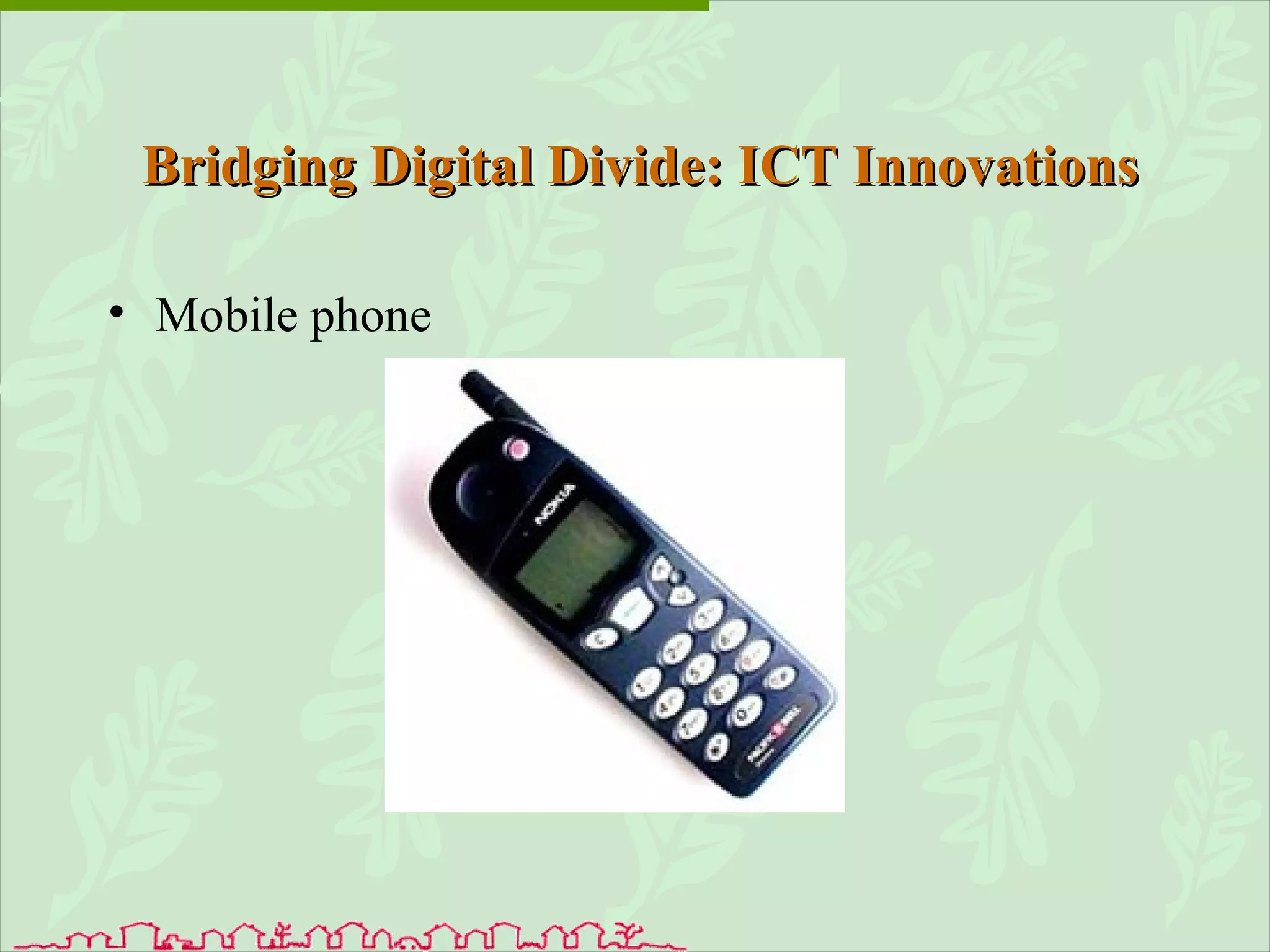
Mobile phone Bridging Digital Divide: ICT Innovations
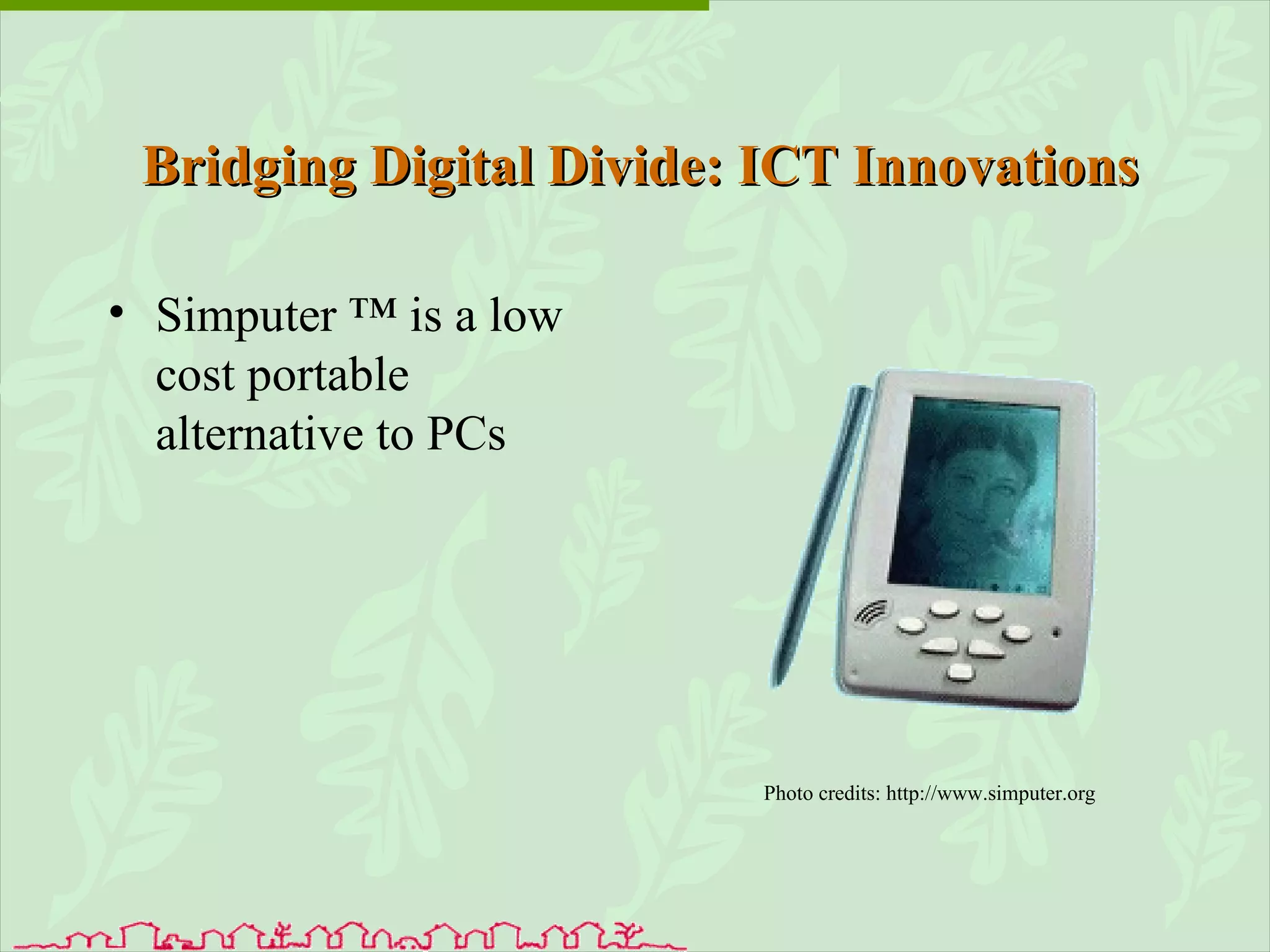
Simputer ™ is a low cost portable alternative to PCs  Bridging Digital Divide: ICT Innovations Photo credits: http://www.simputer.org
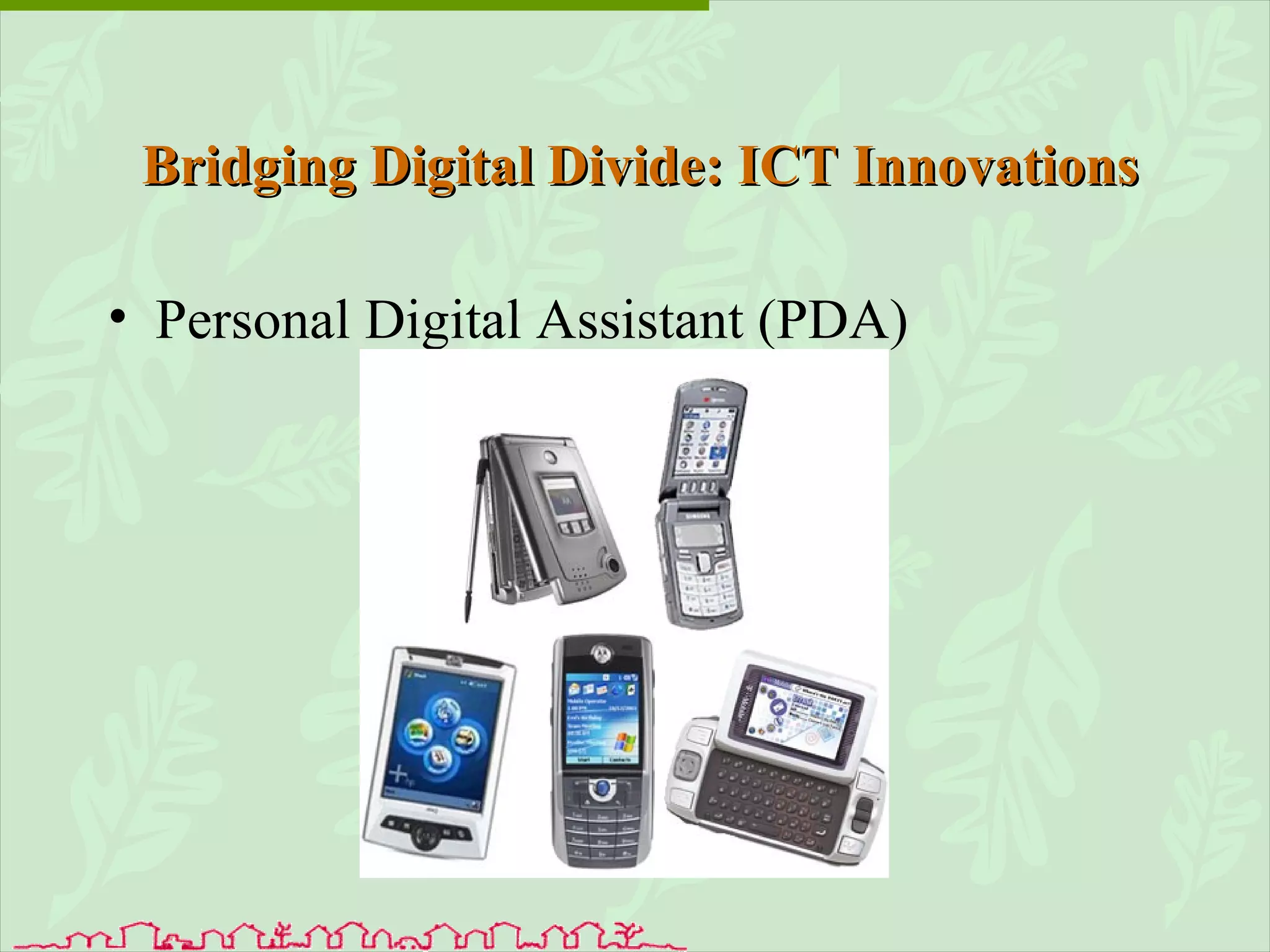
Personal Digital Assistant (PDA) Bridging Digital Divide: ICT Innovations
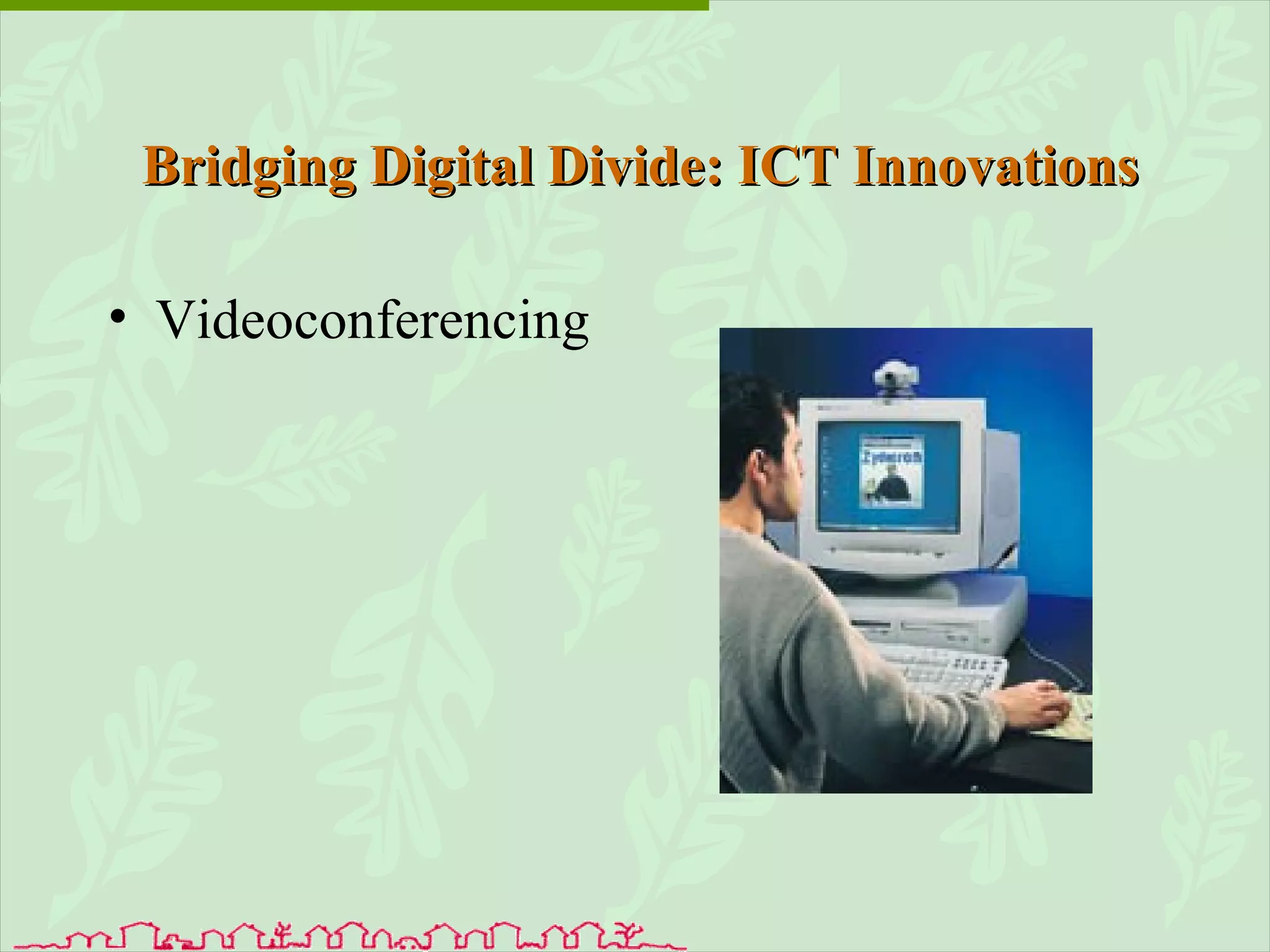
Videoconferencing Bridging Digital Divide: ICT Innovations
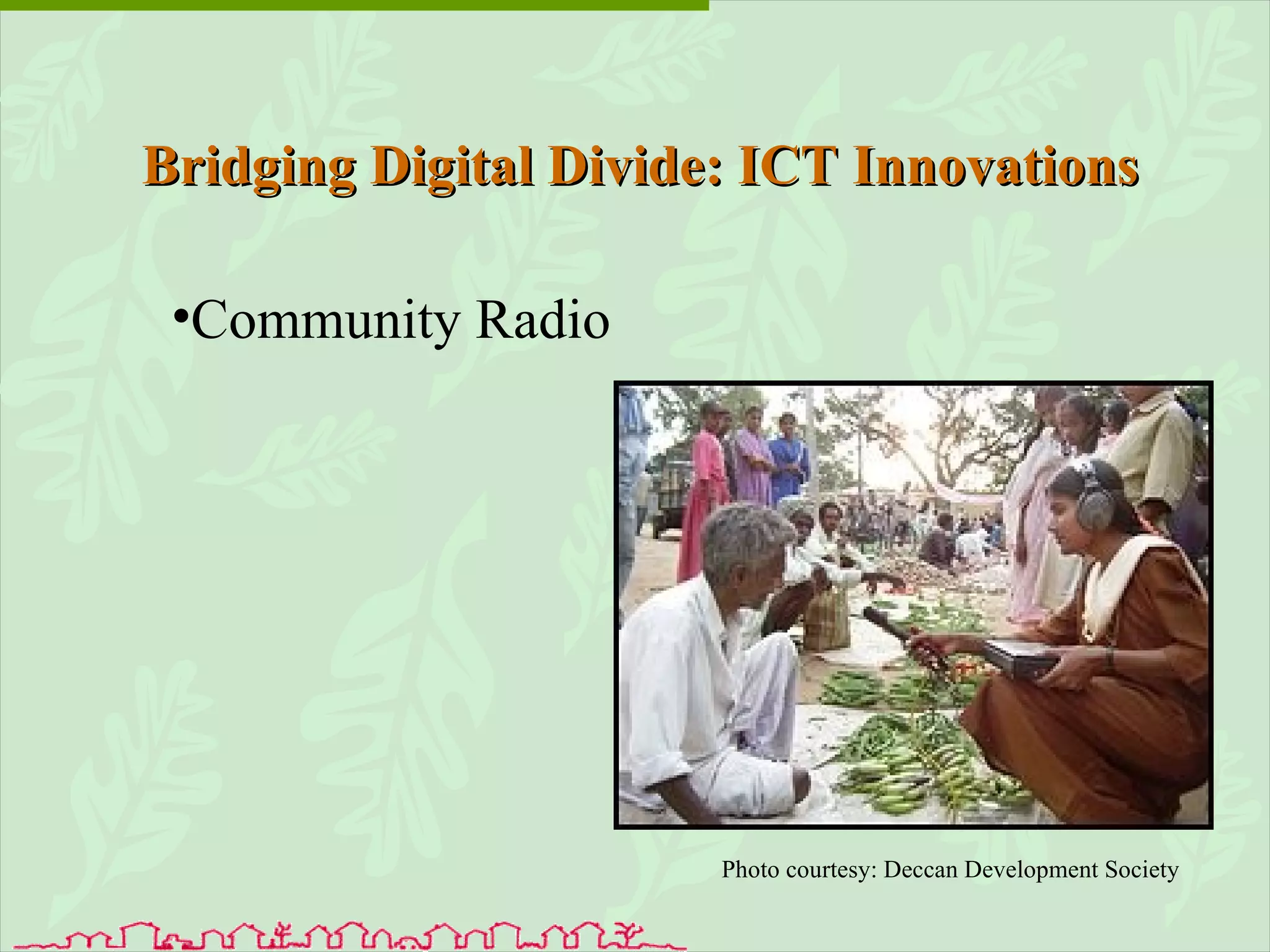
Community Radio Bridging Digital Divide: ICT Innovations Photo courtesy: Deccan Development Society
Application of ICTs Development Governance Agriculture
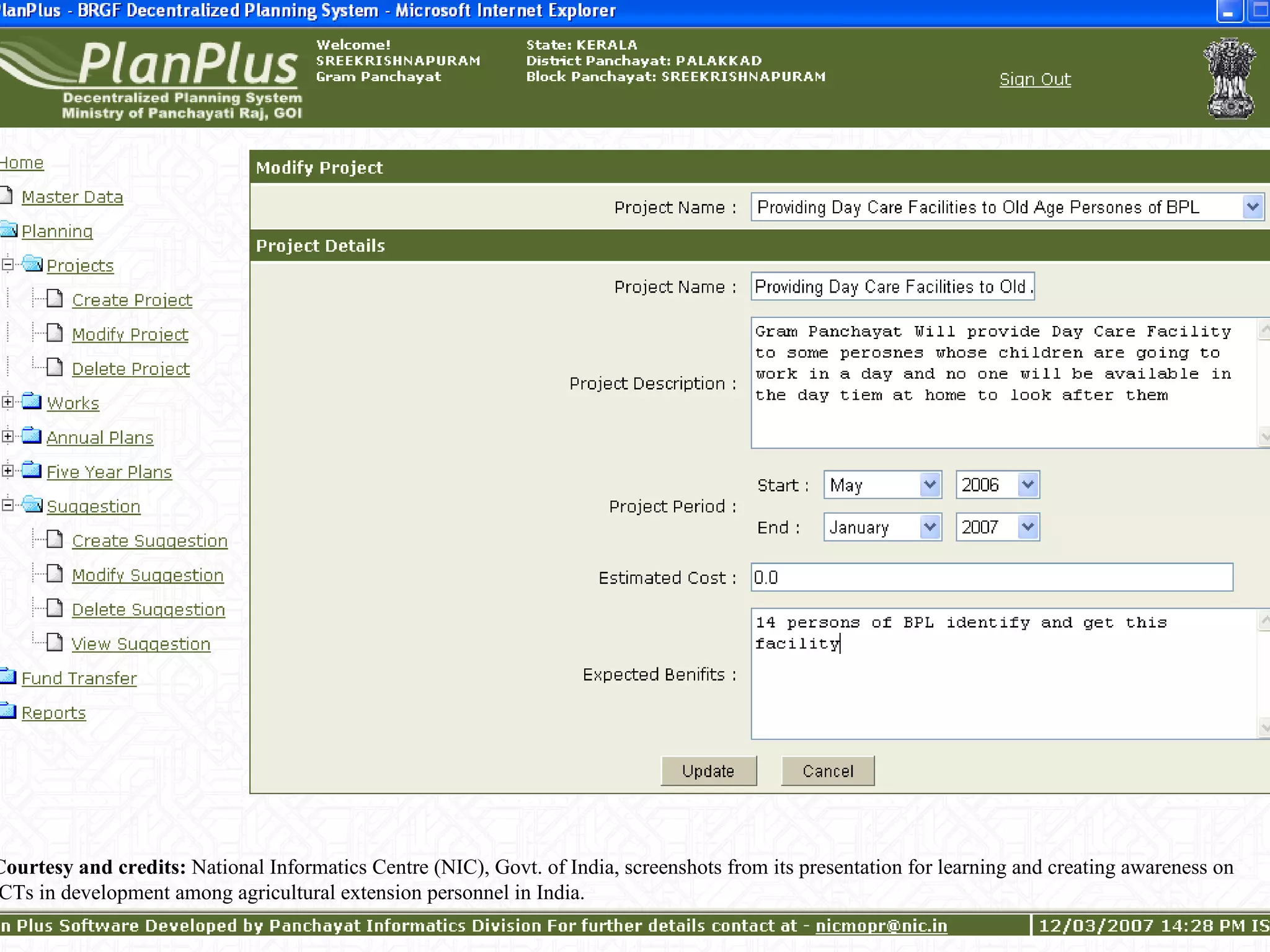
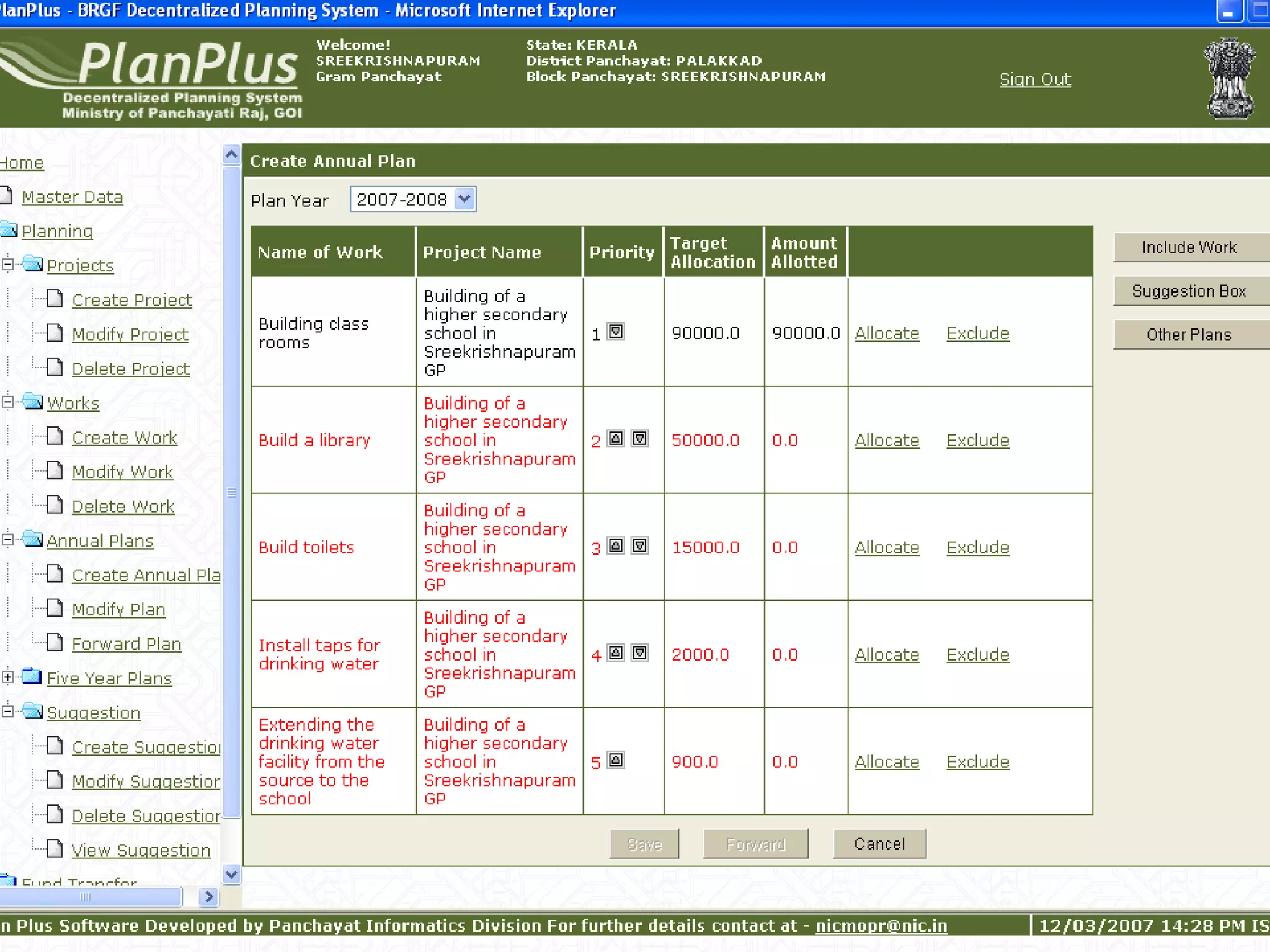
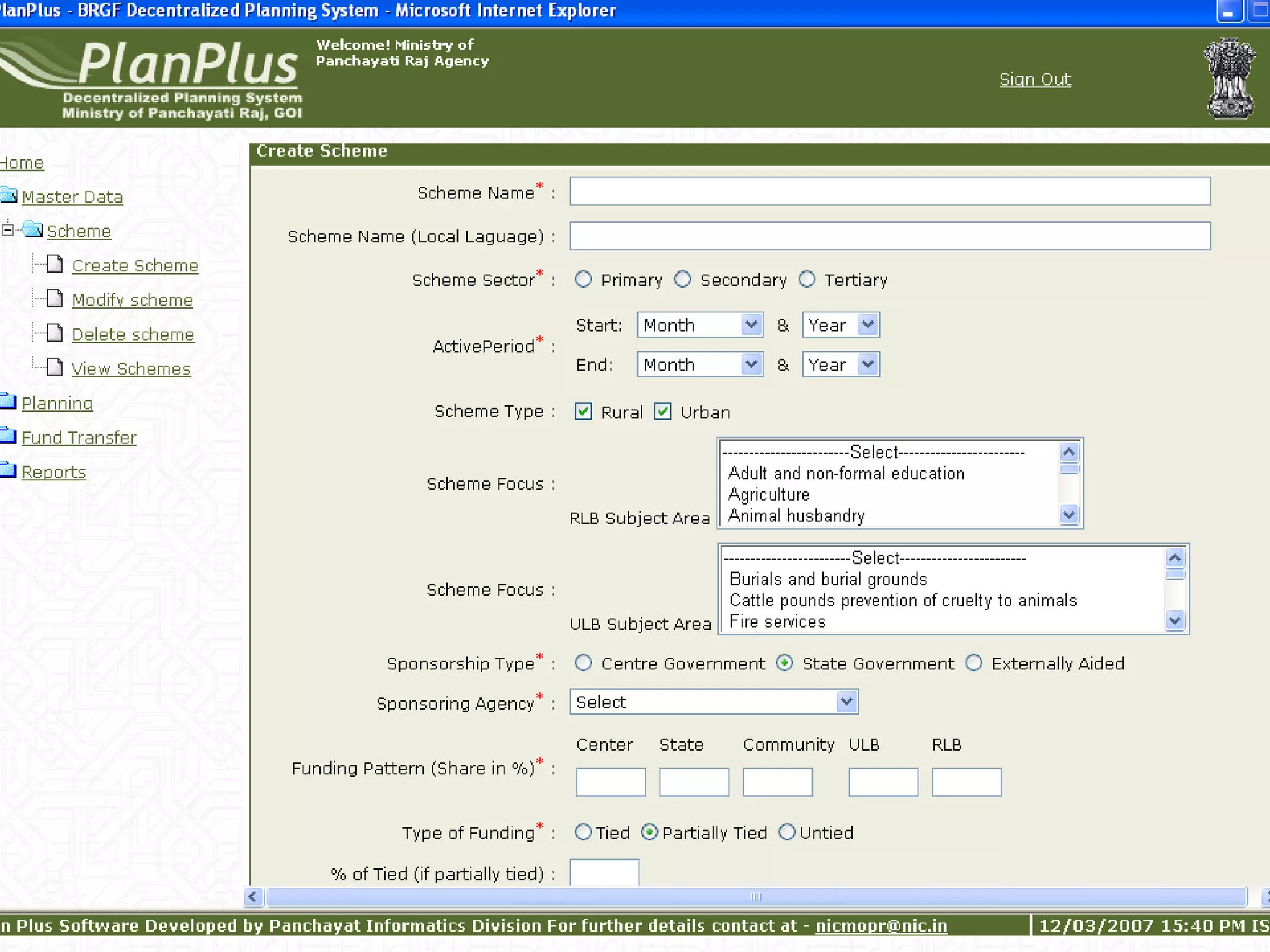
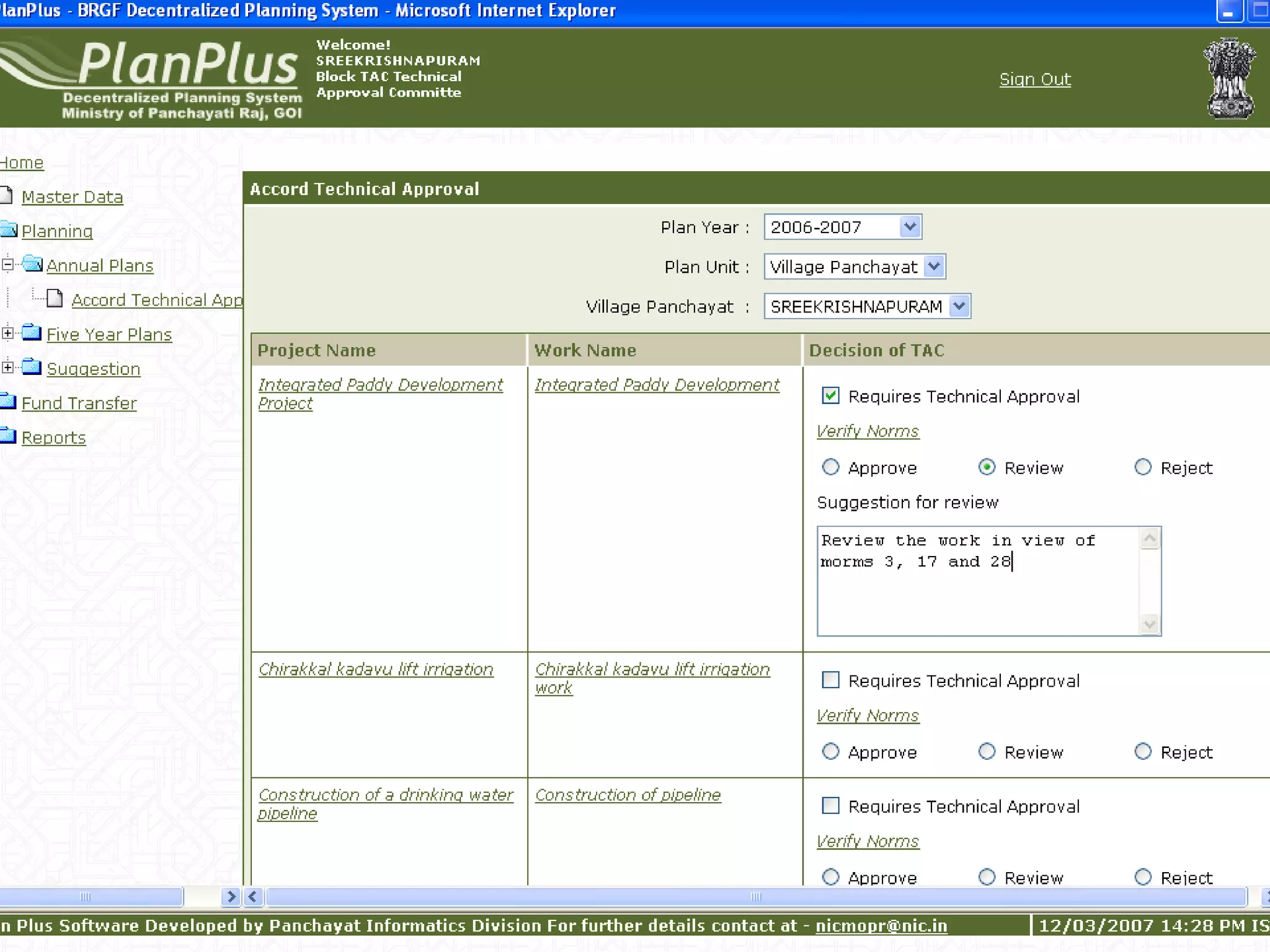
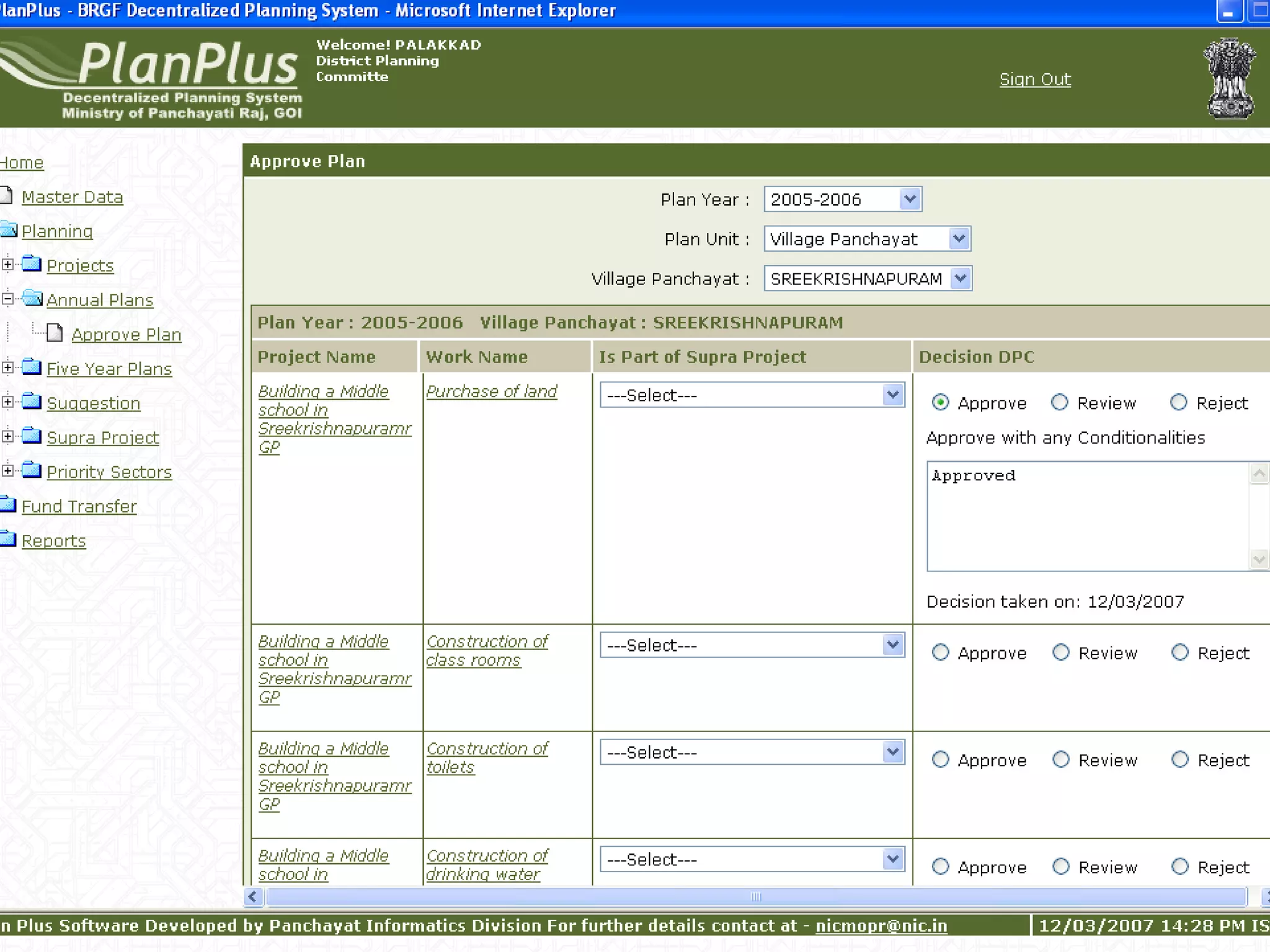
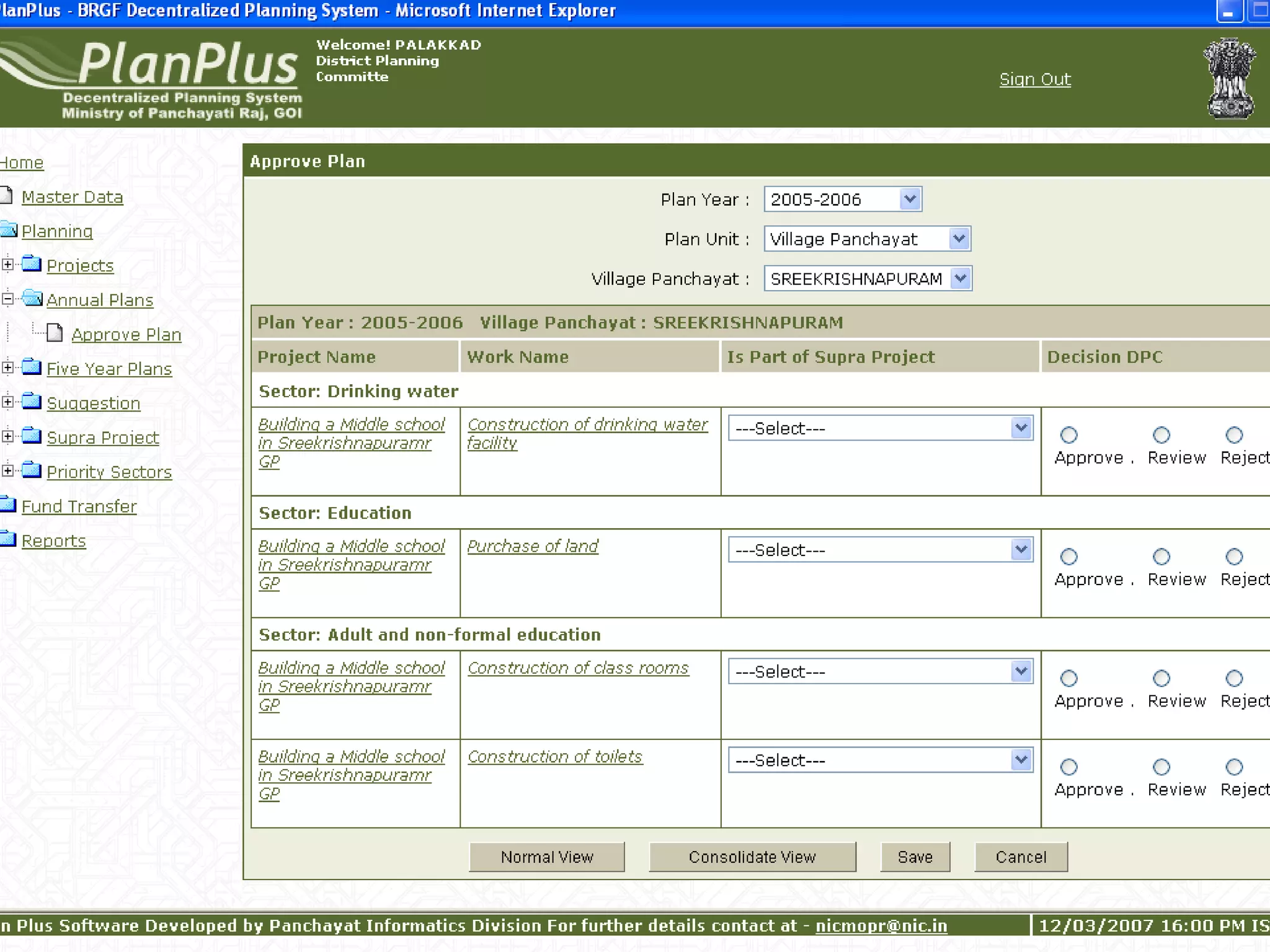
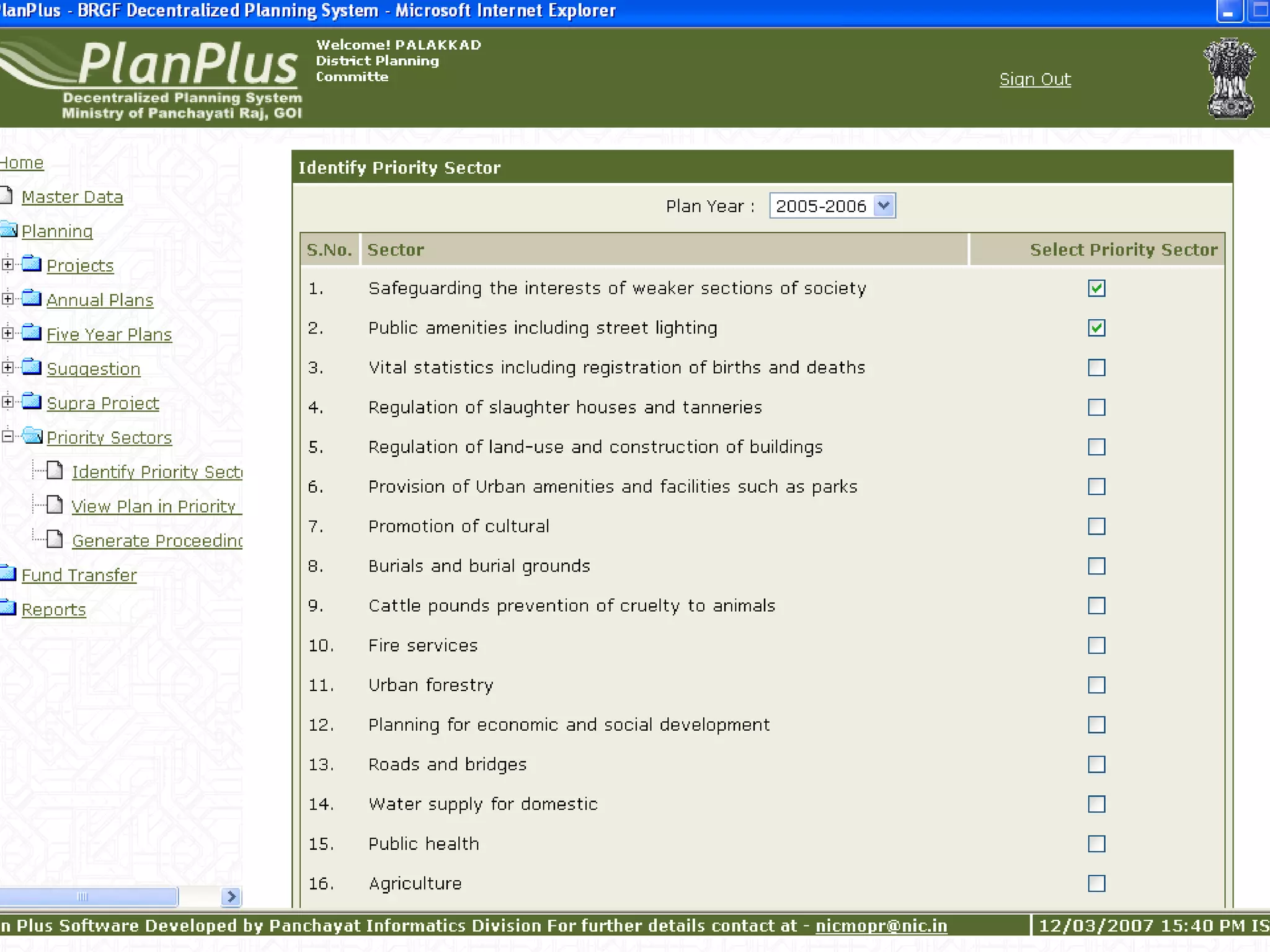
Development Planning for development, Health, Education, Disaster management etc. Application of ICTs
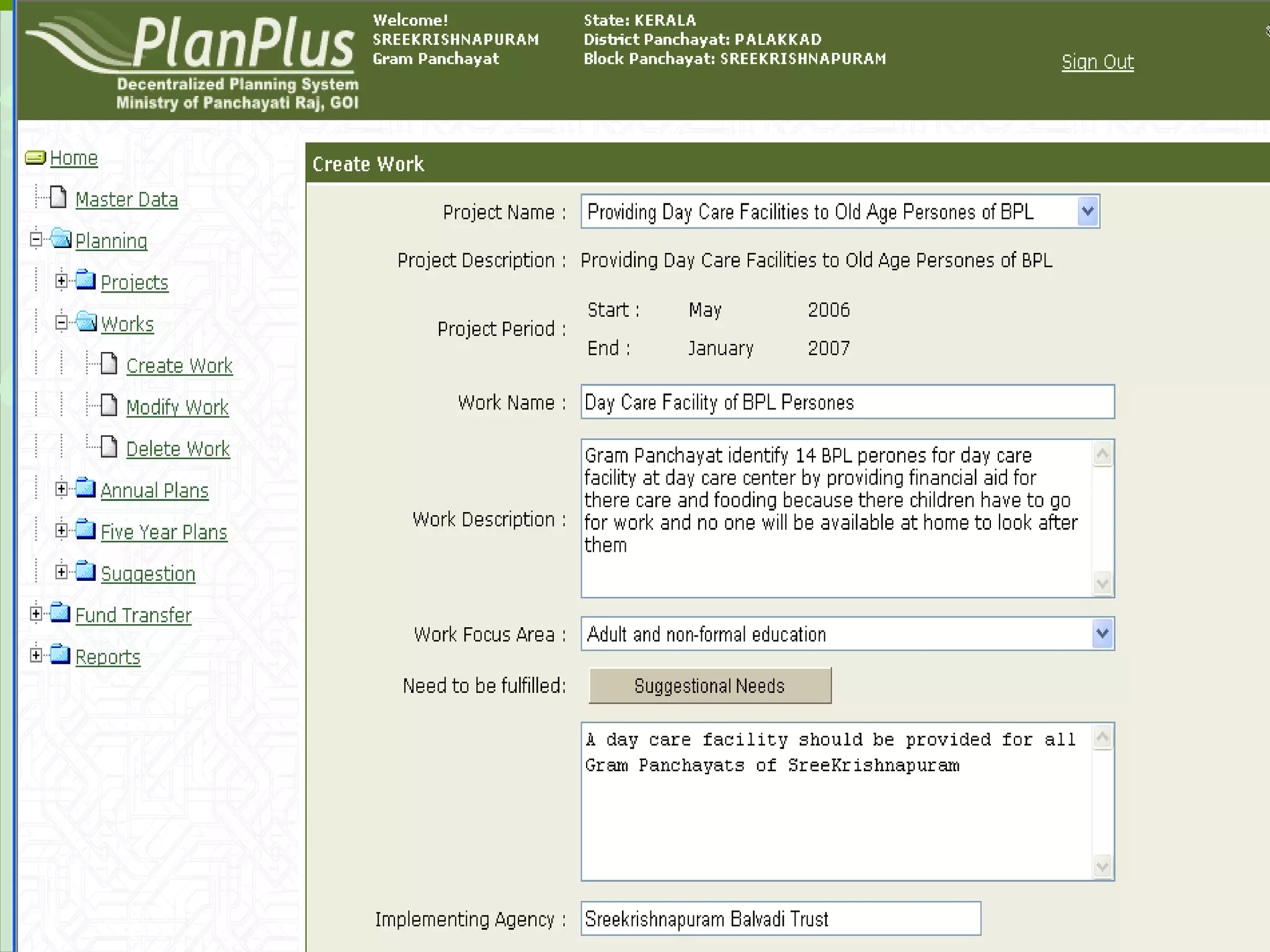
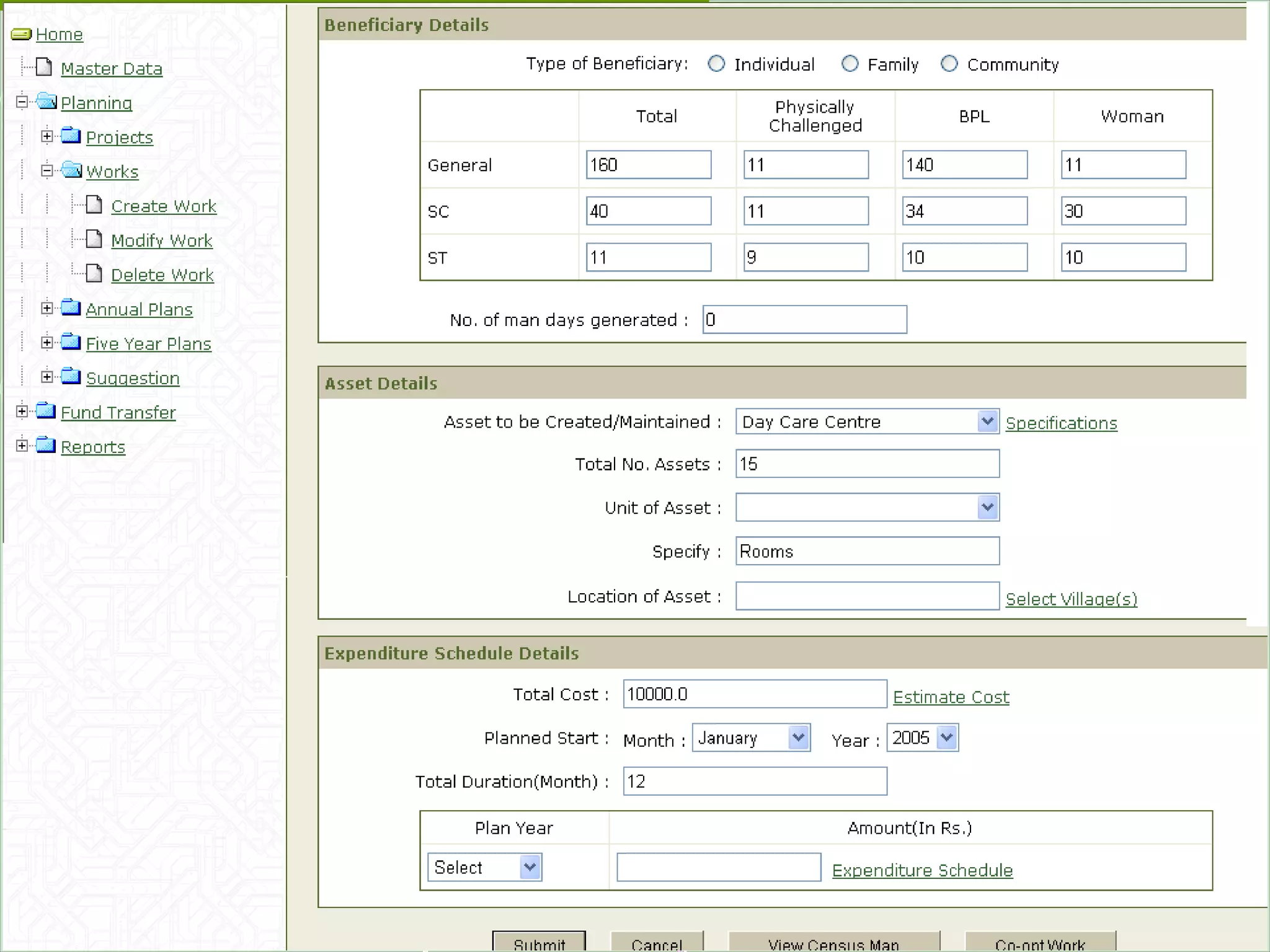
Courtesy and credits:  National Informatics Centre (NIC), Govt. of India, screenshots from its presentation for learning and creating awareness on ICTs in development among agricultural extension personnel in India.


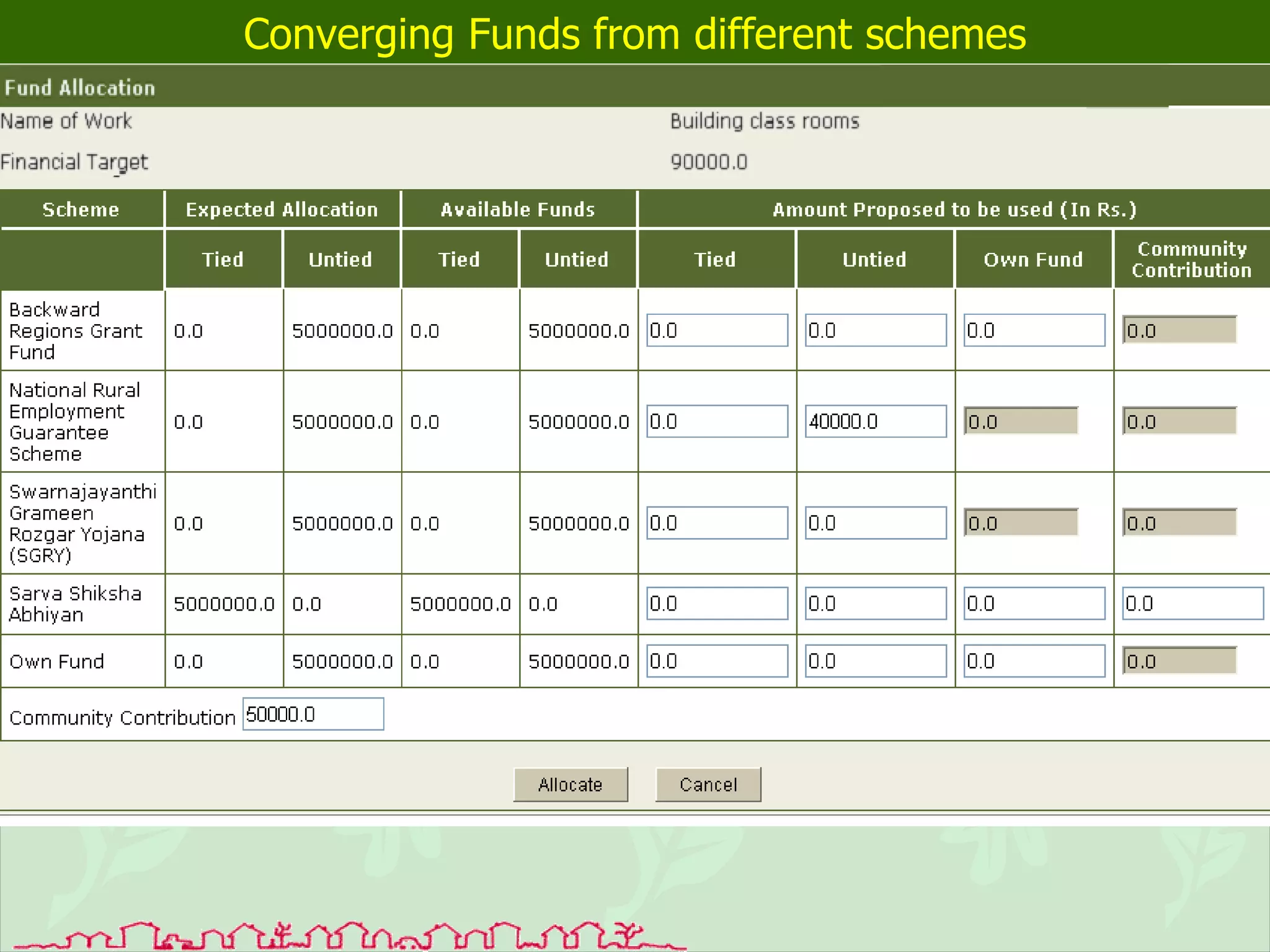
Converging Funds from different schemes


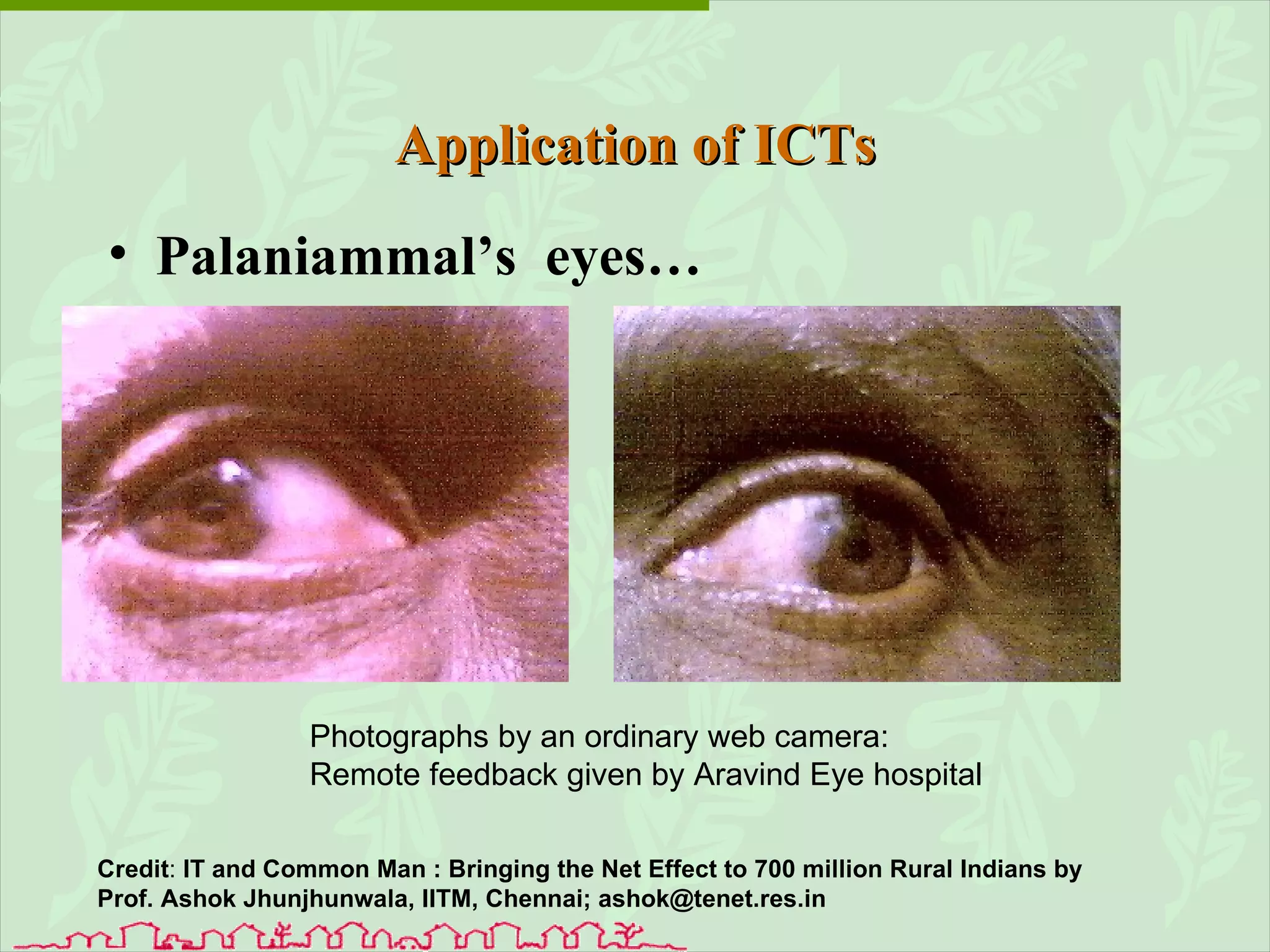
Palaniammal’s  eyes… Application of ICTs Photographs by an ordinary web camera: Remote feedback given by Aravind Eye hospital Credit :  IT and Common Man :  Bringing the Net Effect to 700 million Rural Indians by Prof. Ashok Jhunjhunwala, IITM, Chennai; ashok@tenet.res.in
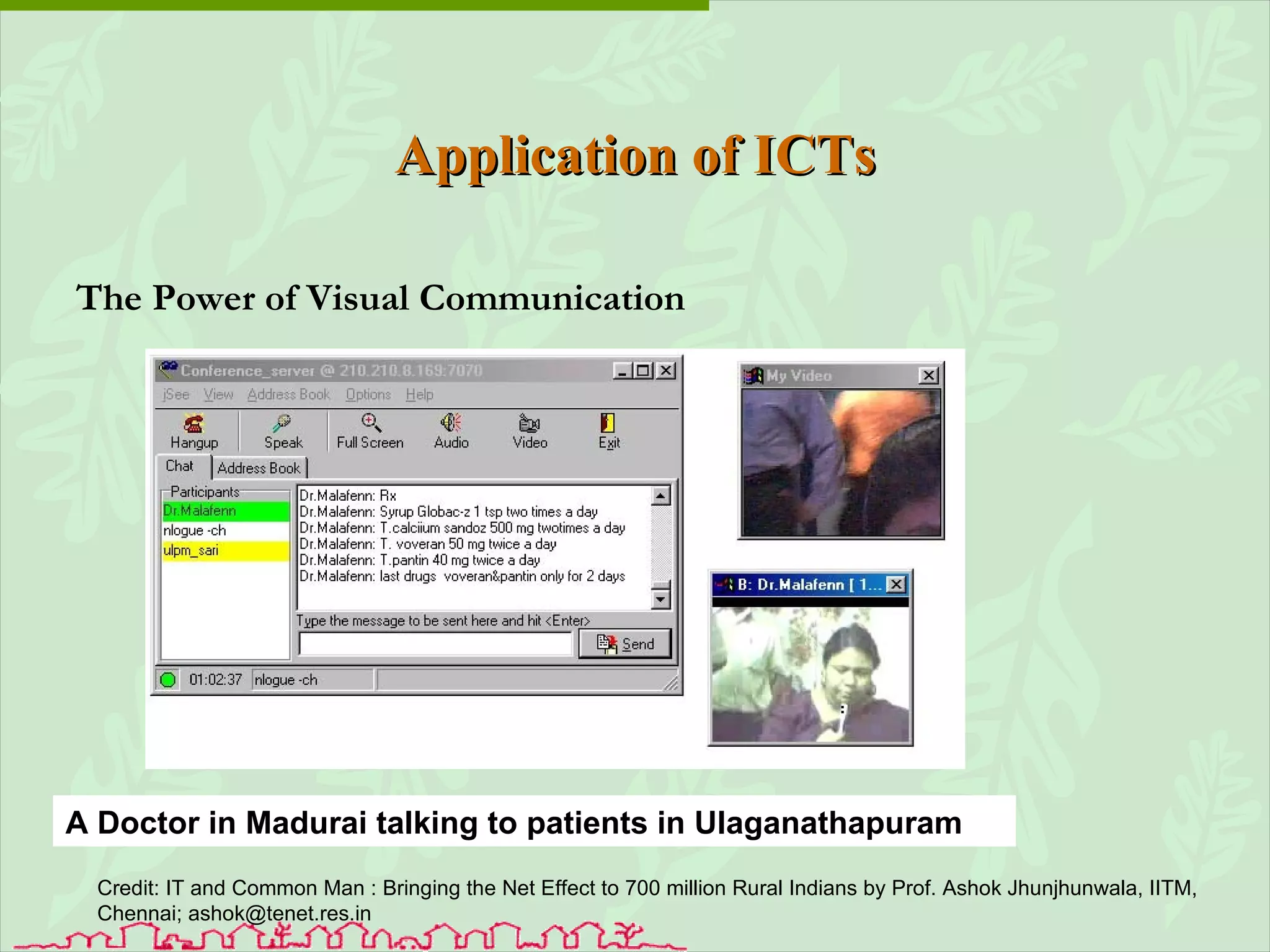
Application of ICTs The Power of Visual Communication A Doctor in Madurai talking to patients in Ulaganathapuram Credit:  IT and Common Man :  Bringing the Net Effect to 700 million Rural Indians by Prof. Ashok Jhunjhunwala, IITM, Chennai; ashok@tenet.res.in
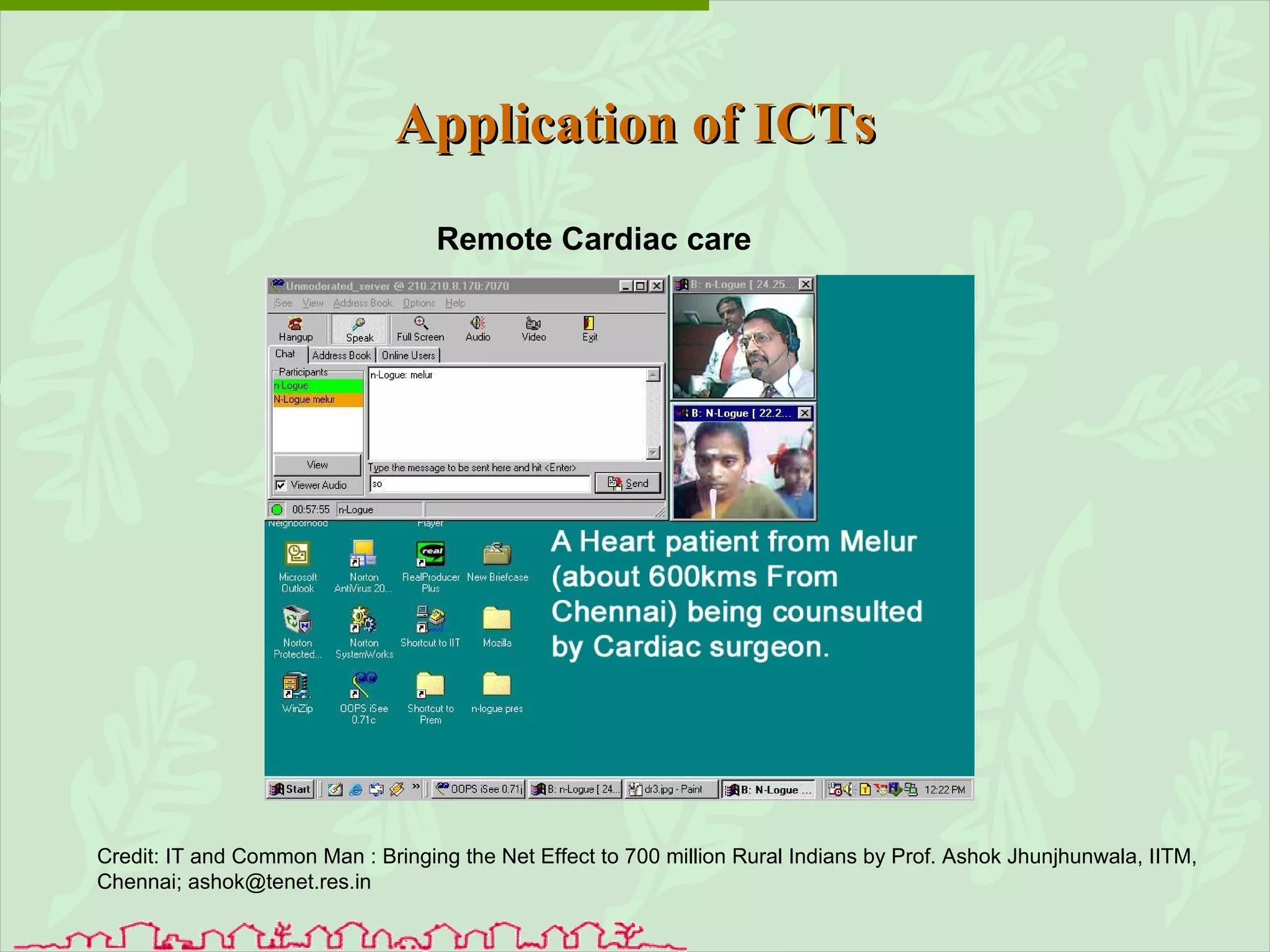
Application of ICTs Remote Cardiac care Credit:  IT and Common Man :  Bringing the Net Effect to 700 million Rural Indians by Prof. Ashok Jhunjhunwala, IITM, Chennai; ashok@tenet.res.in
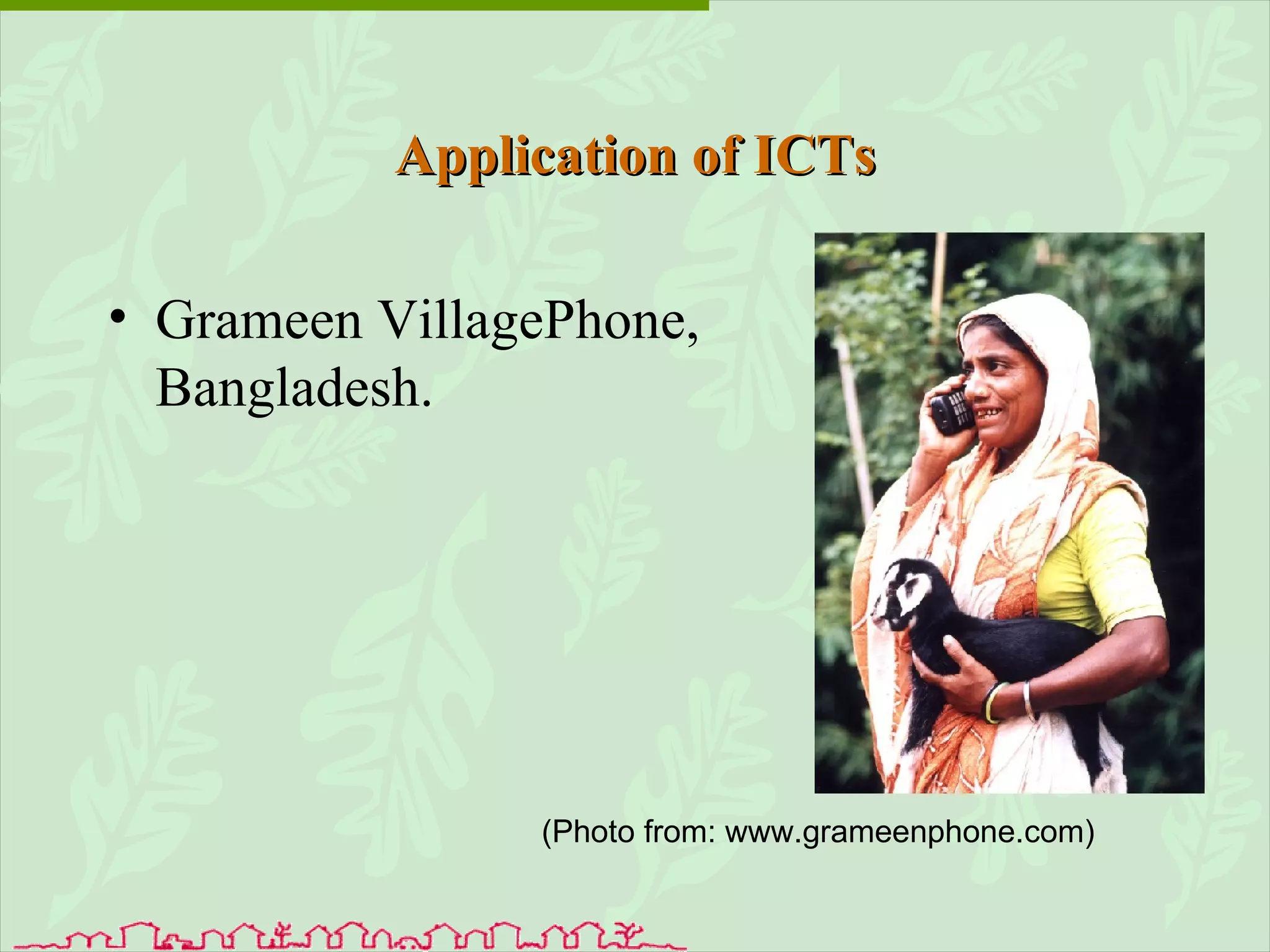
Grameen VillagePhone, Bangladesh. Application of ICTs (Photo from: www.grameenphone.com)
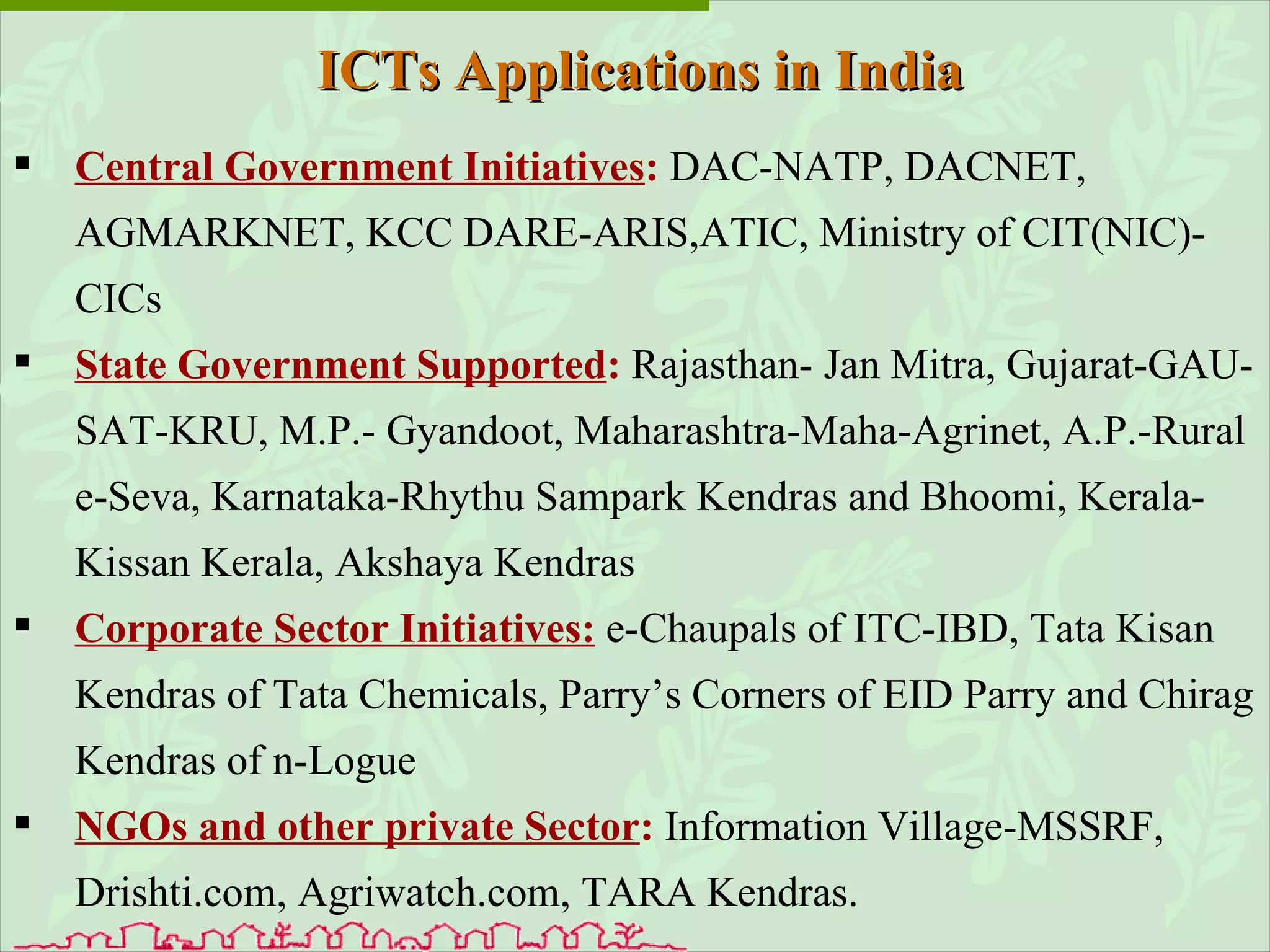
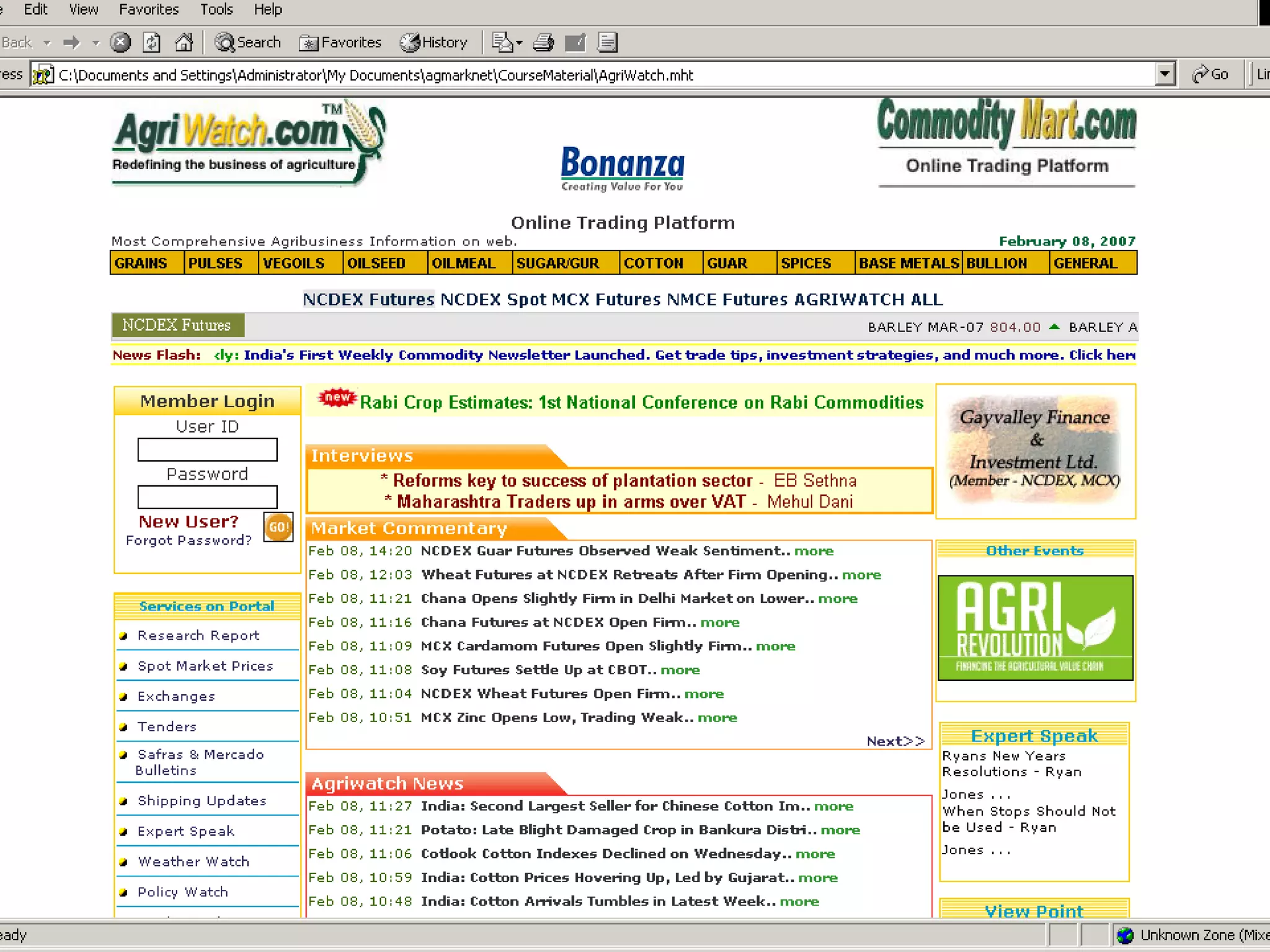
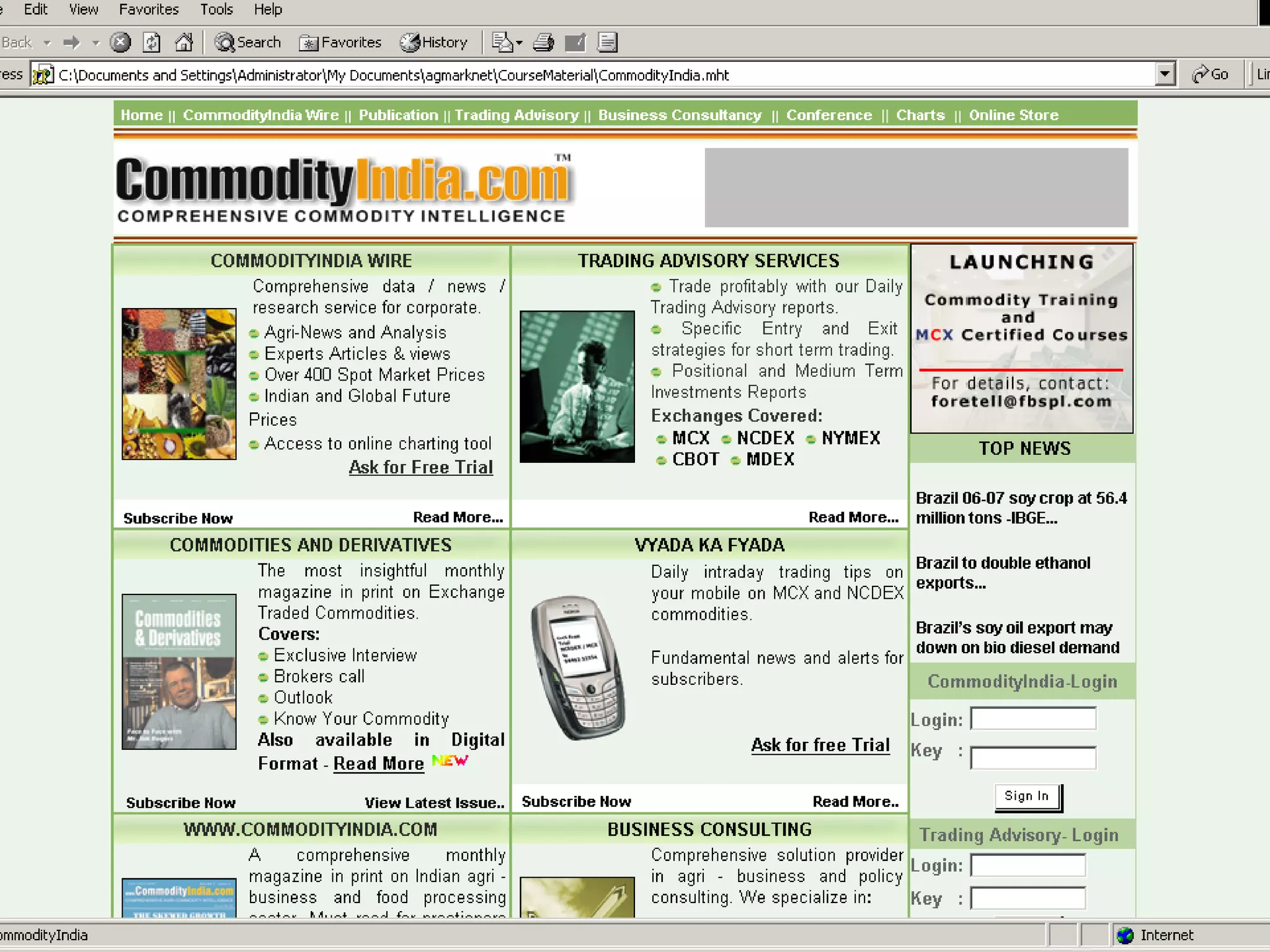
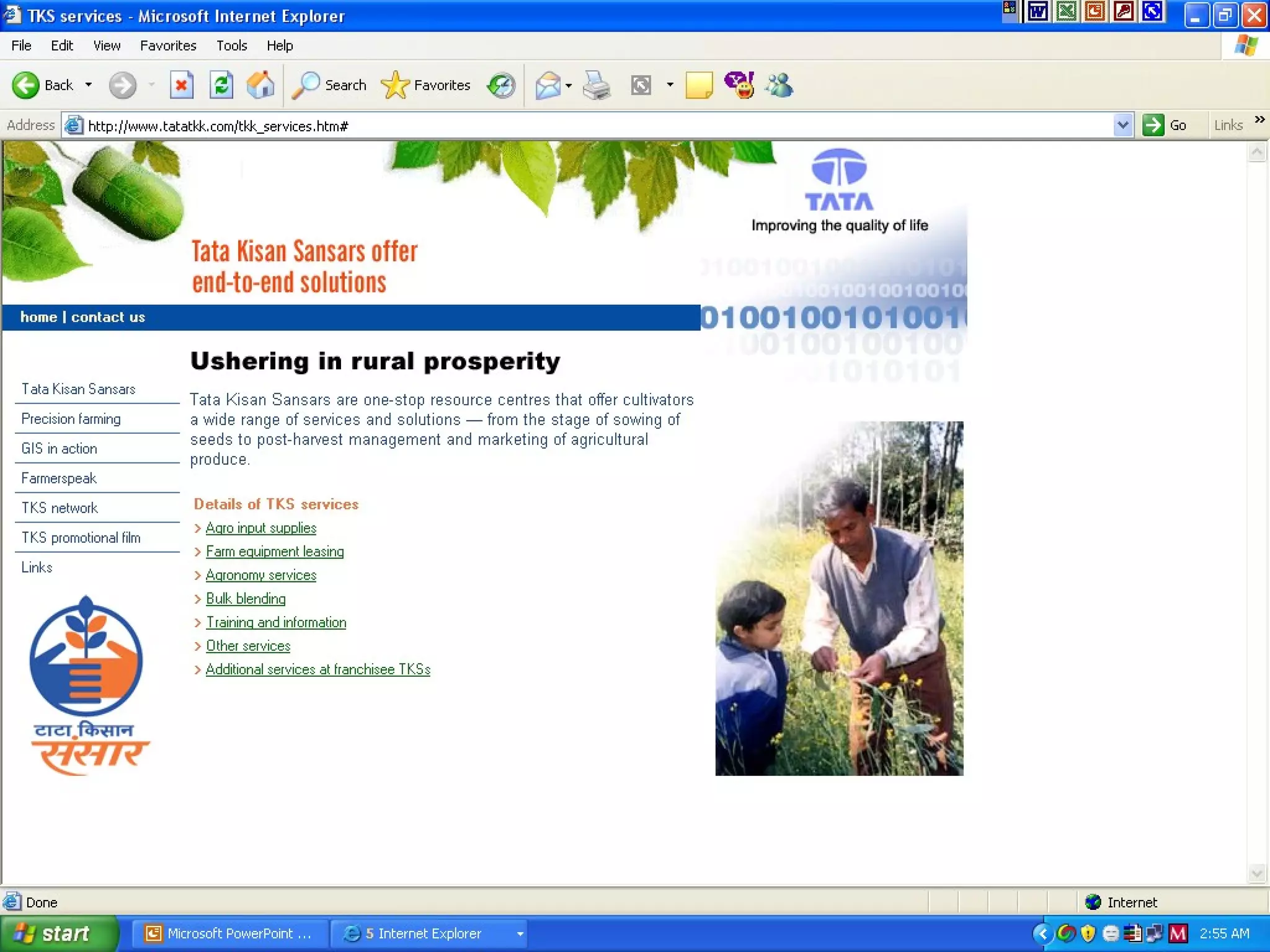
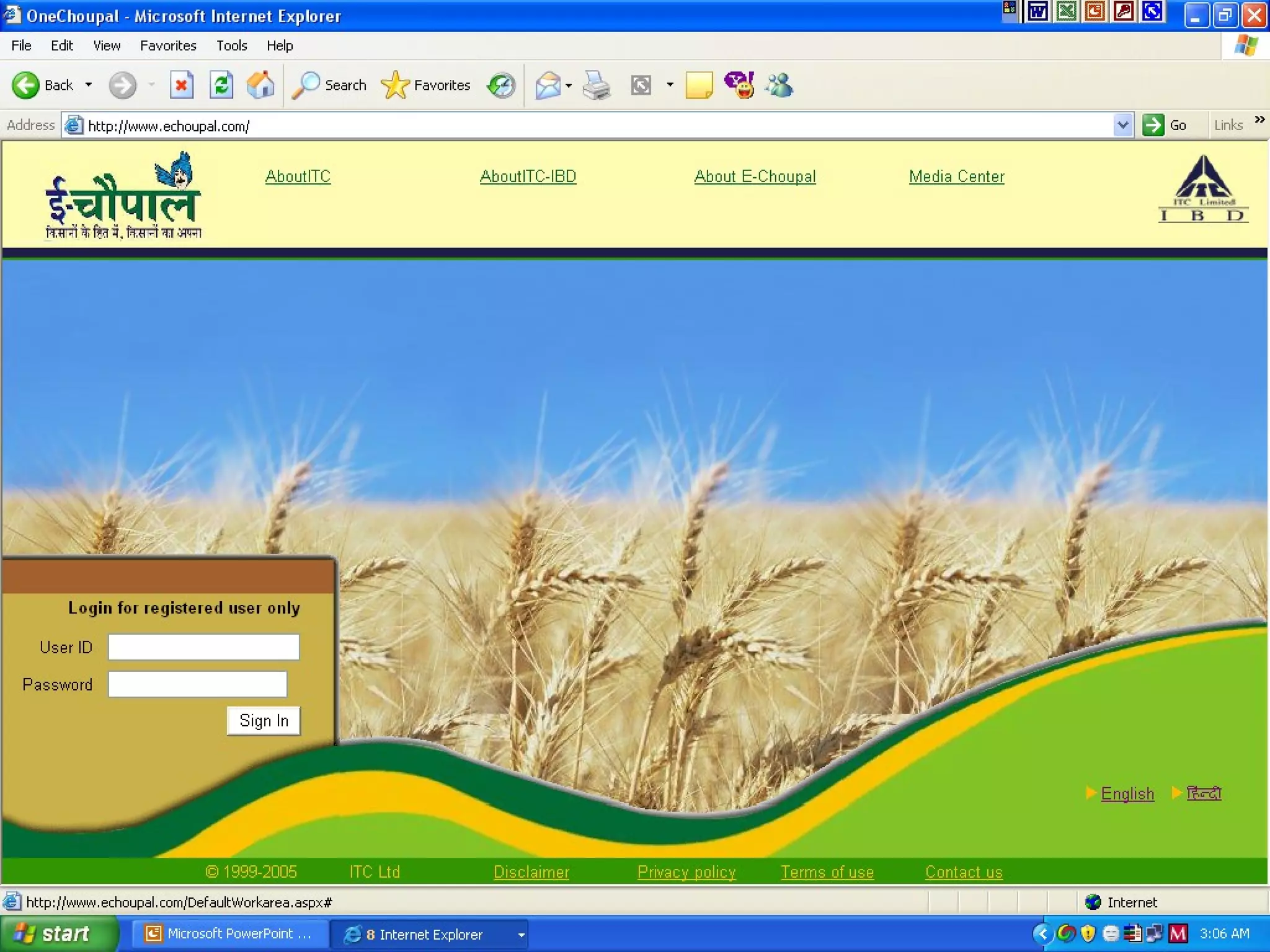
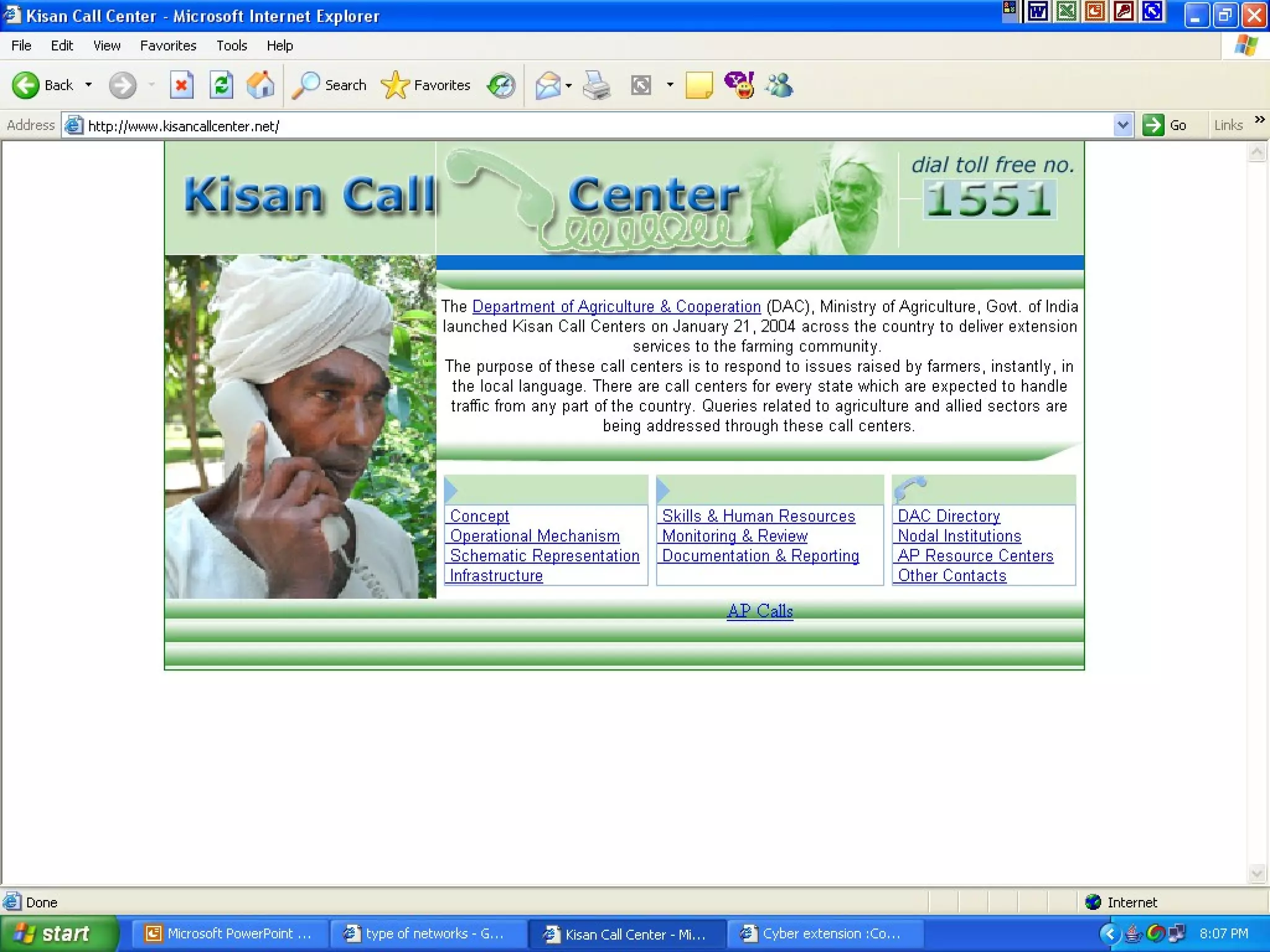
Central Government Initiatives :   DAC-NATP, DACNET, AGMARKNET, KCC DARE-ARIS,ATIC, Ministry of CIT(NIC)- CICs State Government Supported :   Rajasthan- Jan Mitra, Gujarat-GAU-SAT-KRU, M.P.- Gyandoot, Maharashtra-Maha-Agrinet, A.P.-Rural e-Seva, Karnataka-Rhythu Sampark Kendras and Bhoomi, Kerala- Kissan Kerala, Akshaya Kendras Corporate Sector Initiatives:   e-Chaupals of ITC-IBD, Tata Kisan Kendras of Tata Chemicals, Parry’s Corners of EID Parry and Chirag Kendras of n-Logue NGOs and other private Sector :   Information Village-MSSRF, Drishti.com, Agriwatch.com, TARA Kendras. ICTs Applications in India
Ministry of Panchayati Raj to establish Information Kiosks in 2,37,000 Panchayats (Mission 2007) Department of Information Technology (DIT)  plans to initiate over 1,00,000 Common Service Centres (CSCs) under the National eGovernance Plan (NeGP).  ITC is adding 7 new eChaupals a day and plans to scale up to 20,000 eChaupals by 2010 covering 100,000 villages in 15 states. (Sivakumar CEO, ITC-IBD)  Governments of Uttaranchal, Rajasthan, A.P., Kerala have also announced Major Rural Connectivity Projects Application of ICTs in Agriculture
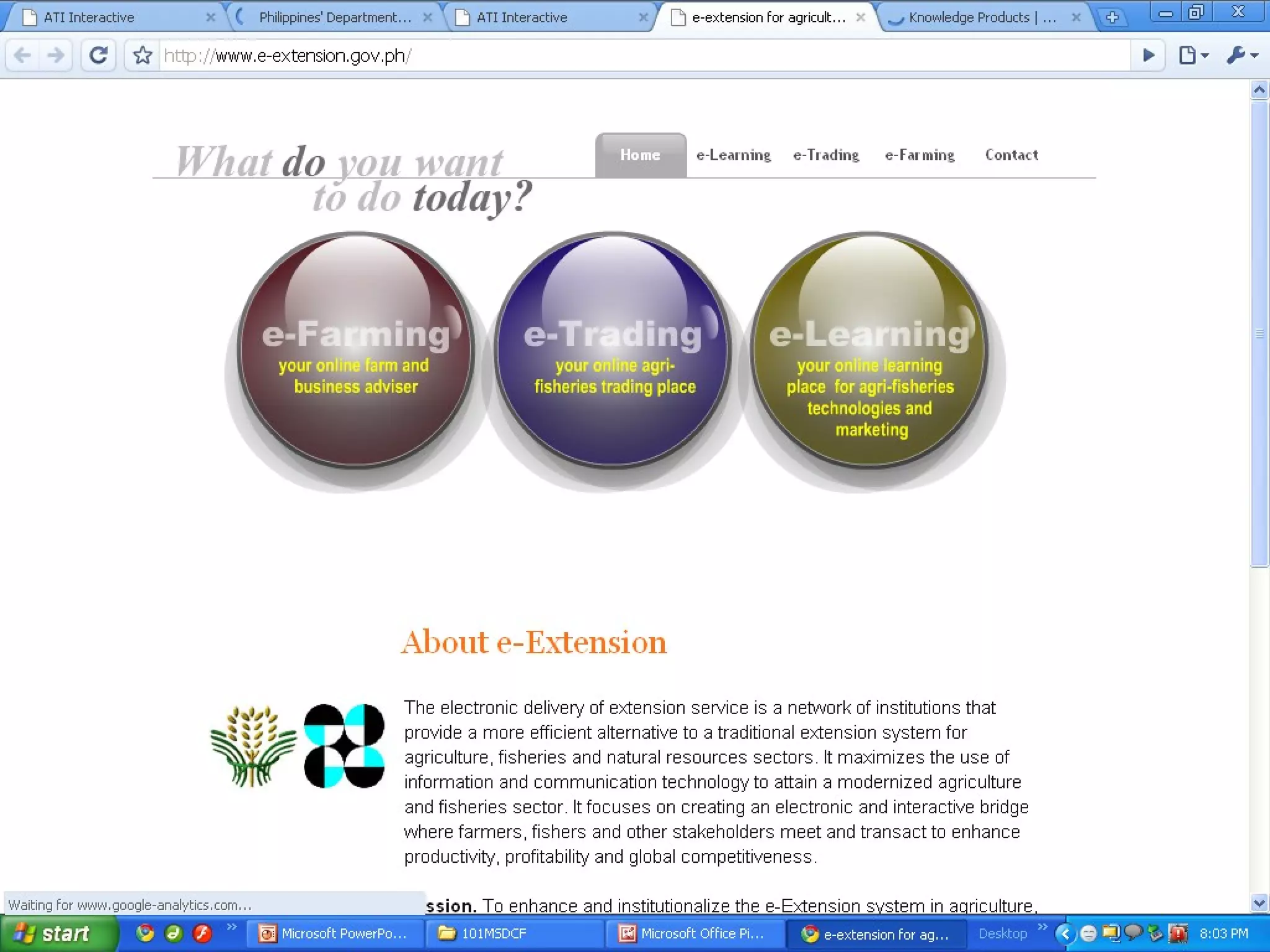
Use of ICT by all NARS Research Information Networks, Expert Systems, Decision Support Systems; Knowledge Networks Agricultural Extension Cyber Extension, e-Extension, Virtual Extension Agribusiness &Marketing Market information websites; Agribusiness portals E-trading Application of ICT in Agricultural Research-Extension-Marketing
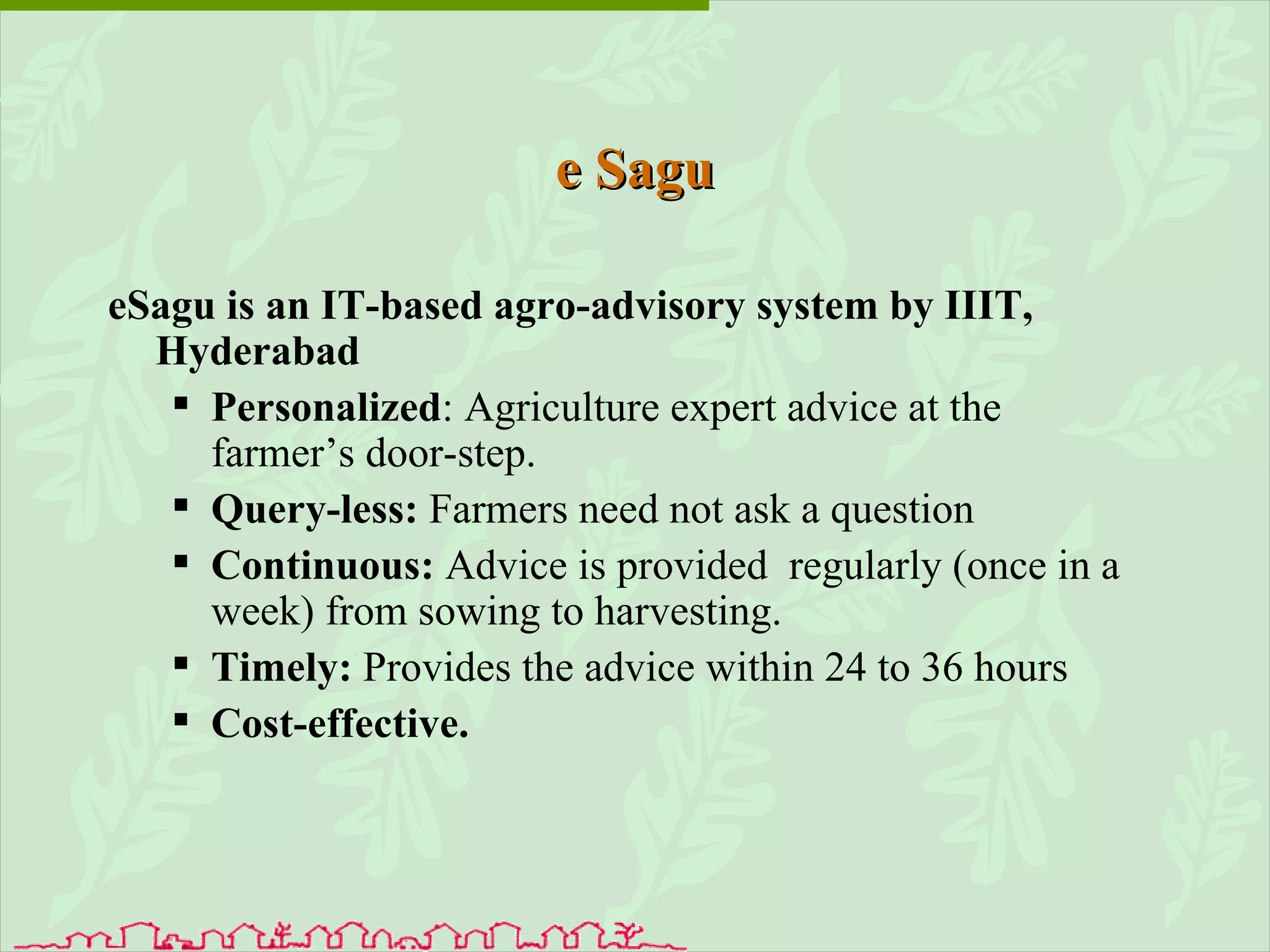
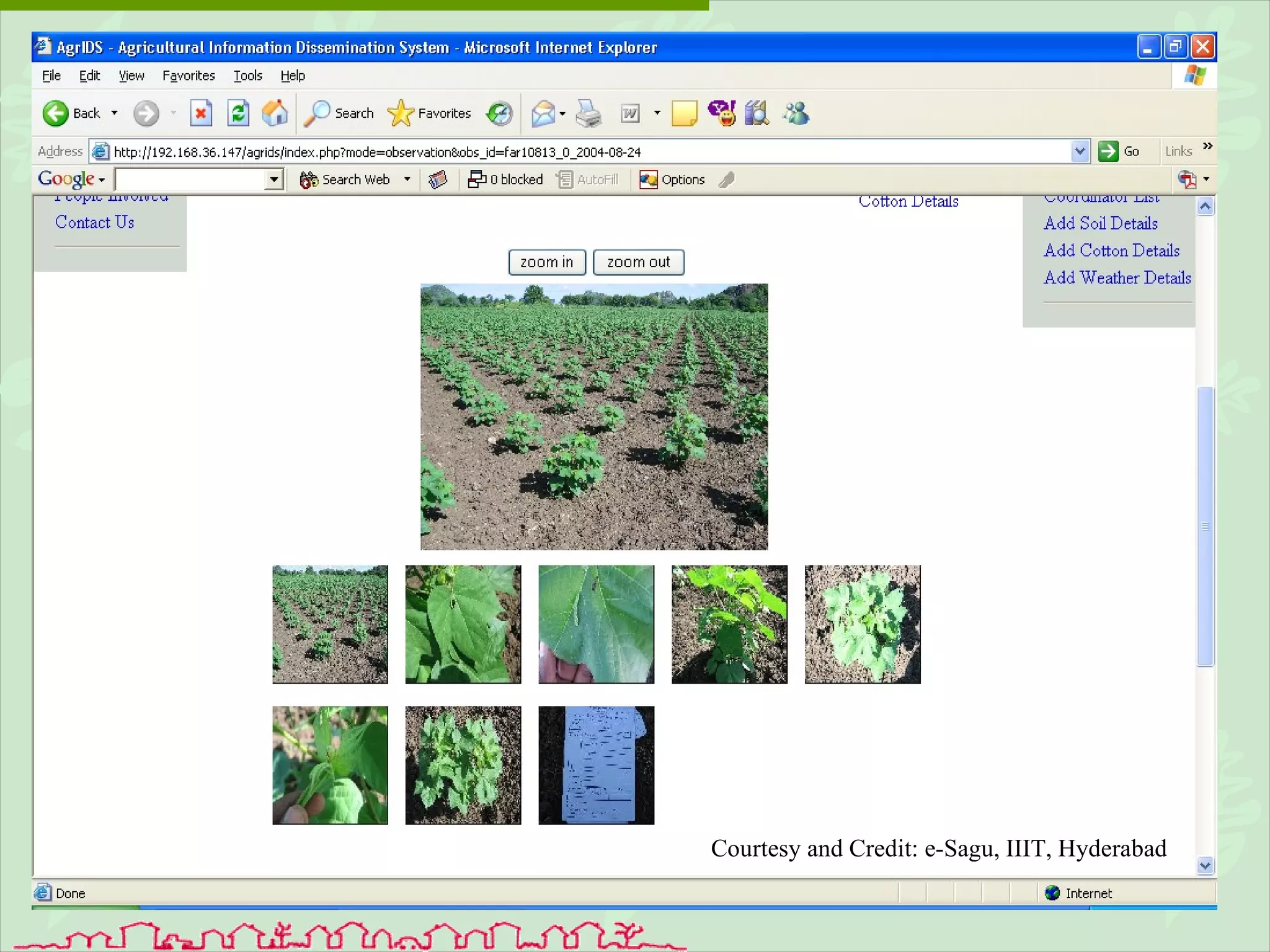
e Sagu eSagu is an IT-based agro-advisory system by IIIT, Hyderabad  Personalized : Agriculture expert advice at the  farmer’s door-step.  Query-less:  Farmers need not ask a question Continuous:  Advice is provided  regularly (once in a week) from sowing to harvesting. Timely:  Provides the advice within 24 to 36 hours Cost-effective.
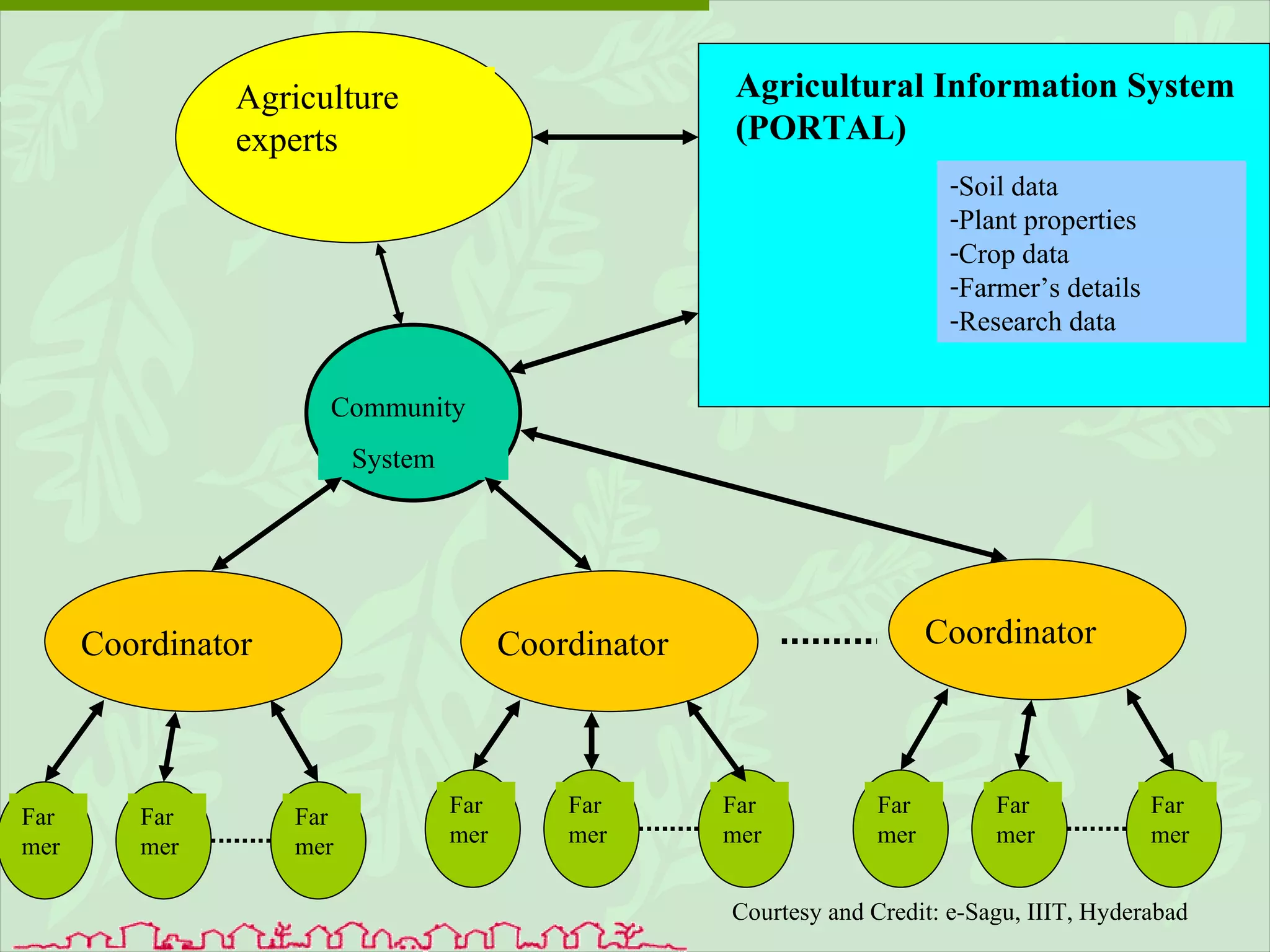
Courtesy and Credit: e-Sagu, IIIT, Hyderabad Agriculture experts Community System Agricultural Information System (PORTAL) Soil data Plant properties Crop data Farmer’s details Research data Coordinator Coordinator Coordinator Far mer Far mer Far mer Far mer Far mer Far mer Far mer Far mer Far mer
Courtesy and Credit: e-Sagu, IIIT, Hyderabad
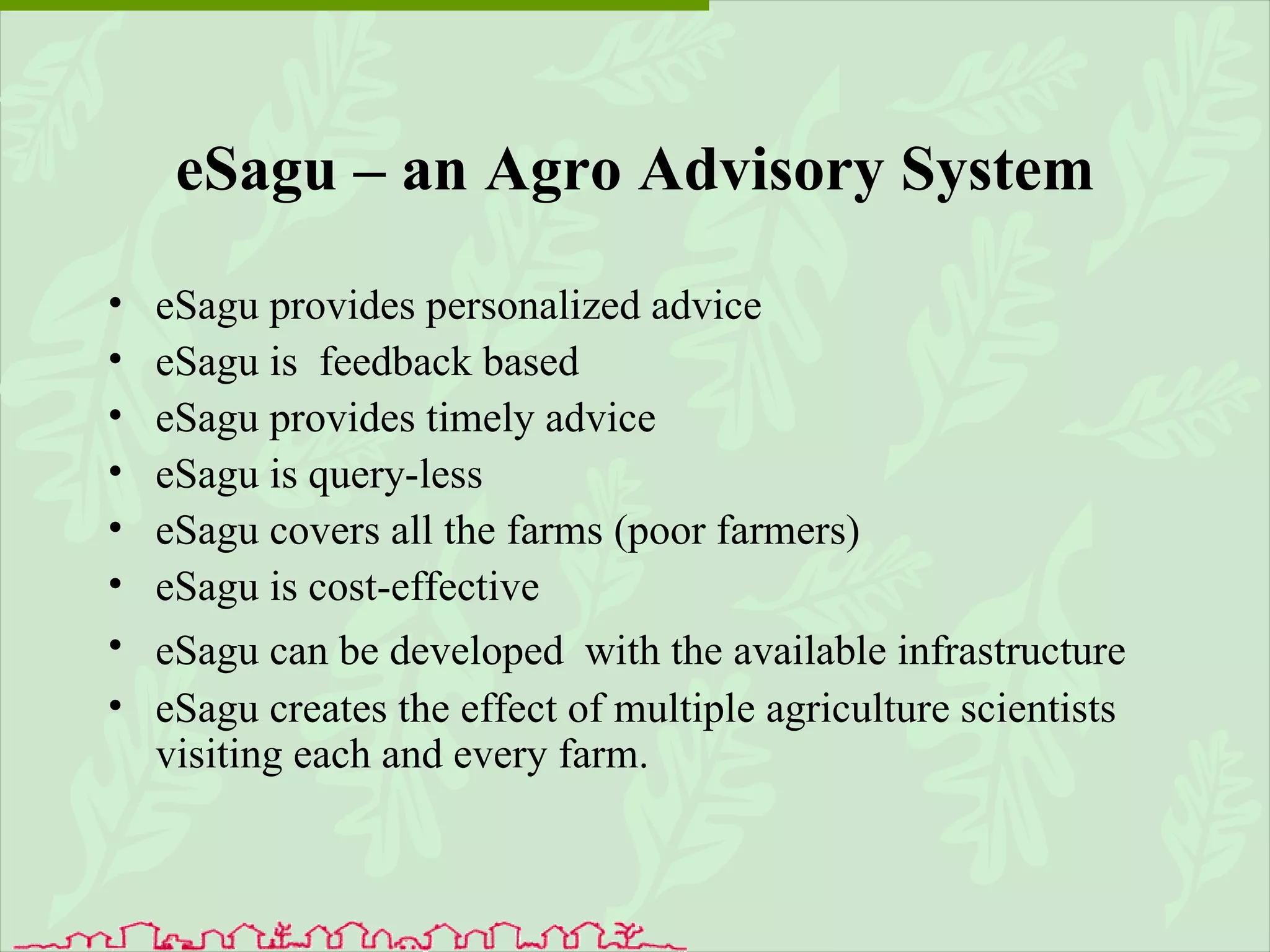
eSagu – an Agro Advisory System eSagu provides personalized advice eSagu is  feedback based  eSagu provides timely advice   eSagu is query-less  eSagu covers all the farms (poor farmers)  eSagu is cost-effective    eSagu can be developed  with the available infrastructure   eSagu creates the effect of multiple agriculture scientists visiting each and every farm.
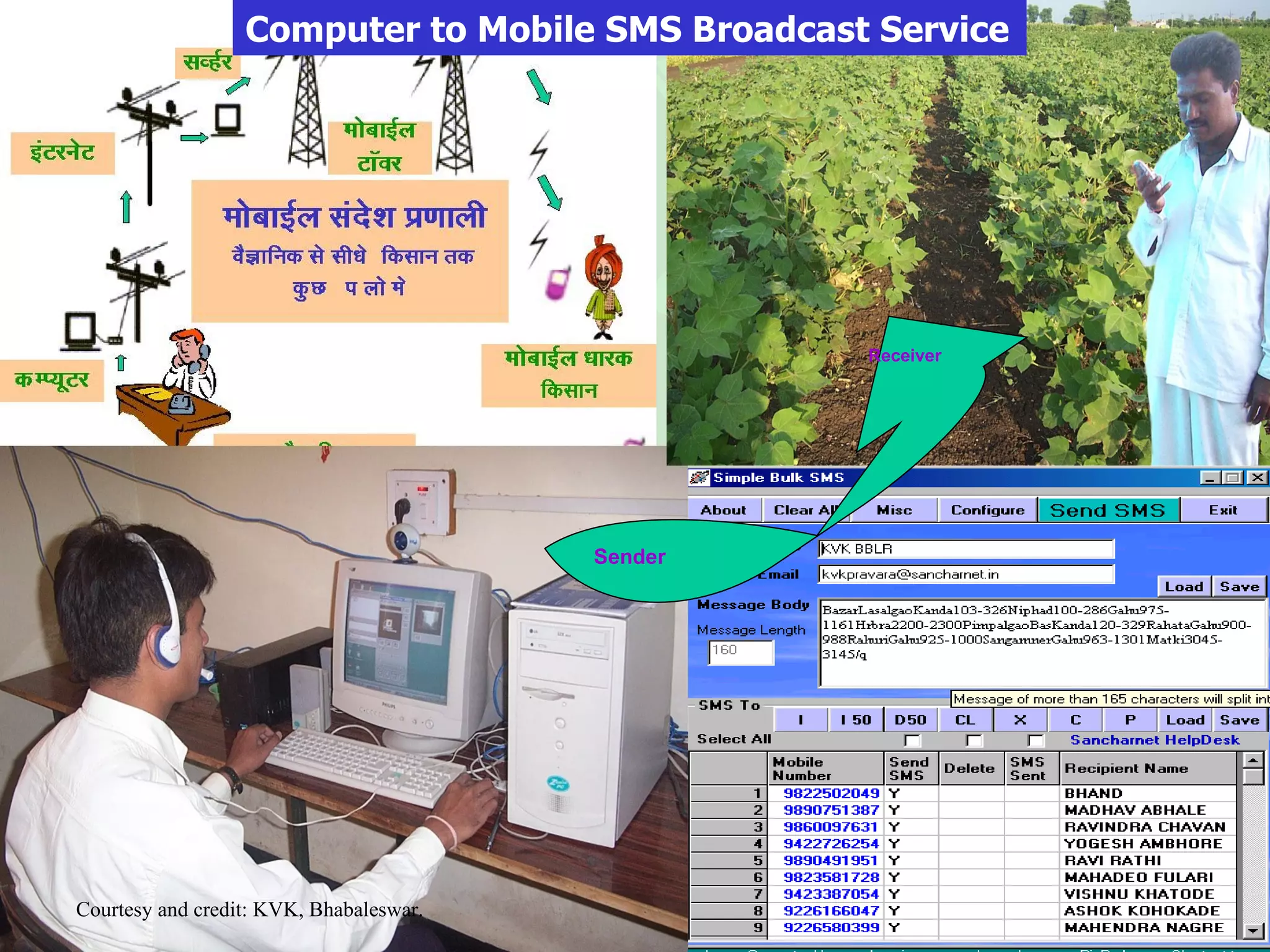
Computer to Mobile SMS Broadcast Service Sender Receiver Courtesy and credit: KVK, Bhabaleswar.
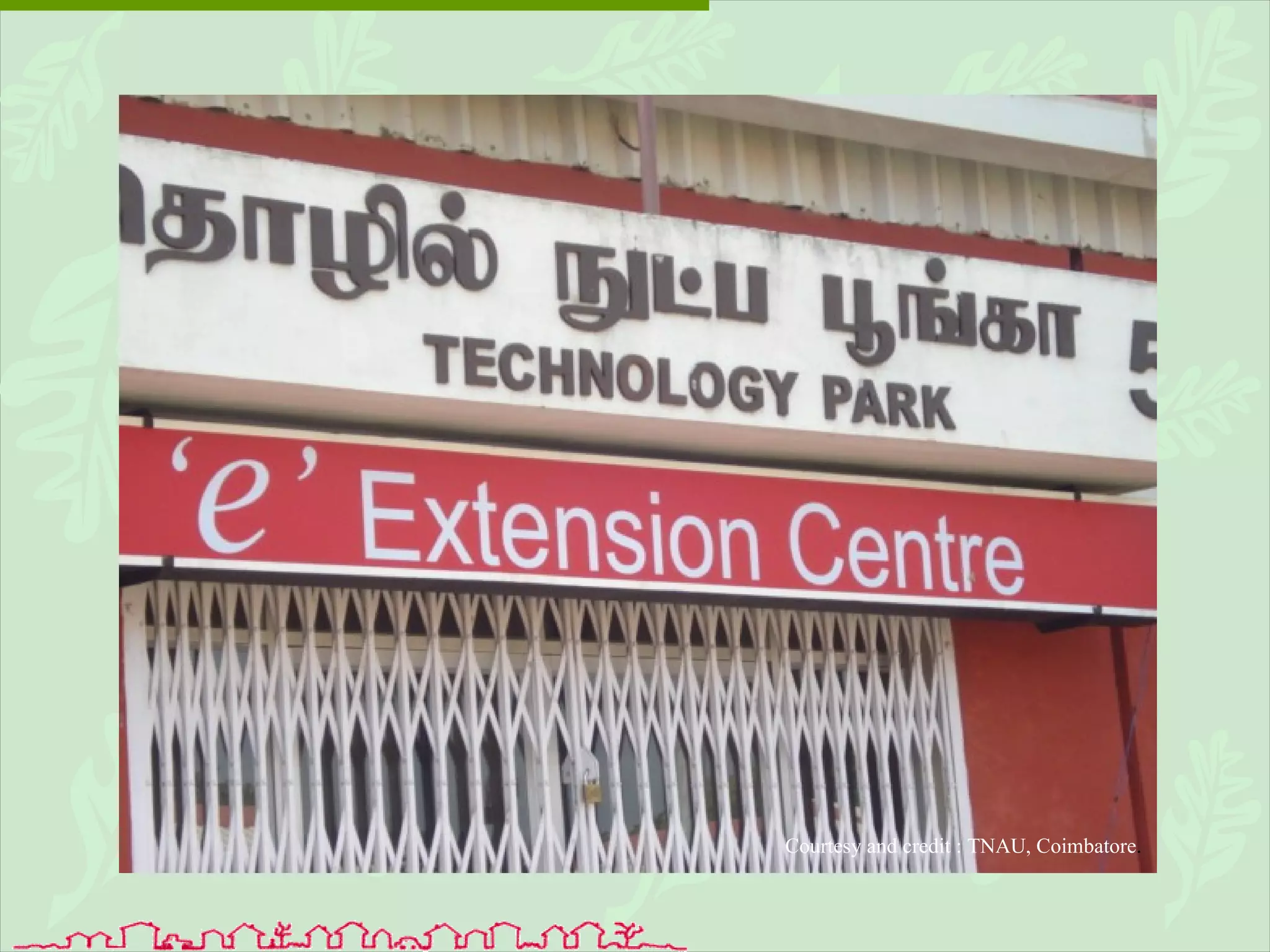
Courtesy and credit : TNAU, Coimbatore .
 
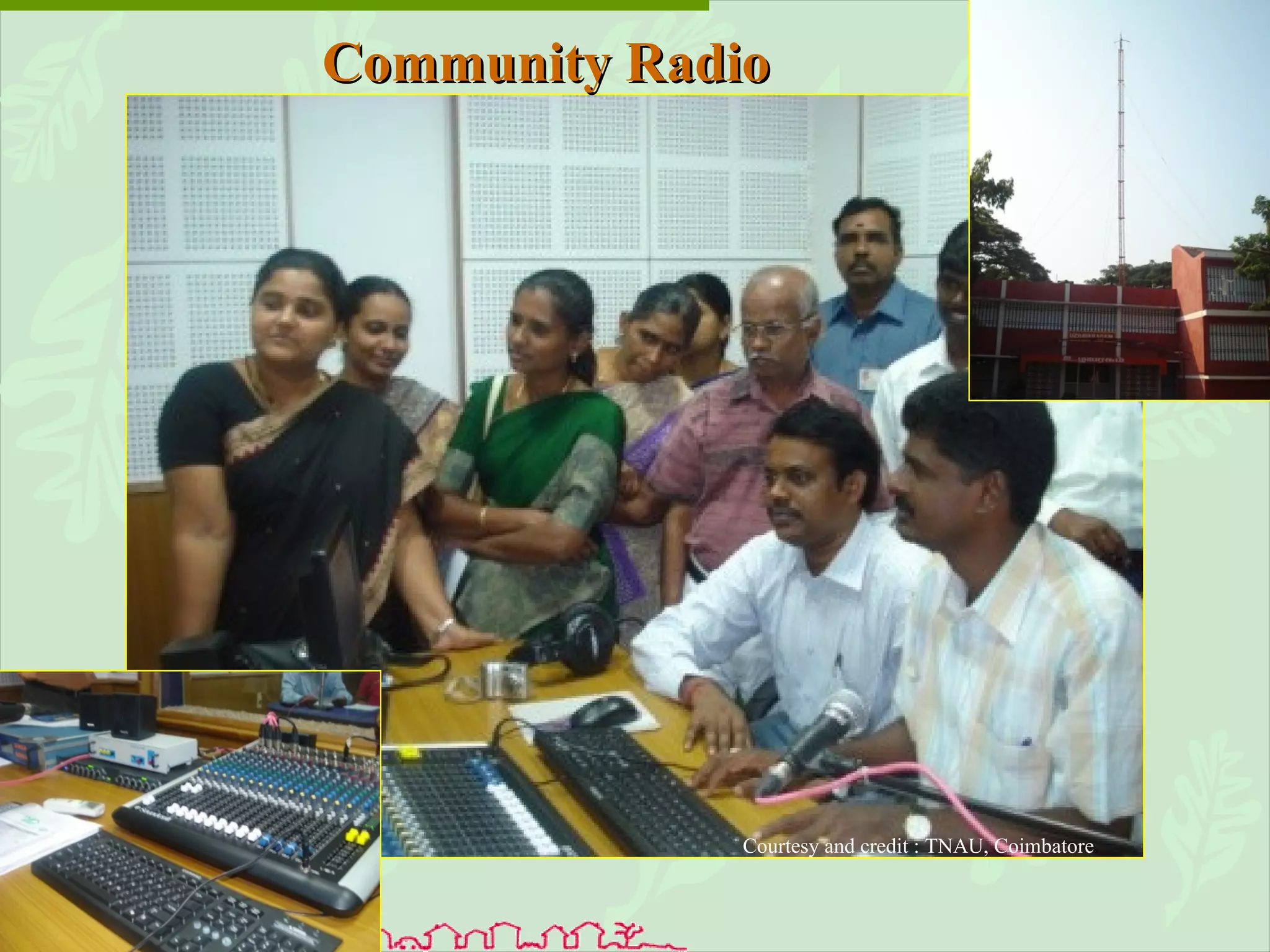
Community Radio Courtesy and credit : TNAU, Coimbatore .
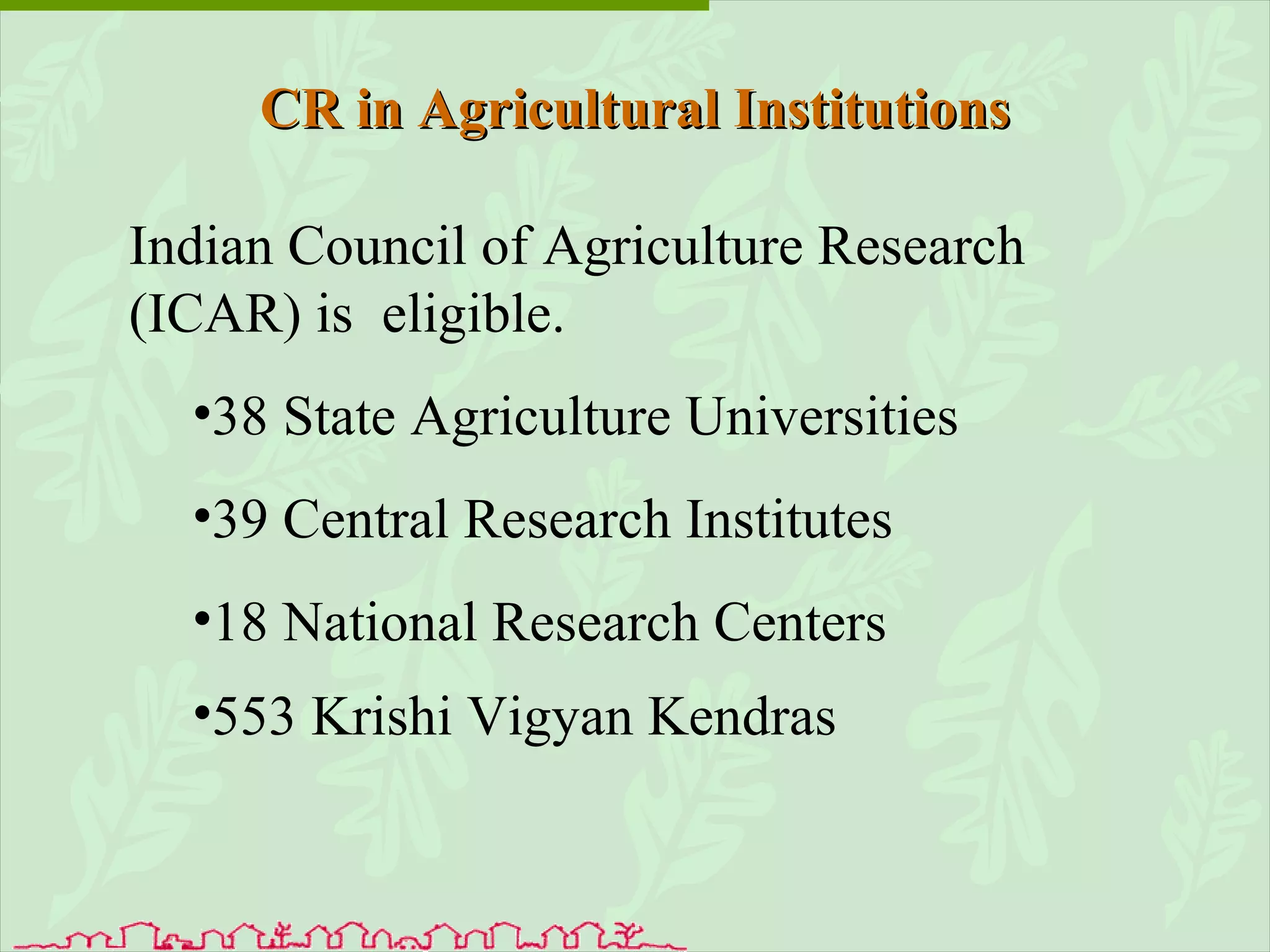
CR in Agricultural Institutions Indian Council of Agriculture Research (ICAR) is  eligible.  38 State Agriculture Universities 39 Central Research Institutes 18 National Research Centers 553 Krishi Vigyan Kendras
In February 2008…………. Krishi Vigyan Kendra, Bharsar, Pauri, Uttarakhand Krishi Vigyan Kendra, Gwaldham.Chamoli, Uttarakhand  Krishi Vigyan Kendra. Ranichauri, Tehri Garhwal, Uttarakhand  Krishi Vigyan Kendra, Chiniyalisaur, Uttarkashi, Uttarakhand  Krishi Vigyan Kendra, Jyolikot, Distt-Nainital, Uttarakhand Krishi Vigyan Kendra, Lohaghat. P.O.Galchoura, Distt-Champawat, Uttarakhand CR in Agricultural Institutions
7. Krishi Vigyan Kendra, Jakhdhar, Rudraprayag, Uttarakhand 8. Krishi Vigyan Kendra, Udham Singh Nagar, Uttarakhand 9. Krishi Vigyan Kendra, Harbatpur, Dehradun, Uttarakhand 10. Krishi Vigyan Kendra, Dhanausi, Haridwar, Uttarakhand  11. Krishi Vigyan Kendra, Ranikhet, Almora, Uttarakhand 12. Krishi Vigyan Kendra, Reddipalli, Anantapur, Andhra Pradesh 13. CCS Haryana Agricultural University, Hissar, Haryana 14. Indian Veterinary Research Institute Izatnagar-Bareilly, Uttar Pradesh . CR in Agricultural Institutions
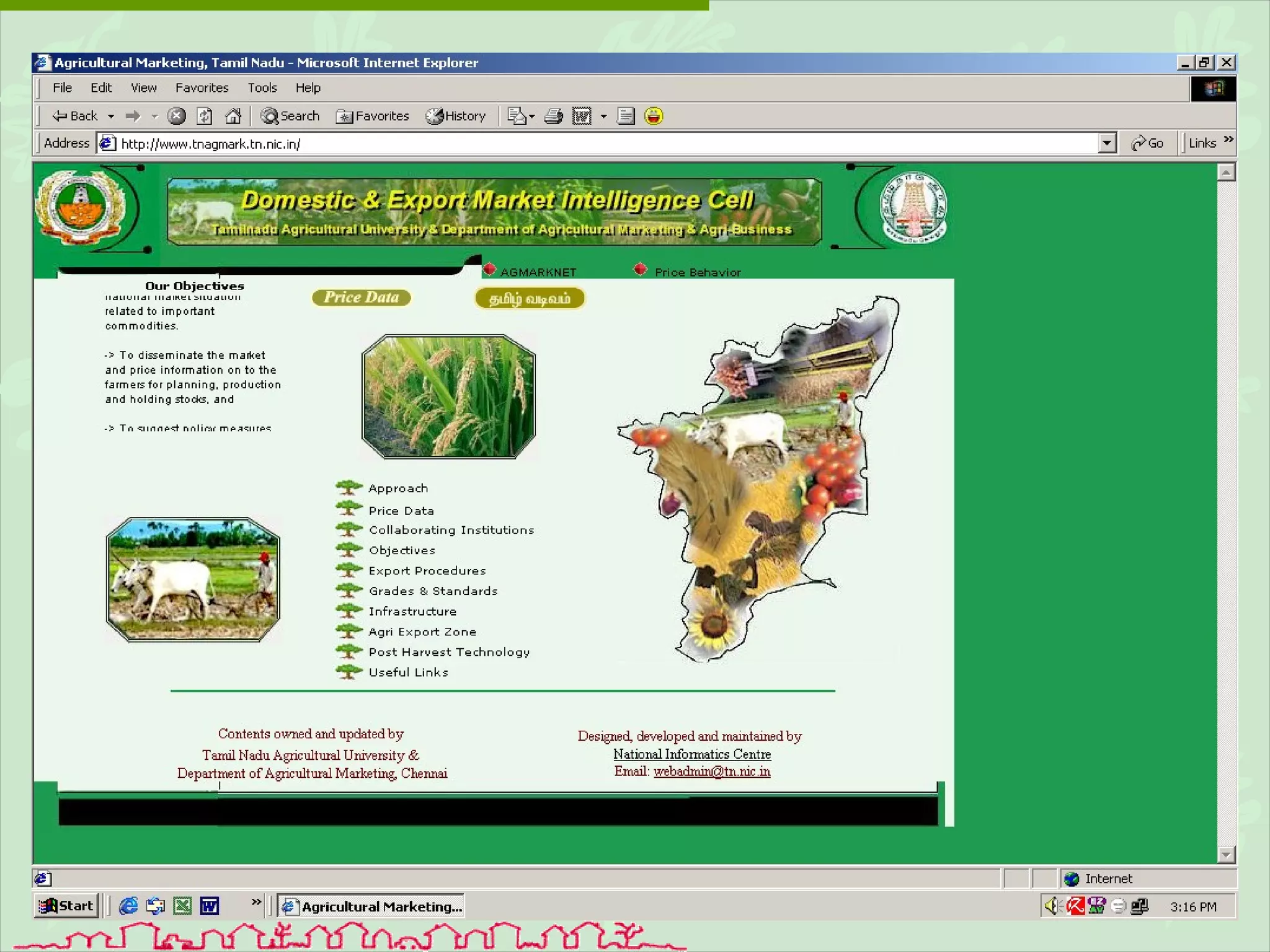
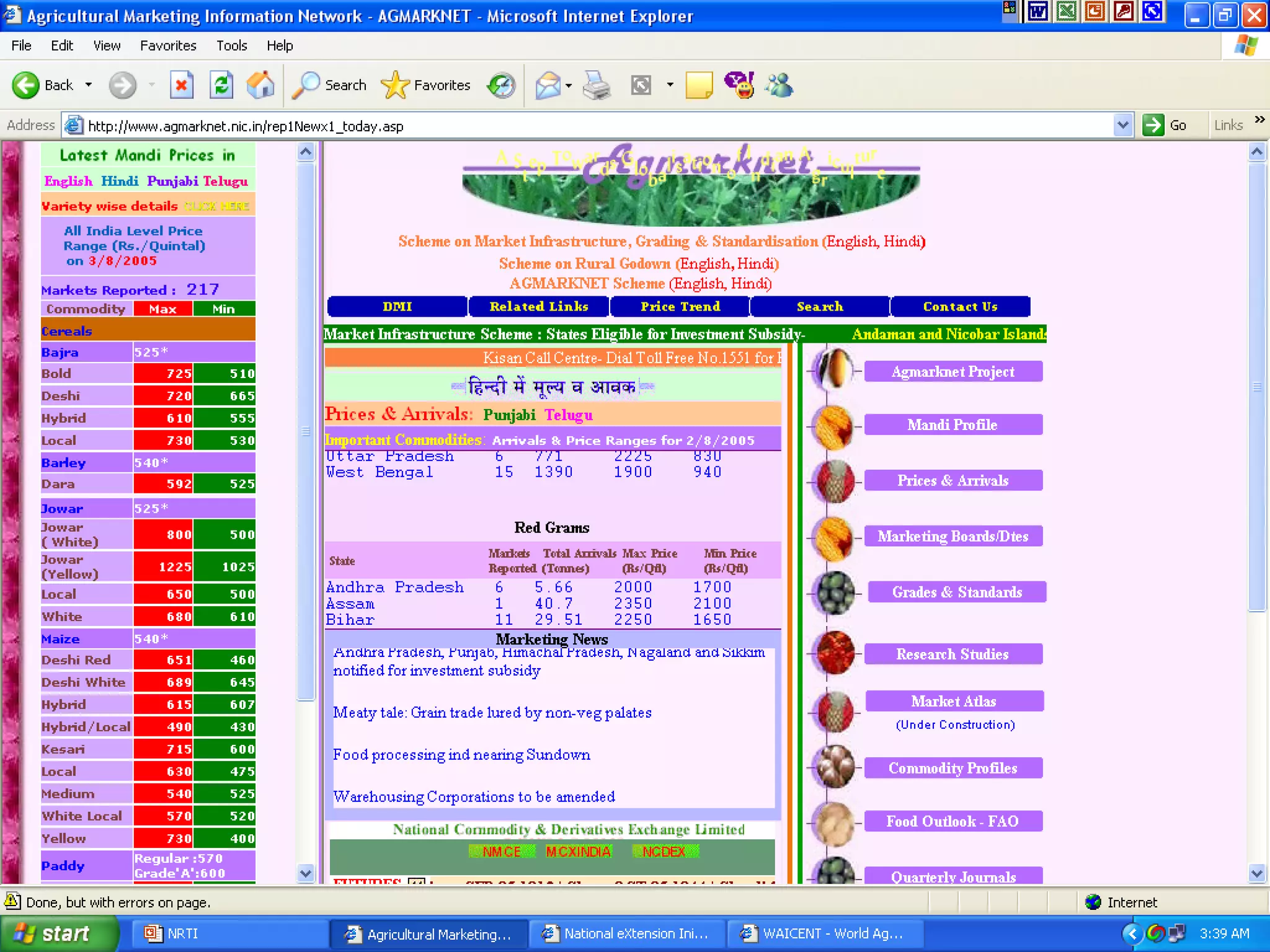
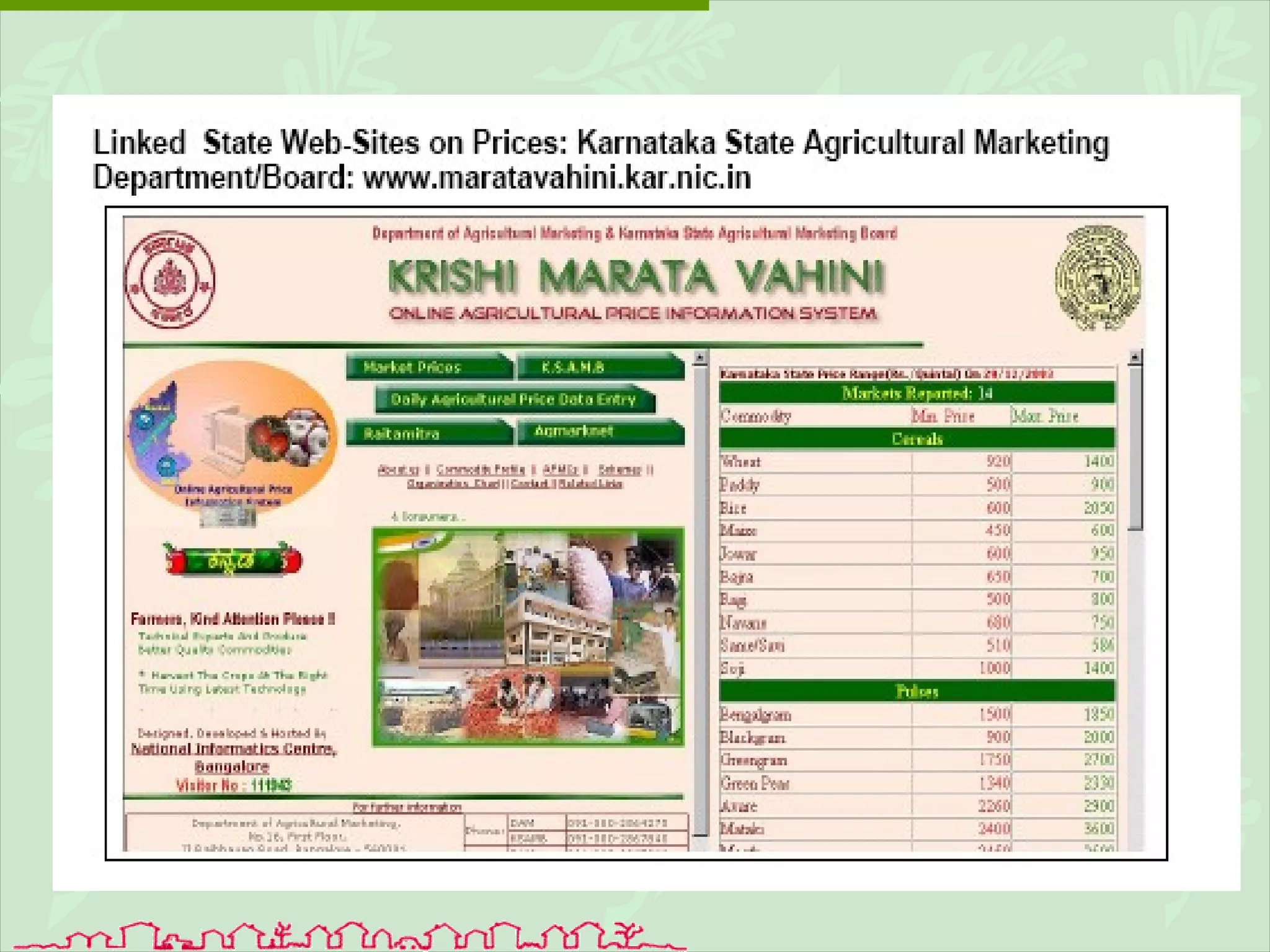
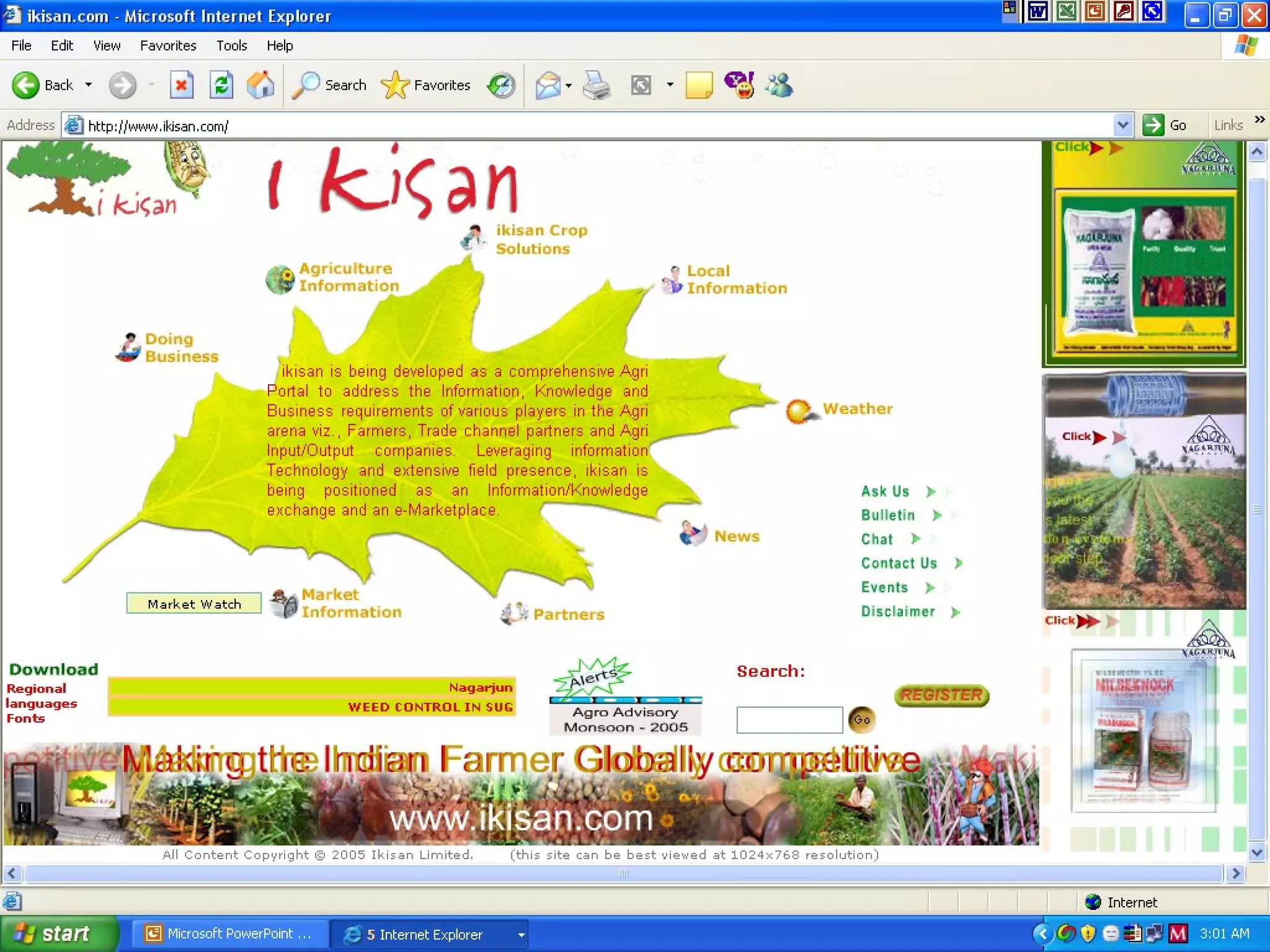
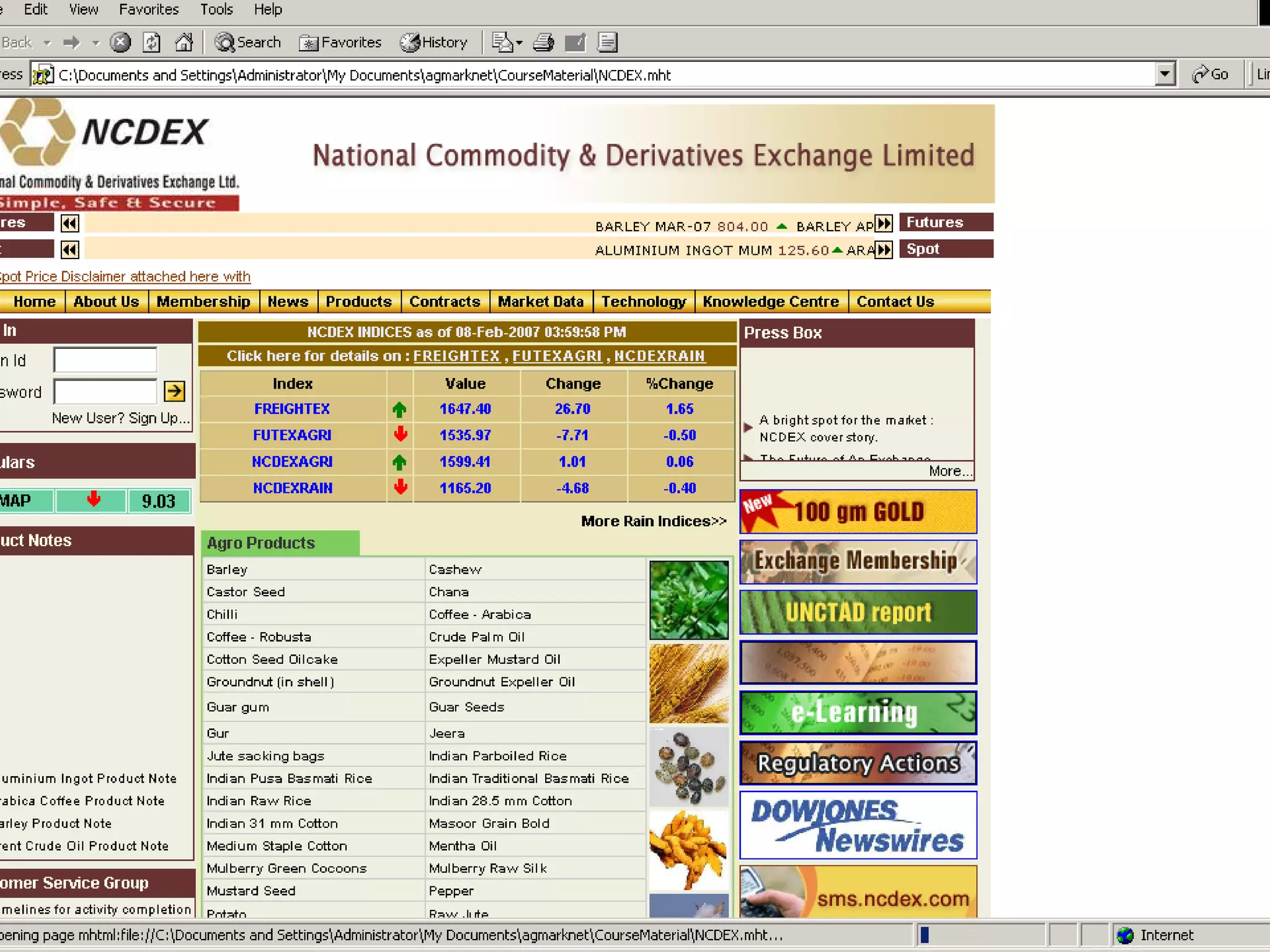
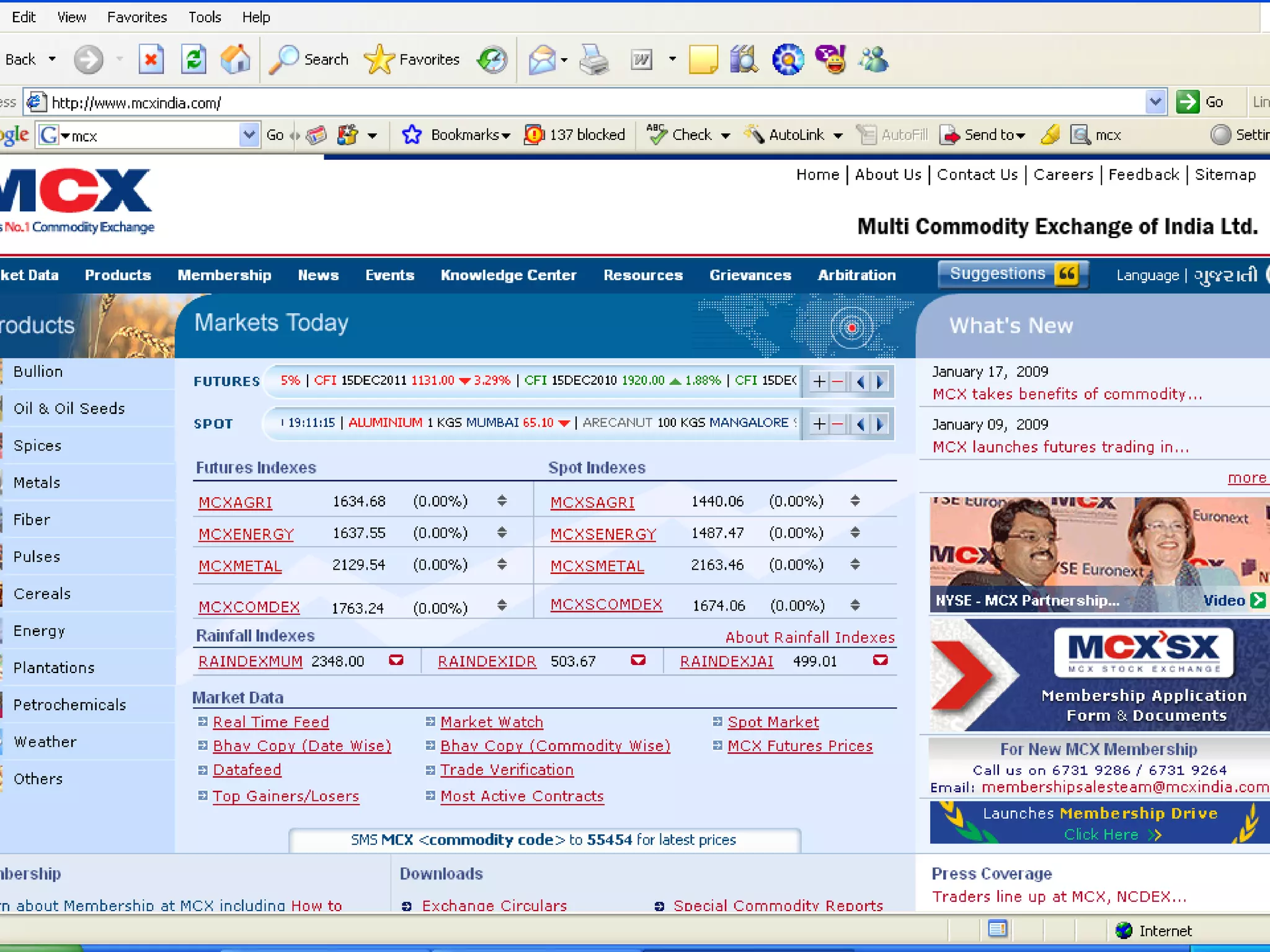
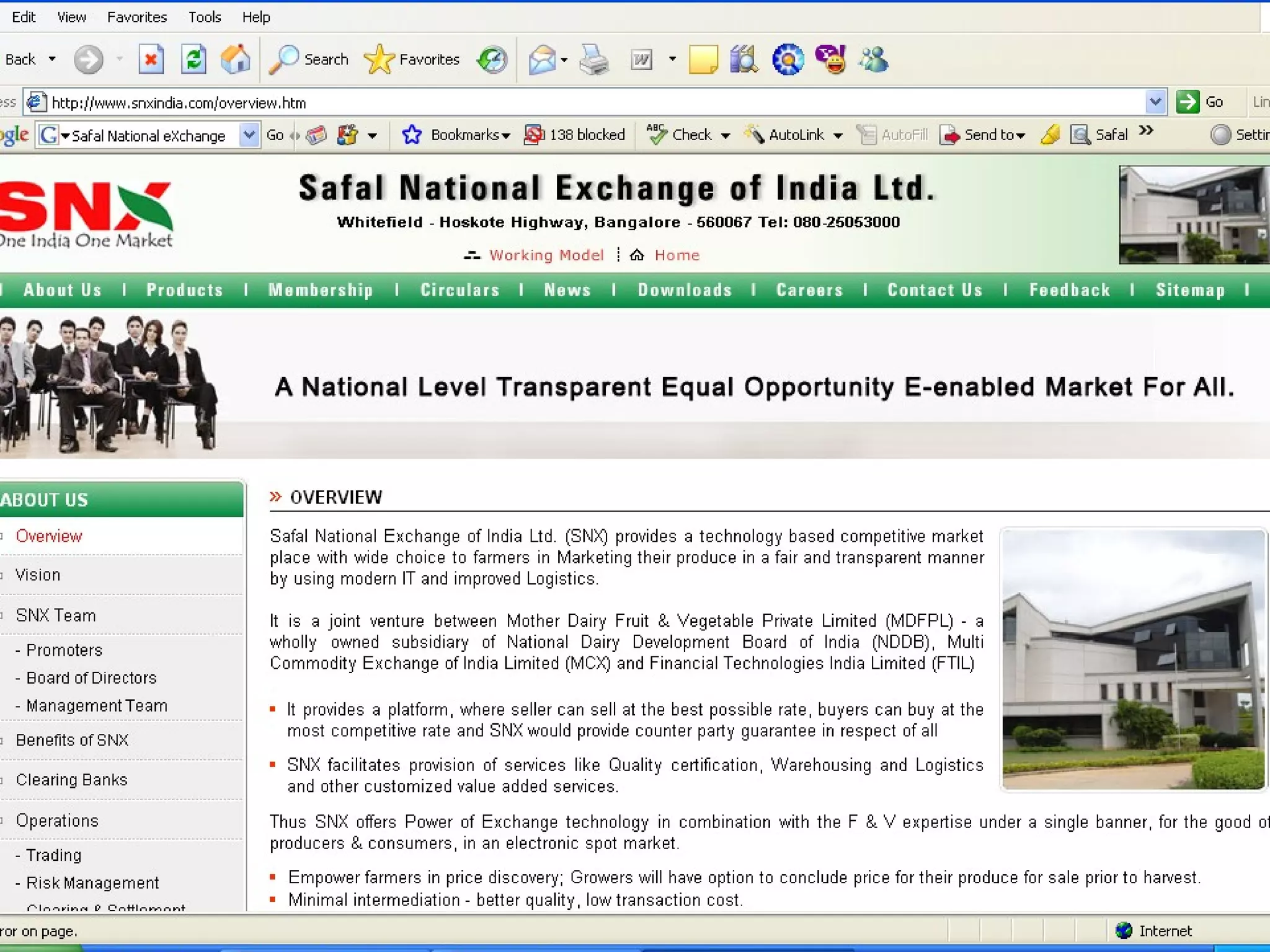
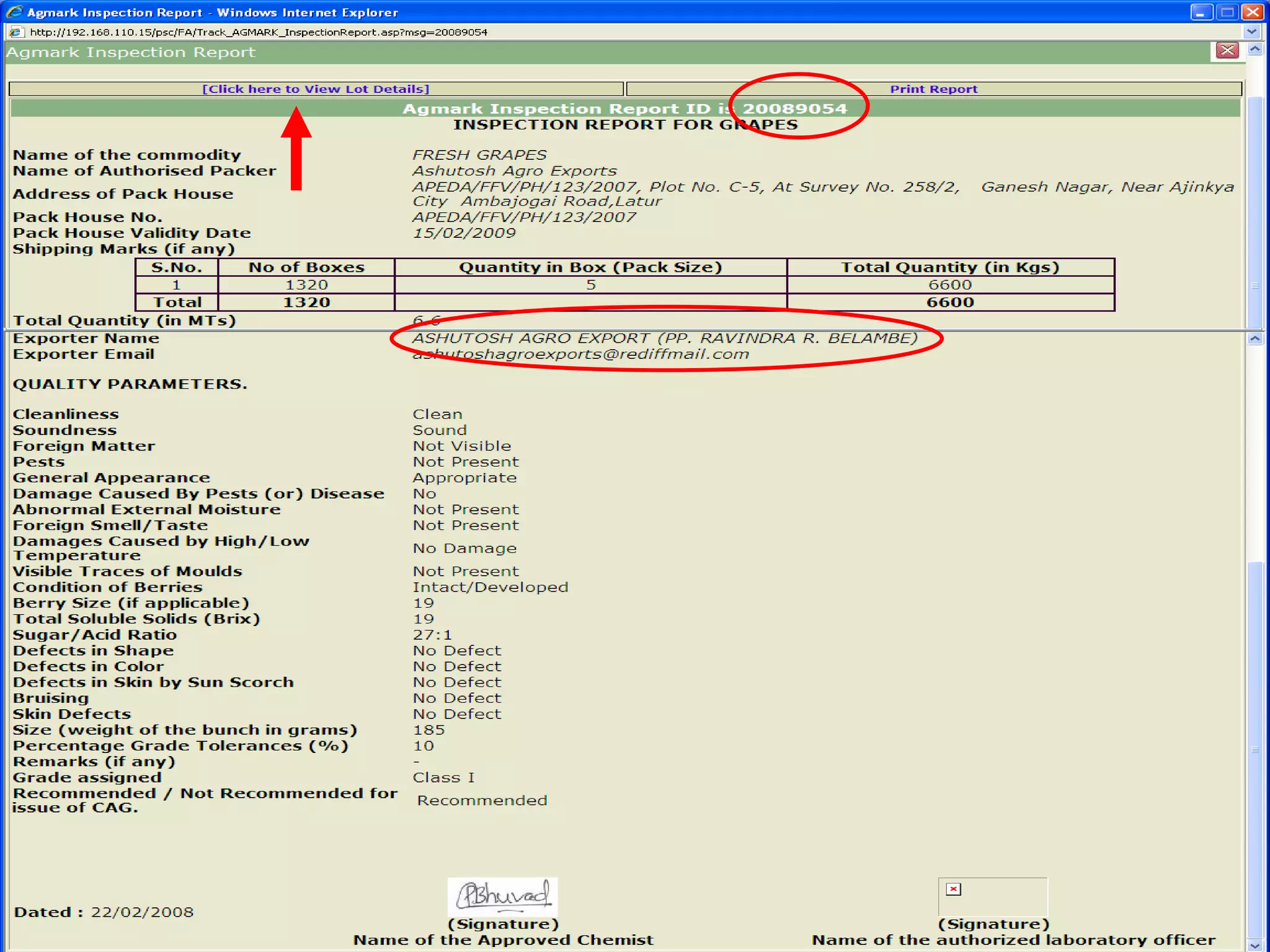
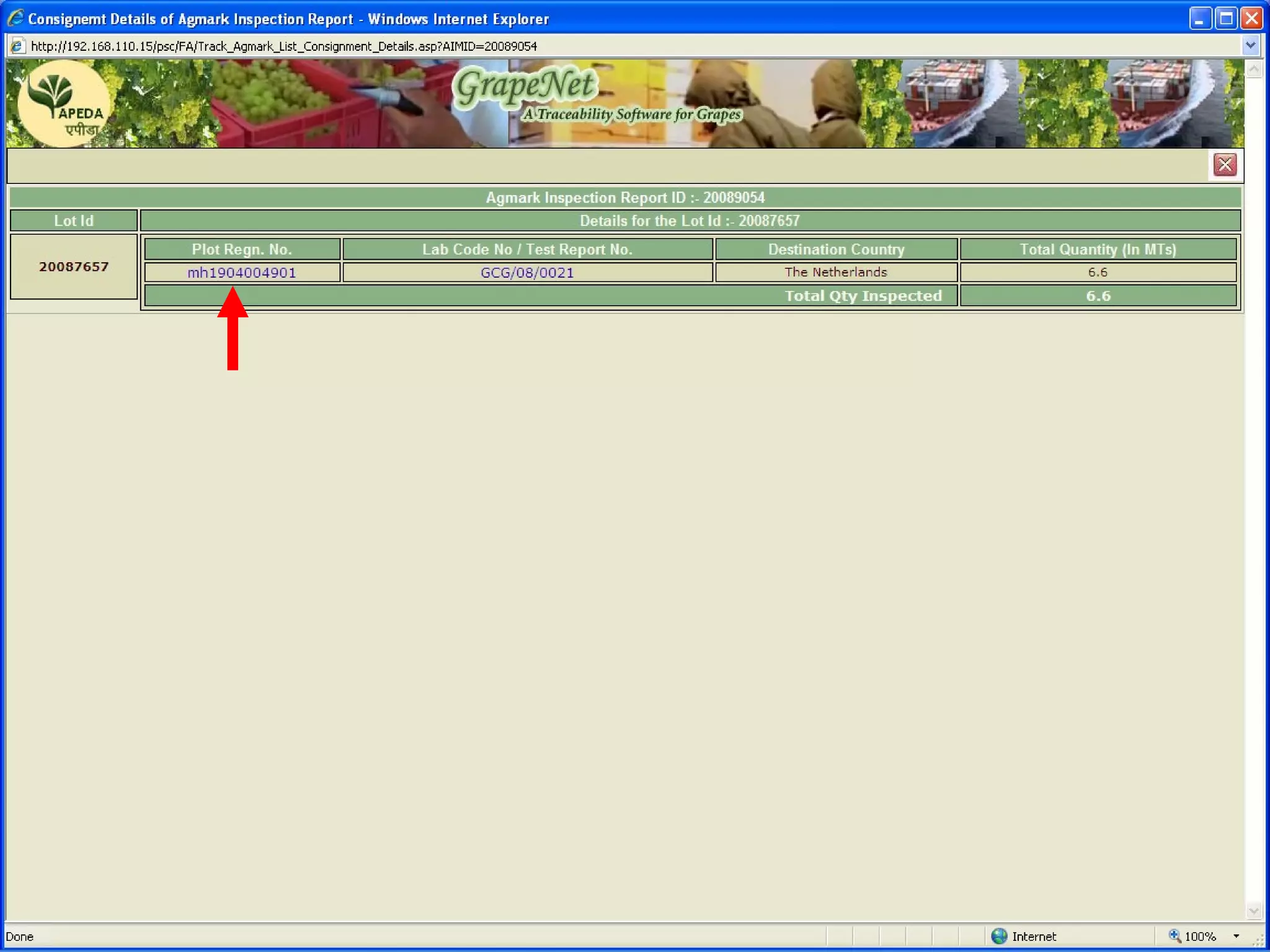
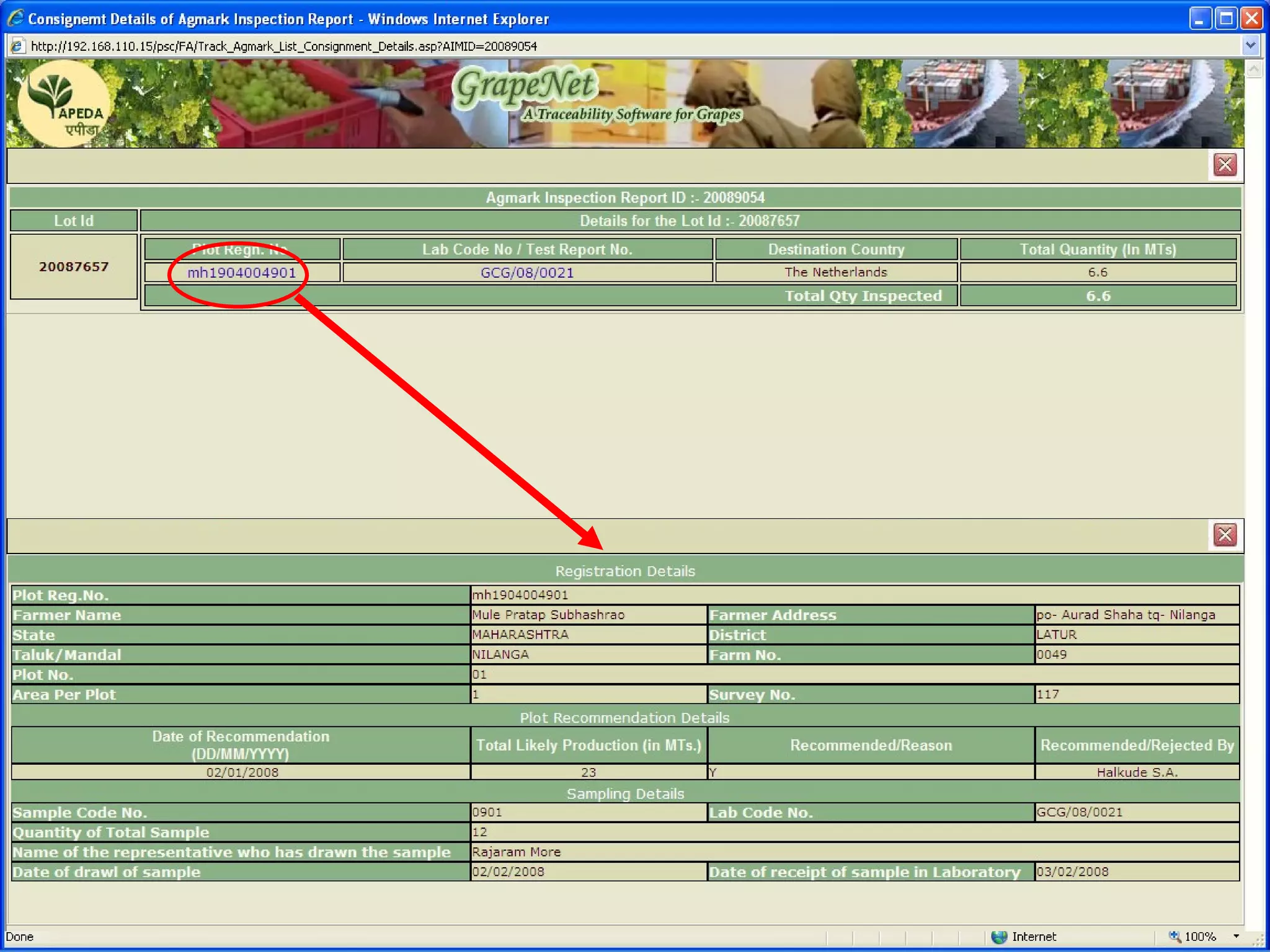
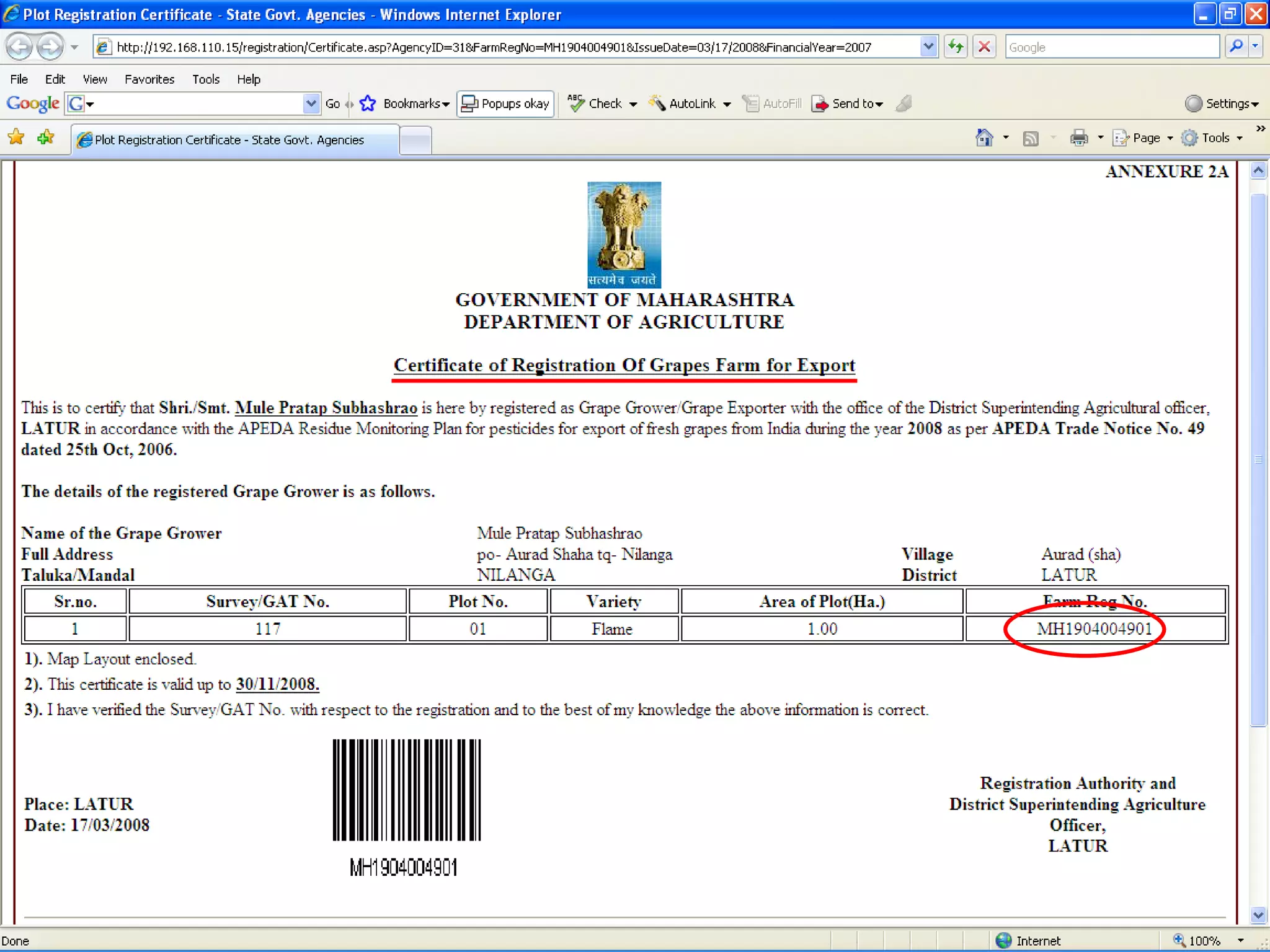
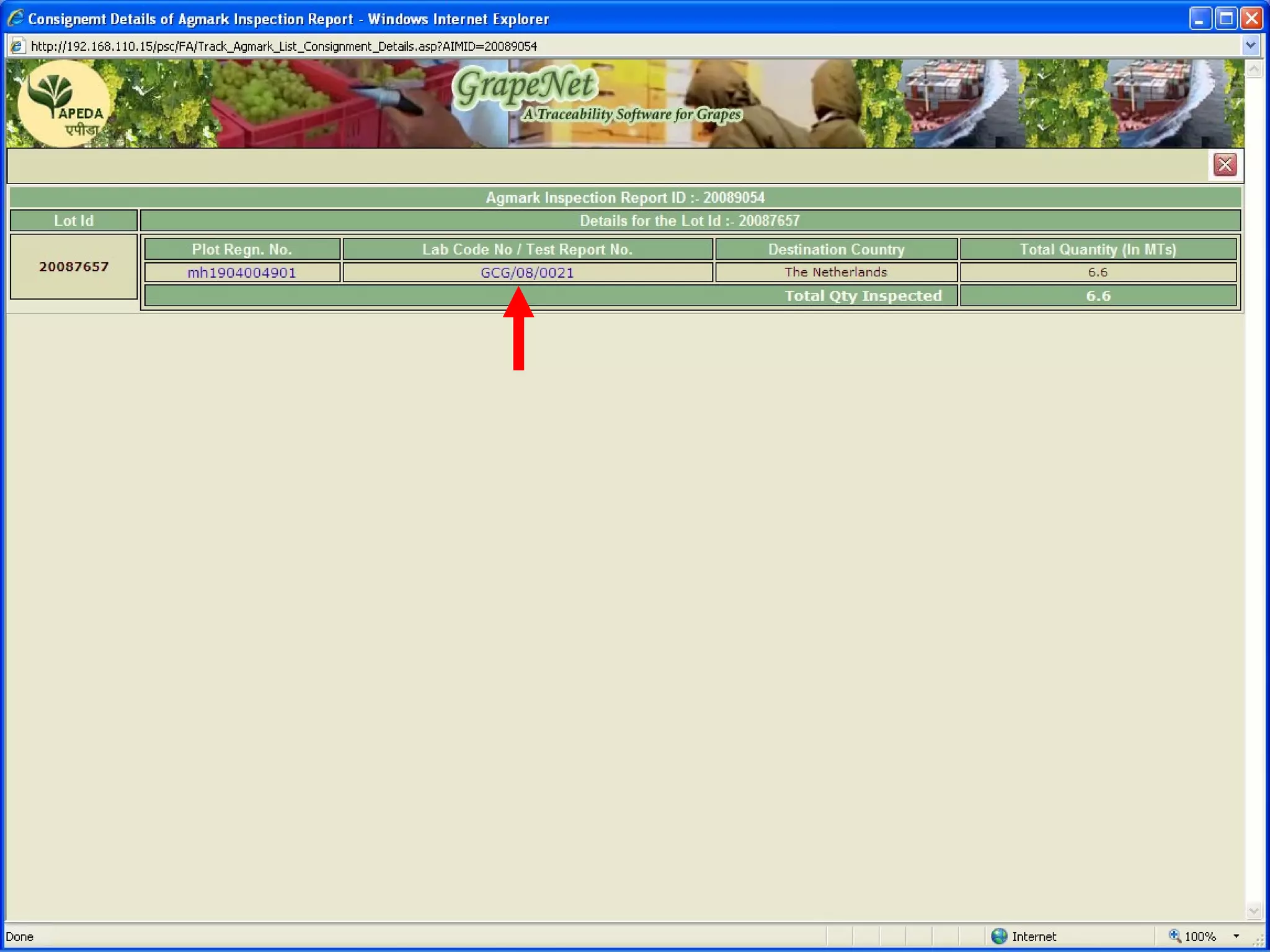
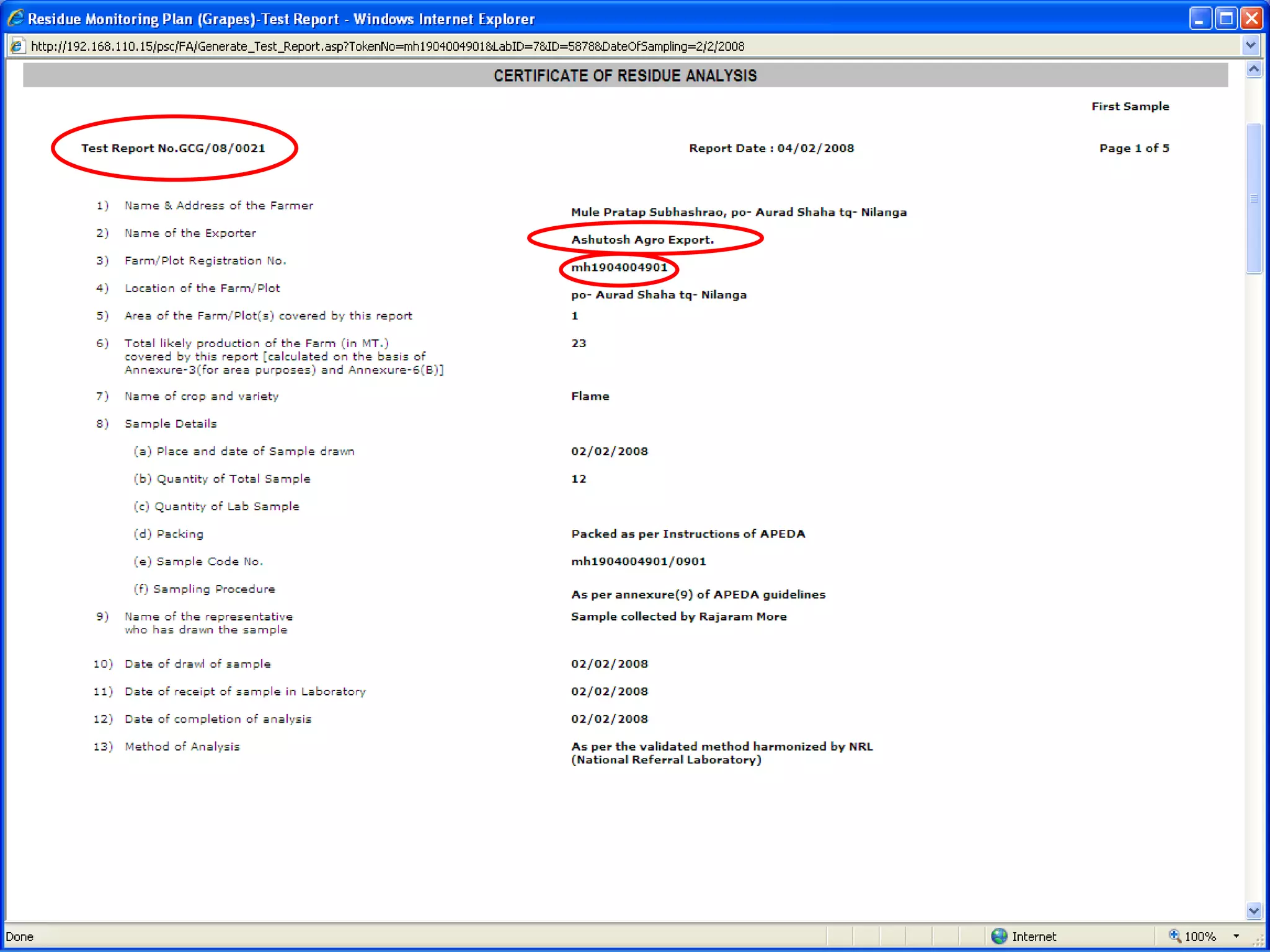
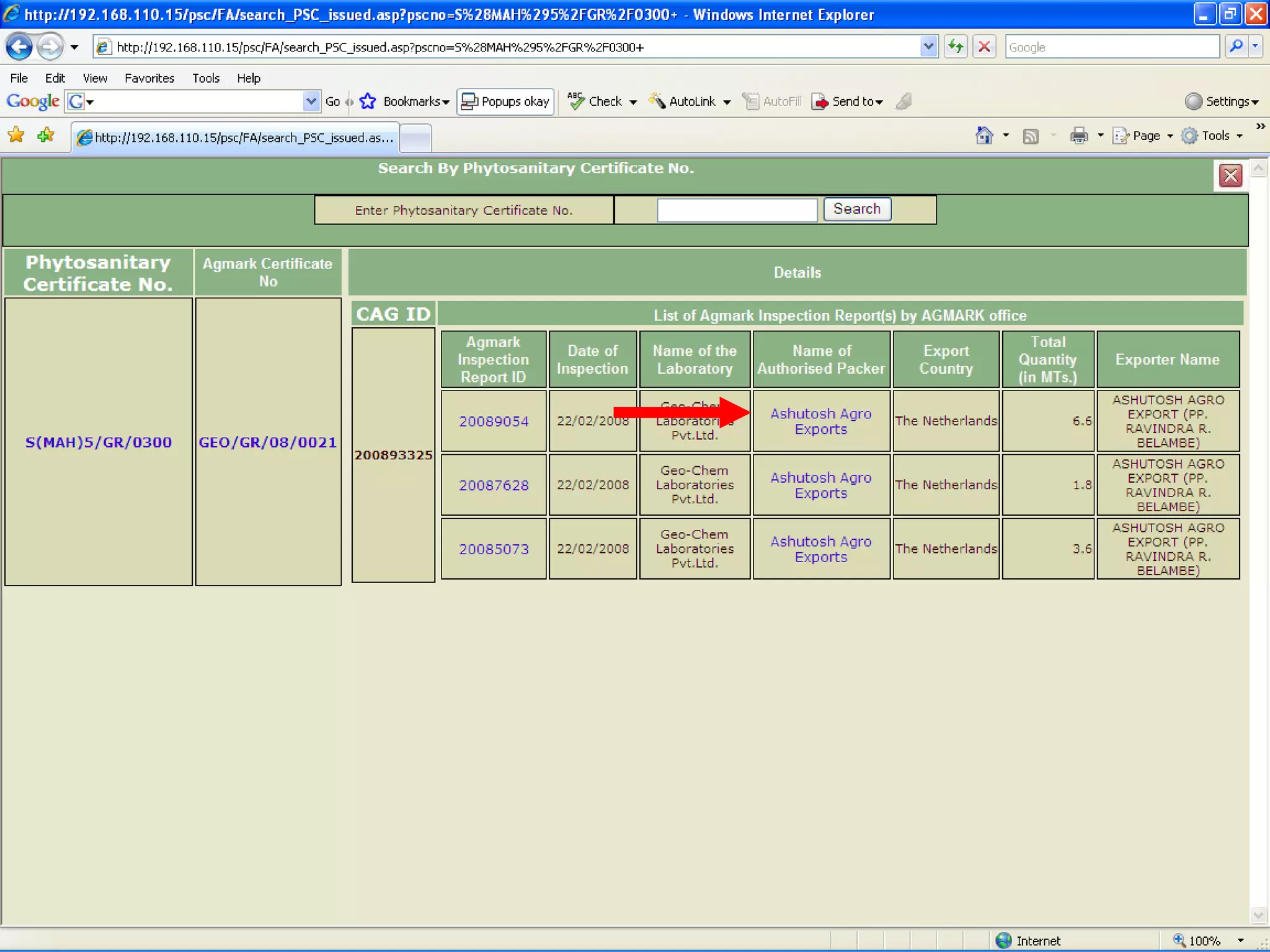
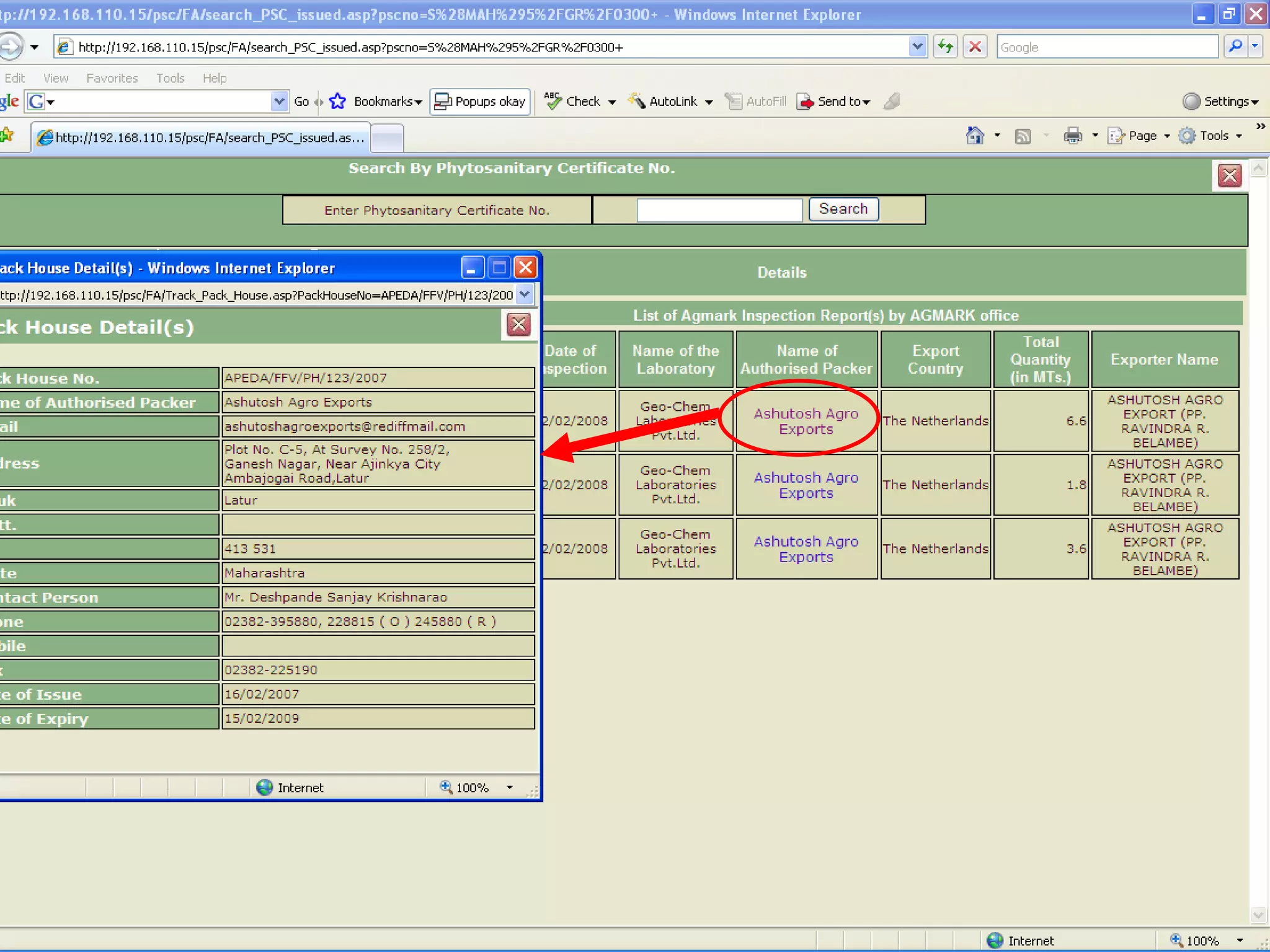
ICTs for Agricultural Marketing Market Information Production information,   Price information, forecasting,  market intelligence, farmers advisory services Networking of Markets through ICTs Commodity Exchanges, Futures Trade Value chain management Knowledge intensive post-harvest management,  Traceability ,  quality and certification, Supply chain  management


mb


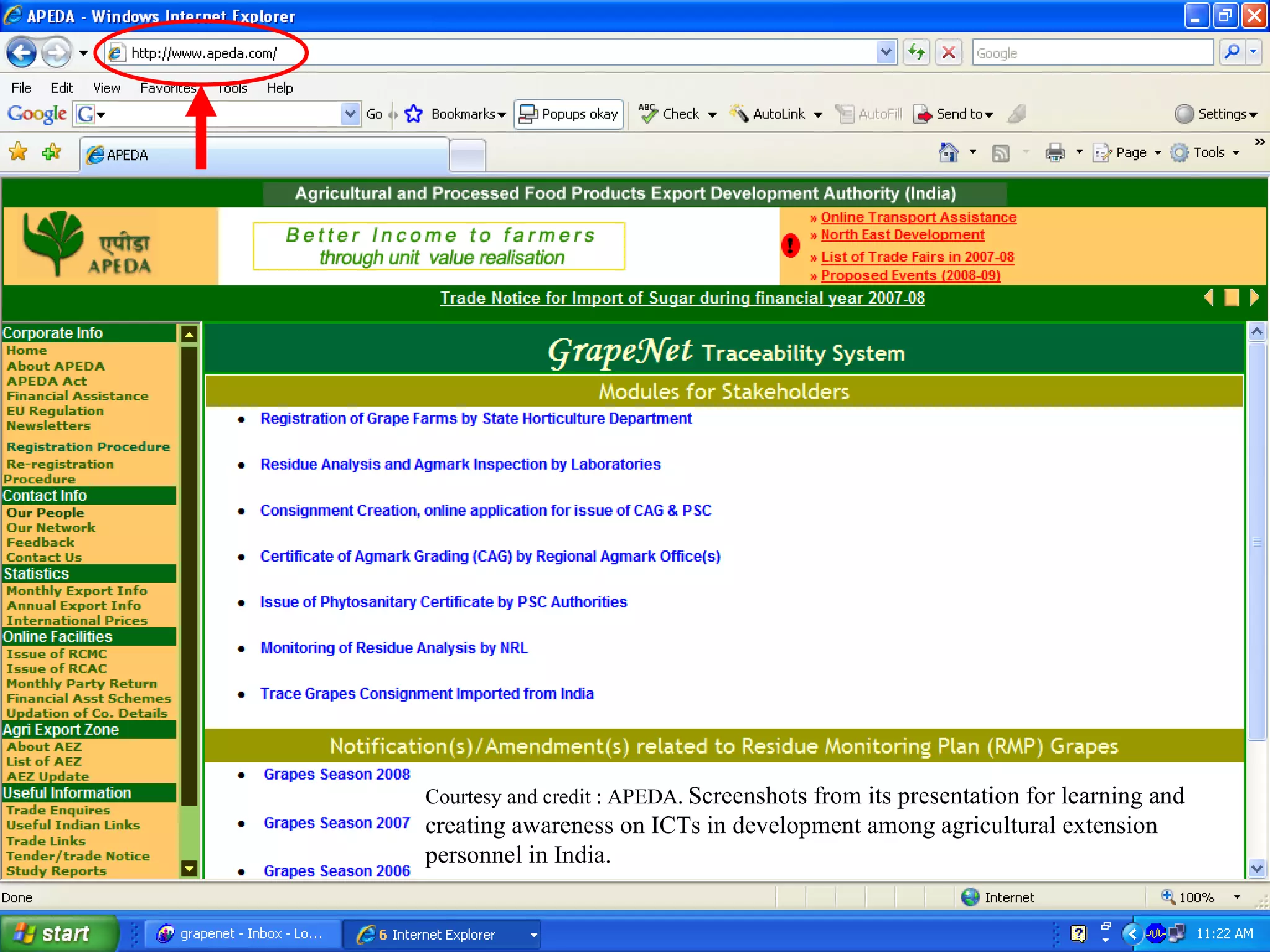
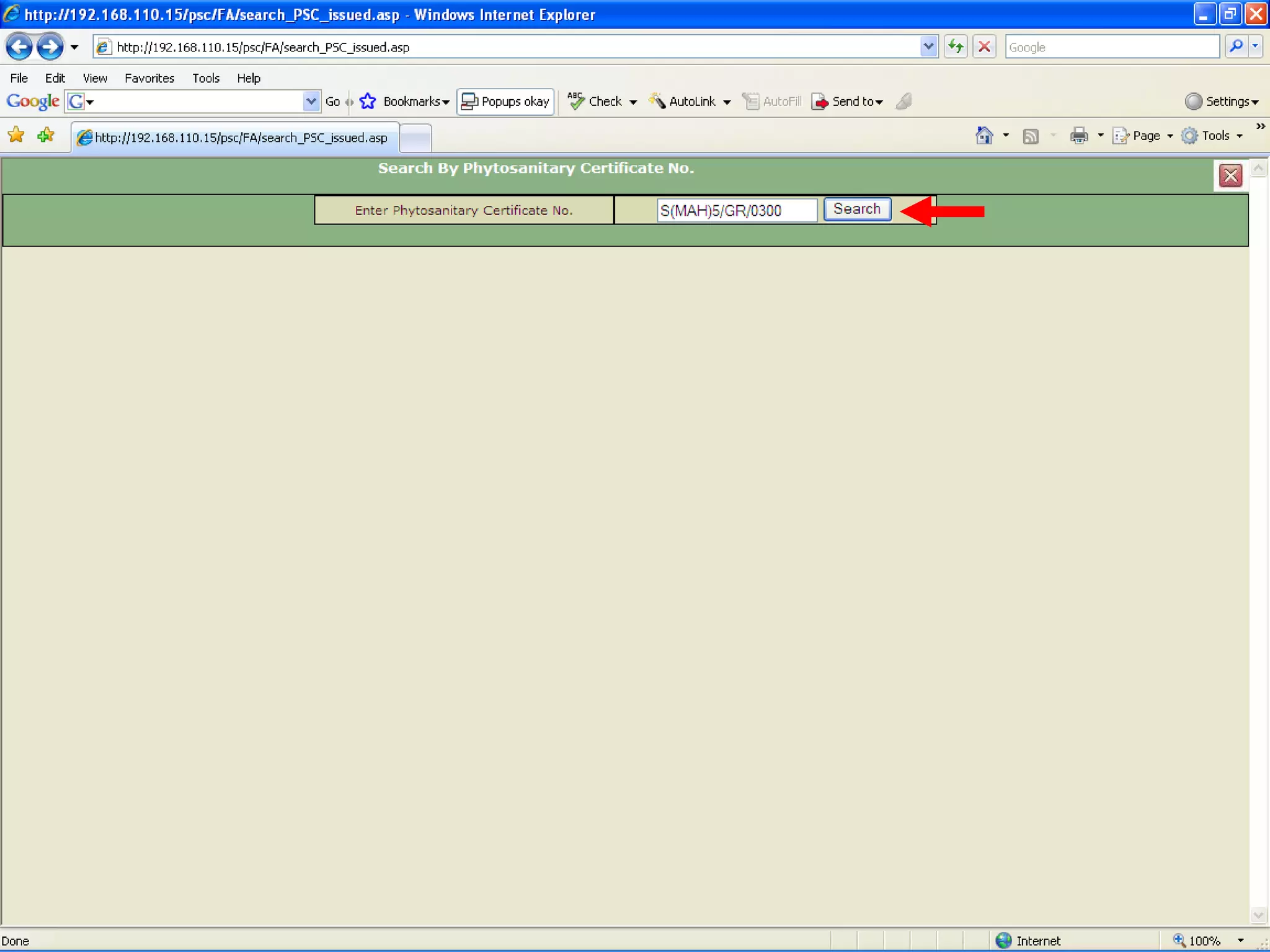
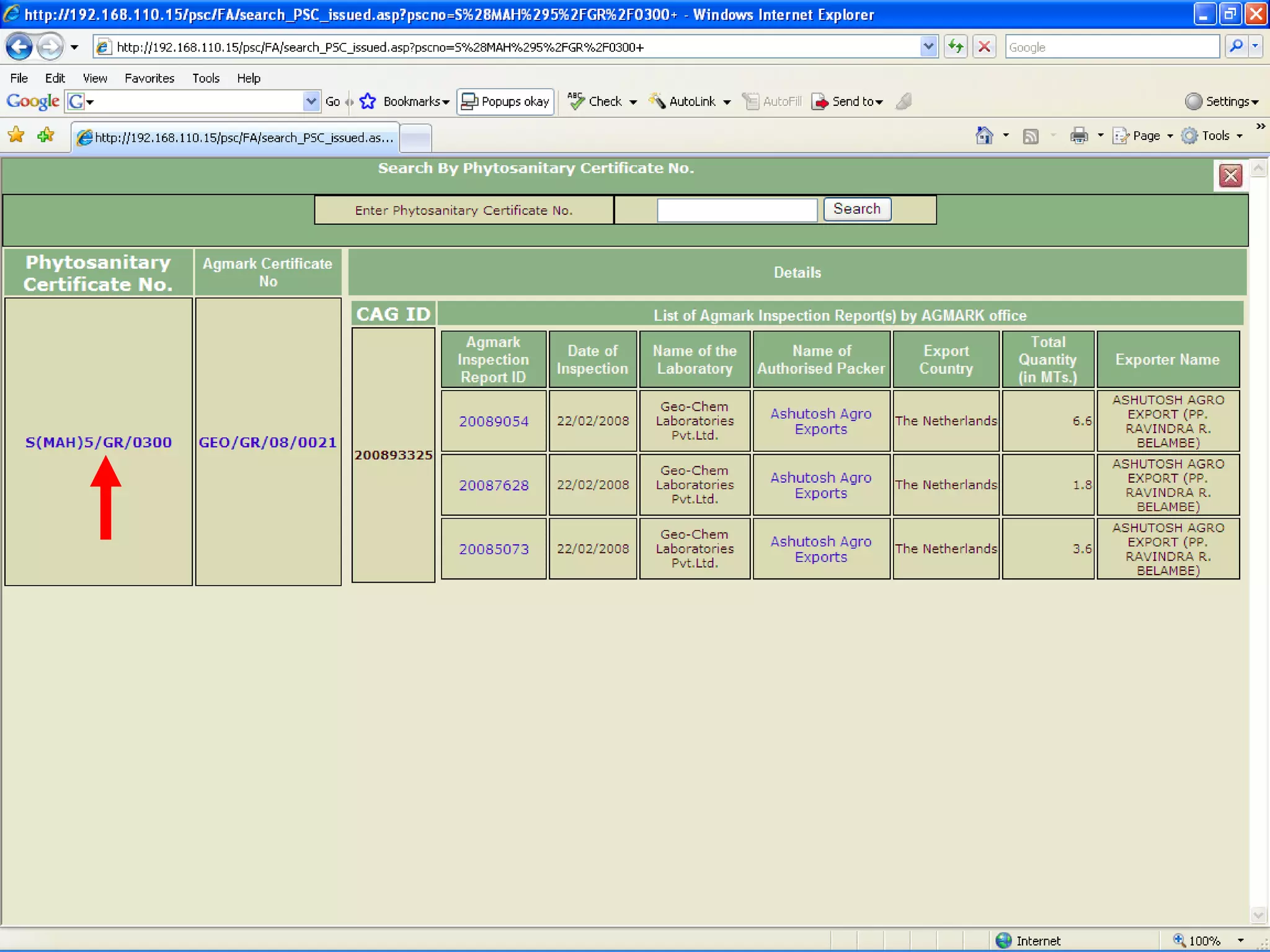
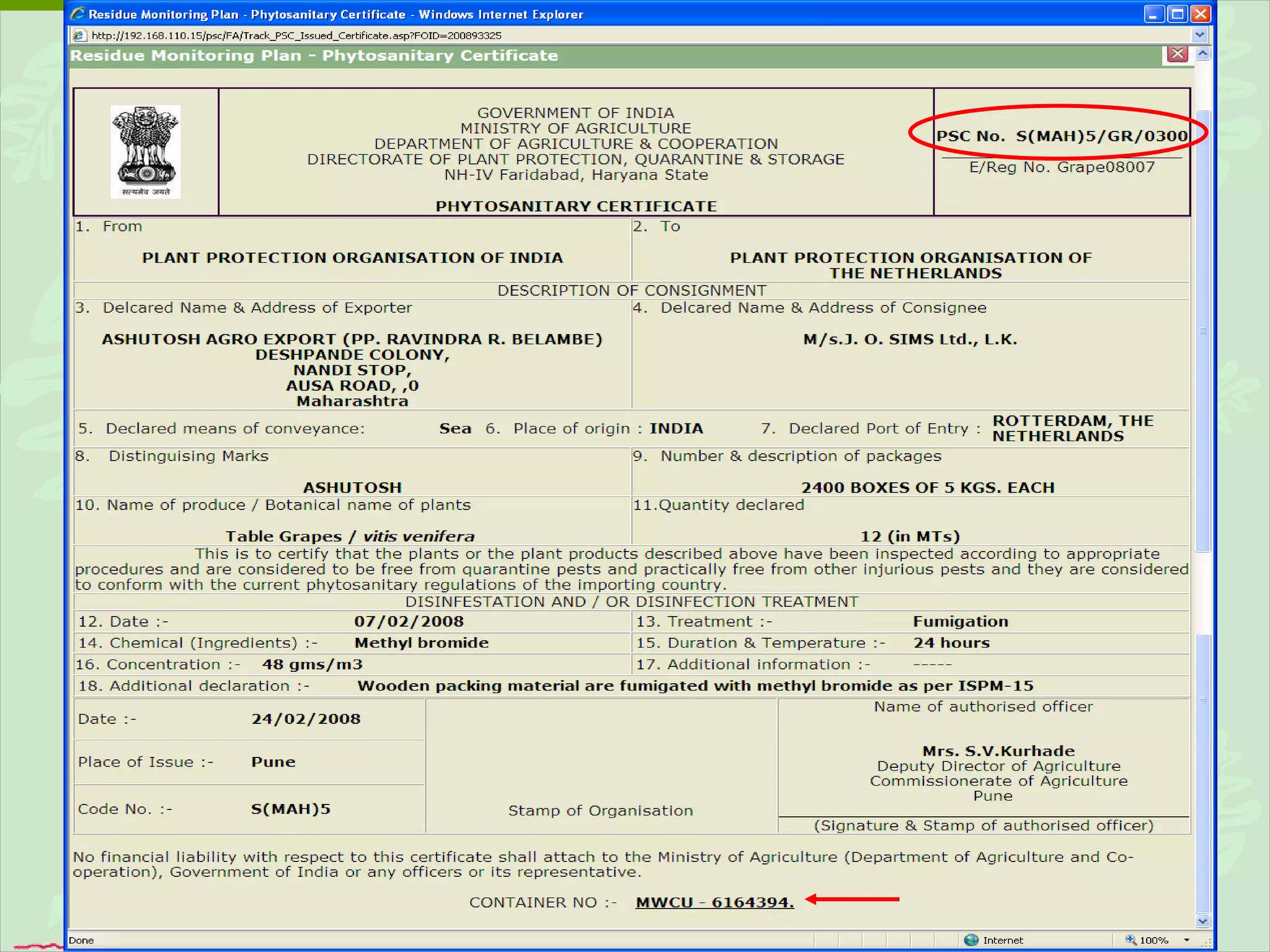
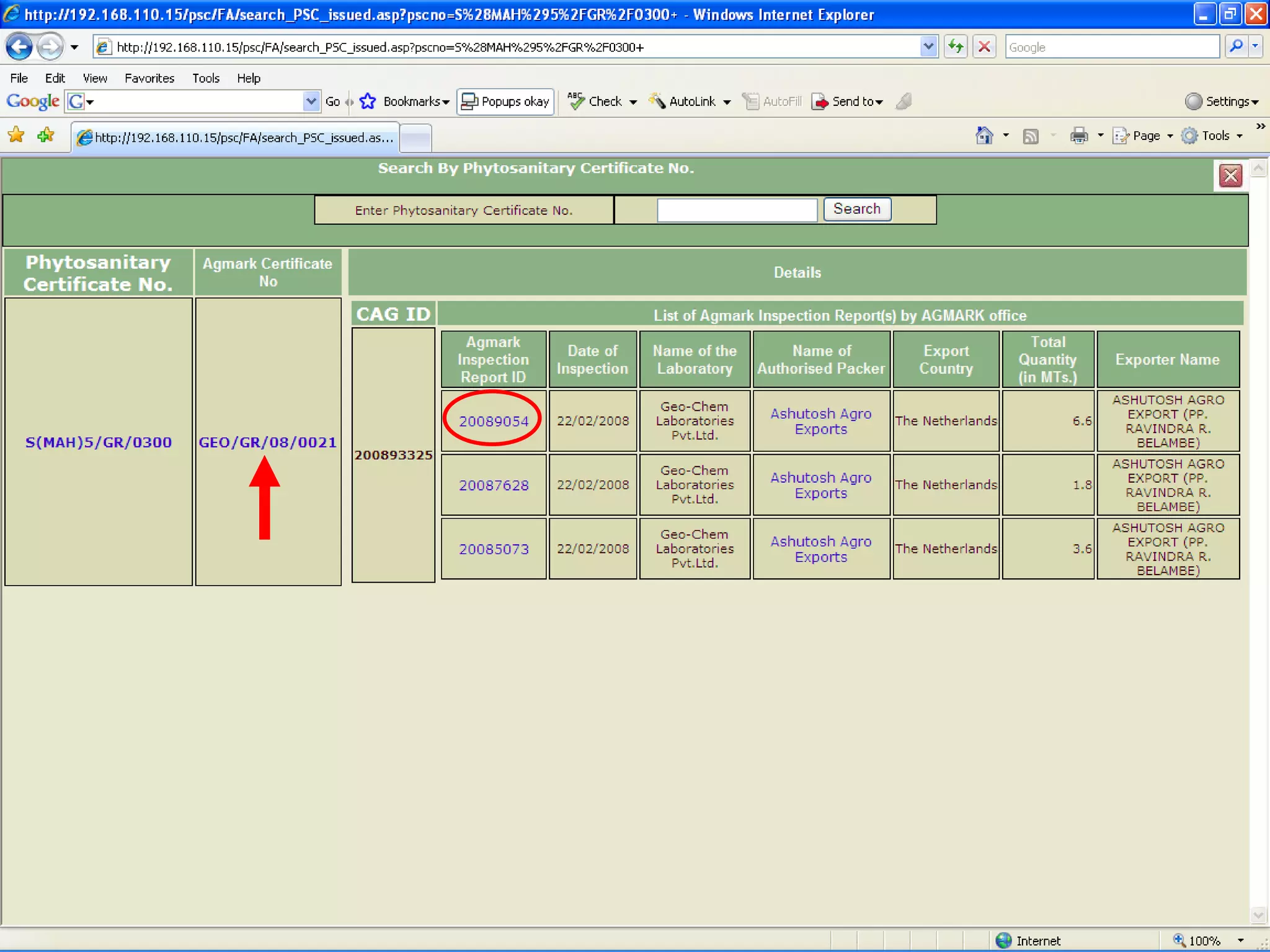
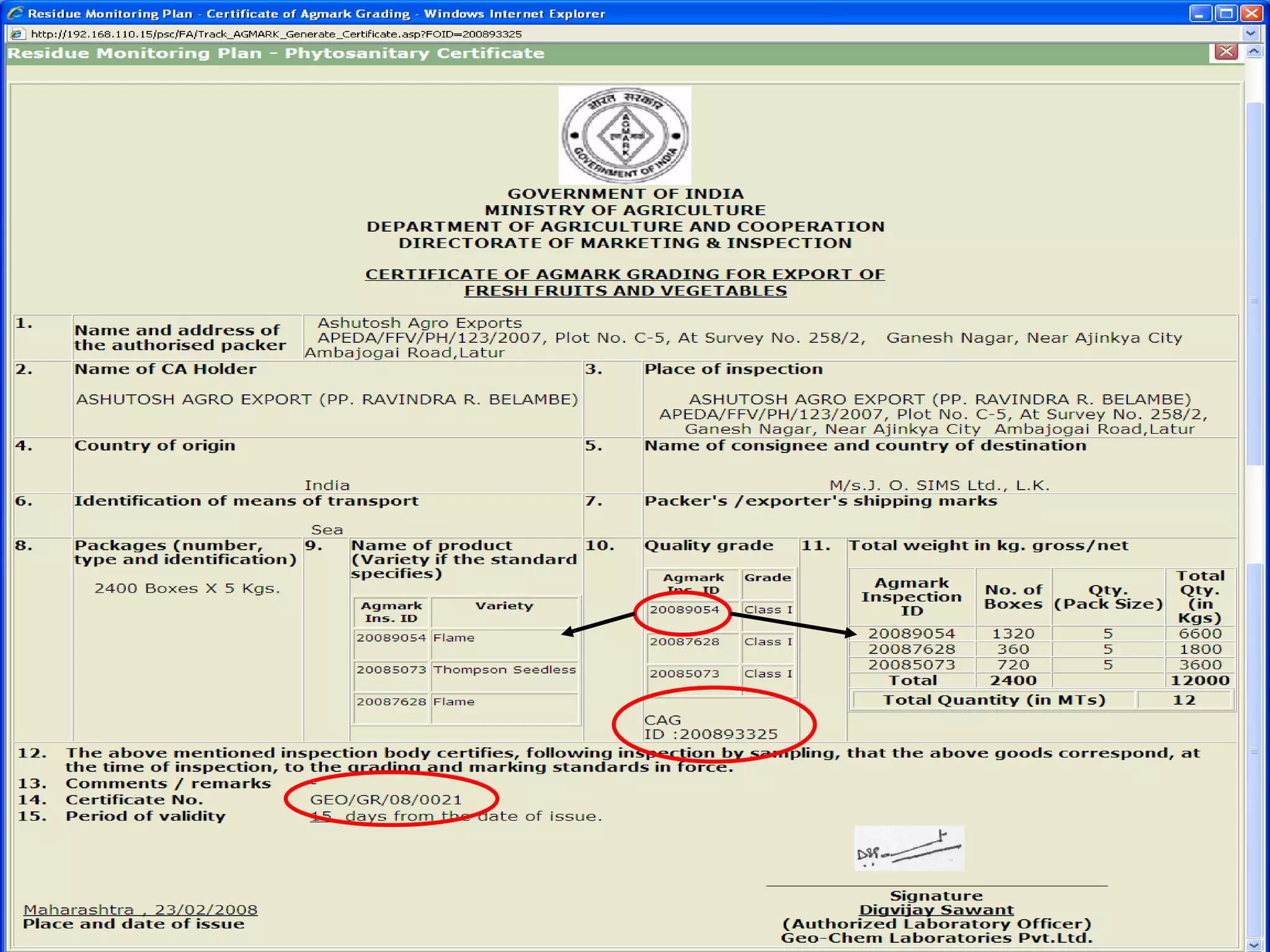
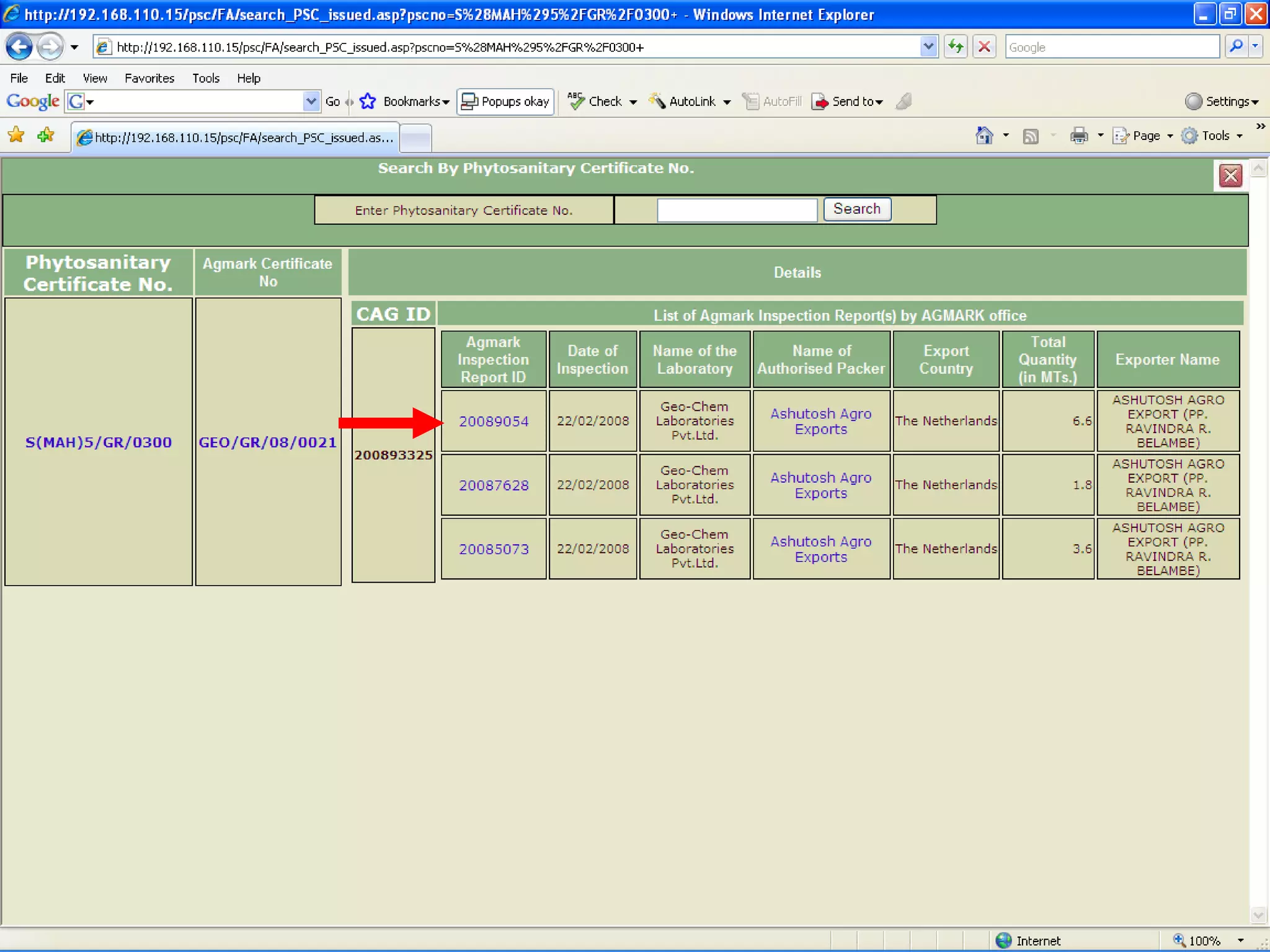
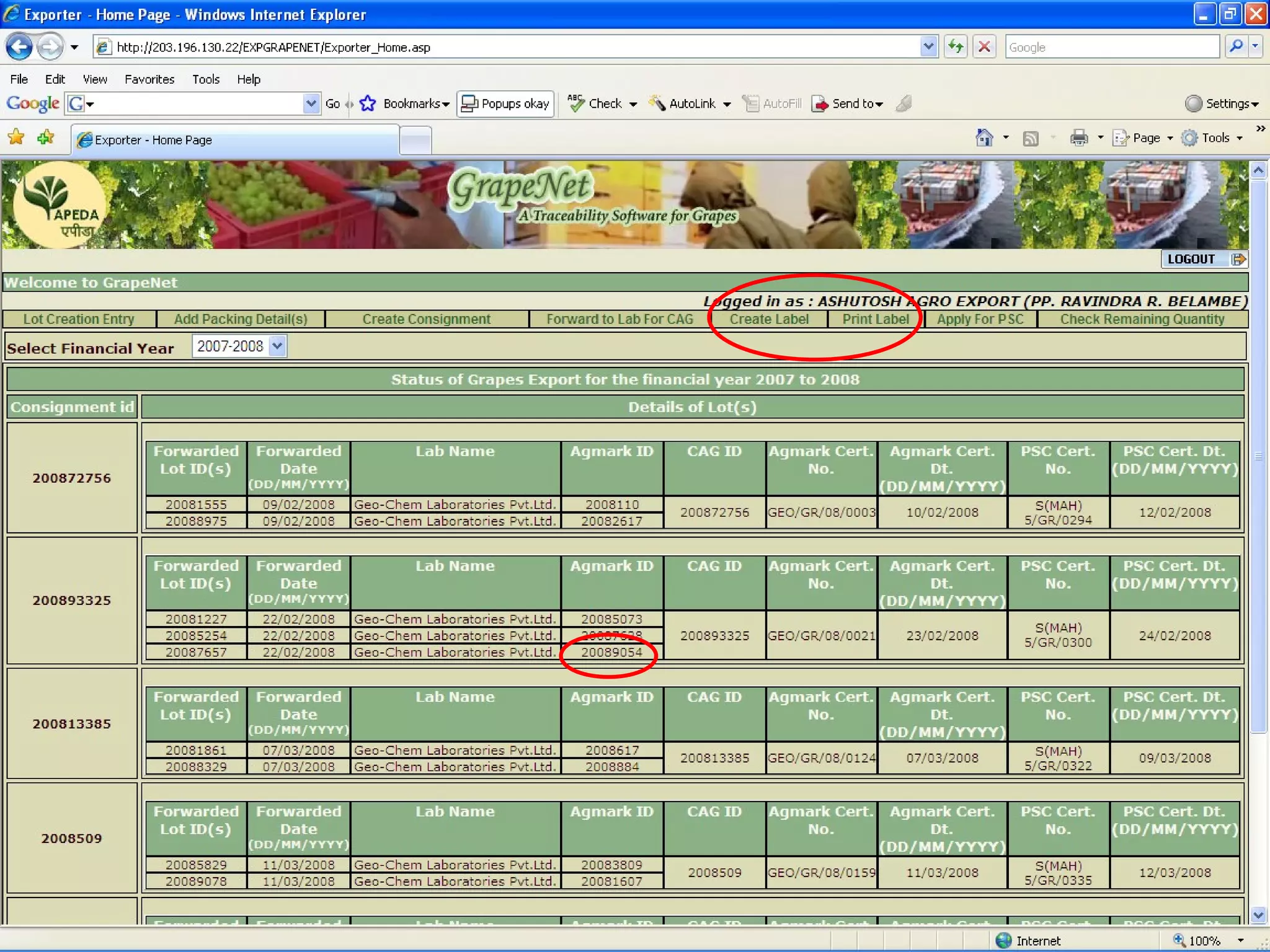
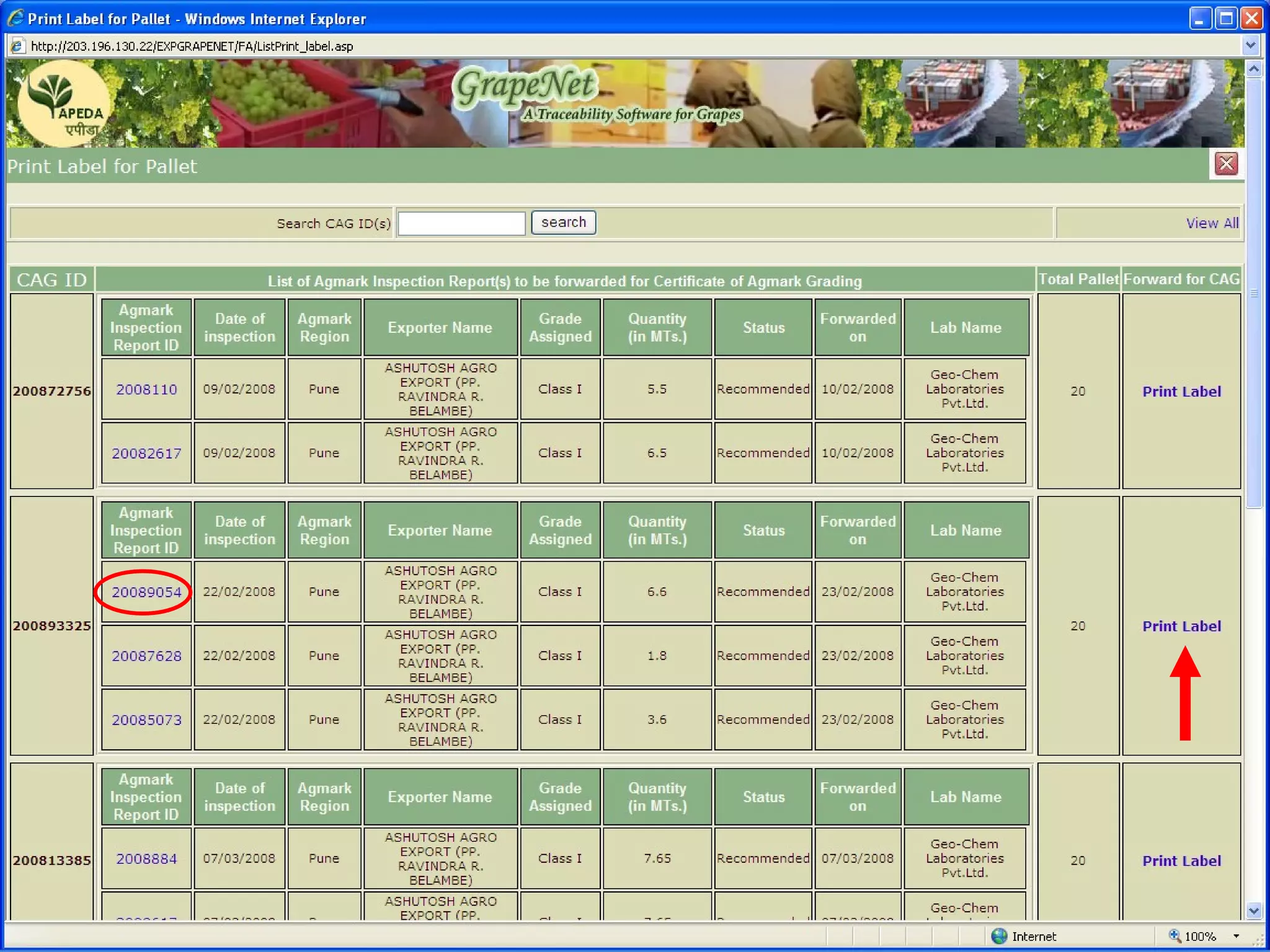
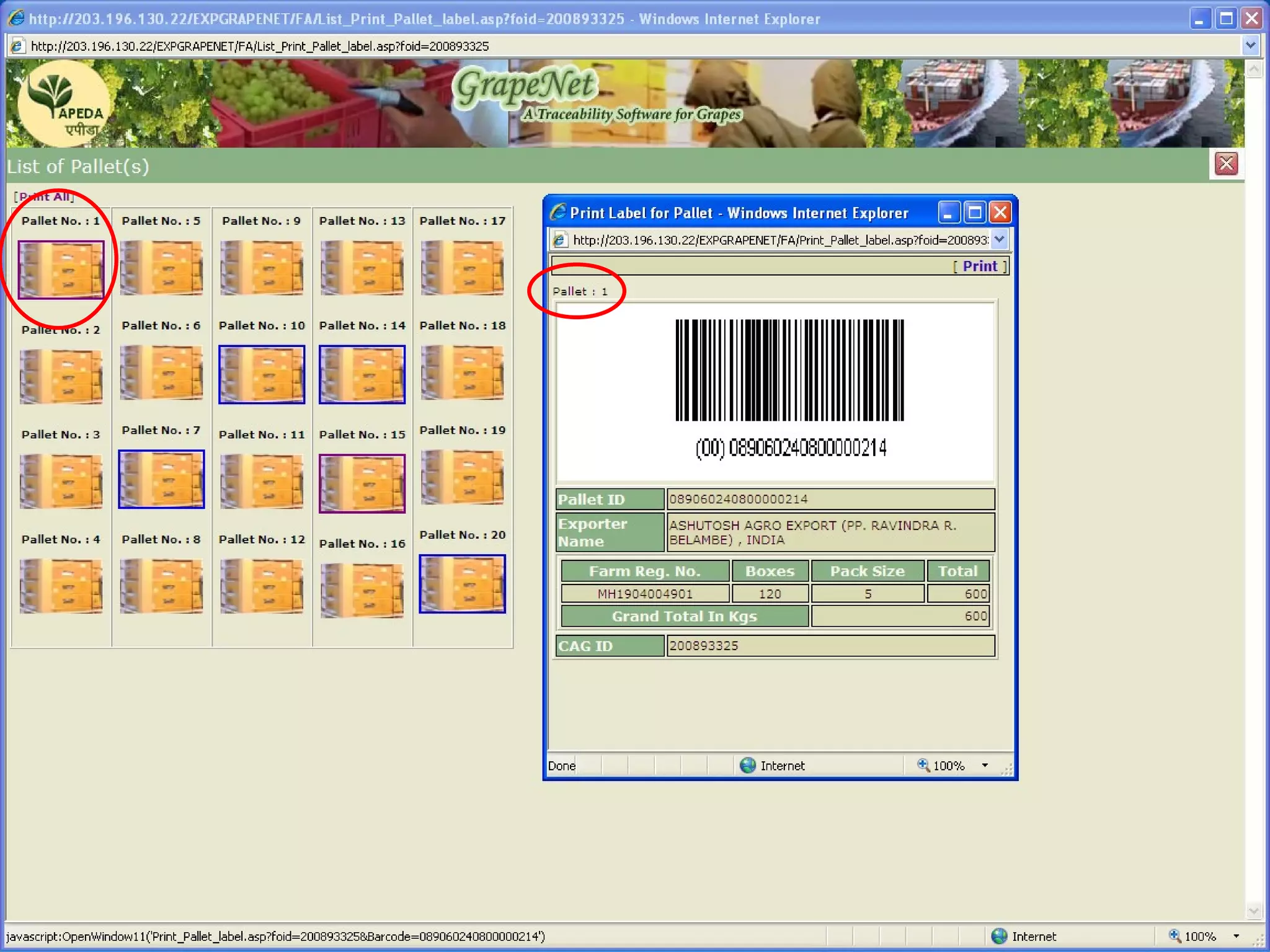
Courtesy and credit : APEDA.  Screenshots from its presentation for learning and creating awareness on ICTs in development among agricultural extension personnel in India.


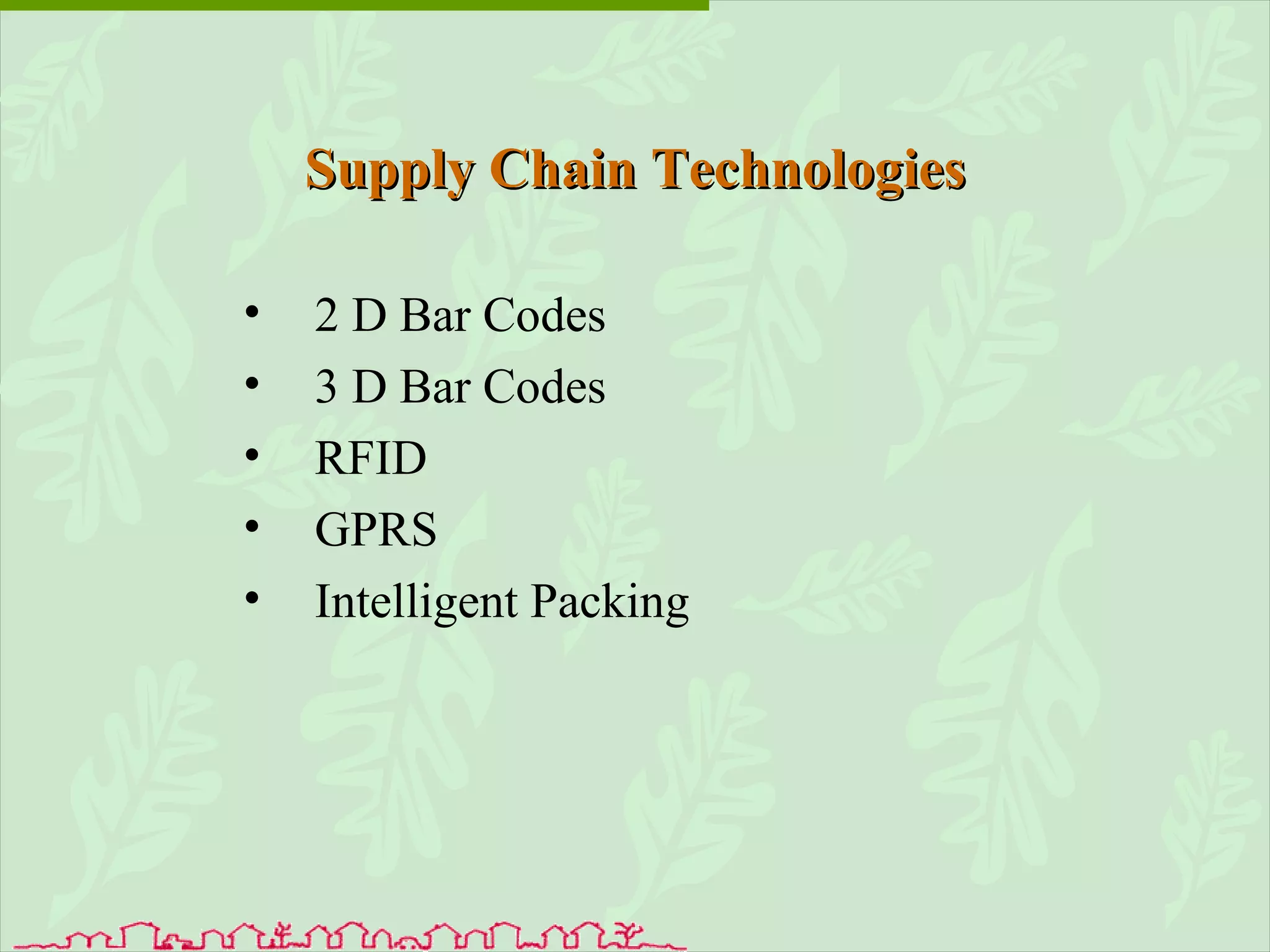
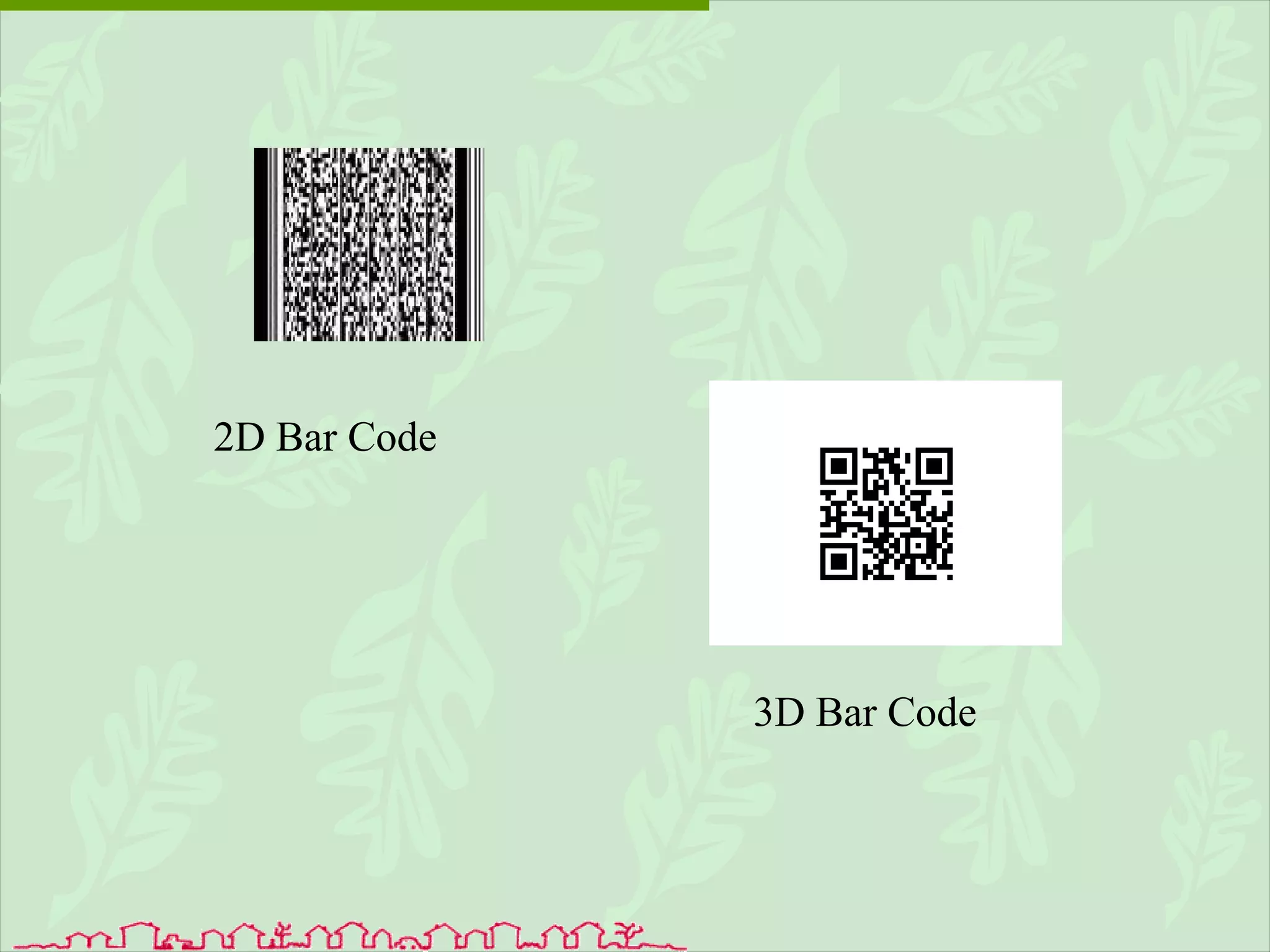
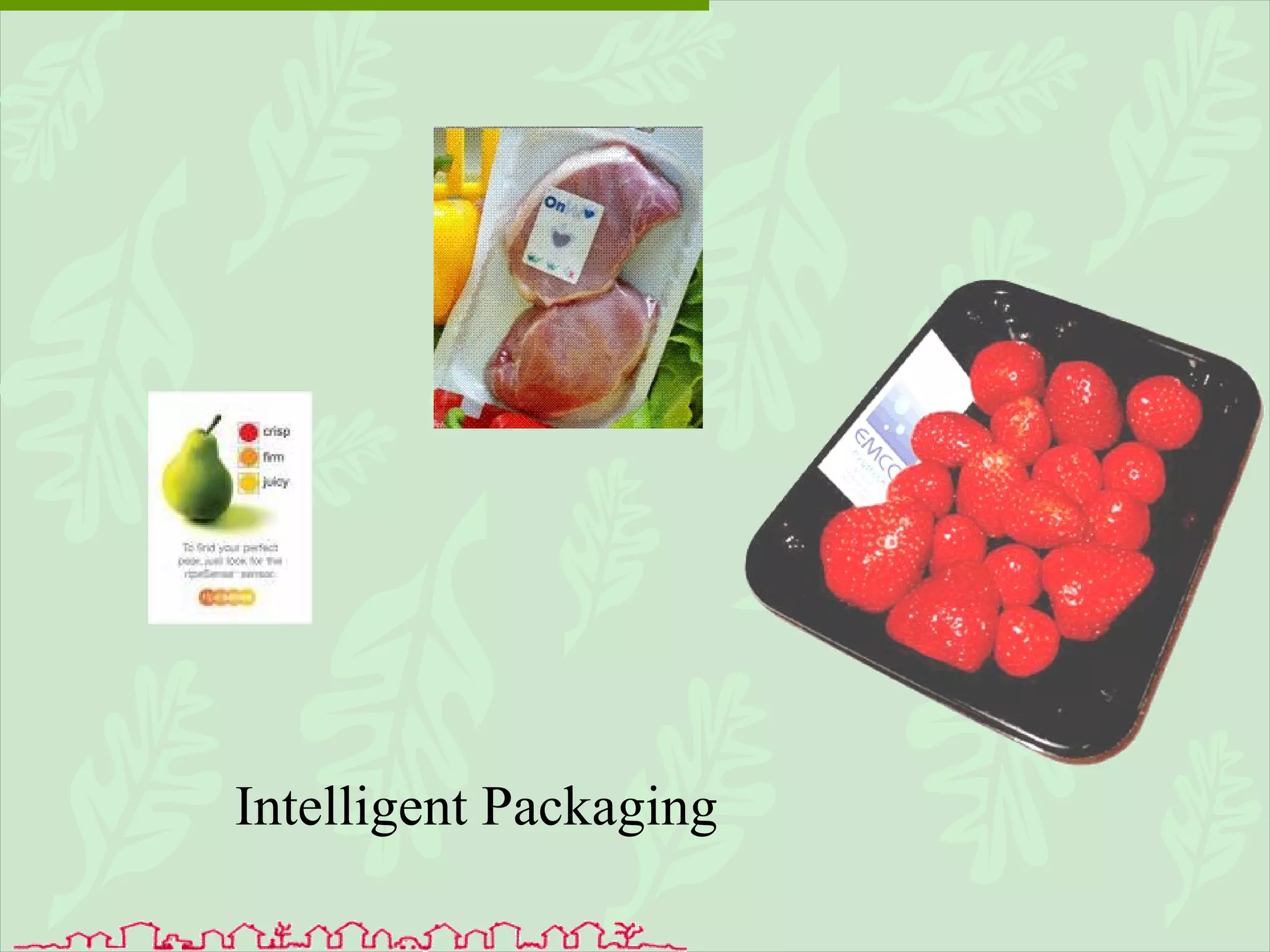
Supply Chain Technologies 2 D Bar Codes 3 D Bar Codes RFID GPRS Intelligent Packing
RFID (Radio Frequency Identification) Transponder Transceiver EPC Global Trade ID Number EPC Network
RFID Current Applications Electronic article surveillance Speed pass payment systems Warehouse management Livestock traceability
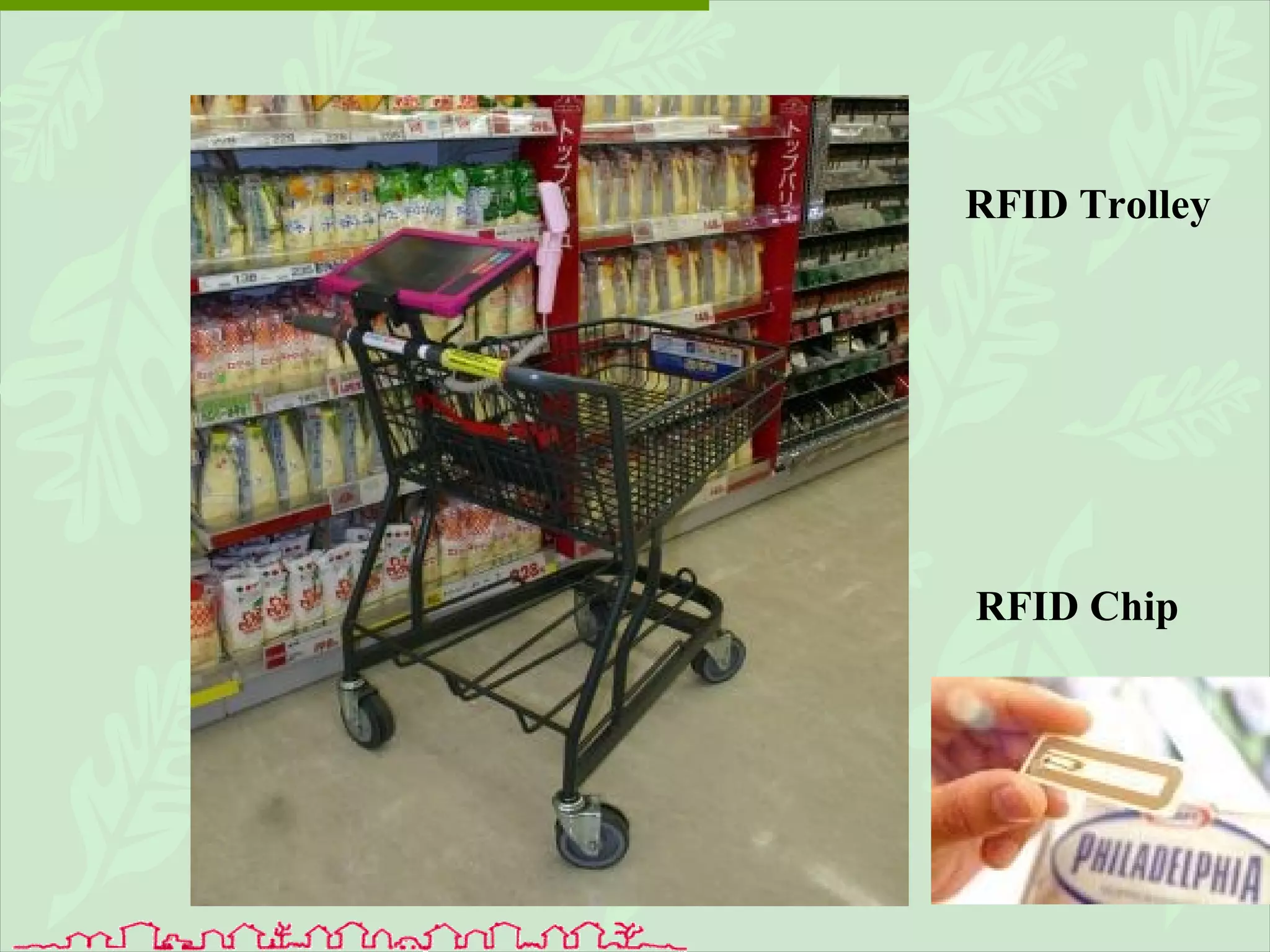
RFID- Benefits Improves security – reduced theft Shrinkage control Labor savings (throughout supply chain) Numerous marketing applications like tracking in store shopper movement and linkage to smart loyalty cards Improved service like total cart out scanning at check outs
RFID Trolley RFID Chip
2D Bar Code 3D Bar Code
Intelligent Packaging
ICT Initiatives at Village Level Public Initiatives Private Initiatives NGOs Initiated Partnerships in ICT enabled services
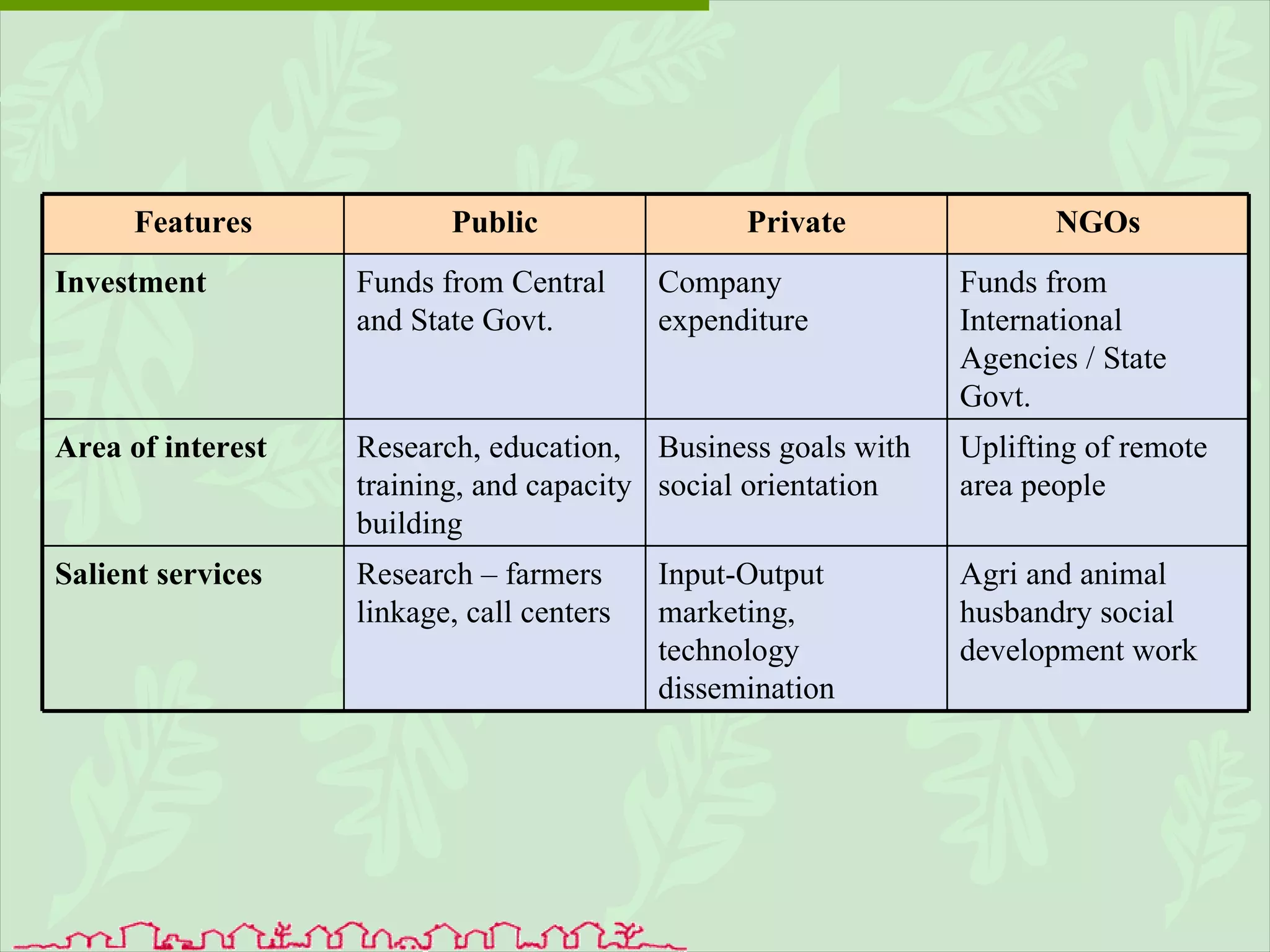
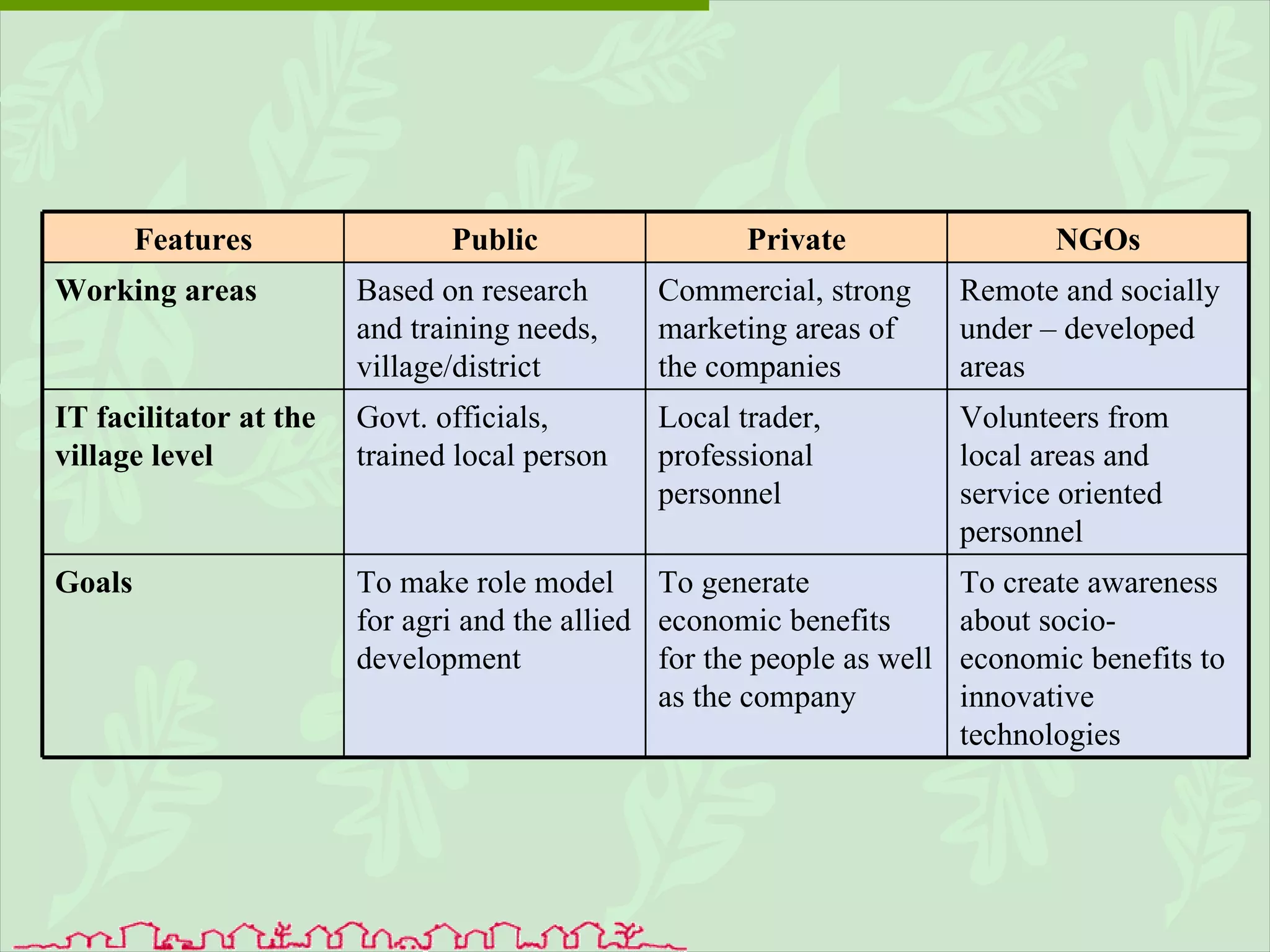
Agri and animal husbandry social development work Input-Output marketing, technology dissemination Research – farmers linkage, call centers Salient services Uplifting of remote area people Business goals with social orientation Research, education, training, and capacity building Area of interest Funds from International Agencies / State Govt. Company expenditure Funds from Central and State Govt. Investment NGOs Private Public Features
NGOs Private Public Features Remote and socially under – developed areas Commercial, strong marketing areas of the companies Based on research and training needs, village/district Working areas To create awareness about socio-economic benefits to innovative technologies To generate economic benefits for the people as well as the company To make role model for agri and the allied development Goals Volunteers from local areas and service oriented personnel Local trader, professional personnel Govt. officials, trained local person IT facilitator at the village level
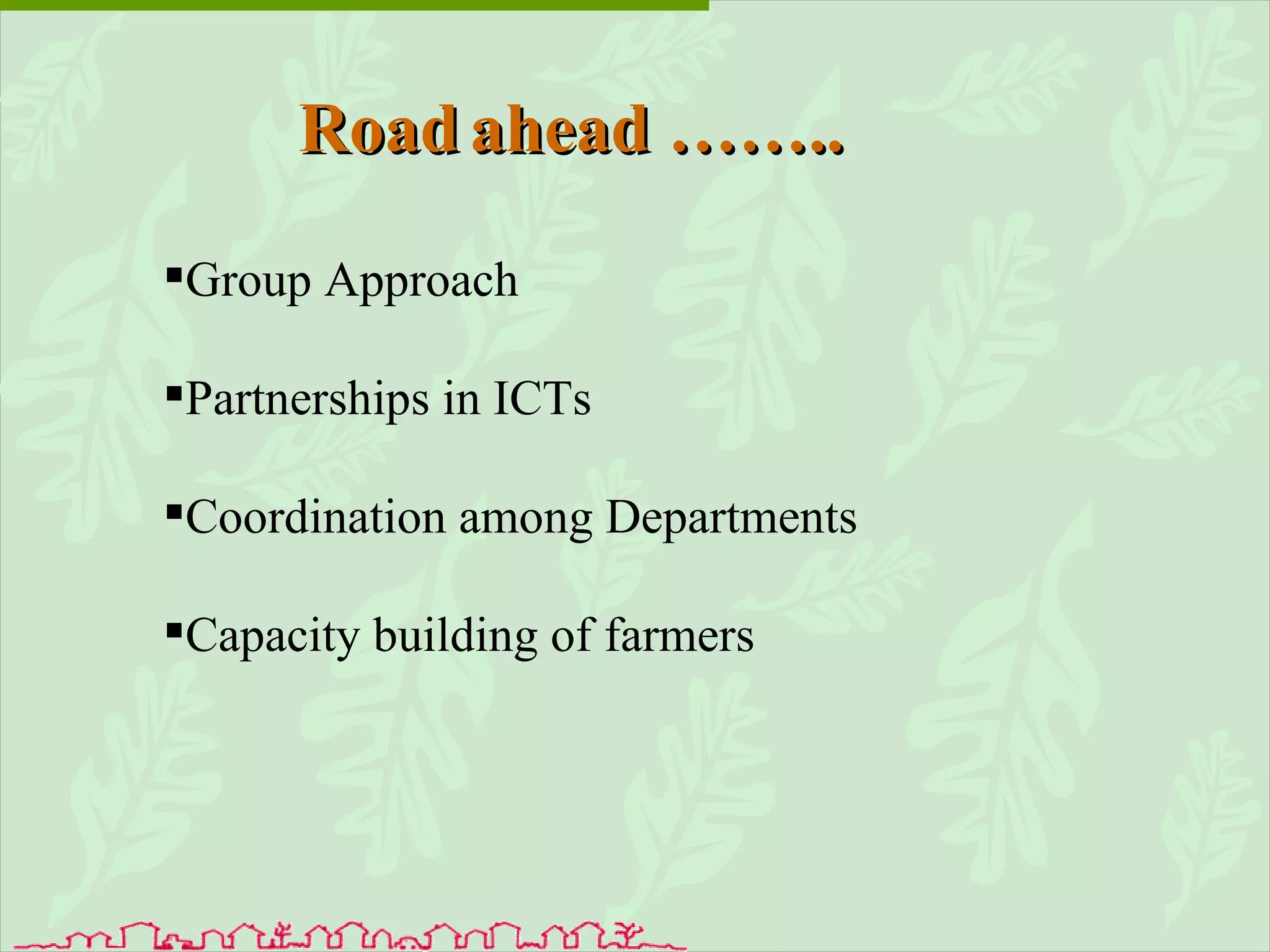
Group Approach Partnerships in ICTs Coordination among Departments Capacity building of farmers Road   ahead ……..
Thanks Credits:   The screenshots of applications and web pages are taken from the presentations of the respective organizations and their websites and presentations of several resource persons for academic purpose only. The credit goes to the these organizations, sources and individuals. Please give proper citation to these sources if in case this material is used. The views and points are purely personal and not necessarily that of MANAGE

ICT-enabled services for agricultural development in India

  • 1.
    ICT-enabled Services for Agricultural Development in India For academic purpose only Dr A.S.Charyulu National Institute of Agricultural Extension Management (MANAGE) Hyderabad, India.
  • 2.
    What is ICT?ICT includes any communication device or application, encompassing: Telephone Radio Television Cellular phone Computers Networks Satellite systems Hardware and software The Internet and its applications, WWW, Portals Various services and applications-videoconferencing and distance learning.
  • 3.
    Digital Revolution Whatis “Digital”? What is “Revolution”? Digital Revolution: Digitization of information Major advances in ICT (over the past two decades) Rapid growth in telecommunication networks (such as the Internet)
  • 4.
    Advances in ICTsConvergence of technologies Miniaturization Speed of processing data Increase of storage capacity Increase of bandwidth Networking – wireless technologies
  • 5.
    Digitalization ↔ Globalization Digitalization Communication Revolution Information flow Networking Globalization Trade flow Private capital flow Outsourcing growth
  • 6.
    Digitalization ↔ Globalization:The New Economy Transform business & market processes Accelerating GLOBALIZATION DIGITALIZATION
  • 7.
  • 8.
    The Digital DivideDifference between: those who have access and effective use of technology , and those who either lack it or don’t use it effectively. Types of Divide : The Global Divide (among countries ) The Social divide (within countries)
  • 9.
    The Global Divide:The disparity, among countries , between those who have access to ICT and use them effectively and those who don’t have access or don’t use them effectively. The Social Divide: The disparity, within a country , between those who have access to ICT and use them effectively and those who don’t have access or don’t use them effectively. The Digital Divide
  • 10.
    The Digital DivideHaves and have-nots based on the followiing facts: Technical aspects (infrastructure, ability, bandwidth) Gender: fewer girls involved Politics: ICT a threat for countries that do not want free flow of information Language: a dominance of English and Western languages: limits access to information Literacy: both illiteracy and IT-illiteracy affect access.
  • 11.
    Mobile phone BridgingDigital Divide: ICT Innovations
  • 12.
    Simputer ™ isa low cost portable alternative to PCs Bridging Digital Divide: ICT Innovations Photo credits: http://www.simputer.org
  • 13.
    Personal Digital Assistant(PDA) Bridging Digital Divide: ICT Innovations
  • 14.
    Videoconferencing Bridging DigitalDivide: ICT Innovations
  • 15.
    Community Radio BridgingDigital Divide: ICT Innovations Photo courtesy: Deccan Development Society
  • 16.
    Application of ICTsDevelopment Governance Agriculture
  • 17.
    Development Planning fordevelopment, Health, Education, Disaster management etc. Application of ICTs
  • 18.
    Courtesy and credits: National Informatics Centre (NIC), Govt. of India, screenshots from its presentation for learning and creating awareness on ICTs in development among agricultural extension personnel in India.
  • 19.
  • 20.
  • 21.
  • 22.
  • 23.
    Converging Funds fromdifferent schemes
  • 24.
  • 25.
  • 26.
  • 27.
  • 28.
    Palaniammal’s eyes…Application of ICTs Photographs by an ordinary web camera: Remote feedback given by Aravind Eye hospital Credit : IT and Common Man : Bringing the Net Effect to 700 million Rural Indians by Prof. Ashok Jhunjhunwala, IITM, Chennai; ashok@tenet.res.in
  • 29.
    Application of ICTsThe Power of Visual Communication A Doctor in Madurai talking to patients in Ulaganathapuram Credit: IT and Common Man : Bringing the Net Effect to 700 million Rural Indians by Prof. Ashok Jhunjhunwala, IITM, Chennai; ashok@tenet.res.in
  • 30.
    Application of ICTsRemote Cardiac care Credit: IT and Common Man : Bringing the Net Effect to 700 million Rural Indians by Prof. Ashok Jhunjhunwala, IITM, Chennai; ashok@tenet.res.in
  • 31.
    Grameen VillagePhone, Bangladesh.Application of ICTs (Photo from: www.grameenphone.com)
  • 32.
    Central Government Initiatives: DAC-NATP, DACNET, AGMARKNET, KCC DARE-ARIS,ATIC, Ministry of CIT(NIC)- CICs State Government Supported : Rajasthan- Jan Mitra, Gujarat-GAU-SAT-KRU, M.P.- Gyandoot, Maharashtra-Maha-Agrinet, A.P.-Rural e-Seva, Karnataka-Rhythu Sampark Kendras and Bhoomi, Kerala- Kissan Kerala, Akshaya Kendras Corporate Sector Initiatives: e-Chaupals of ITC-IBD, Tata Kisan Kendras of Tata Chemicals, Parry’s Corners of EID Parry and Chirag Kendras of n-Logue NGOs and other private Sector : Information Village-MSSRF, Drishti.com, Agriwatch.com, TARA Kendras. ICTs Applications in India
  • 33.
    Ministry of PanchayatiRaj to establish Information Kiosks in 2,37,000 Panchayats (Mission 2007) Department of Information Technology (DIT) plans to initiate over 1,00,000 Common Service Centres (CSCs) under the National eGovernance Plan (NeGP). ITC is adding 7 new eChaupals a day and plans to scale up to 20,000 eChaupals by 2010 covering 100,000 villages in 15 states. (Sivakumar CEO, ITC-IBD) Governments of Uttaranchal, Rajasthan, A.P., Kerala have also announced Major Rural Connectivity Projects Application of ICTs in Agriculture
  • 34.
    Use of ICTby all NARS Research Information Networks, Expert Systems, Decision Support Systems; Knowledge Networks Agricultural Extension Cyber Extension, e-Extension, Virtual Extension Agribusiness &Marketing Market information websites; Agribusiness portals E-trading Application of ICT in Agricultural Research-Extension-Marketing
  • 35.
    e Sagu eSaguis an IT-based agro-advisory system by IIIT, Hyderabad Personalized : Agriculture expert advice at the farmer’s door-step. Query-less: Farmers need not ask a question Continuous: Advice is provided regularly (once in a week) from sowing to harvesting. Timely: Provides the advice within 24 to 36 hours Cost-effective.
  • 36.
    Courtesy and Credit:e-Sagu, IIIT, Hyderabad Agriculture experts Community System Agricultural Information System (PORTAL) Soil data Plant properties Crop data Farmer’s details Research data Coordinator Coordinator Coordinator Far mer Far mer Far mer Far mer Far mer Far mer Far mer Far mer Far mer
  • 37.
    Courtesy and Credit:e-Sagu, IIIT, Hyderabad
  • 38.
    eSagu – anAgro Advisory System eSagu provides personalized advice eSagu is feedback based eSagu provides timely advice eSagu is query-less eSagu covers all the farms (poor farmers) eSagu is cost-effective eSagu can be developed with the available infrastructure eSagu creates the effect of multiple agriculture scientists visiting each and every farm.
  • 39.
    Computer to MobileSMS Broadcast Service Sender Receiver Courtesy and credit: KVK, Bhabaleswar.
  • 40.
    Courtesy and credit: TNAU, Coimbatore .
  • 41.
  • 42.
    Community Radio Courtesyand credit : TNAU, Coimbatore .
  • 43.
    CR in AgriculturalInstitutions Indian Council of Agriculture Research (ICAR) is eligible. 38 State Agriculture Universities 39 Central Research Institutes 18 National Research Centers 553 Krishi Vigyan Kendras
  • 44.
    In February 2008………….Krishi Vigyan Kendra, Bharsar, Pauri, Uttarakhand Krishi Vigyan Kendra, Gwaldham.Chamoli, Uttarakhand Krishi Vigyan Kendra. Ranichauri, Tehri Garhwal, Uttarakhand Krishi Vigyan Kendra, Chiniyalisaur, Uttarkashi, Uttarakhand Krishi Vigyan Kendra, Jyolikot, Distt-Nainital, Uttarakhand Krishi Vigyan Kendra, Lohaghat. P.O.Galchoura, Distt-Champawat, Uttarakhand CR in Agricultural Institutions
  • 45.
    7. Krishi VigyanKendra, Jakhdhar, Rudraprayag, Uttarakhand 8. Krishi Vigyan Kendra, Udham Singh Nagar, Uttarakhand 9. Krishi Vigyan Kendra, Harbatpur, Dehradun, Uttarakhand 10. Krishi Vigyan Kendra, Dhanausi, Haridwar, Uttarakhand 11. Krishi Vigyan Kendra, Ranikhet, Almora, Uttarakhand 12. Krishi Vigyan Kendra, Reddipalli, Anantapur, Andhra Pradesh 13. CCS Haryana Agricultural University, Hissar, Haryana 14. Indian Veterinary Research Institute Izatnagar-Bareilly, Uttar Pradesh . CR in Agricultural Institutions
  • 46.
    ICTs for AgriculturalMarketing Market Information Production information, Price information, forecasting, market intelligence, farmers advisory services Networking of Markets through ICTs Commodity Exchanges, Futures Trade Value chain management Knowledge intensive post-harvest management, Traceability , quality and certification, Supply chain management
  • 47.
  • 48.
  • 49.
  • 50.
  • 51.
  • 52.
  • 53.
  • 54.
  • 55.
  • 56.
  • 57.
  • 58.
  • 59.
  • 60.
  • 61.
    Courtesy and credit: APEDA. Screenshots from its presentation for learning and creating awareness on ICTs in development among agricultural extension personnel in India.
  • 62.
  • 63.
  • 64.
  • 65.
  • 66.
  • 67.
  • 68.
  • 69.
  • 70.
  • 71.
  • 72.
  • 73.
  • 74.
  • 75.
  • 76.
  • 77.
  • 78.
  • 79.
    Supply Chain Technologies2 D Bar Codes 3 D Bar Codes RFID GPRS Intelligent Packing
  • 80.
    RFID (Radio FrequencyIdentification) Transponder Transceiver EPC Global Trade ID Number EPC Network
  • 81.
    RFID Current ApplicationsElectronic article surveillance Speed pass payment systems Warehouse management Livestock traceability
  • 82.
    RFID- Benefits Improvessecurity – reduced theft Shrinkage control Labor savings (throughout supply chain) Numerous marketing applications like tracking in store shopper movement and linkage to smart loyalty cards Improved service like total cart out scanning at check outs
  • 83.
  • 84.
    2D Bar Code3D Bar Code
  • 85.
  • 86.
    ICT Initiatives atVillage Level Public Initiatives Private Initiatives NGOs Initiated Partnerships in ICT enabled services
  • 87.
    Agri and animalhusbandry social development work Input-Output marketing, technology dissemination Research – farmers linkage, call centers Salient services Uplifting of remote area people Business goals with social orientation Research, education, training, and capacity building Area of interest Funds from International Agencies / State Govt. Company expenditure Funds from Central and State Govt. Investment NGOs Private Public Features
  • 88.
    NGOs Private PublicFeatures Remote and socially under – developed areas Commercial, strong marketing areas of the companies Based on research and training needs, village/district Working areas To create awareness about socio-economic benefits to innovative technologies To generate economic benefits for the people as well as the company To make role model for agri and the allied development Goals Volunteers from local areas and service oriented personnel Local trader, professional personnel Govt. officials, trained local person IT facilitator at the village level
  • 89.
    Group Approach Partnershipsin ICTs Coordination among Departments Capacity building of farmers Road ahead ……..
  • 90.
    Thanks Credits: The screenshots of applications and web pages are taken from the presentations of the respective organizations and their websites and presentations of several resource persons for academic purpose only. The credit goes to the these organizations, sources and individuals. Please give proper citation to these sources if in case this material is used. The views and points are purely personal and not necessarily that of MANAGE