By:
Anil Kumar Jain
Assistant Professor,
Dept of Electrical & Electronics Engineering, SVITS,
Shri Vaishnav Vidyapeeth Vishwavidyalaya, Indore
(M.P.)
Synchronous Machine: Construction
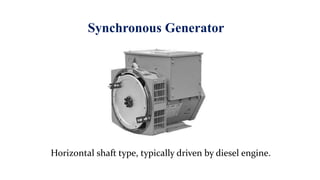
Synchronous Generator
Horizontal shaft type, typically driven by diesel engine.
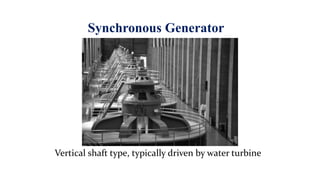
Synchronous Generator
Vertical shaft type, typically driven by water turbine
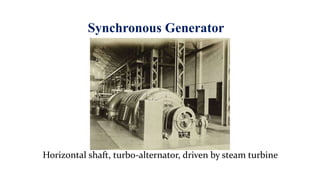
Synchronous Generator
Horizontal shaft, turbo-alternator, driven by steam turbine
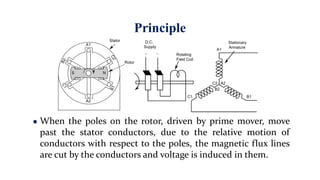
Principle
● When the poles on the rotor, driven by prime mover, move
past the stator conductors, due to the relative motion of
conductors with respect to the poles, the magnetic flux lines
are cut by the conductors and voltage is induced in them.
A1
C2 A2
B2
B1C1
Stationary
Armature
Rotating
Field Coil
D.C.
Supply
S N
A1
A2
Stator
Rotor
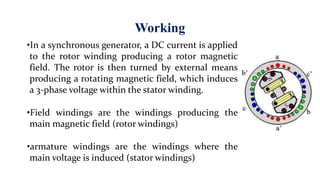
Working
•In a synchronous generator, a DC current is applied
to the rotor winding producing a rotor magnetic
field. The rotor is then turned by external means
producing a rotating magnetic field, which induces
a 3-phase voltage within the stator winding.
•Field windings are the windings producing the
main magnetic field (rotor windings)
•armature windings are the windings where the
main voltage is induced (stator windings)
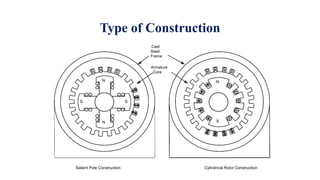
Type of Construction
.
Cast
Steel
Frame
Armature
Core
N
N
S S
N
S
.
. .
. .
.
.
.
.
. .
. . .
.
Salient Pole Construction Cylindrical Rotor Construction
Type of Construction
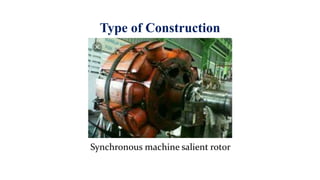
The rotor of a synchronous
machine is a large electromagnet.
The magnetic poles can be either
salient (sticking out of rotor
surface) or non- salient
construction.
Rotors are made laminated to
reduce eddy current losses.
Type of Construction
Synchronous machine salient rotor
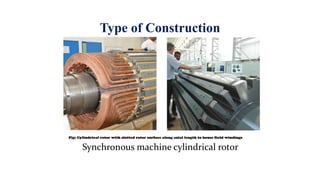
Type of Construction
Synchronous machine cylindrical rotor
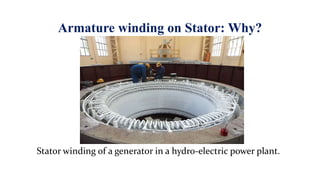
Armature winding on Stator: Why?
Stator winding of a generator in a hydro-electric power plant.
Armature winding on Stator: Why?
• The coil connections can be made easily and securely on the
stator than on the rotor.
• If the armature winding is placed on the rotor, then, three
slip rings would be required where as if the poles are placed
on the rotor, only two slip rings designed to carry low power
for the field winding are required.
• Transferring large armature power through brush and slip
ring causes them to wear out frequently which is prevented
if the armature is stationary.
Armature winding on Stator: Why?
•As the generated voltage is 11 kV or above, armature
winding requires thicker insulation which is difficult to
design if the armature is on the rotor.
•Field winding is lighter than armature winding and
therefore it is preferable to place it on the rotor.
•In very big synchronous generators, forced hydrogen
cooling of armature winding is employed which can be
conveniently implemented if the armature is stationary.
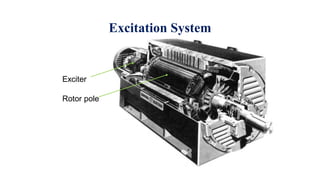
Excitation System
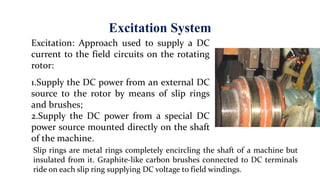
Excitation: Approach used to supply a DC
current to the field circuits on the rotating
rotor:
1.Supply the DC power from an external DC
source to the rotor by means of slip rings
and brushes;
2.Supply the DC power from a special DC
power source mounted directly on the shaft
of the machine.
Slip rings are metal rings completely encircling the shaft of a machine but
insulated from it. Graphite-like carbon brushes connected to DC terminals
ride on each slip ring supplying DC voltage to field windings.
Excitation System
• On large generators and motors, brushless exciters are used.
• A brushless exciter is a small AC generator whose field
circuits are mounted on the stator and armature circuits
are mounted on the rotor shaft.
• The exciter generator’s 3-phase output is rectified to DC by
a 3-phase rectifier (mounted on the shaft) and fed into the
main DC field circuit.
• It is possible to adjust the field current on the main
machine by controlling the small DC field current of the
exciter generator (located on the stator).
Excitation System
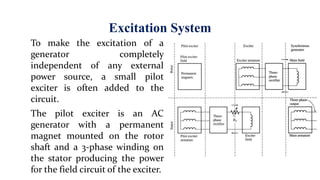
To make the excitation of a
generator completely
independent of any external
power source, a small pilot
exciter is often added to the
circuit.
The pilot exciter is an AC
generator with a permanent
magnet mounted on the rotor
shaft and a 3-phase winding on
the stator producing the power
for the field circuit of the exciter.
Excitation System
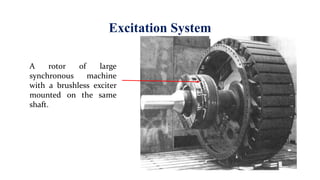
A rotor of large
synchronous machine
with a brushless exciter
mounted on the same
shaft.
Excitation System
Exciter
Rotor pole
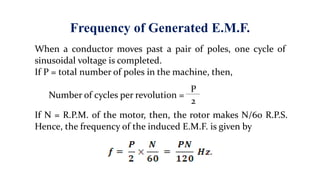
Frequency of Generated E.M.F.
When a conductor moves past a pair of poles, one cycle of
sinusoidal voltage is completed.
If P = total number of poles in the machine, then,
Number of cycles per revolution =
P
2
If N = R.P.M. of the motor, then, the rotor makes N/60 R.P.S.
Hence, the frequency of the induced E.M.F. is given by
E.M.F. Equation
If P = number of poles in the machine and Φ = flux per pole,
Magnetic flux cut by a conductor in one revolution of the rotor
= PΦ. If N is the R.P.M., then, time taken by the rotor to make
one revolution = 60/N seconds. Therefore,
Flux cut per second by a conductor =
But average induced E.M.F. in a conductor = flux cut per
second. Therefore
PΦ
60/N
Average induced E.M.F. in a conductor =
PΦN
60
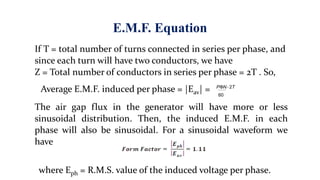
E.M.F. Equation
If T = total number of turns connected in series per phase, and
since each turn will have two conductors, we have
Z = Total number of conductors in series per phase = 2T . So,
Average E.M.F. induced per phase = |Eav| =
The air gap flux in the generator will have more or less
sinusoidal distribution. Then, the induced E.M.F. in each
phase will also be sinusoidal. For a sinusoidal waveform we
have
PΦN
60
·2T
where Eph = R.M.S. value of the induced voltage per phase.
E.M.F. Equation
Therefore, the R.M.S. voltage induced per phase is
But the frequency of the induced E.M.F. is given by
On substituting we get:
Volts
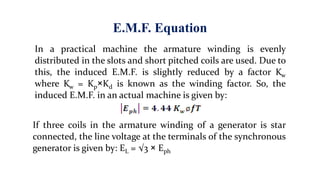
E.M.F. Equation
In a practical machine the armature winding is evenly
distributed in the slots and short pitched coils are used. Due to
this, the induced E.M.F. is slightly reduced by a factor Kw
where Kw = Kp×Kd is known as the winding factor. So, the
induced E.M.F. in an actual machine is given by:
If three coils in the armature winding of a generator is star
connected, the line voltage at the terminals of the synchronous
generator is given by: EL = √3 × Eph

Synchronous generator construction

  • 1.
    By: Anil Kumar Jain AssistantProfessor, Dept of Electrical & Electronics Engineering, SVITS, Shri Vaishnav Vidyapeeth Vishwavidyalaya, Indore (M.P.) Synchronous Machine: Construction
  • 2.
    Synchronous Generator Horizontal shafttype, typically driven by diesel engine.
  • 3.
    Synchronous Generator Vertical shafttype, typically driven by water turbine
  • 4.
    Synchronous Generator Horizontal shaft,turbo-alternator, driven by steam turbine
  • 5.
    Principle ● When thepoles on the rotor, driven by prime mover, move past the stator conductors, due to the relative motion of conductors with respect to the poles, the magnetic flux lines are cut by the conductors and voltage is induced in them. A1 C2 A2 B2 B1C1 Stationary Armature Rotating Field Coil D.C. Supply S N A1 A2 Stator Rotor
  • 6.
    Working •In a synchronousgenerator, a DC current is applied to the rotor winding producing a rotor magnetic field. The rotor is then turned by external means producing a rotating magnetic field, which induces a 3-phase voltage within the stator winding. •Field windings are the windings producing the main magnetic field (rotor windings) •armature windings are the windings where the main voltage is induced (stator windings)
  • 7.
    Type of Construction . Cast Steel Frame Armature Core N N SS N S . . . . . . . . . . . . . . . Salient Pole Construction Cylindrical Rotor Construction
  • 8.
    Type of Construction Therotor of a synchronous machine is a large electromagnet. The magnetic poles can be either salient (sticking out of rotor surface) or non- salient construction. Rotors are made laminated to reduce eddy current losses.
  • 9.
    Type of Construction Synchronousmachine salient rotor
  • 10.
    Type of Construction Synchronousmachine cylindrical rotor
  • 11.
    Armature winding onStator: Why? Stator winding of a generator in a hydro-electric power plant.
  • 12.
    Armature winding onStator: Why? • The coil connections can be made easily and securely on the stator than on the rotor. • If the armature winding is placed on the rotor, then, three slip rings would be required where as if the poles are placed on the rotor, only two slip rings designed to carry low power for the field winding are required. • Transferring large armature power through brush and slip ring causes them to wear out frequently which is prevented if the armature is stationary.
  • 13.
    Armature winding onStator: Why? •As the generated voltage is 11 kV or above, armature winding requires thicker insulation which is difficult to design if the armature is on the rotor. •Field winding is lighter than armature winding and therefore it is preferable to place it on the rotor. •In very big synchronous generators, forced hydrogen cooling of armature winding is employed which can be conveniently implemented if the armature is stationary.
  • 14.
    Excitation System Excitation: Approachused to supply a DC current to the field circuits on the rotating rotor: 1.Supply the DC power from an external DC source to the rotor by means of slip rings and brushes; 2.Supply the DC power from a special DC power source mounted directly on the shaft of the machine. Slip rings are metal rings completely encircling the shaft of a machine but insulated from it. Graphite-like carbon brushes connected to DC terminals ride on each slip ring supplying DC voltage to field windings.
  • 15.
    Excitation System • Onlarge generators and motors, brushless exciters are used. • A brushless exciter is a small AC generator whose field circuits are mounted on the stator and armature circuits are mounted on the rotor shaft. • The exciter generator’s 3-phase output is rectified to DC by a 3-phase rectifier (mounted on the shaft) and fed into the main DC field circuit. • It is possible to adjust the field current on the main machine by controlling the small DC field current of the exciter generator (located on the stator).
  • 16.
    Excitation System To makethe excitation of a generator completely independent of any external power source, a small pilot exciter is often added to the circuit. The pilot exciter is an AC generator with a permanent magnet mounted on the rotor shaft and a 3-phase winding on the stator producing the power for the field circuit of the exciter.
  • 17.
    Excitation System A rotorof large synchronous machine with a brushless exciter mounted on the same shaft.
  • 18.
  • 19.
    Frequency of GeneratedE.M.F. When a conductor moves past a pair of poles, one cycle of sinusoidal voltage is completed. If P = total number of poles in the machine, then, Number of cycles per revolution = P 2 If N = R.P.M. of the motor, then, the rotor makes N/60 R.P.S. Hence, the frequency of the induced E.M.F. is given by
  • 20.
    E.M.F. Equation If P= number of poles in the machine and Φ = flux per pole, Magnetic flux cut by a conductor in one revolution of the rotor = PΦ. If N is the R.P.M., then, time taken by the rotor to make one revolution = 60/N seconds. Therefore, Flux cut per second by a conductor = But average induced E.M.F. in a conductor = flux cut per second. Therefore PΦ 60/N Average induced E.M.F. in a conductor = PΦN 60
  • 21.
    E.M.F. Equation If T= total number of turns connected in series per phase, and since each turn will have two conductors, we have Z = Total number of conductors in series per phase = 2T . So, Average E.M.F. induced per phase = |Eav| = The air gap flux in the generator will have more or less sinusoidal distribution. Then, the induced E.M.F. in each phase will also be sinusoidal. For a sinusoidal waveform we have PΦN 60 ·2T where Eph = R.M.S. value of the induced voltage per phase.
  • 22.
    E.M.F. Equation Therefore, theR.M.S. voltage induced per phase is But the frequency of the induced E.M.F. is given by On substituting we get: Volts
  • 23.
    E.M.F. Equation In apractical machine the armature winding is evenly distributed in the slots and short pitched coils are used. Due to this, the induced E.M.F. is slightly reduced by a factor Kw where Kw = Kp×Kd is known as the winding factor. So, the induced E.M.F. in an actual machine is given by: If three coils in the armature winding of a generator is star connected, the line voltage at the terminals of the synchronous generator is given by: EL = √3 × Eph