SUBMITTED TO:-
MR. ANIL DANGI
(Assistant prof. )
SUBMITTED BY:-
AJAY KUMAR DAS
COURSE:-B.TECH(CSE)
MUR1800226
CONTENTS
1. Introduction.
2. Basic terminology.
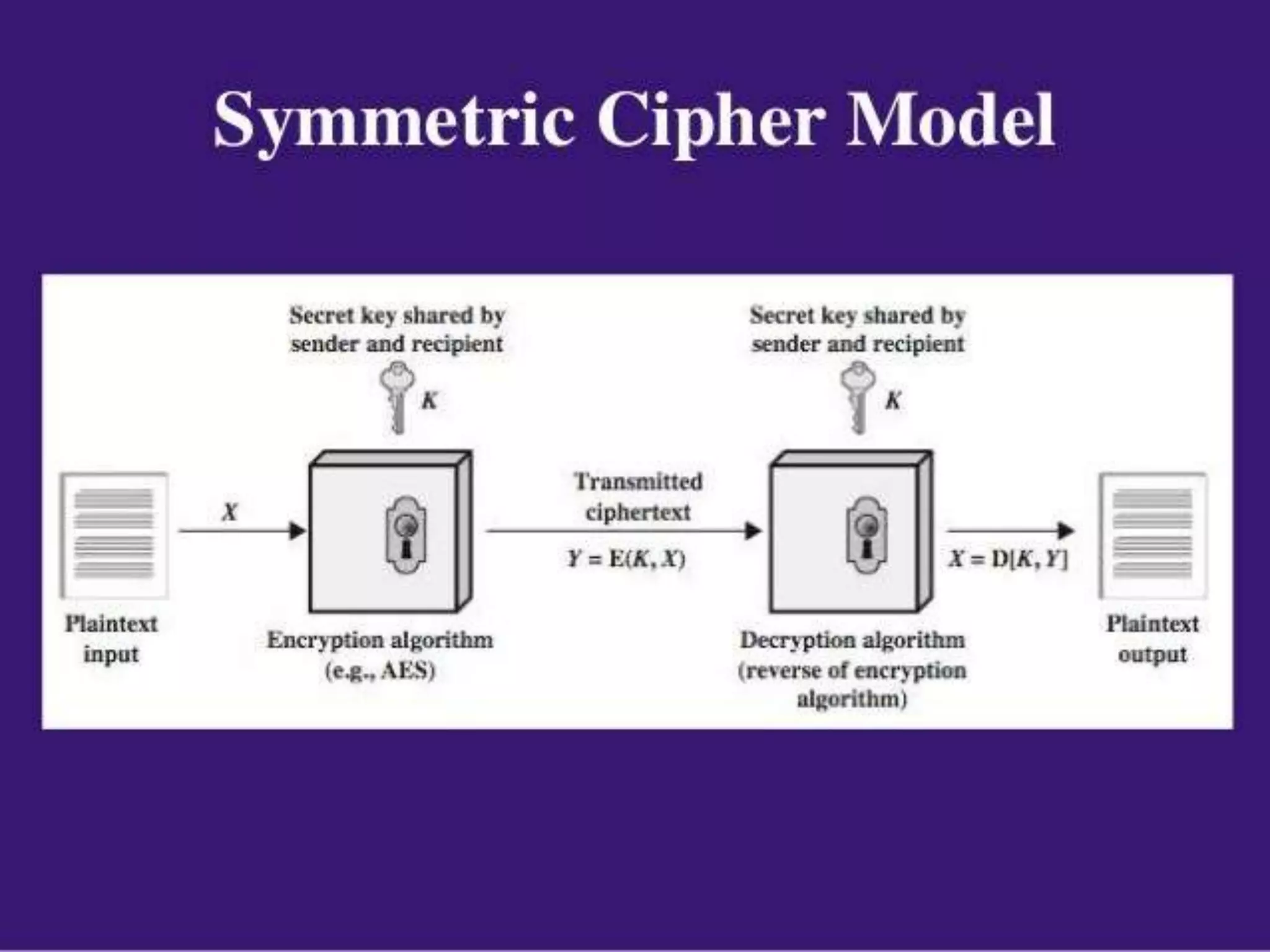
3. Symmetric cipher model.
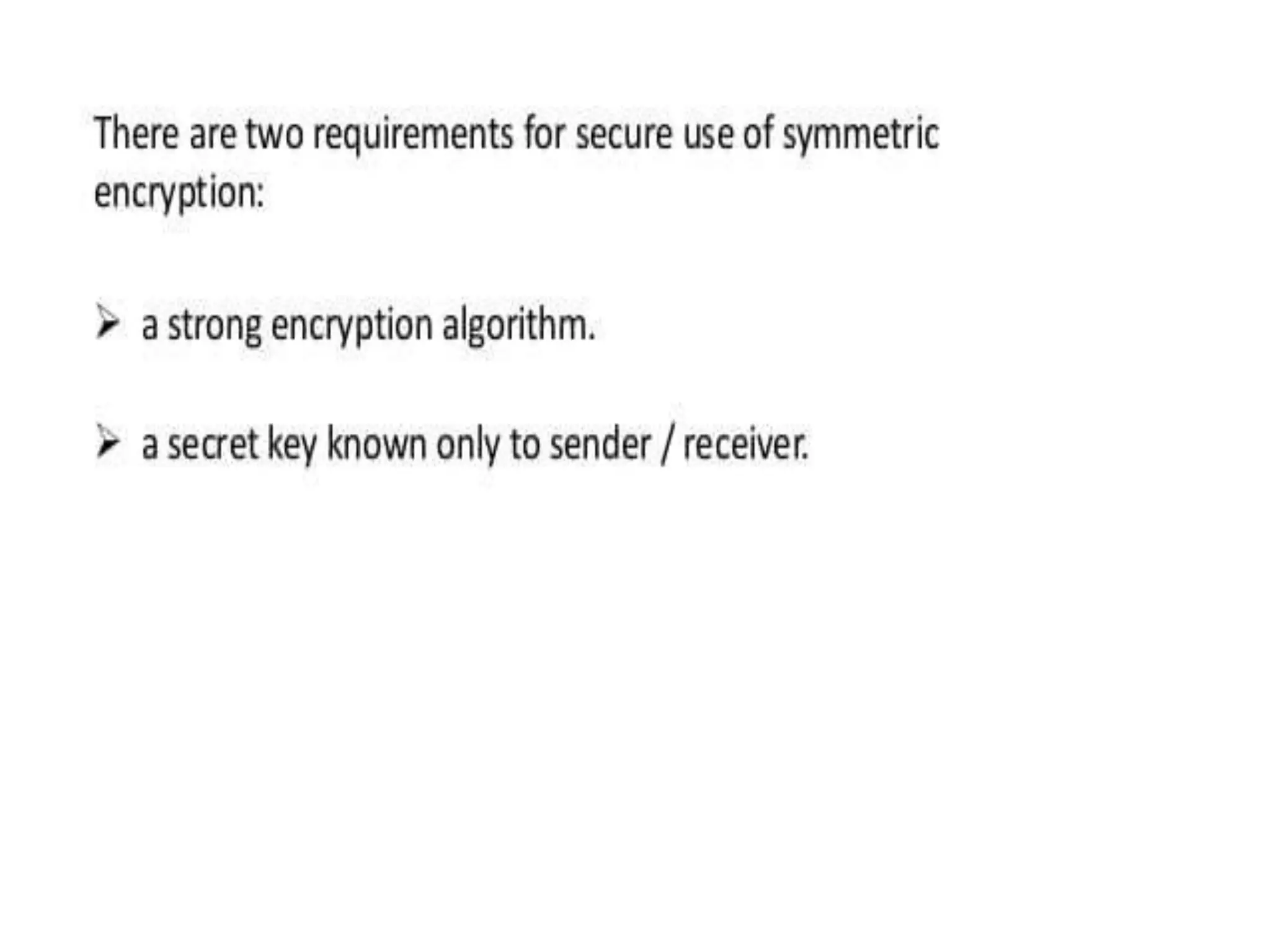
4. Security requirements
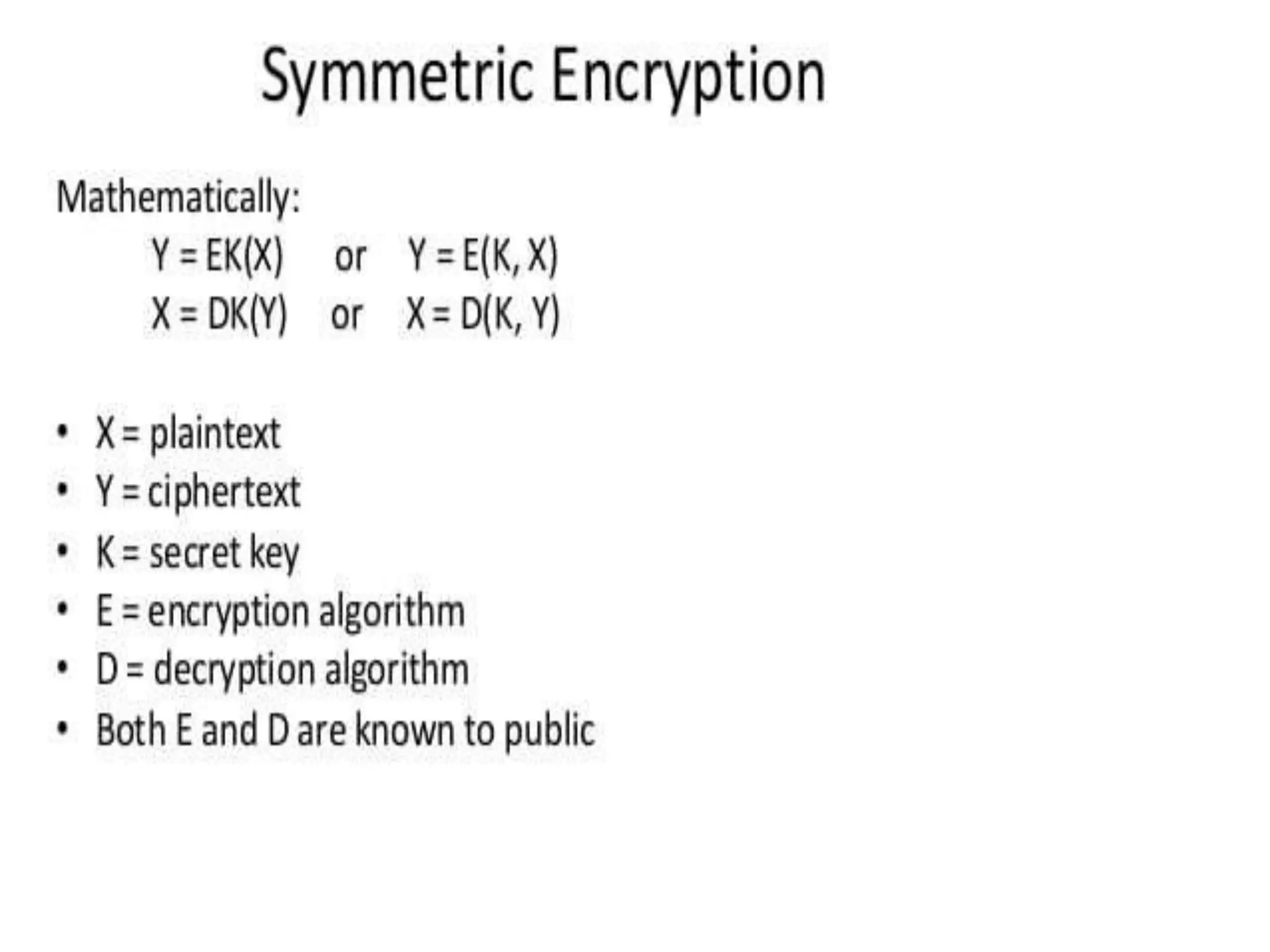
5. Security mathematics
6. Cryptography
7. Cryptanalysis
8. Brute – force- attack
9. Advantage of symmetric cryptosystem.
10.Disadvantage of symmetric cryptosystem.
Introduction
• Symmetric encryption, also referred to as conventional
encryption or single-key encryption, was the only type of
encryption in use prior to the development of public-key
encryption in the 1970s.
• It remains by far the most widely used of the two types
of encryption.
• An original message is known as the plaintext, while the
coded message is called the ciphertext.
• The process of converting from plaintext to ciphertext
is known as enciphering or encryption; restoring the
plaintext from the ciphertext is deciphering or
decryption. Many schemes used for encryption
constitute the area of study known as cryptography.
• Such a scheme is known as a cryptographic system or
a cipher.
• Techniques used for deciphering a message without
any knowledge of the enciphering details fall into the
area of cryptanalysis. Cryptanalysis is what the
layperson calls “breaking the code”.
Some Basic Terminology
• Plaintext - original message.
•Ciphertext - coded message .
•Cipher - algorithm for transforming plaintext to
ciphertext.
• key - info used in cipher known only to sender/receiver
•Encipher (encrypt) - converting plaintext to ciphertext.
•Decipher (decrypt) - recovering ciphertext from
plaintext
•Cryptography - study of encryption principles/methods.
•Cryptanalysis (codebreaking) - study of principles/
methods of deciphering ciphertext without knowing key.
•Cryptology -field of both cryptography and
cryptanalysis.
Cryptography
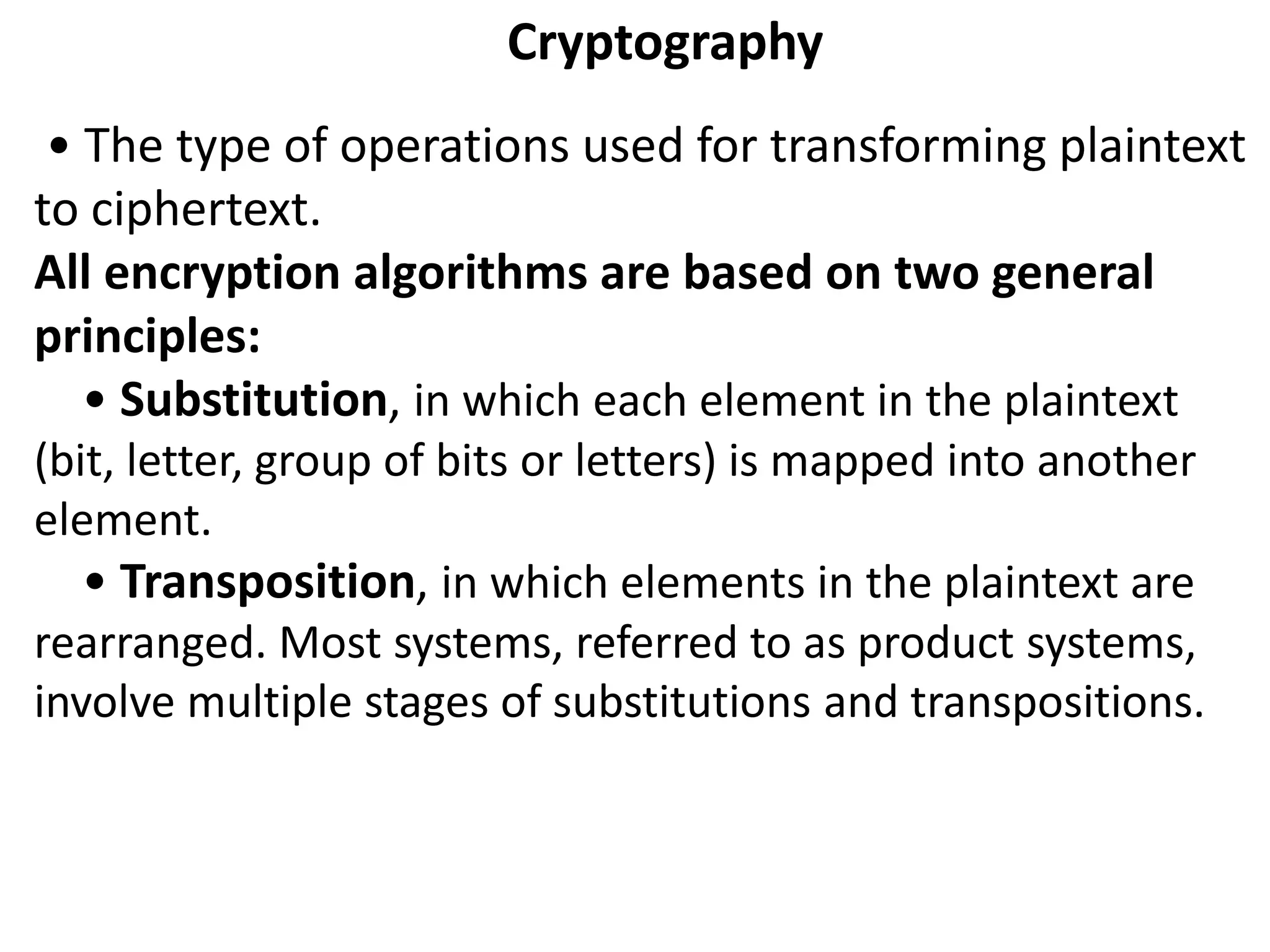
• The type of operations used for transforming plaintext
to ciphertext.
All encryption algorithms are based on two general
principles:
• Substitution, in which each element in the plaintext
(bit, letter, group of bits or letters) is mapped into another
element.
• Transposition, in which elements in the plaintext are
rearranged. Most systems, referred to as product systems,
involve multiple stages of substitutions and transpositions.
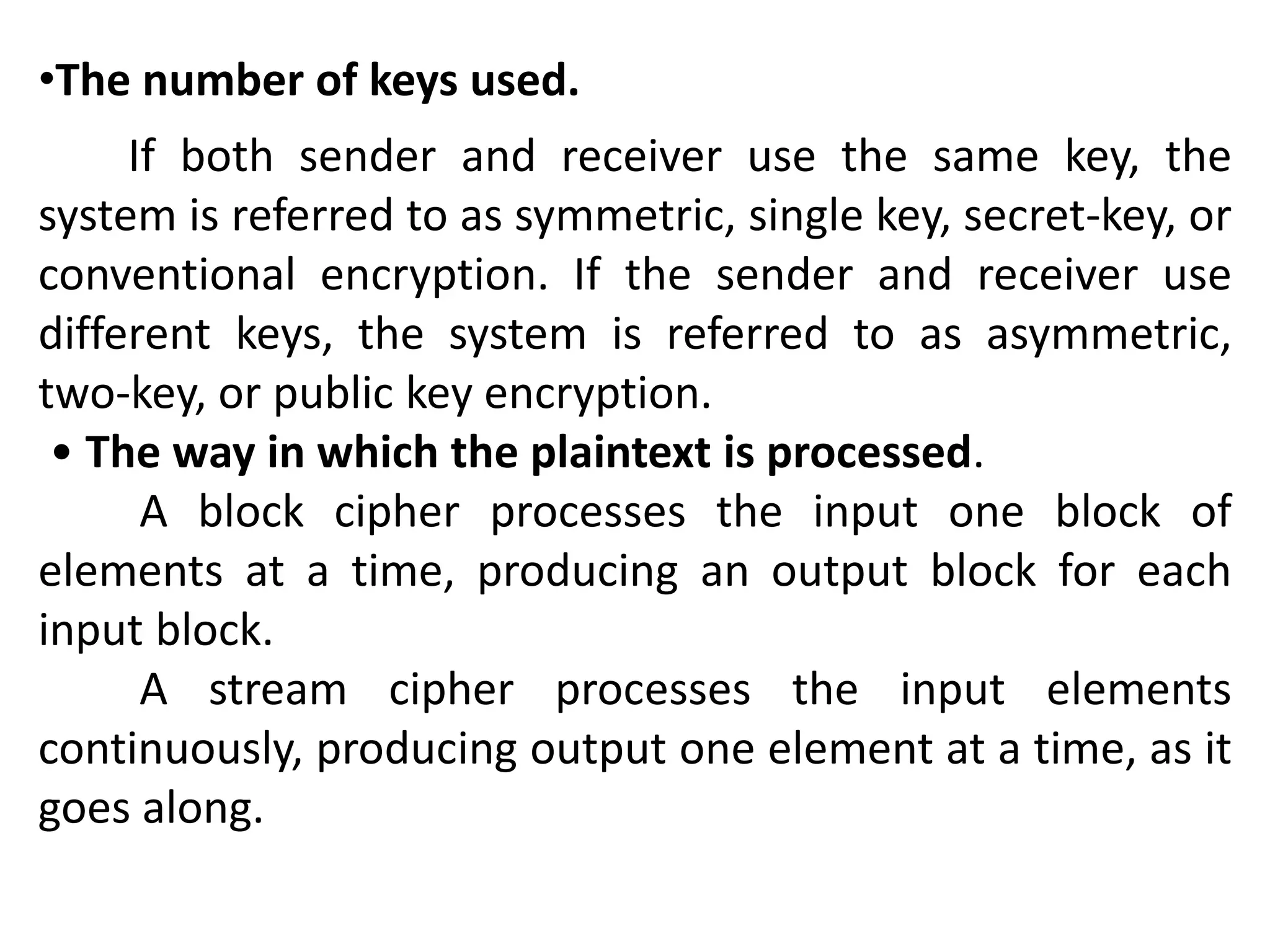
•The number of keys used.
If both sender and receiver use the same key, the
system is referred to as symmetric, single key, secret-key, or
conventional encryption. If the sender and receiver use
different keys, the system is referred to as asymmetric,
two-key, or public key encryption.
• The way in which the plaintext is processed.
A block cipher processes the input one block of
elements at a time, producing an output block for each
input block.
A stream cipher processes the input elements
continuously, producing output one element at a time, as it
goes along.
Cryptanalysis
• The objective of attacking an encryption system is to
recover the key in use rather then simply to recover the
plaintext of a single ciphertext.
• There are two general approaches to attacking a
conventional encryption scheme:
Cryptanalysis
Brute-force attack
Cryptanalysis:
Cryptanalytic attacks rely on the nature of the algorithm
plus perhaps some knowledge of the general
characteristics of the plaintext or even some sample
plaintext-ciphertext pairs. This type of attack exploits the
characteristic of the algorithm to attempt to deduce a
specific plaintext or to deduce the key being used.
•Brute-force attack:
The attacker tries every possible key on a piece of ciphertext
until an intelligible translation into plaintext is obtained. On
average, half of all possible keys must be tried to achieve
success.
If either type of attack succeeds in deducing the key, the
effect is catastrophic: All future and past messages encrypted
with that key are compromised.
Advantages of Symmetric Cryptosystem
• A symmetric cryptosystem is faster.
• In Symmetric Cryptosystems, encrypted data can be
transferred on the link even if there is a possibility that the
data will be intercepted.
• Since there is no key transmitted with the data, the
chances of data being decrypted are null.
• A symmetric cryptosystem uses password authentication
to prove the receiver’s identity.
• A system only which possesses the secret key can decrypt
a message.
Disadvantages of Symmetric Cryptosystem
• Symmetric cryptosystems have a problem of key
transportation. The secret key is to be transmitted to the
receiving system before the actual message is to be
transmitted.
• Every means of electronic communication is insecure as it is
impossible to guarantee that no one will be able to tap
communication channels.
• So the only secure way of exchanging keys would be
exchanging them personally.
• Cannot provide digital signatures that cannot be repudiated
symmetric cipher model.pptx

symmetric cipher model.pptx

  • 1.
    SUBMITTED TO:- MR. ANILDANGI (Assistant prof. ) SUBMITTED BY:- AJAY KUMAR DAS COURSE:-B.TECH(CSE) MUR1800226
  • 2.
    CONTENTS 1. Introduction. 2. Basicterminology. 3. Symmetric cipher model. 4. Security requirements 5. Security mathematics 6. Cryptography 7. Cryptanalysis 8. Brute – force- attack 9. Advantage of symmetric cryptosystem. 10.Disadvantage of symmetric cryptosystem.
  • 3.
    Introduction • Symmetric encryption,also referred to as conventional encryption or single-key encryption, was the only type of encryption in use prior to the development of public-key encryption in the 1970s. • It remains by far the most widely used of the two types of encryption. • An original message is known as the plaintext, while the coded message is called the ciphertext.
  • 4.
    • The processof converting from plaintext to ciphertext is known as enciphering or encryption; restoring the plaintext from the ciphertext is deciphering or decryption. Many schemes used for encryption constitute the area of study known as cryptography. • Such a scheme is known as a cryptographic system or a cipher. • Techniques used for deciphering a message without any knowledge of the enciphering details fall into the area of cryptanalysis. Cryptanalysis is what the layperson calls “breaking the code”.
  • 5.
    Some Basic Terminology •Plaintext - original message. •Ciphertext - coded message . •Cipher - algorithm for transforming plaintext to ciphertext. • key - info used in cipher known only to sender/receiver •Encipher (encrypt) - converting plaintext to ciphertext. •Decipher (decrypt) - recovering ciphertext from plaintext •Cryptography - study of encryption principles/methods. •Cryptanalysis (codebreaking) - study of principles/ methods of deciphering ciphertext without knowing key. •Cryptology -field of both cryptography and cryptanalysis.
  • 9.
    Cryptography • The typeof operations used for transforming plaintext to ciphertext. All encryption algorithms are based on two general principles: • Substitution, in which each element in the plaintext (bit, letter, group of bits or letters) is mapped into another element. • Transposition, in which elements in the plaintext are rearranged. Most systems, referred to as product systems, involve multiple stages of substitutions and transpositions.
  • 10.
    •The number ofkeys used. If both sender and receiver use the same key, the system is referred to as symmetric, single key, secret-key, or conventional encryption. If the sender and receiver use different keys, the system is referred to as asymmetric, two-key, or public key encryption. • The way in which the plaintext is processed. A block cipher processes the input one block of elements at a time, producing an output block for each input block. A stream cipher processes the input elements continuously, producing output one element at a time, as it goes along.
  • 11.
    Cryptanalysis • The objectiveof attacking an encryption system is to recover the key in use rather then simply to recover the plaintext of a single ciphertext. • There are two general approaches to attacking a conventional encryption scheme: Cryptanalysis Brute-force attack Cryptanalysis: Cryptanalytic attacks rely on the nature of the algorithm plus perhaps some knowledge of the general characteristics of the plaintext or even some sample plaintext-ciphertext pairs. This type of attack exploits the characteristic of the algorithm to attempt to deduce a specific plaintext or to deduce the key being used.
  • 12.
    •Brute-force attack: The attackertries every possible key on a piece of ciphertext until an intelligible translation into plaintext is obtained. On average, half of all possible keys must be tried to achieve success. If either type of attack succeeds in deducing the key, the effect is catastrophic: All future and past messages encrypted with that key are compromised.
  • 13.
    Advantages of SymmetricCryptosystem • A symmetric cryptosystem is faster. • In Symmetric Cryptosystems, encrypted data can be transferred on the link even if there is a possibility that the data will be intercepted. • Since there is no key transmitted with the data, the chances of data being decrypted are null. • A symmetric cryptosystem uses password authentication to prove the receiver’s identity. • A system only which possesses the secret key can decrypt a message.
  • 14.
    Disadvantages of SymmetricCryptosystem • Symmetric cryptosystems have a problem of key transportation. The secret key is to be transmitted to the receiving system before the actual message is to be transmitted. • Every means of electronic communication is insecure as it is impossible to guarantee that no one will be able to tap communication channels. • So the only secure way of exchanging keys would be exchanging them personally. • Cannot provide digital signatures that cannot be repudiated