Network Security
Encryption
Symmetric Encryption
Also known as:
“Conventional Encryption”
“Secret-key”
“Single-key encryption”
It was the only encryption in use prior to the development of
public-key encryption in the late 1970s.
It remains by far the most widely used of the two types of
encryption.
Symmetric Encryption Ingredients
A symmetric encryption scheme has five ingredients:
1. Plaintext: This is the original message or data that is fed into the
algorithm as input.
2. Encryption Algorithm: The encryption algorithm performs various
substitutions on the plaintext.
3. Secret Key: The secret key is also an input to the algorithm. The
exact substitutions and transformations performed by the
algorithm depend on the key.
4. Ciphertext: This is the scrambled message produced as output.
5. Decryption Algrorithm: This is essentially the encryption algrithm
run in reverse.
Security requirements
There are two requirements for secure use of symmetric encryption:
1. We need a strong encryption algorithm.
2. Sender and receiver must have obtained copies of the secret key in
a secure fashion and must keep the key secure.
It is important to note that the security of the symmetric encryption
depends on the secrecy of the key.
Cryptography
Cryptographic systems are generically classified along
three independent dimensions:
1. The type of operations used for transforming plaintext
to ciphertext.
2. The number of keys used
3. The way in which the plaintext is processed.
The Type of Operations used for transforming
plaintext to ciphertext
All encryption algorithms are based on two general
principles:
a. Substitution – in which each element in the plaintext is
mapped into another element
b. Transposition – in which elements in the plaintext are
rearranged.
The Number of Keys used
Symmetric Encryption – if both the sender and receiver
use the same key.
Assymetric Encryption – Sender and receiver used
different keys.
The Ways in which the plaintext is being
processed.
Block cipher – processes the input one block at a time,
producing an output block for each input block
Stream cipher – processes the input elements
continuously, producing output one element at a time as
it goes along.
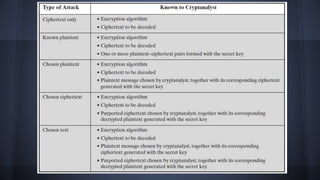
Cryptanalysis
The process of attempting to discover the plaintext or
key.
The next figure summarizes the various types of
cryptanalytic attacks based on the amount of information
known to the cryptanalyst.
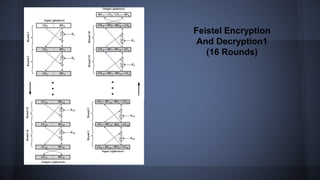
Feistel Cipher Structure
-Described by Horst Feistel of IBM in 1973
-The structure most Symmetric Block Encryption
Algorithms use.
Feistel Encryption
And Decryption1
(16 Rounds)
Symmetric Block Encryption Algorithms
The most commonly used symmetric encryption
algorithms are block ciphers.
A block cipher processes the plaintext input in fixed-sized
blocks and produces a block of ciphertext of equal size for
each plaintext block.
Most Important Symmetric Block Ciphers
- Data Encryption Standard (DES)
-Triple DES (3DS)
- Advanced Encryption Standard (AES)
Data Encryption Standard (DES)
-The most widely used encryption scheme issued in 1977
as Federal Information Processing Standard 46 (FIPS 46) by
the National Bureau of Standards, now known as the
National Institute of Standards and Technology (NIST).
-The algorithm is known as the Data Encryption Algorithm
Description of the Algorithm
The plaintext is 64 bits in length and the key is 56 bits in length;
longer plaintext amounts are processed in 64 bits blocks.
DES structure is a minor variation of the Feistel network
The process of decryption with DES is essentially the same as the
encryption process. The rule is as follows: Use the ciphertext as input
to the DES Algorithm, but use the subkeys Ki in reverse order, That is
use K16 on the first iteration, K15 on the second iteration and so on,
until K1 is used at the 16th round.
Confusion and Diffusion
According to Claude Shannon, there are two primitive
operations with which strong encryption algorithms can be
built:
1. Confusion
is an encryption operation where the relationship between key and
ciphertext is obscured. Ex: Substitution
2. Diffusion
is an encryption operation where the influence of one plaintext symbol is
spread over many ciphertext symbols with the goal of hiding statistical
properties of the plaintext. Ex: bit permutation
DES Internals
1. IP and IP-1
Simple Bit Permutation
2. F function
4 steps
1. Expansion E
2. XOR Round Key
3. S-Box substitution
4. Permutation
Strength of DES
Two concerns:
1. Algorithm itself
-Most studied encryption algorithm
2. The use of 56-bit key.
- Proven insecure by Electronic Frontier Foundation (EFF) by
using a special purpose “DES-cracker” machine.

Network security Encryption

  • 1.
  • 2.
  • 3.
    Symmetric Encryption Also knownas: “Conventional Encryption” “Secret-key” “Single-key encryption” It was the only encryption in use prior to the development of public-key encryption in the late 1970s. It remains by far the most widely used of the two types of encryption.
  • 4.
    Symmetric Encryption Ingredients Asymmetric encryption scheme has five ingredients: 1. Plaintext: This is the original message or data that is fed into the algorithm as input. 2. Encryption Algorithm: The encryption algorithm performs various substitutions on the plaintext. 3. Secret Key: The secret key is also an input to the algorithm. The exact substitutions and transformations performed by the algorithm depend on the key. 4. Ciphertext: This is the scrambled message produced as output. 5. Decryption Algrorithm: This is essentially the encryption algrithm run in reverse.
  • 5.
    Security requirements There aretwo requirements for secure use of symmetric encryption: 1. We need a strong encryption algorithm. 2. Sender and receiver must have obtained copies of the secret key in a secure fashion and must keep the key secure. It is important to note that the security of the symmetric encryption depends on the secrecy of the key.
  • 6.
    Cryptography Cryptographic systems aregenerically classified along three independent dimensions: 1. The type of operations used for transforming plaintext to ciphertext. 2. The number of keys used 3. The way in which the plaintext is processed.
  • 7.
    The Type ofOperations used for transforming plaintext to ciphertext All encryption algorithms are based on two general principles: a. Substitution – in which each element in the plaintext is mapped into another element b. Transposition – in which elements in the plaintext are rearranged.
  • 8.
    The Number ofKeys used Symmetric Encryption – if both the sender and receiver use the same key. Assymetric Encryption – Sender and receiver used different keys.
  • 9.
    The Ways inwhich the plaintext is being processed. Block cipher – processes the input one block at a time, producing an output block for each input block Stream cipher – processes the input elements continuously, producing output one element at a time as it goes along.
  • 10.
    Cryptanalysis The process ofattempting to discover the plaintext or key. The next figure summarizes the various types of cryptanalytic attacks based on the amount of information known to the cryptanalyst.
  • 12.
    Feistel Cipher Structure -Describedby Horst Feistel of IBM in 1973 -The structure most Symmetric Block Encryption Algorithms use.
  • 13.
  • 14.
    Symmetric Block EncryptionAlgorithms The most commonly used symmetric encryption algorithms are block ciphers. A block cipher processes the plaintext input in fixed-sized blocks and produces a block of ciphertext of equal size for each plaintext block.
  • 15.
    Most Important SymmetricBlock Ciphers - Data Encryption Standard (DES) -Triple DES (3DS) - Advanced Encryption Standard (AES)
  • 16.
    Data Encryption Standard(DES) -The most widely used encryption scheme issued in 1977 as Federal Information Processing Standard 46 (FIPS 46) by the National Bureau of Standards, now known as the National Institute of Standards and Technology (NIST). -The algorithm is known as the Data Encryption Algorithm
  • 17.
    Description of theAlgorithm The plaintext is 64 bits in length and the key is 56 bits in length; longer plaintext amounts are processed in 64 bits blocks. DES structure is a minor variation of the Feistel network The process of decryption with DES is essentially the same as the encryption process. The rule is as follows: Use the ciphertext as input to the DES Algorithm, but use the subkeys Ki in reverse order, That is use K16 on the first iteration, K15 on the second iteration and so on, until K1 is used at the 16th round.
  • 18.
    Confusion and Diffusion Accordingto Claude Shannon, there are two primitive operations with which strong encryption algorithms can be built: 1. Confusion is an encryption operation where the relationship between key and ciphertext is obscured. Ex: Substitution 2. Diffusion is an encryption operation where the influence of one plaintext symbol is spread over many ciphertext symbols with the goal of hiding statistical properties of the plaintext. Ex: bit permutation
  • 19.
    DES Internals 1. IPand IP-1 Simple Bit Permutation 2. F function 4 steps 1. Expansion E 2. XOR Round Key 3. S-Box substitution 4. Permutation
  • 20.
    Strength of DES Twoconcerns: 1. Algorithm itself -Most studied encryption algorithm 2. The use of 56-bit key. - Proven insecure by Electronic Frontier Foundation (EFF) by using a special purpose “DES-cracker” machine.