Presented by:
Hamad Alsufyani
1
2
WHAT IS IT?
 The syllable is the basic unit of speech studied in both
the phonetic and phonological levels of analysis.
 Phonetically (i.e. in relation to the way we produce them
and the way they sound), syllables are usually described as
consisting of a centre which has little or no obstruction to
airflow and which sounds comparatively loud; before and
after this centre (i.e. at the beginning and end of the
syllable), there will be greater obstruction to airflow and/or
less loud sound.
Some examples :
 i) A minimum syllable is a single vowel in isolation. It is preceded and
followed by silence.
'are‘ ɑː, 'or‘ ɔː, 'err‘ ɛː )
 ii) Some syllables have an onset - that is, instead of silence, they have
one or more consonants preceding the centre of the syllable:
'bar' bɑː 'key‘ kiː 'more' mɔː
 iii) Syllables may have no onset but have a coda - that is, they end with
one or more consonants:
'am' æm 'ought' ɔːt 'ease‘ i:z
 iv) Some syllables have both onset and coda:
'ran' ræn 'sat' sæt 'fill' fɪl
3
Looking at syllables from the phonological point of
view is quite different. What this involves is looking at the
possible combinations of English phonemes; the study of
the possible phoneme combinations of a language is
called phonotactics.
4
The structure of the English syllable
 If the first syllable of the word in question begins with a
vowel (any vowel may occur, though ʊ is rare) we say that
this initial syllable has a zero onset.
 If the syllable begins with one consonant, that initial
consonant may be any consonant phoneme except ŋ ; ʒ is
rare.
 When we have two or more consonants together we call
them a consonant cluster.
5
 Initial two-consonant clusters are of two sorts in English.
1- s followed by one of a small set of consonants.
e.g. 'sting' stɪŋ , 'sway' sweɪ , 'smoke' sməʊk.
The s in these clusters is called the pre-initial consonant
and the other consonant (t, w, m in the above examples)
the initial consonant .
2- The other sort begins with one of a set of about fifteen
consonants, followed by one of the set l, r, w, j
e.g. 'play' pleɪ, 'try' traɪ, 'quick' kwɪk, 'few' fjuː.
We call the first consonant of these clusters the initial
consonant and the second the post-initial.
6
 Initial three-consonant clusters:
e.g. 'split' splɪt, 'stream' striːm, 'square' skweə
The s is the pre-initial consonant, the p, t, k that follow s
in the three example words are the initial consonant and
the l, r, w are post-initial.
7
Final Consonant Clusters
 If there is no final consonant we say that there is a zero coda.
e.g. ‘blue’ bluː
 When there is one consonant only, this is called the final
consonant. Any consonant may be a final consonant except
h, w, j
e.g. ‘black’ blæk
8
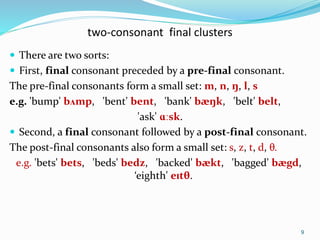
two-consonant final clusters
 There are two sorts:
 First, final consonant preceded by a pre-final consonant.
The pre-final consonants form a small set: m, n, ŋ, l, s
e.g. 'bump' bʌmp, 'bent' bent, 'bank' bæŋk, 'belt' belt,
'ask' ɑːsk.
 Second, a final consonant followed by a post-final consonant.
The post-final consonants also form a small set: s, z, t, d, θ.
e.g. 'bets' bets, 'beds' bedz, 'backed' bækt, 'bagged' bægd,
‘eighth' eɪtθ.
9
three-consonant final clusters
 There are two types :
 First, pre-final plus final plus post-final.
 Second, final plus post-final l plus post-final 2. Post-
final 2 is one of s, z, t, d, θ.
10
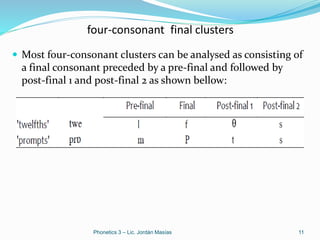
four-consonant final clusters
 Most four-consonant clusters can be analysed as consisting of
a final consonant preceded by a pre-final and followed by
post-final 1 and post-final 2 as shown bellow:
Phonetics 3 – Lic. Jordán Masías 11
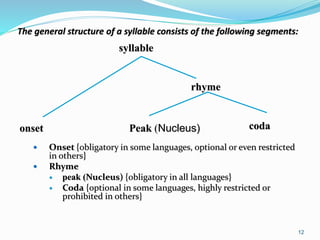
 Onset {obligatory in some languages, optional or even restricted
in others}
 Rhyme
 peak (Nucleus) {obligatory in all languages}
 Coda {optional in some languages, highly restricted or
prohibited in others}
12
The general structure of a syllable consists of the following segments:
onset Peak (Nucleus) coda
rhyme
syllable
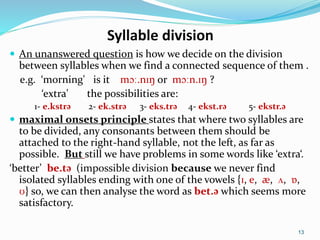
Syllable division
 An unanswered question is how we decide on the division
between syllables when we find a connected sequence of them .
e.g. ‘morning' is it mɔː.nɪŋ or mɔːn.ɪŋ ?
‘extra' the possibilities are:
1- e.kstrə 2- ek.strə 3- eks.trə 4- ekst.rə 5- ekstr.ə
 maximal onsets principle states that where two syllables are
to be divided, any consonants between them should be
attached to the right-hand syllable, not the left, as far as
possible. But still we have problems in some words like ‘extra‘.
‘better’ be.tə (impossible division because we never find
isolated syllables ending with one of the vowels {ɪ, e, æ, ʌ, ɒ,
ʊ} so, we can then analyse the word as bet.ə which seems more
satisfactory.
13
Thank you
for paying attention
14

Chap.8 the syllable

  • 1.
  • 2.
    2 WHAT IS IT? The syllable is the basic unit of speech studied in both the phonetic and phonological levels of analysis.  Phonetically (i.e. in relation to the way we produce them and the way they sound), syllables are usually described as consisting of a centre which has little or no obstruction to airflow and which sounds comparatively loud; before and after this centre (i.e. at the beginning and end of the syllable), there will be greater obstruction to airflow and/or less loud sound.
  • 3.
    Some examples : i) A minimum syllable is a single vowel in isolation. It is preceded and followed by silence. 'are‘ ɑː, 'or‘ ɔː, 'err‘ ɛː )  ii) Some syllables have an onset - that is, instead of silence, they have one or more consonants preceding the centre of the syllable: 'bar' bɑː 'key‘ kiː 'more' mɔː  iii) Syllables may have no onset but have a coda - that is, they end with one or more consonants: 'am' æm 'ought' ɔːt 'ease‘ i:z  iv) Some syllables have both onset and coda: 'ran' ræn 'sat' sæt 'fill' fɪl 3
  • 4.
    Looking at syllablesfrom the phonological point of view is quite different. What this involves is looking at the possible combinations of English phonemes; the study of the possible phoneme combinations of a language is called phonotactics. 4
  • 5.
    The structure ofthe English syllable  If the first syllable of the word in question begins with a vowel (any vowel may occur, though ʊ is rare) we say that this initial syllable has a zero onset.  If the syllable begins with one consonant, that initial consonant may be any consonant phoneme except ŋ ; ʒ is rare.  When we have two or more consonants together we call them a consonant cluster. 5
  • 6.
     Initial two-consonantclusters are of two sorts in English. 1- s followed by one of a small set of consonants. e.g. 'sting' stɪŋ , 'sway' sweɪ , 'smoke' sməʊk. The s in these clusters is called the pre-initial consonant and the other consonant (t, w, m in the above examples) the initial consonant . 2- The other sort begins with one of a set of about fifteen consonants, followed by one of the set l, r, w, j e.g. 'play' pleɪ, 'try' traɪ, 'quick' kwɪk, 'few' fjuː. We call the first consonant of these clusters the initial consonant and the second the post-initial. 6
  • 7.
     Initial three-consonantclusters: e.g. 'split' splɪt, 'stream' striːm, 'square' skweə The s is the pre-initial consonant, the p, t, k that follow s in the three example words are the initial consonant and the l, r, w are post-initial. 7
  • 8.
    Final Consonant Clusters If there is no final consonant we say that there is a zero coda. e.g. ‘blue’ bluː  When there is one consonant only, this is called the final consonant. Any consonant may be a final consonant except h, w, j e.g. ‘black’ blæk 8
  • 9.
    two-consonant final clusters There are two sorts:  First, final consonant preceded by a pre-final consonant. The pre-final consonants form a small set: m, n, ŋ, l, s e.g. 'bump' bʌmp, 'bent' bent, 'bank' bæŋk, 'belt' belt, 'ask' ɑːsk.  Second, a final consonant followed by a post-final consonant. The post-final consonants also form a small set: s, z, t, d, θ. e.g. 'bets' bets, 'beds' bedz, 'backed' bækt, 'bagged' bægd, ‘eighth' eɪtθ. 9
  • 10.
    three-consonant final clusters There are two types :  First, pre-final plus final plus post-final.  Second, final plus post-final l plus post-final 2. Post- final 2 is one of s, z, t, d, θ. 10
  • 11.
    four-consonant final clusters Most four-consonant clusters can be analysed as consisting of a final consonant preceded by a pre-final and followed by post-final 1 and post-final 2 as shown bellow: Phonetics 3 – Lic. Jordán Masías 11
  • 12.
     Onset {obligatoryin some languages, optional or even restricted in others}  Rhyme  peak (Nucleus) {obligatory in all languages}  Coda {optional in some languages, highly restricted or prohibited in others} 12 The general structure of a syllable consists of the following segments: onset Peak (Nucleus) coda rhyme syllable
  • 13.
    Syllable division  Anunanswered question is how we decide on the division between syllables when we find a connected sequence of them . e.g. ‘morning' is it mɔː.nɪŋ or mɔːn.ɪŋ ? ‘extra' the possibilities are: 1- e.kstrə 2- ek.strə 3- eks.trə 4- ekst.rə 5- ekstr.ə  maximal onsets principle states that where two syllables are to be divided, any consonants between them should be attached to the right-hand syllable, not the left, as far as possible. But still we have problems in some words like ‘extra‘. ‘better’ be.tə (impossible division because we never find isolated syllables ending with one of the vowels {ɪ, e, æ, ʌ, ɒ, ʊ} so, we can then analyse the word as bet.ə which seems more satisfactory. 13
  • 14.