1
2
3
4
________ deals with how speech sounds are produced,
transmitted, and perceived.
A. Phonetics B. Phonology
The term ______ is applied for the study of the more
abstract, the more functional, or the more psychological
aspects of speech.
A. Phonetics B. Phonology
_________ identifies where a sound is formed.
Place of articulation
_________ explains how the airflow is manipulated to
produce the sound.
Manner of articulation
Short vowels are held for a ______ period of time, and the
mouth and tongue are in a more ______ position
A. shorter, tense B. shorter, relaxed
C. longer, relaxed D. longer, tense
What is the difference between a monophthong and a diphthong?
A. Monophthongs involve a gradual change in tongue position, while
diphthongs involve a more abrupt change in tongue position.
B. Monophthongs involve a single vowel sound, while diphthongs involve two
vowel sounds.
C. Monophthongs are always at the beginning of words, while diphthongs are
always at the end of words.
• A word will be shown on the screen.
• Count how many syllables the word has.
• Clap once for each syllable.
Example beach summer holiday
RUN
1
CHALLENGE
2
OPPORTUNITY
5
HATRED
2
INCOMPREHENSIBLE
6
TREE
1
Phonetically, syllables consist of a centre which
has little or no obstruction to airflow; and before
and after this centre, there will be greater
obstruction to airflow.
Structures of English syllables
Syllable division
Strong and weak syllables
• Understand the structure of English syllables.
• Apply rules to divide words into syllables accurately.
• Identify and distinguish between strong and weak syllables.
• Engage in interactive activities to reinforce learning.
cat
k æ t
eye
at sky
aɪ
æ t s k aɪ
C V C V C C C V V
A syllable must have one vowel.
A single vowel in isolation is called a minimum syllable.
cat
k æ t
eye
at sky
aɪ
æ t s k aɪ
C V C V C C C V V
onset
O N C N C O N N
coda
nucleus
+ +
The maximum number of onset consonants is 3.
One onset consonant any consonant phoneme
= initial consonant
Two-consonant
cluster
/s/ + a small set of consonants
a small set of consonants + /l/, /r/, /w/, and /j/
• /s/: pre-initial consonant
• others: initial consonants
• /l/, /r/, /w/ and /j/: post-initial consonants
Consonant cluster: a group of 2 or more consonants
Initial C
Pre-
initial C
p t k f m n l w j
s spɪn stɪk skɪn sfɪə smɔːl sneɪk sleɪ sweɪ sjuːt
/s/ + a small set of consonants • /s/: pre-initial consonant
• others: initial consonants
a small set of consonants +
/l/, /r/, /w/, and /j/
• 15 other consonants: initial
consonants
• /l/, /r/, /w/ and /j/: post-initial
consonants
Three-consonant
cluster
Pre-initial consonant
Initial consonant
• /s/
• /p/, /t/, /k/, /f/, /m/, /n/, /l/
Post-initial consonant
• /l/, /r/, /w/ and /j/
Pre-initial
consonant
Initial
consonant
Post-initial
consonant
Vowel
Onset Nucleus
/s/ /l/, /r/, /w/, /j/
Example
• Stand up and make a circle around the middle seating row.
• Walk around the classroom when a song is being played.
• When the song stops, capture the flag to give the answer.
Label the onset consonants
biːtʃ /b/: initial consonant
Label the onset consonants
stænd blæk
pen
sprɪŋ pleɪ mjuːz
neɪl
flæɡ
The maximum number of coda consonants is 4.
One coda consonant any consonant phoneme
= final consonant
Two-consonant
cluster
/m/, /n/, /ŋ/, /l/ and /s/ + other consonants
other consonants + /s/, /z/, /t/, /d/ and /θ/
• /m/, /n/, /ŋ/, /l/ and /s/: pre-final
consonant
• others: final consonants
• /s/, /z/, /t/, /d/ and /θ/: post-final
consonants
Three-consonant
cluster
pre-final + final + post-final
• Example: he - l - p - t
• Example: ne - k - s - t
final + post-final 1 + post-final 2
Four-consonant
cluster
pre-final + final + post-final 1 + post-final 2
• Example: prɒ - m - p - t - s
• Example: te - k - s - t - s
final + post-final 1 + post-final 2 + post-final 3
Pre-final
consonant
Final
consonant
Post-final
consonant 3
Vowel
Coda
Nucleus
Post-final
consonant 2
Post-final
consonant 1
/m/, /n/, /ŋ/,
/l/ and /s/
/s/, /z/, /t/, /d/ and /θ/
• Each team sends 1 player to look at the syllable.
• 5 seconds to memorise the syllable.
• Run back to the team and report the syllable to the teammates.
• Label the coda consonants.
• Shout “STOP THE BUS” when you finish.
Example biːtʃ /tʃ/: final consonant
onset coda
nucleus
+ +
• Work individually.
• Create the maximum phonological structure.
• The first 7 students to submit the structure correctly earn a bonus.
onset coda
nucleus
+ +
• Work in groups.
• Choose 3 words with 1 syllable (ex: beach, hot, shrimp).
• Analyse the onset, nucleus and coda of each syllable.
• Create a poster on Canva.
• Send your poster to Zalo group.
• You have 15 minutes.
Rule 1:
Rule 2:
Rule 3:
Attach as many consonants as possible to the right-hand syllable.
Follow the rules for possible onsets and codas.
Allow 1 consonant to be in the left syllable to prevent the
vowels /ɪ/, /e/, /ʌ/, /ʊ/, /æ/, /ɒ/ from being at the end of a
syllable.
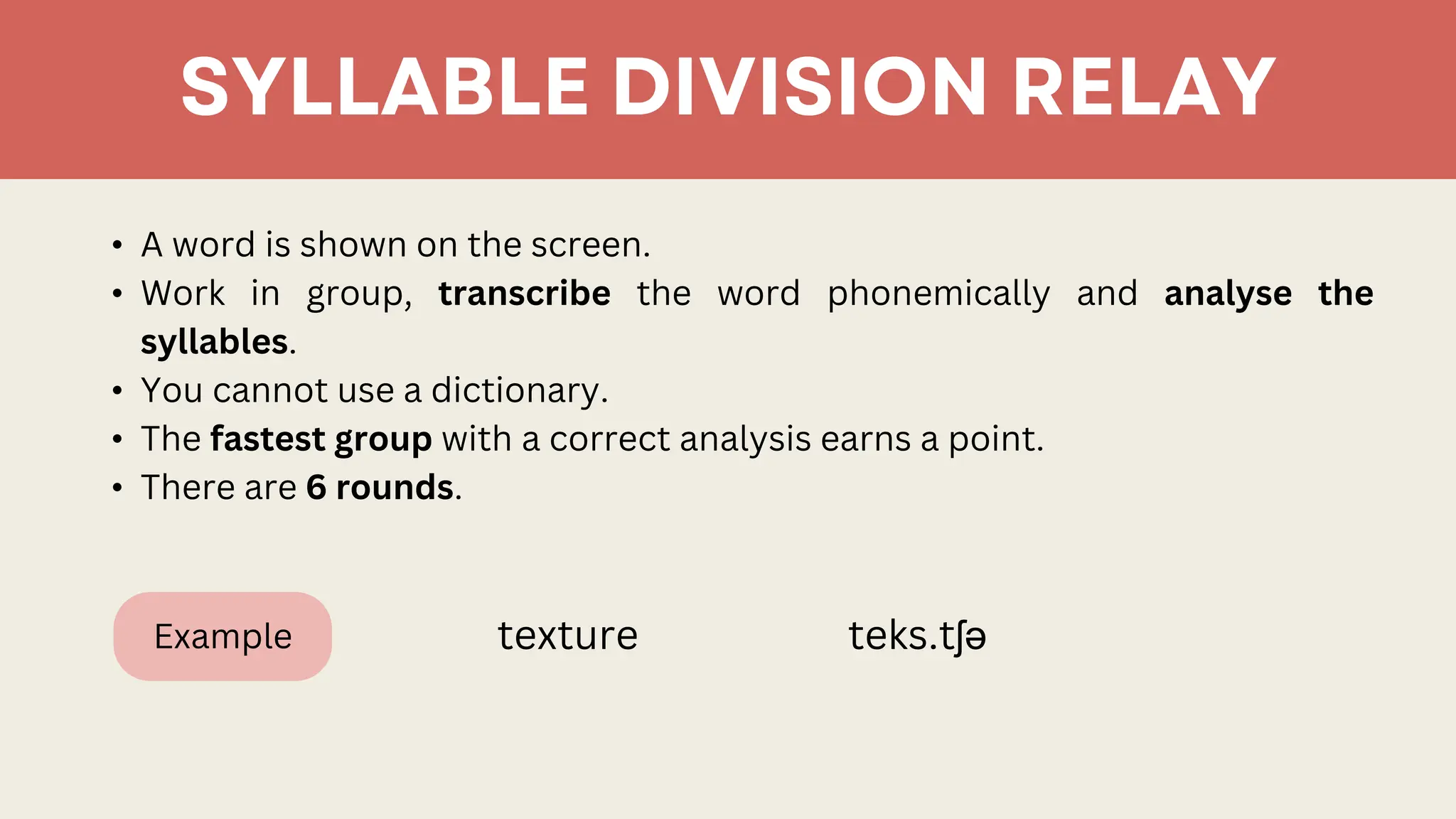
• A word is shown on the screen.
• Work in group, transcribe the word phonemically and analyse the
syllables.
• You cannot use a dictionary.
• The fastest group with a correct analysis earns a point.
• There are 6 rounds.
Example texture teks.tʃə
Water Winter Triumph
Butterfly Sentence Sixteen
bʌt.ə.flaɪ
wɔː.tə traɪ.əmf
wɪn.tə
sɪk.stiːn
sen.təns
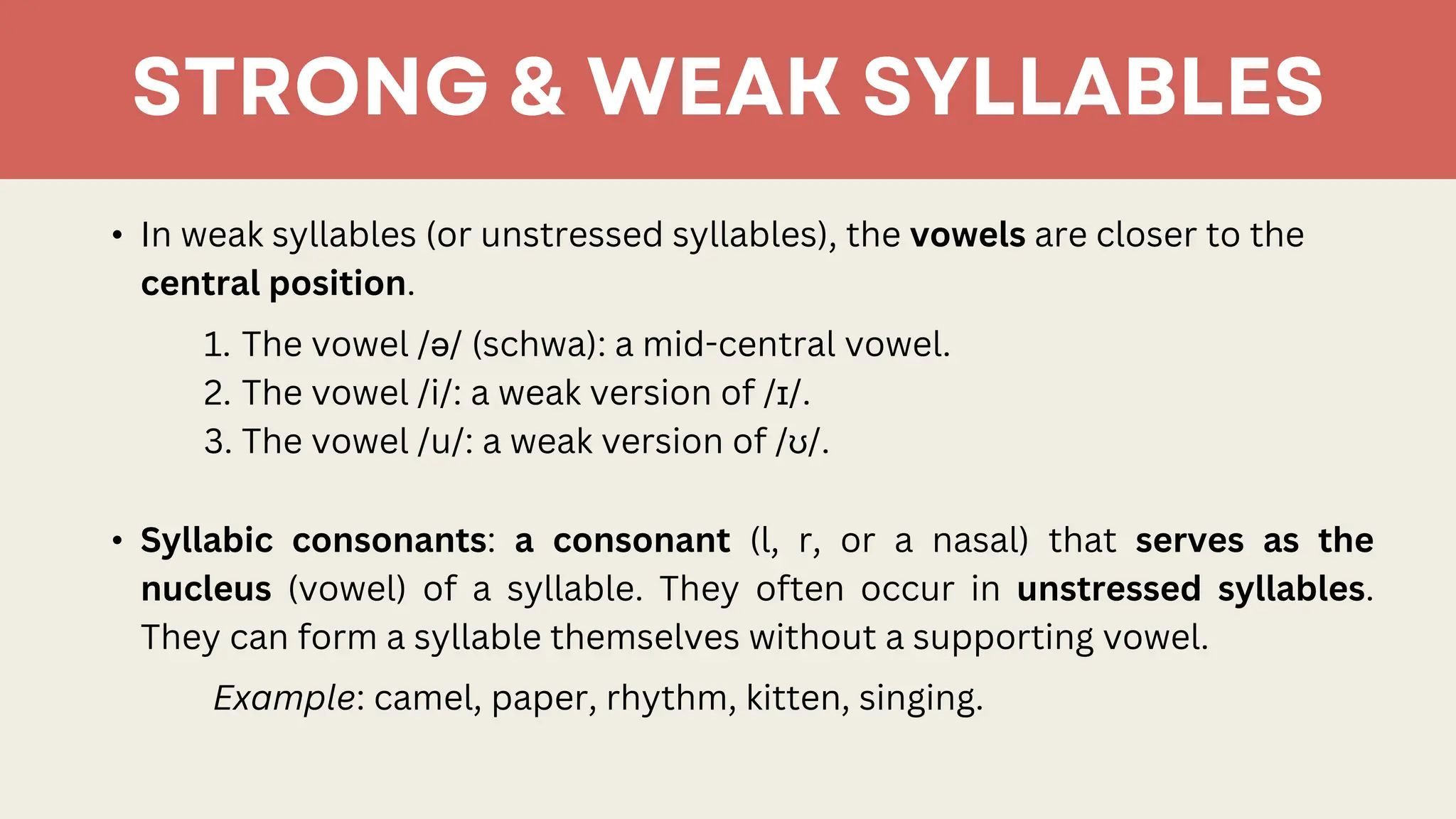
• In weak syllables (or unstressed syllables), the vowels are closer to the
central position.
1. The vowel /ə/ (schwa): a mid-central vowel.
2. The vowel /i/: a weak version of /ɪ/.
3. The vowel /u/: a weak version of /ʊ/.
• Syllabic consonants: a consonant (l, r, or a nasal) that serves as the
nucleus (vowel) of a syllable. They often occur in unstressed syllables.
They can form a syllable themselves without a supporting vowel.
Example: camel, paper, rhythm, kitten, singing.
_______ is a part of a syllable and is made up of one or
more consonants preceding the nucleus.
An onset
_______ is a part of a syllable and is made up of one or
more consonants following the nucleus.
A coda
A single vowel in isolation is called a/an _____.
A. minimum syllable B. consonant cluster
C. onset D. coda
An impossible syllable structure in English is _______.
A. onset, nucleus, coda B. onset, coda
C. onset, nucleus D. nucleus, coda
What is a schwa sound?
A. A type of vowel sound that is pronounced with the tongue
positioned high and forward in the mouth.
B. A type of vowel sound that is pronounced with the tongue
positioned low and back in the mouth.
C. A type of vowel sound that is pronounced with the tongue in a
neutral position.
Pre-initial consonant can only be ___.
A. /s/, /p/, /t/, and /k/ B. /l/, /r/, /w/, and /j/
C. /m/, /n/, /ŋ/, /l/, and /s/ D. /s/
Post-initial consonant can only be ___.
A. /s/, /p/, /t/, and /k/ B. /l/, /r/, /w/, and /j/
C. /m/, /n/, /ŋ/, /l/, and /s/ D. /s/, /z/, /t/, /d/ and /θ/
Pre-final consonant can only be ___.
A. /s/, /p/, /t/, and /k/ B. /l/, /r/, /w/, and /j/
C. /m/, /n/, /ŋ/, /l/, and /s/ D. /s/, /z/, /t/, /d/ and /θ/
Post-final consonant can only be ___.
A. /s/, /p/, /t/, and /k/ B. /l/, /r/, /w/, and /j/
C. /m/, /n/, /ŋ/, /l/, and /s/ D. /s/, /z/, /t/, /d/ and /θ/
The two syllables of “finger” are ___.
A. fɪŋ.ɡə B. fɪŋɡ.ə C. fɪ.ŋɡə
The two syllables of “extra” are ___.
A. e.kstrə B. ek.strə C. eks.trə
REFLECTION
PRE-LESSON
PREPARATION
write a summary of what you learnt in this
lesson
answer questions below:
1. How many levels of stress are there?
2. In simple words like "banana" or "computer",
how do we know which syllable to stress?
What pattern do you notice?
3. When we say compound words like
"toothbrush" or "blackboard", where does
the stress usually fall? Why?

Syllables. in the phonetics and phonology

  • 1.
  • 2.
    ________ deals withhow speech sounds are produced, transmitted, and perceived. A. Phonetics B. Phonology
  • 3.
    The term ______is applied for the study of the more abstract, the more functional, or the more psychological aspects of speech. A. Phonetics B. Phonology
  • 4.
    _________ identifies wherea sound is formed. Place of articulation
  • 5.
    _________ explains howthe airflow is manipulated to produce the sound. Manner of articulation
  • 6.
    Short vowels areheld for a ______ period of time, and the mouth and tongue are in a more ______ position A. shorter, tense B. shorter, relaxed C. longer, relaxed D. longer, tense
  • 7.
    What is thedifference between a monophthong and a diphthong? A. Monophthongs involve a gradual change in tongue position, while diphthongs involve a more abrupt change in tongue position. B. Monophthongs involve a single vowel sound, while diphthongs involve two vowel sounds. C. Monophthongs are always at the beginning of words, while diphthongs are always at the end of words.
  • 8.
    • A wordwill be shown on the screen. • Count how many syllables the word has. • Clap once for each syllable. Example beach summer holiday
  • 9.
  • 10.
  • 11.
  • 12.
  • 13.
  • 14.
  • 15.
    Phonetically, syllables consistof a centre which has little or no obstruction to airflow; and before and after this centre, there will be greater obstruction to airflow.
  • 16.
    Structures of Englishsyllables Syllable division Strong and weak syllables
  • 17.
    • Understand thestructure of English syllables. • Apply rules to divide words into syllables accurately. • Identify and distinguish between strong and weak syllables. • Engage in interactive activities to reinforce learning.
  • 18.
    cat k æ t eye atsky aɪ æ t s k aɪ C V C V C C C V V A syllable must have one vowel. A single vowel in isolation is called a minimum syllable.
  • 19.
    cat k æ t eye atsky aɪ æ t s k aɪ C V C V C C C V V onset O N C N C O N N coda nucleus + +
  • 20.
    The maximum numberof onset consonants is 3. One onset consonant any consonant phoneme = initial consonant
  • 21.
    Two-consonant cluster /s/ + asmall set of consonants a small set of consonants + /l/, /r/, /w/, and /j/ • /s/: pre-initial consonant • others: initial consonants • others: initial consonants • /l/, /r/, /w/ and /j/: post-initial consonants Consonant cluster: a group of 2 or more consonants
  • 22.
    Initial C Pre- initial C pt k f m n l w j s spɪn stɪk skɪn sfɪə smɔːl sneɪk sleɪ sweɪ sjuːt /s/ + a small set of consonants • /s/: pre-initial consonant • others: initial consonants
  • 23.
    a small setof consonants + /l/, /r/, /w/, and /j/ • 15 other consonants: initial consonants • /l/, /r/, /w/ and /j/: post-initial consonants
  • 24.
    Three-consonant cluster Pre-initial consonant Initial consonant •/s/ • /p/, /t/, /k/, /f/, /m/, /n/, /l/ Post-initial consonant • /l/, /r/, /w/ and /j/
  • 25.
  • 26.
    Example • Stand upand make a circle around the middle seating row. • Walk around the classroom when a song is being played. • When the song stops, capture the flag to give the answer. Label the onset consonants biːtʃ /b/: initial consonant
  • 27.
    Label the onsetconsonants stænd blæk pen sprɪŋ pleɪ mjuːz neɪl flæɡ
  • 28.
    The maximum numberof coda consonants is 4. One coda consonant any consonant phoneme = final consonant
  • 29.
    Two-consonant cluster /m/, /n/, /ŋ/,/l/ and /s/ + other consonants other consonants + /s/, /z/, /t/, /d/ and /θ/ • /m/, /n/, /ŋ/, /l/ and /s/: pre-final consonant • others: final consonants • others: final consonants • /s/, /z/, /t/, /d/ and /θ/: post-final consonants
  • 30.
    Three-consonant cluster pre-final + final+ post-final • Example: he - l - p - t • Example: ne - k - s - t final + post-final 1 + post-final 2 Four-consonant cluster pre-final + final + post-final 1 + post-final 2 • Example: prɒ - m - p - t - s • Example: te - k - s - t - s final + post-final 1 + post-final 2 + post-final 3
  • 31.
  • 32.
    • Each teamsends 1 player to look at the syllable. • 5 seconds to memorise the syllable. • Run back to the team and report the syllable to the teammates. • Label the coda consonants. • Shout “STOP THE BUS” when you finish. Example biːtʃ /tʃ/: final consonant
  • 33.
    onset coda nucleus + + •Work individually. • Create the maximum phonological structure. • The first 7 students to submit the structure correctly earn a bonus.
  • 34.
  • 35.
    • Work ingroups. • Choose 3 words with 1 syllable (ex: beach, hot, shrimp). • Analyse the onset, nucleus and coda of each syllable. • Create a poster on Canva. • Send your poster to Zalo group. • You have 15 minutes.
  • 36.
    Rule 1: Rule 2: Rule3: Attach as many consonants as possible to the right-hand syllable. Follow the rules for possible onsets and codas. Allow 1 consonant to be in the left syllable to prevent the vowels /ɪ/, /e/, /ʌ/, /ʊ/, /æ/, /ɒ/ from being at the end of a syllable.
  • 37.
    • A wordis shown on the screen. • Work in group, transcribe the word phonemically and analyse the syllables. • You cannot use a dictionary. • The fastest group with a correct analysis earns a point. • There are 6 rounds. Example texture teks.tʃə
  • 38.
    Water Winter Triumph ButterflySentence Sixteen bʌt.ə.flaɪ wɔː.tə traɪ.əmf wɪn.tə sɪk.stiːn sen.təns
  • 39.
    • In weaksyllables (or unstressed syllables), the vowels are closer to the central position. 1. The vowel /ə/ (schwa): a mid-central vowel. 2. The vowel /i/: a weak version of /ɪ/. 3. The vowel /u/: a weak version of /ʊ/. • Syllabic consonants: a consonant (l, r, or a nasal) that serves as the nucleus (vowel) of a syllable. They often occur in unstressed syllables. They can form a syllable themselves without a supporting vowel. Example: camel, paper, rhythm, kitten, singing.
  • 40.
    _______ is apart of a syllable and is made up of one or more consonants preceding the nucleus. An onset
  • 41.
    _______ is apart of a syllable and is made up of one or more consonants following the nucleus. A coda
  • 42.
    A single vowelin isolation is called a/an _____. A. minimum syllable B. consonant cluster C. onset D. coda
  • 43.
    An impossible syllablestructure in English is _______. A. onset, nucleus, coda B. onset, coda C. onset, nucleus D. nucleus, coda
  • 44.
    What is aschwa sound? A. A type of vowel sound that is pronounced with the tongue positioned high and forward in the mouth. B. A type of vowel sound that is pronounced with the tongue positioned low and back in the mouth. C. A type of vowel sound that is pronounced with the tongue in a neutral position.
  • 45.
    Pre-initial consonant canonly be ___. A. /s/, /p/, /t/, and /k/ B. /l/, /r/, /w/, and /j/ C. /m/, /n/, /ŋ/, /l/, and /s/ D. /s/
  • 46.
    Post-initial consonant canonly be ___. A. /s/, /p/, /t/, and /k/ B. /l/, /r/, /w/, and /j/ C. /m/, /n/, /ŋ/, /l/, and /s/ D. /s/, /z/, /t/, /d/ and /θ/
  • 47.
    Pre-final consonant canonly be ___. A. /s/, /p/, /t/, and /k/ B. /l/, /r/, /w/, and /j/ C. /m/, /n/, /ŋ/, /l/, and /s/ D. /s/, /z/, /t/, /d/ and /θ/
  • 48.
    Post-final consonant canonly be ___. A. /s/, /p/, /t/, and /k/ B. /l/, /r/, /w/, and /j/ C. /m/, /n/, /ŋ/, /l/, and /s/ D. /s/, /z/, /t/, /d/ and /θ/
  • 49.
    The two syllablesof “finger” are ___. A. fɪŋ.ɡə B. fɪŋɡ.ə C. fɪ.ŋɡə
  • 50.
    The two syllablesof “extra” are ___. A. e.kstrə B. ek.strə C. eks.trə
  • 51.
    REFLECTION PRE-LESSON PREPARATION write a summaryof what you learnt in this lesson answer questions below: 1. How many levels of stress are there? 2. In simple words like "banana" or "computer", how do we know which syllable to stress? What pattern do you notice? 3. When we say compound words like "toothbrush" or "blackboard", where does the stress usually fall? Why?