COMMON CHANNEL SIGNALING SYSTEM #73/5/20101
3/5/20102Presented ByMOHD AZAM MCA,BCAEmail- mohd.azam.se@gmail.com
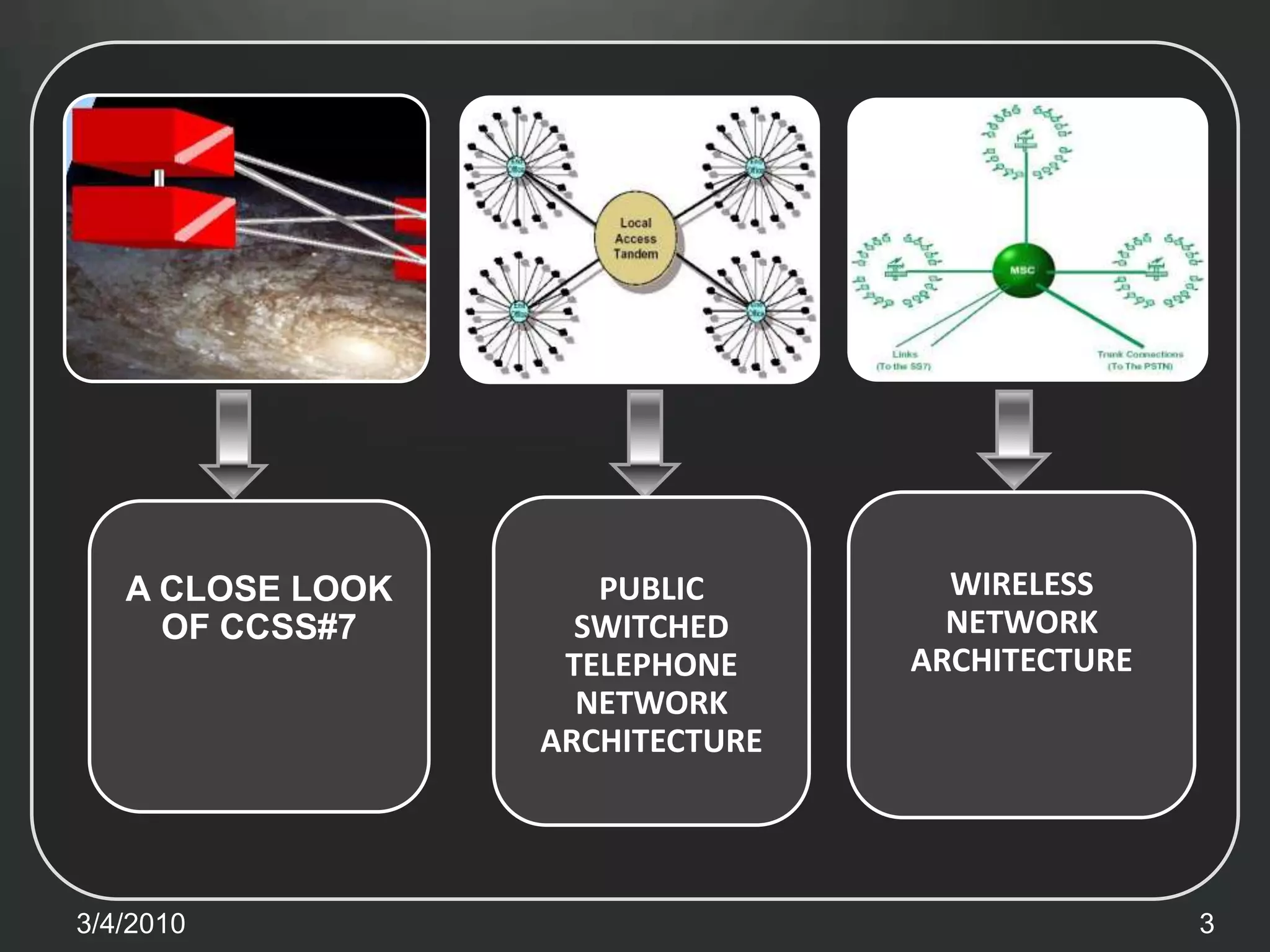
WIRELESS NETWORK ARCHITECTUREPUBLIC SWITCHED TELEPHONE NETWORK ARCHITECTUREA CLOSE LOOK OF CCSS#73/5/20103
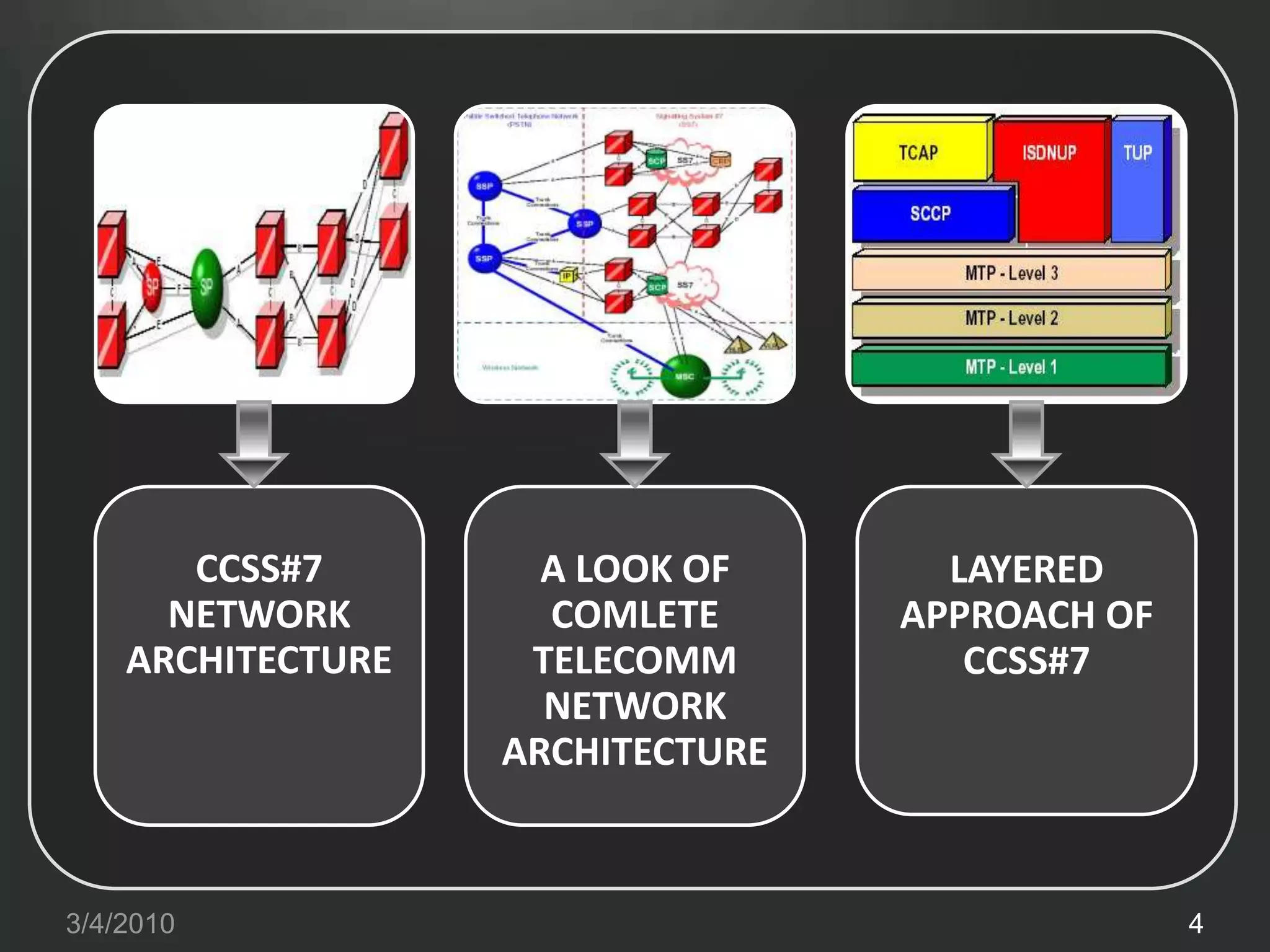
A LOOK OF COMLETE TELECOMM NETWORK ARCHITECTURECCSS#7 NETWORK ARCHITECTURELAYERED APPROACH OF CCSS#73/5/20104
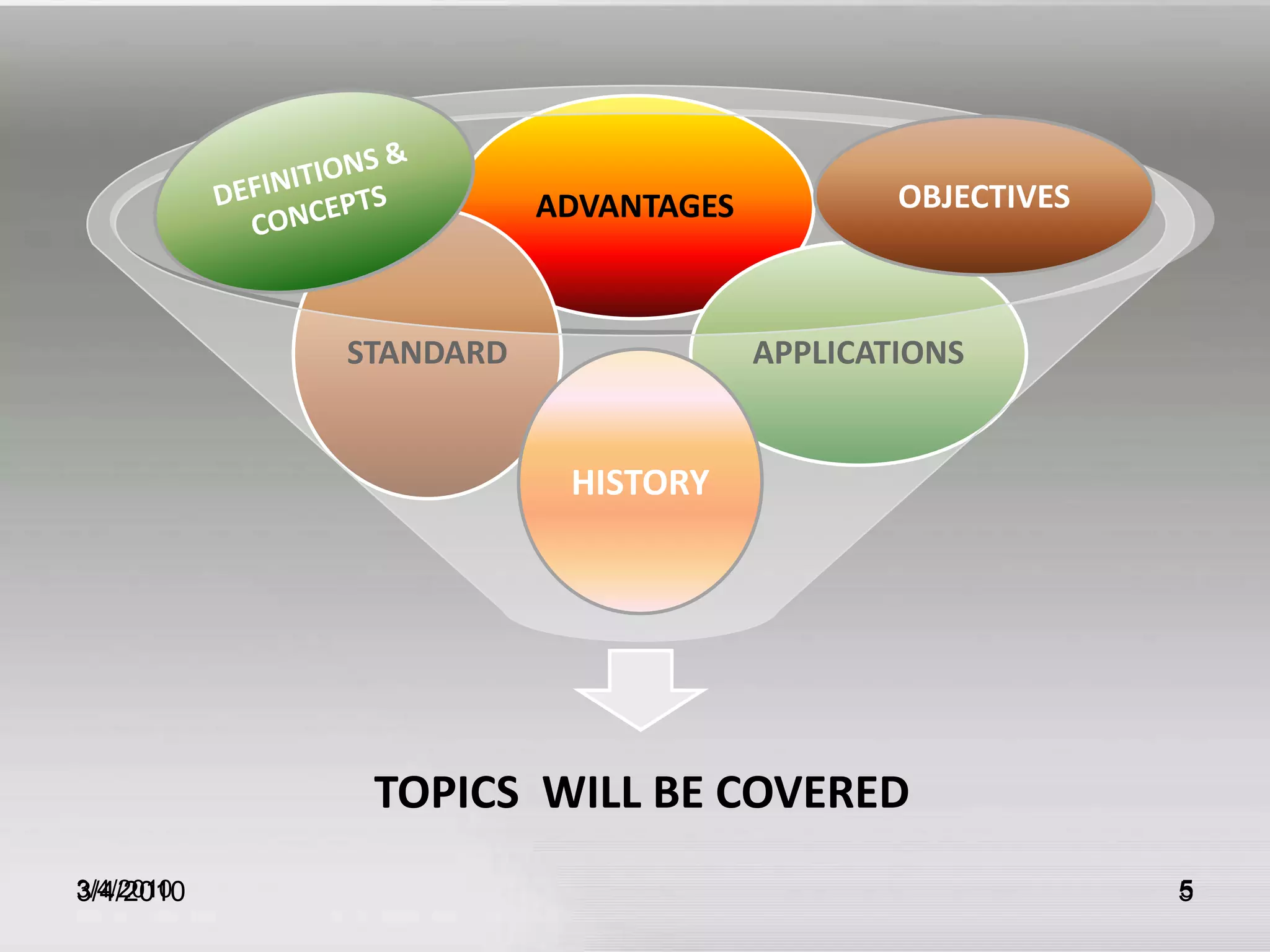
DEFINITIONS & CONCEPTSOBJECTIVESHISTORY3/5/201053/5/20105
3/5/20106Some Basic Concepts to Understand the Common Channel Signaling System
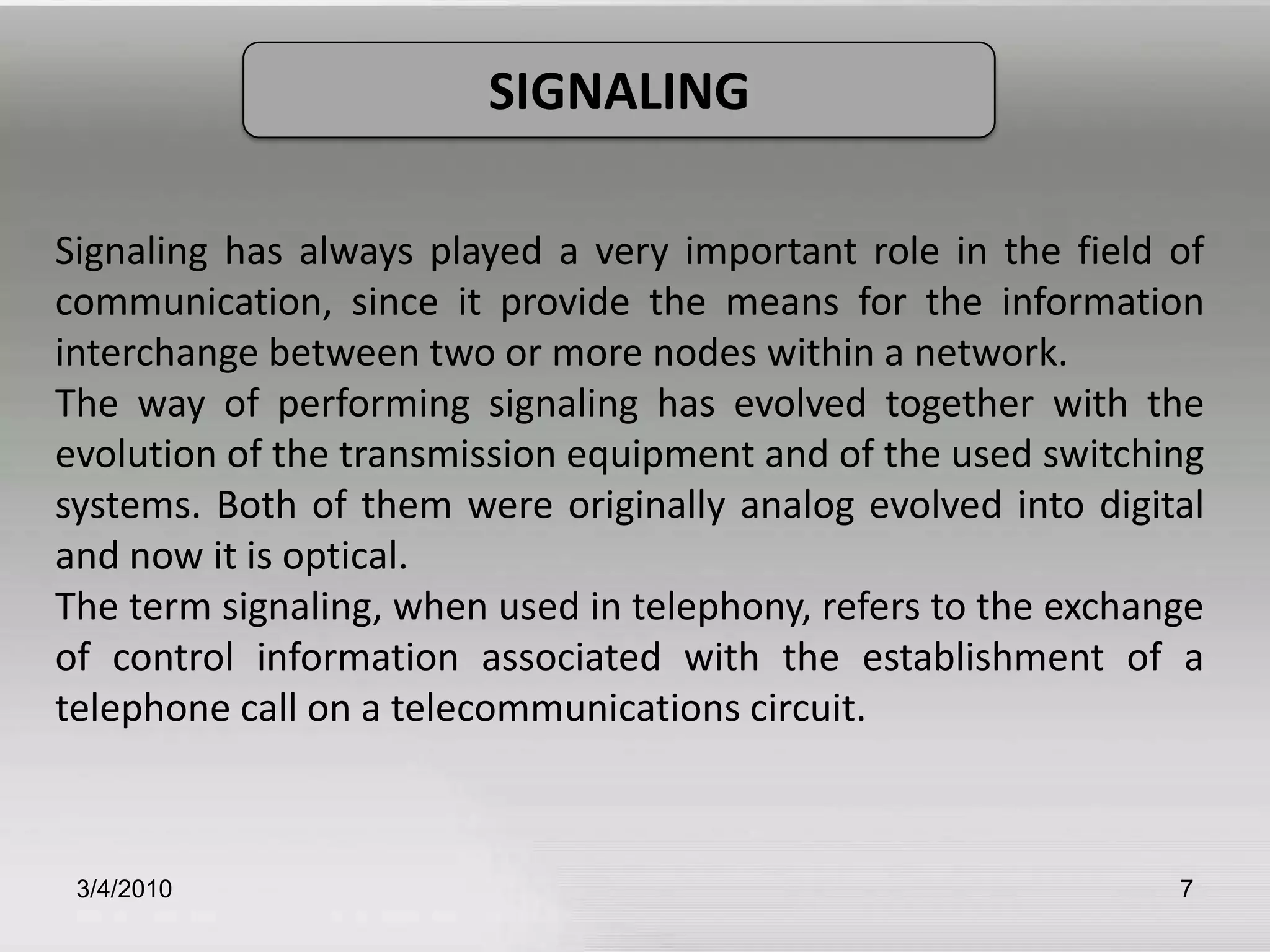
3/5/20107SIGNALINGSignaling has always played a very important role in the field of communication, since it provide the means for the information interchange between two or more nodes within a network.The way of performing signaling has evolved together with the evolution of the transmission equipment and of the used switching systems. Both of them were originally analog evolved into digital and now it is optical. The term signaling, when used in telephony, refers to the exchange of control information associated with the establishment of a telephone call on a telecommunications circuit.
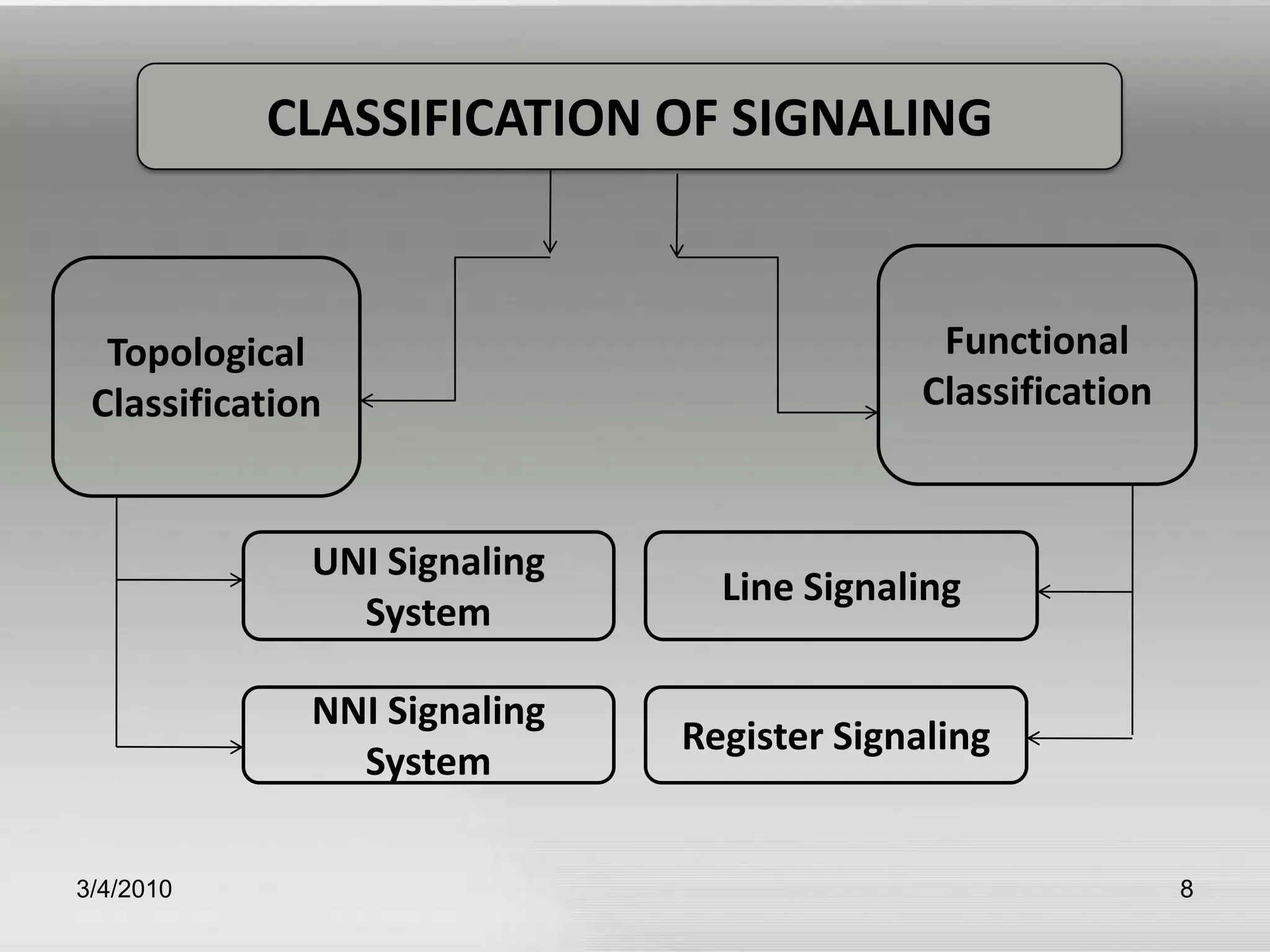
3/5/20108CLASSIFICATION OF SIGNALINGFunctional ClassificationTopological ClassificationUNI Signaling SystemLine Signaling NNI Signaling SystemRegister Signaling
3/5/20109TOPOLOGICAL CLASSIFICATIONUNI (User to Network Interface) Signaling SystemSwitching communication between the calling subscriber and his own switching unit.NNI Signaling SystemA communication will also be required between each switching unit and the next one in the call sequence. This is the Network to Network Interface (NNI).         Channel Associated Signaling System (CAS).
     Common Channel Signaling System #7 (CCS #7).3/5/201010FUNCTIONAL CLASSIFICATION At least two types of information will always have to be “signaled” between adjacent points:Line Signaling = The intention to seize or to release a local line (in case of UNI signaling) or  a trunk circuit (in case of NNI signaling).Register Signaling = The call destination (under the form of dialed  digits) will have to be passed from the register of the previous step to the register of the next exchange.
3/5/201011IN-BAND AND OUT-BAND SIGNALINGIN-BAND: In this signaling the control information and user information are send on a single line.OUT-BAND: In this signaling the control information and user information are send separately into logically or physically separate paths.
3/5/201012SIGNALING MODESThe term “Signaling mode” refers to the association existing between the path taken a signaling message.Associative Mode In this mode, signaling points are directly connected by means of  signaling links. In other words , direct link interconnecting the two points.  Non-Associative ModeIn this mode, two signaling points do not have to be directly connected by a signaling link. The signaling information can be sent via multiple STP’s (signaling transfer point). Since message can be routed indirectly, multiple paths become available between two signaling points.
3/5/201013Cont…Cont…Quasi Associative ModeIt is a limited case of the Non-Associative mode where the path taken by the message through the CCS #7 networks is the same for each message, pertaining to the same call. In this way a correctly sequenced delivery of all the information is guaranteed.Because of these two reasons, CCS #7 is specified for use in the Associated and in the Quasi-Associated modes only.
3/5/201014What is the Common Channel Signaling System #7 (CCSS #7)?CCS #7 is an advanced, digital signaling and control system, that is a set of telephony signaling protocols which are used to set up most of the world's telephone calls. With a high performance packet based communication protocols. standardized byITU-TS (International telecommunication Union and Telecommunication standardization) in the 1980’s.
3/5/201015What about the naming, Common Channel Signaling System #7 (CCSS #7)?It is usually abbreviated to SS#7  and also SS7, though in North America it is often referred to as CCSS#7, an acronym for "Common Channel Signaling System #7". In some European countries, specifically the United Kingdom, it is sometimes called C7 (CCITT number 7) and is also known as number 7 and CCIS7. (ITU-T was formally known as CCITT).
3/5/201016What are the features of Common Channel Signaling System #7 (CCSS #7)?	It is totally Out-Band.           	It is message oriented.     	It support the common channel.     	It is easy to understand and    	implement because of it’s 	layered approach.       	It is also very futuristic because 	any new feature or services 	can 	be added very easily.
3/5/201017HISTORY OF CCSS#7Common channel signaling protocols have been developed by AT&T, BT and the ITU-T since 1975 and the first international Common Channel Signaling protocol was defined by the ITU-T as Signaling System #6 in 1977. Signaling System #7 was defined as an international standard by ITU-T in its 1980. SS5 and earlier used In-Band signaling, where the call-setup information was sent by playing special multi-frequency tones into the telephone lines. This led to security problems.SS6 and SS7 moved to a system in which the signaling information was out-band, carried in a separate signaling channel. This avoided the security problems.
3/5/201018COMING OF STANDARDIt was necessary to provide telecommunications standards that would create the compatibility necessary to provide end-to-end communications between international networks without regard to the nation of origin.CCITT (Consultative Committee on International Telephone and Telegraph)The task of establishing standards was undertaken by the International Telecommunications Union, which is a United Nations Treaty organization. The IT assembled a group known as the CCITT the result of their deliberations was Common Channel Interoffice Signaling System #6, first introduced in the 60s. Were there five previous versions? Of course. But only CCSS 6  survived to deployment.
3/5/201019Cont…Recently, the CCITT group name has been changed to the Telecommunication Standardization Sector (TS) and groups responsible for radio communications (RS) have been added. The use of the term CCITT is rapidly being replaced by ITU-TS.There is only one international SS7 protocol defined by ITU-T. There are however, many national variants of the SS7 protocols. Most national variants are based on two widely deployed national variants as standardized by ANSI and ETSI, which are in turn based on the international protocol defined by ITU-T. Each national variant has its own unique characteristics. Some national variants with rather striking characteristics are the China (PRC) and Japan (TTC) national variants.
3/5/201020OBJECTIVES AND APPLICATIONSSS7, being a high-speed and high-performance packet-based communications protocol, can communicate significant amounts of information when setting up a call, during the call, and at the end of the call. This permits rich call-related services to be developed.Some of the first such services were call management related services that we take for granted today:	Call forwarding (busy and no answer),	voice mail, 	call waiting, 	conference calling,
3/5/201021Cont…	called name and number display, 	call screening, 	malicious caller identification, 	busy callback, etc.	calling name and number display,
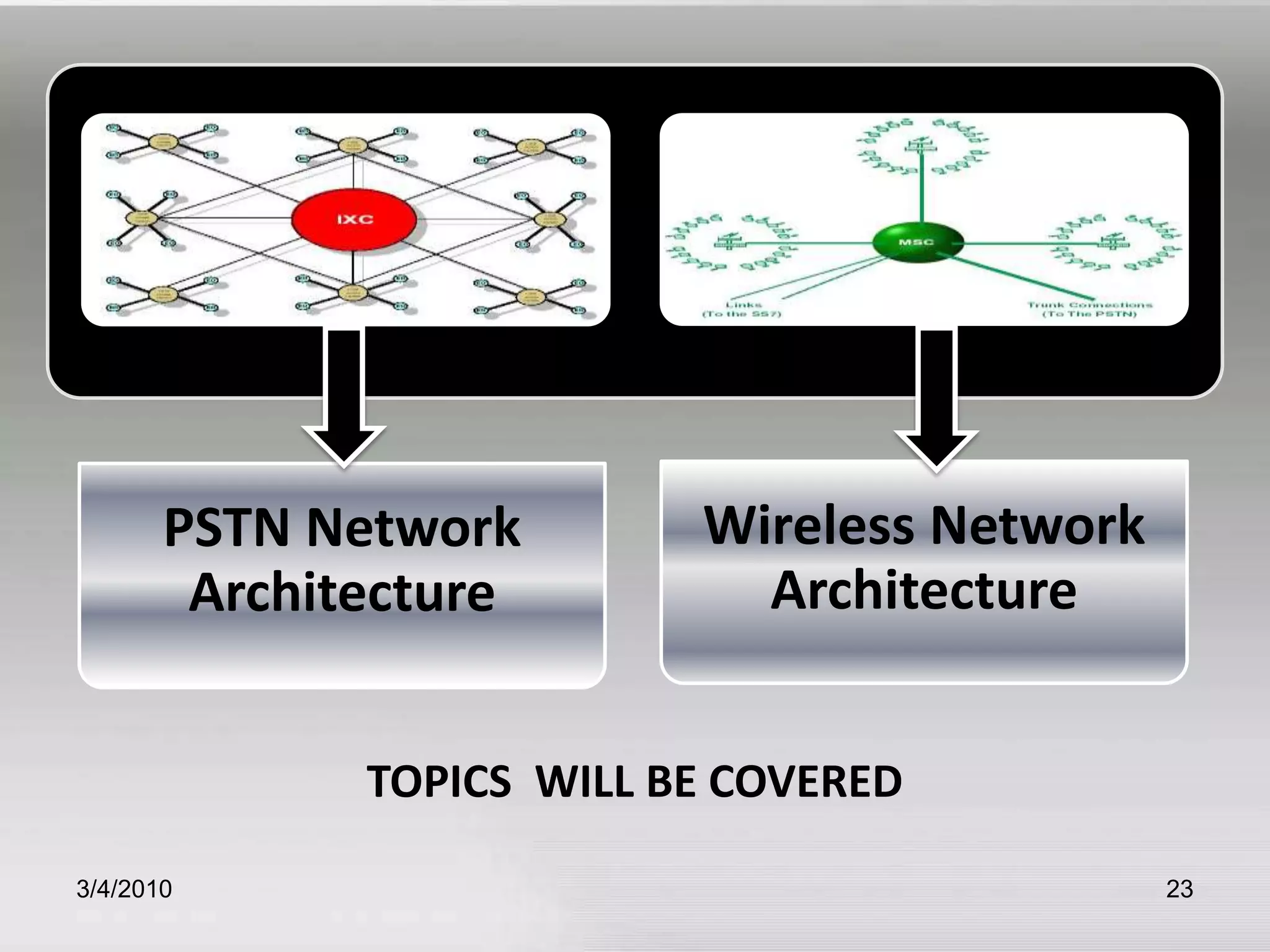
3/5/201022ADVANTAGESThat is optimized for operational in digital 	telecommunications networks with stored programmed 	controlled exchanges.CCS #7 is optimized for operation over 64 kb digital 	channels.It is also suitable for operation over analog channels 	and at lower speeds.It is suitable for point to point terrestrial on satellite 	links. That can meet the present and future requirements for 	call control, remote control, and management and 	maintenance signaling.Maintenance of small local exchange can be carried 	out remotely from a network service center.
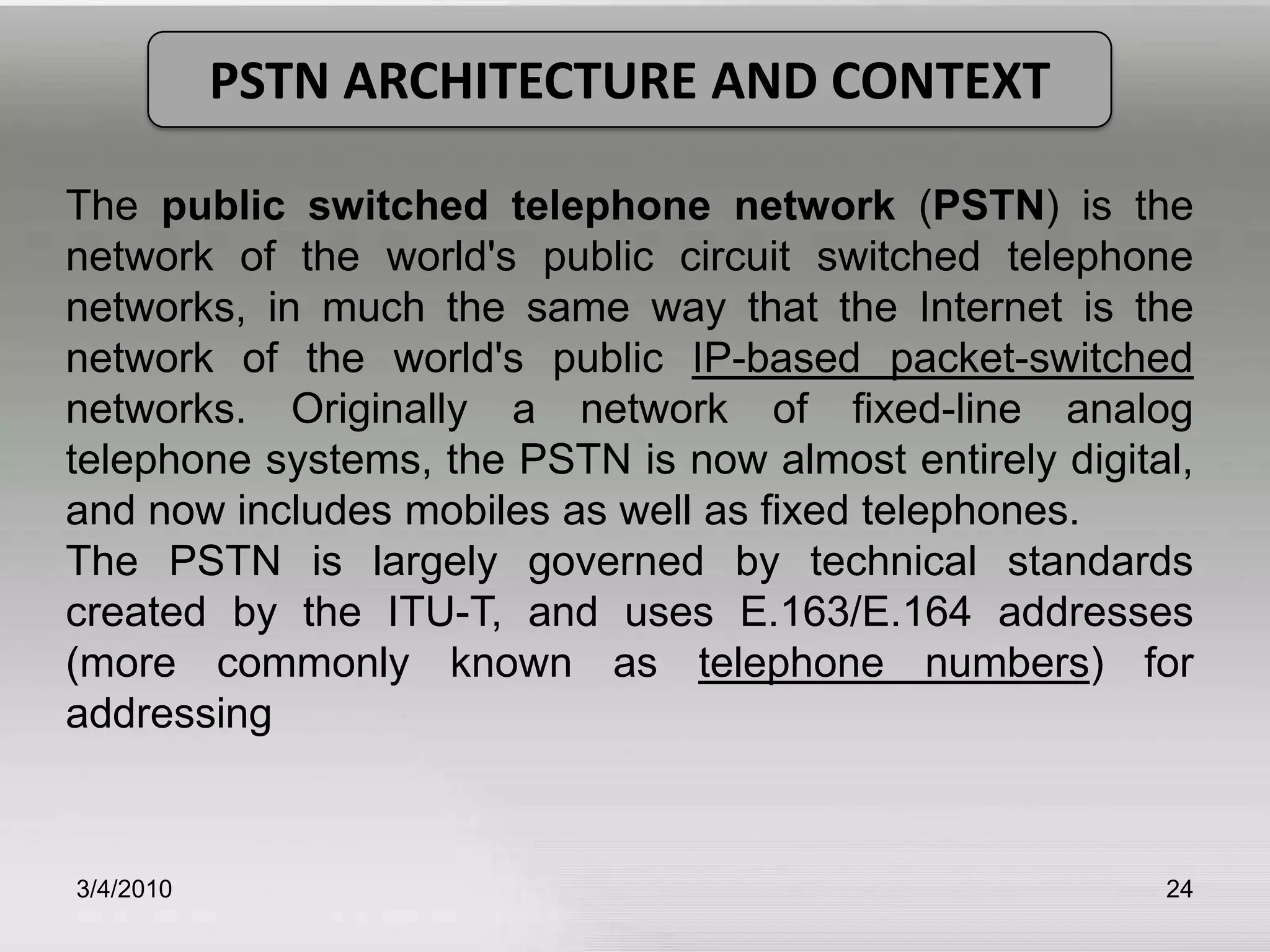
3/5/201023Wireless Network ArchitecturePSTN Network ArchitectureTOPICS  WILL BE COVERED
3/5/201024PSTN ARCHITECTURE AND CONTEXTThe public switched telephone network (PSTN) is the network of the world's public circuit switched telephone networks, in much the same way that the Internet is the network of the world's public IP-based packet-switched  networks. Originally a network of fixed-line analog telephone systems, the PSTN is now almost entirely digital, and now includes mobiles as well as fixed telephones.The PSTN is largely governed by technical standards created by the ITU-T, and uses E.163/E.164 addresses (more commonly known as telephone numbers) for addressing
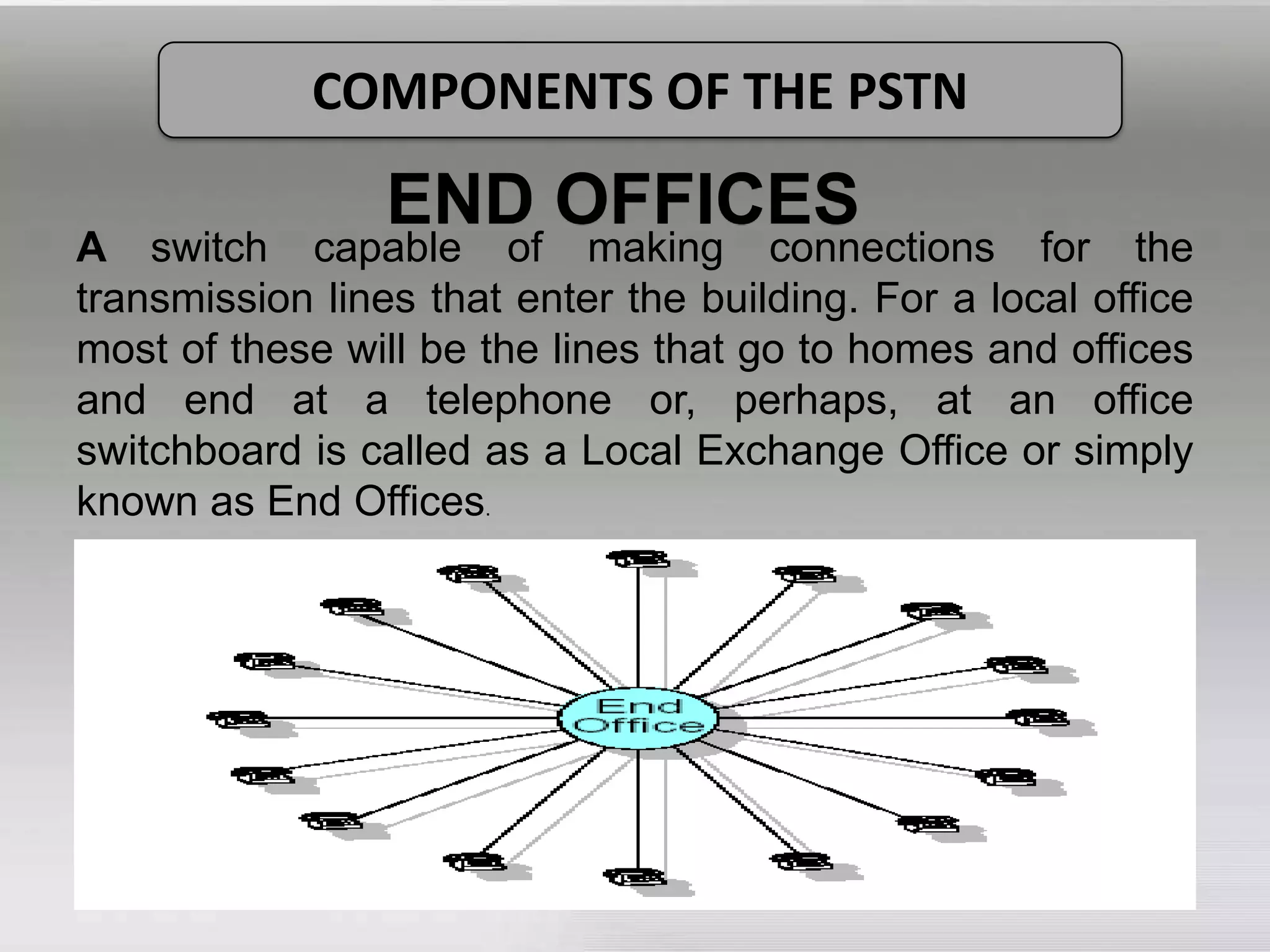
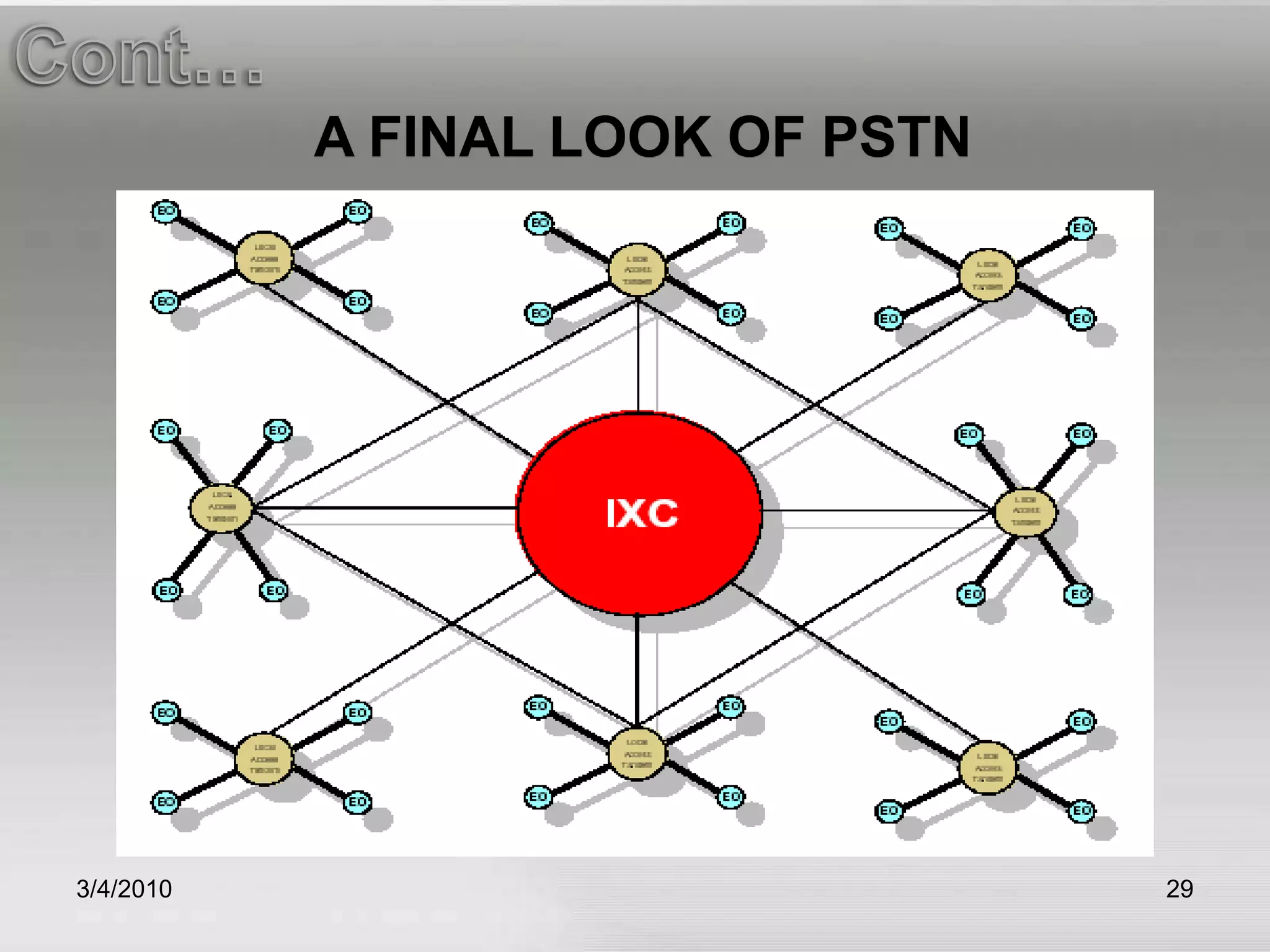
3/5/201025COMPONENTS OF THE PSTNEND OFFICESA switch capable of making connections for the transmission lines that enter the building. For a local office most of these will be the lines that go to homes and offices and end at a telephone or, perhaps, at an office switchboard is called as a Local Exchange Office or simply known as End Offices.
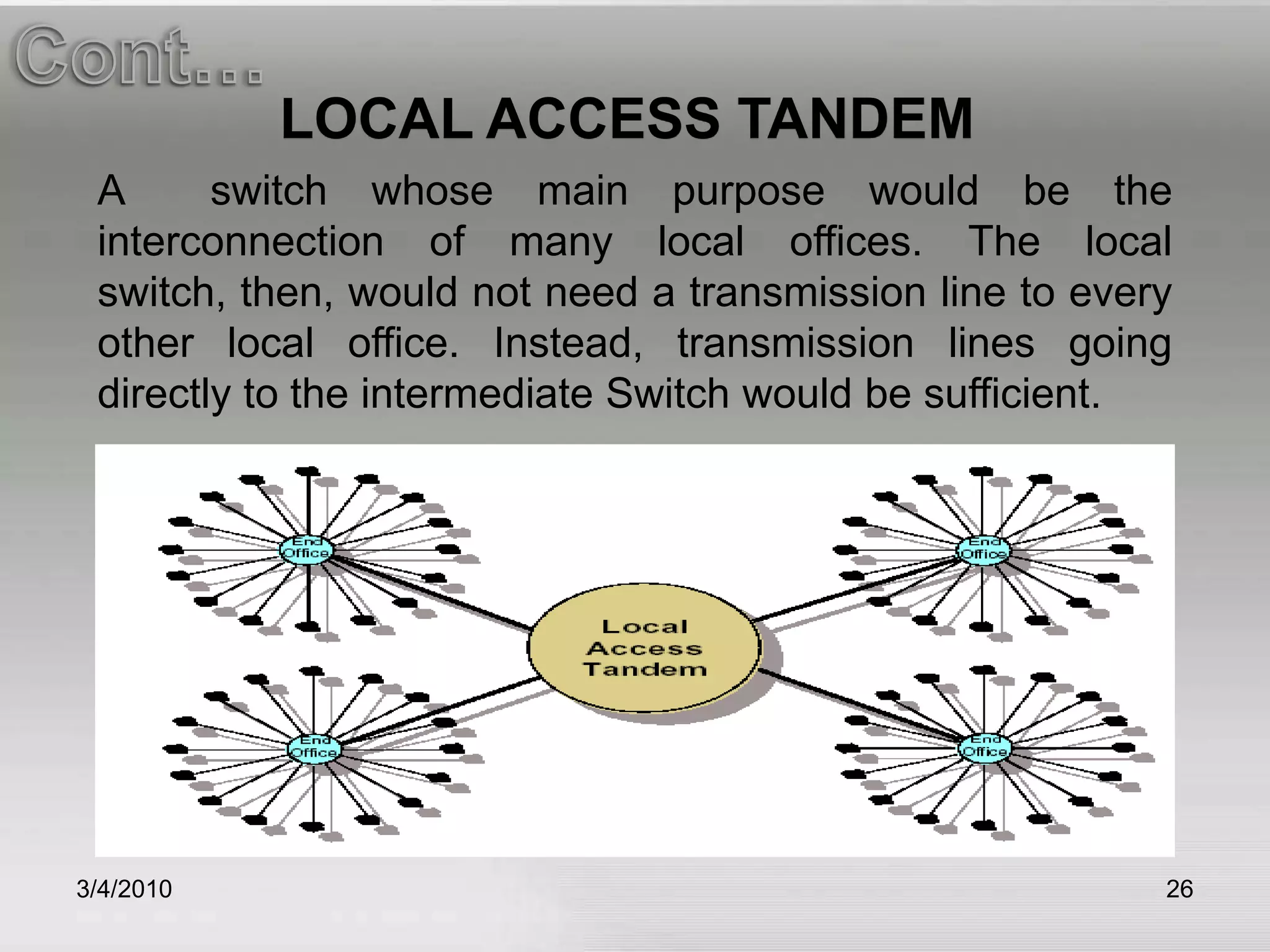
3/5/201026Cont…LOCAL ACCESS TANDEM A  switch whose main purpose would be the interconnection of many local offices. The local switch, then, would not need a transmission line to every other local office. Instead, transmission lines going directly to the intermediate Switch would be sufficient.
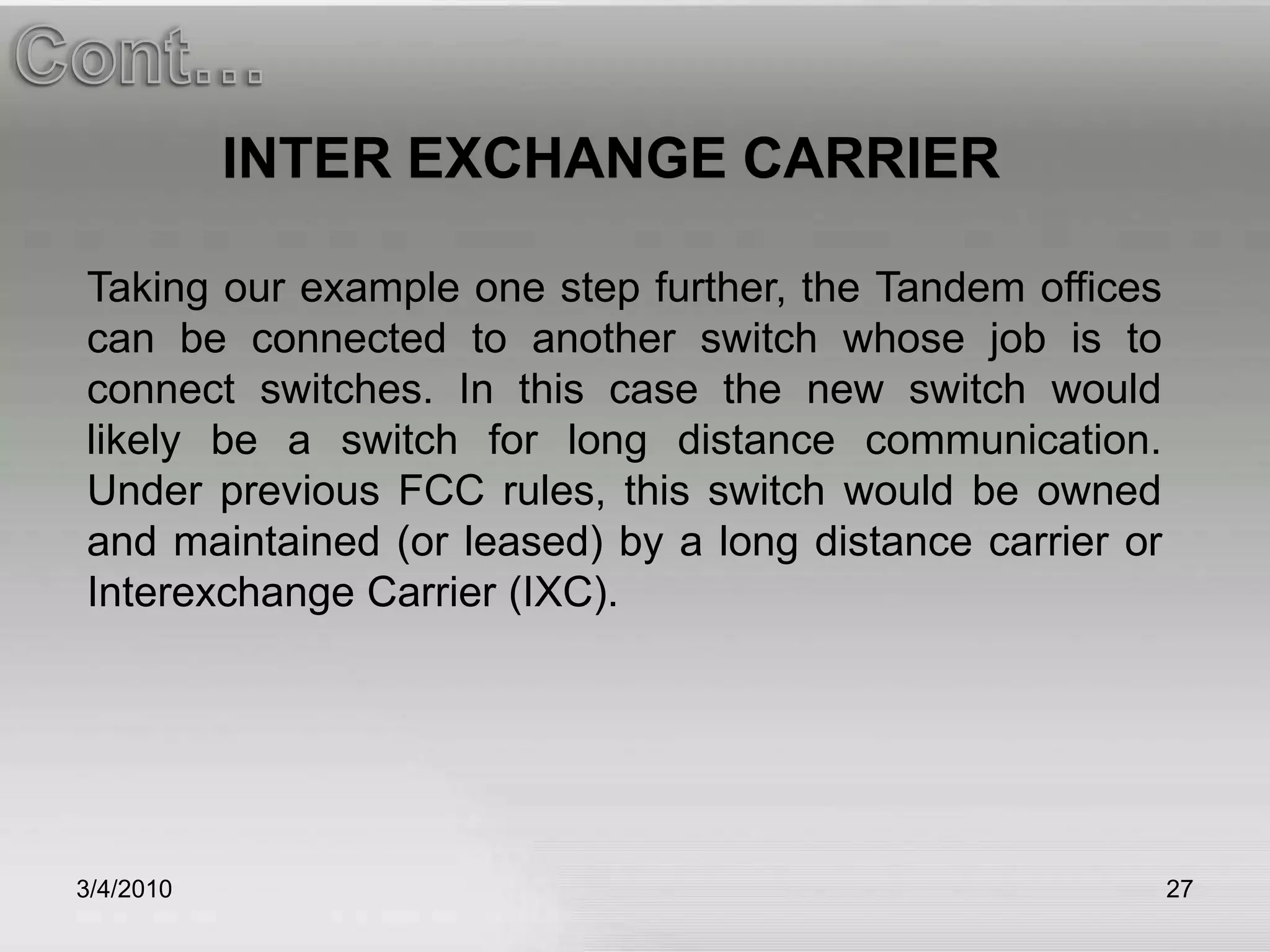
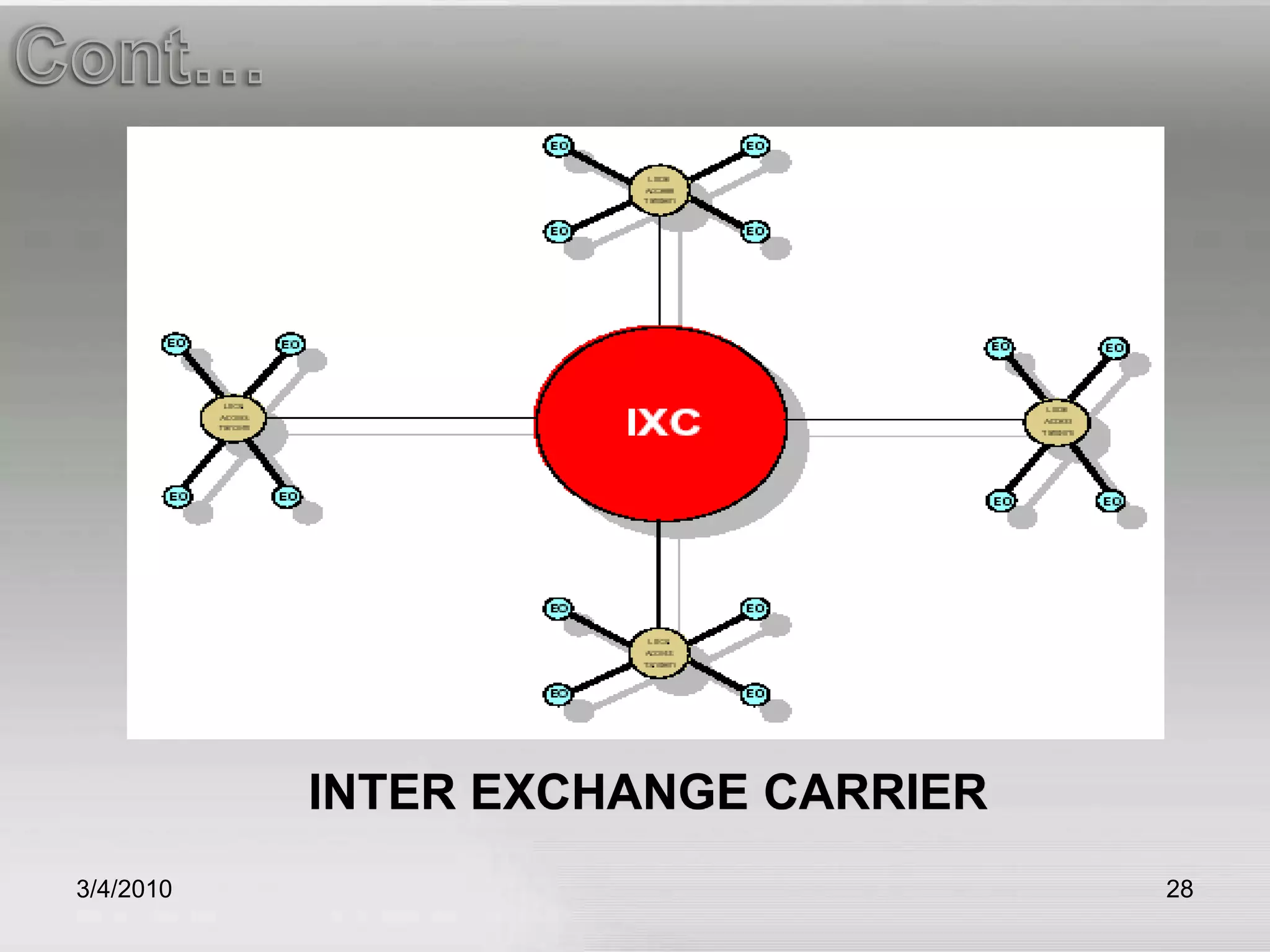
3/5/201027Cont…INTER EXCHANGE CARRIERTaking our example one step further, the Tandem offices can be connected to another switch whose job is to connect switches. In this case the new switch would likely be a switch for long distance communication. Under previous FCC rules, this switch would be owned and maintained (or leased) by a long distance carrier or Interexchange Carrier (IXC).
3/5/201028Cont…INTER EXCHANGE CARRIER
3/5/201029Cont…A FINAL LOOK OF PSTN
3/5/201030WIRELESS NETWORK ARCHITECTURE AND CONTEXTThe truth is that the wireless network is truly “wireless” in only a small portion of its architecture. A mobile telephone transmits and receives to and from a transmitter/receiver. The transmitter/receiver is the first and last place in the network where the communications are wireless. The voice received from the mobile telephone must be connected into the PSTN. The voice received from the PSTN must end up connected to the transmitter for transmission to the telephone.
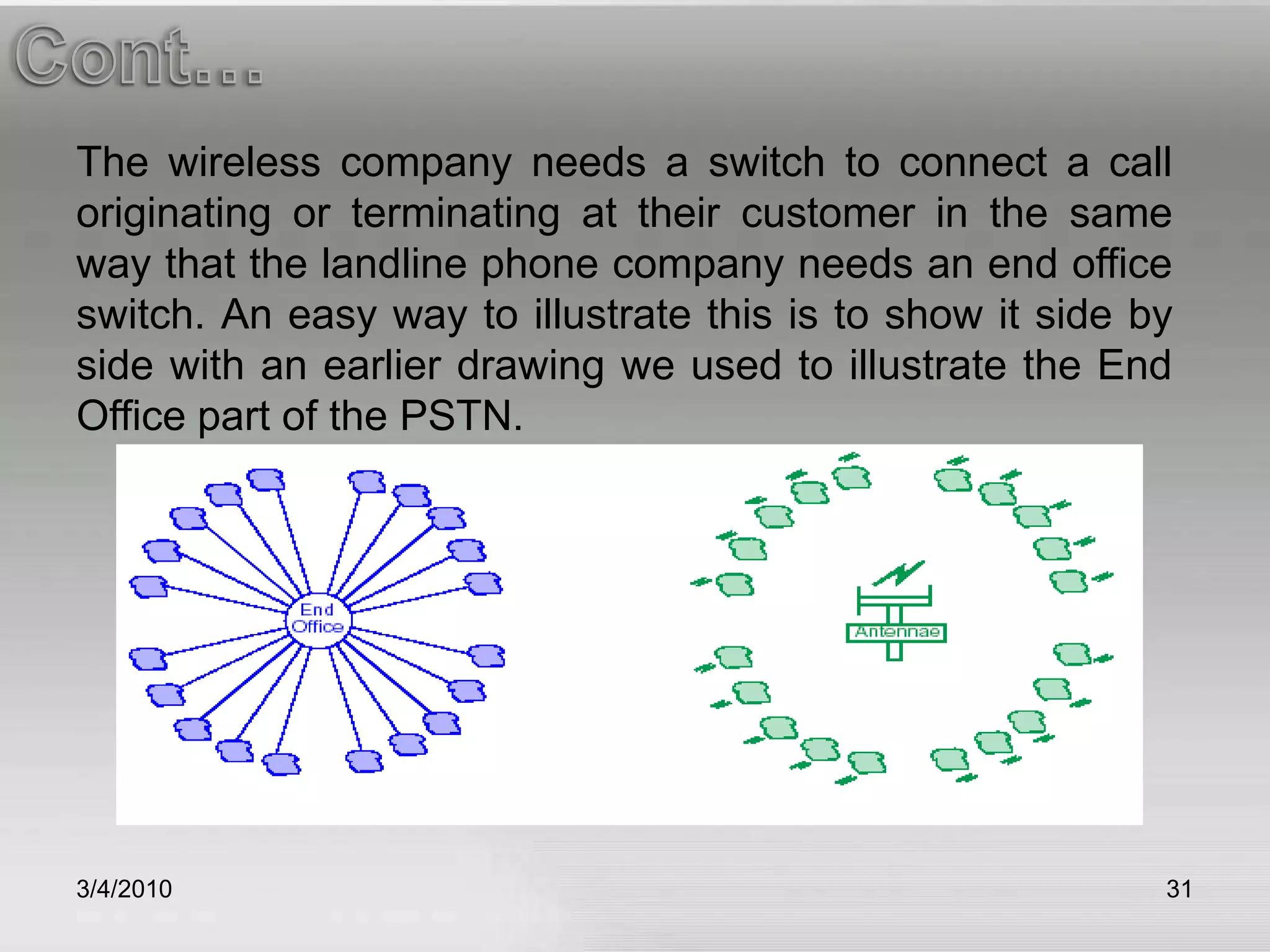
3/5/201031Cont…The wireless company needs a switch to connect a call originating or terminating at their customer in the same way that the landline phone company needs an end office switch. An easy way to illustrate this is to show it side by side with an earlier drawing we used to illustrate the End Office part of the PSTN.
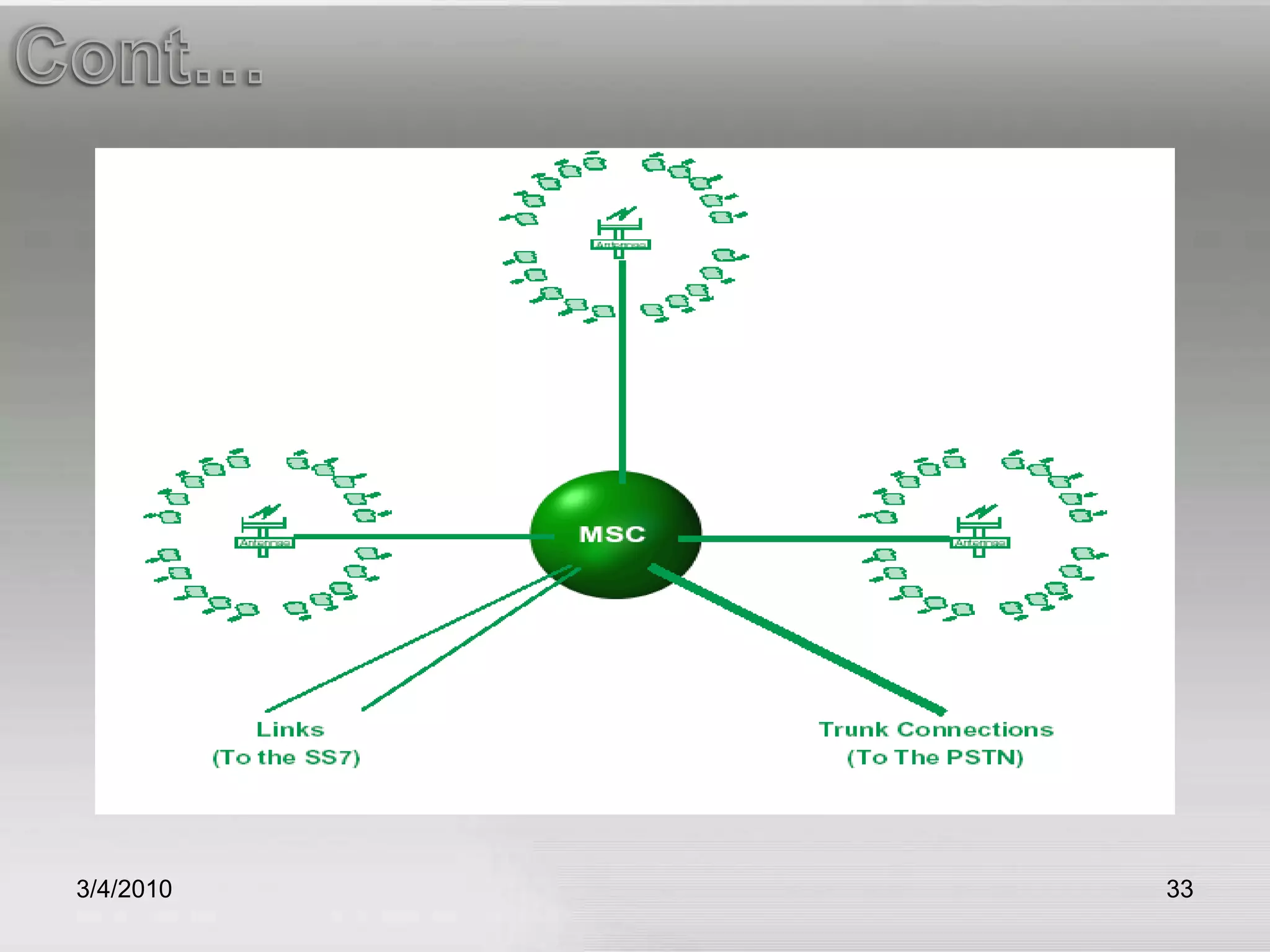
3/5/201032COMPONENTS OF THE WIRELESS NETWORKMOBILE SWITCHING CENTRE (MSC)The MSC needs “one foot” in the PSTN (Public Switched Telephone Network) and “one foot” in the SS7 (Signaling System #7) network. Landline connections must be made to connect the callers. Information pertaining to the call must be sent to the PSTN switches using the services of the SS7. The MSC then has requirements that PSTN switches do not have. Among these is the need to keep track of its subscribers. When the subscriber is within the range of any of the MSC’s transmitter/ receivers, the MSC receives an indication of the signal strength of the subscriber’s telephone at the location of the antennas.
3/5/201033Cont…
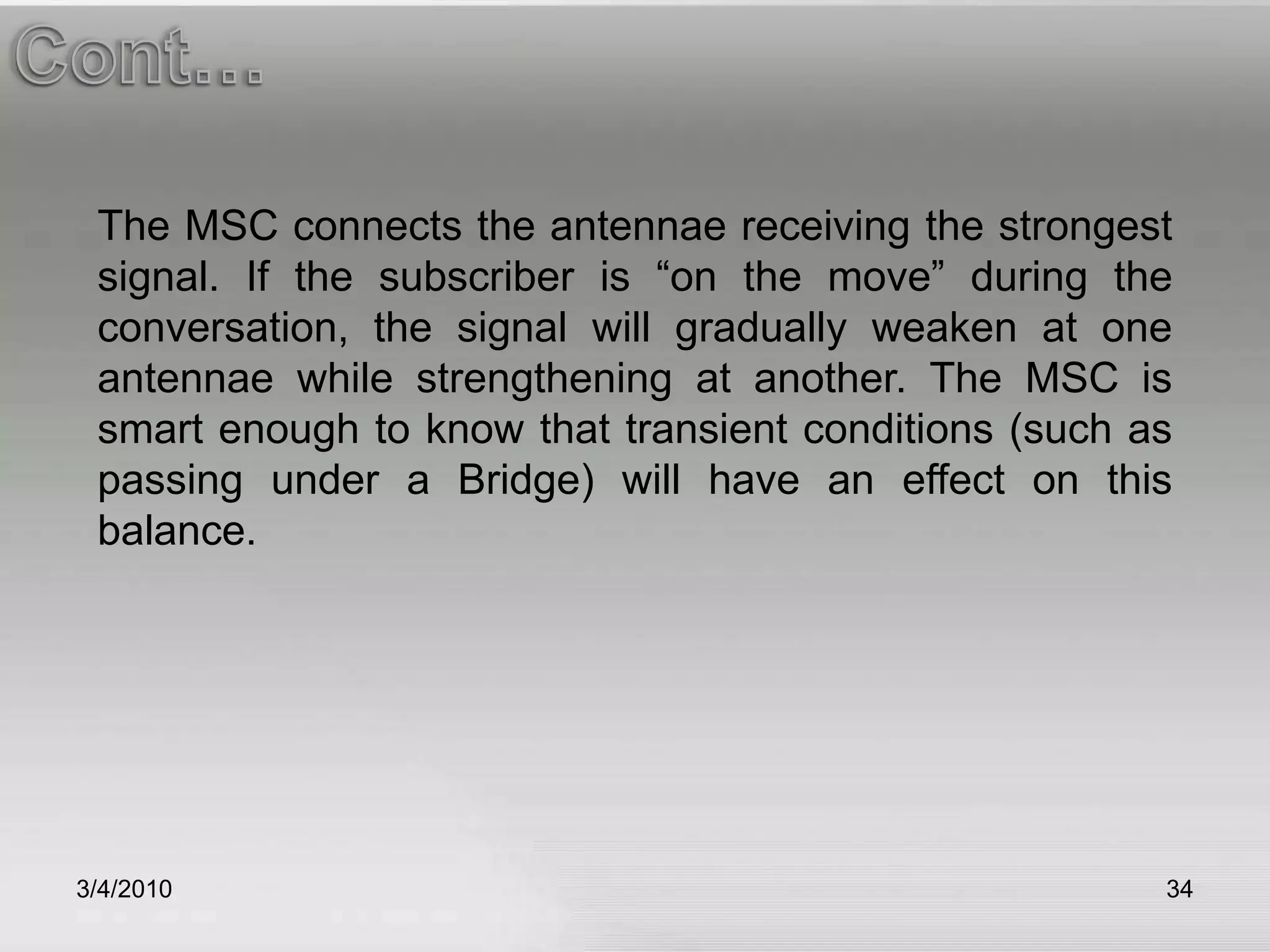
3/5/201034Cont…The MSC connects the antennae receiving the strongest signal. If the subscriber is “on the move” during the conversation, the signal will gradually weaken at one antennae while strengthening at another. The MSC is smart enough to know that transient conditions (such as passing under a Bridge) will have an effect on this balance.
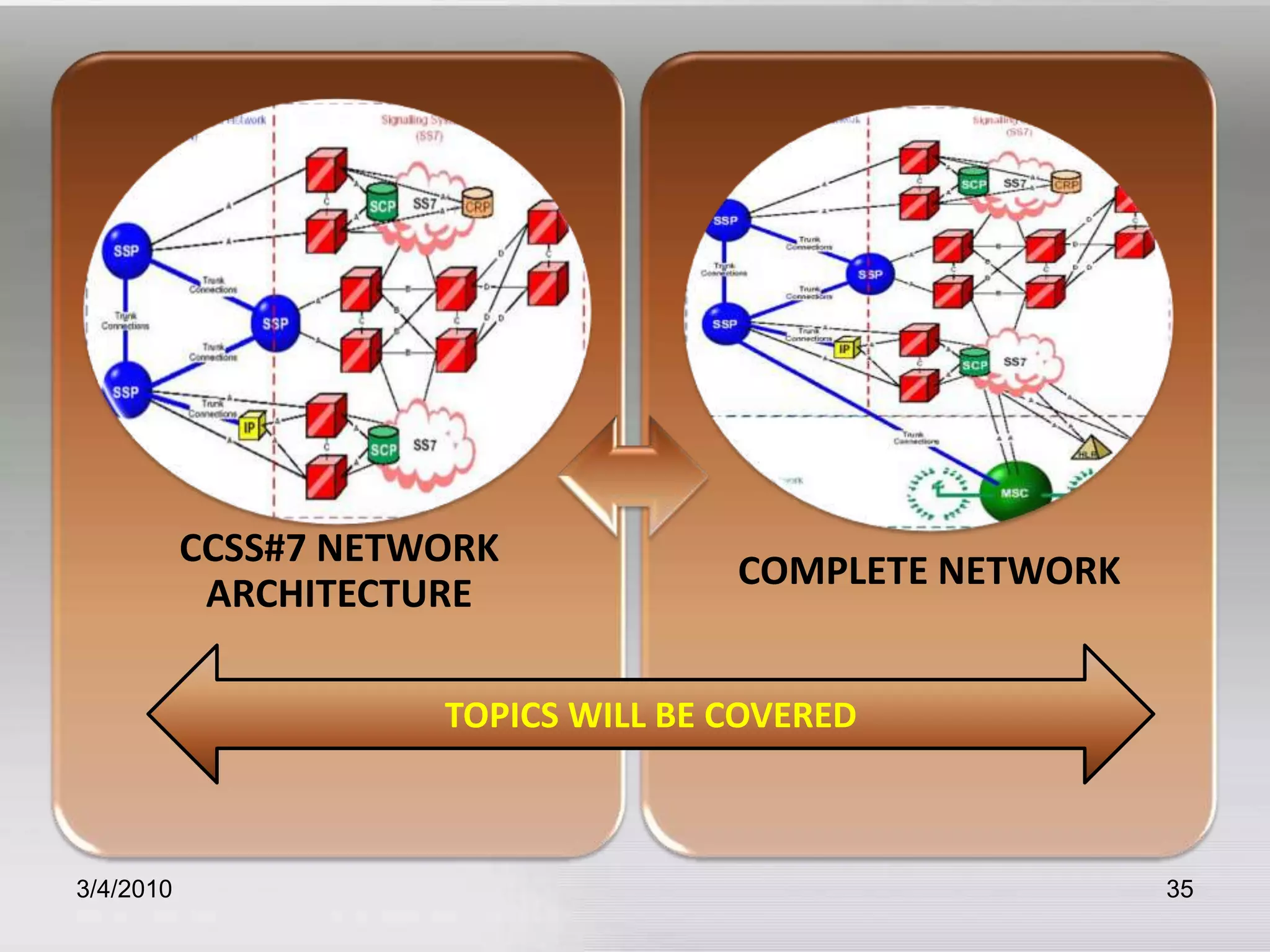
3/5/201035CCSS#7 NETWORK ARCHITECTURECOMPLETE NETWORKTOPICS WILL BE COVERED
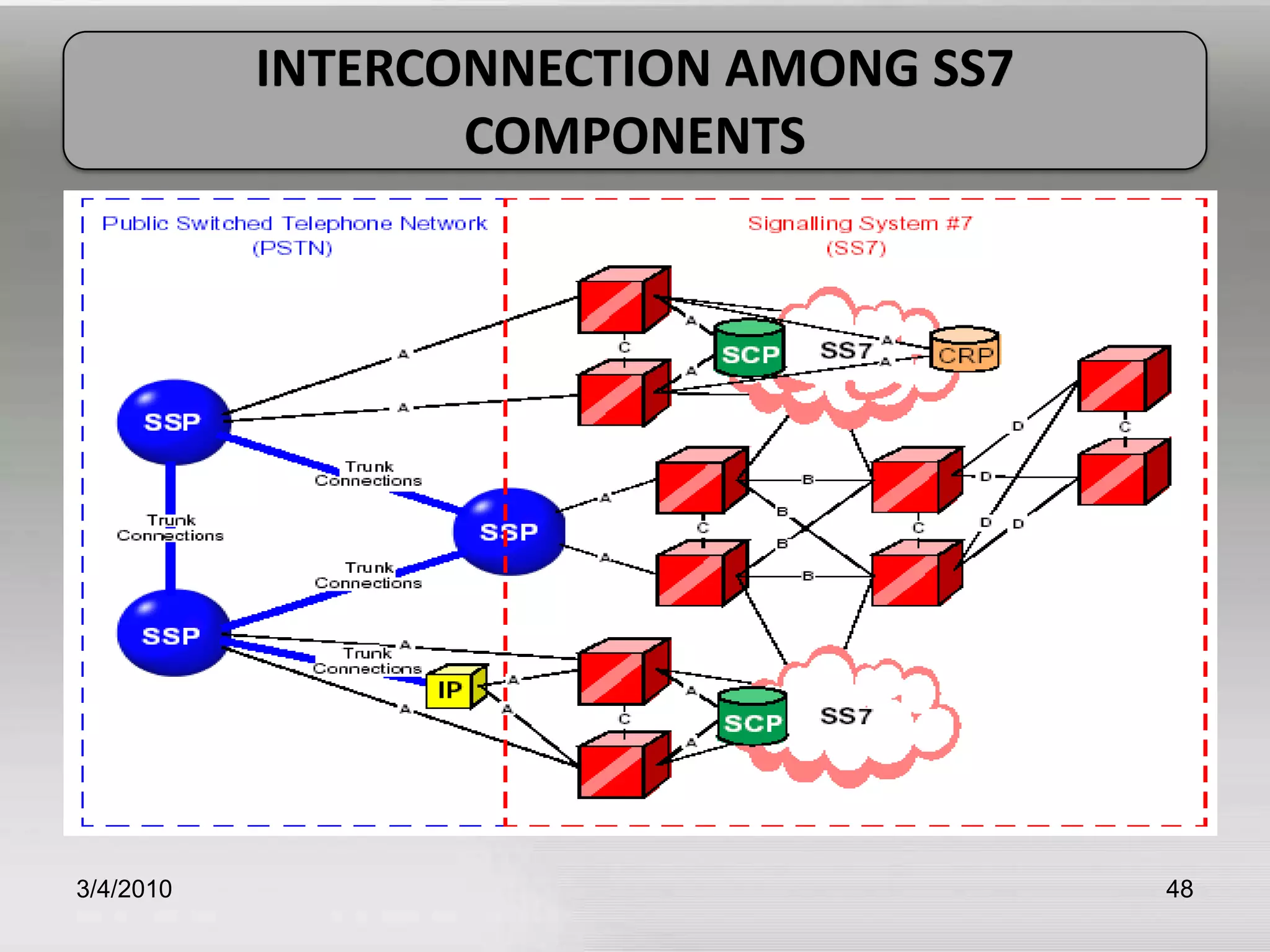
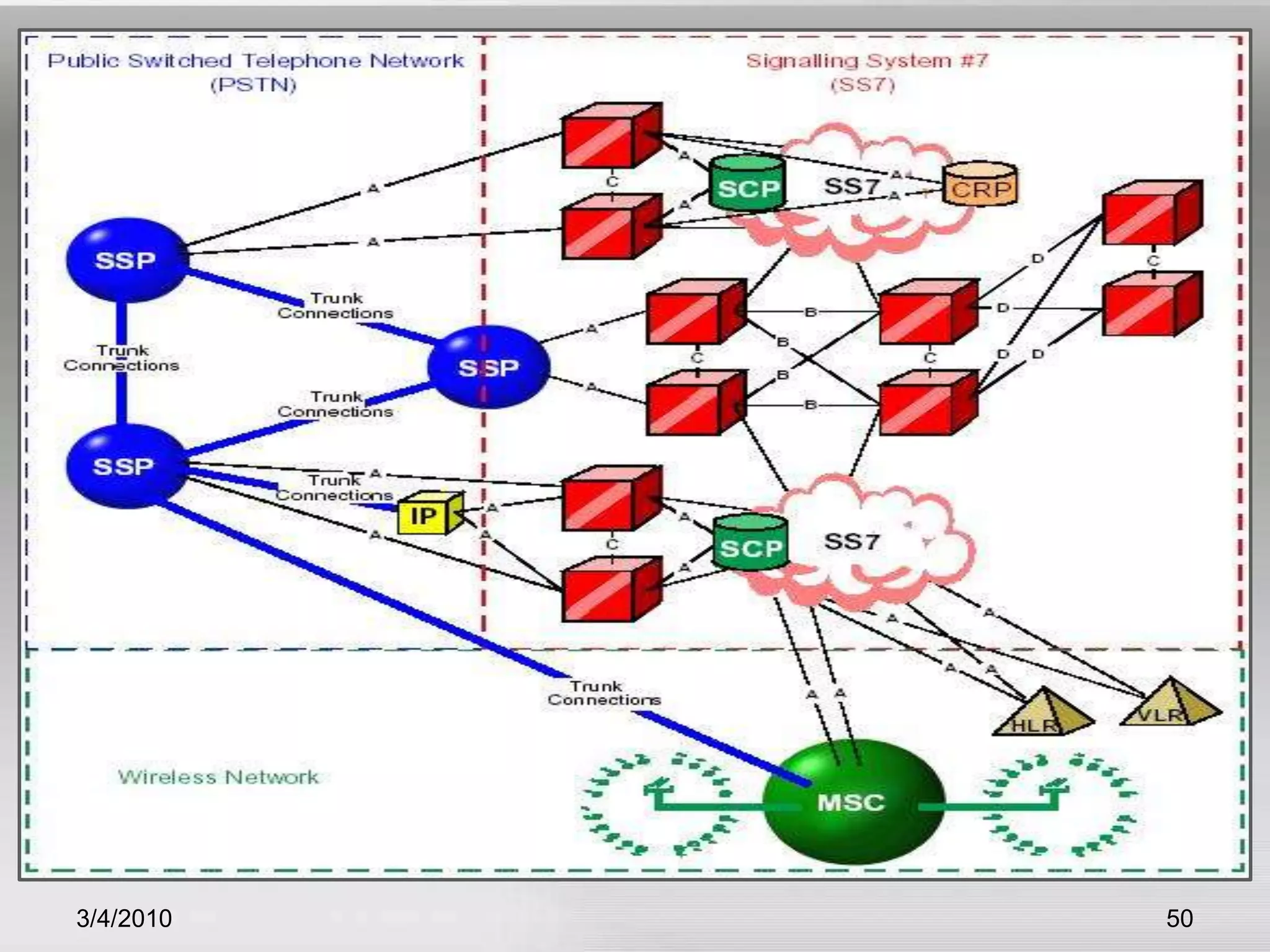
3/5/201036CCSS #7 NETWORKCCSS#7 clearly splits the signaling planes and voice circuits. An SS7 network has to be made up of SS7-capable equipment from end to end in order to provide its full functionality. The network is made up of several link types (A, B, C, D, E, and F) and three signaling nodes – Service Switching point (SSPs), Singling Transfer Point (STPs), and Service Control Point (SCPs). Each node is identified on the network by a number, a point code. Extended services are provided by a database interface at the SCP level using the SS7 network.
3/5/201037COMPONENTS OF THE SS7 NETWORKSTP (Signal Transfer Point)The “knots” that hold the network together. These nodes serve to provide network access to other nodes (by connection with Access Links). STPs transfer messages around the network. STPs maintain routing tables for the purposes of directing messages to their intended destinations.
3/5/201038Cont…SSP (Service Switching Point)The Service Switching Point is a switch associated node which handles call set-up and has the ability to stop call processing, make queries of even unknown databases, and perform actions appropriate to the response. In general, the SS7 messages which originate or terminate here are either circuit or call routing related.
3/5/201039Cont…SCP (Service Control Point)In general, Service Control Points provide access to databases. These nodes are the residences of processes which can access the database, extract the required data and return it to the node requesting the data. The database(s) to which the SCP has access may or may not reside at the same location as the SCP. The same capabilities that allow the SCP to access databases lend themselves to other uses such as providing access to an IP.
3/5/201040Cont…IP (Intelligent Peripheral)The IP is the residence of processes which manage resources such as signaling sensors and voice response equipment. The resource management capabilities become available to switches on demand, thereby freeing switch locations from the need to equip with a myriad of such devices, and providing highly efficient use of both aging and up-to-date technologies.
3/5/201041Cont…CRP (Customer Routing Point)The CRP provides on-premises control of the routing information requested by switches for translation of 800 type dialing (not limited to 800 numbers). The operator of the CRP is a customer who requires rapid update and control of the translation of their own numbers.
3/5/201042Cont…HLR/VLR (Home Location Register/Visitor Location Register)A database that contains customer information about local subscribers is maintained by each provider. This is the Home Location Register. Another company will access this information when a “roamer” appears, and use the data for an entry into its Visitor Location Register.
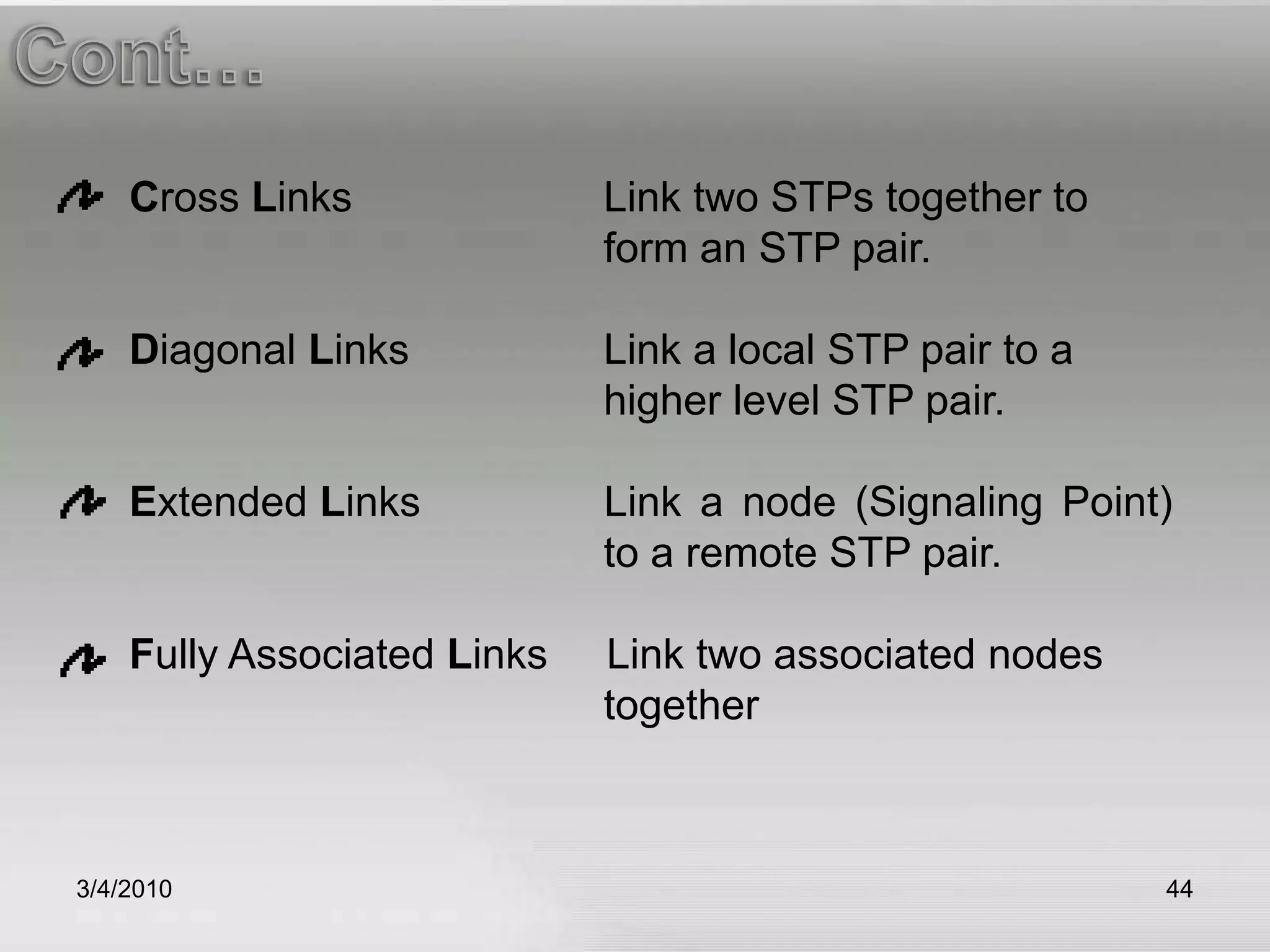
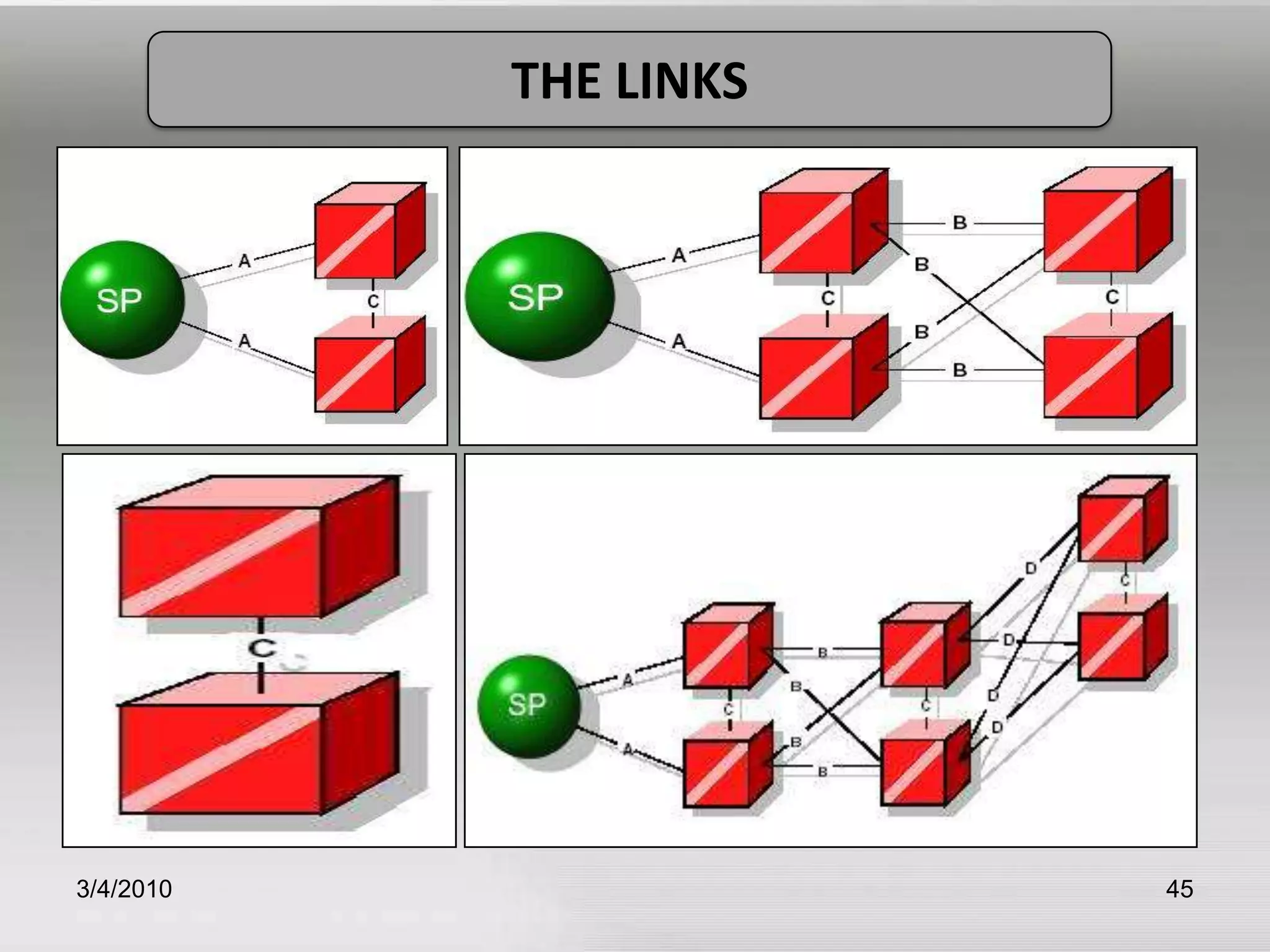
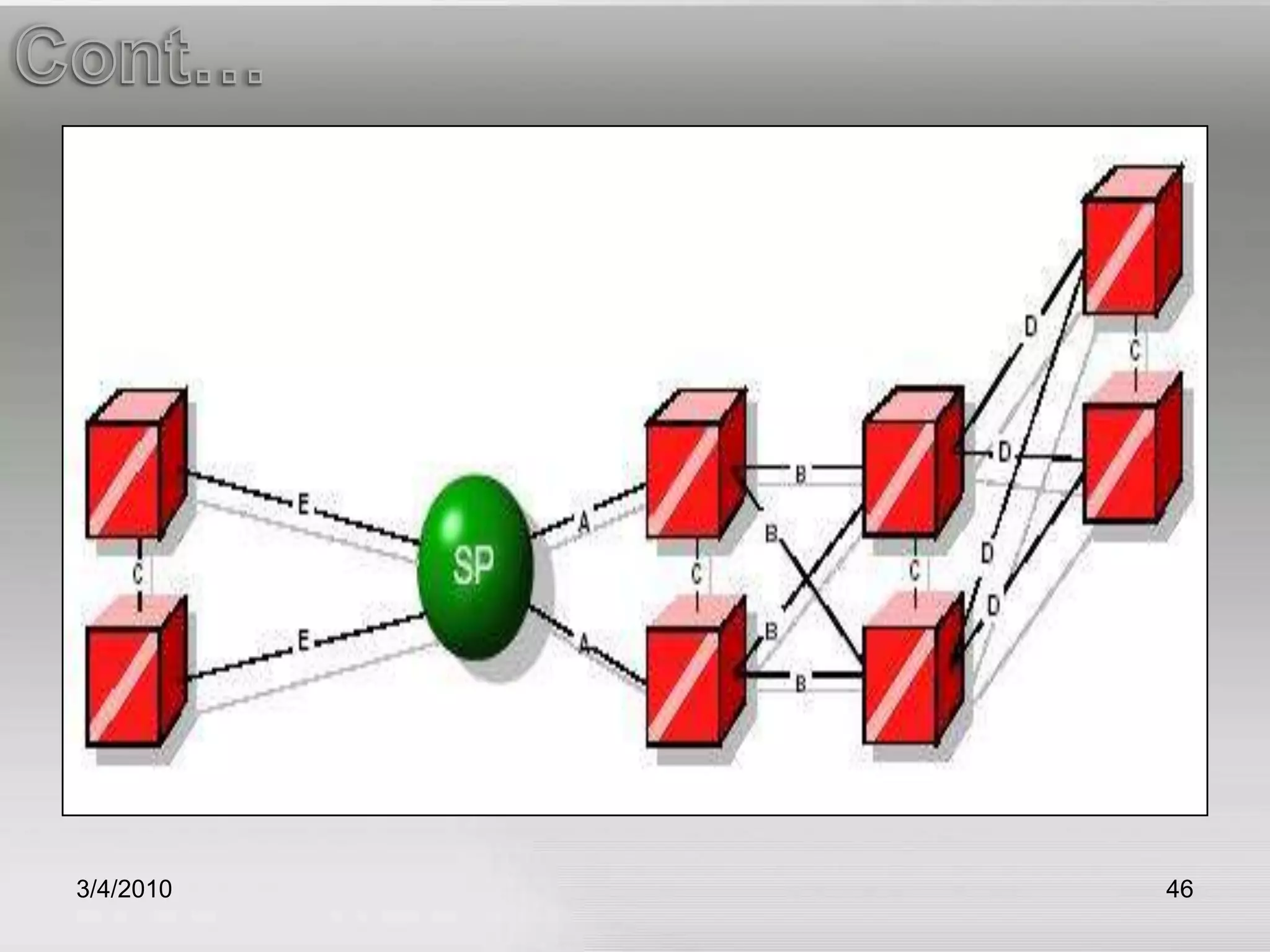
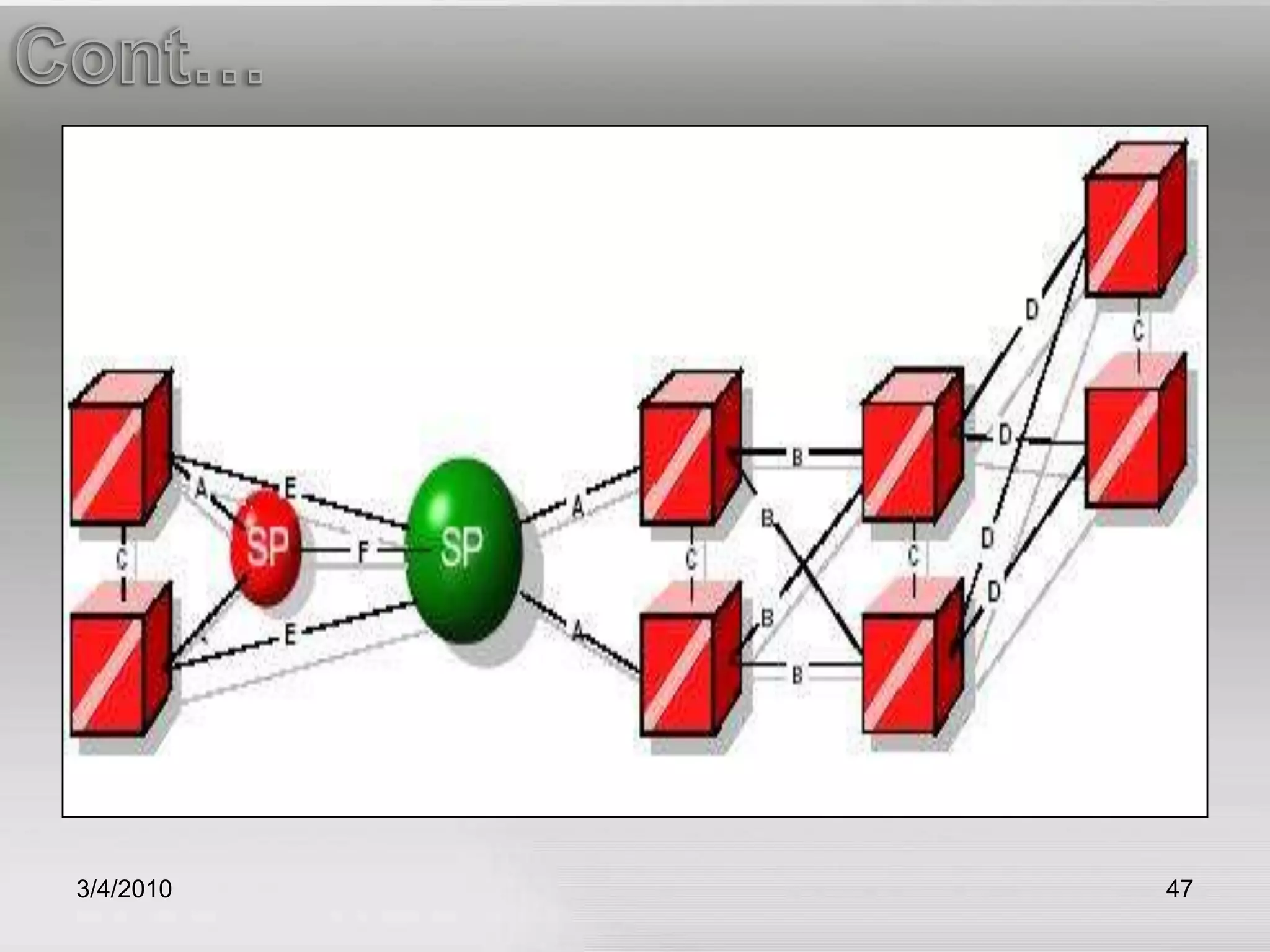
3/5/201043Cont…Network links  Links are simply the connections to establish the whole Network. The different types of links are as follows: Access LinksLink a node (Signaling Point) 			to a local STP pair.  Bridge Links 	Link two pairs at the same 				level (local/local,					regional/regional). 
3/5/201044Cont…Cross Links 		        Link two STPs together to 				        form an STP pair. Diagonal Links	        Link a local STP pair to a 				        higher level STP pair. Extended Links 	        Link a node (Signaling Point) 			        to a remote STP pair. Fully Associated Links     Link two associated nodes 				        together
3/5/201045THE LINKS
3/5/201046Cont…
3/5/201047Cont…
3/5/201048INTERCONNECTION AMONG SS7 COMPONENTS
A COMPLETE TELECOMMUNICATION NETWORK ARCHITECTURE3/5/201049
3/5/201050
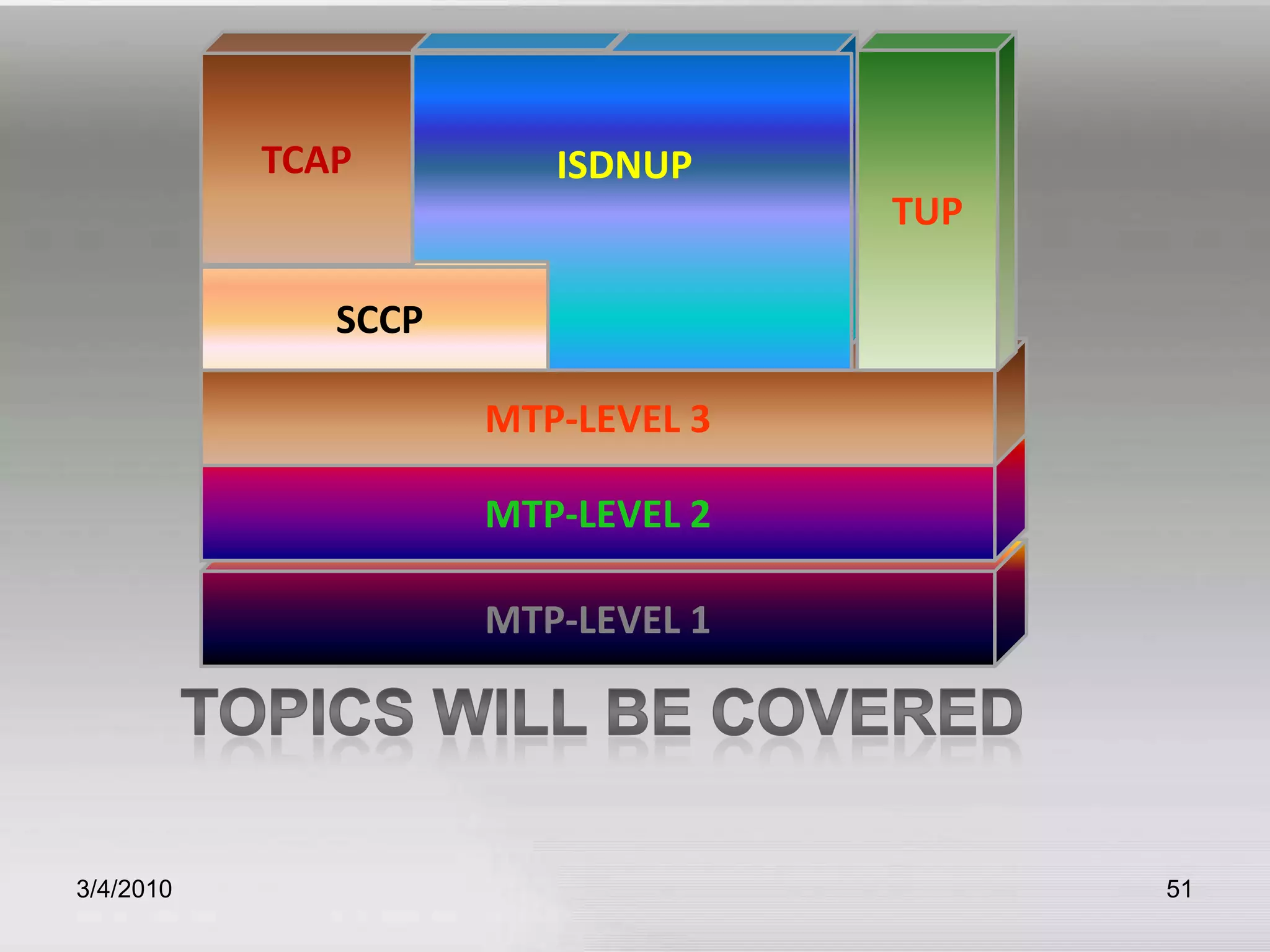
3/5/201051TCAPTUPISDNUPSCCPMTP-LEVEL 3MTP-LEVEL 2MTP-LEVEL 1TOPICS WILL BE COVERED
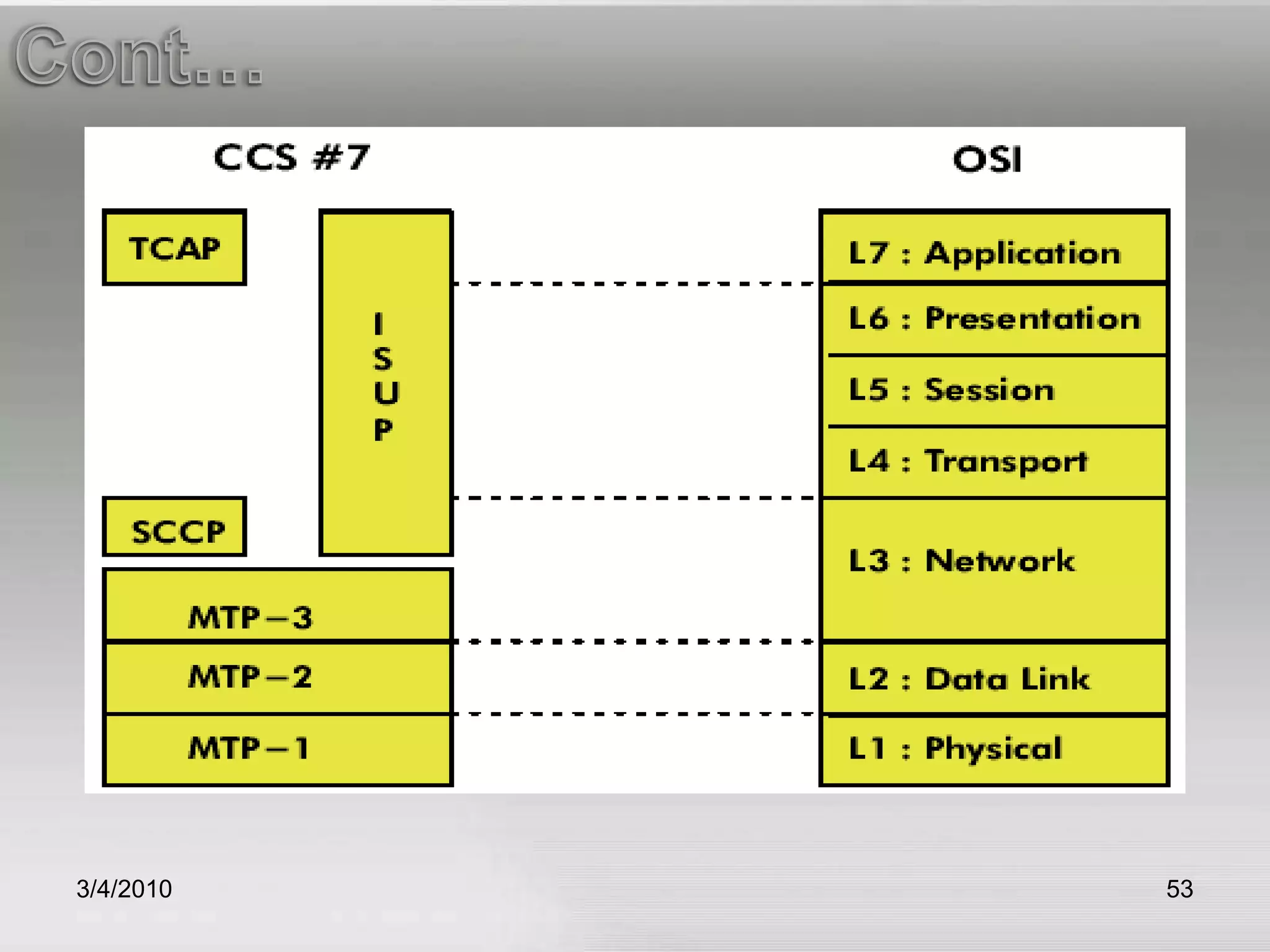
3/5/201052CCSS #7 AND OSI MODELThe OSI model accepted by the ITU-T in 1980 offers a structured approach to the problem of data Communication. Since CCS #7 is in fact nothing more than a particular kind of data communication system (used for the signaling purposes), a very similar structuring with respect to the OSI model can be found.  This similarity is very high for the MTP part, though it becomes more difficult and inexact for the higher layers.
3/5/201053Cont…
3/5/201054CCSS #7 LAYERS
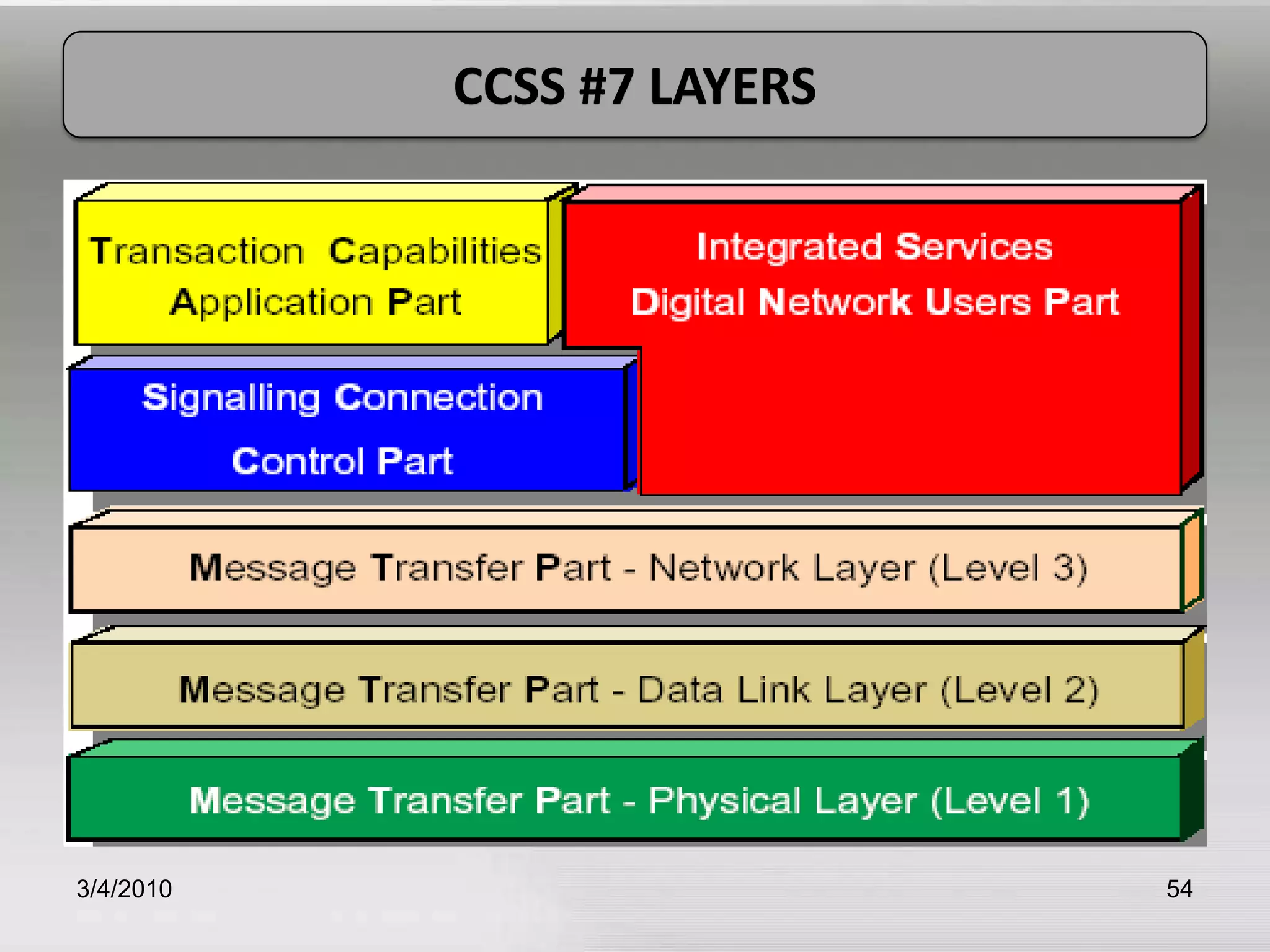
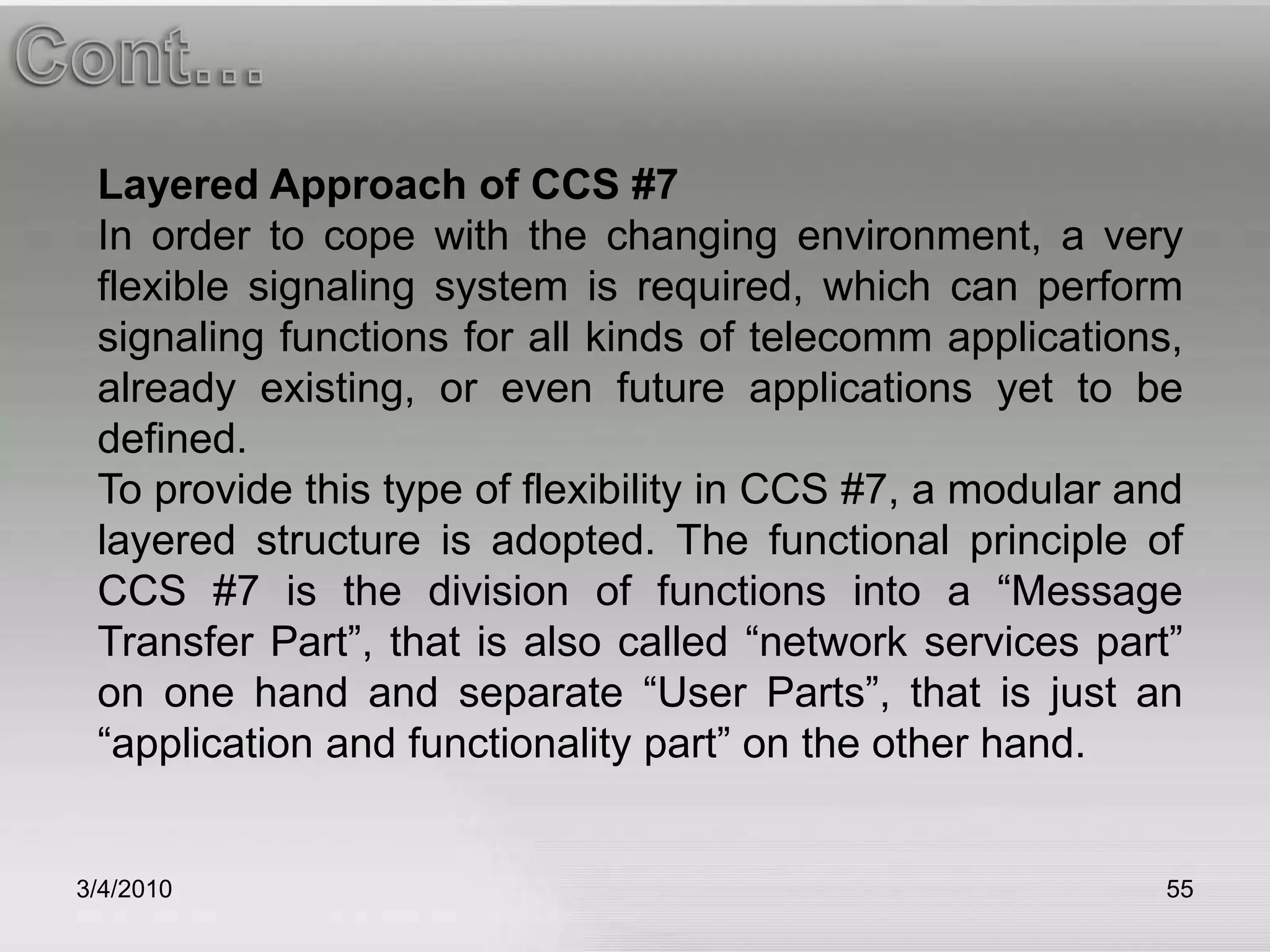
3/5/201055Cont…Layered Approach of CCS #7In order to cope with the changing environment, a very flexible signaling system is required, which can perform signaling functions for all kinds of telecomm applications, already existing, or even future applications yet to be defined. To provide this type of flexibility in CCS #7, a modular and layered structure is adopted. The functional principle of CCS #7 is the division of functions into a “Message Transfer Part”, that is also called “network services part” on one hand and separate “User Parts”, that is just an “application and functionality part” on the other hand.
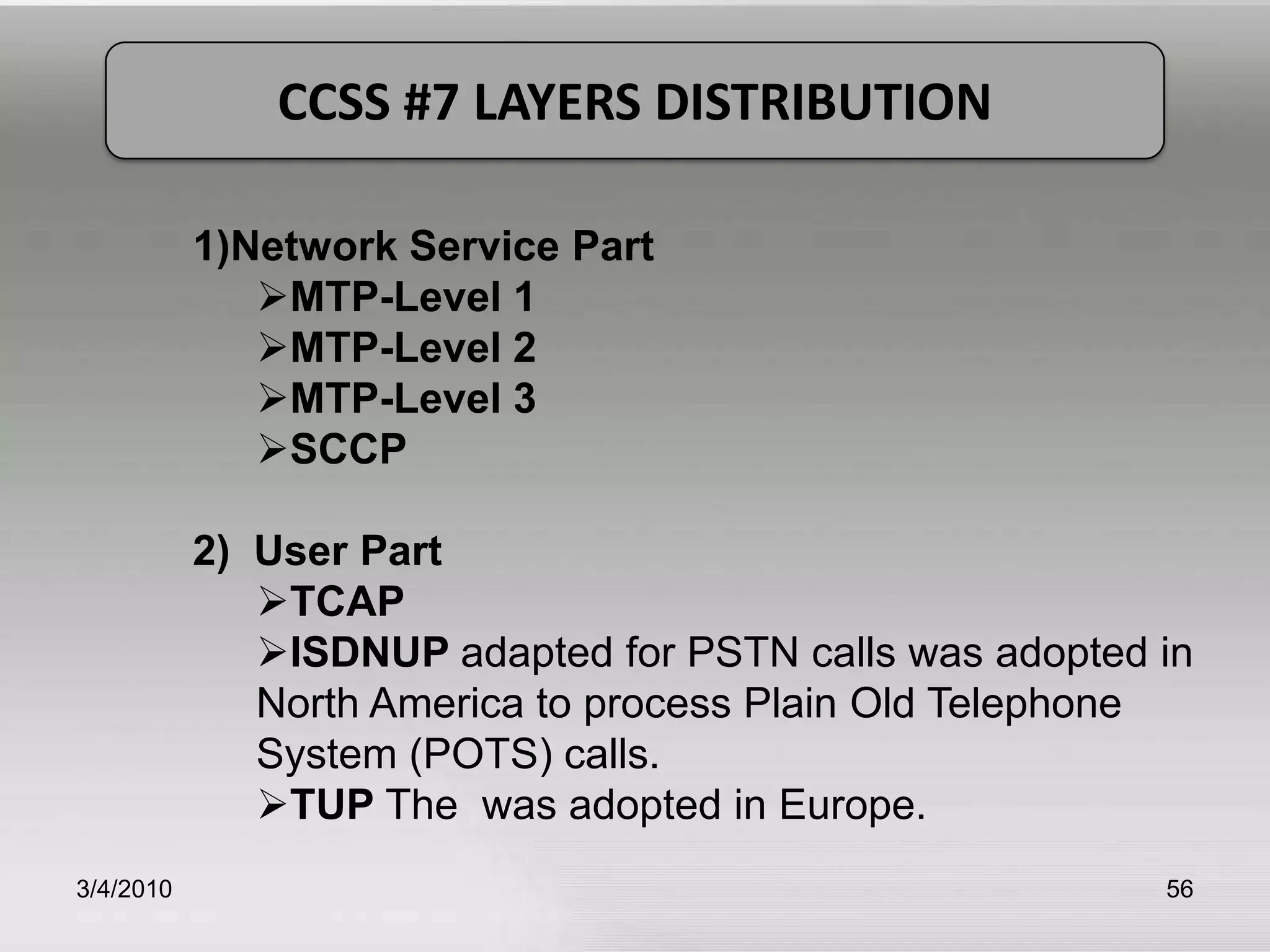
3/5/201056CCSS #7 LAYERS DISTRIBUTIONNetwork Service PartMTP-Level 1
MTP-Level 2
MTP-Level 3
SCCP2)  User PartTCAP
ISDNUP adapted for PSTN calls was adopted in North America to process Plain Old Telephone System (POTS) calls.
TUP The  was adopted in Europe.3/5/201057MTP-LEVEL 1 (PHYSICAL LAYER)MTP1 represents the physical layer. This is, the layer that is responsible for the connection of SS7 Signaling Points into the transmission network over which they communicate with each other. Primarily, this involves the conversion of messaging into electrical signal and the maintenance of the physical links through which these pass.That means it deals with physical issues at the level of links, interface cards, multiplexers etc.
3/5/201058Cont…A signaling data link has the following features:A mechanical interface: A connector providing physical 	access to the outside world.An electrical interface: the set of electrical signals required to send digital data.A functional interface:  a set of extra functions, supplementary to data transport itself.
3/5/2010MTP-LEVEL 2 (DATA LINK LAYER)This is a busy MTP part. It monitors the links and reports on their status. It checks messages to ensure their integrity (both incoming and outgoing). It discards bad messages and requests copies of discarded messages. It tests links before allowing their use. MTP2 provides error detection and sequence checking, and retransmits unacknowledged messages. MTP2 uses packets called signal units to transmit SS7 messages. While MTP-1 will transmit the messages from exchange to exchange. MTP-2 provides reliable transfer of signaling messages between 2 directly connected SP’s. it makes sure that the message is free of errors and that no information will lost during transmission. 59
3/5/201060Cont…FUNCTIONS OF MTP2:Signal Unit DelimitationThe beginning and the end of signal unit are  indicated by a 		unique 8 bit code, called as bit stuff.Signal Unit Alignment	loss of alignment occurs when a bit pattern disallowed by the 	delimitation.Signal Unit Error Detectionit is done by means of 16 check bits provided at the end of 	each of 	SU.Signal Unit Error Correction	There are two methods of error correction. The method 	used depends on whether the transmission is land based or 	satellite based.
3/5/201061Cont…Signal Unit Error MonitoringIt provides two types of monitoring the Alignment   	Error Rate Monitor (AERM) and Signal Unit Error 	Rate Monitor (SUERM).   	 	Flow ControlFlow control allows traffic to be throttled when level 	2 becomes congested. The congested receiving end 	notifies the remote transmitting end by an 	appropriate signal unit and it also withholds 	acknowledgement of all incoming signal units.  
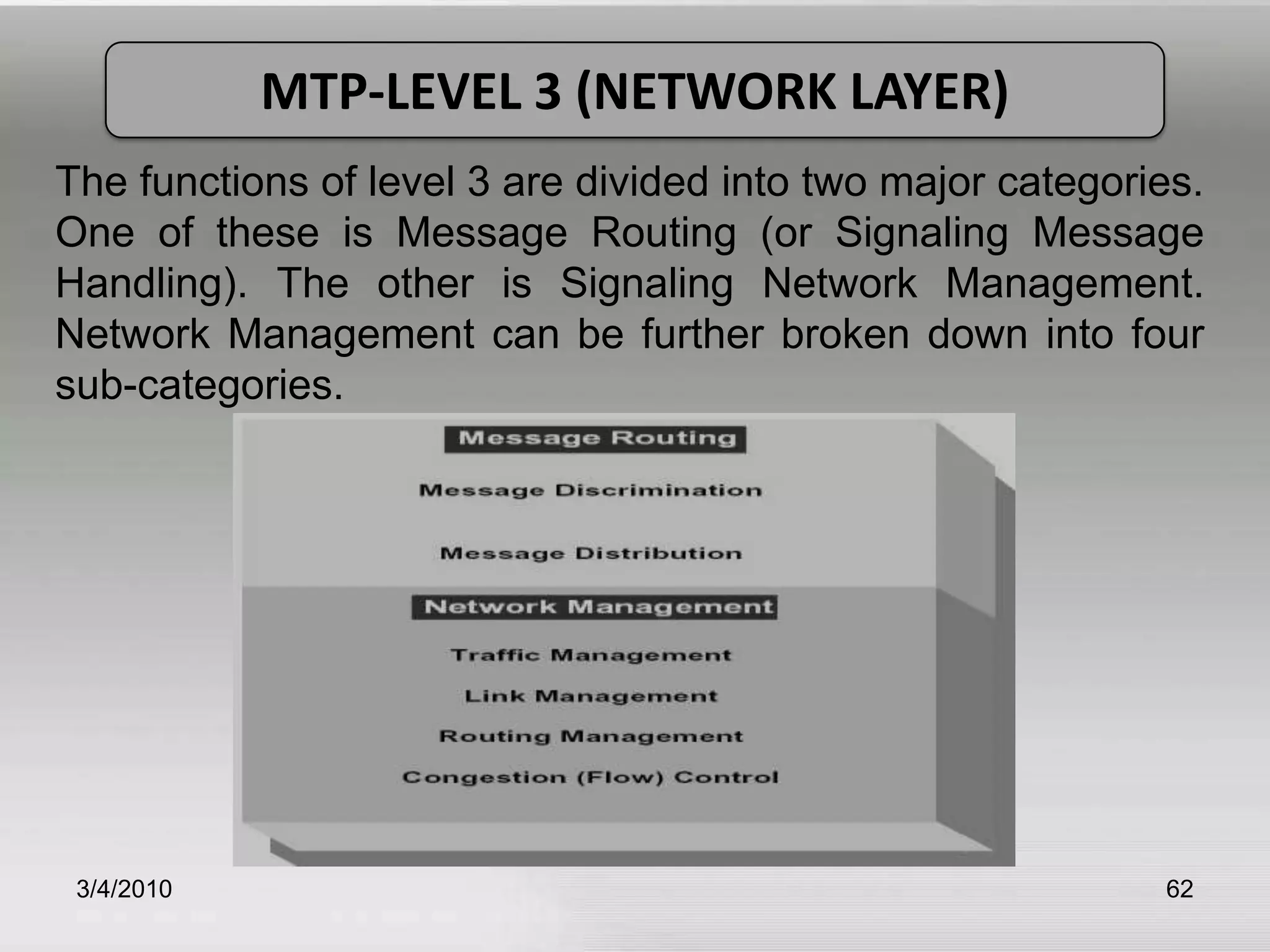
3/5/201062MTP-LEVEL 3 (NETWORK LAYER)The functions of level 3 are divided into two major categories. One of these is Message Routing (or Signaling Message Handling). The other is Signaling Network Management. Network Management can be further broken down into four sub-categories.
3/5/201063Cont…Signaling Message routing functions :These functions ensure that the signaling message originated by a particular User part are delivered to the same User part at the destination signaling point.Message Discrimination:  In this type of functionality, it answers the question “Is this message is intended for this SP?” if yes then go for distribution.Message Distribution:In this type of functionality, it answers the question “For which user part is it intended?”.All messages handed off to level 3 (by either a higher or lower level) are either en route to the application via level 4 user parts (SCCP, ISDNUP, TUP, etc.) or they are en route to the adjacent node via level 2 and the SS7 signalling links.
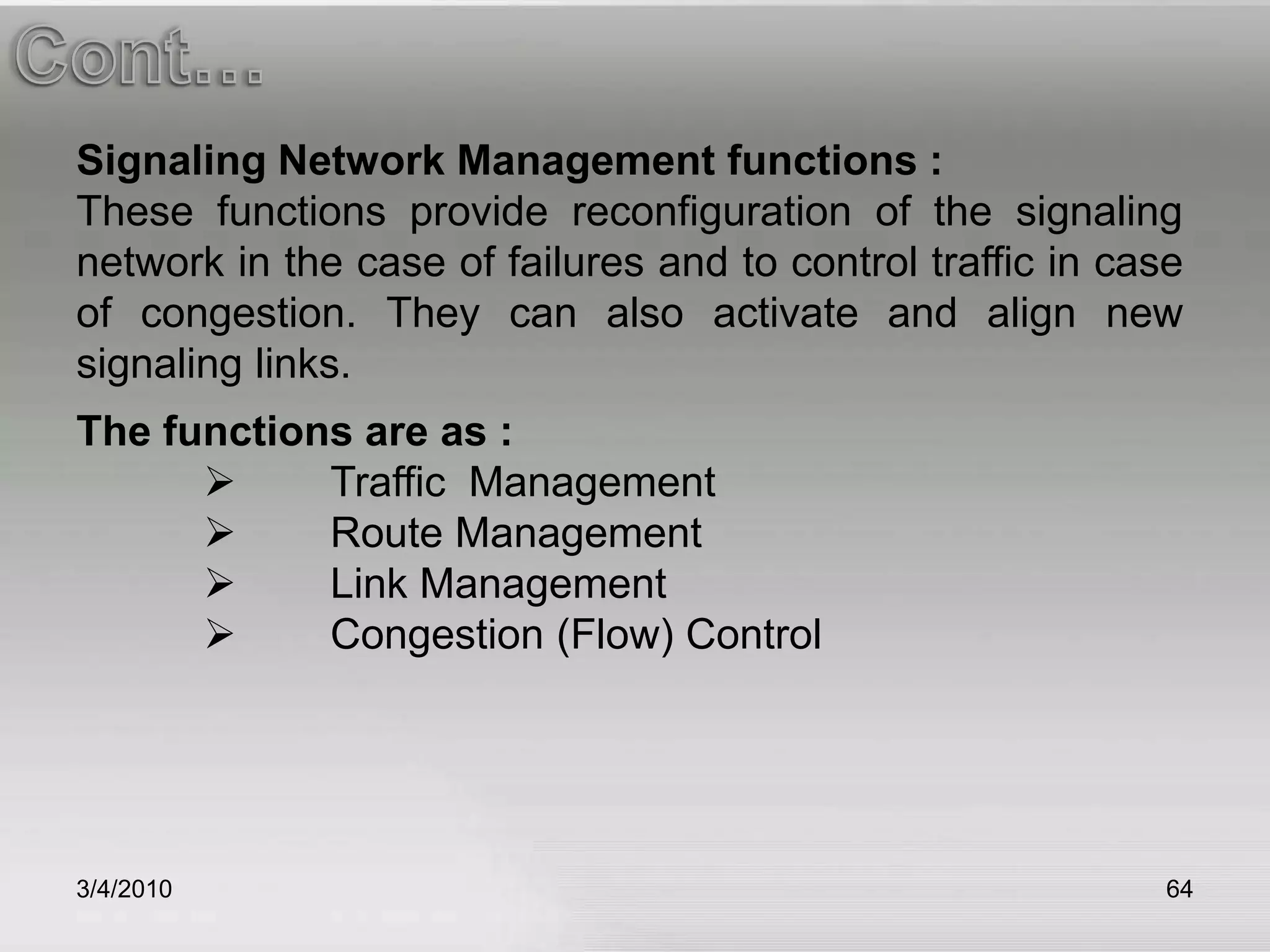
3/5/201064Cont…Signaling Network Management functions :These functions provide reconfiguration of the signaling network in the case of failures and to control traffic in case of congestion. They can also activate and align new signaling links.The functions are as : 	Traffic  Management
 	Route Management
 	Link Management
 	Congestion (Flow) Control3/5/201065THE SCCPThe Signaling Connection Control POINT (SCCP) is a network layer protocol that provides extended routing, flow control, segmentation, connection oriented, and error correction facilities in SS7 telecommunications networks. SCCP relies on the services of MTP for basic routing and error detection. The standards were written for the SCCP to support both connection oriented and connectionless services. The term “connection oriented” refers to a “virtual” connection rather than a physical one. Now we can concentrate on the actual uses of SCCP. The services  offered by the SCCP are shown as :SCCP Service TypesConnectionless
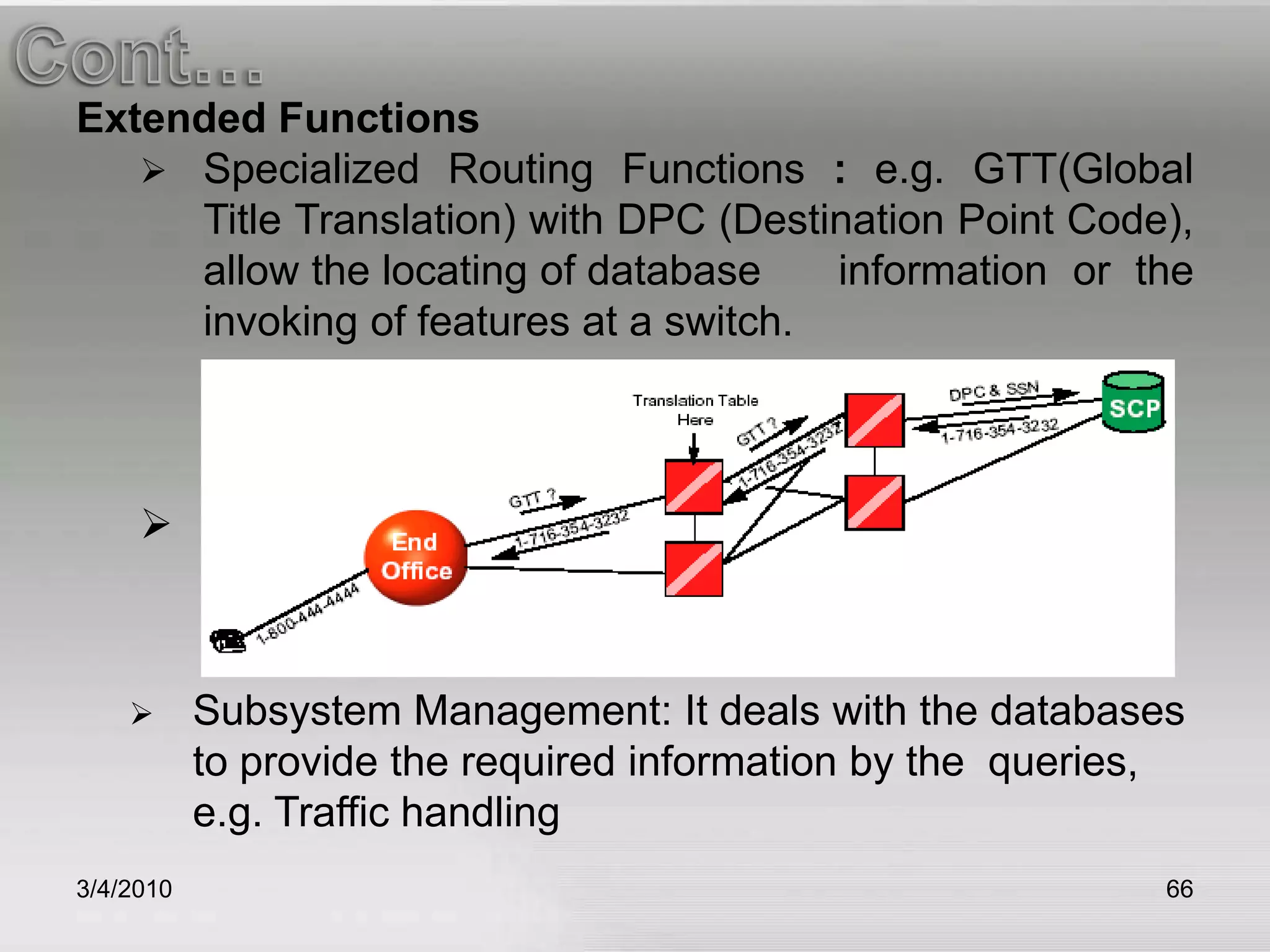
 	Connection Oriented3/5/201066Cont…Extended FunctionsSpecialized Routing Functions : e.g. GTT(Global 	Title Translation) with DPC (Destination Point Code), 	allow the locating of database 	information or the 	invoking of features at a switch.

SS7 Network Technology

  • 1.
    COMMON CHANNEL SIGNALINGSYSTEM #73/5/20101
  • 2.
    3/5/20102Presented ByMOHD AZAMMCA,BCAEmail- mohd.azam.se@gmail.com
  • 3.
    WIRELESS NETWORK ARCHITECTUREPUBLICSWITCHED TELEPHONE NETWORK ARCHITECTUREA CLOSE LOOK OF CCSS#73/5/20103
  • 4.
    A LOOK OFCOMLETE TELECOMM NETWORK ARCHITECTURECCSS#7 NETWORK ARCHITECTURELAYERED APPROACH OF CCSS#73/5/20104
  • 5.
  • 6.
    3/5/20106Some Basic Conceptsto Understand the Common Channel Signaling System
  • 7.
    3/5/20107SIGNALINGSignaling has alwaysplayed a very important role in the field of communication, since it provide the means for the information interchange between two or more nodes within a network.The way of performing signaling has evolved together with the evolution of the transmission equipment and of the used switching systems. Both of them were originally analog evolved into digital and now it is optical. The term signaling, when used in telephony, refers to the exchange of control information associated with the establishment of a telephone call on a telecommunications circuit.
  • 8.
    3/5/20108CLASSIFICATION OF SIGNALINGFunctionalClassificationTopological ClassificationUNI Signaling SystemLine Signaling NNI Signaling SystemRegister Signaling
  • 9.
    3/5/20109TOPOLOGICAL CLASSIFICATIONUNI (Userto Network Interface) Signaling SystemSwitching communication between the calling subscriber and his own switching unit.NNI Signaling SystemA communication will also be required between each switching unit and the next one in the call sequence. This is the Network to Network Interface (NNI). Channel Associated Signaling System (CAS).
  • 10.
    Common Channel Signaling System #7 (CCS #7).3/5/201010FUNCTIONAL CLASSIFICATION At least two types of information will always have to be “signaled” between adjacent points:Line Signaling = The intention to seize or to release a local line (in case of UNI signaling) or a trunk circuit (in case of NNI signaling).Register Signaling = The call destination (under the form of dialed digits) will have to be passed from the register of the previous step to the register of the next exchange.
  • 11.
    3/5/201011IN-BAND AND OUT-BANDSIGNALINGIN-BAND: In this signaling the control information and user information are send on a single line.OUT-BAND: In this signaling the control information and user information are send separately into logically or physically separate paths.
  • 12.
    3/5/201012SIGNALING MODESThe term“Signaling mode” refers to the association existing between the path taken a signaling message.Associative Mode In this mode, signaling points are directly connected by means of signaling links. In other words , direct link interconnecting the two points.  Non-Associative ModeIn this mode, two signaling points do not have to be directly connected by a signaling link. The signaling information can be sent via multiple STP’s (signaling transfer point). Since message can be routed indirectly, multiple paths become available between two signaling points.
  • 13.
    3/5/201013Cont…Cont…Quasi Associative ModeItis a limited case of the Non-Associative mode where the path taken by the message through the CCS #7 networks is the same for each message, pertaining to the same call. In this way a correctly sequenced delivery of all the information is guaranteed.Because of these two reasons, CCS #7 is specified for use in the Associated and in the Quasi-Associated modes only.
  • 14.
    3/5/201014What is theCommon Channel Signaling System #7 (CCSS #7)?CCS #7 is an advanced, digital signaling and control system, that is a set of telephony signaling protocols which are used to set up most of the world's telephone calls. With a high performance packet based communication protocols. standardized byITU-TS (International telecommunication Union and Telecommunication standardization) in the 1980’s.
  • 15.
    3/5/201015What about thenaming, Common Channel Signaling System #7 (CCSS #7)?It is usually abbreviated to SS#7 and also SS7, though in North America it is often referred to as CCSS#7, an acronym for "Common Channel Signaling System #7". In some European countries, specifically the United Kingdom, it is sometimes called C7 (CCITT number 7) and is also known as number 7 and CCIS7. (ITU-T was formally known as CCITT).
  • 16.
    3/5/201016What are thefeatures of Common Channel Signaling System #7 (CCSS #7)? It is totally Out-Band. It is message oriented. It support the common channel. It is easy to understand and implement because of it’s layered approach. It is also very futuristic because any new feature or services can be added very easily.
  • 17.
    3/5/201017HISTORY OF CCSS#7Commonchannel signaling protocols have been developed by AT&T, BT and the ITU-T since 1975 and the first international Common Channel Signaling protocol was defined by the ITU-T as Signaling System #6 in 1977. Signaling System #7 was defined as an international standard by ITU-T in its 1980. SS5 and earlier used In-Band signaling, where the call-setup information was sent by playing special multi-frequency tones into the telephone lines. This led to security problems.SS6 and SS7 moved to a system in which the signaling information was out-band, carried in a separate signaling channel. This avoided the security problems.
  • 18.
    3/5/201018COMING OF STANDARDItwas necessary to provide telecommunications standards that would create the compatibility necessary to provide end-to-end communications between international networks without regard to the nation of origin.CCITT (Consultative Committee on International Telephone and Telegraph)The task of establishing standards was undertaken by the International Telecommunications Union, which is a United Nations Treaty organization. The IT assembled a group known as the CCITT the result of their deliberations was Common Channel Interoffice Signaling System #6, first introduced in the 60s. Were there five previous versions? Of course. But only CCSS 6 survived to deployment.
  • 19.
    3/5/201019Cont…Recently, the CCITTgroup name has been changed to the Telecommunication Standardization Sector (TS) and groups responsible for radio communications (RS) have been added. The use of the term CCITT is rapidly being replaced by ITU-TS.There is only one international SS7 protocol defined by ITU-T. There are however, many national variants of the SS7 protocols. Most national variants are based on two widely deployed national variants as standardized by ANSI and ETSI, which are in turn based on the international protocol defined by ITU-T. Each national variant has its own unique characteristics. Some national variants with rather striking characteristics are the China (PRC) and Japan (TTC) national variants.
  • 20.
    3/5/201020OBJECTIVES AND APPLICATIONSSS7,being a high-speed and high-performance packet-based communications protocol, can communicate significant amounts of information when setting up a call, during the call, and at the end of the call. This permits rich call-related services to be developed.Some of the first such services were call management related services that we take for granted today: Call forwarding (busy and no answer), voice mail, call waiting, conference calling,
  • 21.
    3/5/201021Cont… called name andnumber display, call screening, malicious caller identification, busy callback, etc. calling name and number display,
  • 22.
    3/5/201022ADVANTAGESThat is optimizedfor operational in digital telecommunications networks with stored programmed controlled exchanges.CCS #7 is optimized for operation over 64 kb digital channels.It is also suitable for operation over analog channels and at lower speeds.It is suitable for point to point terrestrial on satellite links. That can meet the present and future requirements for call control, remote control, and management and maintenance signaling.Maintenance of small local exchange can be carried out remotely from a network service center.
  • 23.
    3/5/201023Wireless Network ArchitecturePSTNNetwork ArchitectureTOPICS WILL BE COVERED
  • 24.
    3/5/201024PSTN ARCHITECTURE ANDCONTEXTThe public switched telephone network (PSTN) is the network of the world's public circuit switched telephone networks, in much the same way that the Internet is the network of the world's public IP-based packet-switched networks. Originally a network of fixed-line analog telephone systems, the PSTN is now almost entirely digital, and now includes mobiles as well as fixed telephones.The PSTN is largely governed by technical standards created by the ITU-T, and uses E.163/E.164 addresses (more commonly known as telephone numbers) for addressing
  • 25.
    3/5/201025COMPONENTS OF THEPSTNEND OFFICESA switch capable of making connections for the transmission lines that enter the building. For a local office most of these will be the lines that go to homes and offices and end at a telephone or, perhaps, at an office switchboard is called as a Local Exchange Office or simply known as End Offices.
  • 26.
    3/5/201026Cont…LOCAL ACCESS TANDEMA switch whose main purpose would be the interconnection of many local offices. The local switch, then, would not need a transmission line to every other local office. Instead, transmission lines going directly to the intermediate Switch would be sufficient.
  • 27.
    3/5/201027Cont…INTER EXCHANGE CARRIERTakingour example one step further, the Tandem offices can be connected to another switch whose job is to connect switches. In this case the new switch would likely be a switch for long distance communication. Under previous FCC rules, this switch would be owned and maintained (or leased) by a long distance carrier or Interexchange Carrier (IXC).
  • 28.
  • 29.
  • 30.
    3/5/201030WIRELESS NETWORK ARCHITECTUREAND CONTEXTThe truth is that the wireless network is truly “wireless” in only a small portion of its architecture. A mobile telephone transmits and receives to and from a transmitter/receiver. The transmitter/receiver is the first and last place in the network where the communications are wireless. The voice received from the mobile telephone must be connected into the PSTN. The voice received from the PSTN must end up connected to the transmitter for transmission to the telephone.
  • 31.
    3/5/201031Cont…The wireless companyneeds a switch to connect a call originating or terminating at their customer in the same way that the landline phone company needs an end office switch. An easy way to illustrate this is to show it side by side with an earlier drawing we used to illustrate the End Office part of the PSTN.
  • 32.
    3/5/201032COMPONENTS OF THEWIRELESS NETWORKMOBILE SWITCHING CENTRE (MSC)The MSC needs “one foot” in the PSTN (Public Switched Telephone Network) and “one foot” in the SS7 (Signaling System #7) network. Landline connections must be made to connect the callers. Information pertaining to the call must be sent to the PSTN switches using the services of the SS7. The MSC then has requirements that PSTN switches do not have. Among these is the need to keep track of its subscribers. When the subscriber is within the range of any of the MSC’s transmitter/ receivers, the MSC receives an indication of the signal strength of the subscriber’s telephone at the location of the antennas.
  • 33.
  • 34.
    3/5/201034Cont…The MSC connectsthe antennae receiving the strongest signal. If the subscriber is “on the move” during the conversation, the signal will gradually weaken at one antennae while strengthening at another. The MSC is smart enough to know that transient conditions (such as passing under a Bridge) will have an effect on this balance.
  • 35.
    3/5/201035CCSS#7 NETWORK ARCHITECTURECOMPLETENETWORKTOPICS WILL BE COVERED
  • 36.
    3/5/201036CCSS #7 NETWORKCCSS#7clearly splits the signaling planes and voice circuits. An SS7 network has to be made up of SS7-capable equipment from end to end in order to provide its full functionality. The network is made up of several link types (A, B, C, D, E, and F) and three signaling nodes – Service Switching point (SSPs), Singling Transfer Point (STPs), and Service Control Point (SCPs). Each node is identified on the network by a number, a point code. Extended services are provided by a database interface at the SCP level using the SS7 network.
  • 37.
    3/5/201037COMPONENTS OF THESS7 NETWORKSTP (Signal Transfer Point)The “knots” that hold the network together. These nodes serve to provide network access to other nodes (by connection with Access Links). STPs transfer messages around the network. STPs maintain routing tables for the purposes of directing messages to their intended destinations.
  • 38.
    3/5/201038Cont…SSP (Service SwitchingPoint)The Service Switching Point is a switch associated node which handles call set-up and has the ability to stop call processing, make queries of even unknown databases, and perform actions appropriate to the response. In general, the SS7 messages which originate or terminate here are either circuit or call routing related.
  • 39.
    3/5/201039Cont…SCP (Service ControlPoint)In general, Service Control Points provide access to databases. These nodes are the residences of processes which can access the database, extract the required data and return it to the node requesting the data. The database(s) to which the SCP has access may or may not reside at the same location as the SCP. The same capabilities that allow the SCP to access databases lend themselves to other uses such as providing access to an IP.
  • 40.
    3/5/201040Cont…IP (Intelligent Peripheral)TheIP is the residence of processes which manage resources such as signaling sensors and voice response equipment. The resource management capabilities become available to switches on demand, thereby freeing switch locations from the need to equip with a myriad of such devices, and providing highly efficient use of both aging and up-to-date technologies.
  • 41.
    3/5/201041Cont…CRP (Customer RoutingPoint)The CRP provides on-premises control of the routing information requested by switches for translation of 800 type dialing (not limited to 800 numbers). The operator of the CRP is a customer who requires rapid update and control of the translation of their own numbers.
  • 42.
    3/5/201042Cont…HLR/VLR (Home LocationRegister/Visitor Location Register)A database that contains customer information about local subscribers is maintained by each provider. This is the Home Location Register. Another company will access this information when a “roamer” appears, and use the data for an entry into its Visitor Location Register.
  • 43.
    3/5/201043Cont…Network links  Linksare simply the connections to establish the whole Network. The different types of links are as follows: Access LinksLink a node (Signaling Point) to a local STP pair.  Bridge Links Link two pairs at the same level (local/local, regional/regional). 
  • 44.
    3/5/201044Cont…Cross Links Link two STPs together to form an STP pair. Diagonal Links Link a local STP pair to a higher level STP pair. Extended Links Link a node (Signaling Point) to a remote STP pair. Fully Associated Links Link two associated nodes together
  • 45.
  • 46.
  • 47.
  • 48.
  • 49.
    A COMPLETE TELECOMMUNICATIONNETWORK ARCHITECTURE3/5/201049
  • 50.
  • 51.
  • 52.
    3/5/201052CCSS #7 ANDOSI MODELThe OSI model accepted by the ITU-T in 1980 offers a structured approach to the problem of data Communication. Since CCS #7 is in fact nothing more than a particular kind of data communication system (used for the signaling purposes), a very similar structuring with respect to the OSI model can be found. This similarity is very high for the MTP part, though it becomes more difficult and inexact for the higher layers.
  • 53.
  • 54.
  • 55.
    3/5/201055Cont…Layered Approach ofCCS #7In order to cope with the changing environment, a very flexible signaling system is required, which can perform signaling functions for all kinds of telecomm applications, already existing, or even future applications yet to be defined. To provide this type of flexibility in CCS #7, a modular and layered structure is adopted. The functional principle of CCS #7 is the division of functions into a “Message Transfer Part”, that is also called “network services part” on one hand and separate “User Parts”, that is just an “application and functionality part” on the other hand.
  • 56.
    3/5/201056CCSS #7 LAYERSDISTRIBUTIONNetwork Service PartMTP-Level 1
  • 57.
  • 58.
  • 59.
    SCCP2) UserPartTCAP
  • 60.
    ISDNUP adapted forPSTN calls was adopted in North America to process Plain Old Telephone System (POTS) calls.
  • 61.
    TUP The was adopted in Europe.3/5/201057MTP-LEVEL 1 (PHYSICAL LAYER)MTP1 represents the physical layer. This is, the layer that is responsible for the connection of SS7 Signaling Points into the transmission network over which they communicate with each other. Primarily, this involves the conversion of messaging into electrical signal and the maintenance of the physical links through which these pass.That means it deals with physical issues at the level of links, interface cards, multiplexers etc.
  • 62.
    3/5/201058Cont…A signaling datalink has the following features:A mechanical interface: A connector providing physical access to the outside world.An electrical interface: the set of electrical signals required to send digital data.A functional interface: a set of extra functions, supplementary to data transport itself.
  • 63.
    3/5/2010MTP-LEVEL 2 (DATALINK LAYER)This is a busy MTP part. It monitors the links and reports on their status. It checks messages to ensure their integrity (both incoming and outgoing). It discards bad messages and requests copies of discarded messages. It tests links before allowing their use. MTP2 provides error detection and sequence checking, and retransmits unacknowledged messages. MTP2 uses packets called signal units to transmit SS7 messages. While MTP-1 will transmit the messages from exchange to exchange. MTP-2 provides reliable transfer of signaling messages between 2 directly connected SP’s. it makes sure that the message is free of errors and that no information will lost during transmission. 59
  • 64.
    3/5/201060Cont…FUNCTIONS OF MTP2:SignalUnit DelimitationThe beginning and the end of signal unit are indicated by a unique 8 bit code, called as bit stuff.Signal Unit Alignment loss of alignment occurs when a bit pattern disallowed by the delimitation.Signal Unit Error Detectionit is done by means of 16 check bits provided at the end of each of SU.Signal Unit Error Correction There are two methods of error correction. The method used depends on whether the transmission is land based or satellite based.
  • 65.
    3/5/201061Cont…Signal Unit ErrorMonitoringIt provides two types of monitoring the Alignment Error Rate Monitor (AERM) and Signal Unit Error Rate Monitor (SUERM).   Flow ControlFlow control allows traffic to be throttled when level 2 becomes congested. The congested receiving end notifies the remote transmitting end by an appropriate signal unit and it also withholds acknowledgement of all incoming signal units.  
  • 66.
    3/5/201062MTP-LEVEL 3 (NETWORKLAYER)The functions of level 3 are divided into two major categories. One of these is Message Routing (or Signaling Message Handling). The other is Signaling Network Management. Network Management can be further broken down into four sub-categories.
  • 67.
    3/5/201063Cont…Signaling Message routingfunctions :These functions ensure that the signaling message originated by a particular User part are delivered to the same User part at the destination signaling point.Message Discrimination: In this type of functionality, it answers the question “Is this message is intended for this SP?” if yes then go for distribution.Message Distribution:In this type of functionality, it answers the question “For which user part is it intended?”.All messages handed off to level 3 (by either a higher or lower level) are either en route to the application via level 4 user parts (SCCP, ISDNUP, TUP, etc.) or they are en route to the adjacent node via level 2 and the SS7 signalling links.
  • 68.
    3/5/201064Cont…Signaling Network Managementfunctions :These functions provide reconfiguration of the signaling network in the case of failures and to control traffic in case of congestion. They can also activate and align new signaling links.The functions are as : Traffic Management
  • 69.
  • 70.
  • 71.
    Congestion (Flow)Control3/5/201065THE SCCPThe Signaling Connection Control POINT (SCCP) is a network layer protocol that provides extended routing, flow control, segmentation, connection oriented, and error correction facilities in SS7 telecommunications networks. SCCP relies on the services of MTP for basic routing and error detection. The standards were written for the SCCP to support both connection oriented and connectionless services. The term “connection oriented” refers to a “virtual” connection rather than a physical one. Now we can concentrate on the actual uses of SCCP. The services offered by the SCCP are shown as :SCCP Service TypesConnectionless
  • 72.
    Connection Oriented3/5/201066Cont…ExtendedFunctionsSpecialized Routing Functions : e.g. GTT(Global Title Translation) with DPC (Destination Point Code), allow the locating of database information or the invoking of features at a switch.
  • 73.
    Subsystem Management: Itdeals with the databases to provide the required information by the queries, e.g. Traffic handling3/5/201067THE TCAPThe Transaction Capabilities Application Part offers its services to user designed applications as well as to OMAP (Operations, Maintenance and Administration Part). TCAP is used largely by switching locations to obtain data from databases (SSP from 800 Db, MSC from HLR, etc.), or to Invoke features at another switch (like Automatic Callback or Automatic Recall). It also provide the supports for roaming conditions using HLR(HomeLocation Register) and VLR(VisitorLocation Register).Remember that TCAP uses the services of the SCCP which in turn uses the services of the MTP.
  • 74.
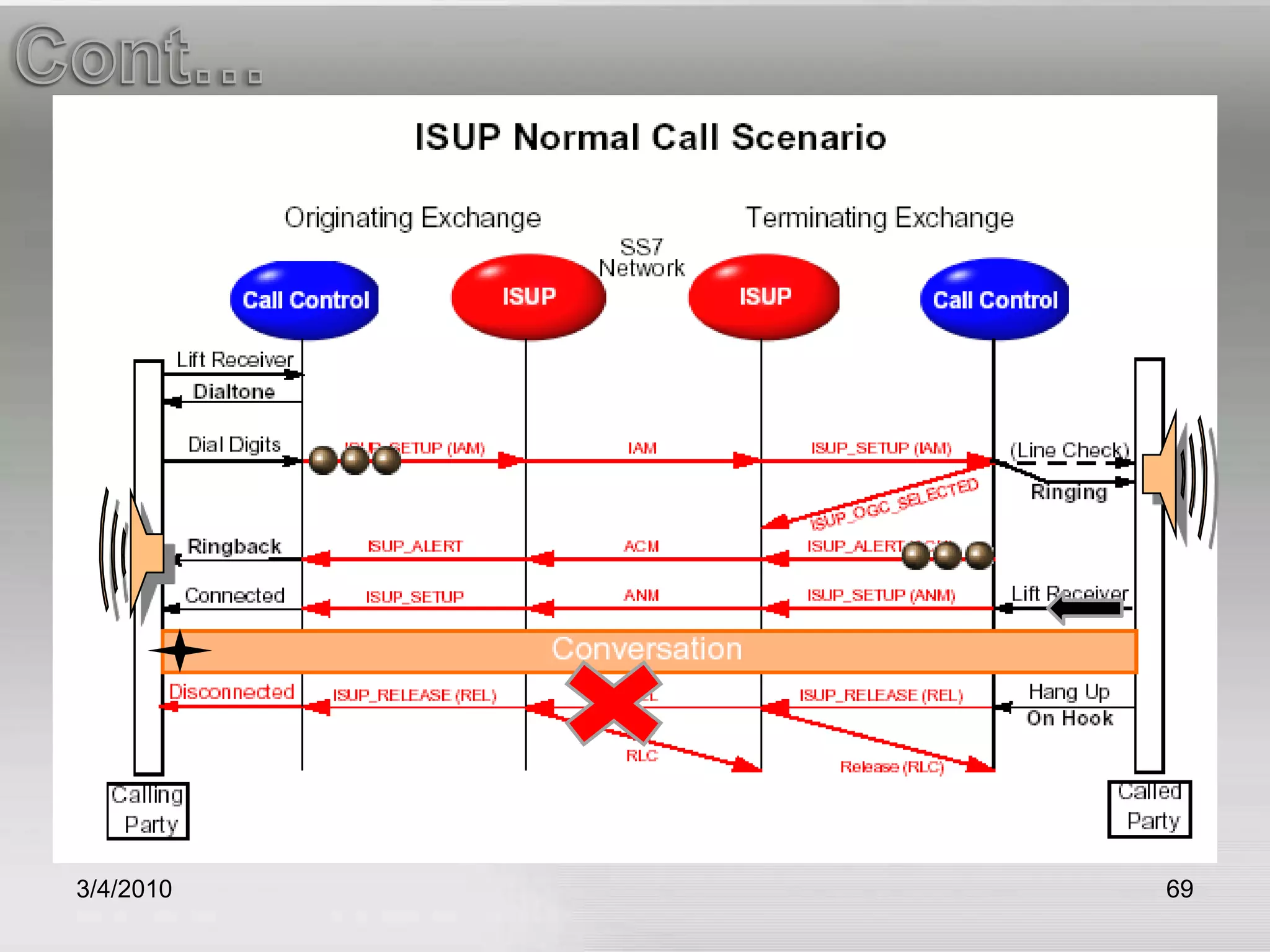
    3/5/201068ISDN USER PART(ISUP)ISUP is used throughout the PSTN to provide the messaging necessary for the setup and teardown of all circuits, both voice and digital. Wireless networks also make use of ISUP to establish the necessary switch connections into the PSTN. ISUP messages are sent from each switch to the switch where the next circuit connection is required.ISUP offers two types of services, known as Basic and Supplementary. Basic Services consist of those services employed in the process of setting up and tearing down a call. Supplementary Services consist of those services employed in passing all messages that may be necessary to maintain and/or modify the call.
  • 75.
  • 76.
    3/5/201070TELEPHONE USER PART(TUP)It is a part formerly employed largely in Europe to help implement switch connections. It is called the Telephone Users Part (TUP), and it has been used in Europe in ways resembling the use of the Integrated Services Digital Network in the U.S. Nevertheless, the use of ISDNUP (or at least the circuit control functionalities commonly called ISUP) is replacing TUP worldwide. Some holdouts (such as China) still use TUP. The Telephone User Part supports the setup and release of telephone calls.
  • 77.
  • 78.
    Simply SS7.ReferencesDryburgh, Lee;Jeff Hewitt (2004). Signaling System No. 7 (SS7/C7): Protocol, Architecture, and Services. Indianapolis: Cisco Press.
  • 79.
    Ronayne, John P.(1986). "The Digital Network", Introduction to Digital Communications Switching
  • 80.
    Russell, Travis (2002).Signaling System #7, 4th Edition, New York: McGraw-Hill.Linkwww.protocol.com
  • 81.