OVERVIEW OF
TELECOMMUNICATION NETWORKS
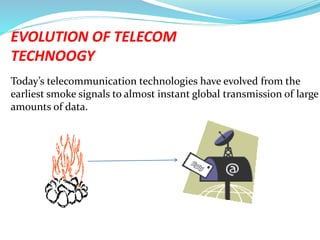
Today’s telecommunication technologies have evolved from the
earliest smoke signals to almost instant global transmission of large
amounts of data.
EVOLUTION OF TELECOM
TECHNOOGY
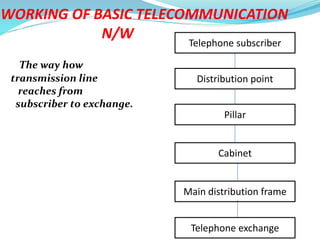
Telephone subscriber
Distribution point
Pillar
Cabinet
Main distribution frame
Telephone exchange
The way how
transmission line
reaches from
subscriber to exchange.
WORKING OF BASIC TELECOMMUNICATION
N/W
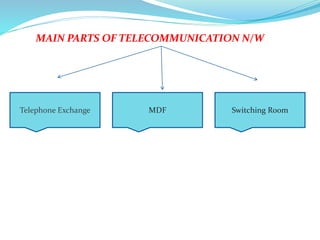
MAIN PARTS OF TELECOMMUNICATION N/W
Telephone Exchange Switching RoomMDF
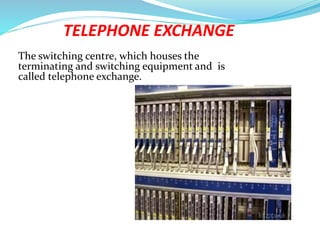
TELEPHONE EXCHANGE
The switching centre, which houses the
terminating and switching equipment and is
called telephone exchange.
EVOLUTION OF TELEPHONE EXCHANGES
Manual
exchange
Automatic
exchange
Electronic
exchange
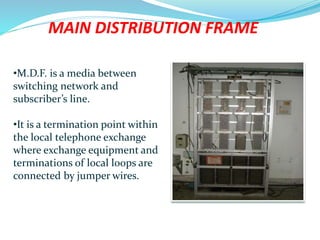
MAIN DISTRIBUTION FRAME
•M.D.F. is a media between
switching network and
subscriber’s line.
•It is a termination point within
the local telephone exchange
where exchange equipment and
terminations of local loops are
connected by jumper wires.
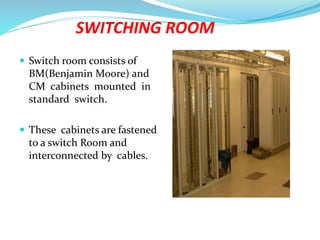
SWITCHING ROOM
 Switch room consists of
BM(Benjamin Moore) and
CM cabinets mounted in
standard switch.
 These cabinets are fastened
to a switch Room and
interconnected by cables.
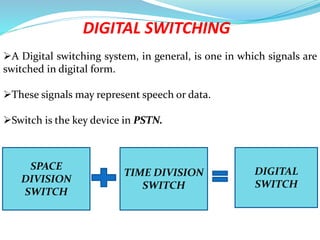
DIGITAL SWITCHING
A Digital switching system, in general, is one in which signals are
switched in digital form.
These signals may represent speech or data.
Switch is the key device in PSTN.
SPACE
DIVISION
SWITCH
TIME DIVISION
SWITCH
DIGITAL
SWITCH
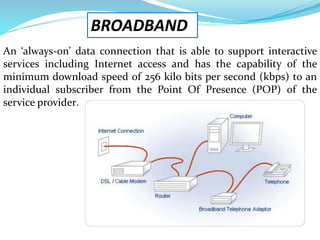
BROADBAND
An ‘always-on’ data connection that is able to support interactive
services including Internet access and has the capability of the
minimum download speed of 256 kilo bits per second (kbps) to an
individual subscriber from the Point Of Presence (POP) of the
service provider.
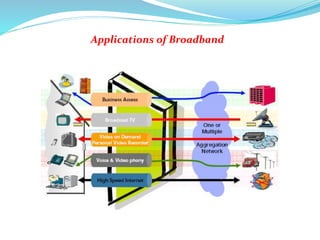
Applications of Broadband
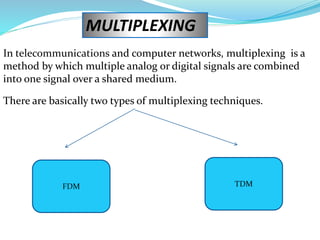
MULTIPLEXING
There are basically two types of multiplexing techniques.
In telecommunications and computer networks, multiplexing is a
method by which multiple analog or digital signals are combined
into one signal over a shared medium.
FDM TDM
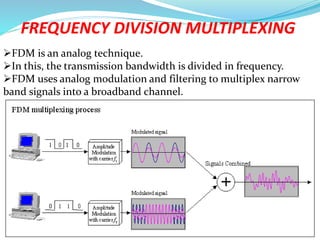
FREQUENCY DIVISION MULTIPLEXING
FDM is an analog technique.
In this, the transmission bandwidth is divided in frequency.
FDM uses analog modulation and filtering to multiplex narrow
band signals into a broadband channel.
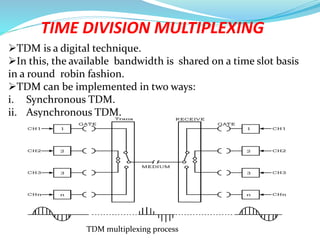
TIME DIVISION MULTIPLEXING
TDM is a digital technique.
In this, the available bandwidth is shared on a time slot basis
in a round robin fashion.
TDM can be implemented in two ways:
i. Synchronous TDM.
ii. Asynchronous TDM.
TDM multiplexing process
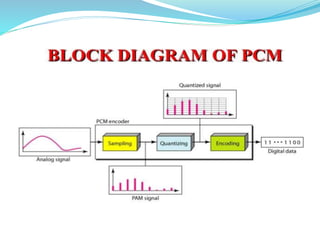
CONCEPTS OF PCM
A pulse modulation technique in which the amplitude of an
analogue signal is converted to a binary value represented as a
series of pulses
To develop a PCM signal from several analogue signals, the
following processing steps are required .
i. Filtering
ii. Sampling
iii. Quantization
iv. Encoding
v. Line Coding
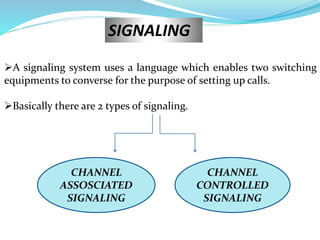
SIGNALING
A signaling system uses a language which enables two switching
equipments to converse for the purpose of setting up calls.
Basically there are 2 types of signaling.
CHANNEL
ASSOSCIATED
SIGNALING
CHANNEL
CONTROLLED
SIGNALING
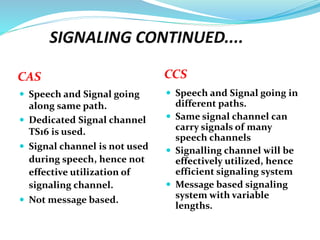
SIGNALING CONTINUED....
CAS CCS
 Speech and Signal going
along same path.
 Dedicated Signal channel
TS16 is used.
 Signal channel is not used
during speech, hence not
effective utilization of
signaling channel.
 Not message based.
 Speech and Signal going in
different paths.
 Same signal channel can
carry signals of many
speech channels
 Signalling channel will be
effectively utilized, hence
efficient signaling system
 Message based signaling
system with variable
lengths.
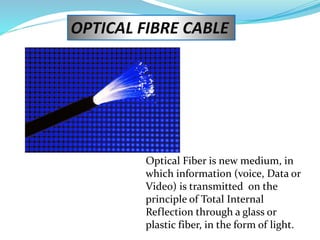
OPTICAL FIBRE CABLE
Optical Fiber is new medium, in
which information (voice, Data or
Video) is transmitted on the
principle of Total Internal
Reflection through a glass or
plastic fiber, in the form of light.
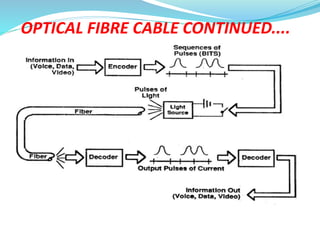
OPTICAL FIBRE CABLE CONTINUED....
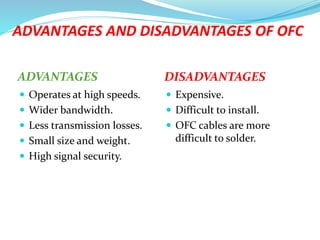
ADVANTAGES AND DISADVANTAGES OF OFC
ADVANTAGES DISADVANTAGES
 Operates at high speeds.
 Wider bandwidth.
 Less transmission losses.
 Small size and weight.
 High signal security.
 Expensive.
 Difficult to install.
 OFC cables are more
difficult to solder.
Overview of telecom networks

Overview of telecom networks

  • 1.
  • 2.
    Today’s telecommunication technologieshave evolved from the earliest smoke signals to almost instant global transmission of large amounts of data. EVOLUTION OF TELECOM TECHNOOGY
  • 3.
    Telephone subscriber Distribution point Pillar Cabinet Maindistribution frame Telephone exchange The way how transmission line reaches from subscriber to exchange. WORKING OF BASIC TELECOMMUNICATION N/W
  • 4.
    MAIN PARTS OFTELECOMMUNICATION N/W Telephone Exchange Switching RoomMDF
  • 5.
    TELEPHONE EXCHANGE The switchingcentre, which houses the terminating and switching equipment and is called telephone exchange.
  • 6.
    EVOLUTION OF TELEPHONEEXCHANGES Manual exchange Automatic exchange Electronic exchange
  • 7.
    MAIN DISTRIBUTION FRAME •M.D.F.is a media between switching network and subscriber’s line. •It is a termination point within the local telephone exchange where exchange equipment and terminations of local loops are connected by jumper wires.
  • 8.
    SWITCHING ROOM  Switchroom consists of BM(Benjamin Moore) and CM cabinets mounted in standard switch.  These cabinets are fastened to a switch Room and interconnected by cables.
  • 9.
    DIGITAL SWITCHING A Digitalswitching system, in general, is one in which signals are switched in digital form. These signals may represent speech or data. Switch is the key device in PSTN. SPACE DIVISION SWITCH TIME DIVISION SWITCH DIGITAL SWITCH
  • 10.
    BROADBAND An ‘always-on’ dataconnection that is able to support interactive services including Internet access and has the capability of the minimum download speed of 256 kilo bits per second (kbps) to an individual subscriber from the Point Of Presence (POP) of the service provider.
  • 11.
  • 12.
    MULTIPLEXING There are basicallytwo types of multiplexing techniques. In telecommunications and computer networks, multiplexing is a method by which multiple analog or digital signals are combined into one signal over a shared medium. FDM TDM
  • 13.
    FREQUENCY DIVISION MULTIPLEXING FDMis an analog technique. In this, the transmission bandwidth is divided in frequency. FDM uses analog modulation and filtering to multiplex narrow band signals into a broadband channel.
  • 14.
    TIME DIVISION MULTIPLEXING TDMis a digital technique. In this, the available bandwidth is shared on a time slot basis in a round robin fashion. TDM can be implemented in two ways: i. Synchronous TDM. ii. Asynchronous TDM. TDM multiplexing process
  • 15.
    CONCEPTS OF PCM Apulse modulation technique in which the amplitude of an analogue signal is converted to a binary value represented as a series of pulses To develop a PCM signal from several analogue signals, the following processing steps are required . i. Filtering ii. Sampling iii. Quantization iv. Encoding v. Line Coding
  • 17.
    SIGNALING A signaling systemuses a language which enables two switching equipments to converse for the purpose of setting up calls. Basically there are 2 types of signaling. CHANNEL ASSOSCIATED SIGNALING CHANNEL CONTROLLED SIGNALING
  • 18.
    SIGNALING CONTINUED.... CAS CCS Speech and Signal going along same path.  Dedicated Signal channel TS16 is used.  Signal channel is not used during speech, hence not effective utilization of signaling channel.  Not message based.  Speech and Signal going in different paths.  Same signal channel can carry signals of many speech channels  Signalling channel will be effectively utilized, hence efficient signaling system  Message based signaling system with variable lengths.
  • 19.
    OPTICAL FIBRE CABLE OpticalFiber is new medium, in which information (voice, Data or Video) is transmitted on the principle of Total Internal Reflection through a glass or plastic fiber, in the form of light.
  • 20.
    OPTICAL FIBRE CABLECONTINUED....
  • 21.
    ADVANTAGES AND DISADVANTAGESOF OFC ADVANTAGES DISADVANTAGES  Operates at high speeds.  Wider bandwidth.  Less transmission losses.  Small size and weight.  High signal security.  Expensive.  Difficult to install.  OFC cables are more difficult to solder.