

Indore Institute of Science & Technology
INDORE
Project On : MPLS Traffic Engineering
Guided by : Presented by:
Mrs.Neha Gupta Kunal Rokade
Mujhaid Khan
Nitin Gehlot
Rhytham Kothari
MPLS Introduction
 Motivation
 MPLS Basics
 Components and Protocols
 Operation
 Advantages and Disadvantages
Motivation
 IP
 The first defined and used protocol
 De facto the only protocol for global
Internet working
… but there are disadvantages
Motivation (cont.)
 IP Routing disadvantages
 Connectionless
- e.g. no QoS
 Each router has to make independent forwarding
decisions based on the IP-address
 Large IP Header
- At least 20 bytes
 Routing in Network Layer
- Slower than Switching
 Usually designed to obtain shortest path
- Do not take into account additional metrics
Motivation (cont.)
 ATM
 connection oriented
- Supports QoS
 fast packet switching with fixed length
packets (cells)
 integration of different traffic types
(voice, data, video)
… but there are also disadvantages
Motivation (cont.)
 ATM disadvantages
 Complex
 Expensive
 Not widely adopted
Motivation (cont.)
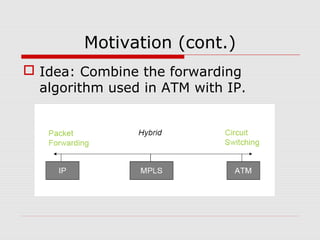
 Idea: Combine the forwarding
algorithm used in ATM with IP.
MPLS Introduction
 Motivation
 MPLS Basics
 Components and Protocols
 Operation
 Advantages and Disadvantages
MPLS Basics
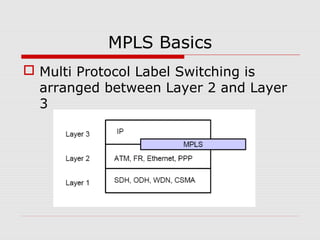
 Multi Protocol Label Switching is
arranged between Layer 2 and Layer
3
MPLS Basics (cont.)
 MPLS Characteristics
 Mechanisms to manage traffic flows of
various granularities (Flow Management)
 Is independent of Layer-2 and Layer-3
protocols
 Maps IP-addresses to fixed length labels
 Interfaces to existing routing protocols
(RSVP, OSPF)
 Supports ATM, Frame-Relay and
Ethernet
MPLS Introduction
 Motivation
 MPLS Basics
 MPLS Components and Protocols
 MPLS Operation
 Advantages and Disadvantages
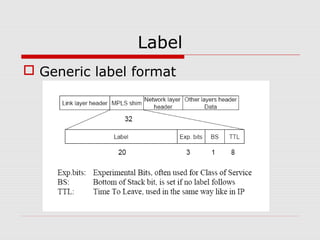
Label
 Generic label format
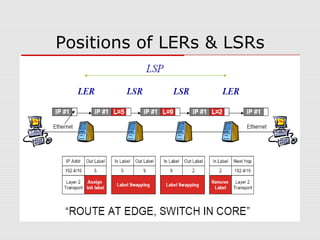
Label Edge Router - LER
 Resides at the edge of an MPLS
network and assigns and removes the
labels from the packets.
 Support multiple ports connected to
dissimilar networks (such as frame
relay, ATM, and Ethernet).
Label Switching Router - LSR
 Is a high speed router in the core on
an MPLS network.
 ATM switches can be used as LSRs
without changing their hardware.
Label switching is equivalent to
VP/VC switching.
Positions of LERs & LSRs
Forward Equivalence Class - FEC
 Is a representation of a group of
packets that share the same
requirements for their transport.
 The assignment of a particular packet
to a particular FEC is done just once
(when the packet enters the
network).
Label-Switched Paths - LSPs
 A path is established before the data
transmission starts.
 A path is a representation of a FEC.
LSP Details
 MPLS provides two options to set up an LSP
 hop-by-hop routing
Each LSR independently selects the next hop for
a given FEC. LSRs support any available routing
protocols (OSPF, ATM …).
 explicit routing
Is similar to source routing. The ingress LSR
specifies the list of nodes through which the
packet traverses.
 The LSP setup for an FEC is unidirectional.
The return traffic must take another LSP!
Label Distribution Protocol - LDP
 An application layer protocol for the
distribution of label binding
information to LSRs.
 It is used to map FECs to labels, which,
in turn, create LSPs.
 LDP sessions are established between
LDP peers in the MPLS network (not
necessarily adjacent).
 Sometimes employs OSPF or BGP.
LDP details
 LDP message types:
 discovery messages—announce and maintain
the presence of an LSR in a network
 session messages—establish, maintain, and
terminate sessions between LDP peers
 advertisement messages—create, change,
and delete label mappings for FECs
 notification messages—provide advisory
information and signal error information
Traffic Engineering
 TE mechanisms to minimize network
congestion and improve network
performance. TE modifies routing patterns
to provide efficient mapping of traffic
streams to network resources.
 RSVP-TE and CR-LDP are two possible
approaches to supply dynamic traffic
engineering and QoS in MPLS.
CR-LDP
 Takes into account parameters, such
as link characteristics (bandwidth,
delay, etc.), hop count, and QoS.
 It is entirely possible that a longer (in
terms of cost) but less loaded path is
selected.
 Drawback: It adds more complexity
to routing calculations.
Virtual Routing and Forwarding
(VRF)
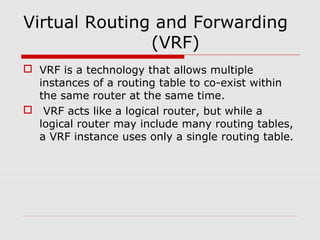
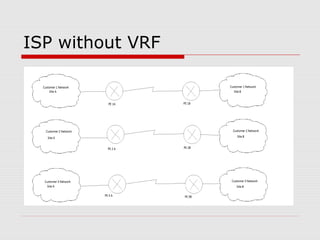
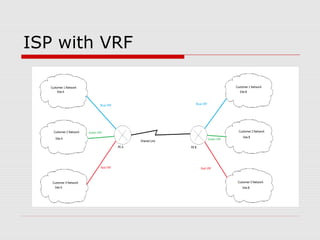
 VRF is a technology that allows multiple
instances of a routing table to co-exist within
the same router at the same time.
 VRF acts like a logical router, but while a
logical router may include many routing tables,
a VRF instance uses only a single routing table.
ISP without VRF
ISP with VRF
MPLS Introduction
 Motivation
 MPLS Basics
 Components and Protocols
 Operation
 Advantages and Disadvantages
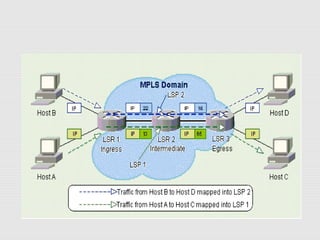
MPLS Operation
1. The IP packet enters at the ingress to the MPLS network.
2. The packet is assigned to a path and a label attached.
3. The labelled packet is sent to the next MPLS node.
4. This node looks at the label - the IP header is not examined.
5. The next hop is chosen by reference to a label forwarding table.
6. The new label is written and the packet sent on its way to the
next MPLS node.
7. This process continues until the packet reaches the last MPLS
node (egress).
8. The label is stripped (popped). This may expose another label or
an IP header. In the latter case, the packet is delivered to the
final destination using standard IP procedures.
MPLS Introduction
 Motivation
 Basics
 Components and Protocols
 Operation
 Advantages and Disadvantages
MPLS Advantages
 Improves packet-forwarding
performance in the network
 Supports QoS and CoS for service
differentiation
 Supports network scalability
 Integrates IP and ATM in the network
 Builds interoperable networks
MPLS Disadvantages
 An additional layer is added
 The router has to understand MPLS
MPLS Operators
 Service Providers:
BSNL, Tata Tele Services, Bharti Telecom,
Idea, Reliance Geo
 Hardware Suppliers:
Cisco, Juniper Networks, Nortel, Alcatel,
Huawei
MPLS Introduction
Thank you!

Mpls Traffic Engineering ppt

  • 1.
    Indore Institute ofScience & Technology INDORE Project On : MPLS Traffic Engineering Guided by : Presented by: Mrs.Neha Gupta Kunal Rokade Mujhaid Khan Nitin Gehlot Rhytham Kothari
  • 2.
    MPLS Introduction  Motivation MPLS Basics  Components and Protocols  Operation  Advantages and Disadvantages
  • 3.
    Motivation  IP  Thefirst defined and used protocol  De facto the only protocol for global Internet working … but there are disadvantages
  • 4.
    Motivation (cont.)  IPRouting disadvantages  Connectionless - e.g. no QoS  Each router has to make independent forwarding decisions based on the IP-address  Large IP Header - At least 20 bytes  Routing in Network Layer - Slower than Switching  Usually designed to obtain shortest path - Do not take into account additional metrics
  • 5.
    Motivation (cont.)  ATM connection oriented - Supports QoS  fast packet switching with fixed length packets (cells)  integration of different traffic types (voice, data, video) … but there are also disadvantages
  • 6.
    Motivation (cont.)  ATMdisadvantages  Complex  Expensive  Not widely adopted
  • 7.
    Motivation (cont.)  Idea:Combine the forwarding algorithm used in ATM with IP.
  • 8.
    MPLS Introduction  Motivation MPLS Basics  Components and Protocols  Operation  Advantages and Disadvantages
  • 9.
    MPLS Basics  MultiProtocol Label Switching is arranged between Layer 2 and Layer 3
  • 10.
    MPLS Basics (cont.) MPLS Characteristics  Mechanisms to manage traffic flows of various granularities (Flow Management)  Is independent of Layer-2 and Layer-3 protocols  Maps IP-addresses to fixed length labels  Interfaces to existing routing protocols (RSVP, OSPF)  Supports ATM, Frame-Relay and Ethernet
  • 11.
    MPLS Introduction  Motivation MPLS Basics  MPLS Components and Protocols  MPLS Operation  Advantages and Disadvantages
  • 12.
  • 13.
    Label Edge Router- LER  Resides at the edge of an MPLS network and assigns and removes the labels from the packets.  Support multiple ports connected to dissimilar networks (such as frame relay, ATM, and Ethernet).
  • 14.
    Label Switching Router- LSR  Is a high speed router in the core on an MPLS network.  ATM switches can be used as LSRs without changing their hardware. Label switching is equivalent to VP/VC switching.
  • 15.
  • 16.
    Forward Equivalence Class- FEC  Is a representation of a group of packets that share the same requirements for their transport.  The assignment of a particular packet to a particular FEC is done just once (when the packet enters the network).
  • 17.
    Label-Switched Paths -LSPs  A path is established before the data transmission starts.  A path is a representation of a FEC.
  • 18.
    LSP Details  MPLSprovides two options to set up an LSP  hop-by-hop routing Each LSR independently selects the next hop for a given FEC. LSRs support any available routing protocols (OSPF, ATM …).  explicit routing Is similar to source routing. The ingress LSR specifies the list of nodes through which the packet traverses.  The LSP setup for an FEC is unidirectional. The return traffic must take another LSP!
  • 19.
    Label Distribution Protocol- LDP  An application layer protocol for the distribution of label binding information to LSRs.  It is used to map FECs to labels, which, in turn, create LSPs.  LDP sessions are established between LDP peers in the MPLS network (not necessarily adjacent).  Sometimes employs OSPF or BGP.
  • 20.
    LDP details  LDPmessage types:  discovery messages—announce and maintain the presence of an LSR in a network  session messages—establish, maintain, and terminate sessions between LDP peers  advertisement messages—create, change, and delete label mappings for FECs  notification messages—provide advisory information and signal error information
  • 21.
    Traffic Engineering  TEmechanisms to minimize network congestion and improve network performance. TE modifies routing patterns to provide efficient mapping of traffic streams to network resources.  RSVP-TE and CR-LDP are two possible approaches to supply dynamic traffic engineering and QoS in MPLS.
  • 22.
    CR-LDP  Takes intoaccount parameters, such as link characteristics (bandwidth, delay, etc.), hop count, and QoS.  It is entirely possible that a longer (in terms of cost) but less loaded path is selected.  Drawback: It adds more complexity to routing calculations.
  • 23.
    Virtual Routing andForwarding (VRF)  VRF is a technology that allows multiple instances of a routing table to co-exist within the same router at the same time.  VRF acts like a logical router, but while a logical router may include many routing tables, a VRF instance uses only a single routing table.
  • 24.
  • 25.
  • 26.
    MPLS Introduction  Motivation MPLS Basics  Components and Protocols  Operation  Advantages and Disadvantages
  • 27.
    MPLS Operation 1. TheIP packet enters at the ingress to the MPLS network. 2. The packet is assigned to a path and a label attached. 3. The labelled packet is sent to the next MPLS node. 4. This node looks at the label - the IP header is not examined. 5. The next hop is chosen by reference to a label forwarding table. 6. The new label is written and the packet sent on its way to the next MPLS node. 7. This process continues until the packet reaches the last MPLS node (egress). 8. The label is stripped (popped). This may expose another label or an IP header. In the latter case, the packet is delivered to the final destination using standard IP procedures.
  • 29.
    MPLS Introduction  Motivation Basics  Components and Protocols  Operation  Advantages and Disadvantages
  • 30.
    MPLS Advantages  Improvespacket-forwarding performance in the network  Supports QoS and CoS for service differentiation  Supports network scalability  Integrates IP and ATM in the network  Builds interoperable networks
  • 31.
    MPLS Disadvantages  Anadditional layer is added  The router has to understand MPLS
  • 32.
    MPLS Operators  ServiceProviders: BSNL, Tata Tele Services, Bharti Telecom, Idea, Reliance Geo  Hardware Suppliers: Cisco, Juniper Networks, Nortel, Alcatel, Huawei
  • 33.