MULTI PROTOCOL LABEL SWITCHING
(MPLS)
VAIBHAV MITTAL
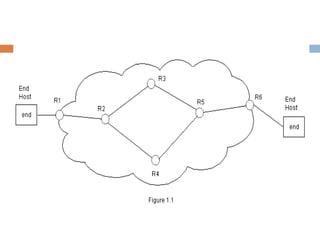
Conventional IP Networks &
Routing
 Client networks are connected to backbone via
edge routers
 LAN, PSTN
 Data packets are routed based on IP address and
other information in the header
 Functional components
 Forwarding
 responsible for actual forwarding across a router
 consists of set of procedures to make forwarding decisions
 Control
 responsible for construction and maintenance of the
forwarding table
 consists of routing protocols such as OSPF, BGP
Cont…..
 IP Routing disadvantages:
Connectionless
e.g. no QoS
 Each router has to make independent
forwarding
decisions based on the IP-address
 Large IP Header
 At least 20 byte
 Routing takes place in Network Layer
 Slower than Switching
Contd…
 ATM
 connection oriented
Supports QoS
 fast packet switching with fixed length packets
(cells)
 integration of different traffic types
(voice,data,video)
… but there are also disadvantages
Contd…..
 ATM disadvantages
Complex
Expensive
Not widely adopted
Need for Multiprotocol Label
Switching (MPLS)
 Forwarding function of a conventional router
 a capacity demanding procedure
 constitutes a bottle neck with increase in line
speed
 MPLS simplifies forwarding function by taking
a totally different approach by introducing a
connection oriented mechanism inside the
connectionless IP networks
Label Switching
 Decomposition of network layer routing into
control and forwarding components applicable
 Label switching forwarding component
algorithm uses
 forwarding table
 label carried in the packet
 What is a Label ?
 Short fixed length entity
MPLS Basics
 A Label Switched Path (LSP) is set up for each
route
 A LSP for a particular packet P is a sequence of
routers,
<R1,R2………..Rn>
for all i, 1< i < n: Ri transmits P to R[i+1] by means
of a label
 Edge routers
 analyze the IP header to decide which LSP to use
 add a corresponding local Label Switched Path
Identifier, in the form of a label
 forward the packet to the next hop
MPLS Basics contd..
 Subsequent nodes
 just forward the packet along the LSP
 simplify the forwarding function greatly
 increase performance and scalability dramatically
 New advanced functionality for QoS,
differentiated services can be introduced in the
edge routers
 Backbone can focus on capacity and
performance
 Routing information obtained using a common
intra domain routing protocol such as OSPF
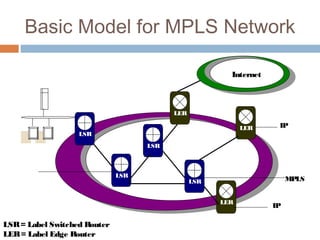
Basic Model for MPLS Network
LER
LER
LSR
LER
LSR
LSR
IP
MPLS
IP
Internet
LSR
LSR= Label Switched Router
LER= Label Edge Router
MPLS Benefits
Comparing MPLS with existing IP core and
IP/ATM technologies, MPLS has many
benefits:
 It hides the differences between different
Layer 2 protocols
 The connectivity and network services of layer
3 networks
 Improves the performance of network layer
routing
 Improved scalability
MPLS Benefits contd..
 Improves the possibilities for traffic
engineering
 Supports the delivery of services with QoS
guarantees
 Avoids need for coordination of IP and ATM
address allocation and routing information
 Label switching increases speed
MPLS Characteristics
 Mechanisms to manage traffic flows of various
types
 Is independent of Layer-2 and Layer-3
protocols
 Maps IP-addresses to fixed length labels
 Interfaces to existing routing protocols (RSVP,
OSPF)
 Supports ATM, Frame-Relay and Ethernet
MPLS Label Imposition and
Forwarding
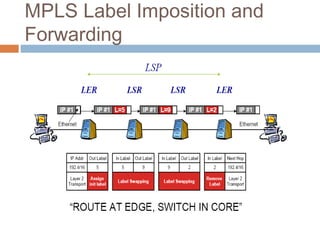
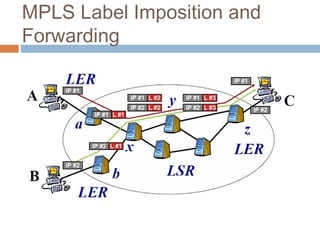
 In order to use MPLS, network layer packets
are converted into labeled packets by adding
a LABEL
 POP: All labels are removed when packet
leaves the MPLS network.
 SWAP: LSR replaces existing label with the
new label and sends the packet to
appropriate next hop.
 PUSH: A label is added to packet when it
enters into MPLS network.
MPLS Label Imposition and
Forwarding
MPLS Label Imposition and
Forwarding
Contd…
 INGRESS LSR: Each packet enters into MPLS
network at INGRESS LSR
 EGRESS LSR: Each packet exits from into MPLS
network at EGRESS LSR
 MPLS network can forward the packets with out
knowing anything about the network protocols used
by the packets
 Only the INGRESS LSR and EGRESS LSR must
Label Switching Router
 As the packets travels in MPLS network, each
LSR swaps the incoming label with outgoing
label and continuous until last LSR, EGRESS
LSR is reached
 LSR keeps two tables which are related to
MPLS forwarding component.
 TAG INFORMATION BASE or
LABEL INFORMATION BASE.
 TAG FORWARDING INFORMATION BASE or
LABEL FORWARDING INFORMATION
LABEL SWITCHED PATH
 LSP connects the INGRESS LSR and
EGRESS LSR.
 LSP is unidirectional
 It is connection oriented scheme because
path is set up prior to any traffic flow.
 Connection set up is based on topology
information
Forward Equivalence Class
 The Forward Equivalence Class is a
representation of a group of packets that
share the
same requirements for their transport.
 The assignment of a particular packet to a
particular FEC is done just once.
 FECs are calculated on source and
destination address pair (TOS).
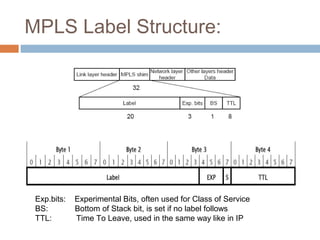
MPLS Label Structure:
Exp.bits: Experimental Bits, often used for Class of Service
BS: Bottom of Stack bit, is set if no label follows
TTL: Time To Leave, used in the same way like in IP
Contd…
 Label value. It is represented by 20 bits.
Range is 0 to 1048576
 EXP: Three bits for experimental use
Range is 0 to 7 used to indicate class of the
service.
 S:Bottom stack indicator.
 TTL: consists of 8 bits
Range is 0 to 255
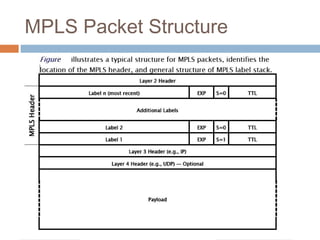
MPLS Packet Structure
 The labels are distributed using LDP (Label
Distribution Protocol) or RSVP (ReSerVation
Protocol) or BGP (Border Gateway Protocol)
and OSPF (Open shortest Path First).
Applications of MPLS
 MPLS-VPN
 TE
 QoS
Overview of MPLS/VPN
 Overview of MPLS/VPN
A VPN is a network in which customer
connectivity among multiple sites is deployed
on shared infrastructure with the same access
or security policies as a private network.
Contd…
 VPN is rather a loosely defined term to mean
a range of technologies.
 There are mainly two types of VPN
Layer 2 VPN
Layer 3 VPN in overlay technology.
Contd…
 Layer 2 VPN can be formed from X.25,
Frame Relay or ATM
 Layer 3 VPN includes tunneling such as
IPSec or GRE and uses devices such as
concentrators.
 MPLS uses Layer 2 peer to peer VPN
model.
Contd…
 Earlier computer network implemented
leased line which were secure but not
cost effective hence statistical
multiplexing schemas were introduced to
form VPN.
 Overall VPN solution has a number of
components
CPE (customer premises equipment )
which is basically a Packet Assembly and
Disassembly (PAD) device,
Contd…
 The CPE device is connected through
transmission medium (leased line or dialup
connection), the edge device is called the
Provider Edge (PE) device.
 The service provider usually has additional
equipment in the core called the P devices.
Contd…
 The service provider can charge either a flat
rate for the VPN depending on bandwidth or
usage based.
 VPDN (Virtual Private Dialup network) uses
technologies such as one-time password or
encryption and uses protocols such as L2F or
L2TP.
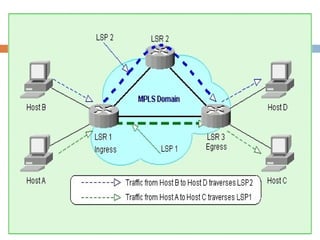
What is MPLS-TE ?
 Process of routing data traffic in order to
balance the traffic load on various links,
routers and switches in the network.
it plays a vital role where multiple parallel
or alternate paths are available.
Motivation:
 To increase the efficiency of bandwidth
resources.
 To ensure most appropriate path for traffic.
 Cost Saving.
 To overcome load-balancing limitations in IP
routing.
Why TE ?
 To avoid congestion in the network due to
changes in traffic patterns.
 Better utilization of bandwidth
 Re-routing time is very low – 60ms.
 Capacity planning.
Goal of TE:
 Major goal is to facilitate efficient and reliable
network operations and simultaneously
optimizing network resources and
performance.
 Cost saving.
TE with MPLS:
 It dynamically establishes and maintains an
LSP across the MPLS domain using signaling
protocols, and the two signaling mechanisms
used are:
CR-LDP& RSVP.
constraints like bandwidth, delay,
hopcount…. are taken into consideration.
Selection of LSP’s:
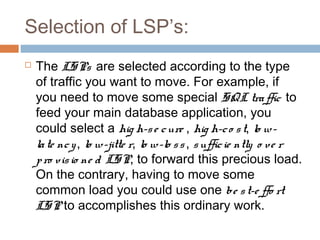
 The LSPs are selected according to the type
of traffic you want to move. For example, if
you need to move some special SQL traffic to
feed your main database application, you
could select a hig h-se cure , hig h-co st, lo w-
late ncy, lo w-jitte r, lo w-lo ss, sufficie ntly o ve r
pro visio ne d LSP, to forward this precious load.
On the contrary, having to move some
common load you could use one be st-e ffo rt
LSP to accomplishes this ordinary work.
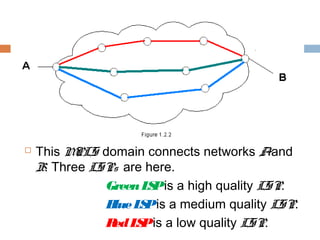
 This MPLS domain connects networks Aand
B. Three LSPs are here.
GreenLSPis a high quality LSP.
BlueLSPis a medium quality LSP.
RedLSPis a low quality LSP.
QOS (Quality Of Service):
 It is the ability to choose a route for a
particular data stream so that the path
provides a desired level of service.
 Providing Quality of Service (QoS) and traffic
engineering capabilities in the Internet is very
essential, especially to support the
requirements of real-time. For this purpose,
the current Internet must be enhanced with
new technology that enables it to offer such
capabilities.
QOS and MPLS:
 Traffic is aggregated into groups called FEC
(Fo rwarding Eq uivale nce Classe s ) and these
groups are assigned to specific Labe l
Switche d Path (LSP). Then traffic e ng ine e ring
can be implemented to assign hig h-prio rity
FECs onto hig h-q uality LSPs and lo we r-
prio rity FECs onto lo we r-q uality LSPs . This
way Qo S is implemented using MPLS.
Failure Detection:
 MPLS, by its specifications, it requires 6 0 m s to
recover from a failure.
 MPLS networks have to detect a problem and
switch the traffic on the faulty path over a new
path of equal quality within 60 ms.
 Two methods are used for this Failure
Detection
they are: He artbe at de te ctio n (polling) and
Erro r m e ssag ing .
Contd…
 Heartbeat detection: This is some kind of
ke e p-alive method. With this, each device in
the network advertise to a network manager
that it is alive, every pre scribe d inte rvalo f tim e
(by using timers). If the he artbe at is m isse d,
the path, link, device or node is declared as
failed and a switchover is performed. the
he artbe at or ke e p-alive messages have to be
flooded at least every 1 0 m s.
Contd…
 Errormessaging: In this method when a
network device detects an error, it sends a
message to its neighbor to redirect traffic to a
path or router that is working.
This method is the preferred when the
switch o ve r tim e is not critical. On the contrary,
the he artbe at m e tho d is the better choice.
Conclusion:
The new emerging technology
MPLS can provide a very good solution to the
internet problems with TE and QOS by using
all the resources in the network.
(which provides congestion less networks)
References:
 www.isoc.org
 www.opalsoft.net
 www.cisco.com
 www.rad.com
 A text book on “MPLS-VPN architectures” by
CISCO
 www.answers.com
thank you….

Mpls

  • 1.
    MULTI PROTOCOL LABELSWITCHING (MPLS) VAIBHAV MITTAL
  • 2.
    Conventional IP Networks& Routing  Client networks are connected to backbone via edge routers  LAN, PSTN  Data packets are routed based on IP address and other information in the header  Functional components  Forwarding  responsible for actual forwarding across a router  consists of set of procedures to make forwarding decisions  Control  responsible for construction and maintenance of the forwarding table  consists of routing protocols such as OSPF, BGP
  • 3.
    Cont…..  IP Routingdisadvantages: Connectionless e.g. no QoS  Each router has to make independent forwarding decisions based on the IP-address  Large IP Header  At least 20 byte  Routing takes place in Network Layer  Slower than Switching
  • 4.
    Contd…  ATM  connectionoriented Supports QoS  fast packet switching with fixed length packets (cells)  integration of different traffic types (voice,data,video) … but there are also disadvantages
  • 5.
  • 6.
    Need for MultiprotocolLabel Switching (MPLS)  Forwarding function of a conventional router  a capacity demanding procedure  constitutes a bottle neck with increase in line speed  MPLS simplifies forwarding function by taking a totally different approach by introducing a connection oriented mechanism inside the connectionless IP networks
  • 7.
    Label Switching  Decompositionof network layer routing into control and forwarding components applicable  Label switching forwarding component algorithm uses  forwarding table  label carried in the packet  What is a Label ?  Short fixed length entity
  • 8.
    MPLS Basics  ALabel Switched Path (LSP) is set up for each route  A LSP for a particular packet P is a sequence of routers, <R1,R2………..Rn> for all i, 1< i < n: Ri transmits P to R[i+1] by means of a label  Edge routers  analyze the IP header to decide which LSP to use  add a corresponding local Label Switched Path Identifier, in the form of a label  forward the packet to the next hop
  • 9.
    MPLS Basics contd.. Subsequent nodes  just forward the packet along the LSP  simplify the forwarding function greatly  increase performance and scalability dramatically  New advanced functionality for QoS, differentiated services can be introduced in the edge routers  Backbone can focus on capacity and performance  Routing information obtained using a common intra domain routing protocol such as OSPF
  • 10.
    Basic Model forMPLS Network LER LER LSR LER LSR LSR IP MPLS IP Internet LSR LSR= Label Switched Router LER= Label Edge Router
  • 11.
    MPLS Benefits Comparing MPLSwith existing IP core and IP/ATM technologies, MPLS has many benefits:  It hides the differences between different Layer 2 protocols  The connectivity and network services of layer 3 networks  Improves the performance of network layer routing  Improved scalability
  • 12.
    MPLS Benefits contd.. Improves the possibilities for traffic engineering  Supports the delivery of services with QoS guarantees  Avoids need for coordination of IP and ATM address allocation and routing information  Label switching increases speed
  • 13.
    MPLS Characteristics  Mechanismsto manage traffic flows of various types  Is independent of Layer-2 and Layer-3 protocols  Maps IP-addresses to fixed length labels  Interfaces to existing routing protocols (RSVP, OSPF)  Supports ATM, Frame-Relay and Ethernet
  • 14.
    MPLS Label Impositionand Forwarding  In order to use MPLS, network layer packets are converted into labeled packets by adding a LABEL  POP: All labels are removed when packet leaves the MPLS network.  SWAP: LSR replaces existing label with the new label and sends the packet to appropriate next hop.  PUSH: A label is added to packet when it enters into MPLS network.
  • 15.
    MPLS Label Impositionand Forwarding
  • 16.
    MPLS Label Impositionand Forwarding
  • 17.
    Contd…  INGRESS LSR:Each packet enters into MPLS network at INGRESS LSR  EGRESS LSR: Each packet exits from into MPLS network at EGRESS LSR  MPLS network can forward the packets with out knowing anything about the network protocols used by the packets  Only the INGRESS LSR and EGRESS LSR must
  • 18.
    Label Switching Router As the packets travels in MPLS network, each LSR swaps the incoming label with outgoing label and continuous until last LSR, EGRESS LSR is reached  LSR keeps two tables which are related to MPLS forwarding component.  TAG INFORMATION BASE or LABEL INFORMATION BASE.  TAG FORWARDING INFORMATION BASE or LABEL FORWARDING INFORMATION
  • 19.
    LABEL SWITCHED PATH LSP connects the INGRESS LSR and EGRESS LSR.  LSP is unidirectional  It is connection oriented scheme because path is set up prior to any traffic flow.  Connection set up is based on topology information
  • 20.
    Forward Equivalence Class The Forward Equivalence Class is a representation of a group of packets that share the same requirements for their transport.  The assignment of a particular packet to a particular FEC is done just once.  FECs are calculated on source and destination address pair (TOS).
  • 21.
    MPLS Label Structure: Exp.bits:Experimental Bits, often used for Class of Service BS: Bottom of Stack bit, is set if no label follows TTL: Time To Leave, used in the same way like in IP
  • 22.
    Contd…  Label value.It is represented by 20 bits. Range is 0 to 1048576  EXP: Three bits for experimental use Range is 0 to 7 used to indicate class of the service.  S:Bottom stack indicator.  TTL: consists of 8 bits Range is 0 to 255
  • 23.
  • 24.
     The labelsare distributed using LDP (Label Distribution Protocol) or RSVP (ReSerVation Protocol) or BGP (Border Gateway Protocol) and OSPF (Open shortest Path First).
  • 25.
    Applications of MPLS MPLS-VPN  TE  QoS
  • 26.
    Overview of MPLS/VPN Overview of MPLS/VPN A VPN is a network in which customer connectivity among multiple sites is deployed on shared infrastructure with the same access or security policies as a private network.
  • 27.
    Contd…  VPN israther a loosely defined term to mean a range of technologies.  There are mainly two types of VPN Layer 2 VPN Layer 3 VPN in overlay technology.
  • 28.
    Contd…  Layer 2VPN can be formed from X.25, Frame Relay or ATM  Layer 3 VPN includes tunneling such as IPSec or GRE and uses devices such as concentrators.  MPLS uses Layer 2 peer to peer VPN model.
  • 29.
    Contd…  Earlier computernetwork implemented leased line which were secure but not cost effective hence statistical multiplexing schemas were introduced to form VPN.  Overall VPN solution has a number of components CPE (customer premises equipment ) which is basically a Packet Assembly and Disassembly (PAD) device,
  • 30.
    Contd…  The CPEdevice is connected through transmission medium (leased line or dialup connection), the edge device is called the Provider Edge (PE) device.  The service provider usually has additional equipment in the core called the P devices.
  • 31.
    Contd…  The serviceprovider can charge either a flat rate for the VPN depending on bandwidth or usage based.  VPDN (Virtual Private Dialup network) uses technologies such as one-time password or encryption and uses protocols such as L2F or L2TP.
  • 32.
    What is MPLS-TE?  Process of routing data traffic in order to balance the traffic load on various links, routers and switches in the network. it plays a vital role where multiple parallel or alternate paths are available.
  • 34.
    Motivation:  To increasethe efficiency of bandwidth resources.  To ensure most appropriate path for traffic.  Cost Saving.  To overcome load-balancing limitations in IP routing.
  • 35.
    Why TE ? To avoid congestion in the network due to changes in traffic patterns.  Better utilization of bandwidth  Re-routing time is very low – 60ms.  Capacity planning.
  • 36.
    Goal of TE: Major goal is to facilitate efficient and reliable network operations and simultaneously optimizing network resources and performance.  Cost saving.
  • 37.
    TE with MPLS: It dynamically establishes and maintains an LSP across the MPLS domain using signaling protocols, and the two signaling mechanisms used are: CR-LDP& RSVP. constraints like bandwidth, delay, hopcount…. are taken into consideration.
  • 39.
    Selection of LSP’s: The LSPs are selected according to the type of traffic you want to move. For example, if you need to move some special SQL traffic to feed your main database application, you could select a hig h-se cure , hig h-co st, lo w- late ncy, lo w-jitte r, lo w-lo ss, sufficie ntly o ve r pro visio ne d LSP, to forward this precious load. On the contrary, having to move some common load you could use one be st-e ffo rt LSP to accomplishes this ordinary work.
  • 40.
     This MPLSdomain connects networks Aand B. Three LSPs are here. GreenLSPis a high quality LSP. BlueLSPis a medium quality LSP. RedLSPis a low quality LSP.
  • 41.
    QOS (Quality OfService):  It is the ability to choose a route for a particular data stream so that the path provides a desired level of service.  Providing Quality of Service (QoS) and traffic engineering capabilities in the Internet is very essential, especially to support the requirements of real-time. For this purpose, the current Internet must be enhanced with new technology that enables it to offer such capabilities.
  • 42.
    QOS and MPLS: Traffic is aggregated into groups called FEC (Fo rwarding Eq uivale nce Classe s ) and these groups are assigned to specific Labe l Switche d Path (LSP). Then traffic e ng ine e ring can be implemented to assign hig h-prio rity FECs onto hig h-q uality LSPs and lo we r- prio rity FECs onto lo we r-q uality LSPs . This way Qo S is implemented using MPLS.
  • 43.
    Failure Detection:  MPLS,by its specifications, it requires 6 0 m s to recover from a failure.  MPLS networks have to detect a problem and switch the traffic on the faulty path over a new path of equal quality within 60 ms.  Two methods are used for this Failure Detection they are: He artbe at de te ctio n (polling) and Erro r m e ssag ing .
  • 44.
    Contd…  Heartbeat detection:This is some kind of ke e p-alive method. With this, each device in the network advertise to a network manager that it is alive, every pre scribe d inte rvalo f tim e (by using timers). If the he artbe at is m isse d, the path, link, device or node is declared as failed and a switchover is performed. the he artbe at or ke e p-alive messages have to be flooded at least every 1 0 m s.
  • 45.
    Contd…  Errormessaging: Inthis method when a network device detects an error, it sends a message to its neighbor to redirect traffic to a path or router that is working. This method is the preferred when the switch o ve r tim e is not critical. On the contrary, the he artbe at m e tho d is the better choice.
  • 46.
    Conclusion: The new emergingtechnology MPLS can provide a very good solution to the internet problems with TE and QOS by using all the resources in the network. (which provides congestion less networks)
  • 47.
    References:  www.isoc.org  www.opalsoft.net www.cisco.com  www.rad.com  A text book on “MPLS-VPN architectures” by CISCO  www.answers.com
  • 48.

Editor's Notes