Arrythmias
Basics, AF, AVRT, AVNRT
Dr Sravan kumar G
Assistant Professor
MRIMS
Action Potential
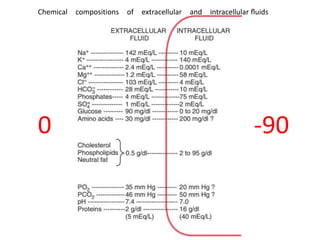
Chemical compositions of extracellular and intracellular fluids
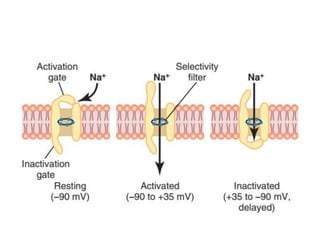
-900
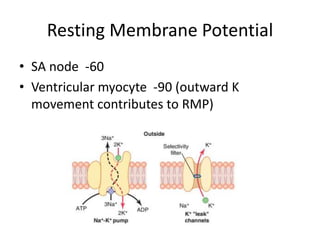
Resting Membrane Potential
• SA node -60
• Ventricular myocyte -90 (outward K
movement contributes to RMP)
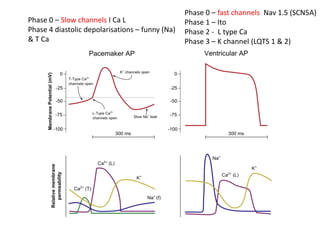
Phase 0 – Slow channels I Ca L
Phase 4 diastolic depolarisations – funny (Na)
& T Ca
Phase 0 – fast channels Nav 1.5 (SCN5A)
Phase 1 – Ito
Phase 2 - L type Ca
Phase 3 – K channel (LQTS 1 & 2)
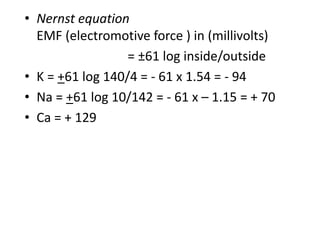
• Nernst equation
EMF (electromotive force ) in (millivolts)
= ±61 log inside/outside
• K = +61 log 140/4 = - 61 x 1.54 = - 94
• Na = +61 log 10/142 = - 61 x – 1.15 = + 70
• Ca = + 129
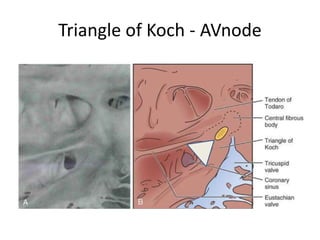
Triangle of Koch - AVnode
Arrhythmias
Dr Sravan kumar G
Assistant Professor
MRIMS
Mechanisms of Arrhythmogenesis
• Disorders of Impulse Formation
– Automaticity
• Normal automaticity(phase 4 diastolic depolarisation) - Sinus tachycardia or
bradycardia
• Abnormal automaticity - ventricular rhythms after myocardial infarction
– Triggered activity
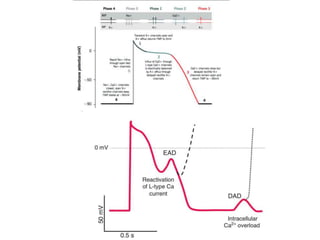
• EADs - low Sr K, Acquired LQTS and associated ventricular arrhythmias
• DADs – Ca Overload of myocyte
• Disorders of Impulse Conduction
Block
– Bidirectional or unidirectional without reentry
• Sinoatrial Block, AV block, bundle branch block
– Unidirectional block with reentry
• Reciprocating tachycardia in Wolff-Parkinson-White syndrome,
• AV nodal reentry tachycardia, ventricular tachycardia caused by bundle branch
reentry
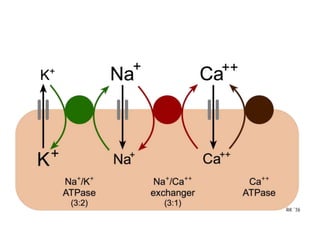
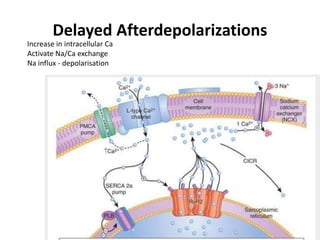
Delayed Afterdepolarizations
Increase in intracellular Ca
Activate Na/Ca exchange
Na influx - depolarisation
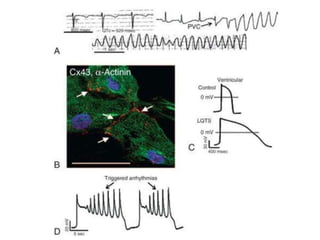
Early Afterdepolarizations
• Long-QT Syndrome
• Increased influx L type Ca channels – more
calcium release – Na Ca exchange - EAD
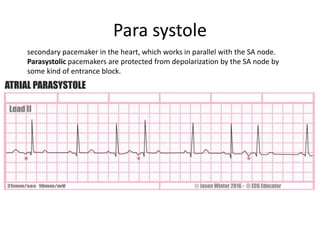
Para systole
secondary pacemaker in the heart, which works in parallel with the SA node.
Parasystolic pacemakers are protected from depolarization by the SA node by
some kind of entrance block.
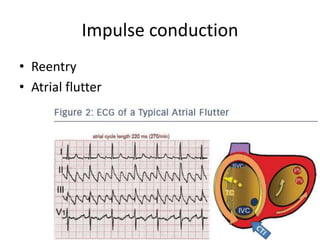
Impulse conduction
• Reentry
• Atrial flutter
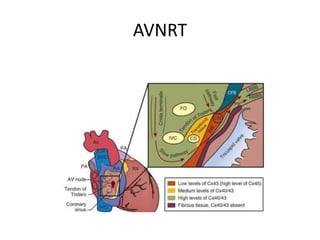
AVNRT
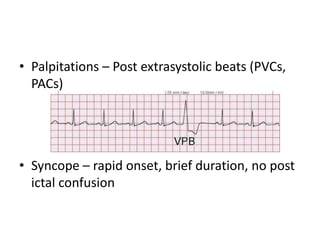
• Palpitations – Post extrasystolic beats (PVCs,
PACs)
• Syncope – rapid onset, brief duration, no post
ictal confusion
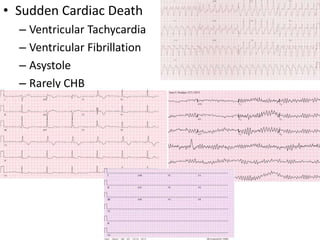
• Sudden Cardiac Death
– Ventricular Tachycardia
– Ventricular Fibrillation
– Asystole
– Rarely CHB
• Regular Cannon A waves
– AVRT, AVNRT
• AV dissociation -intermittent cannon A waves
– VT
• Carotid Sinus Massage
– AVRT, AVNRT
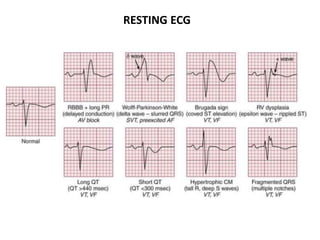
RESTING ECG
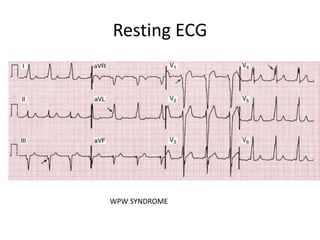
Resting ECG
WPW SYNDROME
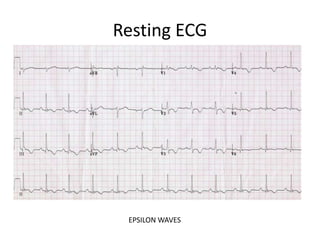
Resting ECG
EPSILON WAVES
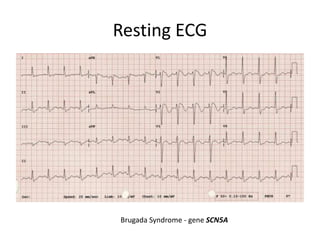
Resting ECG
Brugada Syndrome - gene SCN5A
Resting ECG
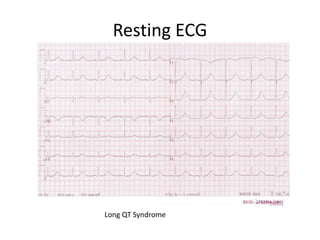
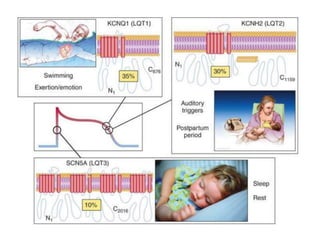
Long QT Syndrome
Resting ECG
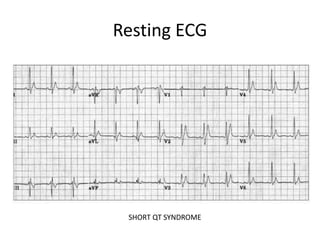
SHORT QT SYNDROME
• Head-UP Tilt Table Testing – neurocardiogenic
Syncope
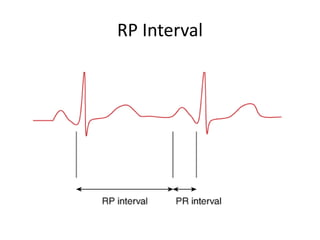
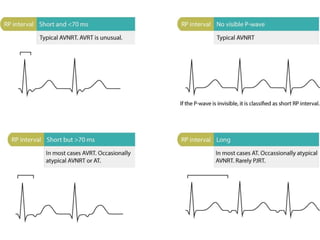
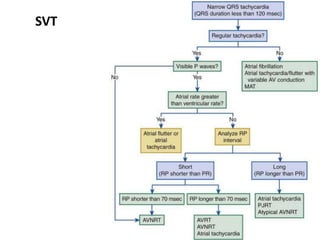
RP Interval
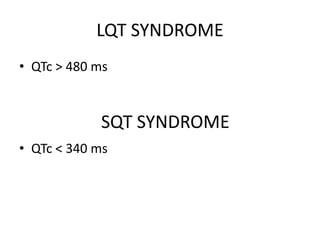
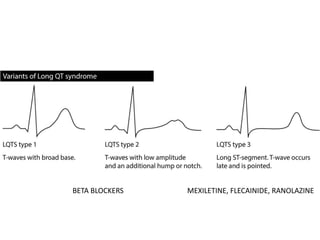
LQT SYNDROME
• QTc > 480 ms
• QTc < 340 ms
SQT SYNDROME
BETA BLOCKERS MEXILETINE, FLECAINIDE, RANOLAZINE
Triadin Knockout Syndrome
• Cardiac triadin is responsible for stabilization of the T
tubule junctional sarcoplasmic reticulum (jSR)
association by linking calsequestrin 2 (Casq2), ryanodine
receptor 2 (RyR2), and junctophilin-2 (JPH2)
proteins together in proximity to the L-type calcium
channel (LTCC), thus facilitating a proper negative
feedback loop for Ca2+ handling.
• Ablation of cardiac triadin results in cardiac dyad structural
remodeling and Ca2+ overload as a result of slower Ca2+-
dependent inactivation of the LTCC. Slower LTCC
inactivation could lengthen the cardiac action potential and
manifest as QT prolongation on the ECG
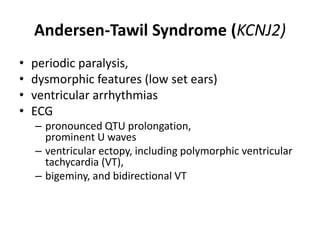
Andersen-Tawil Syndrome (KCNJ2)
• periodic paralysis,
• dysmorphic features (low set ears)
• ventricular arrhythmias
• ECG
– pronounced QTU prolongation,
prominent U waves
– ventricular ectopy, including polymorphic ventricular
tachycardia (VT),
– bigeminy, and bidirectional VT
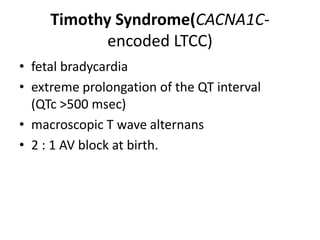
Timothy Syndrome(CACNA1C-
encoded LTCC)
• fetal bradycardia
• extreme prolongation of the QT interval
(QTc >500 msec)
• macroscopic T wave alternans
• 2 : 1 AV block at birth.
SQT SYNDROME
• Atrial fibrillation
• syncope
Drug-Induced Torsade de Pointes
• IKr/Kv11.1 channel blockers (HERG channel
blockers).
• QT-prolonging drugs create an “LQT2-like”
phenotype
Catecholaminergic Polymorphic
Ventricular Tachycardia
• exercise-induced syncope and a QTc less than
460 milliseconds
• exercise-induced premature ventricular
complexes in bigeminy & bidirectional VT.
• RYR2-encoded cardiac ryanodine
receptor/calcium release channel mutation
• calcium overload, delayed depolarizations
Brugada Syndrome
• Coved-type ST-segment elevation (≥2 mm)
followed by a negative T wave in the right
precordial leads V1 through V3
• SCN5A
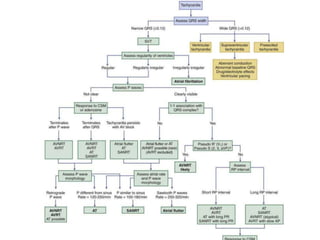
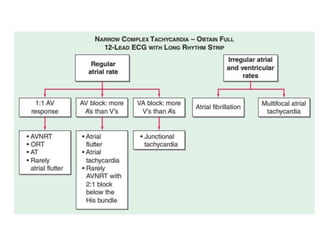
SVT
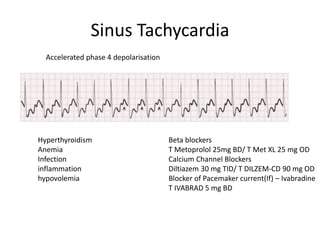
Sinus Tachycardia
Accelerated phase 4 depolarisation
Hyperthyroidism
Anemia
Infection
inflammation
hypovolemia
Beta blockers
T Metoprolol 25mg BD/ T Met XL 25 mg OD
Calcium Channel Blockers
Diltiazem 30 mg TID/ T DILZEM-CD 90 mg OD
Blocker of Pacemaker current(If) – Ivabradine
T IVABRAD 5 mg BD
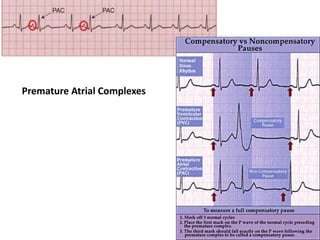
Premature Atrial Complexes
ATRIAL TACHYCARDIAS
ATRIAL FLUTTER
• macroreentrant atrial rhythm
• circulate in a counterclockwise direction
around the tricuspid annulus in the frontal
plane (counterclockwise flutter)
•
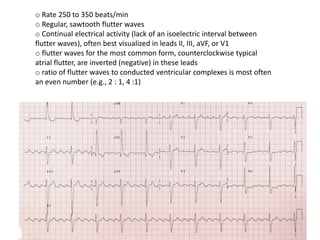
o Rate 250 to 350 beats/min
o Regular, sawtooth flutter waves
o Continual electrical activity (lack of an isoelectric interval between
flutter waves), often best visualized in leads II, III, aVF, or V1
o flutter waves for the most common form, counterclockwise typical
atrial flutter, are inverted (negative) in these leads
o ratio of flutter waves to conducted ventricular complexes is most often
an even number (e.g., 2 : 1, 4 :1)
• Rhythm control
– Cardioversion - synchronous direct current (DC) -
approximately 50 J
– Inj Ibutilide 1 mg iv over 10 min
• Rate control
• CCBs
– Inj Verapamil 2.5 mg slow i.v
– Inj Diltiazem (0.25 mg/kg) 15 mg slow i.v
• Betablockers (Esmolol)
• Digoxin
• Amiodarone
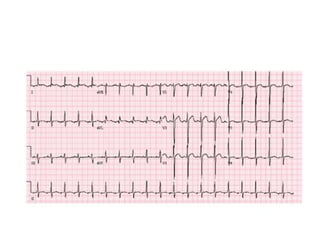
Focal atrial tachycardia
• atrial rates of 150 to 200 beats/min
• P wave contour different from that of the
sinus P wave
• CCBs/betablockers
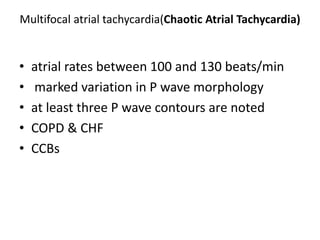
Multifocal atrial tachycardia(Chaotic Atrial Tachycardia)
• atrial rates between 100 and 130 beats/min
• marked variation in P wave morphology
• at least three P wave contours are noted
• COPD & CHF
• CCBs
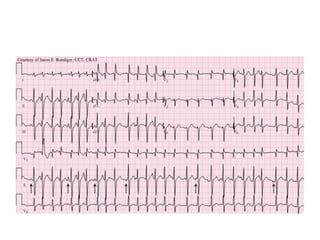
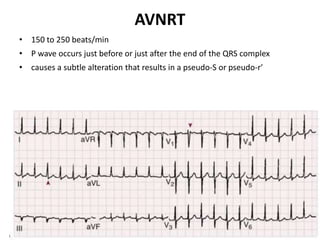
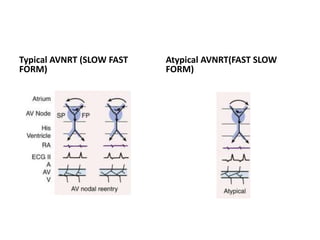
AVNRT
• 150 to 250 beats/min
• P wave occurs just before or just after the end of the QRS complex
• causes a subtle alteration that results in a pseudo-S or pseudo-r′
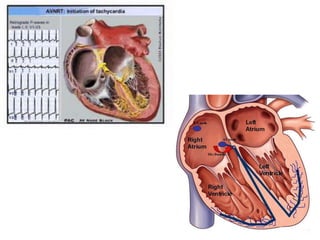
Typical AVNRT (SLOW FAST
FORM)
Atypical AVNRT(FAST SLOW
FORM)
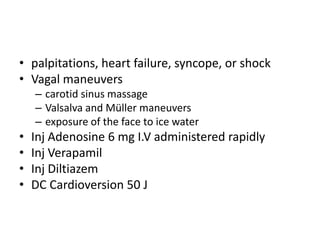
• palpitations, heart failure, syncope, or shock
• Vagal maneuvers
– carotid sinus massage
– Valsalva and Müller maneuvers
– exposure of the face to ice water
• Inj Adenosine 6 mg I.V administered rapidly
• Inj Verapamil
• Inj Diltiazem
• DC Cardioversion 50 J
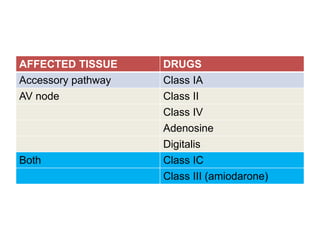
AFFECTED TISSUE DRUGS
Accessory pathway Class IA
AV node Class II
Class IV
Adenosine
Digitalis
Both Class IC
Class III (amiodarone)
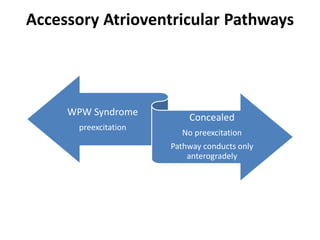
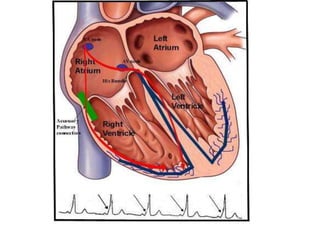
Accessory Atrioventricular Pathways
WPW Syndrome
preexcitation
Concealed
No preexcitation
Pathway conducts only
anterogradely
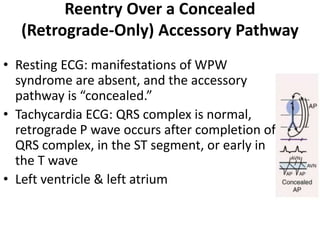
Reentry Over a Concealed
(Retrograde-Only) Accessory Pathway
• Resting ECG: manifestations of WPW
syndrome are absent, and the accessory
pathway is “concealed.”
• Tachycardia ECG: QRS complex is normal,
retrograde P wave occurs after completion of
QRS complex, in the ST segment, or early in
the T wave
• Left ventricle & left atrium
Preexcitation Syndrome
1) PR interval less than 120 milliseconds during
sinus rhythm
2) QRS complex duration exceeding 120
milliseconds with a slurred, slowly rising onset
of the QRS in some leads (delta wave)
and usually a normal terminal QRS portion
3) Secondary ST-T wave changes that are generally
directed in an opposite direction to the major
delta and QRS vectors.
• The major difference between the two is the
capacity for anterograde conduction
over the accessory pathway during atrial
flutter or AF
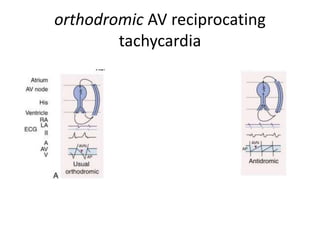
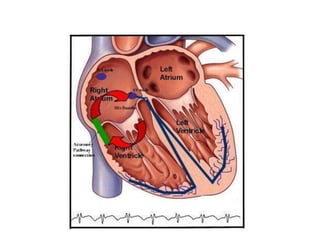
orthodromic AV reciprocating
tachycardia
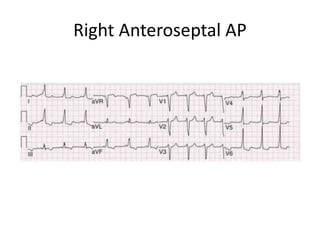
Right Anteroseptal AP
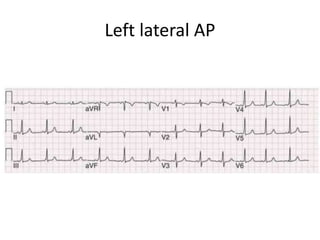
Left lateral AP
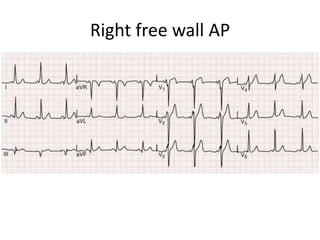
Right free wall AP
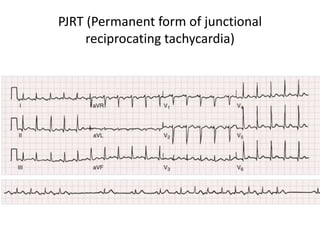
PJRT (Permanent form of junctional
reciprocating tachycardia)
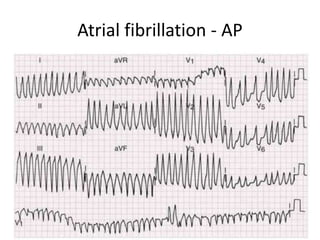
Atrial fibrillation - AP
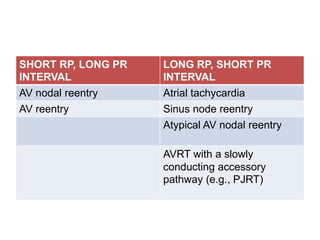
SHORT RP, LONG PR
INTERVAL
LONG RP, SHORT PR
INTERVAL
AV nodal reentry Atrial tachycardia
AV reentry Sinus node reentry
Atypical AV nodal reentry
AVRT with a slowly
conducting accessory
pathway (e.g., PJRT)
ATRIAL FIBRILLATION
• paroxysmal AF - AF that terminates spontaneously within 7
days
– vagotonic AF – evening during relaxation or sleep
– Adrenergic AF – strenous exertion
• persistent AF - AF present continuously for more than 7
days
• longstanding persistent -AF that persists for longer than 1
year is termed
• Permanent - longstanding AF refractory to cardioversion is
termed
• Lone atrial fibrillation - AF that occurs in patients younger
than 60 years who do not have hypertension or any
evidence of structural heart disease
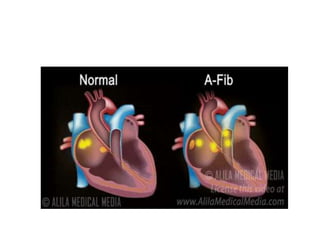
• Sites of origin
• Pulmonary veins – paroxysmal AF
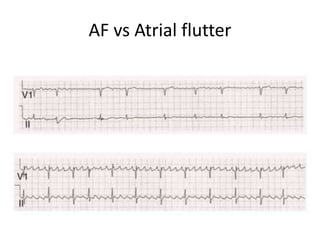
AF vs Atrial flutter
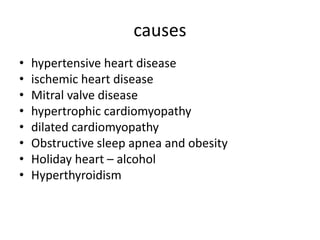
causes
• hypertensive heart disease
• ischemic heart disease
• Mitral valve disease
• hypertrophic cardiomyopathy
• dilated cardiomyopathy
• Obstructive sleep apnea and obesity
• Holiday heart – alcohol
• Hyperthyroidism
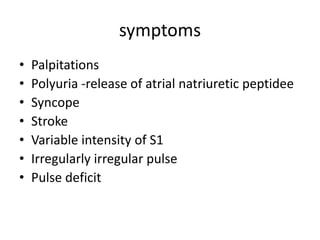
symptoms
• Palpitations
• Polyuria -release of atrial natriuretic peptidee
• Syncope
• Stroke
• Variable intensity of S1
• Irregularly irregular pulse
• Pulse deficit
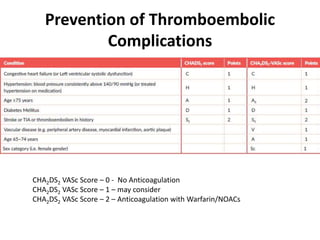
Prevention of Thromboembolic
Complications
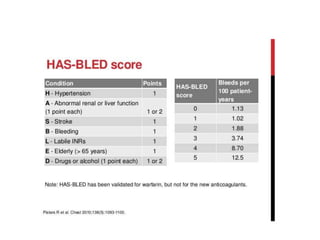
CHA2DS2 VASc Score – 0 - No Anticoagulation
CHA2DS2 VASc Score – 1 – may consider
CHA2DS2 VASc Score – 2 – Anticoagulation with Warfarin/NOACs
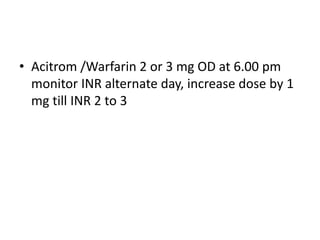
• Acitrom /Warfarin 2 or 3 mg OD at 6.00 pm
monitor INR alternate day, increase dose by 1
mg till INR 2 to 3
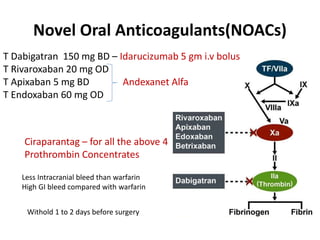
Novel Oral Anticoagulants(NOACs)
T Dabigatran 150 mg BD – Idarucizumab 5 gm i.v bolus
T Rivaroxaban 20 mg OD
T Apixaban 5 mg BD Andexanet Alfa
T Endoxaban 60 mg OD
Ciraparantag – for all the above 4
Prothrombin Concentrates
Less Intracranial bleed than warfarin
High GI bleed compared with warfarin
Withold 1 to 2 days before surgery
Excision or Closure of the Left Atrial
Appendage
• 90% of left atrial thrombi form in the left atrial
appendage (LAA)
WATCHMAN DEVICE
LARIAT SUTURE
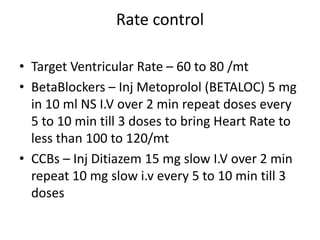
Rate control
• Target Ventricular Rate – 60 to 80 /mt
• BetaBlockers – Inj Metoprolol (BETALOC) 5 mg
in 10 ml NS I.V over 2 min repeat doses every
5 to 10 min till 3 doses to bring Heart Rate to
less than 100 to 120/mt
• CCBs – Inj Ditiazem 15 mg slow I.V over 2 min
repeat 10 mg slow i.v every 5 to 10 min till 3
doses
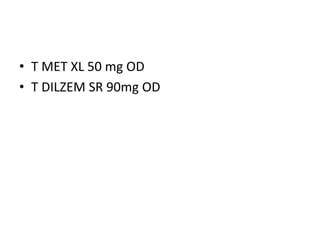
• T MET XL 50 mg OD
• T DILZEM SR 90mg OD
ACUTE RHYTHM CONTROL – if AF less than 48 hours
if > 48 hours – 3 weeks of Anticoagulation before rhytm control
Anticoagulation continued for next 4 weeks after rhythm control
PHARMACOLOGICAL
• Inj Ibutilide 1 mg I.V over 10
min
• Inj Amiodarone (cordarone)
150 mg I.V over 10 min fb
900 mg in 50 ml NS @ 3.4
ml/hr(1 mg/min) for 6 hrs fb
1.7 ml/hr (0.5 mg/min) for
next 18 hrs
CARDIOVERSION
• 200 J synchronised shock
Pharmacological rhytm control
• Lone AF & no Structural heart disease – IC –
Flecainide, Propafenone, Sotalol, Dronedarone
• Structural heart disease or CHF - Amiodarone
Catheter Ablation of Atrial Fibrillation
• Radiofrequency Catheter Ablation
• Cryoballoon Ablation
– almost all ablation strategies include electrical
isolation of the PVs
• Ablation of the Atrioventricular Node
– complete AV nodal block and substitutes a regular,
paced rhythm for an irregular and rapid native rhythm
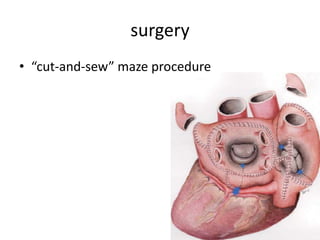
surgery
• “cut-and-sew” maze procedure
• Post operative AF –
after CABG – 40%
• WPW Syndrome AF
• Digitalis & CCBs are contraindicated

Arrhythmias

  • 1.
    Arrythmias Basics, AF, AVRT,AVNRT Dr Sravan kumar G Assistant Professor MRIMS
  • 2.
  • 3.
    Chemical compositions ofextracellular and intracellular fluids -900
  • 4.
    Resting Membrane Potential •SA node -60 • Ventricular myocyte -90 (outward K movement contributes to RMP)
  • 6.
    Phase 0 –Slow channels I Ca L Phase 4 diastolic depolarisations – funny (Na) & T Ca Phase 0 – fast channels Nav 1.5 (SCN5A) Phase 1 – Ito Phase 2 - L type Ca Phase 3 – K channel (LQTS 1 & 2)
  • 7.
    • Nernst equation EMF(electromotive force ) in (millivolts) = ±61 log inside/outside • K = +61 log 140/4 = - 61 x 1.54 = - 94 • Na = +61 log 10/142 = - 61 x – 1.15 = + 70 • Ca = + 129
  • 9.
  • 11.
    Arrhythmias Dr Sravan kumarG Assistant Professor MRIMS
  • 12.
    Mechanisms of Arrhythmogenesis •Disorders of Impulse Formation – Automaticity • Normal automaticity(phase 4 diastolic depolarisation) - Sinus tachycardia or bradycardia • Abnormal automaticity - ventricular rhythms after myocardial infarction – Triggered activity • EADs - low Sr K, Acquired LQTS and associated ventricular arrhythmias • DADs – Ca Overload of myocyte • Disorders of Impulse Conduction Block – Bidirectional or unidirectional without reentry • Sinoatrial Block, AV block, bundle branch block – Unidirectional block with reentry • Reciprocating tachycardia in Wolff-Parkinson-White syndrome, • AV nodal reentry tachycardia, ventricular tachycardia caused by bundle branch reentry
  • 14.
    Delayed Afterdepolarizations Increase inintracellular Ca Activate Na/Ca exchange Na influx - depolarisation
  • 15.
    Early Afterdepolarizations • Long-QTSyndrome • Increased influx L type Ca channels – more calcium release – Na Ca exchange - EAD
  • 17.
    Para systole secondary pacemakerin the heart, which works in parallel with the SA node. Parasystolic pacemakers are protected from depolarization by the SA node by some kind of entrance block.
  • 18.
  • 19.
  • 22.
    • Palpitations –Post extrasystolic beats (PVCs, PACs) • Syncope – rapid onset, brief duration, no post ictal confusion
  • 23.
    • Sudden CardiacDeath – Ventricular Tachycardia – Ventricular Fibrillation – Asystole – Rarely CHB
  • 24.
    • Regular CannonA waves – AVRT, AVNRT • AV dissociation -intermittent cannon A waves – VT • Carotid Sinus Massage – AVRT, AVNRT
  • 25.
  • 26.
  • 27.
  • 28.
  • 29.
  • 30.
  • 31.
    • Head-UP TiltTable Testing – neurocardiogenic Syncope
  • 32.
  • 34.
    LQT SYNDROME • QTc> 480 ms • QTc < 340 ms SQT SYNDROME
  • 36.
    BETA BLOCKERS MEXILETINE,FLECAINIDE, RANOLAZINE
  • 37.
    Triadin Knockout Syndrome •Cardiac triadin is responsible for stabilization of the T tubule junctional sarcoplasmic reticulum (jSR) association by linking calsequestrin 2 (Casq2), ryanodine receptor 2 (RyR2), and junctophilin-2 (JPH2) proteins together in proximity to the L-type calcium channel (LTCC), thus facilitating a proper negative feedback loop for Ca2+ handling. • Ablation of cardiac triadin results in cardiac dyad structural remodeling and Ca2+ overload as a result of slower Ca2+- dependent inactivation of the LTCC. Slower LTCC inactivation could lengthen the cardiac action potential and manifest as QT prolongation on the ECG
  • 38.
    Andersen-Tawil Syndrome (KCNJ2) •periodic paralysis, • dysmorphic features (low set ears) • ventricular arrhythmias • ECG – pronounced QTU prolongation, prominent U waves – ventricular ectopy, including polymorphic ventricular tachycardia (VT), – bigeminy, and bidirectional VT
  • 39.
    Timothy Syndrome(CACNA1C- encoded LTCC) •fetal bradycardia • extreme prolongation of the QT interval (QTc >500 msec) • macroscopic T wave alternans • 2 : 1 AV block at birth.
  • 40.
    SQT SYNDROME • Atrialfibrillation • syncope
  • 41.
    Drug-Induced Torsade dePointes • IKr/Kv11.1 channel blockers (HERG channel blockers). • QT-prolonging drugs create an “LQT2-like” phenotype
  • 42.
    Catecholaminergic Polymorphic Ventricular Tachycardia •exercise-induced syncope and a QTc less than 460 milliseconds • exercise-induced premature ventricular complexes in bigeminy & bidirectional VT. • RYR2-encoded cardiac ryanodine receptor/calcium release channel mutation • calcium overload, delayed depolarizations
  • 43.
    Brugada Syndrome • Coved-typeST-segment elevation (≥2 mm) followed by a negative T wave in the right precordial leads V1 through V3 • SCN5A
  • 44.
  • 45.
    Sinus Tachycardia Accelerated phase4 depolarisation Hyperthyroidism Anemia Infection inflammation hypovolemia Beta blockers T Metoprolol 25mg BD/ T Met XL 25 mg OD Calcium Channel Blockers Diltiazem 30 mg TID/ T DILZEM-CD 90 mg OD Blocker of Pacemaker current(If) – Ivabradine T IVABRAD 5 mg BD
  • 46.
  • 47.
  • 48.
    ATRIAL FLUTTER • macroreentrantatrial rhythm • circulate in a counterclockwise direction around the tricuspid annulus in the frontal plane (counterclockwise flutter) •
  • 49.
    o Rate 250to 350 beats/min o Regular, sawtooth flutter waves o Continual electrical activity (lack of an isoelectric interval between flutter waves), often best visualized in leads II, III, aVF, or V1 o flutter waves for the most common form, counterclockwise typical atrial flutter, are inverted (negative) in these leads o ratio of flutter waves to conducted ventricular complexes is most often an even number (e.g., 2 : 1, 4 :1)
  • 50.
    • Rhythm control –Cardioversion - synchronous direct current (DC) - approximately 50 J – Inj Ibutilide 1 mg iv over 10 min • Rate control • CCBs – Inj Verapamil 2.5 mg slow i.v – Inj Diltiazem (0.25 mg/kg) 15 mg slow i.v • Betablockers (Esmolol) • Digoxin • Amiodarone
  • 51.
    Focal atrial tachycardia •atrial rates of 150 to 200 beats/min • P wave contour different from that of the sinus P wave • CCBs/betablockers
  • 53.
    Multifocal atrial tachycardia(ChaoticAtrial Tachycardia) • atrial rates between 100 and 130 beats/min • marked variation in P wave morphology • at least three P wave contours are noted • COPD & CHF • CCBs
  • 55.
    AVNRT • 150 to250 beats/min • P wave occurs just before or just after the end of the QRS complex • causes a subtle alteration that results in a pseudo-S or pseudo-r′
  • 57.
    Typical AVNRT (SLOWFAST FORM) Atypical AVNRT(FAST SLOW FORM)
  • 58.
    • palpitations, heartfailure, syncope, or shock • Vagal maneuvers – carotid sinus massage – Valsalva and Müller maneuvers – exposure of the face to ice water • Inj Adenosine 6 mg I.V administered rapidly • Inj Verapamil • Inj Diltiazem • DC Cardioversion 50 J
  • 59.
    AFFECTED TISSUE DRUGS Accessorypathway Class IA AV node Class II Class IV Adenosine Digitalis Both Class IC Class III (amiodarone)
  • 60.
    Accessory Atrioventricular Pathways WPWSyndrome preexcitation Concealed No preexcitation Pathway conducts only anterogradely
  • 61.
    Reentry Over aConcealed (Retrograde-Only) Accessory Pathway • Resting ECG: manifestations of WPW syndrome are absent, and the accessory pathway is “concealed.” • Tachycardia ECG: QRS complex is normal, retrograde P wave occurs after completion of QRS complex, in the ST segment, or early in the T wave • Left ventricle & left atrium
  • 62.
    Preexcitation Syndrome 1) PRinterval less than 120 milliseconds during sinus rhythm 2) QRS complex duration exceeding 120 milliseconds with a slurred, slowly rising onset of the QRS in some leads (delta wave) and usually a normal terminal QRS portion 3) Secondary ST-T wave changes that are generally directed in an opposite direction to the major delta and QRS vectors.
  • 64.
    • The majordifference between the two is the capacity for anterograde conduction over the accessory pathway during atrial flutter or AF
  • 65.
  • 67.
  • 68.
  • 69.
  • 70.
    PJRT (Permanent formof junctional reciprocating tachycardia)
  • 71.
  • 72.
    SHORT RP, LONGPR INTERVAL LONG RP, SHORT PR INTERVAL AV nodal reentry Atrial tachycardia AV reentry Sinus node reentry Atypical AV nodal reentry AVRT with a slowly conducting accessory pathway (e.g., PJRT)
  • 73.
  • 74.
    • paroxysmal AF- AF that terminates spontaneously within 7 days – vagotonic AF – evening during relaxation or sleep – Adrenergic AF – strenous exertion • persistent AF - AF present continuously for more than 7 days • longstanding persistent -AF that persists for longer than 1 year is termed • Permanent - longstanding AF refractory to cardioversion is termed • Lone atrial fibrillation - AF that occurs in patients younger than 60 years who do not have hypertension or any evidence of structural heart disease
  • 76.
    • Sites oforigin • Pulmonary veins – paroxysmal AF
  • 77.
    AF vs Atrialflutter
  • 78.
    causes • hypertensive heartdisease • ischemic heart disease • Mitral valve disease • hypertrophic cardiomyopathy • dilated cardiomyopathy • Obstructive sleep apnea and obesity • Holiday heart – alcohol • Hyperthyroidism
  • 79.
    symptoms • Palpitations • Polyuria-release of atrial natriuretic peptidee • Syncope • Stroke • Variable intensity of S1 • Irregularly irregular pulse • Pulse deficit
  • 80.
    Prevention of Thromboembolic Complications CHA2DS2VASc Score – 0 - No Anticoagulation CHA2DS2 VASc Score – 1 – may consider CHA2DS2 VASc Score – 2 – Anticoagulation with Warfarin/NOACs
  • 82.
    • Acitrom /Warfarin2 or 3 mg OD at 6.00 pm monitor INR alternate day, increase dose by 1 mg till INR 2 to 3
  • 83.
    Novel Oral Anticoagulants(NOACs) TDabigatran 150 mg BD – Idarucizumab 5 gm i.v bolus T Rivaroxaban 20 mg OD T Apixaban 5 mg BD Andexanet Alfa T Endoxaban 60 mg OD Ciraparantag – for all the above 4 Prothrombin Concentrates Less Intracranial bleed than warfarin High GI bleed compared with warfarin Withold 1 to 2 days before surgery
  • 84.
    Excision or Closureof the Left Atrial Appendage • 90% of left atrial thrombi form in the left atrial appendage (LAA)
  • 85.
  • 86.
  • 87.
    Rate control • TargetVentricular Rate – 60 to 80 /mt • BetaBlockers – Inj Metoprolol (BETALOC) 5 mg in 10 ml NS I.V over 2 min repeat doses every 5 to 10 min till 3 doses to bring Heart Rate to less than 100 to 120/mt • CCBs – Inj Ditiazem 15 mg slow I.V over 2 min repeat 10 mg slow i.v every 5 to 10 min till 3 doses
  • 88.
    • T METXL 50 mg OD • T DILZEM SR 90mg OD
  • 89.
    ACUTE RHYTHM CONTROL– if AF less than 48 hours if > 48 hours – 3 weeks of Anticoagulation before rhytm control Anticoagulation continued for next 4 weeks after rhythm control PHARMACOLOGICAL • Inj Ibutilide 1 mg I.V over 10 min • Inj Amiodarone (cordarone) 150 mg I.V over 10 min fb 900 mg in 50 ml NS @ 3.4 ml/hr(1 mg/min) for 6 hrs fb 1.7 ml/hr (0.5 mg/min) for next 18 hrs CARDIOVERSION • 200 J synchronised shock
  • 90.
    Pharmacological rhytm control •Lone AF & no Structural heart disease – IC – Flecainide, Propafenone, Sotalol, Dronedarone • Structural heart disease or CHF - Amiodarone
  • 91.
    Catheter Ablation ofAtrial Fibrillation • Radiofrequency Catheter Ablation • Cryoballoon Ablation – almost all ablation strategies include electrical isolation of the PVs • Ablation of the Atrioventricular Node – complete AV nodal block and substitutes a regular, paced rhythm for an irregular and rapid native rhythm
  • 92.
  • 93.
    • Post operativeAF – after CABG – 40% • WPW Syndrome AF • Digitalis & CCBs are contraindicated